Teach Your Child to Read in 100 Easy Lessons
Cary Andrews
Roger Bacon Academy
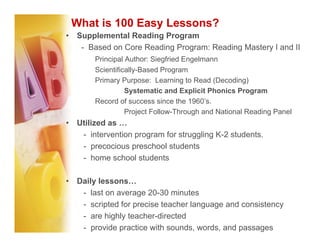
What is 100 Easy Lessons?
• Supplemental Reading Program
B d C R di P R di M t I d II- Based on Core Reading Program: Reading Mastery I and II
Principal Author: Siegfried Engelmann
Scientifically-Based Program
Primary Purpose: Learning to Read (Decoding)
Systematic and Explicit Phonics Program
Record of success since the 1960’s.
Project Follow-Through and National Reading Panel
• Utilized as …
- intervention program for struggling K-2 students.
- precocious preschool students
- home school students
• Daily lessons…
- last on average 20-30 minutes
i d f i h l d i- scripted for precise teacher language and consistency
- are highly teacher-directed
- provide practice with sounds, words, and passages
Major Instructional Tracks
• Sound Practice• Sound Practice
• Oral Segmenting and Blending• Oral Segmenting and Blending
Word Reading• Word Reading
S t d P R di• Sentence and Passage Reading
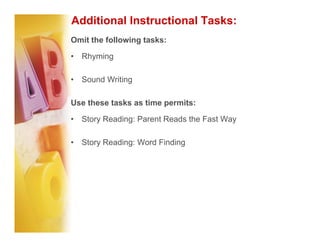
Additional Instructional Tasks:
Omit the following tasks:
• Rhyming
S d W iti• Sound Writing
Use these tasks as time permits:
• Story Reading: Parent Reads the Fast Way
• Story Reading: Word Finding
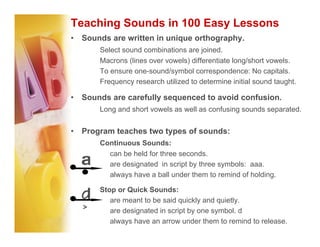
Teaching Sounds in 100 Easy Lessons
• Sounds are written in unique orthography.
Select sound combinations are joined.
Macrons (lines over vowels) differentiate long/short vowels.
To ensure one-sound/symbol correspondence: No capitals.
Frequency research utilized to determine initial sound taught.
• Sounds are carefully sequenced to avoid confusion.
Long and short o els as ell as conf sing so nds separatedLong and short vowels as well as confusing sounds separated.
• Program teaches two types of sounds:
Continuous Sounds:
can be held for three seconds.
are designated in script by three symbols: aaa.a
always have a ball under them to remind of holding.
Stop or Quick Sounds:
are meant to be said quickly and quietly
d are meant to be said quickly and quietly.
are designated in script by one symbol. d
always have an arrow under them to remind to release.
>
Delivery Elements for Instructional Tasks
• Focus…
directs student attention to the task.
After attention is directed instr ctions are pro idedAfter attention is directed, instructions are provided.
• Wait Time…
provides three seconds for students to think of response.
• Cue and Signal…Cue and Signal…
tells students to prepare to respond.
tells students when to start and stop.
• Confirmation…
reinforces the final student response.
1. (Point to e.)  
Here’s a new sound.  I’m going
to touch under this sound and say
Sounds Introduction
1. You’re going to say all these sounds.    
(Touch first ball for a.)  Get ready.  
(Quickly move to the second ball.  Hold.)     
Sounds Review: Slowly
to touch under this sound and say
the sound.  
(Touch first ball of arrow.  Move quickly
to second ball.  Hold.)  EEEEEE
2. Your turn to say the sound when I
y
aaaaaa.
a
touch under it.  (Touch first ball.)  
Get ready.  (Move quickly to second
ball.  Hold.) EEEEEE.
3. (Touch first ball.)  Again.  Get ready.
Move quickly to the second ball. Hold.)
2. (Touch first ball for s.)  
Get ready.  
(Quickly move to the second ball.  Hold.)     
ssssssMove quickly to the second ball.  Hold.)  
EEEEEE.
E
ssssss.
s
3. (Touch first ball for d.)  
Get ready.  
(Quickly move to end of arrow.)Focus: (Quickly move to end of arrow.)     
d.
d
Focus:  __________________
Think: ____________________
C /Si l dCue/Signal:  _______________
Verification:_______________
>
Sound Introduction and Review
1. You’re going to say the sounds slowly,
then you’re going to say them  fast.    
(Touch first ball for s ) Say the sound slowly
Sounds: Slowly and Fast
Focus:  __________________
(Touch first ball for s.)  Say the sound slowly.  
(Move quickly move to second ball.  Hold.)     
sssssss.  Say it fast.  (Move quickly to end 
of arrow.)  s.
s
Think: ____________________
Cue/Signal:  _______________
s
2. (Touch first ball for a.)  Say the sound slowly.  
(Move quickly move to second ball. Hold.)
Verification:_______________
a
(Move quickly move to second ball.  Hold.)     
aaaaaa.  Say it fast.  (Move quickly to end 
of arrow.)  a.
a
3. (Touch first ball for d.)  
Get ready.  
(Quickly move to end of arrow.) d.
Basic Correction:
My turn.  Model.
d
(Quickly move to end of arrow.)   d.
Say it fast.  (Move quickly to end 
of arrow.)  d. Your turn.  Get ready.  
(Signal ) Yes
d>
(Signal.)    Yes, __________.
Starting over.   
Say the Sound: Slowly and Fast
1. (Point to s.)  You’re turn to touch the sounds    
and say them.  First you’re going to say this 
sound slowly and then say it fast.  Touch the 
Child Touches the Sound
Focus:  __________________
Think:y y
first ball of the arrow.  You’re going to move 
to the next ball on the arrow and stop.  
When you stop, say the sound slowly.  Do it.
ssssss.  Now say it fast. s.
s
Think: ____________________
Cue/Signal:  _______________
s
2. Touch the ball for the next sound.                          
Verification:_______________
a
Move to the next ball and say the sound 
slowly. aaaaaa.  Now say it fast.  a.
a
3. Touch the ball for the next sound.                          
Basic Correction:
My turn.  Model.
m
Move to the next ball and say the sound 
slowly. mmmmmm.  Now say it fast.  m.
Your turn.  Get ready.  
(Signal ) Yesm (Signal.)    Yes, __________.
Starting over.   
Child Touches the Sound
1.  (Touch under first ball of arrow.)                                     
You’re going to read this word.   You’re going to 
sound it out Then you’re going to say it fast
Word Reading 4.  (Touch under first ball of arrow.)                            
You’re going to read this word.   You’re going    
to sound it out.  Then you’re going to say it       
fast.  
S d it t (T h d d thsound it out.  Then you re going to say it fast.  
2.  Sound it out.  (Touch under r, a, and m as the 
child says rrraaammm without pausing between 
the sounds.)
(Return to the first ball.)
Sound it out.  (Touch under s,e, and e as the 
child says ssseeeeee without pausing between 
the sounds.)
(Return to the first ball.)
Say it fast.  (Slide quickly to end of arrow.)  see.
Say it fast.  (Slide quickly to end of arrow.)  ram.
Yes, what word?  ram.  Good reading.
Focus:  __________________3.  (Touch the a in eat.)                                     
This word has a little sound in it.  We don’t say 
that sound Just say the big sounds
y ( q y )
Yes, what word?  see.  Good reading.
Think: ____________________
Cue/Signal:  _______________
that sound.  Just say the big sounds.    
(Return to the ball.)  Sound it out.  (Touch under 
e, and t as the child says eeet without pausing 
between the sounds.)
(Return to the first ball.)
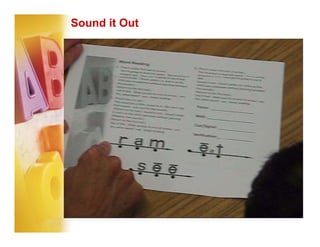
r a m
Verification:_______________
Say it fast.  (Slide quickly to end of arrow.)  eat.
Yes, what word?  eat.  Good reading.
E tr a m Eat
s E E
Sound it Out
1.  (Touch the balls for a and t.)                                     
First you’re going to sound out this part.  
(Point to ball for a ) Get ready (Touch balls for
Word Reading
3.  Now I’m going to sound out cat.                              
(Touch arrow under c.)                                     
(Point to ball for a.)  Get ready.  (Touch balls for               
a and t as child says aaat without pausing 
between sounds.)  Say it fast.  at.
2.  (Touch first ball for cat.)
This word rhymes with at.  What does it rhyme 
This arrow tells us that I can’t stop under the 
sound.  But the arrow tells us that you have to 
say the sound for the c.                                             
(Touch the first ball for cat.)  
4. My turn to sound out cat. (Slide past c.
with? at.
Rhyming with at.  (Slide quickly to end of arrow.)
cat.  What word?  cat.  Yes, cat.
4.  My turn to sound out cat.  (Slide past c.
Stop at ball for a.  Continue to t and say:)
caaat.
5. Your turn to sound it out.  Get ready.                     
(Slide past c.  Stop at ball for a.  Continue to t .)
tcaaat.
What word?  cat.  
c a t
Focus:  __________________
Think: ____________________
c a t Cue/Signal:  _______________
Verification:
>
Verification:_______________
First Sound Quick Sound
1.  Now you’re going to read this word.  
(Touch the first ball for said.)  Sound it out.   
(Touch under s a i and d as the
Word Reading: Funny Words
(Touch under s,a,i, and d as the 
child says:)  sssaaaiiid.
2. That’s how we sound out the word.  Here’s
how we say the word.  (pause.)  said.
How do we say the word?  Said.
3.  (Return to the first ball.)
Sound it out again.  (Touch balls for sounds as 
child says:)  sssaaaiiid.
Now say the word. said.   Yes, what word?  said.  
s a i ds a i d Focus:  __________________
Think: ____________________
Cue/Signal:  _______________
Verification:Verification:_______________
Funny or Irregular Words
1.  Now you’re going to read these words.   
(Touch first ball for ant.)  Sound it out.         
(Touch balls for sounds ) aaannnt
Word Reading 3.  (Touch first ball for fun.)  Sound it out.         
(Touch balls for sounds.) fffuuunnn.  
What word? fun.
Yes, fun.
4 (R t t fi t b ll )(Touch balls for sounds.) aaannnt.  
What word? ant.
Yes, ant.
2.  (Return to first ball.)                                     
Your going to read this word the fast way.  But    
4.  (Return to first ball.)                                     
I’m going to move down the arrow three 
times.  Then you’re going to read the word
the fast way.    
(Move down the arrow three times stopping at 
first I’m going to move down the arrow three 
times.  Take a good look at the sounds and see 
if you can remember this word.  But don’t say 
the sounds out loud until you read it the fast way.    
(Move down the arrow three times stopping at
( pp g
each ball.  Return to the first ball.  )  
Read it the fast way.  (Slide.)  fun.  
Yes, fun.  Good reading.
a n t
(Move down the arrow three times stopping at 
each ball.  Return to the first ball.  )  
Read it the fast way.  (Slide.)  ant.  
Yes, ant.  Good reading.
funa n t fun
Focus:  __________________
Think: ____________________
Cue/Signal:  _______________
Verification:_______________
Transition to Read Fast
1.  (Point to lots, have, his, near, and ears.)                        
Word Reading
lotsYour going to read all of these word the fast way.    
I’ll go down the arrow one time for each word.I ll go down the arrow one time for each word.     
Figure out the word.  But don’t say 
anything out loud until I tell you to read it                    
the fast way.    
2. (Touch the ball for lot.  Touch under the sounds.    
R b ll )
nEarReturn to ball.)  
Read it the fast way.  (Slide.)  lots.  
Yes, lots.  
3.  (Repeat step 2 for remaining words.)
4.  Read all these words again the fast way. Earsg y
5.  (Touch first ball for lots.  Pause three seconds.)
Read it the fast way.  (Slide.)  lots.  Yes, lots.  
6.  (Repeat step 5 for remaining words.)
Ears
gOats
Focus:
gOats
Basic Correction:
Focus:  __________________
Think: ____________________
C /Si l
My turn.  Model.
Your turn.  Get ready.  (Signal.)   Yes, ____.
Sound it out.  Get ready.  (Signal.)  
Cue/Signal:  _______________
Verification:_______________
y ( g )
What word?  (Signal.)  Yes, ___.
Starting over.
Reading the Fast Way
1.  (Touch ball for ar.)                        
Word Reading
arWhen these letters are together they usually
say are. What do they say? aresay are.   What do they say?  are.
2. (Touch the ball for ar in far.)
What do these sounds say?  are.  
Yes, are.  (Touch the ball for far.)  
Sound it out.  (Touch balls for sounds.)  fffararar
R d i h f (Slid ) f
far
Read it the fast way.  (Slide.)  far.  
Yes, far.  
3. (Touch the ball for ar in car.)
What do these sounds say?  are.  
Yes, are.  (Touch the ball for car.)  
car, ( )
Sound it out.  (Slide past c.  Touch ball for ar.)     
cararar
Read it the fast way.  (Slide.)  car.  
Yes, car.  
>
Focus:  __________________
Think: ____________________
Cue/Signal:  _______________
Verification:_______________
Sound Combinations: ar
LESSON FORTY-NINE
BRINGING IT TOGETHERBRINGING IT TOGETHER
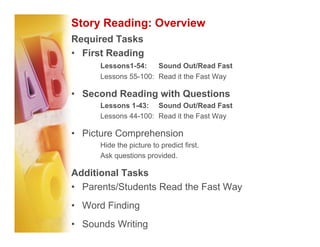
Story Reading: Overview
Required Tasks
• First Reading
Lessons1-54: Sound Out/Read Fast
Lessons 55-100: Read it the Fast WayLessons 55-100: Read it the Fast Way
• Second Reading with Questions
Lessons 1-43: Sound Out/Read FastLessons 1 43: Sound Out/Read Fast
Lessons 44-100: Read it the Fast Way
• Picture Comprehension
Hide the picture to predict first.
Ask questions provided.
Additi l T kAdditional Tasks
• Parents/Students Read the Fast Way
• Word Finding
• Sounds Writing
First Read: Sound it Out/Read Fast (44)
Story Reading
First Reading: Sound it Out/Read Fast
First Word/Next Word.
Sound it out. (Pause.) Get ready.
(Signal for each sound.)
What word? (Signal.)
Yes, ___________.
Second Read: Read Fast and Questions (44)

100 easy lessons revised

  • 1.
    Teach Your Childto Read in 100 Easy Lessons Cary Andrews Roger Bacon Academy
  • 2.
    What is 100Easy Lessons? • Supplemental Reading Program B d C R di P R di M t I d II- Based on Core Reading Program: Reading Mastery I and II Principal Author: Siegfried Engelmann Scientifically-Based Program Primary Purpose: Learning to Read (Decoding) Systematic and Explicit Phonics Program Record of success since the 1960’s. Project Follow-Through and National Reading Panel • Utilized as … - intervention program for struggling K-2 students. - precocious preschool students - home school students • Daily lessons… - last on average 20-30 minutes i d f i h l d i- scripted for precise teacher language and consistency - are highly teacher-directed - provide practice with sounds, words, and passages
  • 3.
    Major Instructional Tracks •Sound Practice• Sound Practice • Oral Segmenting and Blending• Oral Segmenting and Blending Word Reading• Word Reading S t d P R di• Sentence and Passage Reading
  • 4.
    Additional Instructional Tasks: Omitthe following tasks: • Rhyming S d W iti• Sound Writing Use these tasks as time permits: • Story Reading: Parent Reads the Fast Way • Story Reading: Word Finding
  • 5.
    Teaching Sounds in100 Easy Lessons • Sounds are written in unique orthography. Select sound combinations are joined. Macrons (lines over vowels) differentiate long/short vowels. To ensure one-sound/symbol correspondence: No capitals. Frequency research utilized to determine initial sound taught. • Sounds are carefully sequenced to avoid confusion. Long and short o els as ell as conf sing so nds separatedLong and short vowels as well as confusing sounds separated. • Program teaches two types of sounds: Continuous Sounds: can be held for three seconds. are designated in script by three symbols: aaa.a always have a ball under them to remind of holding. Stop or Quick Sounds: are meant to be said quickly and quietly d are meant to be said quickly and quietly. are designated in script by one symbol. d always have an arrow under them to remind to release. >
  • 6.
    Delivery Elements forInstructional Tasks • Focus… directs student attention to the task. After attention is directed instr ctions are pro idedAfter attention is directed, instructions are provided. • Wait Time… provides three seconds for students to think of response. • Cue and Signal…Cue and Signal… tells students to prepare to respond. tells students when to start and stop. • Confirmation… reinforces the final student response.
  • 7.
    1. (Point to e.)   Here’s a new sound.  I’m going to touch underthis sound and say Sounds Introduction 1. You’re going to say all these sounds.     (Touch first ball for a.)  Get ready.   (Quickly move to the second ball.  Hold.)      Sounds Review: Slowly to touch under this sound and say the sound.   (Touch first ball of arrow.  Move quickly to second ball.  Hold.)  EEEEEE 2. Your turn to say the sound when I y aaaaaa. a touch under it.  (Touch first ball.)   Get ready.  (Move quickly to second ball.  Hold.) EEEEEE. 3. (Touch first ball.)  Again.  Get ready. Move quickly to the second ball. Hold.) 2. (Touch first ball for s.)   Get ready.   (Quickly move to the second ball.  Hold.)      ssssssMove quickly to the second ball.  Hold.)   EEEEEE. E ssssss. s 3. (Touch first ball for d.)   Get ready.   (Quickly move to end of arrow.)Focus: (Quickly move to end of arrow.)      d. d Focus:  __________________ Think: ____________________ C /Si l dCue/Signal:  _______________ Verification:_______________ >
  • 8.
  • 9.
    1. You’re going to say the sounds slowly, then you’re going to say them  fast.     (Touch first ballfor s ) Say the sound slowly Sounds: Slowly and Fast Focus:  __________________ (Touch first ball for s.)  Say the sound slowly.   (Move quickly move to second ball.  Hold.)      sssssss.  Say it fast.  (Move quickly to end  of arrow.)  s. s Think: ____________________ Cue/Signal:  _______________ s 2. (Touch first ball for a.)  Say the sound slowly.   (Move quickly move to second ball. Hold.) Verification:_______________ a (Move quickly move to second ball.  Hold.)      aaaaaa.  Say it fast.  (Move quickly to end  of arrow.)  a. a 3. (Touch first ball for d.)   Get ready.   (Quickly move to end of arrow.) d. Basic Correction: My turn.  Model. d (Quickly move to end of arrow.)   d. Say it fast.  (Move quickly to end  of arrow.)  d. Your turn.  Get ready.   (Signal ) Yes d> (Signal.)    Yes, __________. Starting over.   
  • 10.
    Say the Sound:Slowly and Fast
  • 11.
    1. (Point to s.)  You’re turn to touch the sounds     and say them.  First you’re going to say this  sound slowly and then say it fast.  Touch the  Child Touches theSound Focus:  __________________ Think:y y first ball of the arrow.  You’re going to move  to the next ball on the arrow and stop.   When you stop, say the sound slowly.  Do it. ssssss.  Now say it fast. s. s Think: ____________________ Cue/Signal:  _______________ s 2. Touch the ball for the next sound.                           Verification:_______________ a Move to the next ball and say the sound  slowly. aaaaaa.  Now say it fast.  a. a 3. Touch the ball for the next sound.                           Basic Correction: My turn.  Model. m Move to the next ball and say the sound  slowly. mmmmmm.  Now say it fast.  m. Your turn.  Get ready.   (Signal ) Yesm (Signal.)    Yes, __________. Starting over.   
  • 12.
  • 13.
    1.  (Touch under first ball of arrow.)                                      You’re going to read this word.   You’re going to  sound it outThen you’re going to say it fast Word Reading 4.  (Touch under first ball of arrow.)                             You’re going to read this word.   You’re going     to sound it out.  Then you’re going to say it        fast.   S d it t (T h d d thsound it out.  Then you re going to say it fast.   2.  Sound it out.  (Touch under r, a, and m as the  child says rrraaammm without pausing between  the sounds.) (Return to the first ball.) Sound it out.  (Touch under s,e, and e as the  child says ssseeeeee without pausing between  the sounds.) (Return to the first ball.) Say it fast.  (Slide quickly to end of arrow.)  see. Say it fast.  (Slide quickly to end of arrow.)  ram. Yes, what word?  ram.  Good reading. Focus:  __________________3.  (Touch the a in eat.)                                      This word has a little sound in it.  We don’t say  that sound Just say the big sounds y ( q y ) Yes, what word?  see.  Good reading. Think: ____________________ Cue/Signal:  _______________ that sound.  Just say the big sounds.     (Return to the ball.)  Sound it out.  (Touch under  e, and t as the child says eeet without pausing  between the sounds.) (Return to the first ball.) r a m Verification:_______________ Say it fast.  (Slide quickly to end of arrow.)  eat. Yes, what word?  eat.  Good reading. E tr a m Eat s E E
  • 14.
  • 15.
    1.  (Touch the balls for a and t.)                                      First you’re going to sound out this part.   (Point to ballfor a ) Get ready (Touch balls for Word Reading 3.  Now I’m going to sound out cat.                               (Touch arrow under c.)                                      (Point to ball for a.)  Get ready.  (Touch balls for                a and t as child says aaat without pausing  between sounds.)  Say it fast.  at. 2.  (Touch first ball for cat.) This word rhymes with at.  What does it rhyme  This arrow tells us that I can’t stop under the  sound.  But the arrow tells us that you have to  say the sound for the c.                                              (Touch the first ball for cat.)   4. My turn to sound out cat. (Slide past c. with? at. Rhyming with at.  (Slide quickly to end of arrow.) cat.  What word?  cat.  Yes, cat. 4.  My turn to sound out cat.  (Slide past c. Stop at ball for a.  Continue to t and say:) caaat. 5. Your turn to sound it out.  Get ready.                      (Slide past c.  Stop at ball for a.  Continue to t .) tcaaat. What word?  cat.   c a t Focus:  __________________ Think: ____________________ c a t Cue/Signal:  _______________ Verification: > Verification:_______________
  • 16.
  • 17.
    1.  Now you’re going to read this word.   (Touch the first ball for said.)  Sound it out.    (Touch under sa i and d as the Word Reading: Funny Words (Touch under s,a,i, and d as the  child says:)  sssaaaiiid. 2. That’s how we sound out the word.  Here’s how we say the word.  (pause.)  said. How do we say the word?  Said. 3.  (Return to the first ball.) Sound it out again.  (Touch balls for sounds as  child says:)  sssaaaiiid. Now say the word. said.   Yes, what word?  said.   s a i ds a i d Focus:  __________________ Think: ____________________ Cue/Signal:  _______________ Verification:Verification:_______________
  • 18.
  • 19.
    1.  Now you’re going to read these words.    (Touch first ball for ant.)  Sound it out.          (Touch balls forsounds ) aaannnt Word Reading 3.  (Touch first ball for fun.)  Sound it out.          (Touch balls for sounds.) fffuuunnn.   What word? fun. Yes, fun. 4 (R t t fi t b ll )(Touch balls for sounds.) aaannnt.   What word? ant. Yes, ant. 2.  (Return to first ball.)                                      Your going to read this word the fast way.  But     4.  (Return to first ball.)                                      I’m going to move down the arrow three  times.  Then you’re going to read the word the fast way.     (Move down the arrow three times stopping at  first I’m going to move down the arrow three  times.  Take a good look at the sounds and see  if you can remember this word.  But don’t say  the sounds out loud until you read it the fast way.     (Move down the arrow three times stopping at ( pp g each ball.  Return to the first ball.  )   Read it the fast way.  (Slide.)  fun.   Yes, fun.  Good reading. a n t (Move down the arrow three times stopping at  each ball.  Return to the first ball.  )   Read it the fast way.  (Slide.)  ant.   Yes, ant.  Good reading. funa n t fun Focus:  __________________ Think: ____________________ Cue/Signal:  _______________ Verification:_______________
  • 20.
  • 21.
    1.  (Point to lots, have, his, near, and ears.)                         Word Reading lotsYour going to read all of these word the fast way.     I’ll godown the arrow one time for each word.I ll go down the arrow one time for each word.      Figure out the word.  But don’t say  anything out loud until I tell you to read it                     the fast way.     2. (Touch the ball for lot.  Touch under the sounds.     R b ll ) nEarReturn to ball.)   Read it the fast way.  (Slide.)  lots.   Yes, lots.   3.  (Repeat step 2 for remaining words.) 4.  Read all these words again the fast way. Earsg y 5.  (Touch first ball for lots.  Pause three seconds.) Read it the fast way.  (Slide.)  lots.  Yes, lots.   6.  (Repeat step 5 for remaining words.) Ears gOats Focus: gOats Basic Correction: Focus:  __________________ Think: ____________________ C /Si l My turn.  Model. Your turn.  Get ready.  (Signal.)   Yes, ____. Sound it out.  Get ready.  (Signal.)   Cue/Signal:  _______________ Verification:_______________ y ( g ) What word?  (Signal.)  Yes, ___. Starting over.
  • 22.
  • 23.
    1.  (Touch ball for ar.)                         Word Reading arWhen these letters are together they usually say are.What do they say? aresay are.   What do they say?  are. 2. (Touch the ball for ar in far.) What do these sounds say?  are.   Yes, are.  (Touch the ball for far.)   Sound it out.  (Touch balls for sounds.)  fffararar R d i h f (Slid ) f far Read it the fast way.  (Slide.)  far.   Yes, far.   3. (Touch the ball for ar in car.) What do these sounds say?  are.   Yes, are.  (Touch the ball for car.)   car, ( ) Sound it out.  (Slide past c.  Touch ball for ar.)      cararar Read it the fast way.  (Slide.)  car.   Yes, car.   > Focus:  __________________ Think: ____________________ Cue/Signal:  _______________ Verification:_______________
  • 24.
  • 25.
    LESSON FORTY-NINE BRINGING ITTOGETHERBRINGING IT TOGETHER
  • 26.
    Story Reading: Overview RequiredTasks • First Reading Lessons1-54: Sound Out/Read Fast Lessons 55-100: Read it the Fast WayLessons 55-100: Read it the Fast Way • Second Reading with Questions Lessons 1-43: Sound Out/Read FastLessons 1 43: Sound Out/Read Fast Lessons 44-100: Read it the Fast Way • Picture Comprehension Hide the picture to predict first. Ask questions provided. Additi l T kAdditional Tasks • Parents/Students Read the Fast Way • Word Finding • Sounds Writing
  • 27.
    First Read: Soundit Out/Read Fast (44)
  • 28.
    Story Reading First Reading:Sound it Out/Read Fast First Word/Next Word. Sound it out. (Pause.) Get ready. (Signal for each sound.) What word? (Signal.) Yes, ___________.
  • 29.
    Second Read: ReadFast and Questions (44)