Steffen Staab 10 Years of Web Science 1Institute for Web Science and Technologies · University of Koblenz-Landau, Germany
Web and Internet Science Group · ECS · University of Southampton, UK &
10 Years Web Science
and the Next 10 Years
Steffen Staab, Susan Halford, Jim Hendler,
Anni Rowland-Campbell, David de Roure
Steffen Staab 10 Years of Web Science 2
Note by Prof. Dame Wendy Hall
Steffen Staab 10 Years of Web Science 3
Where Dijkstra is inspiring
Computer
Science
Science
about
Computers
Astronomy
Telescope
Science
Web
Science
Science
about the
Web
What is Web Science?
, but was wrong
Science is the Science about the Web –
but it points much beyond
Steffen Staab 10 Years of Web Science 4
The Web Trajectory
Web of People
Web of Things
Web of Services
Web of Data
Web of Documents
Coordination
Monitoring & Control
Delivering
Changing, Understanding
Retrieving
Level of
interactivity
Steffen Staab 10 Years of Web Science 5
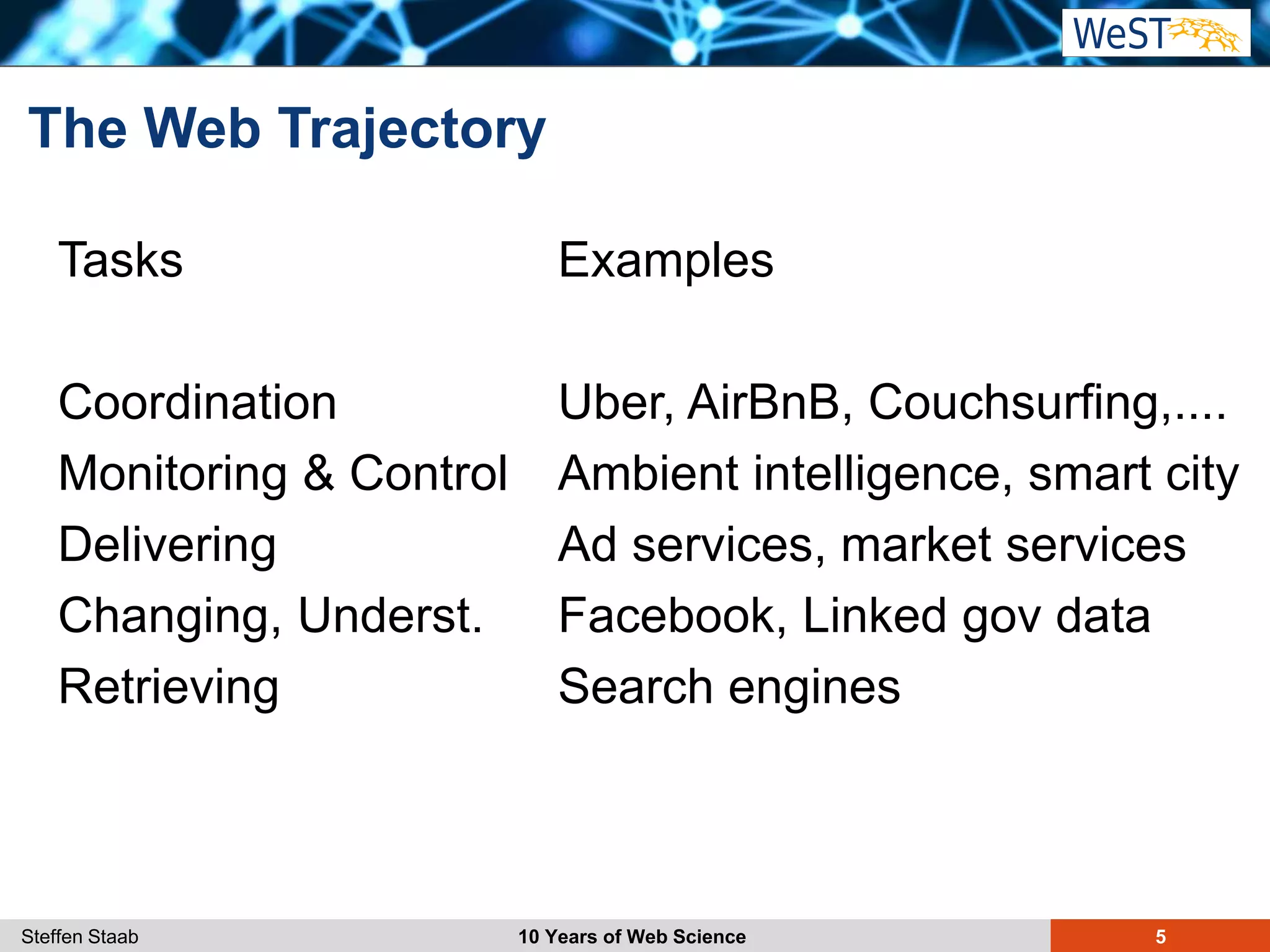
The Web Trajectory
Tasks
Coordination
Monitoring & Control
Delivering
Changing, Underst.
Retrieving
Examples
Uber, AirBnB, Couchsurfing,....
Ambient intelligence, smart city
Ad services, market services
Facebook, Linked gov data
Search engines
Steffen Staab 10 Years of Web Science 6
1. Web Science Case Studies
– Typical Example:
Understanding gender in Wikipedia
– Most research is now located here
2. Web Science Concepts
– „Social Machine“
3. Web Science Models
– Models of tagging involving
• Human actors
• Software system
4. Predictive Web Science „Laws“
– Even possible? Or too much Asimov?
Web Science Progressing as a Science
Steffen Staab 10 Years of Web Science 7
Questions to the Panelists
Web Science
• Strengths
(including accomplishments)
• Weaknesses
• Opportunities
• Threats
Past Ten Years
Next Ten Years
and beyond
Steffen Staab 10 Years of Web Science 8
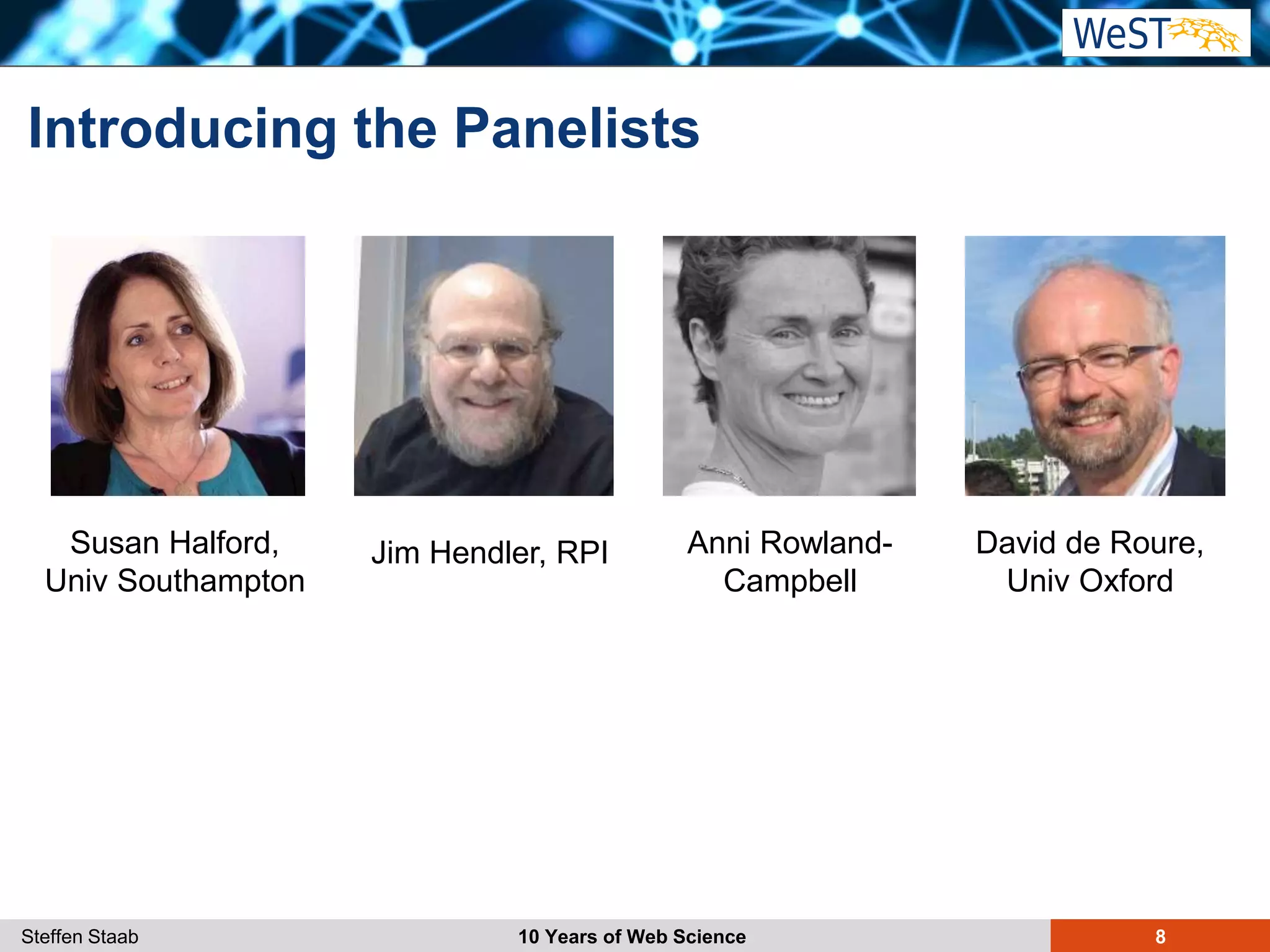
Introducing the Panelists
Anni Rowland-
Campbell
Jim Hendler, RPISusan Halford,
Univ Southampton
David de Roure,
Univ Oxford
Steffen Staab 10 Years of Web Science 9Institute for Web Science and Technologies · University of Koblenz-Landau, Germany
Web and Internet Science Group · ECS · University of Southampton, UK &
10 Years Web Science
and the Next 10 Years
Steffen Staab

10 Years Web Science

  • 1.
    Steffen Staab 10Years of Web Science 1Institute for Web Science and Technologies · University of Koblenz-Landau, Germany Web and Internet Science Group · ECS · University of Southampton, UK & 10 Years Web Science and the Next 10 Years Steffen Staab, Susan Halford, Jim Hendler, Anni Rowland-Campbell, David de Roure
  • 2.
    Steffen Staab 10Years of Web Science 2 Note by Prof. Dame Wendy Hall
  • 3.
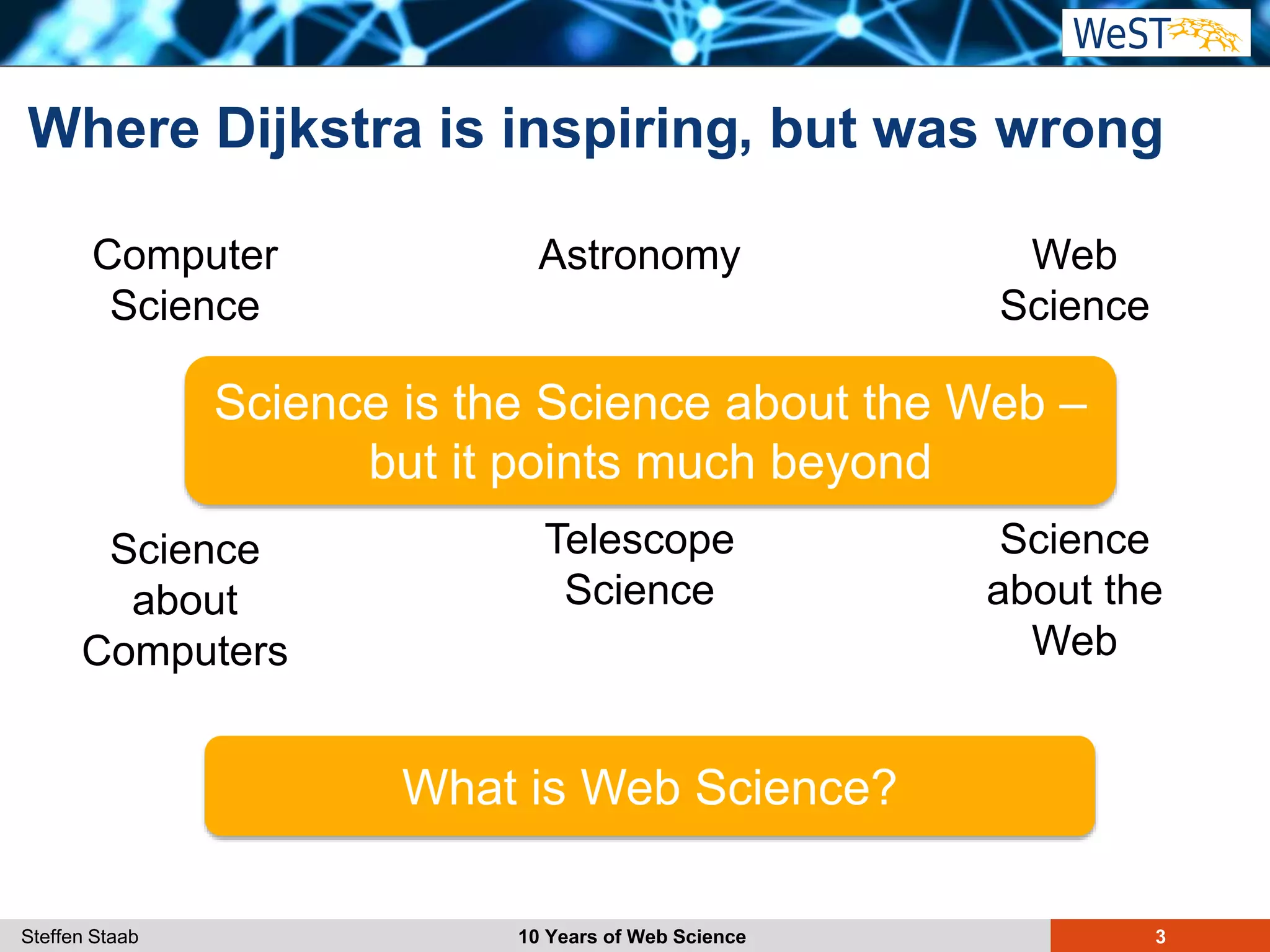
    Steffen Staab 10Years of Web Science 3 Where Dijkstra is inspiring Computer Science Science about Computers Astronomy Telescope Science Web Science Science about the Web What is Web Science? , but was wrong Science is the Science about the Web – but it points much beyond
  • 4.
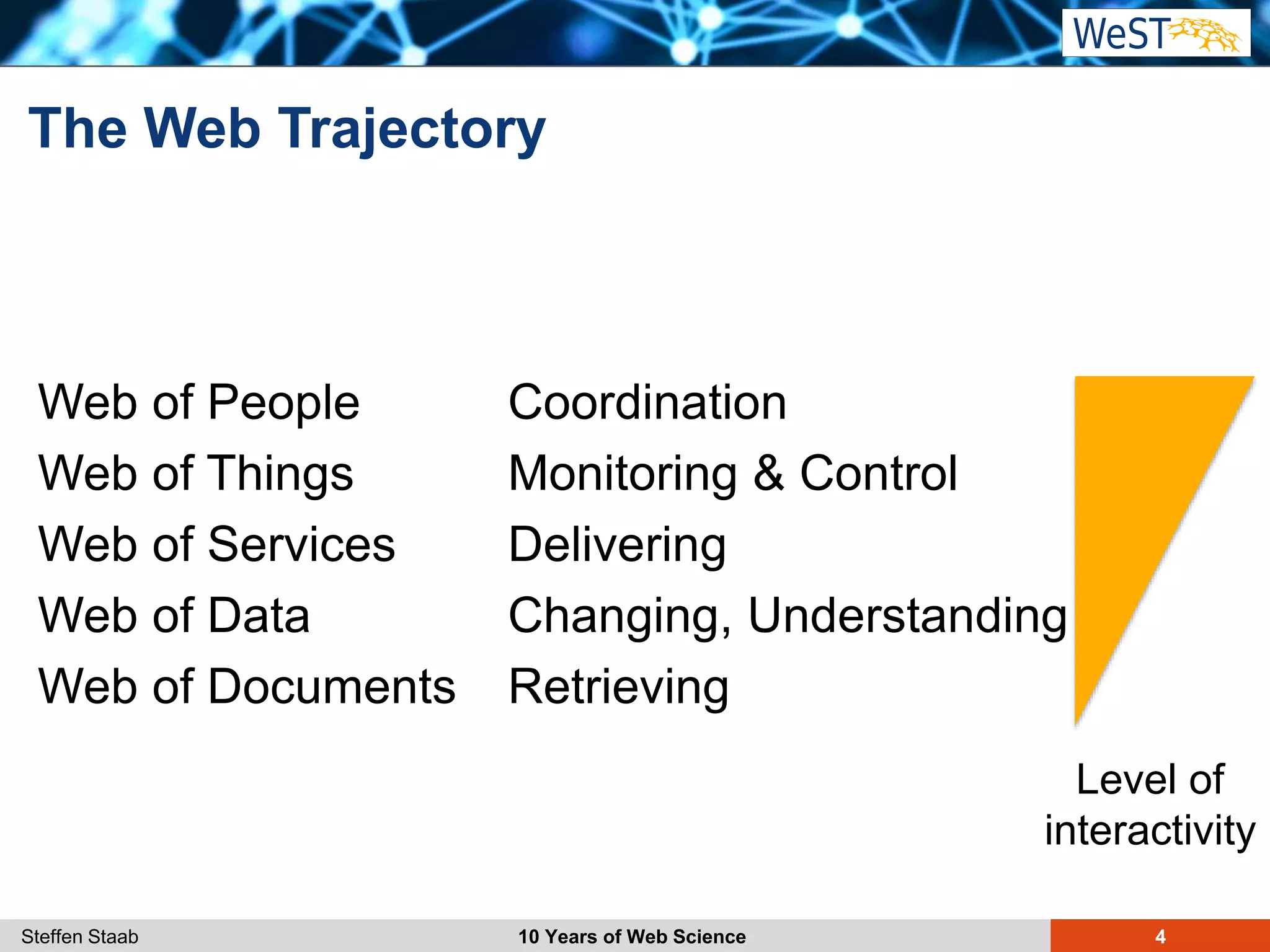
    Steffen Staab 10Years of Web Science 4 The Web Trajectory Web of People Web of Things Web of Services Web of Data Web of Documents Coordination Monitoring & Control Delivering Changing, Understanding Retrieving Level of interactivity
  • 5.
    Steffen Staab 10Years of Web Science 5 The Web Trajectory Tasks Coordination Monitoring & Control Delivering Changing, Underst. Retrieving Examples Uber, AirBnB, Couchsurfing,.... Ambient intelligence, smart city Ad services, market services Facebook, Linked gov data Search engines
  • 6.
    Steffen Staab 10Years of Web Science 6 1. Web Science Case Studies – Typical Example: Understanding gender in Wikipedia – Most research is now located here 2. Web Science Concepts – „Social Machine“ 3. Web Science Models – Models of tagging involving • Human actors • Software system 4. Predictive Web Science „Laws“ – Even possible? Or too much Asimov? Web Science Progressing as a Science
  • 7.
    Steffen Staab 10Years of Web Science 7 Questions to the Panelists Web Science • Strengths (including accomplishments) • Weaknesses • Opportunities • Threats Past Ten Years Next Ten Years and beyond
  • 8.
    Steffen Staab 10Years of Web Science 8 Introducing the Panelists Anni Rowland- Campbell Jim Hendler, RPISusan Halford, Univ Southampton David de Roure, Univ Oxford
  • 9.
    Steffen Staab 10Years of Web Science 9Institute for Web Science and Technologies · University of Koblenz-Landau, Germany Web and Internet Science Group · ECS · University of Southampton, UK & 10 Years Web Science and the Next 10 Years Steffen Staab

Editor's Notes

  • #2 Programming with Semantic Broad Data Steffen Staab   Abstract: Challenges of Big Data are frequently explained by the technical challenges arising from dealing with Volume, Velocity, Variety, and Veracity. The large variety of data in organisations results from having access to a broad set of different information systems with heterogeneous schemata or ontologies. In this talk I will present research efforts that target the management of such broad data. They include: (i) an integrated development environment for programming with broad data, (ii) a query language that allows for typing of query results, (iii) a typed lambda-calculus based on description logics, and (iv) efficient access to data repositories via schema indices.   CV: Steffen Staab is professor for Databases and Information Systems at Universität Koblenz-Landau and holds a chair in Computer and Web Science at University of Southampton. He is interested in managing text and data and specifically in methods that target the management of explicit data semantics as well as the discovery of implicit text and data semantics.
  • #7 Maybe I should read less from Asimov
  • #9 Professor Susan Halford is Director of Web Science Institute at the University of Southampton. She is professor within sociology with a background in geography and urban studies. There are many things to admire, but what I personally appreciate most is her expertise and versatility with approaching difficult research problems that make it a pleasure to work with her and learn from her when coming from another discipline. James Hendler is Tetherless World Professor of Computer, Web and Cognitive Sciences and Director of Rensselaer Institute for Data Exploration and Applications. If Jim would have lived in the 15th century he would have probably become a Columbus or Magellan. Born in our times, he has been a leading pioneer in diverse fields such as AI planning, Semantic Web and – Web Science. Anni is a "Web Science practitioner“ working towards raising awareness and understanding of the Web among senior managers and advisors, with focus on „digital literacy“ and „digital transformation“. She has a diverse background having worked in the arts, government, corporate research and the non-profit sector.   Professor David De Roure is Director of the Oxford e-Research Centre. He is a Strategic Advisor to the UK Economic and Social Research Council in the area of new forms of data and real time analytics. David has been very activie and successful in supporting a broad set of actors using Web infrastructures from Humanities (including musicology), over life sciences to education. So, he is a perfect panelist to report back and predict about interdisciplinary Web science development in the past an din the future.
  • #10 Programming with Semantic Broad Data Steffen Staab   Abstract: Challenges of Big Data are frequently explained by the technical challenges arising from dealing with Volume, Velocity, Variety, and Veracity. The large variety of data in organisations results from having access to a broad set of different information systems with heterogeneous schemata or ontologies. In this talk I will present research efforts that target the management of such broad data. They include: (i) an integrated development environment for programming with broad data, (ii) a query language that allows for typing of query results, (iii) a typed lambda-calculus based on description logics, and (iv) efficient access to data repositories via schema indices.   CV: Steffen Staab is professor for Databases and Information Systems at Universität Koblenz-Landau and holds a chair in Computer and Web Science at University of Southampton. He is interested in managing text and data and specifically in methods that target the management of explicit data semantics as well as the discovery of implicit text and data semantics.