Lesson Objectives:
At the end of the lesson, the learners are expected to:
a. Define and identify Resume as one of the written
methods of Professional Correspondence through
discussion.
b. Write their own resume for future purposes.
c. Show appreciation of resume by understanding its
importance as they look for a job in the near future.
Professional
Correspondence
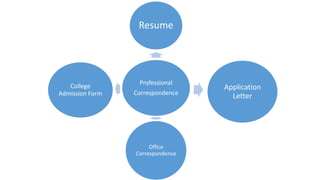
Professional
Correspondence
Resume
Application
Letter
Office
Correspondence
College
Admission Form
Correspondence
is a commonly used form of
communication in business.
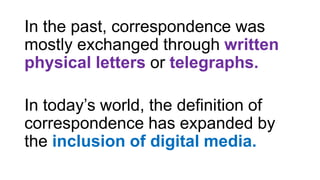
In the past, correspondence was
mostly exchanged through written
physical letters or telegraphs.
In today’s world, the definition of
correspondence has expanded by
the inclusion of digital media.
E-mails, text messages, documents
exchanged through social platforms and
digital agreements are new ways to deliver
correspondence.
The formal element embedded into these
written methods of communication makes
them appropriate to transmit important
business information between businesses or
from businesses to clients.
What is a Resume?
A resume is a formal
document that provides an
overview of your professional
qualifications, including your
relevant work experience, skills,
education, and notable
accomplishments.
Usually paired with a cover letter, a
resume helps you demonstrate your
abilities and convince employers
you’re qualified and hirable. The
spelling of “résumé” actually
originates from French, and means
“summary.”
Resume should include the following
sections:
•Contact details: include your first and
last name, phone number, and email address.
Additionally, you can add your LinkedIn profile if
yours is up to date, and your mailing address if
you want to prove you live near the place you’re
applying.
Resume should include the following
sections:
•Introduction: a concise overview of
your professional background and key
qualifications. Your introduction can be in
the form of a resume summary, professional
profile, resume objective, or qualifications
summary.
Resume should include the following
sections:
•Experience: list any relevant work
experience you have. Include your title, the
company you worked for, years worked, and a
bulleted list of your key responsibilities and
notable successes. Be sure to also include as
many relevant accomplishments on your resume
as possible.
Resume should include the following
sections:
•Education: Include your school
names, highest degree earned, majors and
minors. Additionally, you can add your GPA
and relevant coursework if you lack
experience or it’s related to the position.
Resume should include the following
sections:
•Skills: include any resume skills you
possess that are relevant to the position. Be
sure to use a strong mix of hard skills and
soft skills to demonstrate that you’re a well-
rounded candidate.
Types of Résumé Format
1) Chronological Format
The chronological format is used to emphasize the
applicant’s work experiences progress. It starts with the
complete work experiences, followed by the
educational background. It is best used if the applicant
is applying for a job related to his previous experiences,
and has ten to fifteen years work experiences.
1) Chronological Format
Heading
Objective:
Work Experience:
Educational
Background:
Skills/Expertise:
Voluntary
Activities/Involvement:
Types of Résumé Format
2) Functional Format
Functional format, on the other hand, focuses on
the skills, not on the work history. It is best used if
the applicant changed career or if re-entering the
industry after a long absence. It is also used by
the high school or college students entering the
industry.
2) Functional Format
Heading
---------------------------
Objective:
Professional Summary:
Work Experience:
Educational
Background:
Skills and Expertise:
Types of Résumé Format
3) Combination or Hybrid Format
Combination or Hybrid combines the
chronological and functional format. It works
best if the applicant is aiming for a career
change or wants to present both skills and
accomplishment.
3) Combination or Hybrid Format
Heading
--------------------------
Objective:
Professional Summary:
Expertise and
Achievements:
Work Experience:
Educational Background:
Basic features of a Resume
1) Heading
The resume heading includes the applicant’s
complete name, current address and contact
details such as cell phone number or e-mail
address. The heading can be written in the center
or on the left-side. Make sure that the formatting
style, especially the font type, looks professional.
The heading contains basic information about the
applicant.
1) Heading
Example:
Alexa S. Cabido
Fidel Bas St. Purok Malipayon, Brgy. Mohon, Talisay City, Cebu
Phone: (088) 387-000 Mobile: (+63) 967 570 1927
e-mail: ronankinaadman@yahoo.com
Basic features of a Resume
2) Objectives
An objective also referred to as job objective or
career objective, reflects the applicant’s career goals
and intention for applying for the job. Remember to
write a direct and specific objective that contains
what you want to achieve in your career and what the
employer could expect from you.
2) Objectives
Example:
To land a job as hotel chamberlain,
making every room a home of their own.
Basic features of a Resume
3) Professional Summary
Professional summary, also referred to as ‘career
summary’ or ‘career profile’, showcases your
knowledge and abilities. It includes short recent
job summary, together with your soft skills (e.g.
problem-solving capability, adaptability to
change, etc.)
3) Professional Summary
•This example highlights the most valuable and
recent job experience of the applicants.
•Good cleaner, a flexible and hardworking.
Hotelier with one year experience in
providing customer service, preparing beds
and maintaining cleanliness of the hotel
rooms.
Basic features of a Resume
4) Expertise and Achievement
This also refers to the ‘professional skills’
and ‘qualification’ of the applicant. It
includes personal and technical skills
including the certifications and recognition
received.
4) Expertise and Achievement
• Example:
Order Taking Skills
Received recognition as best housekeeper dated October 2004
excellent in finishing room make up on time
• Explanation:
This is the part where the applicant, with or without
experience, can write a detailed description of his abilities and
skills.
Basic features of a Resume
5) Work Experience
This is also called "employment history," "relevant
experience", or "work history." Work experience
is a part of a résumé where the applicant states
all 4 previous employment. If you have no work
experience yet, write first the educational
background, and include the optional part
Training and Seminar Attended.
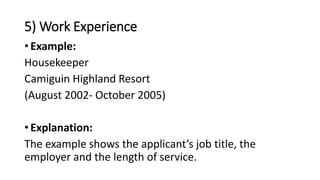
5) Work Experience
• Example:
Housekeeper
Camiguin Highland Resort
(August 2002- October 2005)
• Explanation:
The example shows the applicant’s job title, the
employer and the length of service.
Basic features of a Resume
6) Educational Background
The educational background section can also
be labelled as Academic, Academic
Qualification or Education and Certifications.
Write the degree together with your major,
minor or concentration (if there is any),
school and year attended.
6) Educational Background
• Example:
TESDA
Camiguin School of Arts and Trades
2001-2002
• Explanation:
The inclusion of educational background from preschool to
junior high school is not required in this part. Mentioning only
the details on where and when the applicant got his senior
high school and college degree would be enough.
Why resume
is
important?
‘’The best part for
tomorrow, is doing your
best today.’’
Professional Correspondence.pptx

Professional Correspondence.pptx

  • 4.
    Lesson Objectives: At theend of the lesson, the learners are expected to: a. Define and identify Resume as one of the written methods of Professional Correspondence through discussion. b. Write their own resume for future purposes. c. Show appreciation of resume by understanding its importance as they look for a job in the near future.
  • 5.
  • 6.
  • 7.
    Correspondence is a commonlyused form of communication in business.
  • 8.
    In the past,correspondence was mostly exchanged through written physical letters or telegraphs. In today’s world, the definition of correspondence has expanded by the inclusion of digital media.
  • 9.
    E-mails, text messages,documents exchanged through social platforms and digital agreements are new ways to deliver correspondence. The formal element embedded into these written methods of communication makes them appropriate to transmit important business information between businesses or from businesses to clients.
  • 10.
    What is aResume?
  • 11.
    A resume isa formal document that provides an overview of your professional qualifications, including your relevant work experience, skills, education, and notable accomplishments.
  • 12.
    Usually paired witha cover letter, a resume helps you demonstrate your abilities and convince employers you’re qualified and hirable. The spelling of “résumé” actually originates from French, and means “summary.”
  • 13.
    Resume should includethe following sections: •Contact details: include your first and last name, phone number, and email address. Additionally, you can add your LinkedIn profile if yours is up to date, and your mailing address if you want to prove you live near the place you’re applying.
  • 14.
    Resume should includethe following sections: •Introduction: a concise overview of your professional background and key qualifications. Your introduction can be in the form of a resume summary, professional profile, resume objective, or qualifications summary.
  • 15.
    Resume should includethe following sections: •Experience: list any relevant work experience you have. Include your title, the company you worked for, years worked, and a bulleted list of your key responsibilities and notable successes. Be sure to also include as many relevant accomplishments on your resume as possible.
  • 16.
    Resume should includethe following sections: •Education: Include your school names, highest degree earned, majors and minors. Additionally, you can add your GPA and relevant coursework if you lack experience or it’s related to the position.
  • 17.
    Resume should includethe following sections: •Skills: include any resume skills you possess that are relevant to the position. Be sure to use a strong mix of hard skills and soft skills to demonstrate that you’re a well- rounded candidate.
  • 18.
    Types of RésuméFormat 1) Chronological Format The chronological format is used to emphasize the applicant’s work experiences progress. It starts with the complete work experiences, followed by the educational background. It is best used if the applicant is applying for a job related to his previous experiences, and has ten to fifteen years work experiences.
  • 19.
    1) Chronological Format Heading Objective: WorkExperience: Educational Background: Skills/Expertise: Voluntary Activities/Involvement:
  • 20.
    Types of RésuméFormat 2) Functional Format Functional format, on the other hand, focuses on the skills, not on the work history. It is best used if the applicant changed career or if re-entering the industry after a long absence. It is also used by the high school or college students entering the industry.
  • 21.
    2) Functional Format Heading --------------------------- Objective: ProfessionalSummary: Work Experience: Educational Background: Skills and Expertise:
  • 22.
    Types of RésuméFormat 3) Combination or Hybrid Format Combination or Hybrid combines the chronological and functional format. It works best if the applicant is aiming for a career change or wants to present both skills and accomplishment.
  • 23.
    3) Combination orHybrid Format Heading -------------------------- Objective: Professional Summary: Expertise and Achievements: Work Experience: Educational Background:
  • 24.
    Basic features ofa Resume 1) Heading The resume heading includes the applicant’s complete name, current address and contact details such as cell phone number or e-mail address. The heading can be written in the center or on the left-side. Make sure that the formatting style, especially the font type, looks professional. The heading contains basic information about the applicant.
  • 25.
    1) Heading Example: Alexa S.Cabido Fidel Bas St. Purok Malipayon, Brgy. Mohon, Talisay City, Cebu Phone: (088) 387-000 Mobile: (+63) 967 570 1927 e-mail: ronankinaadman@yahoo.com
  • 26.
    Basic features ofa Resume 2) Objectives An objective also referred to as job objective or career objective, reflects the applicant’s career goals and intention for applying for the job. Remember to write a direct and specific objective that contains what you want to achieve in your career and what the employer could expect from you.
  • 27.
    2) Objectives Example: To landa job as hotel chamberlain, making every room a home of their own.
  • 28.
    Basic features ofa Resume 3) Professional Summary Professional summary, also referred to as ‘career summary’ or ‘career profile’, showcases your knowledge and abilities. It includes short recent job summary, together with your soft skills (e.g. problem-solving capability, adaptability to change, etc.)
  • 29.
    3) Professional Summary •Thisexample highlights the most valuable and recent job experience of the applicants. •Good cleaner, a flexible and hardworking. Hotelier with one year experience in providing customer service, preparing beds and maintaining cleanliness of the hotel rooms.
  • 30.
    Basic features ofa Resume 4) Expertise and Achievement This also refers to the ‘professional skills’ and ‘qualification’ of the applicant. It includes personal and technical skills including the certifications and recognition received.
  • 31.
    4) Expertise andAchievement • Example: Order Taking Skills Received recognition as best housekeeper dated October 2004 excellent in finishing room make up on time • Explanation: This is the part where the applicant, with or without experience, can write a detailed description of his abilities and skills.
  • 32.
    Basic features ofa Resume 5) Work Experience This is also called "employment history," "relevant experience", or "work history." Work experience is a part of a résumé where the applicant states all 4 previous employment. If you have no work experience yet, write first the educational background, and include the optional part Training and Seminar Attended.
  • 33.
    5) Work Experience •Example: Housekeeper Camiguin Highland Resort (August 2002- October 2005) • Explanation: The example shows the applicant’s job title, the employer and the length of service.
  • 34.
    Basic features ofa Resume 6) Educational Background The educational background section can also be labelled as Academic, Academic Qualification or Education and Certifications. Write the degree together with your major, minor or concentration (if there is any), school and year attended.
  • 35.
    6) Educational Background •Example: TESDA Camiguin School of Arts and Trades 2001-2002 • Explanation: The inclusion of educational background from preschool to junior high school is not required in this part. Mentioning only the details on where and when the applicant got his senior high school and college degree would be enough.
  • 37.
  • 38.
    ‘’The best partfor tomorrow, is doing your best today.’’