Audrey Stampaert – January 2018
Inspirational Deck
10 Trends every marketer
should know for 2018
As we go into 2018, it’s time to take a
deep-dive into the marketing trends for
the upcoming year.
Where should marketers spent their
budgets, time and resources in 2018?
Let’s take a look at the top 10 trends every
marketer should know.
Bringing Chatbots to the Next Level
1
Chatbots experienced a rapid rise in 2017, but in the coming year, chatbots will become a far more
common solution for brands wishing to serve their customers in a more cost-effective and smarter
way.
With Artificial Intelligence now being easier to integrate into various tools and services chatbots
will become more personalised with each individual interaction it has with your customers.
Hence, in 2018 we may see a customer service revolution as brands will use bots to handle
enquiries and common customer interactions.
The Starbucks Barista bot for Facebook Messenger serves a very specific
purpose: it orders you coffee.
When you have a desperate need for a coffee with minimal human interaction
and effort, My Starbucks Barista has you covered. Thanks to the advanced
voice recognition technology, the bot even understands complicated orders
like "double upside down macchiato half decaf with room and a splash of
cream in a grande cup."
1
These brands were already doing it back in 2017:
Starbucks – My Starbucks Barista
1
This year we saw a number of big players boost their AR offerings. In 2018 this trend is set to
continue and we can expect many more major announcements from brands like Amazon, Apple,
Facebook and Samsung who will invest further in immersive computing.
The use of Augmented Reality on mobile devices provides a niche and engaging way for
marketers to reach their target audience - it's quick, easy and very interactive.
Developments in hardware and software will continue to align to make the ability to create content
for AR more robust, scalable, efficient and affordable.
Have you ever bought a piece of furniture which was beautiful in store but
didn’t match with your interior and you had to go back to the store and return
it?
Ikea found the perfect solution for this problem with 'Place‘, an app you can
use to preview furniture in your own interior before buying it. With this type of
AR integration Ikea seeks to increase conversions by showing customers
how their products will look in their own home.
2
These brands were already doing it back in 2017:
IKEA – Augmented Reality furniture app
Increasing Customer Engagement with
Augmented Reality
The strongest brands have the best stories — ones that are eminently attention-getting,
relatable and most importantly, shareable. In our always-on, always-connected world, brand
stories are central to your brand strategy and sharing is a key factor to achieving essential brand
growth.
You must win the heart of your consumers to move the mind because they buy your product or
service with emotion first and justify it with rational arguments afterwards.
So, again in 2018, brand storytelling is the most powerful tool marketers have.
Mattel decided to reinvent Barbie and to take their customers on a storytelling
journey. They did so with a short film: “When Girls Are Free to Imagine They
Can Be Anything”. The story line is that when a girl plays with her Barbie, she
imagines everything she can become: is it a vet, a pilot, an astronaut,.... The
story was also accompanied by a refreshed product line starring new dolls
with different skin tones, body types, and hair colours. By rebranding their
ancient Barbie-doll, Mattel takes Barbie from her 1959 Baby Boomer
introduction to Gen Z customers.
3
These brands were already doing it back in 2017:
Mattel – When Girls are free to imagine
Focusing on Building Connections, not
Sales
When a girl plays with
She images everything she can become
1
The strongest brands have the strongest brand ambassadors — — Forget the ivory tower of
a company, more and more brands will invest and train to inspire, empower, and develop
employees as the outstanding front line of brand ambassadors. No one is more interested in
seeing the company successful and the brand be liked than the people who work for it. And, no
one is better than your own employees at communicating positive news, building relationships and
increasing loyalty.
In addition, your prospects and customers want a relationship with people they trust, not with
corporate marketing. It is through the direct conversation between employees and customers that
brands will win in 2018.
Every brand has an inside story, a reason why they do what they do. Your
customers want to know about that story and they want you to communicate
about it in a natural, authentic way.
So when it comes to customer-centricity and building a relationship with your
customers, e-commerce platform Coolblue is a best-in-class example. Their
mission ‘Everything for a smile’ is carried out throughout every touchpoint and
all employees embody these values. They are true ambassadors of the
company’s culture.
4
These brands were already doing it back in 2017:
Coolblue – Employees as true brand ambassadors
Direct Conversation between Employees
and Customers
In 2018, influencers will continue to be an important aspect of your marketing strategy.
However, partnering with a celebrity to represent your company on social media comes at a high
price.
And when it comes to social influencing, to be considered a celebrity, one has to have over 1
million followers. People with 500k–1 million followers and 100k–500k followers fall into the macro-
influencer and middle-influencer categories. Micro-influencers have between 1k–100k followers on
social media.
In 2018, brands will be reaching out to these micro-influencers. Why? It is easier for your customer
to relate to them. These people aren’t actually famous. They have normal jobs and live regular
lives. But they happen to be popular on social media.
5Reaching out to Micro-Influencers
Adidas worked with micro-influencers like Emily of @myhealthyishlife to promote the Adidas Ultra
Boost. The influencer admitted she first had a negative stereotype about the shoe. However, she
explained that she was pleasantly proven wrong and shared what she loved so much about it.
This enabled her to start a conversation around the brand and product, ultimately accomplishing
the goal of promoting them.
These brands were already doing it back in 2017:
Adidas – Adidas Ultra Boost
Over the past years we’ve individualised everything: from soda cans to shoes; and mass customisation has
transformed into personalization. Personalization tactics increase customer retention, which will lead to cross- and up-
sell, higher customer loyalty and eventually a greater wallet share.
Companies with an ecommerce website for example should encourage customers to create a customer profile on their
website or mobile application. In this way, you can monitor their habits and give them special offers based on their
browsing pattern or previous purchases.
Another digital marketing channel for creating personalised campaigns is email marketing. Email personalisation can
improve conversion rates by 10% and increase click-through rates by 14%. If you personalise the subject line of an
email, there is a 26% greater chance of the recipient opening it.
But to make personalisation work you need to apply the single individual view, looking at one customer through a
single lens. You also need a combination of marketing automation, web analytics and CRM, which are all linked
together providing you with the full customer story.
6Increasing Customer Retention with
Personalisation Tactics
These brands were already doing it back in 2017:
KLM – A personalised and interactive edition of its brand magazine
Is it from personalised email campaigns to retargeting, KLM knows how to enhance customer experience. But for the
brands anniversary they took personalisation to the next level and developed an interactive edition of their brand
magazine. Whereas the magazine normally displays reviews and travel tips, this edition allowed readers to select 5
favourite travel destinations with a chance of winning the trip of their choice! An easy example on how to give your
readers a reason to interact and engage.
1
The Internet of Things is the concept of connecting any device to the Internet and to other
connected devices. The IoT is a giant network of devices all collecting and sharing data
about the way we use them and the environment around us. By connected devices we do not
only mean mobile phones, it includes an vast number of objects of all shapes and sizes: from
smart fridges to fitness devices and even self-driving cars.
The amount of interconnected devices keeps rising, so in 2018 there will be even more of them
collecting and sharing data. The growth of the number of “smart” devices will allow expanding the
processes that utilize IoT and therefore make them easier and more accurate.
As a result of the access to consumers’ personal information and processing of the big amount of
data, marketers will be able to create personal advertisements based on user needs, profile
and behaviour. Additionally IoT will allow them to place these personalised ads on the devices
and platforms their customers are using.
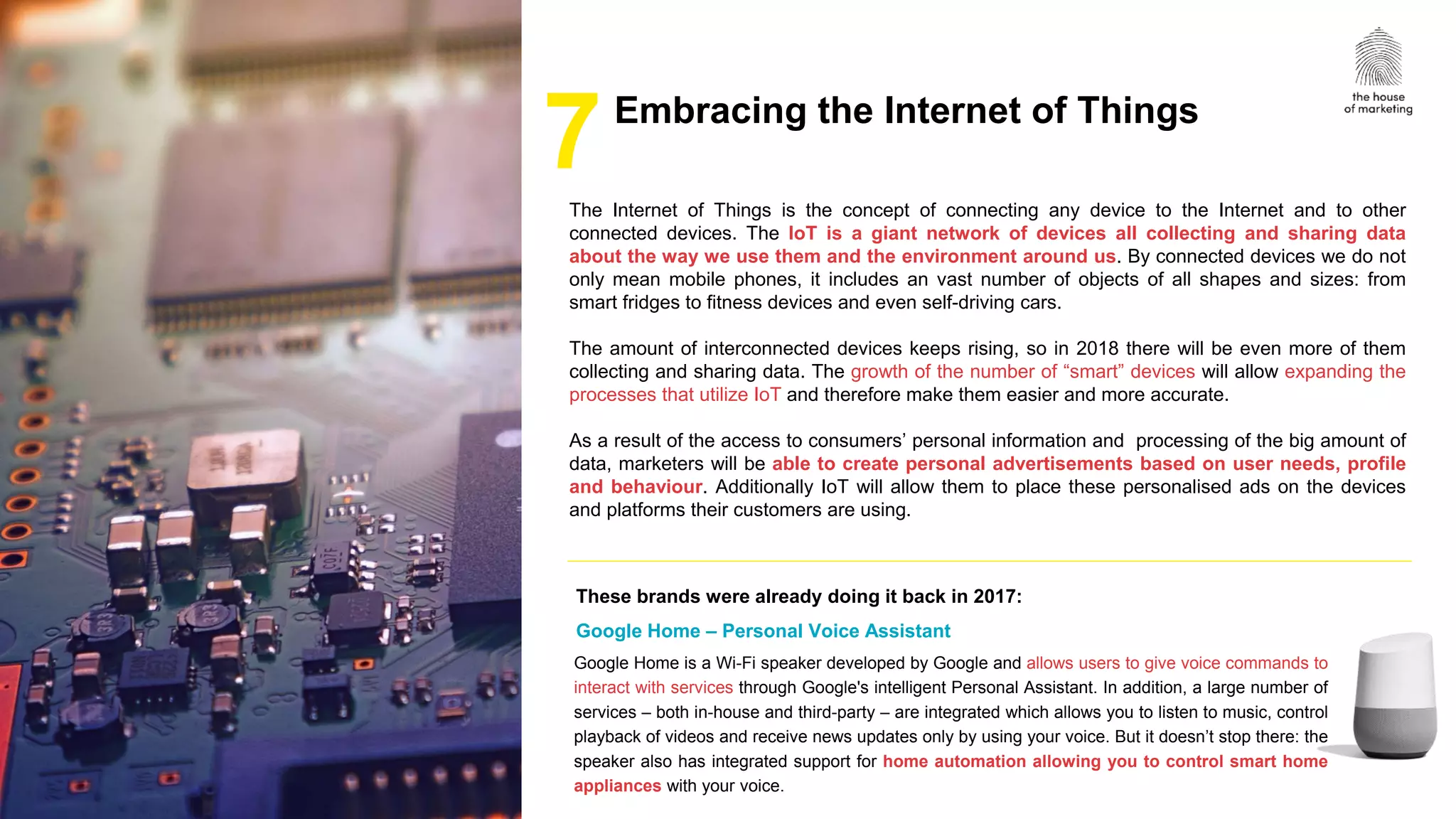
Google Home is a Wi-Fi speaker developed by Google and allows users to give voice commands to
interact with services through Google's intelligent Personal Assistant. In addition, a large number of
services – both in-house and third-party – are integrated which allows you to listen to music, control
playback of videos and receive news updates only by using your voice. But it doesn’t stop there: the
speaker also has integrated support for home automation allowing you to control smart home
appliances with your voice.
7
These brands were already doing it back in 2017:
Google Home – Personal Voice Assistant
Embracing the Internet of Things
In 2017 video streaming represented 75% of all internet traffic and there are no signs showing
things will slow down in the upcoming year. So it should be no surprise that video continues to
dominate social in 2018. In addition, studies have found that viewers watch live streams 3x
longer than pre-recorded video, so for the year to come we expect to see a continued shift
towards live video.
Major platforms such as Facebook, Instagram and Snapchat will increase the amount of live
videos by improving feed quality and adding more interactive features.
In addition, two-thirds of marketers say that they will increase the number of live events they
host in 2018. This is because they recognise that live events are one of the most effective
marketing channels. Look at Salesforce, Airbnb and Google, who host an annual event to bring
existing customers, prospects and press together.
8Livestreaming and Live Events
Red Bull is one of the pioneers when it comes to organising and livestreaming events. With livestreaming
these events on social media, they improve the way fans get a feel of the atmosphere. Apart from being
able to watch their favourite artists perform, RedBull TV will also live stream artists’ and funny side stories.
All these offer the audience, outside and inside the festival, unprecedented access to backstage of the
event.
These brands were already doing it back in 2017:
Red Bull – Livestreaming Music Festivals
1
People have never been more traced, decoded, and analysed than in the past years. With
contextual data inputs via Face ID and voice search, algorithms can now better understand and
design content based on the preferences and interests of your customer.
However, this automation also has an important downside. More and more people become
suspicious on whether content is created by machines or humans. And when brands are not
transparent about it, customers will voice their concerns more than ever.
As a result, we can see that ‘made by humans' will gain more importance in 2018. Creative
products made by humans will become an ethical choice, just like ‘made locally’ or 'fair trade‘ was
a thought through choice over the past year. Hence, there will be increased pressure on brands
to reveal whether content was made by humans or by machines.
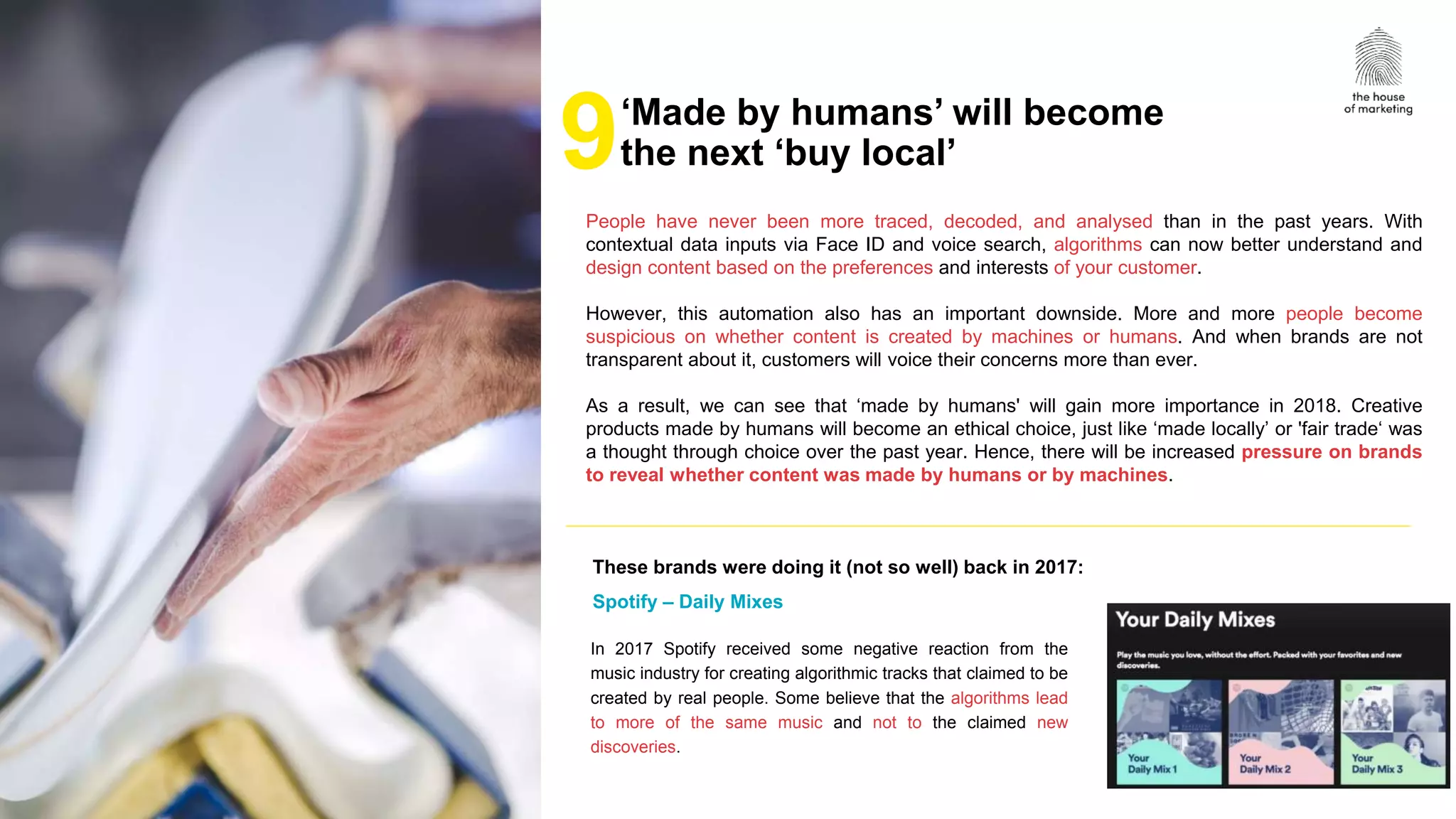
In 2017 Spotify received some negative reaction from the
music industry for creating algorithmic tracks that claimed to be
created by real people. Some believe that the algorithms lead
to more of the same music and not to the claimed new
discoveries.
9
These brands were doing it (not so well) back in 2017:
Spotify – Daily Mixes
‘Made by humans’ will become
the next ‘buy local’
1
Location-based technology is opening up a world of possibilities for marketers: There was once a
time when we had no mobile devices, but that time is long gone. Today, wherever we go, our
device goes with us. On average, people trigger 75 separate mobile sessions per day. That means
we engage with our device across lots of locations throughout the day. And marketers benefit from
it.
They use geofencing technology to gather information about their customers and target
them as they enter, leave or stay in specific areas. Geofencing is the practice of using global
positioning (GPS) or radio frequency identification to define a geographic boundary. Then, once
this “virtual barrier” or “geofence” is defined, the marketer can set up triggers that send a text
message, email or notification (e.g. with special discounts)when a mobile device enters (or exits)
the identified area. In this way businesses can determine a geographic area and communicate
with devices that are active in that location.
10 Using Geofencing technology
L’Oréal created a virtual art exhibition which could only be discovered by attendees who
used their mobile devices to navigate an area. As customers walked around the place,
virtual works of art were displayed depending on the location they were situated in. To
achieve this, L’Oréal used the same geolocation technology as used by the popular game
Pokémon Go. This technique allows the brand to manipulate reality and to place customers
in an undiscoverable setting.
These brands were already doing it back in 2017:
L’Oréal – Virtual art exhibition
Interested in which trends are
impacting your industry?
Contact us and let’s find out
together!
Audrey Stampaert
Junior Consultant
audrey.stampaert@thom.eu

10 Trends every marketer should know for 2018

  • 1.
    Audrey Stampaert –January 2018 Inspirational Deck 10 Trends every marketer should know for 2018
  • 2.
    As we gointo 2018, it’s time to take a deep-dive into the marketing trends for the upcoming year. Where should marketers spent their budgets, time and resources in 2018? Let’s take a look at the top 10 trends every marketer should know.
  • 3.
    Bringing Chatbots tothe Next Level 1 Chatbots experienced a rapid rise in 2017, but in the coming year, chatbots will become a far more common solution for brands wishing to serve their customers in a more cost-effective and smarter way. With Artificial Intelligence now being easier to integrate into various tools and services chatbots will become more personalised with each individual interaction it has with your customers. Hence, in 2018 we may see a customer service revolution as brands will use bots to handle enquiries and common customer interactions. The Starbucks Barista bot for Facebook Messenger serves a very specific purpose: it orders you coffee. When you have a desperate need for a coffee with minimal human interaction and effort, My Starbucks Barista has you covered. Thanks to the advanced voice recognition technology, the bot even understands complicated orders like "double upside down macchiato half decaf with room and a splash of cream in a grande cup." 1 These brands were already doing it back in 2017: Starbucks – My Starbucks Barista
  • 4.
    1 This year wesaw a number of big players boost their AR offerings. In 2018 this trend is set to continue and we can expect many more major announcements from brands like Amazon, Apple, Facebook and Samsung who will invest further in immersive computing. The use of Augmented Reality on mobile devices provides a niche and engaging way for marketers to reach their target audience - it's quick, easy and very interactive. Developments in hardware and software will continue to align to make the ability to create content for AR more robust, scalable, efficient and affordable. Have you ever bought a piece of furniture which was beautiful in store but didn’t match with your interior and you had to go back to the store and return it? Ikea found the perfect solution for this problem with 'Place‘, an app you can use to preview furniture in your own interior before buying it. With this type of AR integration Ikea seeks to increase conversions by showing customers how their products will look in their own home. 2 These brands were already doing it back in 2017: IKEA – Augmented Reality furniture app Increasing Customer Engagement with Augmented Reality
  • 5.
    The strongest brandshave the best stories — ones that are eminently attention-getting, relatable and most importantly, shareable. In our always-on, always-connected world, brand stories are central to your brand strategy and sharing is a key factor to achieving essential brand growth. You must win the heart of your consumers to move the mind because they buy your product or service with emotion first and justify it with rational arguments afterwards. So, again in 2018, brand storytelling is the most powerful tool marketers have. Mattel decided to reinvent Barbie and to take their customers on a storytelling journey. They did so with a short film: “When Girls Are Free to Imagine They Can Be Anything”. The story line is that when a girl plays with her Barbie, she imagines everything she can become: is it a vet, a pilot, an astronaut,.... The story was also accompanied by a refreshed product line starring new dolls with different skin tones, body types, and hair colours. By rebranding their ancient Barbie-doll, Mattel takes Barbie from her 1959 Baby Boomer introduction to Gen Z customers. 3 These brands were already doing it back in 2017: Mattel – When Girls are free to imagine Focusing on Building Connections, not Sales When a girl plays with She images everything she can become
  • 6.
    1 The strongest brandshave the strongest brand ambassadors — — Forget the ivory tower of a company, more and more brands will invest and train to inspire, empower, and develop employees as the outstanding front line of brand ambassadors. No one is more interested in seeing the company successful and the brand be liked than the people who work for it. And, no one is better than your own employees at communicating positive news, building relationships and increasing loyalty. In addition, your prospects and customers want a relationship with people they trust, not with corporate marketing. It is through the direct conversation between employees and customers that brands will win in 2018. Every brand has an inside story, a reason why they do what they do. Your customers want to know about that story and they want you to communicate about it in a natural, authentic way. So when it comes to customer-centricity and building a relationship with your customers, e-commerce platform Coolblue is a best-in-class example. Their mission ‘Everything for a smile’ is carried out throughout every touchpoint and all employees embody these values. They are true ambassadors of the company’s culture. 4 These brands were already doing it back in 2017: Coolblue – Employees as true brand ambassadors Direct Conversation between Employees and Customers
  • 7.
    In 2018, influencerswill continue to be an important aspect of your marketing strategy. However, partnering with a celebrity to represent your company on social media comes at a high price. And when it comes to social influencing, to be considered a celebrity, one has to have over 1 million followers. People with 500k–1 million followers and 100k–500k followers fall into the macro- influencer and middle-influencer categories. Micro-influencers have between 1k–100k followers on social media. In 2018, brands will be reaching out to these micro-influencers. Why? It is easier for your customer to relate to them. These people aren’t actually famous. They have normal jobs and live regular lives. But they happen to be popular on social media. 5Reaching out to Micro-Influencers Adidas worked with micro-influencers like Emily of @myhealthyishlife to promote the Adidas Ultra Boost. The influencer admitted she first had a negative stereotype about the shoe. However, she explained that she was pleasantly proven wrong and shared what she loved so much about it. This enabled her to start a conversation around the brand and product, ultimately accomplishing the goal of promoting them. These brands were already doing it back in 2017: Adidas – Adidas Ultra Boost
  • 8.
    Over the pastyears we’ve individualised everything: from soda cans to shoes; and mass customisation has transformed into personalization. Personalization tactics increase customer retention, which will lead to cross- and up- sell, higher customer loyalty and eventually a greater wallet share. Companies with an ecommerce website for example should encourage customers to create a customer profile on their website or mobile application. In this way, you can monitor their habits and give them special offers based on their browsing pattern or previous purchases. Another digital marketing channel for creating personalised campaigns is email marketing. Email personalisation can improve conversion rates by 10% and increase click-through rates by 14%. If you personalise the subject line of an email, there is a 26% greater chance of the recipient opening it. But to make personalisation work you need to apply the single individual view, looking at one customer through a single lens. You also need a combination of marketing automation, web analytics and CRM, which are all linked together providing you with the full customer story. 6Increasing Customer Retention with Personalisation Tactics These brands were already doing it back in 2017: KLM – A personalised and interactive edition of its brand magazine Is it from personalised email campaigns to retargeting, KLM knows how to enhance customer experience. But for the brands anniversary they took personalisation to the next level and developed an interactive edition of their brand magazine. Whereas the magazine normally displays reviews and travel tips, this edition allowed readers to select 5 favourite travel destinations with a chance of winning the trip of their choice! An easy example on how to give your readers a reason to interact and engage.
  • 9.
    1 The Internet ofThings is the concept of connecting any device to the Internet and to other connected devices. The IoT is a giant network of devices all collecting and sharing data about the way we use them and the environment around us. By connected devices we do not only mean mobile phones, it includes an vast number of objects of all shapes and sizes: from smart fridges to fitness devices and even self-driving cars. The amount of interconnected devices keeps rising, so in 2018 there will be even more of them collecting and sharing data. The growth of the number of “smart” devices will allow expanding the processes that utilize IoT and therefore make them easier and more accurate. As a result of the access to consumers’ personal information and processing of the big amount of data, marketers will be able to create personal advertisements based on user needs, profile and behaviour. Additionally IoT will allow them to place these personalised ads on the devices and platforms their customers are using. Google Home is a Wi-Fi speaker developed by Google and allows users to give voice commands to interact with services through Google's intelligent Personal Assistant. In addition, a large number of services – both in-house and third-party – are integrated which allows you to listen to music, control playback of videos and receive news updates only by using your voice. But it doesn’t stop there: the speaker also has integrated support for home automation allowing you to control smart home appliances with your voice. 7 These brands were already doing it back in 2017: Google Home – Personal Voice Assistant Embracing the Internet of Things
  • 10.
    In 2017 videostreaming represented 75% of all internet traffic and there are no signs showing things will slow down in the upcoming year. So it should be no surprise that video continues to dominate social in 2018. In addition, studies have found that viewers watch live streams 3x longer than pre-recorded video, so for the year to come we expect to see a continued shift towards live video. Major platforms such as Facebook, Instagram and Snapchat will increase the amount of live videos by improving feed quality and adding more interactive features. In addition, two-thirds of marketers say that they will increase the number of live events they host in 2018. This is because they recognise that live events are one of the most effective marketing channels. Look at Salesforce, Airbnb and Google, who host an annual event to bring existing customers, prospects and press together. 8Livestreaming and Live Events Red Bull is one of the pioneers when it comes to organising and livestreaming events. With livestreaming these events on social media, they improve the way fans get a feel of the atmosphere. Apart from being able to watch their favourite artists perform, RedBull TV will also live stream artists’ and funny side stories. All these offer the audience, outside and inside the festival, unprecedented access to backstage of the event. These brands were already doing it back in 2017: Red Bull – Livestreaming Music Festivals
  • 11.
    1 People have neverbeen more traced, decoded, and analysed than in the past years. With contextual data inputs via Face ID and voice search, algorithms can now better understand and design content based on the preferences and interests of your customer. However, this automation also has an important downside. More and more people become suspicious on whether content is created by machines or humans. And when brands are not transparent about it, customers will voice their concerns more than ever. As a result, we can see that ‘made by humans' will gain more importance in 2018. Creative products made by humans will become an ethical choice, just like ‘made locally’ or 'fair trade‘ was a thought through choice over the past year. Hence, there will be increased pressure on brands to reveal whether content was made by humans or by machines. In 2017 Spotify received some negative reaction from the music industry for creating algorithmic tracks that claimed to be created by real people. Some believe that the algorithms lead to more of the same music and not to the claimed new discoveries. 9 These brands were doing it (not so well) back in 2017: Spotify – Daily Mixes ‘Made by humans’ will become the next ‘buy local’
  • 12.
    1 Location-based technology isopening up a world of possibilities for marketers: There was once a time when we had no mobile devices, but that time is long gone. Today, wherever we go, our device goes with us. On average, people trigger 75 separate mobile sessions per day. That means we engage with our device across lots of locations throughout the day. And marketers benefit from it. They use geofencing technology to gather information about their customers and target them as they enter, leave or stay in specific areas. Geofencing is the practice of using global positioning (GPS) or radio frequency identification to define a geographic boundary. Then, once this “virtual barrier” or “geofence” is defined, the marketer can set up triggers that send a text message, email or notification (e.g. with special discounts)when a mobile device enters (or exits) the identified area. In this way businesses can determine a geographic area and communicate with devices that are active in that location. 10 Using Geofencing technology L’Oréal created a virtual art exhibition which could only be discovered by attendees who used their mobile devices to navigate an area. As customers walked around the place, virtual works of art were displayed depending on the location they were situated in. To achieve this, L’Oréal used the same geolocation technology as used by the popular game Pokémon Go. This technique allows the brand to manipulate reality and to place customers in an undiscoverable setting. These brands were already doing it back in 2017: L’Oréal – Virtual art exhibition
  • 13.
    Interested in whichtrends are impacting your industry? Contact us and let’s find out together!
  • 14.

Editor's Notes

  • #4 Source: https://www.brandwatch.com/blog/marketing-trends-for-2018/ https://blog.hubspot.com/marketing/brands-already-using-chatbots-in-their-marketing https://www.geekwire.com/2016/coffee-chatbot-starbucks-unveil-starbucks-barista-ai-technology-placing-mobile-orders/
  • #5 Source: https://www.smartinsights.com/digital-marketing-platforms/video-marketing/is-marketing-ready-for-vr-ar-in-2018/ https://www.brandwatch.com/blog/marketing-trends-for-2018/ https://www.bloovi.be/nieuws/detail/baanbrekende-app-met-belgische-technologie-wil-nieuwe-standaard-zetten-voor-mobiele-ar
  • #6 Source: http://www.personadesign.ie/top-7-branding-trends-in-2017/
  • #7 Source: http://www.personadesign.ie/brand-sponsorships-the-best-brand-ambassadors-are-already-on-your-payroll/ https://www.brandwatch.com/blog/marketing-trends-for-2018/ http://wouterkleinsman.nl/online-marketing/de-customer-journey-van-coolblue-die-leidt-tot-een-glimlach/ https://www.youtube.com/watch?v=AdCfAsosoQs
  • #8 Source: https://www.quicksprout.com/2017/12/27/the-top-9-marketing-trends-to-look-for-in-2018/ https://contevo.com.au/micro-influencers-statistics-2016/ https://www.forbes.com/sites/forbescoachescouncil/2017/09/29/using-micro-influencers-to-successfully-promote-your-brand/#4e754e3a1763
  • #9 Source: https://www.entrepreneur.com/article/305047 https://www.forbes.com/sites/danielnewman/2016/10/18/the-top-10-trends-driving-marketing-in-2017/#3430740f3ade https://www.quicksprout.com/2017/12/27/the-top-9-marketing-trends-to-look-for-in-2018/ https://econsultancy.com/blog/69207-how-six-travel-hospitality-brands-use-personalisation-to-enhance-the-customer-experience
  • #10 Source: https://hackernoon.com/the-most-promising-internet-of-things-trends-for-2018-10a852ccd189 https://www.ibm.com/blogs/internet-of-things/what-is-the-iot/ http://www.liquidagency.com/brand-exchange/the-internet-of-things-a-brands-new-world/
  • #11 Source: https://www.huffingtonpost.com/entry/10-marketing-trends-to-think-about-for-2018_us_5994b288e4b055243ea1357c https://medium.com/convince-and-convert/how-brands-are-using-live-streaming-video-successfully-6f1e14940eb0 https://blog.streamaxia.com/is-live-streaming-the-future-of-content-sharing-71b13151ea52
  • #12 Source: https://www.popsugar.com/news/Exclusive-TBWA-Backslash-Pre-Trend-Report-2018-44456989 https://sciencealert.com/google-s-ai-built-it-s-own-ai-that-outperforms-any-made-by-humans https://www.theverge.com/2018/1/2/16840940/spotify-algorithm-music-discovery-mix-cds-resolution
  • #13 Source: https://www.huffingtonpost.com/entry/10-marketing-trends-to-think-about-for-2018_us_5994b288e4b055243ea1357c http://www.geomarketing.com/geomarketing-101-what-is-geofencing https://creativepool.com/magazine/technology/how-brands-are-using-geolocation-marketing.13034