Digital Trends 2015Top 10
Smart Marketers are
Technology Marketers
In 2015, the smart marketer will be a technology
marketer. Living in an ‘always connected’ world means
marketers have more opportunities to engage with
consumers in real-time.
Technology has helped four areas in marketing;
speed, relevance, reach, and measurement. Smart ad-
buying mechanisms like Google RTB, Facebook RTB
and AppNexus have revolutionised the way in which
customers can be engaged in real-time and at a speed
that traditional ad platforms can’t deliver; improving the
reachability, relevance and speed at which a brand
can engage with its audience.
Creative smart marketers have to either work closely
with a technology team who has an understanding of
mathematics, computers and new technologies, or
transform themselves into technology marketers.
The emergence of data availability further supports the
transformation of technology marketers.
Raw data now allows marketers to optimise the
consumer decision journey, accurately target
consumers, and be able to measure results of
marketing activity more effectively. 
At Fast Web Media, we’ve been combining technology
and marketing since 1995, and continue to up our
game every year in this ever evolving market; as
evidenced in our portfolio of services.
Attribution Solution
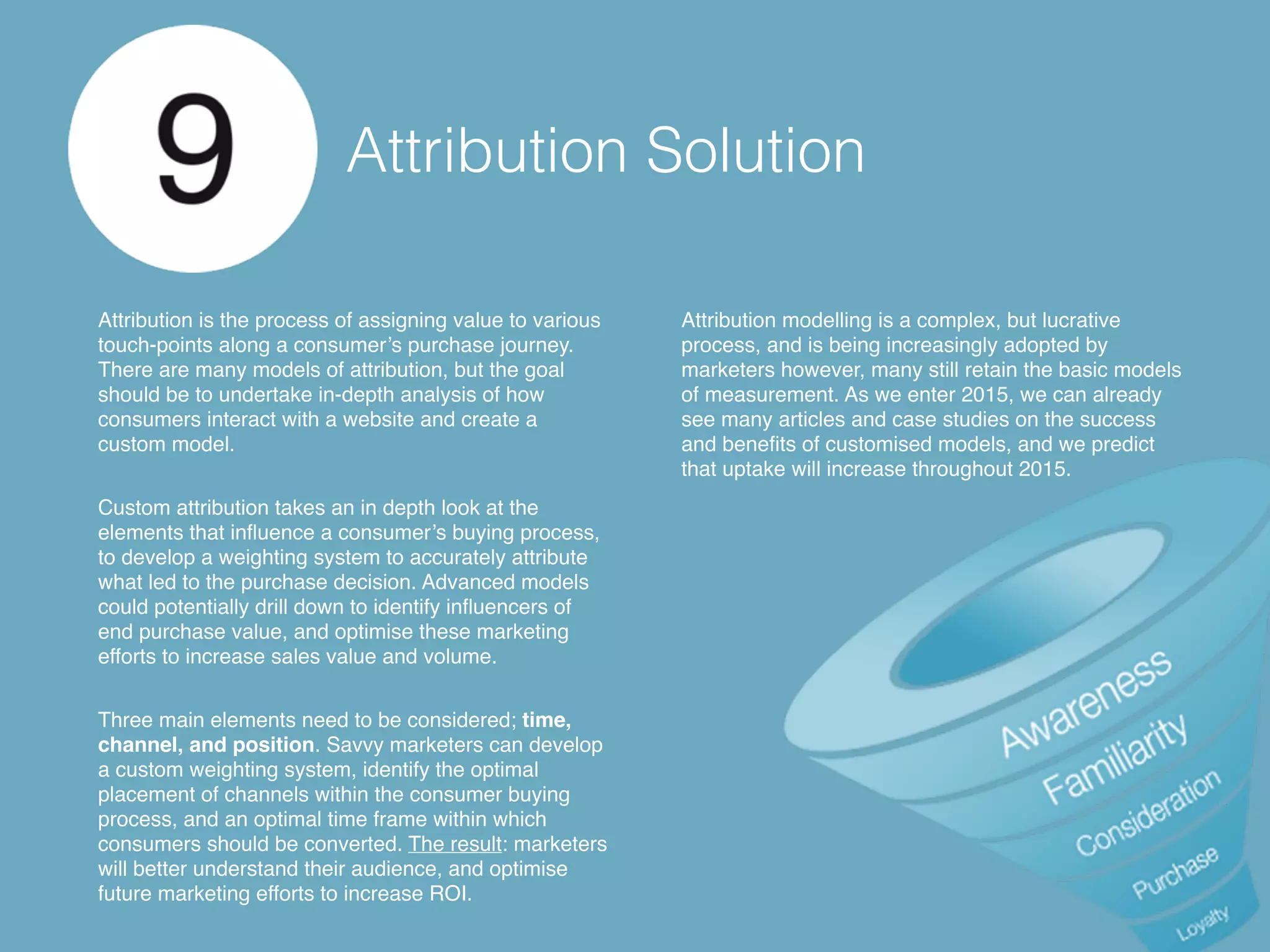
Attribution is the process of assigning value to various
touch-points along a consumer’s purchase journey.
There are many models of attribution, but the goal
should be to undertake in-depth analysis of how
consumers interact with a website and create a
custom model.
Custom attribution takes an in depth look at the
elements that influence a consumer’s buying process,
to develop a weighting system to accurately attribute
what led to the purchase decision. Advanced models
could potentially drill down to identify influencers of
end purchase value, and optimise these marketing
efforts to increase sales value and volume.
Three main elements need to be considered; time,
channel, and position. Savvy marketers can develop
a custom weighting system, identify the optimal
placement of channels within the consumer buying
process, and an optimal time frame within which
consumers should be converted. The result: marketers
will better understand their audience, and optimise
future marketing efforts to increase ROI.
Attribution modelling is a complex, but lucrative
process, and is being increasingly adopted by
marketers however, many still retain the basic models
of measurement. As we enter 2015, we can already
see many articles and case studies on the success
and benefits of customised models, and we predict
that uptake will increase throughout 2015.
Wearable Tech à la Mode
Very few of the products in this sector have really
moved into the mass market in the last 12 months.
Brands like Fitbit took initial steps in the health
monitoring arena but focused mostly on the fitness
aspect. More advanced products coming in 2015 will
move from pure fitness and fun towards advanced
health monitoring and tracking, which wasn’t available
in 2014.
With Apple soon to launch the Apple Watch and
updates in Google Glass with Intel supplying the
System on Chip, these products could break into the
mass market at a more affordable rate.
Clothing could be the big mover next year, with health
being a big driver; clothing opens up more possibilities
to utilise technology for different means. LikeAGlove, a
tight piece of clothing that takes your exact
measurements and syncs with shopping websites,
aims to make online shopping easier and reduce
returns.
ProGlove is a professional wearable production tool
that enables users to work faster and easier and
opens up a new level in control and business
intelligence for production management.
It would seem that there is some pretty big potential
for growth in 2015 and while it is not easy to predict
the future, consistent research and investment will
ensure that this area is here to stay and the market will
keep striving for the product which will define the first
success of the wearable tech era.
Mobile Payment Goes
Mainstream
Despite the growing trend for consumers to shop via
mobiles, some retailers are still offering a clunky and
difficult to use mobile experience. Slow checkout
processes, form filling, errors, or confusing checkouts
are barriers that are deterring shoppers from following
through with mobile purchases. 2015 will be the year
where m-commerce will start to demand its own
platform, with brands offering customers a bespoke,
mobile-only solution.
There is growing demand for mobile payment
solutions, and although uptake has been slow, in-store
capabilities and loyalty programs are making
transactions frictionless. Security fears are holding the
market back, but options like Apply Pay and Zapp offer
secure mobile payment options. This is the natural
progression, as more consumers are relying on mobile
banking as a solution to their everyday banking needs.
Retailers can offer bespoke mobile payment solutions
tied into existing, successful loyalty schemes. Boots
launched a new transactional app in July with a focus
on its Advantage Card Scheme.
Starbucks revealed in March that 14% of its US in-
store payments came via its mobile app, with users
liking that they can swipe their phones to pay and the
app is tied to their Starbucks Rewards.
2015 will see brands placing mobile at the top of their
digital strategy, with retailers offering bespoke mobile
only m-commerce solutions and payment options to
drive sales and loyalty.
Design Evolution Not
Revolution
With the emergence of different types of connected
devices, designers can no longer look at designing for
mobile, tablet and desktop; instead they need to
design for small screens, large screens, and
everything in between. Taking a smallest screen first
approach, responsive design is ever more relevant.
Vector images, based on mathematical expressions
allowing for rescaling of any sort whilst retaining a
small file size, will become more popular in 2015 and
may have an impact on the branding of companies
with responsive logos. Many Vector images will be
based on flat design, however Google believes this
needs to develop into a more powerful tool, so is
introducing material design, which focuses on the
reason why an item has a certain appearance, giving
a sense of reality to flat design through hierarchy,
meaning, and focus.
Full width imagery, typography with a statement, and
vibrant colours are being seen more over the web and
although many trends in design this year will not be
completely new ideas, but they will expand and
change from what we have known of them in the past
due to the development of new technologies and
continued improvements in digital devices.
Open For Business
2014 saw Microsoft appoint a new CEO for only the
third time in its history. Since Satya Nadella took over,
there has been a shift in the Redmond Campus
towards openness, and improving the lives of
developers and end users. Microsoft announced that
the .net framework would become open source,
allowing anyone to contribute to its codebase and use
its technologies on other platforms. There’s talk of
more of Windows becoming freely available in the lead
up to the launch of Windows 10.
2015 will finally see Internet Explorer try to
emulate the model of Chrome & Firefox, supporting
only the latest browser (pushed to end users via
automatic updates) and releasing updates more
frequently.
Five of the seven major contributors on the node.js
framework announced they would be splitting off to
create their own version, io.js, throwing the future of
the framework in doubt.
The growth in mobile device usage has led brands to
focus their attention on providing a more native
experience for the end user through custom apps.
These have often grabbed their information from a
website, purely because brands were creating apps as
an after-thought, not really understanding their
potential. However, there is a move in the industry
towards creating a central API, which any front end
can access. This leads to a more consistent
experience, less development issues and a faster
turnaround with releases. We believe this will continue
to increase in popularity throughout 2015.
Telling Tales
Brand Storytelling is becoming increasingly important;
this is the application of narrative thinking and
storytelling techniques to define a brand, inform
strategy, and structure creative activity. It’s a way of
thinking about brands that puts narrative at their heart,
and makes them compelling and meaningful.
Brand storytelling is hardly a new idea, but we as a
nation are becoming savvier and less likely to be
taken in by a manufactured backstory. As a result,
brands are harnessing the way they tell their story to
connect with the audience in a more sophisticated
way. Interactive storytelling moves beyond being just
about content, incorporating elements of design and
user interaction. Brands are delivering more personal
experiences through advertising and personalised
websites.
The Honda Civic ‘The Other Side’ ad is a great
example; the interactive dual-story video gives viewers
the choice to dictate how the story is told, empowering
the user and offering a more personal experience.
Tesla Motors’ website follows a similar idea, using
leading edge techniques in web design like parallax
scrolling, webgraphics and microinteractions to
demonstrate their content and key product features. It
demonstrates how interactivity and design can be
combined to create a personalised story within a
brand.
Interactive storytelling has helped to bring brands alive
and we will undoubtedly see this continue to develop
in 2015. We are living in an age of increasing digital
noise and these techniques will not only make brands
stand out but help to nurture and engage
communities.
The Personal Touch
Personalisation in email marketing is becoming
common practice amongst many brands; but the
experience often ends when consumers click through
to the website to find generic, static content. The
progression of personalisation isn’t a new concept;
good integrated marketing strategies aim to get the
right content in front of the right audience at the right
time. Marketers know that providing customers with
relevant informative content at each stage of the
purchasing process leads to increased engagement
and conversions. However, a recent survey by
Econsultancy shows that only 20% of companies are
actively personalising the web experience; a low figure
given all the opportunities available.
Every time a customer engages with a brand online,
they’re opening the door for personal communication
via personalised content, imagery, ads, videos, and
promotions. Segmentation of customer profiles builds
a picture of their needs, behaviour and interests,
allowing marketers to address those whilst promoting
their products/services to increase conversion rates.
keters to use customer data in a way where
personalisation will become the norm.
The use of multiple devices during the customer
journey makes things more challenging, but geo-
location targeting can influence behaviour and
decision-making.
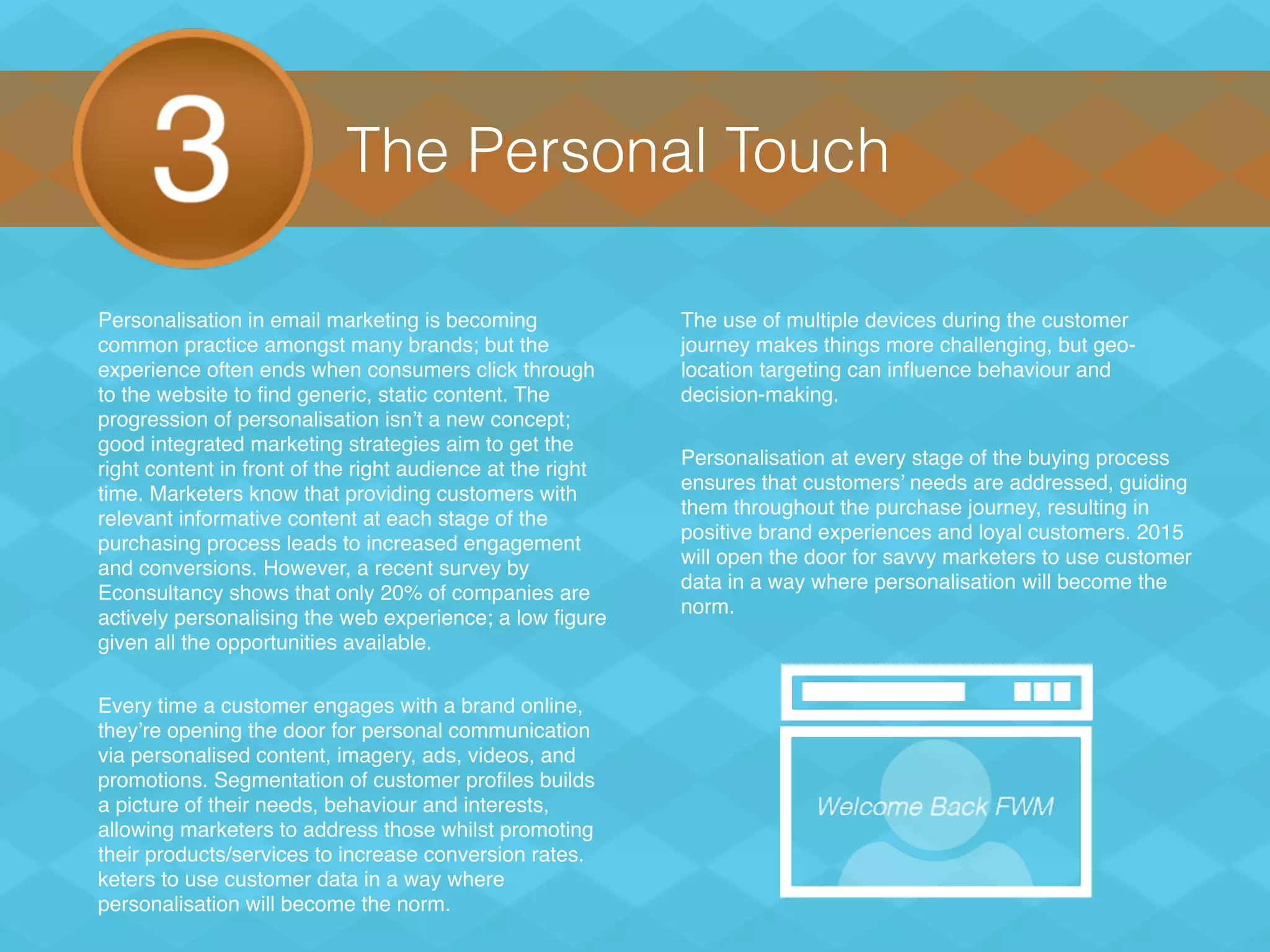
Personalisation at every stage of the buying process
ensures that customers’ needs are addressed, guiding
them throughout the purchase journey, resulting in
positive brand experiences and loyal customers. 2015
will open the door for savvy marketers to use customer
data in a way where personalisation will become the
norm.
How to Write Right
Online content has changed significantly, and will
continue to do so. Consumers are not just looking for
enlightenment anymore; they want entertainment,
quickly and easily. It’s become a very simple equation:
Demand + Ease (x Entertainment)
In 2015 we’ll see the content landscape change as
readers start seeing through such formulaic content,
and Google legislates against it. Syndicated content at
the bottom of articles recommending similar articles
will likely become less popular as these pieces have
devolved into cynical clickbait. Formulaic and keyword
stuffed headlines too will come under scrutiny.
Buzzfeed has recently started creating more long-form
content. These are popular, especially those that tug
at the heartstrings and contain an element of
nostalgia. Emotion and social value come into the
picture, and it’s no surprise that 75% of Buzzfeed’s
monthly traffic comes from social sites. That doesn’t
mean that social is the key to good content.
Buzzfeed’s success comes from the integrated way it
approaches site and social; its social feed is a content
platform and its site is a social platform. It’s not about
mastering both; it’s about mastering the link between
both. As this link becomes more important, alternate
social networks like Reddit, Tumblr, and Instagram will
see a rise in their significance.
The final piece of the puzzle is analysis; drawing
insights from your content will help the content itself,
improve tone of voice on social, and hone search
strategy. It’s a holistic, integrated approach and when
you put the three together and you have a new
equation for 2015, Demand + Ease (x Entertainment)
is both outdated and ineffective. Instead, think about:
Site + Social (x Search)
Automatic For The People
Effective use of Business Intelligence in 2015 will
allow for more appropriate marketing automation;
whereby business prospects are nurtured with highly
personalised, useful and relevant content that helps
convert them into delighted and loyal customers.
Successful use of marketing automation can be a
powerful tool for businesses and can generate new
revenue and excellent ROI.
However, the term “marketing automation” has
become a buzzword, where marketers believe they
simply need to seek out one-size-fits-all marketing
automation software. This misconception leaves many
marketers with sophisticated, expensive software that
doesn’t fulfil all of their customers’ needs.
Automated intelligence allows for efficiencies to be
generated and new markets to be created. In past
years, Fast Web Media has been automatically using
the power of weather in clients’ digital presences using
our weatherFIT PPC tool to improve ROI from PPC,
but smart use of Business Intelligence needs more
than just technology; it requires strong ethical
behaviour, knowledgeable staff, and effective risk
management. Here at Fast Web Media, we’ve been
exploring these issues since 2012 through
our Knowledge Transfer Partnership in with the
University of Salford.
2015 is going to be an exciting year for Business
Intelligence and the changes we will see are
fundamental and going to have an effect for years to
come.
Award Winning Data & Technology-Driven
Marketing Since 1995
Thank You
hello@fastwebmedia.com
+44 (0)203 427 5585
@fastwebmedia

Top 10 digital trends 2015

  • 1.
  • 2.
    Smart Marketers are TechnologyMarketers In 2015, the smart marketer will be a technology marketer. Living in an ‘always connected’ world means marketers have more opportunities to engage with consumers in real-time. Technology has helped four areas in marketing; speed, relevance, reach, and measurement. Smart ad- buying mechanisms like Google RTB, Facebook RTB and AppNexus have revolutionised the way in which customers can be engaged in real-time and at a speed that traditional ad platforms can’t deliver; improving the reachability, relevance and speed at which a brand can engage with its audience. Creative smart marketers have to either work closely with a technology team who has an understanding of mathematics, computers and new technologies, or transform themselves into technology marketers. The emergence of data availability further supports the transformation of technology marketers. Raw data now allows marketers to optimise the consumer decision journey, accurately target consumers, and be able to measure results of marketing activity more effectively.  At Fast Web Media, we’ve been combining technology and marketing since 1995, and continue to up our game every year in this ever evolving market; as evidenced in our portfolio of services.
  • 3.
    Attribution Solution Attribution isthe process of assigning value to various touch-points along a consumer’s purchase journey. There are many models of attribution, but the goal should be to undertake in-depth analysis of how consumers interact with a website and create a custom model. Custom attribution takes an in depth look at the elements that influence a consumer’s buying process, to develop a weighting system to accurately attribute what led to the purchase decision. Advanced models could potentially drill down to identify influencers of end purchase value, and optimise these marketing efforts to increase sales value and volume. Three main elements need to be considered; time, channel, and position. Savvy marketers can develop a custom weighting system, identify the optimal placement of channels within the consumer buying process, and an optimal time frame within which consumers should be converted. The result: marketers will better understand their audience, and optimise future marketing efforts to increase ROI. Attribution modelling is a complex, but lucrative process, and is being increasingly adopted by marketers however, many still retain the basic models of measurement. As we enter 2015, we can already see many articles and case studies on the success and benefits of customised models, and we predict that uptake will increase throughout 2015.
  • 4.
    Wearable Tech àla Mode Very few of the products in this sector have really moved into the mass market in the last 12 months. Brands like Fitbit took initial steps in the health monitoring arena but focused mostly on the fitness aspect. More advanced products coming in 2015 will move from pure fitness and fun towards advanced health monitoring and tracking, which wasn’t available in 2014. With Apple soon to launch the Apple Watch and updates in Google Glass with Intel supplying the System on Chip, these products could break into the mass market at a more affordable rate. Clothing could be the big mover next year, with health being a big driver; clothing opens up more possibilities to utilise technology for different means. LikeAGlove, a tight piece of clothing that takes your exact measurements and syncs with shopping websites, aims to make online shopping easier and reduce returns. ProGlove is a professional wearable production tool that enables users to work faster and easier and opens up a new level in control and business intelligence for production management. It would seem that there is some pretty big potential for growth in 2015 and while it is not easy to predict the future, consistent research and investment will ensure that this area is here to stay and the market will keep striving for the product which will define the first success of the wearable tech era.
  • 5.
    Mobile Payment Goes Mainstream Despitethe growing trend for consumers to shop via mobiles, some retailers are still offering a clunky and difficult to use mobile experience. Slow checkout processes, form filling, errors, or confusing checkouts are barriers that are deterring shoppers from following through with mobile purchases. 2015 will be the year where m-commerce will start to demand its own platform, with brands offering customers a bespoke, mobile-only solution. There is growing demand for mobile payment solutions, and although uptake has been slow, in-store capabilities and loyalty programs are making transactions frictionless. Security fears are holding the market back, but options like Apply Pay and Zapp offer secure mobile payment options. This is the natural progression, as more consumers are relying on mobile banking as a solution to their everyday banking needs. Retailers can offer bespoke mobile payment solutions tied into existing, successful loyalty schemes. Boots launched a new transactional app in July with a focus on its Advantage Card Scheme. Starbucks revealed in March that 14% of its US in- store payments came via its mobile app, with users liking that they can swipe their phones to pay and the app is tied to their Starbucks Rewards. 2015 will see brands placing mobile at the top of their digital strategy, with retailers offering bespoke mobile only m-commerce solutions and payment options to drive sales and loyalty.
  • 6.
    Design Evolution Not Revolution Withthe emergence of different types of connected devices, designers can no longer look at designing for mobile, tablet and desktop; instead they need to design for small screens, large screens, and everything in between. Taking a smallest screen first approach, responsive design is ever more relevant. Vector images, based on mathematical expressions allowing for rescaling of any sort whilst retaining a small file size, will become more popular in 2015 and may have an impact on the branding of companies with responsive logos. Many Vector images will be based on flat design, however Google believes this needs to develop into a more powerful tool, so is introducing material design, which focuses on the reason why an item has a certain appearance, giving a sense of reality to flat design through hierarchy, meaning, and focus. Full width imagery, typography with a statement, and vibrant colours are being seen more over the web and although many trends in design this year will not be completely new ideas, but they will expand and change from what we have known of them in the past due to the development of new technologies and continued improvements in digital devices.
  • 7.
    Open For Business 2014saw Microsoft appoint a new CEO for only the third time in its history. Since Satya Nadella took over, there has been a shift in the Redmond Campus towards openness, and improving the lives of developers and end users. Microsoft announced that the .net framework would become open source, allowing anyone to contribute to its codebase and use its technologies on other platforms. There’s talk of more of Windows becoming freely available in the lead up to the launch of Windows 10. 2015 will finally see Internet Explorer try to emulate the model of Chrome & Firefox, supporting only the latest browser (pushed to end users via automatic updates) and releasing updates more frequently. Five of the seven major contributors on the node.js framework announced they would be splitting off to create their own version, io.js, throwing the future of the framework in doubt. The growth in mobile device usage has led brands to focus their attention on providing a more native experience for the end user through custom apps. These have often grabbed their information from a website, purely because brands were creating apps as an after-thought, not really understanding their potential. However, there is a move in the industry towards creating a central API, which any front end can access. This leads to a more consistent experience, less development issues and a faster turnaround with releases. We believe this will continue to increase in popularity throughout 2015.
  • 8.
    Telling Tales Brand Storytellingis becoming increasingly important; this is the application of narrative thinking and storytelling techniques to define a brand, inform strategy, and structure creative activity. It’s a way of thinking about brands that puts narrative at their heart, and makes them compelling and meaningful. Brand storytelling is hardly a new idea, but we as a nation are becoming savvier and less likely to be taken in by a manufactured backstory. As a result, brands are harnessing the way they tell their story to connect with the audience in a more sophisticated way. Interactive storytelling moves beyond being just about content, incorporating elements of design and user interaction. Brands are delivering more personal experiences through advertising and personalised websites. The Honda Civic ‘The Other Side’ ad is a great example; the interactive dual-story video gives viewers the choice to dictate how the story is told, empowering the user and offering a more personal experience. Tesla Motors’ website follows a similar idea, using leading edge techniques in web design like parallax scrolling, webgraphics and microinteractions to demonstrate their content and key product features. It demonstrates how interactivity and design can be combined to create a personalised story within a brand. Interactive storytelling has helped to bring brands alive and we will undoubtedly see this continue to develop in 2015. We are living in an age of increasing digital noise and these techniques will not only make brands stand out but help to nurture and engage communities.
  • 9.
    The Personal Touch Personalisationin email marketing is becoming common practice amongst many brands; but the experience often ends when consumers click through to the website to find generic, static content. The progression of personalisation isn’t a new concept; good integrated marketing strategies aim to get the right content in front of the right audience at the right time. Marketers know that providing customers with relevant informative content at each stage of the purchasing process leads to increased engagement and conversions. However, a recent survey by Econsultancy shows that only 20% of companies are actively personalising the web experience; a low figure given all the opportunities available. Every time a customer engages with a brand online, they’re opening the door for personal communication via personalised content, imagery, ads, videos, and promotions. Segmentation of customer profiles builds a picture of their needs, behaviour and interests, allowing marketers to address those whilst promoting their products/services to increase conversion rates. keters to use customer data in a way where personalisation will become the norm. The use of multiple devices during the customer journey makes things more challenging, but geo- location targeting can influence behaviour and decision-making. Personalisation at every stage of the buying process ensures that customers’ needs are addressed, guiding them throughout the purchase journey, resulting in positive brand experiences and loyal customers. 2015 will open the door for savvy marketers to use customer data in a way where personalisation will become the norm.
  • 10.
    How to WriteRight Online content has changed significantly, and will continue to do so. Consumers are not just looking for enlightenment anymore; they want entertainment, quickly and easily. It’s become a very simple equation: Demand + Ease (x Entertainment) In 2015 we’ll see the content landscape change as readers start seeing through such formulaic content, and Google legislates against it. Syndicated content at the bottom of articles recommending similar articles will likely become less popular as these pieces have devolved into cynical clickbait. Formulaic and keyword stuffed headlines too will come under scrutiny. Buzzfeed has recently started creating more long-form content. These are popular, especially those that tug at the heartstrings and contain an element of nostalgia. Emotion and social value come into the picture, and it’s no surprise that 75% of Buzzfeed’s monthly traffic comes from social sites. That doesn’t mean that social is the key to good content. Buzzfeed’s success comes from the integrated way it approaches site and social; its social feed is a content platform and its site is a social platform. It’s not about mastering both; it’s about mastering the link between both. As this link becomes more important, alternate social networks like Reddit, Tumblr, and Instagram will see a rise in their significance. The final piece of the puzzle is analysis; drawing insights from your content will help the content itself, improve tone of voice on social, and hone search strategy. It’s a holistic, integrated approach and when you put the three together and you have a new equation for 2015, Demand + Ease (x Entertainment) is both outdated and ineffective. Instead, think about: Site + Social (x Search)
  • 11.
    Automatic For ThePeople Effective use of Business Intelligence in 2015 will allow for more appropriate marketing automation; whereby business prospects are nurtured with highly personalised, useful and relevant content that helps convert them into delighted and loyal customers. Successful use of marketing automation can be a powerful tool for businesses and can generate new revenue and excellent ROI. However, the term “marketing automation” has become a buzzword, where marketers believe they simply need to seek out one-size-fits-all marketing automation software. This misconception leaves many marketers with sophisticated, expensive software that doesn’t fulfil all of their customers’ needs. Automated intelligence allows for efficiencies to be generated and new markets to be created. In past years, Fast Web Media has been automatically using the power of weather in clients’ digital presences using our weatherFIT PPC tool to improve ROI from PPC, but smart use of Business Intelligence needs more than just technology; it requires strong ethical behaviour, knowledgeable staff, and effective risk management. Here at Fast Web Media, we’ve been exploring these issues since 2012 through our Knowledge Transfer Partnership in with the University of Salford. 2015 is going to be an exciting year for Business Intelligence and the changes we will see are fundamental and going to have an effect for years to come.
  • 12.
    Award Winning Data& Technology-Driven Marketing Since 1995 Thank You hello@fastwebmedia.com +44 (0)203 427 5585 @fastwebmedia