PIAGET
VYGOTSKY
BANDURA
교수학습이론 GROUP 10
CONTENTS FOR OUR
PRESENTAION

I.   News 1 - Piaget
II. News 2 - Vygotsky
III. News 3 - Bandura
IV. Talk with the expert
     Gyogong Kim - Best Instructional Strategy


                                                 2
NEWS 1
: HOW TO CHOOSE TOYS

NEWS 1 is based on the theory of Piaget


Parents should consider the developmental
stage of their children when choosing toys.


                                              3
NEWS 1
: HOW TO CHOOSE TOYS

    Four stages of
                                   Purpose of toys
     development

   Sensorimotor stage         to facilitate children’s senses


   Preoperational stage      to express in words and images


Concrete operational stage to think logically by real objects

                             to conceptualize more abstract
 Formal operational stage
                                  and complex factors

                                                                4
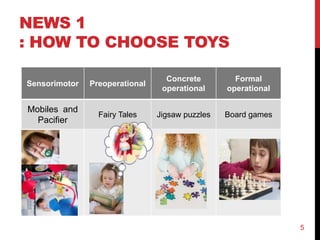
NEWS 1
: HOW TO CHOOSE TOYS

                                  Concrete         Formal
Sensorimotor   Preoperational
                                 operational     operational

Mobiles and
                 Fairy Tales    Jigsaw puzzles   Board games
  Pacifier


                                                               5
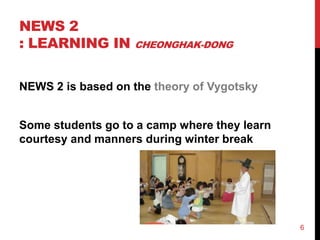
NEWS 2
: LEARNING IN CHEONGHAK-DONG

NEWS 2 is based on the theory of Vygotsky


Some students go to a camp where they learn
courtesy and manners during winter break


                                              6
NEWS 2
: LEARNING IN CHEONGHAK-DONG

        In Cheonghak-dong                            Vygotsky’s theory
Students at seodang help
new student in many ways.                              Peer instruction

Hunjangnim provides
some assistance to children,                             Scaffolding
never gives them a full help.

Hunjangnim says that
                                                      Zone of proximal
the role of him is helping out children to get the
highest level they can approach.                       development

Childeren learn not only courtesy and manners
but also chinese traditional ideology,                     Culture
Confucianism.
                                                                          7
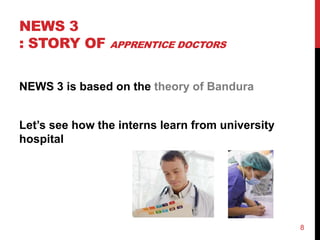
NEWS 3
: STORY OF APPRENTICE DOCTORS

NEWS 3 is based on the theory of Bandura


Let’s see how the interns learn from university
hospital


                                                  8
NEWS 3
: STORY OF APPRENTICE DOCTORS

        Life of interns          Bandura’s theory
  Senior doctors                     Role models
  Inspecting the process of
  medical operation by senior         Observing
  doctors

  When the other interns get    Vicarious reinforcement
  compliment or scolding by
  answering senior doctor’s
                                           &
  question                       Vicarious punishment


                                                          9
TALK WITH THE EXPERT
: THE BEST INSTRUCTIONAL STRATEGY


Each instructional theory should be combined.
 • Hunjangnim in article 2 uses vicarious
   reinforcement & punishment.
 • In article 3, the senior doctor give interns
   scaffolding like questioning.
Each theory can covers up its disadvantages.
 • Strategy for young adults are developed through
   Vygotsky and Bandura.


                                                     10
TALK WITH THE EXPERT
: THE BEST INSTRUCTIONAL STRATEGY

        Advantages                      Disadvantages

  Well-organized developmental      NOT detailed explanations on
   stages for young children         children above 11 years old

 Recognition of learning through
                                     Does NOT explain in depth
     social interactions

   Emphasis on self-efficacy       Difficult to create in classrooms


                                                                       11
Concrete
    Sensorimotor          Preoperational                                           Formal Operational
                                                   Operational
     (0-2 years)            (2-7 years)                                             (above 11 years)
                                                   (7-11 years)
•    Object          •       “Think out      •     Conservation •           Logical reasoning
    Permanence              loud”                  of quantity              without concrete objects
•    “insert-in-the- •       Centration      •     Transitivity   •         Develop mental operations
     mouth”                                  •     Reversibility            on abstractions
•    Reaction to                             •     Classification
    external factor                          •     Seriation
        Reaction           Internal Speech       Social Interaction With   Higher Level of Social
    to external factors                           Peers and Teachers          Interaction


                                                                           • Finding their career
                                                                             (observational learning)
                                                                           - visiting and observing role models
                                                                           • Learning in depth
                                                                           - through vicarious reinforcement
                                                                           • Understanding of globalization
                                                                           - education on foreign languages


                                                                                                                  12
Cognitive Conflict


          Bandura’s Theory

           Making decisions on their career

           Finding their egos

           Secondhand experience through observation

          Vygotsky’s Theory
           An effective study of difficult knowledge through scaffolding

           Improving global communication skills

           Changing attitude to become a globalized, open-minded person

           Learning foreign languages by understanding new culture


                                                                      Equilibration
Q&A

      14
THANK YOU FOR
YOUR
ATTENTION


                15

10조 ppt

  • 1.
  • 2.
    CONTENTS FOR OUR PRESENTAION I. News 1 - Piaget II. News 2 - Vygotsky III. News 3 - Bandura IV. Talk with the expert Gyogong Kim - Best Instructional Strategy 2
  • 3.
    NEWS 1 : HOWTO CHOOSE TOYS NEWS 1 is based on the theory of Piaget Parents should consider the developmental stage of their children when choosing toys. 3
  • 4.
    NEWS 1 : HOWTO CHOOSE TOYS Four stages of Purpose of toys development Sensorimotor stage to facilitate children’s senses Preoperational stage to express in words and images Concrete operational stage to think logically by real objects to conceptualize more abstract Formal operational stage and complex factors 4
  • 5.
    NEWS 1 : HOWTO CHOOSE TOYS Concrete Formal Sensorimotor Preoperational operational operational Mobiles and Fairy Tales Jigsaw puzzles Board games Pacifier 5
  • 6.
    NEWS 2 : LEARNINGIN CHEONGHAK-DONG NEWS 2 is based on the theory of Vygotsky Some students go to a camp where they learn courtesy and manners during winter break 6
  • 7.
    NEWS 2 : LEARNINGIN CHEONGHAK-DONG In Cheonghak-dong Vygotsky’s theory Students at seodang help new student in many ways. Peer instruction Hunjangnim provides some assistance to children, Scaffolding never gives them a full help. Hunjangnim says that Zone of proximal the role of him is helping out children to get the highest level they can approach. development Childeren learn not only courtesy and manners but also chinese traditional ideology, Culture Confucianism. 7
  • 8.
    NEWS 3 : STORYOF APPRENTICE DOCTORS NEWS 3 is based on the theory of Bandura Let’s see how the interns learn from university hospital 8
  • 9.
    NEWS 3 : STORYOF APPRENTICE DOCTORS Life of interns Bandura’s theory Senior doctors Role models Inspecting the process of medical operation by senior Observing doctors When the other interns get Vicarious reinforcement compliment or scolding by answering senior doctor’s & question Vicarious punishment 9
  • 10.
    TALK WITH THEEXPERT : THE BEST INSTRUCTIONAL STRATEGY Each instructional theory should be combined. • Hunjangnim in article 2 uses vicarious reinforcement & punishment. • In article 3, the senior doctor give interns scaffolding like questioning. Each theory can covers up its disadvantages. • Strategy for young adults are developed through Vygotsky and Bandura. 10
  • 11.
    TALK WITH THEEXPERT : THE BEST INSTRUCTIONAL STRATEGY Advantages Disadvantages Well-organized developmental NOT detailed explanations on stages for young children children above 11 years old Recognition of learning through Does NOT explain in depth social interactions Emphasis on self-efficacy Difficult to create in classrooms 11
  • 12.
    Concrete Sensorimotor Preoperational Formal Operational Operational (0-2 years) (2-7 years) (above 11 years) (7-11 years) • Object • “Think out • Conservation • Logical reasoning Permanence loud” of quantity without concrete objects • “insert-in-the- • Centration • Transitivity • Develop mental operations mouth” • Reversibility on abstractions • Reaction to • Classification external factor • Seriation Reaction Internal Speech Social Interaction With Higher Level of Social to external factors Peers and Teachers Interaction • Finding their career (observational learning) - visiting and observing role models • Learning in depth - through vicarious reinforcement • Understanding of globalization - education on foreign languages 12
  • 13.
    Cognitive Conflict Bandura’s Theory  Making decisions on their career  Finding their egos  Secondhand experience through observation Vygotsky’s Theory  An effective study of difficult knowledge through scaffolding  Improving global communication skills  Changing attitude to become a globalized, open-minded person  Learning foreign languages by understanding new culture Equilibration
  • 14.
    Q&A 14
  • 15.