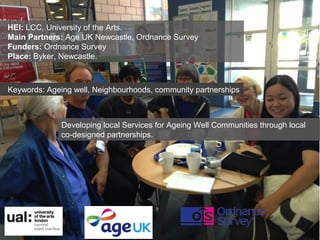
HEI: LCC, University of the Arts.
Main Partners: Age UK Newcastle, Ordnance Survey
Funders: Ordnance Survey
Place: Byker, Newcastle.

Keywords: Ageing well, Neighbourhoods, community partnerships

Developing local Services for Ageing Well Communities through local
co-designed partnerships.
The context

Context:
This project grew from Ordnance Survey’s Geovation Challenge where
Age UK Newcastle had been an unsuccessful finalist.
In the current climate of Local Authority cuts, Age Uk felt they needed new
ways to connect to existing non-Age UK community Services.
The Project Response:
Taking a Design Anthropological approach, the project aimed to understand
the role of place and daily practices for the ageing population of Byker in
Newcastle. Students undertook participatory activities, volunteering at lunch
clubs, joining tea dances and co-designing activities to understand a sense
of place for local residents.
Actor profiles
Motivations for involvement (agendas):
Sharing experiences of what they enjoyed about Byker as an elderly person, the
struggles and difficulties and personal stories of what helps them to stay happy,
content or issues that contribute to isolation.
To provide Age UK volunteers and employees with a greater understanding of
the local community and to identify non-Age UK networks and services for the
elderly.
Contribution to the project (assets):
Age UK provided access to community centres, time and expertise. Financial
support from Ordnance Survey for travel and staying in Newcastle.
The project outcomes for this actor:
More joined up and visible services for the elderly within the community.
Framing the Questions:
How does the elderly community use local services
within Byker?
How can Age UK Newcastle connect with local
businesses to encourage partnerships in order to make
services for the elderly more visible and available?
Creating Community business profiles.
•Pam’s: A local business that has been opened for more than 30 years.
•Daily they have around 38-40 customers. Many of their clientele are
established customers
•Only women customers that go weekly or monthly.
•The majority of the customers are elderly.
Methods Used: Co-designing with Cultural
Probes
Methods Used: Co-designing through
Photography capturing who and what is
important.
Methods Used: Mapping stories and places
A new geomedia tool for Age UK to engage with its community,
mapping businesses and community groups that provide vital services
for the elderly.
Currently being prototyped in
Newcastle the solution is a nondigital service reward scheme:
Age UK will gain greater visibility in
the community with the potential to
expand their services locally and
with business partners.
Businesses participating will have
Age UK advertising in-store plus an
Age UK sticker in their window.
Elderly card holder owners will
receive financial benefits.
Age UK volunteers will also be able
to own a card and receive rewards
for supporting their community.
MDes Service Design Innovation students gain:
Experience in participatory and co-designing methods
and practices.
An understanding of ethical issues and insights on
working on social design projects.
An appreciation of the value of design as a catalyst for
facilitation, visualization, experimentation and
prototyping.
First hand experience of design’s role as a vehicle for
change through a holistic visual lens.
Appendix

DEVELOPING LOCAL SERVICES FOR AGEING WELL COMMUNITIES, By Alison Prendiville, London College of Communication

  • 1.
    HEI: LCC, Universityof the Arts. Main Partners: Age UK Newcastle, Ordnance Survey Funders: Ordnance Survey Place: Byker, Newcastle. Keywords: Ageing well, Neighbourhoods, community partnerships Developing local Services for Ageing Well Communities through local co-designed partnerships.
  • 2.
    The context Context: This projectgrew from Ordnance Survey’s Geovation Challenge where Age UK Newcastle had been an unsuccessful finalist. In the current climate of Local Authority cuts, Age Uk felt they needed new ways to connect to existing non-Age UK community Services.
  • 3.
    The Project Response: Takinga Design Anthropological approach, the project aimed to understand the role of place and daily practices for the ageing population of Byker in Newcastle. Students undertook participatory activities, volunteering at lunch clubs, joining tea dances and co-designing activities to understand a sense of place for local residents.
  • 4.
    Actor profiles Motivations forinvolvement (agendas): Sharing experiences of what they enjoyed about Byker as an elderly person, the struggles and difficulties and personal stories of what helps them to stay happy, content or issues that contribute to isolation. To provide Age UK volunteers and employees with a greater understanding of the local community and to identify non-Age UK networks and services for the elderly. Contribution to the project (assets): Age UK provided access to community centres, time and expertise. Financial support from Ordnance Survey for travel and staying in Newcastle. The project outcomes for this actor: More joined up and visible services for the elderly within the community.
  • 5.
    Framing the Questions: Howdoes the elderly community use local services within Byker? How can Age UK Newcastle connect with local businesses to encourage partnerships in order to make services for the elderly more visible and available?
  • 6.
    Creating Community businessprofiles. •Pam’s: A local business that has been opened for more than 30 years. •Daily they have around 38-40 customers. Many of their clientele are established customers •Only women customers that go weekly or monthly. •The majority of the customers are elderly.
  • 7.
    Methods Used: Co-designingwith Cultural Probes
  • 8.
    Methods Used: Co-designingthrough Photography capturing who and what is important.
  • 9.
    Methods Used: Mappingstories and places
  • 10.
    A new geomediatool for Age UK to engage with its community, mapping businesses and community groups that provide vital services for the elderly.
  • 11.
    Currently being prototypedin Newcastle the solution is a nondigital service reward scheme: Age UK will gain greater visibility in the community with the potential to expand their services locally and with business partners. Businesses participating will have Age UK advertising in-store plus an Age UK sticker in their window. Elderly card holder owners will receive financial benefits. Age UK volunteers will also be able to own a card and receive rewards for supporting their community.
  • 12.
    MDes Service DesignInnovation students gain: Experience in participatory and co-designing methods and practices. An understanding of ethical issues and insights on working on social design projects. An appreciation of the value of design as a catalyst for facilitation, visualization, experimentation and prototyping. First hand experience of design’s role as a vehicle for change through a holistic visual lens.
  • 13.