Colourful Stories
Exploring transformative potential of colour
in a Northumbrian former mining town
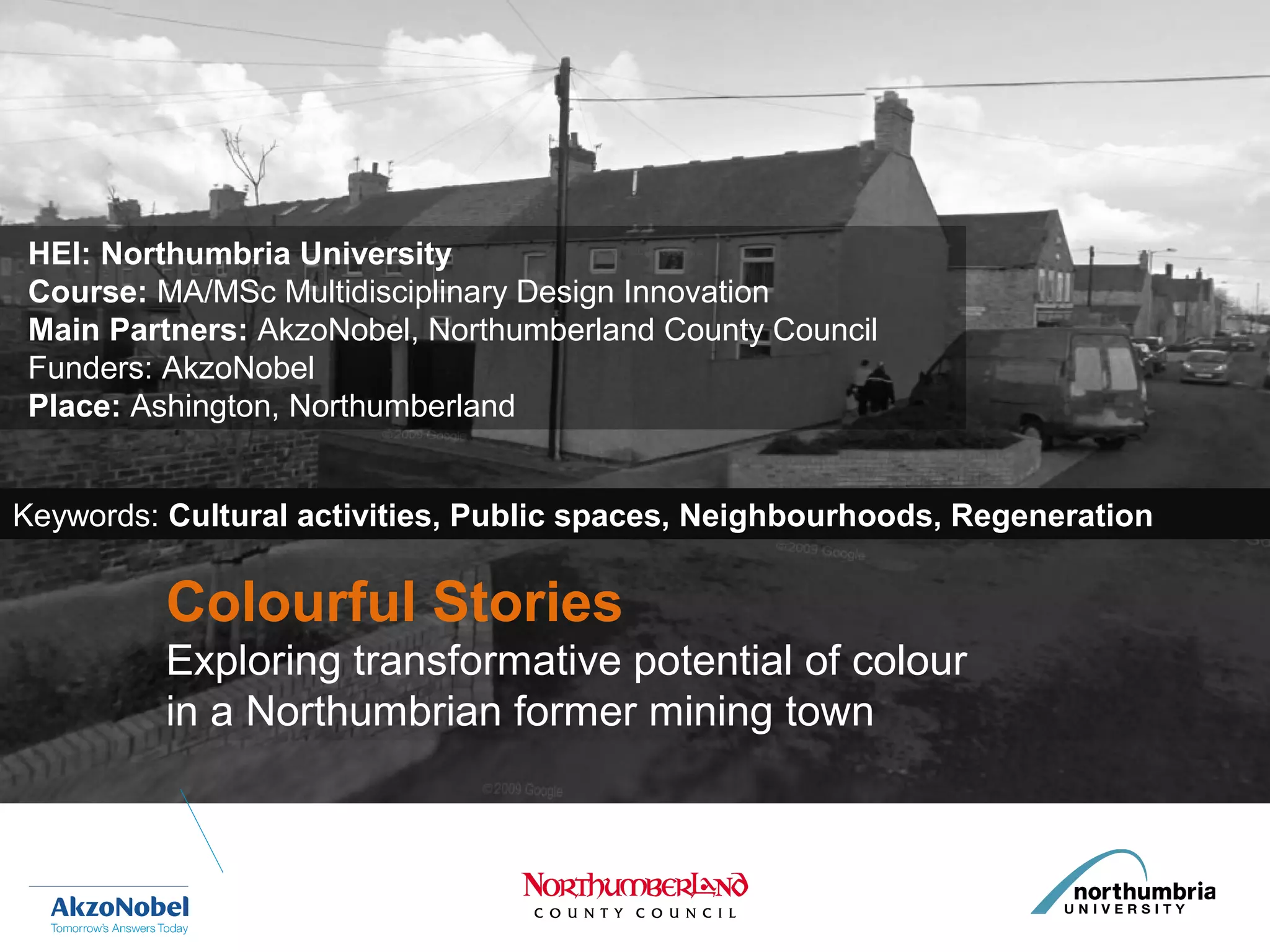
HEI: Northumbria University
Course: MA/MSc Multidisciplinary Design Innovation
Main Partners: AkzoNobel, Northumberland County Council
Funders: AkzoNobel
Place: Ashington, Northumberland
Keywords: Cultural activities, Public spaces, Neighbourhoods, Regeneration
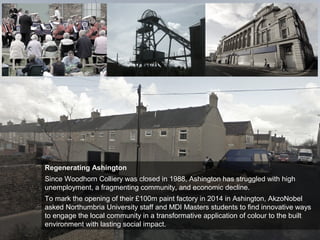
Regenerating Ashington
Since Woodhorn Colliery was closed in 1988, Ashington has struggled with high
unemployment, a fragmenting community, and economic decline.
To mark the opening of their £100m paint factory in 2014 in Ashington, AkzoNobel
asked Northumbria University staff and MDI Masters students to find innovative ways
to engage the local community in a transformative application of colour to the built
environment with lasting social impact.
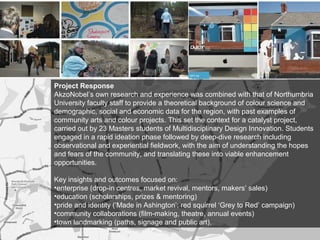
Project Response
AkzoNobel’s own research and experience was combined with that of Northumbria
University faculty staff to provide a theoretical background of colour science and
demographic, social and economic data for the region, with past examples of
community arts and colour projects. This set the context for a catalyst project,
carried out by 23 Masters students of Multidisciplinary Design Innovation. Students
engaged in a rapid ideation phase followed by deep-dive research including
observational and experiential fieldwork, with the aim of understanding the hopes
and fears of the community, and translating these into viable enhancement
opportunities.
Key insights and outcomes focused on:
•enterprise (drop-in centres, market revival, mentors, makers’ sales)
•education (scholarships, prizes & mentoring)
•pride and identity (‘Made in Ashington’; red squirrel ‘Grey to Red’ campaign)
•community collaborations (film-making, theatre, annual events)
•town landmarking (paths, signage and public art).
Actor Profile:
AkzoNobel, Project client & sponsors, including Head of Colour Marketing, Global
Color Knowledge Manager.
Agenda: to bring positive change to the town through regenerative initiatives along
a colour theme, in line with their mission ‘adding colour to people’s lives’.
Assets: Past experience with ‘Let’s Color’ global projects. Funding for this two-
phase student project, and for one or several of the chosen concepts to be
implemented in 2013-14.
Outcomes: Strengthened links with local authority and Northumbria University.
Sponsors were impressed by the depth of research undertaken and important
insights arising, by the originality and boldness of proposals, and by the high
standards of presentation and communication.
Actor Profile:
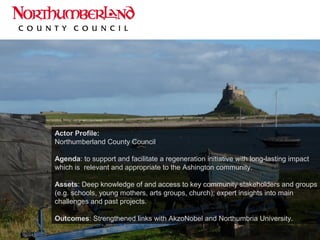
Northumberland County Council
Agenda: to support and facilitate a regeneration initiative with long-lasting impact
which is relevant and appropriate to the Ashington community.
Assets: Deep knowledge of and access to key community stakeholders and groups
(e.g. schools, young mothers, arts groups, church); expert insights into main
challenges and past projects.
Outcomes: Strengthened links with AkzoNobel and Northumbria University.
Actor Profile:
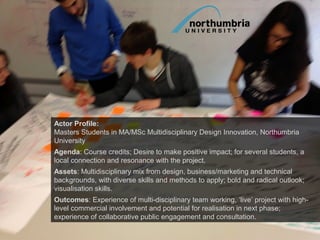
Masters Students in MA/MSc Multidisciplinary Design Innovation, Northumbria
University
Agenda: Course credits; Desire to make positive impact; for several students, a
local connection and resonance with the project.
Assets: Multidisciplinary mix from design, business/marketing and technical
backgrounds, with diverse skills and methods to apply; bold and radical outlook;
visualisation skills.
Outcomes: Experience of multi-disciplinary team working, ‘live’ project with high-
level commercial involvement and potential for realisation in next phase;
experience of collaborative public engagement and consultation.
Process, Tools and Methods
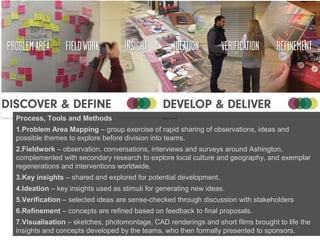
1.Problem Area Mapping – group exercise of rapid sharing of observations, ideas and
possible themes to explore before division into teams.
2.Fieldwork – observation, conversations, interviews and surveys around Ashington,
complemented with secondary research to explore local culture and geography, and exemplar
regenerations and interventions worldwide.
3.Key insights – shared and explored for potential development.
4.Ideation – key insights used as stimuli for generating new ideas.
5.Verification – selected ideas are sense-checked through discussion with stakeholders
6.Refinement – concepts are refined based on feedback to final proposals.
7.Visualisation – sketches, photomontage, CAD renderings and short films brought to life the
insights and concepts developed by the teams, who then formally presented to sponsors.
Design Role
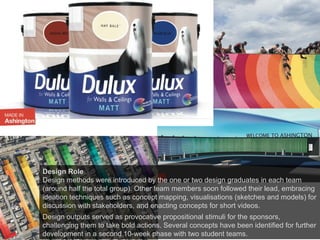
Design methods were introduced by the one or two design graduates in each team
(around half the total group). Other team members soon followed their lead, embracing
ideation techniques such as concept mapping, visualisations (sketches and models) for
discussion with stakeholders, and enacting concepts for short videos.
Design outputs served as provocative propositional stimuli for the sponsors,
challenging them to take bold actions. Several concepts have been identified for further
development in a second 10-week phase with two student teams.
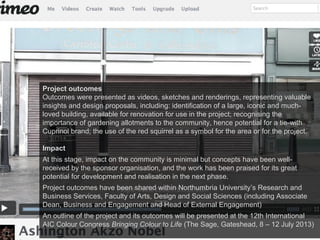
Project outcomes
Outcomes were presented as videos, sketches and renderings, representing valuable
insights and design proposals, including: identification of a large, iconic and much-
loved building, available for renovation for use in the project; recognising the
importance of gardening allotments to the community, hence potential for a tie-with
Cuprinol brand; the use of the red squirrel as a symbol for the area or for the project.
Impact
At this stage, impact on the community is minimal but concepts have been well-
received by the sponsor organisation, and the work has been praised for its great
potential for development and realisation in the next phase.
Project outcomes have been shared within Northumbria University’s Research and
Business Services, Faculty of Arts, Design and Social Sciences (including Associate
Dean, Business and Engagement and Head of External Engagement)
An outline of the project and its outcomes will be presented at the 12th International
AIC Colour Congress Bringing Colour to Life (The Sage, Gateshead, 8 – 12 July 2013)
Learning outcomes:
Students
Valuable experience of multi-stakeholder and multidisciplinary engagement, including
the public; working with an industry client, and presenting formally to a professional
audience; application of design methods to a real social challenge, complementing
their taught modules.
Northumbria University
New and valuable relationships established with the local authority and with this
regional industry.
AkzoNobel:
The value of even a short project with a small cohort of students: deep insights and
radical but achievable proposals, the best of which are being pursued in a second
longer phase (10 weeks).
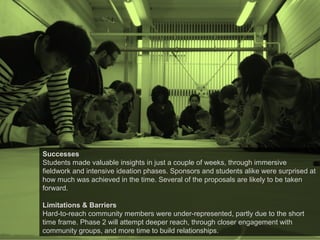
Successes
Students made valuable insights in just a couple of weeks, through immersive
fieldwork and intensive ideation phases. Sponsors and students alike were surprised at
how much was achieved in the time. Several of the proposals are likely to be taken
forward.
Limitations & Barriers
Hard-to-reach community members were under-represented, partly due to the short
time frame. Phase 2 will attempt deeper reach, through closer engagement with
community groups, and more time to build relationships.

COLOURFUL STORIES - By Northumbria University

  • 1.
    Colourful Stories Exploring transformativepotential of colour in a Northumbrian former mining town HEI: Northumbria University Course: MA/MSc Multidisciplinary Design Innovation Main Partners: AkzoNobel, Northumberland County Council Funders: AkzoNobel Place: Ashington, Northumberland Keywords: Cultural activities, Public spaces, Neighbourhoods, Regeneration
  • 2.
    Regenerating Ashington Since WoodhornColliery was closed in 1988, Ashington has struggled with high unemployment, a fragmenting community, and economic decline. To mark the opening of their £100m paint factory in 2014 in Ashington, AkzoNobel asked Northumbria University staff and MDI Masters students to find innovative ways to engage the local community in a transformative application of colour to the built environment with lasting social impact.
  • 3.
    Project Response AkzoNobel’s ownresearch and experience was combined with that of Northumbria University faculty staff to provide a theoretical background of colour science and demographic, social and economic data for the region, with past examples of community arts and colour projects. This set the context for a catalyst project, carried out by 23 Masters students of Multidisciplinary Design Innovation. Students engaged in a rapid ideation phase followed by deep-dive research including observational and experiential fieldwork, with the aim of understanding the hopes and fears of the community, and translating these into viable enhancement opportunities. Key insights and outcomes focused on: •enterprise (drop-in centres, market revival, mentors, makers’ sales) •education (scholarships, prizes & mentoring) •pride and identity (‘Made in Ashington’; red squirrel ‘Grey to Red’ campaign) •community collaborations (film-making, theatre, annual events) •town landmarking (paths, signage and public art).
  • 4.
    Actor Profile: AkzoNobel, Projectclient & sponsors, including Head of Colour Marketing, Global Color Knowledge Manager. Agenda: to bring positive change to the town through regenerative initiatives along a colour theme, in line with their mission ‘adding colour to people’s lives’. Assets: Past experience with ‘Let’s Color’ global projects. Funding for this two- phase student project, and for one or several of the chosen concepts to be implemented in 2013-14. Outcomes: Strengthened links with local authority and Northumbria University. Sponsors were impressed by the depth of research undertaken and important insights arising, by the originality and boldness of proposals, and by the high standards of presentation and communication.
  • 5.
    Actor Profile: Northumberland CountyCouncil Agenda: to support and facilitate a regeneration initiative with long-lasting impact which is relevant and appropriate to the Ashington community. Assets: Deep knowledge of and access to key community stakeholders and groups (e.g. schools, young mothers, arts groups, church); expert insights into main challenges and past projects. Outcomes: Strengthened links with AkzoNobel and Northumbria University.
  • 6.
    Actor Profile: Masters Studentsin MA/MSc Multidisciplinary Design Innovation, Northumbria University Agenda: Course credits; Desire to make positive impact; for several students, a local connection and resonance with the project. Assets: Multidisciplinary mix from design, business/marketing and technical backgrounds, with diverse skills and methods to apply; bold and radical outlook; visualisation skills. Outcomes: Experience of multi-disciplinary team working, ‘live’ project with high- level commercial involvement and potential for realisation in next phase; experience of collaborative public engagement and consultation.
  • 7.
    Process, Tools andMethods 1.Problem Area Mapping – group exercise of rapid sharing of observations, ideas and possible themes to explore before division into teams. 2.Fieldwork – observation, conversations, interviews and surveys around Ashington, complemented with secondary research to explore local culture and geography, and exemplar regenerations and interventions worldwide. 3.Key insights – shared and explored for potential development. 4.Ideation – key insights used as stimuli for generating new ideas. 5.Verification – selected ideas are sense-checked through discussion with stakeholders 6.Refinement – concepts are refined based on feedback to final proposals. 7.Visualisation – sketches, photomontage, CAD renderings and short films brought to life the insights and concepts developed by the teams, who then formally presented to sponsors.
  • 8.
    Design Role Design methodswere introduced by the one or two design graduates in each team (around half the total group). Other team members soon followed their lead, embracing ideation techniques such as concept mapping, visualisations (sketches and models) for discussion with stakeholders, and enacting concepts for short videos. Design outputs served as provocative propositional stimuli for the sponsors, challenging them to take bold actions. Several concepts have been identified for further development in a second 10-week phase with two student teams.
  • 9.
    Project outcomes Outcomes werepresented as videos, sketches and renderings, representing valuable insights and design proposals, including: identification of a large, iconic and much- loved building, available for renovation for use in the project; recognising the importance of gardening allotments to the community, hence potential for a tie-with Cuprinol brand; the use of the red squirrel as a symbol for the area or for the project. Impact At this stage, impact on the community is minimal but concepts have been well- received by the sponsor organisation, and the work has been praised for its great potential for development and realisation in the next phase. Project outcomes have been shared within Northumbria University’s Research and Business Services, Faculty of Arts, Design and Social Sciences (including Associate Dean, Business and Engagement and Head of External Engagement) An outline of the project and its outcomes will be presented at the 12th International AIC Colour Congress Bringing Colour to Life (The Sage, Gateshead, 8 – 12 July 2013)
  • 10.
    Learning outcomes: Students Valuable experienceof multi-stakeholder and multidisciplinary engagement, including the public; working with an industry client, and presenting formally to a professional audience; application of design methods to a real social challenge, complementing their taught modules. Northumbria University New and valuable relationships established with the local authority and with this regional industry. AkzoNobel: The value of even a short project with a small cohort of students: deep insights and radical but achievable proposals, the best of which are being pursued in a second longer phase (10 weeks).
  • 11.
    Successes Students made valuableinsights in just a couple of weeks, through immersive fieldwork and intensive ideation phases. Sponsors and students alike were surprised at how much was achieved in the time. Several of the proposals are likely to be taken forward. Limitations & Barriers Hard-to-reach community members were under-represented, partly due to the short time frame. Phase 2 will attempt deeper reach, through closer engagement with community groups, and more time to build relationships.