Becoming virtual: prerequisites to learning in virtual worlds Mark Childs 13 th  Sept 2010
Preamble 1: Teaching approaches Associative – we can look around and observe, take in information from models, objects, notecards. Cognitive – exploring, creating, making sense of spaces and events and integrating experiences into prior knowledge. Situative – co-creating knowledge through discussion, exchange of ideas.


Preamble 2: Presence
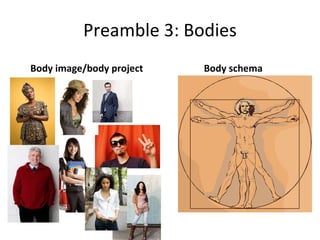
Preamble 3: Bodies Body image/body project Body schema
“ for some, bodies can become conscious ‘body projects’ to manipulate this means of representing identity to others” – Phoenix “ body schema is for action and body image is for identification’’ – de Vignemont What bodies mean
Findings - quantitative
Qualitative findings: associative At first, students have to focus on software. Can answer questions that constitute a “window at” technology (hypermediacy). After an hour or two, students acquire enough competence at operating software.  Can answer factual questions about spaces that constitute a “window through” technology (immediacy).
More findings - situative Students engaged in social constructivist activities, such as discussions, identity formation tend to: Value social presence. Use avatars as identifiers. Prioritise avatar design even above navigation. Feel exposed to peers and particularly non-classmates.
Qualitative findings: cognitive Experiential learning, field trips, etc. At an early stage students could not answer “what does this space  feel  like?” Also could not answer questions on what could be inferred about communities from the spaces.  The former can take weeks or months. The latter years, maybe never.
What’s going on? The interpretation of these data is: To purely communicate information, IVWs can be treated as just a piece of software. For more complex activities, IVWs need to be learned as a world, and avatars as bodies, as in the physical world.
Virtual body image Used as a basis for social interaction. Needs to be designed, personalised, recognisable, aligned to identity. Situative learning activities need to be preceded by: Time designing the look. Shopping.
Virtual body schema Given enough time spent inworld, virtual body becomes mapped to body schema, technology “disappears into the architecture of the body”. Proprioception (Rowe).  Appropriation (Littleton et al). Approprioception (me). Around the same time students report “feeling the atmosphere of the space”.
A link? Embodied cognition. “ Cognitive processes are deeply rooted in the body’s interactions with the world” – Wilson. For cognition in virtual worlds to be effective :. need to establish virtual body schema.
 
Bodies defined by acting Interaction is not what the objects do, it’s what the avatars do Experiential activities need to be preceded by a long time: Acting inworld / interacting with spaces Locations that have an emotional resonance
A FRAMEWORK FOR  ENGAGEMENT
Contact [email_address] SL: Gann McGann Portfolio at  http://go.warwick.ac.uk/edrfap/ Thesis available on request
References Slide 2 Mayes, T. and de Freitas, S. (2004). Review of e-learning frameworks, models and theories: JISC e-learning models desk study, JISC Slide 8 Childs, M. (2010) A conceptual framework for mediated environments, Educational Research 52, 2, June 2010, 197–213 Slide 10 Phoenix, A. (2007) Identities and diversities, in D. Miell, A. Phoenix and K. Thomas (eds)  DSE212 Mapping Psychology Book 1 , The Open University de Vignemont, F. (2007). Habeas corpus: The sense of ownership of one’s own body.  Mind and Language ,  22 (4), 427–449.
References Slide 12 Dobson, S. (2009) Remediation. Understanding New Media: Revisiting a Classic, Seminar.net - International journal of media, technology and lifelong learning, 5 (2)  Slide 17 Littleton, K., Toates, F. and Braisby, N. (2007) Three Approaches to Learning, in D. Miell, A. Phoenix and K. Thomas (Eds.)  DSE212 Mapping Psychology Book 1 , The OU Murray, D.C. and Sixsmith, J. (1999) The Corporeal Body in Virtual Reality, Ethos, 27 (3) Body, Self, and Technology (Sep., 1999), 315-343 Slide 18 Wilson, M. (2002)  Six views of embodied cognition,  Psychonomic Bulletin & Review 2002, 9 (4), 625-636

10 09-07 becoming virtual

  • 1.
    Becoming virtual: prerequisitesto learning in virtual worlds Mark Childs 13 th Sept 2010
  • 2.
    Preamble 1: Teachingapproaches Associative – we can look around and observe, take in information from models, objects, notecards. Cognitive – exploring, creating, making sense of spaces and events and integrating experiences into prior knowledge. Situative – co-creating knowledge through discussion, exchange of ideas.
  • 3.
  • 4.
  • 5.
  • 6.
  • 7.
  • 8.
  • 9.
    Preamble 3: BodiesBody image/body project Body schema
  • 10.
    “ for some,bodies can become conscious ‘body projects’ to manipulate this means of representing identity to others” – Phoenix “ body schema is for action and body image is for identification’’ – de Vignemont What bodies mean
  • 11.
  • 12.
    Qualitative findings: associativeAt first, students have to focus on software. Can answer questions that constitute a “window at” technology (hypermediacy). After an hour or two, students acquire enough competence at operating software. Can answer factual questions about spaces that constitute a “window through” technology (immediacy).
  • 13.
    More findings -situative Students engaged in social constructivist activities, such as discussions, identity formation tend to: Value social presence. Use avatars as identifiers. Prioritise avatar design even above navigation. Feel exposed to peers and particularly non-classmates.
  • 14.
    Qualitative findings: cognitiveExperiential learning, field trips, etc. At an early stage students could not answer “what does this space feel like?” Also could not answer questions on what could be inferred about communities from the spaces. The former can take weeks or months. The latter years, maybe never.
  • 15.
    What’s going on?The interpretation of these data is: To purely communicate information, IVWs can be treated as just a piece of software. For more complex activities, IVWs need to be learned as a world, and avatars as bodies, as in the physical world.
  • 16.
    Virtual body imageUsed as a basis for social interaction. Needs to be designed, personalised, recognisable, aligned to identity. Situative learning activities need to be preceded by: Time designing the look. Shopping.
  • 17.
    Virtual body schemaGiven enough time spent inworld, virtual body becomes mapped to body schema, technology “disappears into the architecture of the body”. Proprioception (Rowe). Appropriation (Littleton et al). Approprioception (me). Around the same time students report “feeling the atmosphere of the space”.
  • 18.
    A link? Embodiedcognition. “ Cognitive processes are deeply rooted in the body’s interactions with the world” – Wilson. For cognition in virtual worlds to be effective :. need to establish virtual body schema.
  • 19.
  • 20.
    Bodies defined byacting Interaction is not what the objects do, it’s what the avatars do Experiential activities need to be preceded by a long time: Acting inworld / interacting with spaces Locations that have an emotional resonance
  • 21.
    A FRAMEWORK FOR ENGAGEMENT
  • 22.
    Contact [email_address] SL:Gann McGann Portfolio at http://go.warwick.ac.uk/edrfap/ Thesis available on request
  • 23.
    References Slide 2Mayes, T. and de Freitas, S. (2004). Review of e-learning frameworks, models and theories: JISC e-learning models desk study, JISC Slide 8 Childs, M. (2010) A conceptual framework for mediated environments, Educational Research 52, 2, June 2010, 197–213 Slide 10 Phoenix, A. (2007) Identities and diversities, in D. Miell, A. Phoenix and K. Thomas (eds) DSE212 Mapping Psychology Book 1 , The Open University de Vignemont, F. (2007). Habeas corpus: The sense of ownership of one’s own body. Mind and Language , 22 (4), 427–449.
  • 24.
    References Slide 12Dobson, S. (2009) Remediation. Understanding New Media: Revisiting a Classic, Seminar.net - International journal of media, technology and lifelong learning, 5 (2) Slide 17 Littleton, K., Toates, F. and Braisby, N. (2007) Three Approaches to Learning, in D. Miell, A. Phoenix and K. Thomas (Eds.) DSE212 Mapping Psychology Book 1 , The OU Murray, D.C. and Sixsmith, J. (1999) The Corporeal Body in Virtual Reality, Ethos, 27 (3) Body, Self, and Technology (Sep., 1999), 315-343 Slide 18 Wilson, M. (2002) Six views of embodied cognition, Psychonomic Bulletin & Review 2002, 9 (4), 625-636

Editor's Notes

  • #3 Mayes, T. and de Freitas, S. (2004). Review of e-learning frameworks, models and theories: JISC e-learning models desk study, JISC