DYNAMIC STRUCTURE OF
INNOVATIVE COMPANIES AND SIMULATION
OF BUSINESS PROCESSES BASED ON
GRAPH GRAMMARS
Daria Novototskih
Victor Romanov
Cyrill Dutov
CONFERENCE ABSTRACTS
2
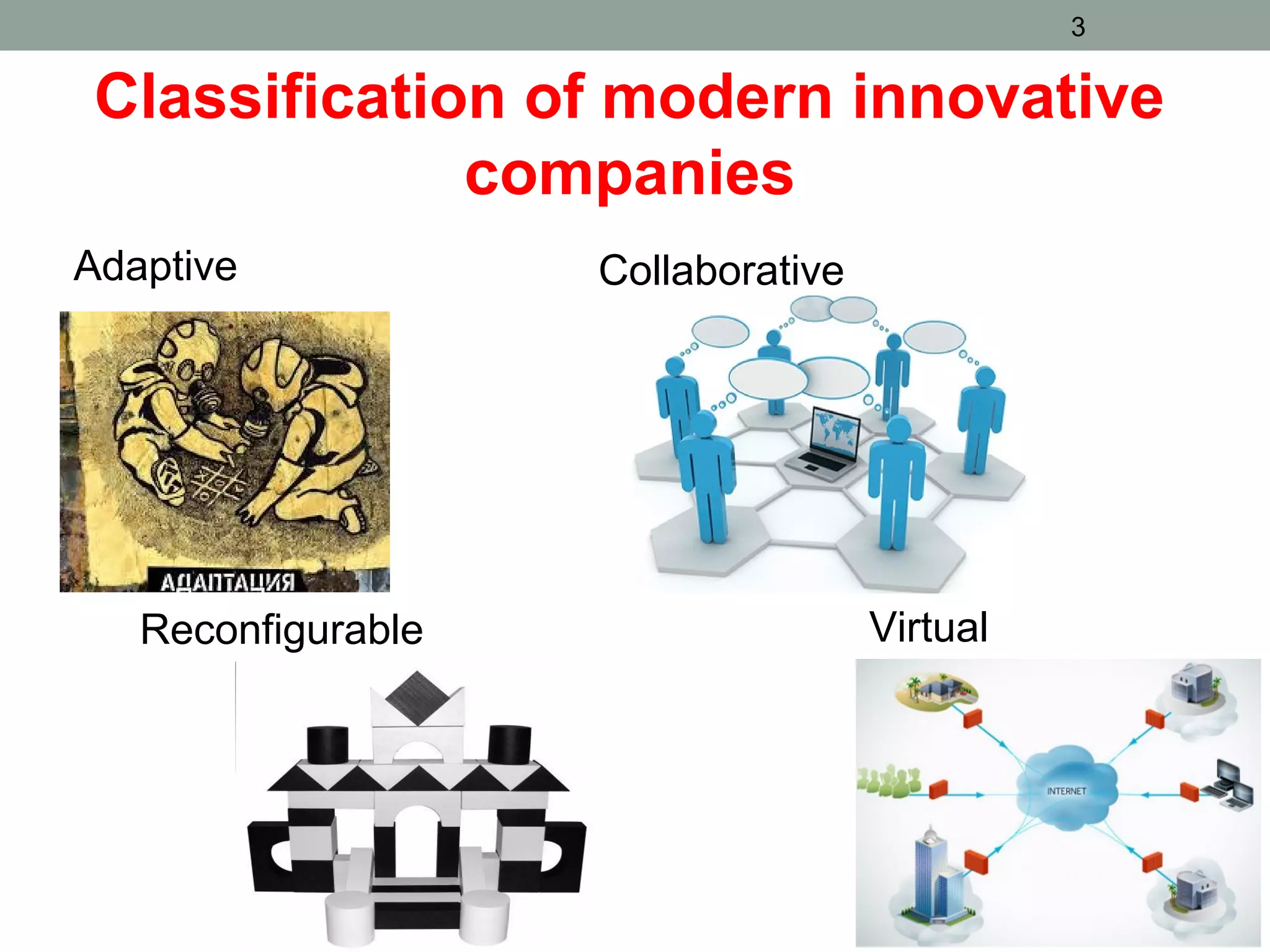
Classification of modern innovative
companies
3
Adaptive
Reconfigurable
Collaborative
Virtual
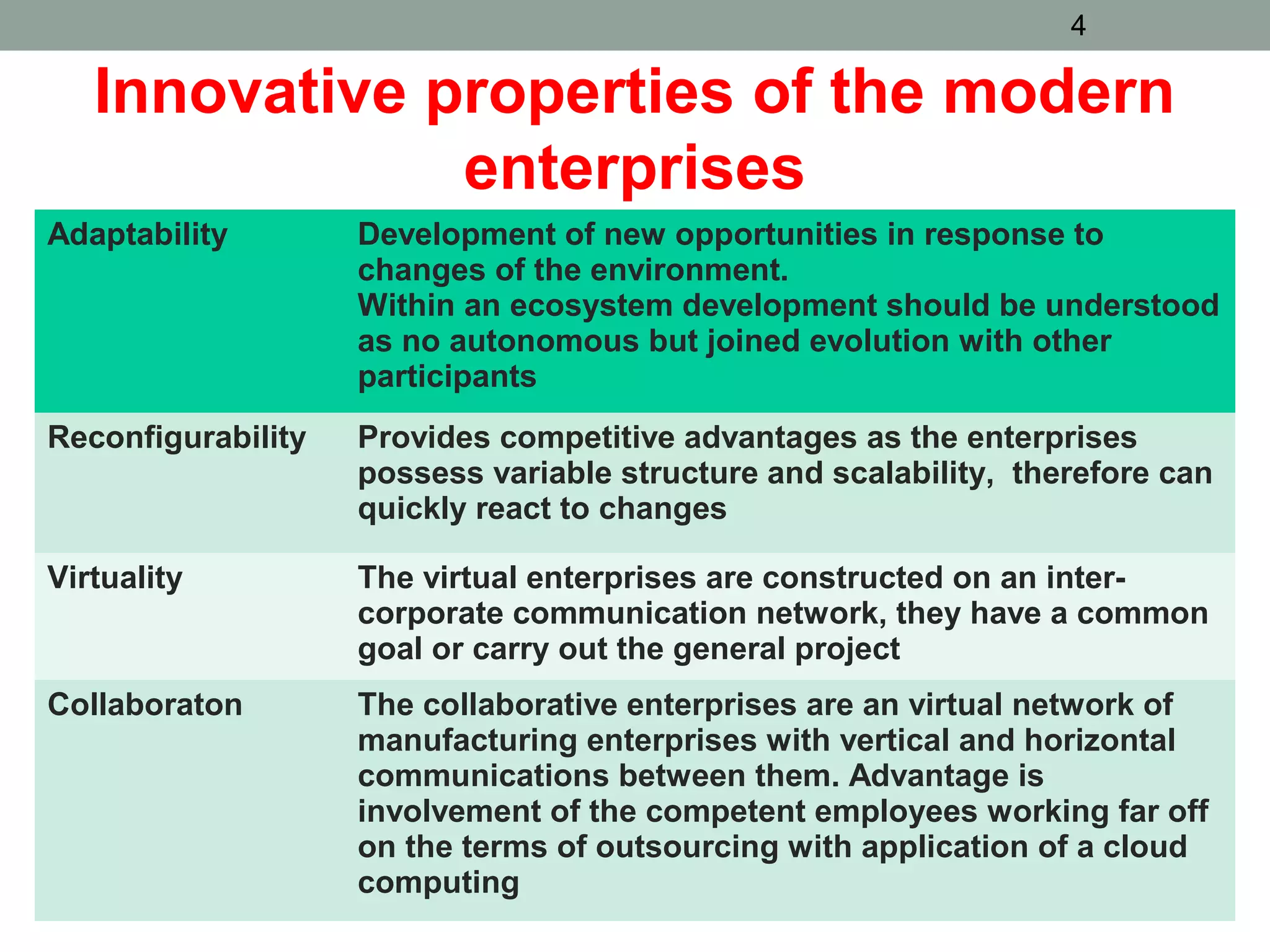
Innovative properties of the modern
enterprises
4
Adaptability Development of new opportunities in response to
changes of the environment.
Within an ecosystem development should be understood
as no autonomous but joined evolution with other
participants
Reconfigurability Provides competitive advantages as the enterprises
possess variable structure and scalability, therefore can
quickly react to changes
Virtuality The virtual enterprises are constructed on an inter-
corporate communication network, they have a common
goal or carry out the general project
Collaboraton The collaborative enterprises are an virtual network of
manufacturing enterprises with vertical and horizontal
communications between them. Advantage is
involvement of the competent employees working far off
on the terms of outsourcing with application of a cloud
computing
Metamodel of a network of
collaboration
The collaboration of the enterprises means integration of their information
systems. Inter-corporate information system is founded on a global meta-model
which unites models of the collaborative enterprises. Integrity and structure of a
global meta-model is maintained by ontology.
5
Collaborative
Enterprise 1
Collaborative
Enterprise 2
Collaborative
Enterprise 3
Inter-corporate information system
Meta-model
Business
model 3
Business
model 2
Business
model 1
Ontology
Integration of local ontologies into
global
It is offered to automate
creation of local ontologies
by means of the document
analysis of the collaborative
enterprises by method of
the formal concept analysis.
The global ontology is
created by all participants of
collaboration, they define
syntax and semantics of
joined processes, all
collaborator have access to
global ontology
6
Collaborative
Enterprise 1
Collaborative
Enterprise 2
Collaborative
Enterprise 3
Inter-corporate information system
Document
flow
Document
flow
Document
flow
Local
Ontology 1
Local
Ontology 2
Local
Ontology 3
Integrated ontology
Analysis of
formal
concepts
Analysis of
formal
concepts
Analysis of
formal
concepts
Concepts Concepts Concepts
Example of transformation of commercial banks
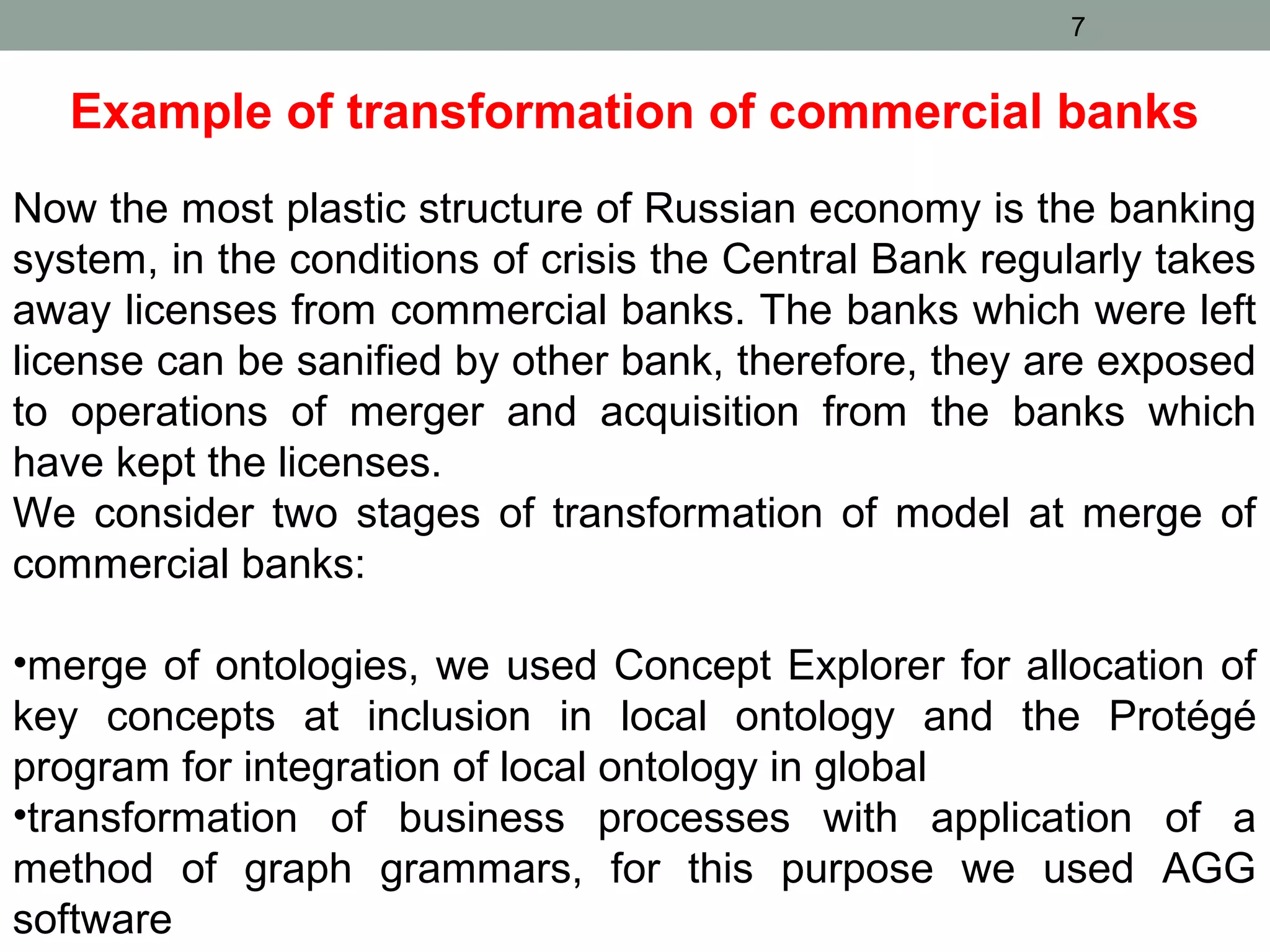
Now the most plastic structure of Russian economy is the banking
system, in the conditions of crisis the Central Bank regularly takes
away licenses from commercial banks. The banks which were left
license can be sanified by other bank, therefore, they are exposed
to operations of merger and acquisition from the banks which
have kept the licenses.
We consider two stages of transformation of model at merge of
commercial banks:
•merge of ontologies, we used Concept Explorer for allocation of
key concepts at inclusion in local ontology and the Protégé
program for integration of local ontology in global
•transformation of business processes with application of a
method of graph grammars, for this purpose we used AGG
software
7
Formal context
8
The formal analysis of concepts allows us to allocate the essential concepts
characterizing business processes of bank and also the relation between them.
On the submitted table the formal context on which lines correspond to units,
and columns to functions of these divisions is shown.
functions
units
9
Lattice of formal concepts
Concept <1> - CED1 - CED4 - Department of crediting of physical entities
Concept <2> - ECD3 - ECD4 - Economical department
Concept <3> - CFD1 - CFD4 - Department of crediting to legal entities
Concept <4> - ECD1 - ECD2 - Economical department
10
In the analysis of association rules for credit departments, we see:
there are rules to the 100% value of the confidence indicator combine 4
objects belonging to the Department of crediting of physical entities or 4
properties belonging to the Department of crediting to legal entities.
Example of association rules:
•<4> RAW RAI RAL ILA GIW ACW FCW FCI FCL FCC PGL MTR CCR PBC IGP ARC LNL PAS
IBL ALW ALI ALS CGW CGT CGS SNI RMS CCW CCI CUW CUI MOR CCT CCI FAL IWL PNI​​
CAA PII = [100%] => < 4> FPD GII ACI SNS CRW CRI CFD;
At the same time, there are rules to unite all 8 credit departments:
•Example:
•<8> RAI ACW FCW FCI ALW ALI ALS CGT PII = [100%] => <8> RAL ILA GIW FCL FCC PGL
MTR CCR PBC IGP ARC LNL PAS IBL CGW CGS SNI RMS CCW CCI CUW CUI MOR CCT CCI​​
FAL IWL;
It is advisable to draw a conclusion:
a. On the one hand have separate departments
b. On the other hand units should be combined at a higher level
Example of interpretation of association rules
11
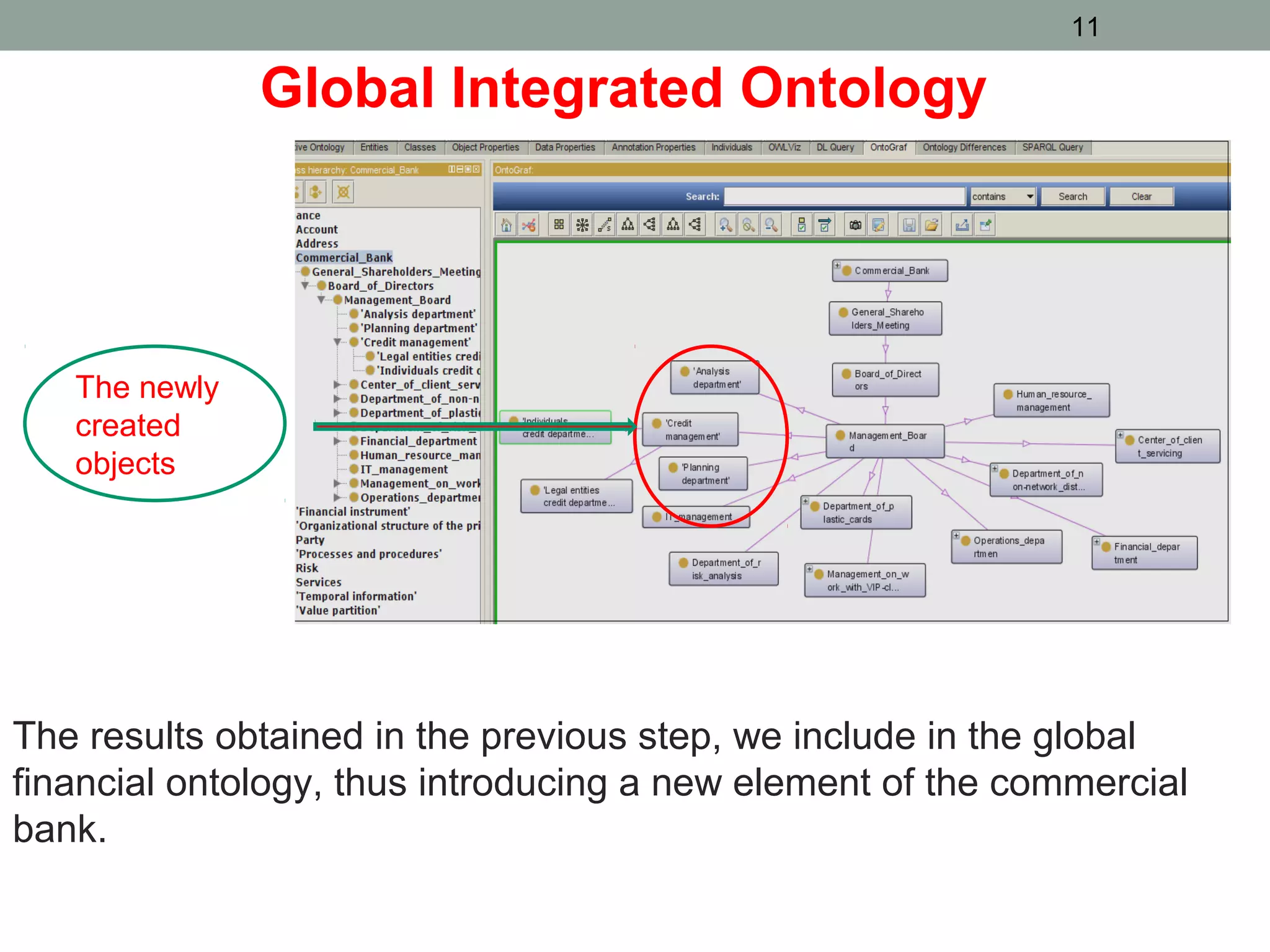
Global Integrated Ontology
The newly
created
objects
The results obtained in the previous step, we include in the global
financial ontology, thus introducing a new element of the commercial
bank.
12
There are a number of software tools for graph transformation, among
them: AGG, GReAT, VIATRA, FUJABA.
To create a local business processes, we propose to use AGG program
- a development environment to describe and perform transformations
of typed attribute graphs, implemented on the Java platform.
The program produces local changes to all occurrences of LHS in the
original host graph.
Includes tools convert graphs, search subgraph corresponding left-hand
side and replace it with the corresponding subgraph of the right-hand
side of the rule, and generates a set of rules and conditions of their
implementation.
Sets attributes, perform calculations, restrict the positive, negative and
global.
Justification of AGG tool choice
13
Rules of local transformation of the count
Standard processes LHS RHS
Merge of divisions
Resubmission of divisions
Splitting of divisions
K L
M
K L
M
A B C
J H G
The graph grammar finds all occurrences of a subgraph of LHS and
automatically replaces with RHS subgraph
14
Count of administrative structure of bank
We see that AGG allows to set names to tops and the count's edges to
appropriate them attributes and initial values.
15
Application of rules of transformation of the
count
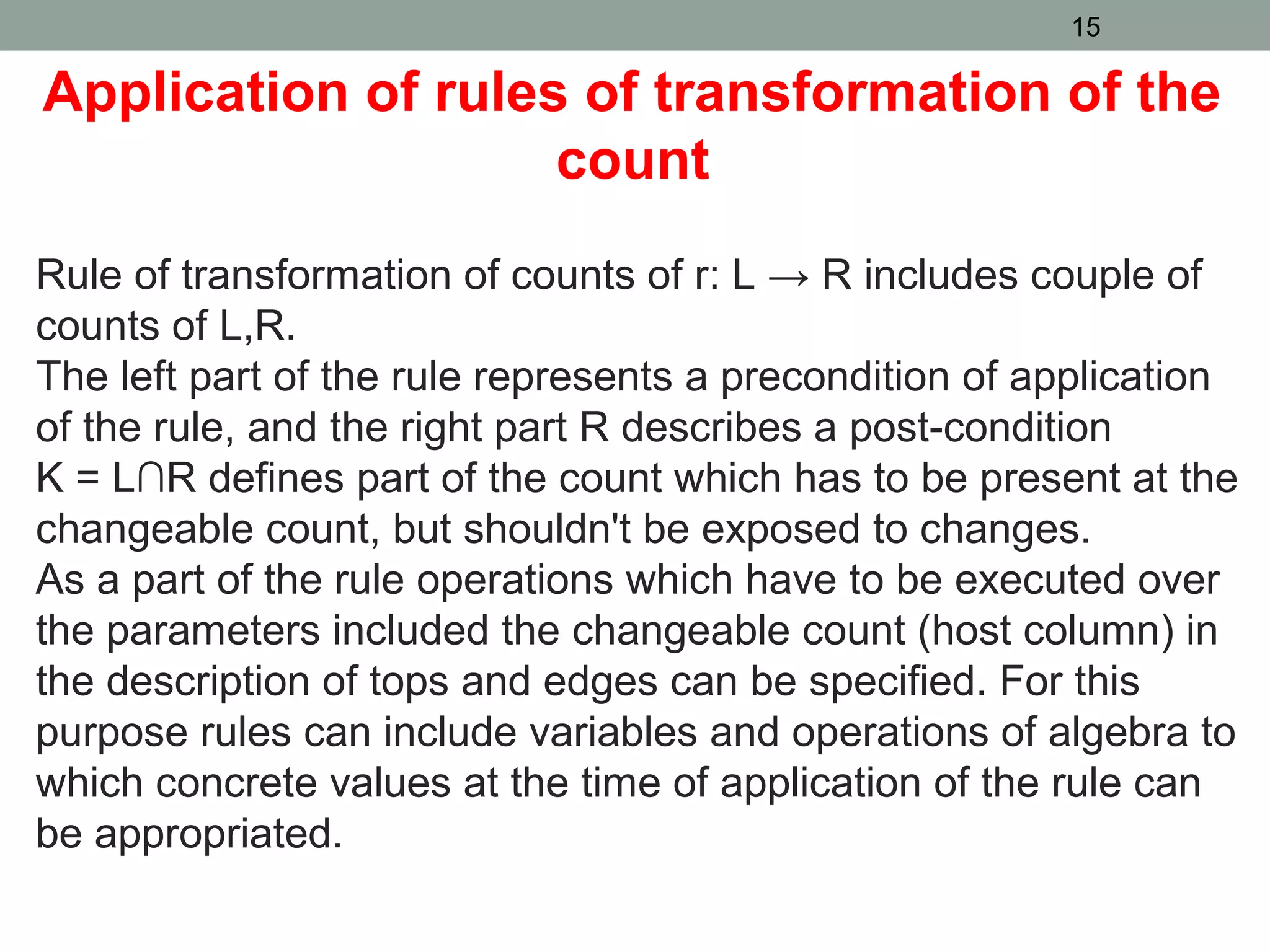
Rule of transformation of counts of r: L → R includes couple of
counts of L,R.
The left part of the rule represents a precondition of application
of the rule, and the right part R describes a post-condition
K = L∩R defines part of the count which has to be present at the
changeable count, but shouldn't be exposed to changes.
As a part of the rule operations which have to be executed over
the parameters included the changeable count (host column) in
the description of tops and edges can be specified. For this
purpose rules can include variables and operations of algebra to
which concrete values at the time of application of the rule can
be appropriated.
16
Application of rules for transformation of the
count
In the left top corner
application of the
negative rule is shown
NAC, L – a subgraph
corresponding to the left
part of the rule,
R - subgraph
corresponding to the
right part of the rule
Application of this rule has
allowed to apply automatically
transformation on creation of new
Credit Department and to include
two credit departments in his
structure: crediting of natural
persons and legal entities
17
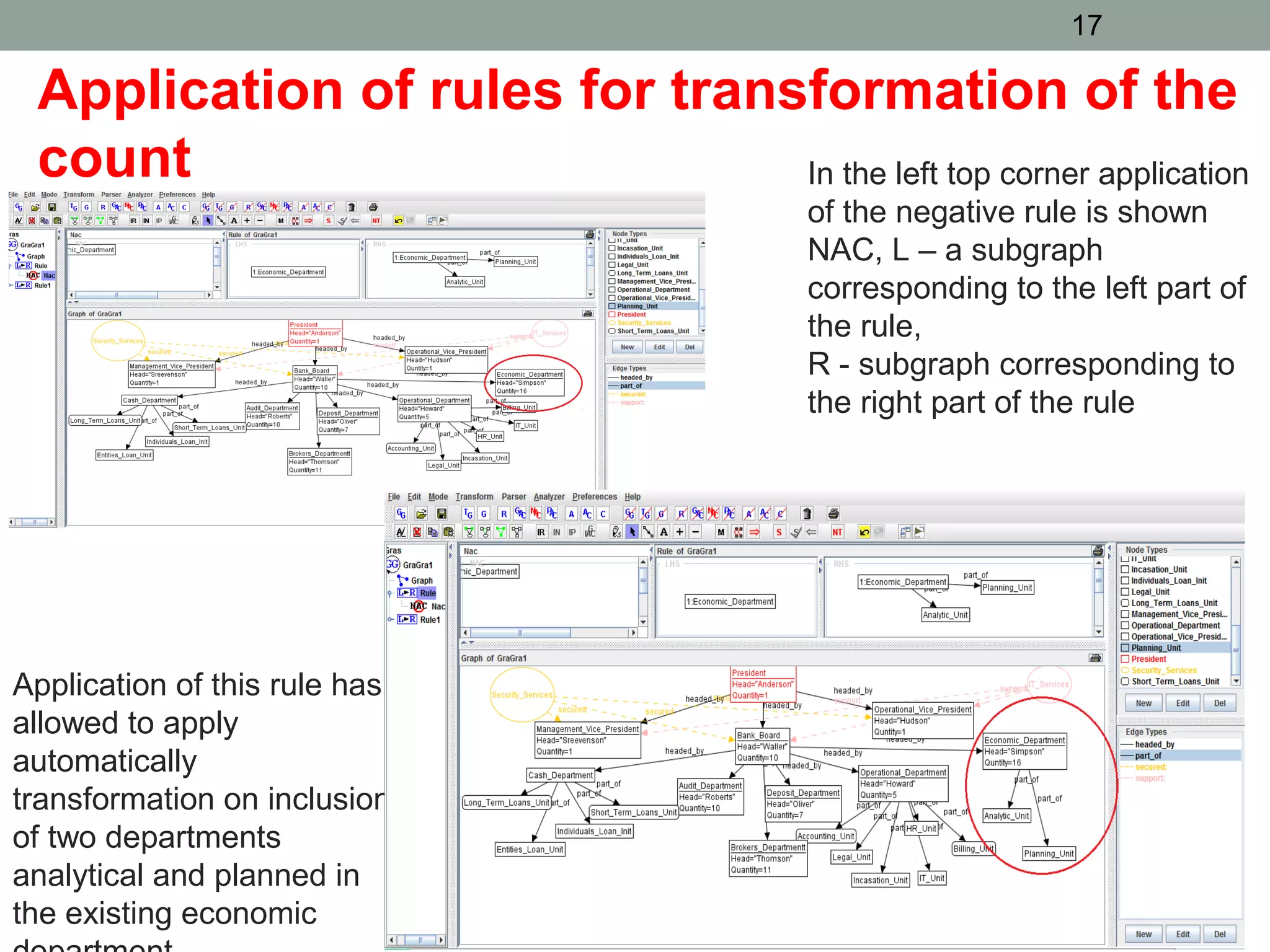
Application of rules for transformation of the
count In the left top corner application
of the negative rule is shown
NAC, L – a subgraph
corresponding to the left part of
the rule,
R - subgraph corresponding to
the right part of the rule
Application of this rule has
allowed to apply
automatically
transformation on inclusion
of two departments
analytical and planned in
the existing economic
18
The modern enterprises are dynamic – their structures constantly change (for
example, merge, absorption, expansion of structure and others).
The analysis shows that modern development tools of business processes
don't provide automatic allocation of the entities and the relations characteristic
of the local enterprise. Allocation is made manually, is labor-consuming
operation and leads to delay and decline in quality of development of business
processes
High rate of change of the enterprises defines need of continuous
transformation of business processes of the enterprises, and also demands
higher extent of automation of creation and transformation of counts, than that
which exists in the available means for modeling of business processes
The possibility of allocation of entities and the relations characteristic of the
enterprise on the basis of a representative collection of documents is shown by
means of the formal analysis of concepts.
Creation of global ontology on the basis of local by means of the Protégé
program, and also application of AGG for expeditious development and the
subsequent transformation of counts of business processes is shown
Conclusion:
Thank you for
attention!

1 ws

  • 1.
    DYNAMIC STRUCTURE OF INNOVATIVECOMPANIES AND SIMULATION OF BUSINESS PROCESSES BASED ON GRAPH GRAMMARS Daria Novototskih Victor Romanov Cyrill Dutov
  • 2.
  • 3.
    Classification of moderninnovative companies 3 Adaptive Reconfigurable Collaborative Virtual
  • 4.
    Innovative properties ofthe modern enterprises 4 Adaptability Development of new opportunities in response to changes of the environment. Within an ecosystem development should be understood as no autonomous but joined evolution with other participants Reconfigurability Provides competitive advantages as the enterprises possess variable structure and scalability, therefore can quickly react to changes Virtuality The virtual enterprises are constructed on an inter- corporate communication network, they have a common goal or carry out the general project Collaboraton The collaborative enterprises are an virtual network of manufacturing enterprises with vertical and horizontal communications between them. Advantage is involvement of the competent employees working far off on the terms of outsourcing with application of a cloud computing
  • 5.
    Metamodel of anetwork of collaboration The collaboration of the enterprises means integration of their information systems. Inter-corporate information system is founded on a global meta-model which unites models of the collaborative enterprises. Integrity and structure of a global meta-model is maintained by ontology. 5 Collaborative Enterprise 1 Collaborative Enterprise 2 Collaborative Enterprise 3 Inter-corporate information system Meta-model Business model 3 Business model 2 Business model 1 Ontology
  • 6.
    Integration of localontologies into global It is offered to automate creation of local ontologies by means of the document analysis of the collaborative enterprises by method of the formal concept analysis. The global ontology is created by all participants of collaboration, they define syntax and semantics of joined processes, all collaborator have access to global ontology 6 Collaborative Enterprise 1 Collaborative Enterprise 2 Collaborative Enterprise 3 Inter-corporate information system Document flow Document flow Document flow Local Ontology 1 Local Ontology 2 Local Ontology 3 Integrated ontology Analysis of formal concepts Analysis of formal concepts Analysis of formal concepts Concepts Concepts Concepts
  • 7.
    Example of transformationof commercial banks Now the most plastic structure of Russian economy is the banking system, in the conditions of crisis the Central Bank regularly takes away licenses from commercial banks. The banks which were left license can be sanified by other bank, therefore, they are exposed to operations of merger and acquisition from the banks which have kept the licenses. We consider two stages of transformation of model at merge of commercial banks: •merge of ontologies, we used Concept Explorer for allocation of key concepts at inclusion in local ontology and the Protégé program for integration of local ontology in global •transformation of business processes with application of a method of graph grammars, for this purpose we used AGG software 7
  • 8.
    Formal context 8 The formalanalysis of concepts allows us to allocate the essential concepts characterizing business processes of bank and also the relation between them. On the submitted table the formal context on which lines correspond to units, and columns to functions of these divisions is shown. functions units
  • 9.
    9 Lattice of formalconcepts Concept <1> - CED1 - CED4 - Department of crediting of physical entities Concept <2> - ECD3 - ECD4 - Economical department Concept <3> - CFD1 - CFD4 - Department of crediting to legal entities Concept <4> - ECD1 - ECD2 - Economical department
  • 10.
    10 In the analysisof association rules for credit departments, we see: there are rules to the 100% value of the confidence indicator combine 4 objects belonging to the Department of crediting of physical entities or 4 properties belonging to the Department of crediting to legal entities. Example of association rules: •<4> RAW RAI RAL ILA GIW ACW FCW FCI FCL FCC PGL MTR CCR PBC IGP ARC LNL PAS IBL ALW ALI ALS CGW CGT CGS SNI RMS CCW CCI CUW CUI MOR CCT CCI FAL IWL PNI​​ CAA PII = [100%] => < 4> FPD GII ACI SNS CRW CRI CFD; At the same time, there are rules to unite all 8 credit departments: •Example: •<8> RAI ACW FCW FCI ALW ALI ALS CGT PII = [100%] => <8> RAL ILA GIW FCL FCC PGL MTR CCR PBC IGP ARC LNL PAS IBL CGW CGS SNI RMS CCW CCI CUW CUI MOR CCT CCI​​ FAL IWL; It is advisable to draw a conclusion: a. On the one hand have separate departments b. On the other hand units should be combined at a higher level Example of interpretation of association rules
  • 11.
    11 Global Integrated Ontology Thenewly created objects The results obtained in the previous step, we include in the global financial ontology, thus introducing a new element of the commercial bank.
  • 12.
    12 There are anumber of software tools for graph transformation, among them: AGG, GReAT, VIATRA, FUJABA. To create a local business processes, we propose to use AGG program - a development environment to describe and perform transformations of typed attribute graphs, implemented on the Java platform. The program produces local changes to all occurrences of LHS in the original host graph. Includes tools convert graphs, search subgraph corresponding left-hand side and replace it with the corresponding subgraph of the right-hand side of the rule, and generates a set of rules and conditions of their implementation. Sets attributes, perform calculations, restrict the positive, negative and global. Justification of AGG tool choice
  • 13.
    13 Rules of localtransformation of the count Standard processes LHS RHS Merge of divisions Resubmission of divisions Splitting of divisions K L M K L M A B C J H G The graph grammar finds all occurrences of a subgraph of LHS and automatically replaces with RHS subgraph
  • 14.
    14 Count of administrativestructure of bank We see that AGG allows to set names to tops and the count's edges to appropriate them attributes and initial values.
  • 15.
    15 Application of rulesof transformation of the count Rule of transformation of counts of r: L → R includes couple of counts of L,R. The left part of the rule represents a precondition of application of the rule, and the right part R describes a post-condition K = L∩R defines part of the count which has to be present at the changeable count, but shouldn't be exposed to changes. As a part of the rule operations which have to be executed over the parameters included the changeable count (host column) in the description of tops and edges can be specified. For this purpose rules can include variables and operations of algebra to which concrete values at the time of application of the rule can be appropriated.
  • 16.
    16 Application of rulesfor transformation of the count In the left top corner application of the negative rule is shown NAC, L – a subgraph corresponding to the left part of the rule, R - subgraph corresponding to the right part of the rule Application of this rule has allowed to apply automatically transformation on creation of new Credit Department and to include two credit departments in his structure: crediting of natural persons and legal entities
  • 17.
    17 Application of rulesfor transformation of the count In the left top corner application of the negative rule is shown NAC, L – a subgraph corresponding to the left part of the rule, R - subgraph corresponding to the right part of the rule Application of this rule has allowed to apply automatically transformation on inclusion of two departments analytical and planned in the existing economic
  • 18.
    18 The modern enterprisesare dynamic – their structures constantly change (for example, merge, absorption, expansion of structure and others). The analysis shows that modern development tools of business processes don't provide automatic allocation of the entities and the relations characteristic of the local enterprise. Allocation is made manually, is labor-consuming operation and leads to delay and decline in quality of development of business processes High rate of change of the enterprises defines need of continuous transformation of business processes of the enterprises, and also demands higher extent of automation of creation and transformation of counts, than that which exists in the available means for modeling of business processes The possibility of allocation of entities and the relations characteristic of the enterprise on the basis of a representative collection of documents is shown by means of the formal analysis of concepts. Creation of global ontology on the basis of local by means of the Protégé program, and also application of AGG for expeditious development and the subsequent transformation of counts of business processes is shown Conclusion:
  • 19.