TV drama
A genre
A category of artistic composition, as in music or
literature, characterized by similarities in
form, style, or subject matter.
Horror, romantic, comedy, action, western.
Sub genre
A subcategory within a particular genre:
drama – crime, soaps, medical, costumes
Medical drama
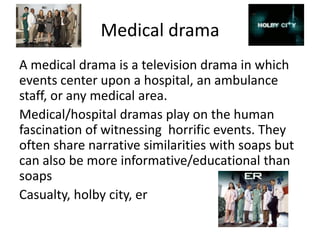
A medical drama is a television drama in which
events center upon a hospital, an ambulance
staff, or any medical area.
Medical/hospital dramas play on the human
fascination of witnessing horrific events. They
often share narrative similarities with soaps but
can also be more informative/educational than
soaps
Casualty, holby city, er
conventions between all medical
dramas
A convention is a widely accepted device used in
television dramas.
Plot
Setting – ambulance, hospital
Characters – doctors, nurses
Themes
Narrative
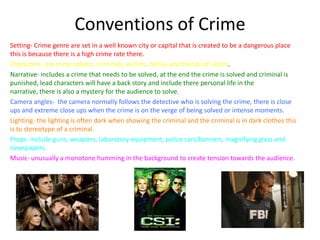
Conventions of Crime
Setting- Crime genre are set in a well known city or capital that is created to be a dangerous place
this is because there is a high crime rate there.
Characters- are crime solvers, criminals, victims, family and friends of victim.
Narrative- includes a crime that needs to be solved, at the end the crime is solved and criminal is
punished, lead characters will have a back story and include there personal life in the
narrative, there is also a mystery for the audience to solve.
Camera angles- the camera normally follows the detective who is solving the crime, there is close
ups and extreme close ups when the crime is on the verge of being solved or intense moments.
Lighting- the lighting is often dark when showing the criminal and the criminal is in dark clothes this
is to stereotype of a criminal.
Props- include guns, weapons, laboratory equipment, police cars/banners, magnifying glass and
newspapers.
Music- unusually a monotone humming in the background to create tension towards the audience.
How do we know Crime is a TV
Drama?
• Involves a crime and a criminal.
• Is a program not a film.
• Follows the different types of characters.
• The crime is always solved by the end of the
episode or series.
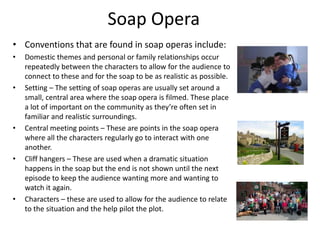
Soap Opera
• Conventions that are found in soap operas include:
• Domestic themes and personal or family relationships occur
repeatedly between the characters to allow for the audience to
connect to these and for the soap to be as realistic as possible.
• Setting – The setting of soap operas are usually set around a
small, central area where the soap opera is filmed. These place
a lot of important on the community as they’re often set in
familiar and realistic surroundings.
• Central meeting points – These are points in the soap opera
where all the characters regularly go to interact with one
another.
• Cliff hangers – These are used when a dramatic situation
happens in the soap but the end is not shown until the next
episode to keep the audience wanting more and wanting to
watch it again.
• Characters – these are used to allow for the audience to relate
to the situation and the help pilot the plot.
• On going – Series do not have a particular start or end as they usually run all year
round.
• Scheduling – Soaps are usually scheduled for target audience and is usually shown
on specific days and specific times related to the target audience.
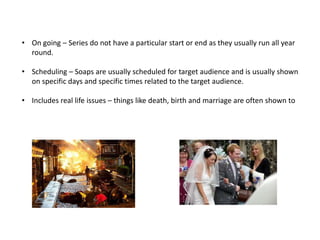
• Includes real life issues – things like death, birth and marriage are often shown to
make the soap as real as possible.

Presentation1

  • 1.
  • 2.
    A genre A categoryof artistic composition, as in music or literature, characterized by similarities in form, style, or subject matter. Horror, romantic, comedy, action, western.
  • 3.
    Sub genre A subcategorywithin a particular genre: drama – crime, soaps, medical, costumes
  • 4.
    Medical drama A medicaldrama is a television drama in which events center upon a hospital, an ambulance staff, or any medical area. Medical/hospital dramas play on the human fascination of witnessing horrific events. They often share narrative similarities with soaps but can also be more informative/educational than soaps Casualty, holby city, er
  • 5.
    conventions between allmedical dramas A convention is a widely accepted device used in television dramas. Plot Setting – ambulance, hospital Characters – doctors, nurses Themes Narrative
  • 6.
    Conventions of Crime Setting-Crime genre are set in a well known city or capital that is created to be a dangerous place this is because there is a high crime rate there. Characters- are crime solvers, criminals, victims, family and friends of victim. Narrative- includes a crime that needs to be solved, at the end the crime is solved and criminal is punished, lead characters will have a back story and include there personal life in the narrative, there is also a mystery for the audience to solve. Camera angles- the camera normally follows the detective who is solving the crime, there is close ups and extreme close ups when the crime is on the verge of being solved or intense moments. Lighting- the lighting is often dark when showing the criminal and the criminal is in dark clothes this is to stereotype of a criminal. Props- include guns, weapons, laboratory equipment, police cars/banners, magnifying glass and newspapers. Music- unusually a monotone humming in the background to create tension towards the audience.
  • 7.
    How do weknow Crime is a TV Drama? • Involves a crime and a criminal. • Is a program not a film. • Follows the different types of characters. • The crime is always solved by the end of the episode or series.
  • 8.
    Soap Opera • Conventionsthat are found in soap operas include: • Domestic themes and personal or family relationships occur repeatedly between the characters to allow for the audience to connect to these and for the soap to be as realistic as possible. • Setting – The setting of soap operas are usually set around a small, central area where the soap opera is filmed. These place a lot of important on the community as they’re often set in familiar and realistic surroundings. • Central meeting points – These are points in the soap opera where all the characters regularly go to interact with one another. • Cliff hangers – These are used when a dramatic situation happens in the soap but the end is not shown until the next episode to keep the audience wanting more and wanting to watch it again. • Characters – these are used to allow for the audience to relate to the situation and the help pilot the plot.
  • 9.
    • On going– Series do not have a particular start or end as they usually run all year round. • Scheduling – Soaps are usually scheduled for target audience and is usually shown on specific days and specific times related to the target audience. • Includes real life issues – things like death, birth and marriage are often shown to make the soap as real as possible.