Name- Arpita Dinesh Patankar
NLC-4th
Seat No.
Custom as a Source of Law
Custom is considered as important source of law.
It is the oldest form of law making. A study of ancient law shows
that in primitive society, the lives of the people were regulated by
the customs which developed according to the circumstances.
Some jurists believe that the customs are originated from the
common consciousness of people, custom came into existence
because of necessity and imitation.
• When the same thing was done again and again in particular way
of doing it, it assumed the form of custom.
Introduction:
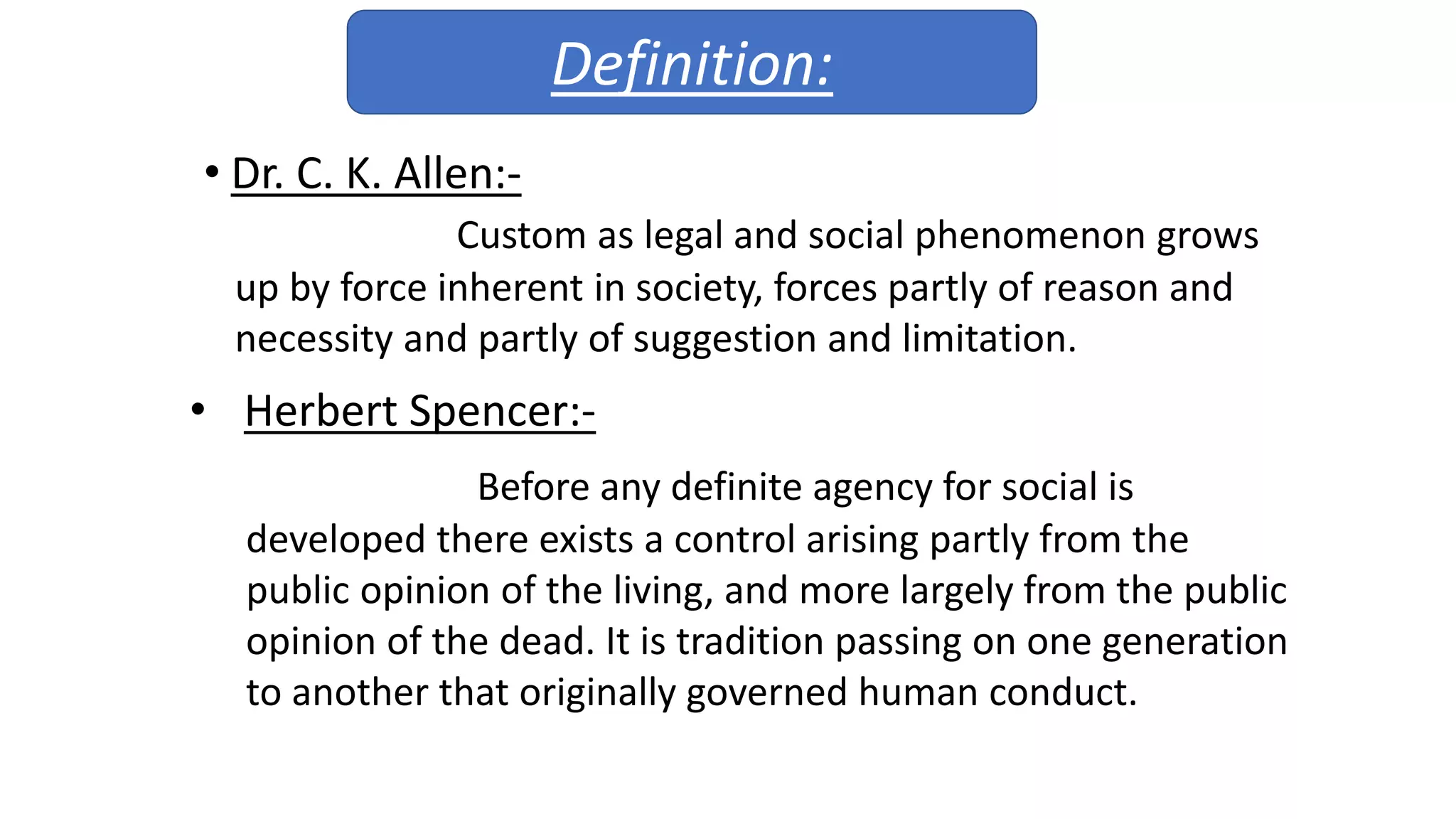
• Dr. C. K. Allen:-
Custom as legal and social phenomenon grows
up by force inherent in society, forces partly of reason and
necessity and partly of suggestion and limitation.
• Herbert Spencer:-
Before any definite agency for social is
developed there exists a control arising partly from the
public opinion of the living, and more largely from the public
opinion of the dead. It is tradition passing on one generation
to another that originally governed human conduct.
Definition:
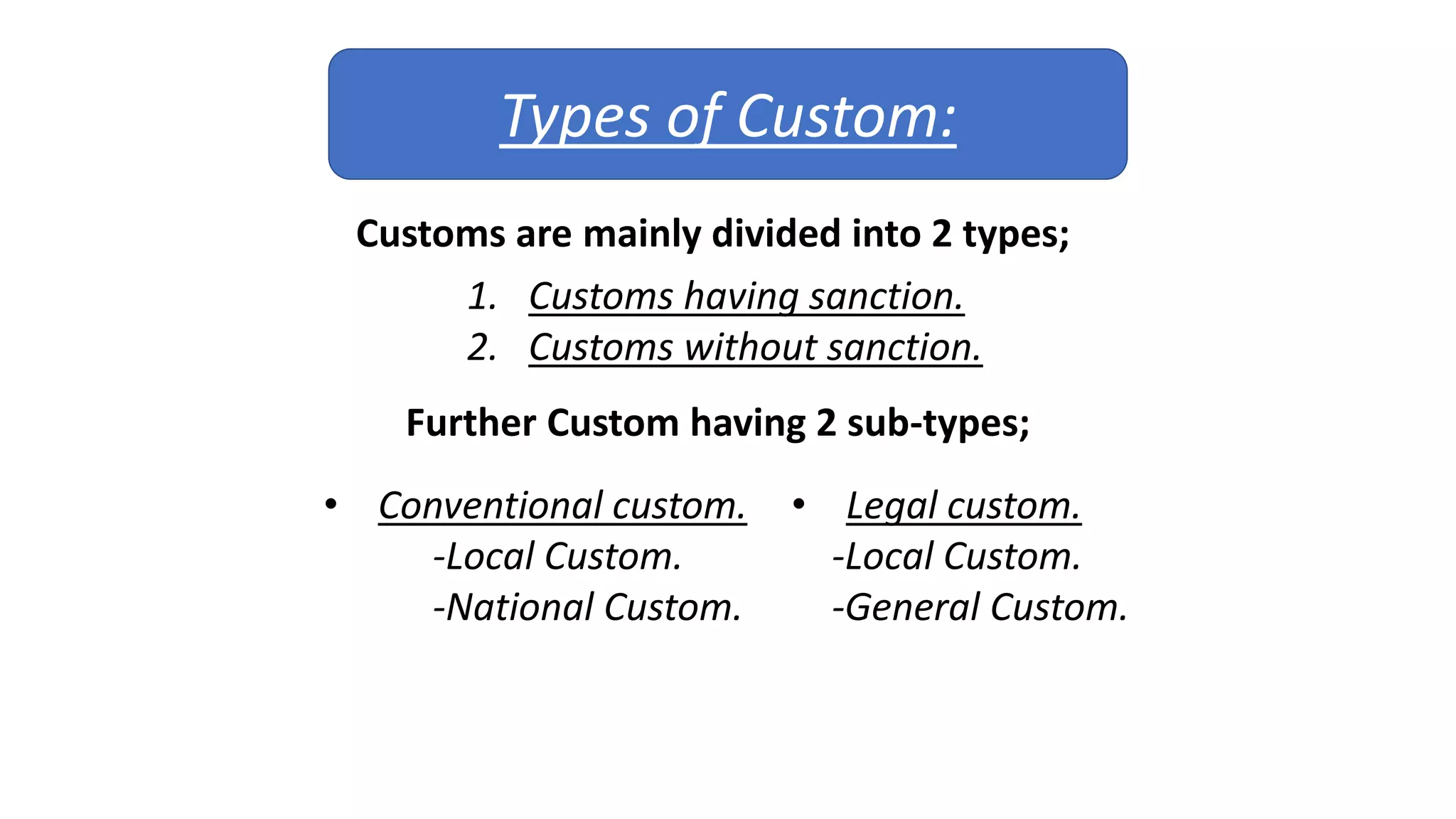
Types of Custom:
Customs are mainly divided into 2 types;
1. Customs having sanction.
2. Customs without sanction.
Further Custom having 2 sub-types;
• Conventional custom. • Legal custom.
-Local Custom.
-National Custom.
-Local Custom.
-General Custom.
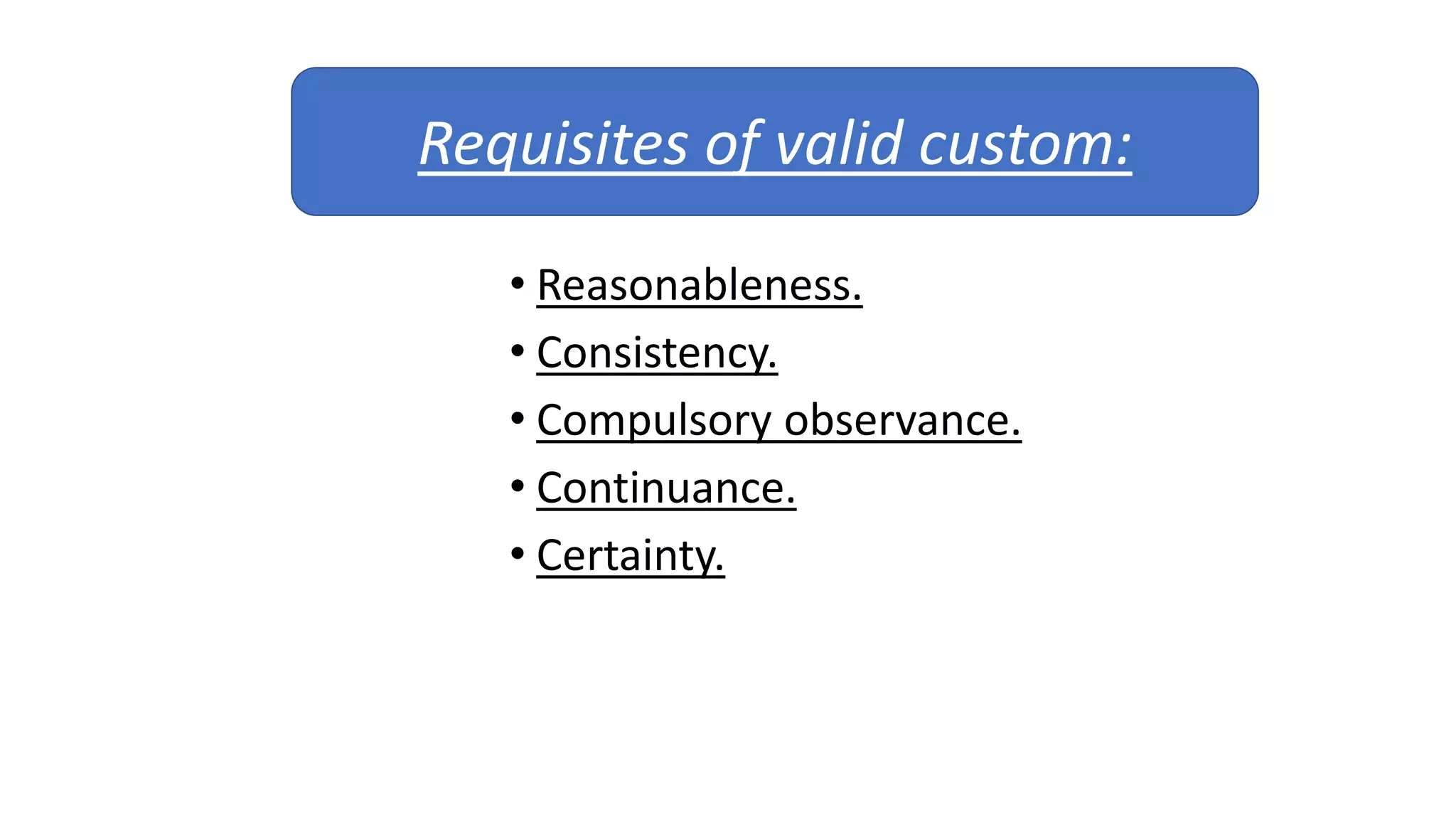
• Reasonableness.
• Consistency.
• Compulsory observance.
• Continuance.
• Certainty.
Requisites of valid custom:

Custom as source of law

  • 1.
    Name- Arpita DineshPatankar NLC-4th Seat No. Custom as a Source of Law
  • 2.
    Custom is consideredas important source of law. It is the oldest form of law making. A study of ancient law shows that in primitive society, the lives of the people were regulated by the customs which developed according to the circumstances. Some jurists believe that the customs are originated from the common consciousness of people, custom came into existence because of necessity and imitation. • When the same thing was done again and again in particular way of doing it, it assumed the form of custom. Introduction:
  • 3.
    • Dr. C.K. Allen:- Custom as legal and social phenomenon grows up by force inherent in society, forces partly of reason and necessity and partly of suggestion and limitation. • Herbert Spencer:- Before any definite agency for social is developed there exists a control arising partly from the public opinion of the living, and more largely from the public opinion of the dead. It is tradition passing on one generation to another that originally governed human conduct. Definition:
  • 4.
    Types of Custom: Customsare mainly divided into 2 types; 1. Customs having sanction. 2. Customs without sanction. Further Custom having 2 sub-types; • Conventional custom. • Legal custom. -Local Custom. -National Custom. -Local Custom. -General Custom.
  • 5.
    • Reasonableness. • Consistency. •Compulsory observance. • Continuance. • Certainty. Requisites of valid custom: