PLANNING THE SERVICE
DELIVERY SYSTEMHOSPITALITY PRINCIPLE; to provide seamless service delivery
Presented by:
Daisy Mae Abogne
Andrea Marisse Calamba
Kim Concepcion
DESIGNING AND DELIVERING
SERVICE DELIVERY SYSTEM
Presented by;
Kim Concepcion
Planning the Service Delivery System
includes all aspects of the service experience -- service
product, service setting, and service delivery
To have a smooth work process, these are some of the
things to be considered;
• Developing a service product that meet guests' needs
• Well-trained staffs, motivated and enthusiastic employees
Richard Metters & Ann Marucheck maintain
that;
“ the urgency for rigorous study to guide service
managers in improving the design, competitiveness,
efficiency and effectiveness of service delivery, both at
the firm and the industry levels, has never been greater.”
The Total Quality Movement
- which emphasized that everyone is responsible for
quality
THE GOAL: Fail No Guest, Delight Every Guest
Developing the Service Delivery Sysytem
- after almost 50 years of research, Joseph Juran
published the Juran Trilogy in 1986
3 Management Processes according to Juran
1. Quality Planning
2. Quality Control
3. Quality Improvement
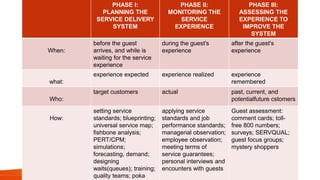
PHASE I:
PLANNING THE
SERVICE DELIVERY
SYSTEM
PHASE II:
MONITORING THE
SERVICE
EXPERIENCE
PHASE III:
ASSESSING THE
EXPERIENCE TO
IMPROVE THE
SYSTEM
When:
before the guest
arrives, and while is
waiting for the service
experience
during the guest's
experience
after the guest's
experience
what:
experience expected experience realized experience
remembered
Who:
target customers actual past, current, and
potentialfuture cstomers
How:
setting service
standards; blueprinting;
universal service map;
fishbone analysis;
PERT/CPM;
simulations;
forecasting, demand;
designing
waits(queues); training;
quality teams; poka
applying service
standards and job
performance standards;
managerial observation;
employee observation;
meeting terms of
service guarantees;
personal interviews and
encounters with guests
Guest assessment:
comment cards; toll-
free 800 numbers;
surveys; SERVQUAL;
guest focus groups;
mystery shoppers
Planning the System
“ any good delivery system begins with careful analysis”
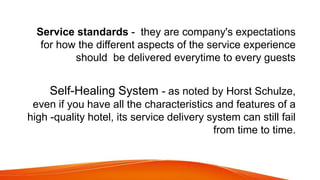
Service standards - they are company's expectations
for how the different aspects of the service experience
should be delivered everytime to every guests
Self-Healing System - as noted by Horst Schulze,
even if you have all the characteristics and features of a
high -quality hotel, its service delivery system can still fail
from time to time.
PLANNING TECHNIQUES
in Service Delivery System
Daisy Mae C. Abogne
BSHM 4-1D
Total Quality Management
Blueprinting
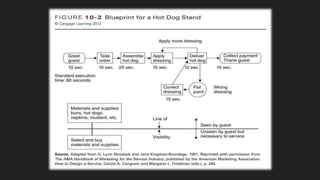
 The most commonly discussed type of service diagramming
is blueprinting. The entire service delivery process and its
subprocesses are described in blueprint format as if one
were building a house and needed a plan of what went
where.
 The blueprint should attach times to the activities and
processes involved in providing the service and the time for
the entire guest experience.
 The purpose of blueprinting is not only to satisfy the guest
but also to enable the organization to achieve its profit
 Physical evidence. The tangible physical parts of the service experience that can
impact customer assessment of quality and value.
 Customer actions. The actions and behaviors of customers, which drive the creation
of a blueprint.
 Onstage/visible contact-employee actions. Things that customer-contact employes
do as part of the face-to-face encounter and which customers see.
 Backstage/nonvisible contact-employee actions. Things that customer-contact
employees do out of sight of customers but which must happen for the experience
to take place; also includes nonvisible interaction with customers.
 Support processes. Activities essential to providing the service but carried out by
individuals and units that do not have direct contact with the customer.
The Five Parts of Blueprinting:
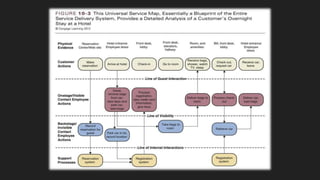
 A variant (and, typically, more elaborate version) of a blueprint
that can be generally applied to a variety of service situations. It
begins, appropriately, with the guest making a reservation.
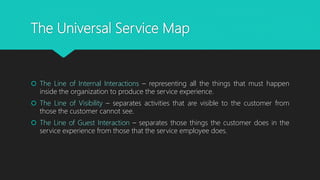
The Universal Service Map
 The Line of Internal Interactions – representing all the things that must happen
inside the organization to produce the service experience.
 The Line of Visibility – separates activities that are visible to the customer from
those the customer cannot see.
 The Line of Guest Interaction – separates those things the customer does in the
service experience from those that the service employee does.
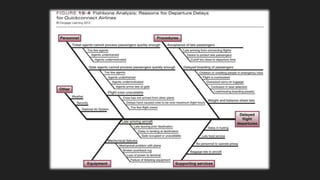
 It provides a way to concentrate on the problem areas to
avoid or recover from faulty service outcomes. The results of
fishbone analysis are often used to make major changes in
the delivery system.
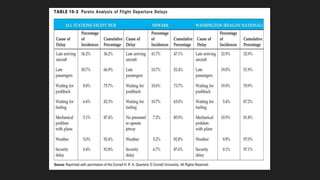
 The prioritizing technique, known as Pareto analysis, calls for
arranging the potential causes of the problem based on the
frequency in which they occur.
Fish Bone Analysis (Cause-
and-Effect Analysis)
PLANNING TECHNIQUE:
PERT/CPM
PERT- Program Evaluation Review
Technique
CPM- Critical Path Method
• Offers benefits of any good planning
tool.
• Detailed and well-organized plan
• With control measurement process
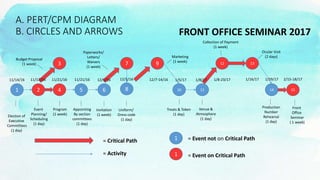
A. PERT/CPM DIAGRAM
B. CIRCLES AND ARROWS
1 2
3 97 13
84 5 6 10 11 14
12
15
11/14/16 11/17/16 11/21/16 11/21/16 12/1/16 12/5/16 12/7-14/16 1/5/17 1/8/17 1/8-23/17 1/16/17 1/29/17 2/15-18/17
Election of
Executive
Committees
(1 day)
Event
Planning/
Scheduling
(1 day)
Budget Proposal
(1 week)
Treats & Token
(1 day)
Program
(1 week)
Appointing
By section
committees
(1 day)
Invitation
(1 week)
Paperworks/
Letters/
Waivers
(1 week)
Uniform/
Dress code
(1 day)
Marketing
(1 week)
Venue &
Atmosphere
(1 day)
Collection of Payment
(1 week)
Ocular Visit
(2 days)
Production
Number
Rehearsal
(1 day)
Front
Office
Seminar
( 1 week)
1
1
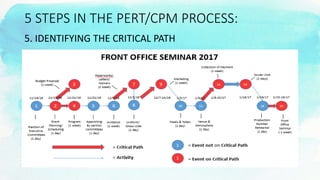
= Critical Path
= Activity
= Event not on Critical Path
= Event on Critical Path
FRONT OFFICE SEMINAR 2017
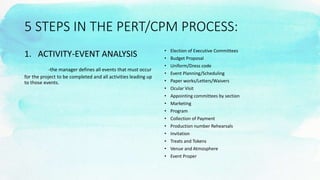
5 STEPS IN THE PERT/CPM PROCESS:
1. ACTIVITY-EVENT ANALYSIS
-the manager defines all events that must occur
for the project to be completed and all activities leading up
to those events.
• Election of Executive Committees
• Budget Proposal
• Uniform/Dress code
• Event Planning/Scheduling
• Paper works/Letters/Waivers
• Ocular Visit
• Appointing committees by section
• Marketing
• Program
• Collection of Payment
• Production number Rehearsals
• Invitation
• Treats and Tokens
• Venue and Atmosphere
• Event Proper
5 STEPS IN THE PERT/CPM PROCESS:
2. ACTIVITY-EVENT
SEQUENCING
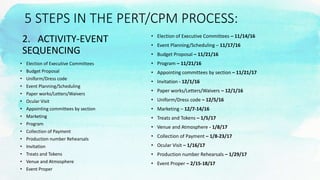
• Election of Executive Committees – 11/14/16
• Event Planning/Scheduling – 11/17/16
• Budget Proposal – 11/21/16
• Program – 11/21/16
• Appointing committees by section – 11/21/17
• Invitation - 12/1/16
• Paper works/Letters/Waivers – 12/1/16
• Uniform/Dress code – 12/5/16
• Marketing – 12/7-14/16
• Treats and Tokens – 1/5/17
• Venue and Atmosphere - 1/8/17
• Collection of Payment – 1/8-23/17
• Ocular Visit – 1/16/17
• Production number Rehearsals – 1/29/17
• Event Proper – 2/15-18/17
• Election of Executive Committees
• Budget Proposal
• Uniform/Dress code
• Event Planning/Scheduling
• Paper works/Letters/Waivers
• Ocular Visit
• Appointing committees by section
• Marketing
• Program
• Collection of Payment
• Production number Rehearsals
• Invitation
• Treats and Tokens
• Venue and Atmosphere
• Event Proper
5 STEPS IN THE PERT/CPM PROCESS:
3. ACTIVITY TIME
ESTIMATES
-the next step is for the manager to
estimate how much time each activity will take so that
an expected time for completing each event and the
entire project can be calculated.
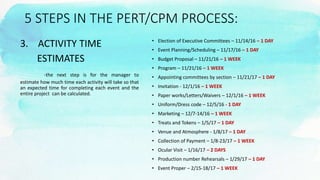
• Election of Executive Committees – 11/14/16 – 1 DAY
• Event Planning/Scheduling – 11/17/16 – 1 DAY
• Budget Proposal – 11/21/16 – 1 WEEK
• Program – 11/21/16 – 1 WEEK
• Appointing committees by section – 11/21/17 – 1 DAY
• Invitation - 12/1/16 – 1 WEEK
• Paper works/Letters/Waivers – 12/1/16 – 1 WEEK
• Uniform/Dress code – 12/5/16 - 1 DAY
• Marketing – 12/7-14/16 – 1 WEEK
• Treats and Tokens – 1/5/17 – 1 DAY
• Venue and Atmosphere - 1/8/17 – 1 DAY
• Collection of Payment – 1/8-23/17 – 1 WEEK
• Ocular Visit – 1/16/17 – 2 DAYS
• Production number Rehearsals – 1/29/17 – 1 DAY
• Event Proper – 2/15-18/17 – 1 WEEK
5 STEPS IN THE PERT/CPM PROCESS:
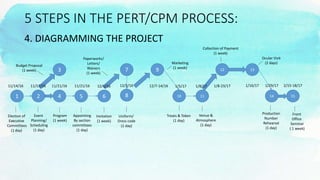
4. DIAGRAMMING THE PROJECT
1 2
3 97 13
84 5 6 10 11 14
12
15
11/17/16 11/21/16 11/21/16 12/1/16 12/5/16 12/7-14/16 1/5/17 1/8/17 1/8-23/17 1/16/17 1/29/17 2/15-18/17
Event
Planning/
Scheduling
(1 day)
Budget Proposal
(1 week)
Treats & Token
(1 day)
Program
(1 week)
Appointing
By section
committees
(1 day)
Invitation
(1 week)
Paperworks/
Letters/
Waivers
(1 week)
Uniform/
Dress code
(1 day)
Marketing
(1 week)
Venue &
Atmosphere
(1 day)
Collection of Payment
(1 week)
Ocular Visit
(2 days)
Production
Number
Rehearsal
(1 day)
Front
Office
Seminar
( 1 week)
Election of
Executive
Committees
(1 day)
11/14/16
5 STEPS IN THE PERT/CPM PROCESS:
5. IDENTIFYING THE CRITICAL PATH
TARGETING SPECIFIC
PROBLEM AREAS IN
SERVICE DELIVERY SYSTEM
Presented by;
Andrea Marisse Calamba
1. FORECASTING DEMAND TO PREVENT PROBLEMS
2. TRAINING
- Adequate trainings of employees before they ever get the chance to serve
a customer can prevent failures.
3. QUALITY TEAMS
4. POKA-YOKE
- failue-preventing device/procedure
- “mistake-proofing”/ “avoid mistakes” in Japanese
- Shigeo Shingo, Japanese quality expert
A. TYPES OF INSPECTION
1) Source Inspection
- potential mistakes are located at their source and fixed
before they can get into the delivery system.
2) Self-inspection
– people check their own work
3) Successive Inspection
– the person next in the delivery system checks the quality
and accuracy of the previous persons work.
B. WARNINGS AND CONTROL POKA-
YOKE
WARNING POKA-YOKE
- Before error is made
• 3 TYPES OF WARNING AND CONTROL POKA-YOKE:
1. CONTACT POKA-YOKE
- monitor the items physical characteristics to
determine if they meet predefined specifications.
2. FIXED VALUES
- used when a certain step is repeated.
3. MOTION STEP/ Sequence Method
- used when more than one step is involved.
CONTROL POKA-YOKE
- Keeps a process from beginning and continuing
after error is made.
D. SPEED PARKING
• To prevent customers from their own problems.
• Customers can be prepared to do their part even before the
service experience begins.
C. POKA-YOKES FOR CUSTOMER
5. CROSS-FUNCTIONAL PROJECT
AND MATRIX ORGANIZATION
- Organizing people and groups to enable them to
focus on the guest’s needs, wants, and expectations
across the boundaries of functional organizational
unit.
“Being nice to people is just 20%
of the customer service. The
important part is designing
systems that allow you to do the
job right the first time.”
– Carl Sewell, Customers for Life

Planning service delivery system

  • 1.
    PLANNING THE SERVICE DELIVERYSYSTEMHOSPITALITY PRINCIPLE; to provide seamless service delivery Presented by: Daisy Mae Abogne Andrea Marisse Calamba Kim Concepcion
  • 2.
    DESIGNING AND DELIVERING SERVICEDELIVERY SYSTEM Presented by; Kim Concepcion
  • 3.
    Planning the ServiceDelivery System includes all aspects of the service experience -- service product, service setting, and service delivery
  • 4.
    To have asmooth work process, these are some of the things to be considered; • Developing a service product that meet guests' needs • Well-trained staffs, motivated and enthusiastic employees
  • 5.
    Richard Metters &Ann Marucheck maintain that; “ the urgency for rigorous study to guide service managers in improving the design, competitiveness, efficiency and effectiveness of service delivery, both at the firm and the industry levels, has never been greater.”
  • 6.
    The Total QualityMovement - which emphasized that everyone is responsible for quality THE GOAL: Fail No Guest, Delight Every Guest
  • 7.
    Developing the ServiceDelivery Sysytem - after almost 50 years of research, Joseph Juran published the Juran Trilogy in 1986 3 Management Processes according to Juran 1. Quality Planning 2. Quality Control 3. Quality Improvement
  • 8.
    PHASE I: PLANNING THE SERVICEDELIVERY SYSTEM PHASE II: MONITORING THE SERVICE EXPERIENCE PHASE III: ASSESSING THE EXPERIENCE TO IMPROVE THE SYSTEM When: before the guest arrives, and while is waiting for the service experience during the guest's experience after the guest's experience what: experience expected experience realized experience remembered Who: target customers actual past, current, and potentialfuture cstomers How: setting service standards; blueprinting; universal service map; fishbone analysis; PERT/CPM; simulations; forecasting, demand; designing waits(queues); training; quality teams; poka applying service standards and job performance standards; managerial observation; employee observation; meeting terms of service guarantees; personal interviews and encounters with guests Guest assessment: comment cards; toll- free 800 numbers; surveys; SERVQUAL; guest focus groups; mystery shoppers
  • 9.
    Planning the System “any good delivery system begins with careful analysis”
  • 10.
    Service standards -they are company's expectations for how the different aspects of the service experience should be delivered everytime to every guests Self-Healing System - as noted by Horst Schulze, even if you have all the characteristics and features of a high -quality hotel, its service delivery system can still fail from time to time.
  • 11.
    PLANNING TECHNIQUES in ServiceDelivery System Daisy Mae C. Abogne BSHM 4-1D Total Quality Management
  • 12.
    Blueprinting  The mostcommonly discussed type of service diagramming is blueprinting. The entire service delivery process and its subprocesses are described in blueprint format as if one were building a house and needed a plan of what went where.  The blueprint should attach times to the activities and processes involved in providing the service and the time for the entire guest experience.  The purpose of blueprinting is not only to satisfy the guest but also to enable the organization to achieve its profit
  • 13.
     Physical evidence.The tangible physical parts of the service experience that can impact customer assessment of quality and value.  Customer actions. The actions and behaviors of customers, which drive the creation of a blueprint.  Onstage/visible contact-employee actions. Things that customer-contact employes do as part of the face-to-face encounter and which customers see.  Backstage/nonvisible contact-employee actions. Things that customer-contact employees do out of sight of customers but which must happen for the experience to take place; also includes nonvisible interaction with customers.  Support processes. Activities essential to providing the service but carried out by individuals and units that do not have direct contact with the customer. The Five Parts of Blueprinting:
  • 15.
     A variant(and, typically, more elaborate version) of a blueprint that can be generally applied to a variety of service situations. It begins, appropriately, with the guest making a reservation. The Universal Service Map
  • 16.
    The Universal ServiceMap  The Line of Internal Interactions – representing all the things that must happen inside the organization to produce the service experience.  The Line of Visibility – separates activities that are visible to the customer from those the customer cannot see.  The Line of Guest Interaction – separates those things the customer does in the service experience from those that the service employee does.
  • 18.
     It providesa way to concentrate on the problem areas to avoid or recover from faulty service outcomes. The results of fishbone analysis are often used to make major changes in the delivery system.  The prioritizing technique, known as Pareto analysis, calls for arranging the potential causes of the problem based on the frequency in which they occur. Fish Bone Analysis (Cause- and-Effect Analysis)
  • 21.
    PLANNING TECHNIQUE: PERT/CPM PERT- ProgramEvaluation Review Technique CPM- Critical Path Method • Offers benefits of any good planning tool. • Detailed and well-organized plan • With control measurement process
  • 22.
    A. PERT/CPM DIAGRAM B.CIRCLES AND ARROWS 1 2 3 97 13 84 5 6 10 11 14 12 15 11/14/16 11/17/16 11/21/16 11/21/16 12/1/16 12/5/16 12/7-14/16 1/5/17 1/8/17 1/8-23/17 1/16/17 1/29/17 2/15-18/17 Election of Executive Committees (1 day) Event Planning/ Scheduling (1 day) Budget Proposal (1 week) Treats & Token (1 day) Program (1 week) Appointing By section committees (1 day) Invitation (1 week) Paperworks/ Letters/ Waivers (1 week) Uniform/ Dress code (1 day) Marketing (1 week) Venue & Atmosphere (1 day) Collection of Payment (1 week) Ocular Visit (2 days) Production Number Rehearsal (1 day) Front Office Seminar ( 1 week) 1 1 = Critical Path = Activity = Event not on Critical Path = Event on Critical Path FRONT OFFICE SEMINAR 2017
  • 23.
    5 STEPS INTHE PERT/CPM PROCESS: 1. ACTIVITY-EVENT ANALYSIS -the manager defines all events that must occur for the project to be completed and all activities leading up to those events. • Election of Executive Committees • Budget Proposal • Uniform/Dress code • Event Planning/Scheduling • Paper works/Letters/Waivers • Ocular Visit • Appointing committees by section • Marketing • Program • Collection of Payment • Production number Rehearsals • Invitation • Treats and Tokens • Venue and Atmosphere • Event Proper
  • 24.
    5 STEPS INTHE PERT/CPM PROCESS: 2. ACTIVITY-EVENT SEQUENCING • Election of Executive Committees – 11/14/16 • Event Planning/Scheduling – 11/17/16 • Budget Proposal – 11/21/16 • Program – 11/21/16 • Appointing committees by section – 11/21/17 • Invitation - 12/1/16 • Paper works/Letters/Waivers – 12/1/16 • Uniform/Dress code – 12/5/16 • Marketing – 12/7-14/16 • Treats and Tokens – 1/5/17 • Venue and Atmosphere - 1/8/17 • Collection of Payment – 1/8-23/17 • Ocular Visit – 1/16/17 • Production number Rehearsals – 1/29/17 • Event Proper – 2/15-18/17 • Election of Executive Committees • Budget Proposal • Uniform/Dress code • Event Planning/Scheduling • Paper works/Letters/Waivers • Ocular Visit • Appointing committees by section • Marketing • Program • Collection of Payment • Production number Rehearsals • Invitation • Treats and Tokens • Venue and Atmosphere • Event Proper
  • 25.
    5 STEPS INTHE PERT/CPM PROCESS: 3. ACTIVITY TIME ESTIMATES -the next step is for the manager to estimate how much time each activity will take so that an expected time for completing each event and the entire project can be calculated. • Election of Executive Committees – 11/14/16 – 1 DAY • Event Planning/Scheduling – 11/17/16 – 1 DAY • Budget Proposal – 11/21/16 – 1 WEEK • Program – 11/21/16 – 1 WEEK • Appointing committees by section – 11/21/17 – 1 DAY • Invitation - 12/1/16 – 1 WEEK • Paper works/Letters/Waivers – 12/1/16 – 1 WEEK • Uniform/Dress code – 12/5/16 - 1 DAY • Marketing – 12/7-14/16 – 1 WEEK • Treats and Tokens – 1/5/17 – 1 DAY • Venue and Atmosphere - 1/8/17 – 1 DAY • Collection of Payment – 1/8-23/17 – 1 WEEK • Ocular Visit – 1/16/17 – 2 DAYS • Production number Rehearsals – 1/29/17 – 1 DAY • Event Proper – 2/15-18/17 – 1 WEEK
  • 26.
    5 STEPS INTHE PERT/CPM PROCESS: 4. DIAGRAMMING THE PROJECT 1 2 3 97 13 84 5 6 10 11 14 12 15 11/17/16 11/21/16 11/21/16 12/1/16 12/5/16 12/7-14/16 1/5/17 1/8/17 1/8-23/17 1/16/17 1/29/17 2/15-18/17 Event Planning/ Scheduling (1 day) Budget Proposal (1 week) Treats & Token (1 day) Program (1 week) Appointing By section committees (1 day) Invitation (1 week) Paperworks/ Letters/ Waivers (1 week) Uniform/ Dress code (1 day) Marketing (1 week) Venue & Atmosphere (1 day) Collection of Payment (1 week) Ocular Visit (2 days) Production Number Rehearsal (1 day) Front Office Seminar ( 1 week) Election of Executive Committees (1 day) 11/14/16
  • 27.
    5 STEPS INTHE PERT/CPM PROCESS: 5. IDENTIFYING THE CRITICAL PATH
  • 28.
    TARGETING SPECIFIC PROBLEM AREASIN SERVICE DELIVERY SYSTEM Presented by; Andrea Marisse Calamba
  • 29.
    1. FORECASTING DEMANDTO PREVENT PROBLEMS 2. TRAINING - Adequate trainings of employees before they ever get the chance to serve a customer can prevent failures. 3. QUALITY TEAMS
  • 30.
    4. POKA-YOKE - failue-preventingdevice/procedure - “mistake-proofing”/ “avoid mistakes” in Japanese - Shigeo Shingo, Japanese quality expert A. TYPES OF INSPECTION 1) Source Inspection - potential mistakes are located at their source and fixed before they can get into the delivery system. 2) Self-inspection – people check their own work 3) Successive Inspection – the person next in the delivery system checks the quality and accuracy of the previous persons work.
  • 31.
    B. WARNINGS ANDCONTROL POKA- YOKE WARNING POKA-YOKE - Before error is made • 3 TYPES OF WARNING AND CONTROL POKA-YOKE: 1. CONTACT POKA-YOKE - monitor the items physical characteristics to determine if they meet predefined specifications. 2. FIXED VALUES - used when a certain step is repeated. 3. MOTION STEP/ Sequence Method - used when more than one step is involved. CONTROL POKA-YOKE - Keeps a process from beginning and continuing after error is made.
  • 32.
    D. SPEED PARKING •To prevent customers from their own problems. • Customers can be prepared to do their part even before the service experience begins. C. POKA-YOKES FOR CUSTOMER
  • 34.
    5. CROSS-FUNCTIONAL PROJECT ANDMATRIX ORGANIZATION - Organizing people and groups to enable them to focus on the guest’s needs, wants, and expectations across the boundaries of functional organizational unit.
  • 35.
    “Being nice topeople is just 20% of the customer service. The important part is designing systems that allow you to do the job right the first time.” – Carl Sewell, Customers for Life