Effects of nanobubbles on the physicochemical properties of water:
The basis for peculiar properties of water containing nanobubbles
Shu Liu a
, Yoshinori Kawagoe b
, Yoshio Makino a
, Seiichi Oshita a,n
a
Graduate School of Agricultural & Life Sciences, The University of Tokyo, Yayoi 1-1-1, Bunkyo-ku, Tokyo 113-8657, Japan
b
College of Bioresource Sciences, Nihon University, Kameino 1866, Fujisawa, Kanagawa 252-0880, Japan
H I G H L I G H T S
c Germination rates of barley seeds
dipped in nanobubbles(NBs) water
increased.
c The number of NBs had a positive
correlation with the T2 value of the
water.
c NBs could increase the mobility of
the water molecules in bulk.
G R A P H I C A L A B S T R A C T
G: germinating seed, NG: non-germinating seed.
a r t i c l e i n f o
Article history:
Received 27 June 2012
Received in revised form
17 January 2013
Accepted 4 February 2013
Available online 11 February 2013
Keywords:
Bubble
Food processing
Metabolism
Nanostructure
Proton relaxation time T2
Water mobility
a b s t r a c t
The mechanism with which nanobubbles (NBs) promote physiological activity is investigated using
germination tests and nuclear magnetic resonance (NMR) relaxation-time measurements. The germi-
nation rates of barley seeds dipped in water containing NBs (bubbles formed from gas mixtures of
nitrogen and pure air) were 15–25 percentage points greater than those of the seed dipped in distilled
water with the same concentration of dissolved oxygen (DO). In addition, the proton NMR relaxation
time, T2, of water containing NBs (bubbles formed from nitrogen) was measured and compared with
the T2 of control water (water without bubbles or DO). After T2 measurements, both water containing
NBs and control water were degassed, and the T2 values were subsequently measured again to examine
its changes before and after degassing. Water containing NBs exhibited T2 values that were statistically
longer than those of control water. After degassing, the T2 values of water containing NBs decreased,
which indicated that the decrease in the NB number density shortened T2. On the basis of these results,
we concluded that the number of NBs was positively correlated with the T2 value of the water. The
increase in T2 with the generation of NBs indicated that the mobility of the water molecules increased;
consequently, a longer time was required to reach the equilibrium state through spin–spin relaxation.
These observations indicated that the NBs in water could influence the physical properties of water and
that it could also be used to verify the stability of NBs in the water.
& 2013 Elsevier Ltd. All rights reserved.
1. Introduction
Micro- and nanobubbles (MNBs) have been a subject of inten-
sive research over the past decade. The characteristics of MNBs
include the increased solubility of gases in liquids, reduced friction,
either negative or positive zeta potentials and the generation of
free radicals (Takahashi et al., 2003; Serizawa et al., 2003; Chu
et al., 2008), leading to numerous promising applications. A few of
these applications include the sewage treatment of polluted water
by air flotation (Liu et al., 2012b, 2010), reducing the friction of
flowing liquids (Hara et al., 2011) and the detergent-free cleaning
of adsorbed proteins (Liu et al., 2010; Wu et al., 2008).
Contents lists available at SciVerse ScienceDirect
journal homepage: www.elsevier.com/locate/ces
Chemical Engineering Science
0009-2509/$ - see front matter & 2013 Elsevier Ltd. All rights reserved.
http://dx.doi.org/10.1016/j.ces.2013.02.004
n
Corresponding author. Tel.: þ81 3 5841 5362.
E-mail address: aoshita@mail.ecc.u-tokyo.ac.jp (S. Oshita).
Chemical Engineering Science 93 (2013) 250–256
Recently, the application of MNB technology in biological
processes has been focused upon considerably. Water that con-
tains MNBs has been reported to accelerate the growth of plants
and shellfish and has also been used in the aerobic cultivation of
yeast. The air micro-bubble supply resulted in a better cultivation
of oysters (Heterocapsa circularisquama) in terms of size and
taste (Ohnari, 2001). Kurata et al. (2008), who applied oxygen
micro-bubbles in an osteoblast cell-culture system, reported
greater alkaline phosphatase activity, which was related to
increased osteoblastic cell activity. Park and Kurata (2009) found
that fresh weights of micro-bubble treated lettuces were 2.1 times
greater than those of the macro-bubble treated lettuces, when
grown under a similar dissolved oxygen (DO) concentration.
Ushikubo et al. (2008) showed that when barley coleoptile cells
were floated in water after the generation of oxygen MNBs,
cytoplasmic streaming rates inside the cells were accelerated.
Moreover, nanobubbles (NBs) may provide a transport mechan-
ism for gas delivery to a membrane or cell and thus affect trans-
membrane proteins or the membrane structure. Both effects
considerably alter the cell function (Dzubiella, 2010; Seddon
et al., 2012).
However, no explanations have been provided for these new
scientific findings. Furthermore, according to classical thermo-
dynamic theory, NBs do not exist (Ljunggren and Eriksson, 1997).
Although numerous researchers have reported their existence in
water on the basis of the results of experiments (Ushikubo et al.,
2010; Uchida et al., 2011; Weijs et al., 2012), a few fundamental
aspects of the water containing NBs still remain unclear (Philip,
2012). Thus, basic research on the physicochemical properties of
water containing NBs is important.
In this study, we attempted to use a germination test to
verify the ability of NBs to promote the metabolism of barley
seeds and provide reasonable and convincing explanations of these
effects by basic research on the physical properties of water
containing NBs.
2. Materials and methods
2.1. Seed germination
2.1.1. Seed material
Seeds of barley (Hordeum vulgare L.), which were harvested in
2011 and stored under controlled conditions (room temperature),
were obtained from the University of Ehime, Japan. These seeds
were screened with a magnifying lens, and only large seeds
without visible defects were selected.
2.1.2. Germination tests
Germination tests were performed with a pair of seed groups
composed of 100 and/or 120 barley seeds each. Each group was
sealed in plastic net bags; one group was dipped in a 1-L beaker
filled with distilled water containing NBs and the other in a
beaker filled with distilled water. The gas mixture, which con-
tained nitrogen (purity 99.99995%, Taiyo Nippon Sanso Co. Ltd.,
Japan) and air (CO2 o1 ppm, THCo1 ppm, Taiyo Nippon Sanso
Co. Ltd., Japan), was introduced into distilled water through a
micro-bubble generator (OM4-GP-040, Aura Tec Co. Ltd., Japan)
for 1 h at a constant temperature of 20 1C to prepare ‘water
containing NBs. The DO concentration of water containing NBs
was adjusted to be the same as that of distilled water through a
mixed-gas flow regulator (Log MIX-D100A-0050 and Log MIX-
D100A-0052, FRONTO Co. Ltd., Japan). Germination temperature
was maintained at 25 1C with a water bath. After the seeds had
been dipped in the water for approximately 20 h, germination
rate was determined.
2.1.3. NMR measurements
The proton spin–spin relaxation times (T2) were measured
using a pulsed spectrometer (JNM-MU25A, JEOL, Japan) operated at
25 MHz and at a constant temperature of 20 1C. The pulse sequence
used for T2 was the Carr–Purcell–Meiboom–Gill sequence. Five
replicates of each sample were collected in NMR tubes with an
outer diameter of 10 mm and were then sealed.
2.1.4. Samples for NMR measurements
Twelve seeds were collected from the beaker filled with 1-L
distilled water or from water containing NBs. The seeds were
wiped gently with a tissue paper to remove external water and
were immediately analysed using NMR. The volume height of the
seed sample in the NMR tube was approximately 2 cm.
2.2. Properties of water with and without NBs
2.2.1. Ultrapure water
Ultrapure water was obtained using a water-purification sys-
tem (Direct-Q, Nihon Millipore Ltd., Japan), which was equipped
with a reverse-osmosis cartridge and ion-exchange and activated-
carbon modules. According to the results of nanoparticle-tracking
analysis (Z-NTA, Quantum Design Inc., Japan), ultrapure water did
not contain any particles or bubbles (data not shown), but it
naturally contained approximately 6–9-mg/L dissolved oxygen.
2.2.2. Control water
Ideally, control water should exhibit a low DO concentration
and be free of bubbles. To remove DO from ultrapure water,
bubbling method was used. Dissolved gasses were purged in 2-L
ultra-pure water via the direct introduction of nitrogen gas
through a tube with an inner diameter of 4 mm. The DO
concentration of this control water was less than 0.15 mg/L, and
few bubbles were observed using a laser-scattering image system
(Zeecom, Microtech Co. Ltd., Japan).
2.2.3. Water containing NBs
Control water was placed in an Erlenmeyer flask. The gas (N2,
purity 99.99995%, Taiyo Nippon Sanso Co. Ltd., Japan) was
introduced into the water through a micro-bubble generator for
1 h at a constant temperature of 20 1C to obtain ‘water containing
NBs’. The difference between DO concentration in control water
and that in water containing NBs was less than 0.05 mg/L.
2.2.4. Samples for NMR measurement
For NMR measurements, the volume of water samples was
typically 0.4 mL. In this study, two methods were used to
eliminate the paramagnetic effect of dissolved oxygen. In the first
method, NMR tubes were filled with water and then sealed. In the
second method, after 0.4-mL water was placed in each tube, and a
vacuum pump (5 L/min, 60 Hz and 0.02 MPa) was used to degas
the air in the headspace of the water sample for 15 s. Next, the air
was replaced by nitrogen from a gas bag through a three-way
value. All tubes were stored in an incubator at 20 1C. Five
replicates of each sample were collected in pressure-tight tubes
with inner diameters of 8.5 mm and then sealed.
2.2.5. Bubble-size distribution
Bubble-size distributions were measured using the nano-
particle tracking analysis method (NanoSight-LM10, Quantum
Design Inc., Japan). Using a laser-illuminated optical microscope,
we observed NBs as light-scattering centres moving under Brow-
nian motion. After NBs were generated, water containing NBs was
stored in 15 BOD bottles in an incubator at 20 1C. Bubble-size
S. Liu et al. / Chemical Engineering Science 93 (2013) 250–256 251
distribution was subsequently measured as a function of
storage time.
2.2.6. Degassing
A vacuum pump (5 L/min, 50 Hz and 0.02 MPa) was used to
degas water samples. The pressure for degassing was approxi-
mately 0.02 MPa. After the water was degassed, the head space of
the NMR tubes was filled with nitrogen to maintain the water
sample under atmospheric pressure. Degassing was conducted
with the samples placed in a water bath at 30 1C.
2.3. Zeta potential
Zeta-potential measurements were performed with a Zeta
Potential Analyzer (Zeecom, Microtech Co. Ltd., Japan). This
system detects the electrophoretic mobility of particles and is
equipped with a microscope and CCD camera to observe the
movement of particles in the range 20–100 mm. Small particles
can be observed by the scattering of laser light. Fifty particles
were tracked manually to determine their speed, and zeta
potential was calculated using the Smoluchowski equation.
2.4. DO concentration
DO concentration was measured in both control water and
water containing NBs at 20 1C using a DO metre (SG6, Mettler
Toledo GmbH, Switzerland).
2.5. Statistical analysis
Statistical tests were performed using the EXCEL 2007 soft-
ware. The paired-sample t-test was used to compare the differ-
ence between control water and water containing NBs with a
significance level (p-value) of 0.0005–0.25.
3. Results and discussion
3.1. Seed-germination tests
Seed germination is a crucial process in the seed-plant life
cycle and is also important for plant establishment in natural and
agricultural ecosystems (Karin et al., 2011). During germination,
the seeds rapidly recover physically from maturation drying,
resume a sustained intensity of metabolism, complete essential
cellular events to allow the embryo to emerge and prepare for
subsequent seeding growth (Nonogaki et al., 2010). Therefore,
germination test is an appropriate method to verify the ability of
water containing NBs to promote physiological processes.
Comparison experiments were performed using distilled water
and water containing NBs produced from each batch of distilled
water. The DO concentration of distilled water was approximately
9 mg/L. NBs were formed from the mixture of nitrogen and air
and the DO concentration of water containing NBs was adjusted
to be the same as that of distilled water. Germination rate was
calculated on the basis of the following formula:
Germination rate¼(The number of germinated seeds)/(the
total number of seeds) Â 100%
As shown in Fig. 1, six repetitive germination experiments
showed that the germination rates of barley seeds dipped in
water containing NBs were 15–25 percentage points greater than
that of those dipped in distilled water; these results clearly verify
the physiological effect of NBs. The earlier germination might be
explained by greater activities of germination-related enzymes,
the early hydration of the membrane and greater molecular
mobility of the bulk and hydration water fractions (Vashisth
and Nagarajan (2010)).
The proton–nuclear magnetic resonance relaxation time can
be used to detect weak molecular interactions such as hydrogen
bonding, molecular mobility and steric effects (Balci, 2005). Thus, it
is widely used to study the mobility and diffusion of the water
molecules in agriculture and food fields. Recently, both spin–lattice
relaxation time (T1) and spin–spin relaxation time (T2) of germi-
nated seeds dipped in water containing NBs were reported to be
significantly greater than those of seeds dipped in distilled water
(Liu et al., 2012a). Moreover, Ishibashi et al. (2005) have reported
that T2 is a suitable indicator for examining the degree of endosperm
degradation in germinating seeds of rice, which was, in turn, related
to the availability of T2 as a probe for metabolic activities.
Thus, in this research, the water status of seeds dipped in water
containing NBs and in distilled water during germination was
determined via NMR spectroscopy. The T2 of barley seeds was
composed of two components: T2a (long) and T2b (short). As evident
in Fig. 2, two repetitive experiments showed that the T2 values of
germinated seeds dipped in water containing NBs were significantly
greater than those dipped in distilled water (po0.05).
3.2. Change in T2 values of control water and water containing NBs
as a function of the water-storage time
Considering these results, spin–spin relaxation times (T2) in
both control water and water containing NBs were measured
1 2 3 4 5 6
20
40
60
80
100
Germinationrate(%)
Test number
Distilled water NBs water
Fig. 1. Comparison of barley seed germination rate between the water containing
NBs and the distilled water under the same DO concentration (The average values
of germination rates in the water containing NBs and the distilled water were 77.9
and 59.2%, respectively).
50
60
70
80
90
Test number
1 2 1 2
5
6
7
8
9
10
Distilled water NBs water Distilled water NBs water
Test number
Fig. 2. T2 of germinated seeds dipped in the water containing NBs and distilled
water (T2a and T2b are the long and the short components of T2; The bars showed
the standard error of five replicates).
S. Liu et al. / Chemical Engineering Science 93 (2013) 250–256252
using a pulsed spectrometer (JNM-MU25A, JEOL, Japan) at 25 MHz
to determine the effect of NBs on the physicochemical properties of
water in bulk.
Under normal conditions, a significance level greater than 0.05
is not meaningful. To compare the difference between control
water and water containing NBs as a function of storage time, test
levels with p values greater than 0.05 (0.1 and 0.25) were also
used. Water containing NBs displayed statistically longer T2
values compared to those of control water, as shown in Fig. 3a.
Sample temperature was 20 1C. The pH values for control water
and water containing NBs were 6.31 and 7.06, respectively. The T2
of the proton is independent of the pH value. The T2 values of both
control water and water containing NBs decreased after 2 days,
and the difference in the T2 values observed on the day of the
generation of NBs became unclear with time. T2 values and the
difference in T2 values decreased because oxygen (a paramagnetic
molecule) in the head space of the NMR tube dissolved in the
water, which resulted in elevated DO in sample water and
consequently, a reduced T2 value. Bubble-size distributions were
simultaneously measured using the nanoparticle tracking analysis
method, a kind of Dynamic Light Scattering (NanoSight-LM10,
Quantum Design Inc., Japan), which has been widely used to
determine the sizes of nanoparticles in liquids (Bunkin et al.,
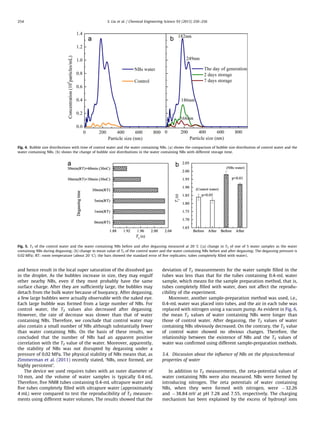
2012). Bubble-number density decreased with longer storage
times, which was supported by results shown in Fig. 4, in which
both the total number of bubbles and size of the main bubbles
decreased with longer storage time. The main bubble size
observed was classified into two sizes, 182 and 249 nm, on the
day of the generation of NBs; two days later, the bubble size was
186 nm, and seven days later it was 168 nm. The tendency of the
bubble sizes to shrink was clearly observed.
The total bubble-number density of water containing NBs was
1.97 Â 108
particles/mL on the day of the generation of NBs. For
control water, the total bubble-number density was approxi-
mately 0.09 Â 108
particles/mL, which was less than 1/20th the
density of water containing NBs (Fig. 4). The measurement was
done at room temperature, and the temperatures for the water
containing NBs and the control water were 29.8 and 28.7 1C,
respectively. Therefore, the effect of NBs on T2 was partly masked
by the paramagnetic effect of oxygen during measurements
performed after 2 or more days.
The presence of oxygen would shorten the relaxation time. To
eliminate the paramagnetic effect of oxygen in the head space, we
filled pressure-tight tubes with both control water and water
containing NBs to ensure that they contained no gas. As evident in
Fig. 3b, water containing NBs exhibited statistically longer T2
values than those of control water. The sample temperature was
20 1C. The pH values for control water and water containing NBs
were 7.91 and 8.01, respectively. The T2 values of both control
water and water containing NBs did not substantially change
even after 1 week, and the difference in their T2 values was still
obvious. Apart from the elimination of the paramagnetic effect of
oxygen, the closed environment, which precluded the presence
of gas above the water in the tube, might also account for the
prolonged existence of NBs.
3.3. Change in T2 values of control water and water containing NBs
after degassing
The results from the previously discussed experiments showed
that the introduction of NBs increased the T2 value of water. In
order to clarify the relationship between the T2 value of the water
and that of water containing NBs, degassing was used to remove
NBs from the water sample. If NBs were the only factor that
caused the increase in the T2 of the water; then, the T2 of degassed
water sample should decrease to the original T2 value.
After T2 measurements, both water containing NBs and control
water were degassed under a pressure of 0.02 MPa. The T2 values
were subsequently measured again to examine the effects of the
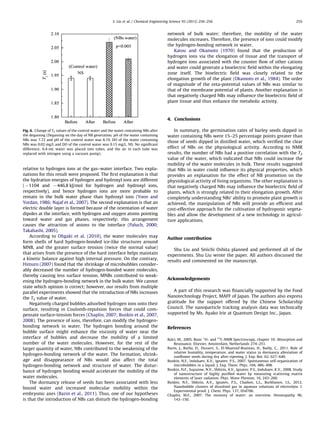
disappearance of NBs due to degassing. As evident in Fig. 5a, the
T2 value of one among five samples of degassed water containing
NBs decreased from 2.03 to 1.92 s. The T2 values did not change
until the samples were degassed for 5 min. After 30 min of
degassing at room temperature, the T2 value decreased only
slightly. NBs were apparently so stable that under a degassing
pressure of 0.02 MPa, they could not be easily removed. Therefore,
we increased the degassing temperature to 30 1C; after another
30 min of degassing at this temperature, the T2 value decreased to
1.96, and, 1 h later, the T2 value decreased to 1.92.
After the tendency of the T2 value to diminish with longer
degassing time was confirmed, the other nine water samples (five
samples of control water and four samples of water containing
NBs) were also degassed for 45 min at 30 1C. As shown in Fig. 5b,
the T2 values of water containing NBs obviously decreased after
degassing, and the values after degassing were still statistically
longer than that of control water.
For water containing NBs, after degassing, a few large bubbles
were formed from the coalescence of several NBs. Henry’s law
suggests that exposing a water droplet to an external pressure
lower than atmospheric pressure can reduce the solubility of air
Fig. 3. Time-dependent change of T2 values of the control water and the water containing NBs at 20 1C ((a) water sample of 0.4 mL in the NMR tube under air atmosphere;
(b) water samples filled in pressure-tight tubes; The bars showed the standard error of five replicates; tubes containing 0.4-mL water sample).
S. Liu et al. / Chemical Engineering Science 93 (2013) 250–256 253
and hence result in the local super saturation of the dissolved gas
in the droplet. As the bubbles increase in size, they may engulf
other nearby NBs, even if they most probably have the same
surface charge. After they are sufficiently large, the bubbles may
detach from the bulk water because of buoyancy. After degassing,
a few large bubbles were actually observable with the naked eye.
Each large bubble was formed from a large number of NBs. For
control water, the T2 values also decreased after degassing.
However, the rate of decrease was slower than that of water
containing NBs. Therefore, we conclude that control water may
also contain a small number of NBs although substantially fewer
than water containing NBs. On the basis of these results, we
concluded that the number of NBs had an apparent positive
correlation with the T2 value of the water. Moreover, apparently,
the stability of NBs was not disrupted by degassing under a
pressure of 0.02 MPa. The physical stability of NBs means that, as
Zimmerman et al. (2011) recently stated, ‘NBs, once formed, are
highly persistent’.
The device we used requires tubes with an outer diameter of
10 mm, and the volume of water samples is typically 0.4 mL.
Therefore, five NMR tubes containing 0.4-mL ultrapure water and
five tubes completely filled with ultrapure water (approximately
4 mL) were compared to test the reproducibility of T2 measure-
ments using different water volumes. The results showed that the
deviation of T2 measurements for the water sample filled in the
tubes was less than that for the tubes containing 0.4-mL water
sample, which means for the sample preparation method, that is,
tubes completely filled with water, does not affect the reprodu-
cibility of the experiment.
Moreover, another sample-preparation method was used, i.e.,
0.4-mL water was placed into tubes, and the air in each tube was
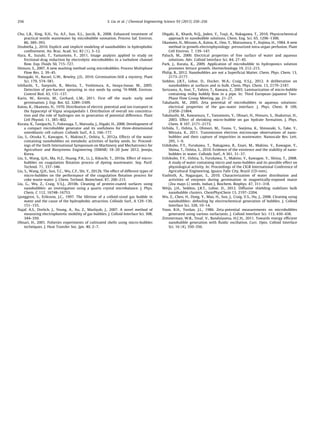
replaced with nitrogen using a vacuum pump. As evident in Fig. 6,
the mean T2 values of water containing NBs were longer than
those of control water. After degassing, the T2 values of water
containing NBs obviously decreased. On the contrary, the T2 value
of control water showed no obvious changes. Therefore, the
relationship between the existence of NBs and the T2 values of
water was confirmed using different sample-preparation methods.
3.4. Discussion about the influence of NBs on the physicochemical
properties of water
In addition to T2 measurements, the zeta-potential values of
water containing NBs were also measured. NBs were formed by
introducing nitrogen. The zeta potentials of water containing
NBs, when they were formed with nitrogen, were À32.26
and À38.84 mV at pH 7.28 and 7.55, respectively. The charging
mechanism has been explained by the excess of hydroxyl ions
Fig. 4. Bubble size distributions with time of control water and the water containing NBs. (a) shows the comparison of bubble size distribution of control water and the
water containing NBs. (b) shows the change of bubble size distributions in the water containing NBs with different storage time.
Fig. 5. T2 of the control water and the water containing NBs before and after degassing measured at 20 1C ((a) change in T2 of one of 5 water samples as the water
containing NBs during degassing; (b) change in mean value of T2 of the control water and the water containing NBs before and after degassing; The degassing pressure is
0.02 MPa; RT: room temperature (about 20 1C); the bars showed the standard error of five replicates; tubes completely filled with water).
S. Liu et al. / Chemical Engineering Science 93 (2013) 250–256254
relative to hydrogen ions at the gas–water interface. Two expla-
nations for this result were proposed. The first explanation is that
the hydration energies of hydrogen and hydroxyl ions are different
(À1104 and À446.8 kJ/mol for hydrogen and hydroxyl ions,
respectively), and hence hydrogen ions are more probable to
remain in the bulk water phase than hydroxyl ions (Yoon and
Yordan, 1986; Najaf et al., 2007). The second explanation is that an
electric double layer is formed because of the orientation of water
dipoles at the interface, with hydrogen and oxygen atoms pointing
toward water and gas phases, respectively; this arrangement
causes the attraction of anions to the interface (Paluch, 2000;
Takahashi, 2005).
According to Ohgaki et al. (2010), the water molecules may
form shells of hard hydrogen-bonded ice-like structures around
MNB, and the greater surface tension (twice the normal value)
that arises from the presence of the hard interface helps maintain
a kinetic balance against high internal pressure. On the contrary,
Himuro (2007) found that the shrinkage of microbubbles consider-
ably decreased the number of hydrogen-bonded water molecules,
thereby causing less surface tension. MNBs contributed to weak-
ening the hydrogen-bonding network in the bulk water. We cannot
state which opinion is correct; however, our results from multiple
parallel experiments showed that the introduction of NBs increases
the T2 value of water.
Negatively charged bubbles adsorbed hydrogen ions onto their
surface, resulting in Coulomb-repulsion forces that could com-
pensate surface-tension forces (Chaplin, 2007; Bunkin et al., 2007,
2008). The presence of ions, therefore, can modify the hydrogen-
bonding network in water. The hydrogen bonding around the
bubble surface might enhance the viscosity of water near the
interface of bubbles and decrease the mobility of a limited
number of the water molecules. However, for the rest of the
larger quantity of water, NBs contributed to the weakening of the
hydrogen-bonding network of the water. The formation, shrink-
age and disappearance of NBs would also affect the total
hydrogen-bonding network and structure of water. The distur-
bance of hydrogen bonding would accelerate the mobility of the
water molecules.
The dormancy release of seeds has been associated with less
bound water and increased molecular mobility within the
embryonic axes (Bazin et al., 2011). Thus, one of our hypotheses
is that the introduction of NBs can disturb the hydrogen-bonding
network of bulk water; therefore, the mobility of the water
molecules increases. Therefore, the presence of ions could modify
the hydrogen-bonding network in water.
Katou and Okamoto (1970) found that the production of
hydrogen ions via the elongation of tissue and the transport of
hydrogen ions associated with the counter flow of other cations
and water could generate a bioelectric field within the elongating
zone itself. The bioelectric field was closely related to the
elongation growth of the plant (Okamoto et al., 1984). The order
of magnitude of the zeta-potential values of NBs was similar to
that of the membrane potential of plants. Another explanation is
that negatively charged NBs may influence the bioelectric field of
plant tissue and thus enhance the metabolic activity.
4. Conclusions
In summary, the germination rates of barley seeds dipped in
water containing NBs were 15–25 percentage points greater than
those of seeds dipped in distilled water, which verified the clear
effect of NBs on the physiological activity. According to NMR
results, the number of NBs had a positive correlation with the T2
value of the water, which indicated that NBs could increase the
mobility of the water molecules in bulk. These results suggested
that NBs in water could influence its physical properties, which
provides an explanation for the effect of NB promotion on the
physiological activity of living organisms. The other explanation is
that negatively charged NBs may influence the bioelectric field of
plants, which is strongly related to their elongation growth. After
completely understanding NBs’ ability to promote plant growth is
achieved, the manipulation of NBs will provide an efficient and
cost-effective approach for the cultivation of hydroponic vegeta-
bles and allow the development of a new technology in agricul-
ture applications.
Author contribution
Shu Liu and Seiichi Oshita planned and performed all of the
experiments. Shu Liu wrote the paper. All authors discussed the
results and commented on the manuscript.
Acknowledgements
A part of this research was financially supported by the Food
Nanotechnology Project, MAFF of Japan. The authors also express
gratitude for the support offered by the Chinese Scholarship
Council. The nanoparticle tracking analysis data was technically
supported by Ms. Ayako Irie at Quantum Design Inc., Japan.
References
Balci, M., 2005. Basic 1
H- and 13
C-NMR Spectroscopy, chapter 10: Absorption and
Resonance. Elsevier, Amsterdam, Netherlands 274–251.
Bazin, J., Batlla, D., Dussert, S., EI-Maarouf-Bouteau, H., Bailly, C., 2011. Role of
relative humidity, temperature, and water status in dormancy alleviation of
sunflower seeds during dry after-ripening. J. Exp. Bot. 62, 627–640.
Bunkin, N.F., Indukaev, K.V., Ignatev, P.S., 2007. Spontaneous self-organization of
microbubbles in a liquid. J. Exp. Theor. Phys. 104, 486–498.
Bunkin, N.F., Suyazow, N.V., Shkirin, A.V., Ignatev, P.S., Indukaev, K.V., 2008. Study
of nanostructure of highly purified water by measuring scattering matrix
elements of laser radiation. Phys. Wave Phenom. 16, 243–260.
Bunkin, N.F., Shkirin, A.V., Ignatev, P.S., Chaikov, L.L., Burkhanov, I.S., 2012.
Nanobubble clusters of dissolved gas in aqueous solutions of electrolyte. I.
Experimental proof. J. Chem. Phys. 137, 054706.
Chaplin, M.F., 2007. The memory of water: an overview. Homeopathy 96,
143–150.
Fig. 6. Change of T2 values of the control water and the water containing NBs after
the degassing (Degassing on the day of NB generation. pH of the water containing
NBs was 7.72 and pH of the control water was 8.19. DO of the water containing
NBs was 0.02 mg/L and DO of the control water was 0.15 mg/L. NS: No significant
difference; 0.4-mL water was placed into tubes, and the air in each tube was
replaced with nitrogen using a vacuum pump).
S. Liu et al. / Chemical Engineering Science 93 (2013) 250–256 255
Chu, L.B., Xing, X.H., Yu, A.F., Sun, X.L., Jurcik, B., 2008. Enhanced treatment of
practical textile wastewater by microbubble ozonation. Process Saf. Environ.
86, 389–393.
Dzubiella, J., 2010. Explicit and implicit modeling of nanobubbles in hydrophobic
confinement. An. Braz. Acad. Sci. 82 (1), 3–12.
Hara, K., Suzuki, T., Yamamoto, F., 2011. Image analysis applied to study on
frictional-drag reduction by electrolytic microbubbles in a turbulent channel
flow. Exp. Fluids 50, 715–727.
Himuro, S., 2007. A new washing method using microbubbles. Process Multiphase
Flow Res. 2, 39–45.
Nonogaki, H., Bassel, G.W., Bewley, J.D., 2010. Germination-Still a mystery. Plant
Sci. 179, 574–581.
Ishibashi, Y., Sueyoshi, R., Morita, T., Yoshimura, A., Iwaya-Inoue, M., 2005.
Detection of pre-harvest sprouting in rice seeds by using 1
H-NMR. Environ.
Control Biol. 43, 131–137.
Karin, W., Kerstin, M., Gerhard, L.M., 2011. First off the mark: early seed
germination. J. Exp. Bot. 62, 3289–3309.
Katou, K., Okamoto, H., 1970. Distribution of electric potential and ion transport in
the hypocotyl of Vigna sesquipedalis I. Distribution of overall ion concentra-
tion and the role of hydrogen ion in generation of potential difference. Plant
Cell Physiol. 11, 385–402.
Kurata, K., Taniguchi, T., Fukunaga, T., Matsuda, J., Higaki, H., 2008. Development of
a compact microbubble generator and its usefulness for three-dimensional
osteoblastic cell culture. Colloids Surf., A 2, 166–177.
Liu, S., Otsuka Y., Kawagoe, Y., Makino,Y., Oshita, S., 2012a. Effects of the water
containing nanobubbles on metabolic activities of barley seeds. In: Proceed-
ings of the Sixth International Symposium on Machinery and Mechatronics for
Agriculture and Biosystems Engineering (ISMAB) 18–20 June 2012, Jeonju,
Korea.
Liu, S., Wang, Q.H., Ma, H.Z., Huang, P.K., Li, J., Kikuchi, T., 2010a. Effect of micro-
bubbles on coagulation flotation process of dyeing wastewater. Sep. Purif.
Technol. 71, 337–346.
Liu, S., Wang, Q.H., Sun, T.C., Wu, C.F., Shi, Y., 2012b. The effect of different types of
micro-bubbles on the performance of the coagulation flotation process for
coke waste-water. J. Chem. Technol. Biotechnol. 87, 206–215.
Liu, G., Wu, Z., Craig, V.S.J., 2010b. Cleaning of protein-coated surfaces using
nanobubbles: an investigation using a quartz crystal microbalance. J. Phys.
Chem. C 112, 16748–16753.
Ljunggren, S., Eriksson, J.C., 1997. The lifetime of a colloid-sized gas bubble in
water and the cause of the hydrophobic attraction. Colloids Surf., A 129–130,
151–155.
Najaf, A.S., Drelich, J., Yeung, A., Xu, Z., Masliyah, J., 2007. A novel method of
measuring electrophoretic mobility of gas bubbles. J. Colloid Interface Sci. 308,
344–350.
Ohnari, H., 2001. Fisheries experiments of cultivated shells using micro-bubbles
techniques. J. Heat Transfer Soc. Jpn. 40, 2–7.
Ohgaki, K., Khanh, N.Q., Joden, Y., Tsuji, A., Nakagawa, T., 2010. Physicochemical
approach to nanobubble solutions. Chem. Eng. Sci. 65, 1296–1300.
Okamoto, H., Mizuno, A., Katou, K., Ono, Y., Matsumura, Y., Kojima, H., 1984. A new
method in growth-electrophysiology: pressurized intra-organ perfusion. Plant
Cell Environ. 7, 139–147.
Paluch, M., 2000. Electrical properties of free surface of water and aqueous
solutions. Adv. Colloid Interface Sci. 84, 27–45.
Park, J., Kurata, K., 2009. Application of microbubble to hydroponics solution
promotes lettuce growth. Horttechnology 19, 212–215.
Philip, B., 2012. Nanobubbles are not a Superficial Matter. Chem. Phys. Chem. 13,
2173–2177.
Seddon, J.R.T., Lohse, D., Ducker, W.A., Craig, V.S.J., 2012. A deliberation on
nanobubbles at surfaces and in bulk. Chem. Phys. Chem. 13, 2179–2187.
Serizawa, A., Inui, T., Yahiro, T., Kawara, Z., 2003. Laminarization of micro-bubble
containing milky bubbly flow in a pipe. In: Third European–Japanese Two-
Phase Flow Group Meeting, pp. 21–27.
Takahashi, M., 2005. Zeta potential of microbubbles in aqueous solutions:
electrical properties of the gas–water interface. J. Phys. Chem. B 109,
21858–21864.
Takahashi, M., Kawamura, T., Yamamoto, Y., Ohnari, H., Himuro, S., Shakutsui, H.,
2003. Effect of shrinking micro-bubble on gas hydrate formation. J. Phys.
Chem. B 107, 2171–2173.
Uchida, T., Oshita, S., Ohmori, M., Tsuno, T., Soejima, K., Shinozaki, S., Take, Y.,
Mitsuta, K., 2011. Transmission electron microscope observations of nano-
bubbles and their capture of impurities in wastewater. Nanoscale Res. Lett.
295, 1–9.
Ushikubo, F.Y., Furukawa, T., Nakagawa, R., Enari, M., Makino, Y., Kawagoe, Y.,
Shiina, T., Oshita, S., 2010. Evidence of the existence and the stability of nano-
bubbles in water. Colloids Surf., A 361, 31–37.
Ushikubo, F.Y., Oshita, S., Furukawa, T., Makino, Y., Kawagoe, Y., Shiina, T., 2008.
A study of water containing micro and nano-bubbles and its possible effect on
physiological activity. In: Proceedings of the CIGR International Conference of
Agricultural Engineering, Iguazu Falls City, Brazil (CD-rom).
Vashisth, A., Nagarajan, S., 2010. Characterization of water distribution and
activities of enzymes during germination in magnetically-exposed maize
(Zea mays L) seeds. Indian J. Biochem. Biophys. 47, 311–318.
Weijs, J.H., Seddon, J.R.T., Lohse, D., 2012. Diffusive shielding stabilizes bulk
nanobubble clusters. ChemPhysChem 13, 2197–2204.
Wu, Z., Chen, H., Dong, Y., Mao, H., Sun, J., Craig, V.S., Hu, J., 2008. Cleaning using
nanobubbles: defouling by electrochemical generation of bubbles. J. Colloid
Interface Sci. 328, 10–14.
Yoon, R.H., Yordan, J.L., 1986. Zeta-potential measurements on microbubbles
generated using various surfactants. J. Colloid Interface Sci. 113, 430–438.
Zimmerman, W.B., Tesaˇr, V., Bandulasena, H.C.H., 2011. Towards energy efficient
nanobubble generation with fluidic oscillation. Curr. Opin. Colloid Interface
Sci. 16 (4), 350–356.
S. Liu et al. / Chemical Engineering Science 93 (2013) 250–256256

1 s2.0-s0009250913000948-main

  • 1.
    Effects of nanobubbleson the physicochemical properties of water: The basis for peculiar properties of water containing nanobubbles Shu Liu a , Yoshinori Kawagoe b , Yoshio Makino a , Seiichi Oshita a,n a Graduate School of Agricultural & Life Sciences, The University of Tokyo, Yayoi 1-1-1, Bunkyo-ku, Tokyo 113-8657, Japan b College of Bioresource Sciences, Nihon University, Kameino 1866, Fujisawa, Kanagawa 252-0880, Japan H I G H L I G H T S c Germination rates of barley seeds dipped in nanobubbles(NBs) water increased. c The number of NBs had a positive correlation with the T2 value of the water. c NBs could increase the mobility of the water molecules in bulk. G R A P H I C A L A B S T R A C T G: germinating seed, NG: non-germinating seed. a r t i c l e i n f o Article history: Received 27 June 2012 Received in revised form 17 January 2013 Accepted 4 February 2013 Available online 11 February 2013 Keywords: Bubble Food processing Metabolism Nanostructure Proton relaxation time T2 Water mobility a b s t r a c t The mechanism with which nanobubbles (NBs) promote physiological activity is investigated using germination tests and nuclear magnetic resonance (NMR) relaxation-time measurements. The germi- nation rates of barley seeds dipped in water containing NBs (bubbles formed from gas mixtures of nitrogen and pure air) were 15–25 percentage points greater than those of the seed dipped in distilled water with the same concentration of dissolved oxygen (DO). In addition, the proton NMR relaxation time, T2, of water containing NBs (bubbles formed from nitrogen) was measured and compared with the T2 of control water (water without bubbles or DO). After T2 measurements, both water containing NBs and control water were degassed, and the T2 values were subsequently measured again to examine its changes before and after degassing. Water containing NBs exhibited T2 values that were statistically longer than those of control water. After degassing, the T2 values of water containing NBs decreased, which indicated that the decrease in the NB number density shortened T2. On the basis of these results, we concluded that the number of NBs was positively correlated with the T2 value of the water. The increase in T2 with the generation of NBs indicated that the mobility of the water molecules increased; consequently, a longer time was required to reach the equilibrium state through spin–spin relaxation. These observations indicated that the NBs in water could influence the physical properties of water and that it could also be used to verify the stability of NBs in the water. & 2013 Elsevier Ltd. All rights reserved. 1. Introduction Micro- and nanobubbles (MNBs) have been a subject of inten- sive research over the past decade. The characteristics of MNBs include the increased solubility of gases in liquids, reduced friction, either negative or positive zeta potentials and the generation of free radicals (Takahashi et al., 2003; Serizawa et al., 2003; Chu et al., 2008), leading to numerous promising applications. A few of these applications include the sewage treatment of polluted water by air flotation (Liu et al., 2012b, 2010), reducing the friction of flowing liquids (Hara et al., 2011) and the detergent-free cleaning of adsorbed proteins (Liu et al., 2010; Wu et al., 2008). Contents lists available at SciVerse ScienceDirect journal homepage: www.elsevier.com/locate/ces Chemical Engineering Science 0009-2509/$ - see front matter & 2013 Elsevier Ltd. All rights reserved. http://dx.doi.org/10.1016/j.ces.2013.02.004 n Corresponding author. Tel.: þ81 3 5841 5362. E-mail address: aoshita@mail.ecc.u-tokyo.ac.jp (S. Oshita). Chemical Engineering Science 93 (2013) 250–256
  • 2.
    Recently, the applicationof MNB technology in biological processes has been focused upon considerably. Water that con- tains MNBs has been reported to accelerate the growth of plants and shellfish and has also been used in the aerobic cultivation of yeast. The air micro-bubble supply resulted in a better cultivation of oysters (Heterocapsa circularisquama) in terms of size and taste (Ohnari, 2001). Kurata et al. (2008), who applied oxygen micro-bubbles in an osteoblast cell-culture system, reported greater alkaline phosphatase activity, which was related to increased osteoblastic cell activity. Park and Kurata (2009) found that fresh weights of micro-bubble treated lettuces were 2.1 times greater than those of the macro-bubble treated lettuces, when grown under a similar dissolved oxygen (DO) concentration. Ushikubo et al. (2008) showed that when barley coleoptile cells were floated in water after the generation of oxygen MNBs, cytoplasmic streaming rates inside the cells were accelerated. Moreover, nanobubbles (NBs) may provide a transport mechan- ism for gas delivery to a membrane or cell and thus affect trans- membrane proteins or the membrane structure. Both effects considerably alter the cell function (Dzubiella, 2010; Seddon et al., 2012). However, no explanations have been provided for these new scientific findings. Furthermore, according to classical thermo- dynamic theory, NBs do not exist (Ljunggren and Eriksson, 1997). Although numerous researchers have reported their existence in water on the basis of the results of experiments (Ushikubo et al., 2010; Uchida et al., 2011; Weijs et al., 2012), a few fundamental aspects of the water containing NBs still remain unclear (Philip, 2012). Thus, basic research on the physicochemical properties of water containing NBs is important. In this study, we attempted to use a germination test to verify the ability of NBs to promote the metabolism of barley seeds and provide reasonable and convincing explanations of these effects by basic research on the physical properties of water containing NBs. 2. Materials and methods 2.1. Seed germination 2.1.1. Seed material Seeds of barley (Hordeum vulgare L.), which were harvested in 2011 and stored under controlled conditions (room temperature), were obtained from the University of Ehime, Japan. These seeds were screened with a magnifying lens, and only large seeds without visible defects were selected. 2.1.2. Germination tests Germination tests were performed with a pair of seed groups composed of 100 and/or 120 barley seeds each. Each group was sealed in plastic net bags; one group was dipped in a 1-L beaker filled with distilled water containing NBs and the other in a beaker filled with distilled water. The gas mixture, which con- tained nitrogen (purity 99.99995%, Taiyo Nippon Sanso Co. Ltd., Japan) and air (CO2 o1 ppm, THCo1 ppm, Taiyo Nippon Sanso Co. Ltd., Japan), was introduced into distilled water through a micro-bubble generator (OM4-GP-040, Aura Tec Co. Ltd., Japan) for 1 h at a constant temperature of 20 1C to prepare ‘water containing NBs. The DO concentration of water containing NBs was adjusted to be the same as that of distilled water through a mixed-gas flow regulator (Log MIX-D100A-0050 and Log MIX- D100A-0052, FRONTO Co. Ltd., Japan). Germination temperature was maintained at 25 1C with a water bath. After the seeds had been dipped in the water for approximately 20 h, germination rate was determined. 2.1.3. NMR measurements The proton spin–spin relaxation times (T2) were measured using a pulsed spectrometer (JNM-MU25A, JEOL, Japan) operated at 25 MHz and at a constant temperature of 20 1C. The pulse sequence used for T2 was the Carr–Purcell–Meiboom–Gill sequence. Five replicates of each sample were collected in NMR tubes with an outer diameter of 10 mm and were then sealed. 2.1.4. Samples for NMR measurements Twelve seeds were collected from the beaker filled with 1-L distilled water or from water containing NBs. The seeds were wiped gently with a tissue paper to remove external water and were immediately analysed using NMR. The volume height of the seed sample in the NMR tube was approximately 2 cm. 2.2. Properties of water with and without NBs 2.2.1. Ultrapure water Ultrapure water was obtained using a water-purification sys- tem (Direct-Q, Nihon Millipore Ltd., Japan), which was equipped with a reverse-osmosis cartridge and ion-exchange and activated- carbon modules. According to the results of nanoparticle-tracking analysis (Z-NTA, Quantum Design Inc., Japan), ultrapure water did not contain any particles or bubbles (data not shown), but it naturally contained approximately 6–9-mg/L dissolved oxygen. 2.2.2. Control water Ideally, control water should exhibit a low DO concentration and be free of bubbles. To remove DO from ultrapure water, bubbling method was used. Dissolved gasses were purged in 2-L ultra-pure water via the direct introduction of nitrogen gas through a tube with an inner diameter of 4 mm. The DO concentration of this control water was less than 0.15 mg/L, and few bubbles were observed using a laser-scattering image system (Zeecom, Microtech Co. Ltd., Japan). 2.2.3. Water containing NBs Control water was placed in an Erlenmeyer flask. The gas (N2, purity 99.99995%, Taiyo Nippon Sanso Co. Ltd., Japan) was introduced into the water through a micro-bubble generator for 1 h at a constant temperature of 20 1C to obtain ‘water containing NBs’. The difference between DO concentration in control water and that in water containing NBs was less than 0.05 mg/L. 2.2.4. Samples for NMR measurement For NMR measurements, the volume of water samples was typically 0.4 mL. In this study, two methods were used to eliminate the paramagnetic effect of dissolved oxygen. In the first method, NMR tubes were filled with water and then sealed. In the second method, after 0.4-mL water was placed in each tube, and a vacuum pump (5 L/min, 60 Hz and 0.02 MPa) was used to degas the air in the headspace of the water sample for 15 s. Next, the air was replaced by nitrogen from a gas bag through a three-way value. All tubes were stored in an incubator at 20 1C. Five replicates of each sample were collected in pressure-tight tubes with inner diameters of 8.5 mm and then sealed. 2.2.5. Bubble-size distribution Bubble-size distributions were measured using the nano- particle tracking analysis method (NanoSight-LM10, Quantum Design Inc., Japan). Using a laser-illuminated optical microscope, we observed NBs as light-scattering centres moving under Brow- nian motion. After NBs were generated, water containing NBs was stored in 15 BOD bottles in an incubator at 20 1C. Bubble-size S. Liu et al. / Chemical Engineering Science 93 (2013) 250–256 251
  • 3.
    distribution was subsequentlymeasured as a function of storage time. 2.2.6. Degassing A vacuum pump (5 L/min, 50 Hz and 0.02 MPa) was used to degas water samples. The pressure for degassing was approxi- mately 0.02 MPa. After the water was degassed, the head space of the NMR tubes was filled with nitrogen to maintain the water sample under atmospheric pressure. Degassing was conducted with the samples placed in a water bath at 30 1C. 2.3. Zeta potential Zeta-potential measurements were performed with a Zeta Potential Analyzer (Zeecom, Microtech Co. Ltd., Japan). This system detects the electrophoretic mobility of particles and is equipped with a microscope and CCD camera to observe the movement of particles in the range 20–100 mm. Small particles can be observed by the scattering of laser light. Fifty particles were tracked manually to determine their speed, and zeta potential was calculated using the Smoluchowski equation. 2.4. DO concentration DO concentration was measured in both control water and water containing NBs at 20 1C using a DO metre (SG6, Mettler Toledo GmbH, Switzerland). 2.5. Statistical analysis Statistical tests were performed using the EXCEL 2007 soft- ware. The paired-sample t-test was used to compare the differ- ence between control water and water containing NBs with a significance level (p-value) of 0.0005–0.25. 3. Results and discussion 3.1. Seed-germination tests Seed germination is a crucial process in the seed-plant life cycle and is also important for plant establishment in natural and agricultural ecosystems (Karin et al., 2011). During germination, the seeds rapidly recover physically from maturation drying, resume a sustained intensity of metabolism, complete essential cellular events to allow the embryo to emerge and prepare for subsequent seeding growth (Nonogaki et al., 2010). Therefore, germination test is an appropriate method to verify the ability of water containing NBs to promote physiological processes. Comparison experiments were performed using distilled water and water containing NBs produced from each batch of distilled water. The DO concentration of distilled water was approximately 9 mg/L. NBs were formed from the mixture of nitrogen and air and the DO concentration of water containing NBs was adjusted to be the same as that of distilled water. Germination rate was calculated on the basis of the following formula: Germination rate¼(The number of germinated seeds)/(the total number of seeds) Â 100% As shown in Fig. 1, six repetitive germination experiments showed that the germination rates of barley seeds dipped in water containing NBs were 15–25 percentage points greater than that of those dipped in distilled water; these results clearly verify the physiological effect of NBs. The earlier germination might be explained by greater activities of germination-related enzymes, the early hydration of the membrane and greater molecular mobility of the bulk and hydration water fractions (Vashisth and Nagarajan (2010)). The proton–nuclear magnetic resonance relaxation time can be used to detect weak molecular interactions such as hydrogen bonding, molecular mobility and steric effects (Balci, 2005). Thus, it is widely used to study the mobility and diffusion of the water molecules in agriculture and food fields. Recently, both spin–lattice relaxation time (T1) and spin–spin relaxation time (T2) of germi- nated seeds dipped in water containing NBs were reported to be significantly greater than those of seeds dipped in distilled water (Liu et al., 2012a). Moreover, Ishibashi et al. (2005) have reported that T2 is a suitable indicator for examining the degree of endosperm degradation in germinating seeds of rice, which was, in turn, related to the availability of T2 as a probe for metabolic activities. Thus, in this research, the water status of seeds dipped in water containing NBs and in distilled water during germination was determined via NMR spectroscopy. The T2 of barley seeds was composed of two components: T2a (long) and T2b (short). As evident in Fig. 2, two repetitive experiments showed that the T2 values of germinated seeds dipped in water containing NBs were significantly greater than those dipped in distilled water (po0.05). 3.2. Change in T2 values of control water and water containing NBs as a function of the water-storage time Considering these results, spin–spin relaxation times (T2) in both control water and water containing NBs were measured 1 2 3 4 5 6 20 40 60 80 100 Germinationrate(%) Test number Distilled water NBs water Fig. 1. Comparison of barley seed germination rate between the water containing NBs and the distilled water under the same DO concentration (The average values of germination rates in the water containing NBs and the distilled water were 77.9 and 59.2%, respectively). 50 60 70 80 90 Test number 1 2 1 2 5 6 7 8 9 10 Distilled water NBs water Distilled water NBs water Test number Fig. 2. T2 of germinated seeds dipped in the water containing NBs and distilled water (T2a and T2b are the long and the short components of T2; The bars showed the standard error of five replicates). S. Liu et al. / Chemical Engineering Science 93 (2013) 250–256252
  • 4.
    using a pulsedspectrometer (JNM-MU25A, JEOL, Japan) at 25 MHz to determine the effect of NBs on the physicochemical properties of water in bulk. Under normal conditions, a significance level greater than 0.05 is not meaningful. To compare the difference between control water and water containing NBs as a function of storage time, test levels with p values greater than 0.05 (0.1 and 0.25) were also used. Water containing NBs displayed statistically longer T2 values compared to those of control water, as shown in Fig. 3a. Sample temperature was 20 1C. The pH values for control water and water containing NBs were 6.31 and 7.06, respectively. The T2 of the proton is independent of the pH value. The T2 values of both control water and water containing NBs decreased after 2 days, and the difference in the T2 values observed on the day of the generation of NBs became unclear with time. T2 values and the difference in T2 values decreased because oxygen (a paramagnetic molecule) in the head space of the NMR tube dissolved in the water, which resulted in elevated DO in sample water and consequently, a reduced T2 value. Bubble-size distributions were simultaneously measured using the nanoparticle tracking analysis method, a kind of Dynamic Light Scattering (NanoSight-LM10, Quantum Design Inc., Japan), which has been widely used to determine the sizes of nanoparticles in liquids (Bunkin et al., 2012). Bubble-number density decreased with longer storage times, which was supported by results shown in Fig. 4, in which both the total number of bubbles and size of the main bubbles decreased with longer storage time. The main bubble size observed was classified into two sizes, 182 and 249 nm, on the day of the generation of NBs; two days later, the bubble size was 186 nm, and seven days later it was 168 nm. The tendency of the bubble sizes to shrink was clearly observed. The total bubble-number density of water containing NBs was 1.97 Â 108 particles/mL on the day of the generation of NBs. For control water, the total bubble-number density was approxi- mately 0.09 Â 108 particles/mL, which was less than 1/20th the density of water containing NBs (Fig. 4). The measurement was done at room temperature, and the temperatures for the water containing NBs and the control water were 29.8 and 28.7 1C, respectively. Therefore, the effect of NBs on T2 was partly masked by the paramagnetic effect of oxygen during measurements performed after 2 or more days. The presence of oxygen would shorten the relaxation time. To eliminate the paramagnetic effect of oxygen in the head space, we filled pressure-tight tubes with both control water and water containing NBs to ensure that they contained no gas. As evident in Fig. 3b, water containing NBs exhibited statistically longer T2 values than those of control water. The sample temperature was 20 1C. The pH values for control water and water containing NBs were 7.91 and 8.01, respectively. The T2 values of both control water and water containing NBs did not substantially change even after 1 week, and the difference in their T2 values was still obvious. Apart from the elimination of the paramagnetic effect of oxygen, the closed environment, which precluded the presence of gas above the water in the tube, might also account for the prolonged existence of NBs. 3.3. Change in T2 values of control water and water containing NBs after degassing The results from the previously discussed experiments showed that the introduction of NBs increased the T2 value of water. In order to clarify the relationship between the T2 value of the water and that of water containing NBs, degassing was used to remove NBs from the water sample. If NBs were the only factor that caused the increase in the T2 of the water; then, the T2 of degassed water sample should decrease to the original T2 value. After T2 measurements, both water containing NBs and control water were degassed under a pressure of 0.02 MPa. The T2 values were subsequently measured again to examine the effects of the disappearance of NBs due to degassing. As evident in Fig. 5a, the T2 value of one among five samples of degassed water containing NBs decreased from 2.03 to 1.92 s. The T2 values did not change until the samples were degassed for 5 min. After 30 min of degassing at room temperature, the T2 value decreased only slightly. NBs were apparently so stable that under a degassing pressure of 0.02 MPa, they could not be easily removed. Therefore, we increased the degassing temperature to 30 1C; after another 30 min of degassing at this temperature, the T2 value decreased to 1.96, and, 1 h later, the T2 value decreased to 1.92. After the tendency of the T2 value to diminish with longer degassing time was confirmed, the other nine water samples (five samples of control water and four samples of water containing NBs) were also degassed for 45 min at 30 1C. As shown in Fig. 5b, the T2 values of water containing NBs obviously decreased after degassing, and the values after degassing were still statistically longer than that of control water. For water containing NBs, after degassing, a few large bubbles were formed from the coalescence of several NBs. Henry’s law suggests that exposing a water droplet to an external pressure lower than atmospheric pressure can reduce the solubility of air Fig. 3. Time-dependent change of T2 values of the control water and the water containing NBs at 20 1C ((a) water sample of 0.4 mL in the NMR tube under air atmosphere; (b) water samples filled in pressure-tight tubes; The bars showed the standard error of five replicates; tubes containing 0.4-mL water sample). S. Liu et al. / Chemical Engineering Science 93 (2013) 250–256 253
  • 5.
    and hence resultin the local super saturation of the dissolved gas in the droplet. As the bubbles increase in size, they may engulf other nearby NBs, even if they most probably have the same surface charge. After they are sufficiently large, the bubbles may detach from the bulk water because of buoyancy. After degassing, a few large bubbles were actually observable with the naked eye. Each large bubble was formed from a large number of NBs. For control water, the T2 values also decreased after degassing. However, the rate of decrease was slower than that of water containing NBs. Therefore, we conclude that control water may also contain a small number of NBs although substantially fewer than water containing NBs. On the basis of these results, we concluded that the number of NBs had an apparent positive correlation with the T2 value of the water. Moreover, apparently, the stability of NBs was not disrupted by degassing under a pressure of 0.02 MPa. The physical stability of NBs means that, as Zimmerman et al. (2011) recently stated, ‘NBs, once formed, are highly persistent’. The device we used requires tubes with an outer diameter of 10 mm, and the volume of water samples is typically 0.4 mL. Therefore, five NMR tubes containing 0.4-mL ultrapure water and five tubes completely filled with ultrapure water (approximately 4 mL) were compared to test the reproducibility of T2 measure- ments using different water volumes. The results showed that the deviation of T2 measurements for the water sample filled in the tubes was less than that for the tubes containing 0.4-mL water sample, which means for the sample preparation method, that is, tubes completely filled with water, does not affect the reprodu- cibility of the experiment. Moreover, another sample-preparation method was used, i.e., 0.4-mL water was placed into tubes, and the air in each tube was replaced with nitrogen using a vacuum pump. As evident in Fig. 6, the mean T2 values of water containing NBs were longer than those of control water. After degassing, the T2 values of water containing NBs obviously decreased. On the contrary, the T2 value of control water showed no obvious changes. Therefore, the relationship between the existence of NBs and the T2 values of water was confirmed using different sample-preparation methods. 3.4. Discussion about the influence of NBs on the physicochemical properties of water In addition to T2 measurements, the zeta-potential values of water containing NBs were also measured. NBs were formed by introducing nitrogen. The zeta potentials of water containing NBs, when they were formed with nitrogen, were À32.26 and À38.84 mV at pH 7.28 and 7.55, respectively. The charging mechanism has been explained by the excess of hydroxyl ions Fig. 4. Bubble size distributions with time of control water and the water containing NBs. (a) shows the comparison of bubble size distribution of control water and the water containing NBs. (b) shows the change of bubble size distributions in the water containing NBs with different storage time. Fig. 5. T2 of the control water and the water containing NBs before and after degassing measured at 20 1C ((a) change in T2 of one of 5 water samples as the water containing NBs during degassing; (b) change in mean value of T2 of the control water and the water containing NBs before and after degassing; The degassing pressure is 0.02 MPa; RT: room temperature (about 20 1C); the bars showed the standard error of five replicates; tubes completely filled with water). S. Liu et al. / Chemical Engineering Science 93 (2013) 250–256254
  • 6.
    relative to hydrogenions at the gas–water interface. Two expla- nations for this result were proposed. The first explanation is that the hydration energies of hydrogen and hydroxyl ions are different (À1104 and À446.8 kJ/mol for hydrogen and hydroxyl ions, respectively), and hence hydrogen ions are more probable to remain in the bulk water phase than hydroxyl ions (Yoon and Yordan, 1986; Najaf et al., 2007). The second explanation is that an electric double layer is formed because of the orientation of water dipoles at the interface, with hydrogen and oxygen atoms pointing toward water and gas phases, respectively; this arrangement causes the attraction of anions to the interface (Paluch, 2000; Takahashi, 2005). According to Ohgaki et al. (2010), the water molecules may form shells of hard hydrogen-bonded ice-like structures around MNB, and the greater surface tension (twice the normal value) that arises from the presence of the hard interface helps maintain a kinetic balance against high internal pressure. On the contrary, Himuro (2007) found that the shrinkage of microbubbles consider- ably decreased the number of hydrogen-bonded water molecules, thereby causing less surface tension. MNBs contributed to weak- ening the hydrogen-bonding network in the bulk water. We cannot state which opinion is correct; however, our results from multiple parallel experiments showed that the introduction of NBs increases the T2 value of water. Negatively charged bubbles adsorbed hydrogen ions onto their surface, resulting in Coulomb-repulsion forces that could com- pensate surface-tension forces (Chaplin, 2007; Bunkin et al., 2007, 2008). The presence of ions, therefore, can modify the hydrogen- bonding network in water. The hydrogen bonding around the bubble surface might enhance the viscosity of water near the interface of bubbles and decrease the mobility of a limited number of the water molecules. However, for the rest of the larger quantity of water, NBs contributed to the weakening of the hydrogen-bonding network of the water. The formation, shrink- age and disappearance of NBs would also affect the total hydrogen-bonding network and structure of water. The distur- bance of hydrogen bonding would accelerate the mobility of the water molecules. The dormancy release of seeds has been associated with less bound water and increased molecular mobility within the embryonic axes (Bazin et al., 2011). Thus, one of our hypotheses is that the introduction of NBs can disturb the hydrogen-bonding network of bulk water; therefore, the mobility of the water molecules increases. Therefore, the presence of ions could modify the hydrogen-bonding network in water. Katou and Okamoto (1970) found that the production of hydrogen ions via the elongation of tissue and the transport of hydrogen ions associated with the counter flow of other cations and water could generate a bioelectric field within the elongating zone itself. The bioelectric field was closely related to the elongation growth of the plant (Okamoto et al., 1984). The order of magnitude of the zeta-potential values of NBs was similar to that of the membrane potential of plants. Another explanation is that negatively charged NBs may influence the bioelectric field of plant tissue and thus enhance the metabolic activity. 4. Conclusions In summary, the germination rates of barley seeds dipped in water containing NBs were 15–25 percentage points greater than those of seeds dipped in distilled water, which verified the clear effect of NBs on the physiological activity. According to NMR results, the number of NBs had a positive correlation with the T2 value of the water, which indicated that NBs could increase the mobility of the water molecules in bulk. These results suggested that NBs in water could influence its physical properties, which provides an explanation for the effect of NB promotion on the physiological activity of living organisms. The other explanation is that negatively charged NBs may influence the bioelectric field of plants, which is strongly related to their elongation growth. After completely understanding NBs’ ability to promote plant growth is achieved, the manipulation of NBs will provide an efficient and cost-effective approach for the cultivation of hydroponic vegeta- bles and allow the development of a new technology in agricul- ture applications. Author contribution Shu Liu and Seiichi Oshita planned and performed all of the experiments. Shu Liu wrote the paper. All authors discussed the results and commented on the manuscript. Acknowledgements A part of this research was financially supported by the Food Nanotechnology Project, MAFF of Japan. The authors also express gratitude for the support offered by the Chinese Scholarship Council. The nanoparticle tracking analysis data was technically supported by Ms. Ayako Irie at Quantum Design Inc., Japan. References Balci, M., 2005. Basic 1 H- and 13 C-NMR Spectroscopy, chapter 10: Absorption and Resonance. Elsevier, Amsterdam, Netherlands 274–251. Bazin, J., Batlla, D., Dussert, S., EI-Maarouf-Bouteau, H., Bailly, C., 2011. Role of relative humidity, temperature, and water status in dormancy alleviation of sunflower seeds during dry after-ripening. J. Exp. Bot. 62, 627–640. Bunkin, N.F., Indukaev, K.V., Ignatev, P.S., 2007. Spontaneous self-organization of microbubbles in a liquid. J. Exp. Theor. Phys. 104, 486–498. Bunkin, N.F., Suyazow, N.V., Shkirin, A.V., Ignatev, P.S., Indukaev, K.V., 2008. Study of nanostructure of highly purified water by measuring scattering matrix elements of laser radiation. Phys. Wave Phenom. 16, 243–260. Bunkin, N.F., Shkirin, A.V., Ignatev, P.S., Chaikov, L.L., Burkhanov, I.S., 2012. Nanobubble clusters of dissolved gas in aqueous solutions of electrolyte. I. Experimental proof. J. Chem. Phys. 137, 054706. Chaplin, M.F., 2007. The memory of water: an overview. Homeopathy 96, 143–150. Fig. 6. Change of T2 values of the control water and the water containing NBs after the degassing (Degassing on the day of NB generation. pH of the water containing NBs was 7.72 and pH of the control water was 8.19. DO of the water containing NBs was 0.02 mg/L and DO of the control water was 0.15 mg/L. NS: No significant difference; 0.4-mL water was placed into tubes, and the air in each tube was replaced with nitrogen using a vacuum pump). S. Liu et al. / Chemical Engineering Science 93 (2013) 250–256 255
  • 7.
    Chu, L.B., Xing,X.H., Yu, A.F., Sun, X.L., Jurcik, B., 2008. Enhanced treatment of practical textile wastewater by microbubble ozonation. Process Saf. Environ. 86, 389–393. Dzubiella, J., 2010. Explicit and implicit modeling of nanobubbles in hydrophobic confinement. An. Braz. Acad. Sci. 82 (1), 3–12. Hara, K., Suzuki, T., Yamamoto, F., 2011. Image analysis applied to study on frictional-drag reduction by electrolytic microbubbles in a turbulent channel flow. Exp. Fluids 50, 715–727. Himuro, S., 2007. A new washing method using microbubbles. Process Multiphase Flow Res. 2, 39–45. Nonogaki, H., Bassel, G.W., Bewley, J.D., 2010. Germination-Still a mystery. Plant Sci. 179, 574–581. Ishibashi, Y., Sueyoshi, R., Morita, T., Yoshimura, A., Iwaya-Inoue, M., 2005. Detection of pre-harvest sprouting in rice seeds by using 1 H-NMR. Environ. Control Biol. 43, 131–137. Karin, W., Kerstin, M., Gerhard, L.M., 2011. First off the mark: early seed germination. J. Exp. Bot. 62, 3289–3309. Katou, K., Okamoto, H., 1970. Distribution of electric potential and ion transport in the hypocotyl of Vigna sesquipedalis I. Distribution of overall ion concentra- tion and the role of hydrogen ion in generation of potential difference. Plant Cell Physiol. 11, 385–402. Kurata, K., Taniguchi, T., Fukunaga, T., Matsuda, J., Higaki, H., 2008. Development of a compact microbubble generator and its usefulness for three-dimensional osteoblastic cell culture. Colloids Surf., A 2, 166–177. Liu, S., Otsuka Y., Kawagoe, Y., Makino,Y., Oshita, S., 2012a. Effects of the water containing nanobubbles on metabolic activities of barley seeds. In: Proceed- ings of the Sixth International Symposium on Machinery and Mechatronics for Agriculture and Biosystems Engineering (ISMAB) 18–20 June 2012, Jeonju, Korea. Liu, S., Wang, Q.H., Ma, H.Z., Huang, P.K., Li, J., Kikuchi, T., 2010a. Effect of micro- bubbles on coagulation flotation process of dyeing wastewater. Sep. Purif. Technol. 71, 337–346. Liu, S., Wang, Q.H., Sun, T.C., Wu, C.F., Shi, Y., 2012b. The effect of different types of micro-bubbles on the performance of the coagulation flotation process for coke waste-water. J. Chem. Technol. Biotechnol. 87, 206–215. Liu, G., Wu, Z., Craig, V.S.J., 2010b. Cleaning of protein-coated surfaces using nanobubbles: an investigation using a quartz crystal microbalance. J. Phys. Chem. C 112, 16748–16753. Ljunggren, S., Eriksson, J.C., 1997. The lifetime of a colloid-sized gas bubble in water and the cause of the hydrophobic attraction. Colloids Surf., A 129–130, 151–155. Najaf, A.S., Drelich, J., Yeung, A., Xu, Z., Masliyah, J., 2007. A novel method of measuring electrophoretic mobility of gas bubbles. J. Colloid Interface Sci. 308, 344–350. Ohnari, H., 2001. Fisheries experiments of cultivated shells using micro-bubbles techniques. J. Heat Transfer Soc. Jpn. 40, 2–7. Ohgaki, K., Khanh, N.Q., Joden, Y., Tsuji, A., Nakagawa, T., 2010. Physicochemical approach to nanobubble solutions. Chem. Eng. Sci. 65, 1296–1300. Okamoto, H., Mizuno, A., Katou, K., Ono, Y., Matsumura, Y., Kojima, H., 1984. A new method in growth-electrophysiology: pressurized intra-organ perfusion. Plant Cell Environ. 7, 139–147. Paluch, M., 2000. Electrical properties of free surface of water and aqueous solutions. Adv. Colloid Interface Sci. 84, 27–45. Park, J., Kurata, K., 2009. Application of microbubble to hydroponics solution promotes lettuce growth. Horttechnology 19, 212–215. Philip, B., 2012. Nanobubbles are not a Superficial Matter. Chem. Phys. Chem. 13, 2173–2177. Seddon, J.R.T., Lohse, D., Ducker, W.A., Craig, V.S.J., 2012. A deliberation on nanobubbles at surfaces and in bulk. Chem. Phys. Chem. 13, 2179–2187. Serizawa, A., Inui, T., Yahiro, T., Kawara, Z., 2003. Laminarization of micro-bubble containing milky bubbly flow in a pipe. In: Third European–Japanese Two- Phase Flow Group Meeting, pp. 21–27. Takahashi, M., 2005. Zeta potential of microbubbles in aqueous solutions: electrical properties of the gas–water interface. J. Phys. Chem. B 109, 21858–21864. Takahashi, M., Kawamura, T., Yamamoto, Y., Ohnari, H., Himuro, S., Shakutsui, H., 2003. Effect of shrinking micro-bubble on gas hydrate formation. J. Phys. Chem. B 107, 2171–2173. Uchida, T., Oshita, S., Ohmori, M., Tsuno, T., Soejima, K., Shinozaki, S., Take, Y., Mitsuta, K., 2011. Transmission electron microscope observations of nano- bubbles and their capture of impurities in wastewater. Nanoscale Res. Lett. 295, 1–9. Ushikubo, F.Y., Furukawa, T., Nakagawa, R., Enari, M., Makino, Y., Kawagoe, Y., Shiina, T., Oshita, S., 2010. Evidence of the existence and the stability of nano- bubbles in water. Colloids Surf., A 361, 31–37. Ushikubo, F.Y., Oshita, S., Furukawa, T., Makino, Y., Kawagoe, Y., Shiina, T., 2008. A study of water containing micro and nano-bubbles and its possible effect on physiological activity. In: Proceedings of the CIGR International Conference of Agricultural Engineering, Iguazu Falls City, Brazil (CD-rom). Vashisth, A., Nagarajan, S., 2010. Characterization of water distribution and activities of enzymes during germination in magnetically-exposed maize (Zea mays L) seeds. Indian J. Biochem. Biophys. 47, 311–318. Weijs, J.H., Seddon, J.R.T., Lohse, D., 2012. Diffusive shielding stabilizes bulk nanobubble clusters. ChemPhysChem 13, 2197–2204. Wu, Z., Chen, H., Dong, Y., Mao, H., Sun, J., Craig, V.S., Hu, J., 2008. Cleaning using nanobubbles: defouling by electrochemical generation of bubbles. J. Colloid Interface Sci. 328, 10–14. Yoon, R.H., Yordan, J.L., 1986. Zeta-potential measurements on microbubbles generated using various surfactants. J. Colloid Interface Sci. 113, 430–438. Zimmerman, W.B., Tesaˇr, V., Bandulasena, H.C.H., 2011. Towards energy efficient nanobubble generation with fluidic oscillation. Curr. Opin. Colloid Interface Sci. 16 (4), 350–356. S. Liu et al. / Chemical Engineering Science 93 (2013) 250–256256