1 INTRODUCTION TO MANAGEMENT
MANAGEMENT
The concept of management has acquired special significance in the present competitive and
complex business world. Efficient and purposeful management is absolutely essential for the survival
of a business unit. Management concept is comprehensive and covers all aspects of business. In
simple words, management means utilising available resources in the best possible manner and also
for achieving well defined objectives. It is a distinct and dynamic process involving use of different
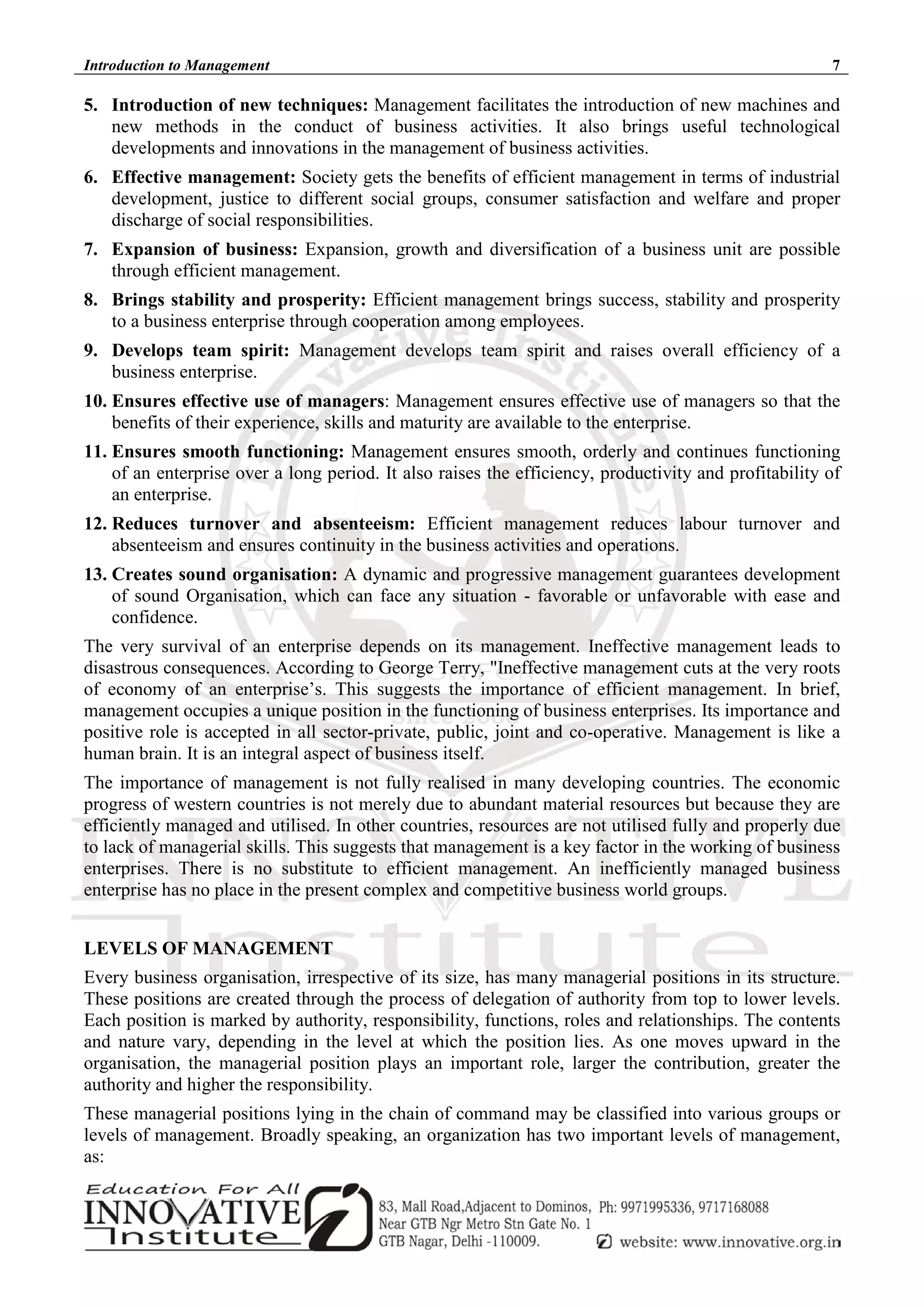
resources for achieving well defined objectives. The resources are: men, money, materials, machines,
methods and markets. These are the six basic inputs in management process (six M's of
management) and the output is in the form of achievement of objectives. It is the end result of inputs
and is available through efficient management process.
The term 'management' is used extensively in business. It is the core or life giving element in
business. We expect that a business unit should be managed efficiently. This is precisely what is
done in management. Management is essential for the conduct of business activity in an orderly
manner. It is a vital function concerned with all aspects of working of an enterprise.
Definitions of Management
According to George R. Terry, "Management is a distinct process consisting of planning,
organising, actuating and controlling, performed to determine and accomplish stated objectives by
the use of human beings and other resources".
According to Henry Fayol, "To manage is to forecast and to plan, to organise, to command, to
coordinate and to control".
According to Peter Drucker, "Management is a multi-purpose organ that manages business and
manages managers and manages workers and work".
According to Harold Koontz, "Management is the art of getting things done through and with
people in formally organized groups”.
According to Mary Parker Fallett, "Management is the art of getting things done through people".
Characteristics of Management
1. Management is a managerial process: Management is a process and not merely a body of
individuals. Those who perform this process are called managers. The managers exercise
leadership by assuming authority and direct others to act within the organisation. Management
process involves planning, organising, directing and unifying human efforts for the
accomplishment of given tasks.
2. Management is a social process- Management takes place through people. The importance of
human factor in management cannot be ignored. A manager's job is to get the things done with
the support and cooperation of subordinates. It is this human element which gives management
its special character.
3. Management is action-based: Management is always for achieving certain objectives in terms
of sales, profit, etc. It is a result-oriented concept and not merely an abstract philosophy. It gives
importance to concrete performance through suitable actions. It is an action based activity.
4. Management involves achieving results through the efforts of others: Management is the art
of getting the things done through others. Managers are expected to guide and motivate
2 Business Management
subordinates and get the expected performance from them. Management acts as an activating
factor.
5. Management is a group activity: Management is not an isolated individual activity but it is a
collective activity or an activity of a group. It aims at using group efforts for achieving
objectives. Managers manage the groups and coordinate the activities of groups functioning in an
organisation.
6. Management is intangible: Management is not directly visible but its presence is noticed in the
form of concrete results. Management is intangible. It is like invisible spirit, which guides and
motivates people working in a business unit. Management is like government, which functions
but is not visible in physical form.
7. Management is aided, not replaced by computers: The computer is an extremely powerful
tool of management. It helps a manager to widen his vision. The computer supplies ocean of
information for important decision-making. The computer has unbelievable data processing and
feedback facilities. This has enabled the manager to conduct quick analysis towards making
correct decisions. A computer supports manager in his managerial work. However, it cannot
replace managers in business. They were required in the past, at present and also in future. Their
existence is absolutely essential in the management process.
8. Management is all pervasive: Management is comprehensive and covers all departments,
activities and employees. Managers operate at different levels but their functions are identical.
This indicates that management is a universal and all pervasive process.
9. Management is an art, science as well as a profession: Management is an art because certain
skills, essential for good management, are unique to individuals. Management is a science
because it has an organised body of knowledge. Management is also a profession because it is
based on advanced and cultivated knowledge.
10. Management aims at coordination of activities: Coordination is the essence of management. It
gives one clear direction to the whole organisation and brings unity and harmony in the whole
business unit. For such coordination, effective communication at all levels is essential.
11. Management is innovative: Management techniques are dynamic and innovative. They need to
be adjusted as per the requirements of the situations. Another manager need not repeat the
decisions of one manager. Similarly, a manager has to change his decisions under different
situations.
12. Management has different operational levels: Every Organization needs managers for
managing business activities. The manager's job is basically the same at all levels. The managers
at the higher levels have more important duties while managers at the lower levels have to
perform routine functions i.e duties.
13. Management is different from ownership: Management is concerned with the management of
business activities. Managers are not the owners but they manage the business on behalf of the
owners. Separation of ownership and management is a special feature of modem business
organisation.
14. Management has vast scope: The scope of management is quite comprehensive. It covers all
aspects of business. The principles of management guide managers while managing various
business activities
15. Management is dynamic: Business is influenced by changes in economic, social, political
technological and human resource. Management adjusts itself to the changing atmosphere
Introduction to Management 3
making suitable forecasts and changes in the policies. Hence, management is treated as a
dynamic activity.
16. Management aims at achieving predetermined objectives: Management is a meaningful
activity. All organisations are essentially groups of individuals formed for achieving common
objectives. An Organisation exists for the attainment of specific objectives.
Need for Management
1. Direction, coordination and control of group efforts: In business, many persons work
together. They need proper direction and guidance for raising their efficiency. In the absence of
guidance, people will work as per their desire and the, orderly working of enterprise will not be
possible. Management is needed for planning business activities, for guiding employees in the
right direction and finally for coordinating their efforts for achieving best/most favorable results.
2. Orderly achievement of business objectives: Efficient management is needed in order to
achieve the objectives of business activity in an orderly and quick manner.
3. Performance of basic managerial functions: Planning, Organising, Co-ordinating and
Controlling are the basic functions of management. Management is needed as these functions are
performed through the management process.
4. Effective communication at all levels: Management is needed for effective communication
within and outside the Organisation.
5. Motivation of employees: Management is needed for motivating employees and also for
coordinating their efforts so as to achieve business objectives quickly.
6. Success and stability of business enterprise : Efficient management is needed for success,
stability and prosperity of a business enterprise.
Modern business is highly competitive and needs efficient and capable management for survival and
growth. Management is needed as it occupies a unique position in the smooth functioning of a
business unit. This suggests the need of efficient management of business enterprises.
Profitable/successful business may not he possible without efficient management. In this sense, "No
management, no business" is true. Survival of a business unit in the present competitive world is
possible only through efficient and competent management.
MANAGEMENT PROCESS
The term management is explained in different ways. For example, it is said that management is
what management does. Here, management is explained with reference to its basic functions which
include planning, organising, coordinating and controlling. Similarly, management is described as a
process which involves various elements. Management process is a continuous one and is run by the
managers functioning at different levels. Management is now recognised as a distinct process in
which managers plan, organise, lead, motivate and control human efforts in order to achieve well
defined goals. In fact, process means a series of activities/operations undertaken/conducted for
achieving a specific objective. Process is a systematic way of doing things. For example, in a factory
there is a production process. Similarly, in the management process, resources and human efforts are
used in an orderly manner for achieving specific objectives. The management process suggests
functions to be performed by the managers.
Definitions of Management Process
According to D. E. McFarland, "Management is the distinct process by which the managers create,
direct, maintain and operate purposive organisation through systematic, co-coordinated and
cooperative human efforts”.
4 Business Management
According to Gemp R. Terry, "Management is a distinct process consisting of planning,
organisisng, actuating, and controlling, performed to determine and accomplish objectives by the use
of people and other resources".
Functions of Management
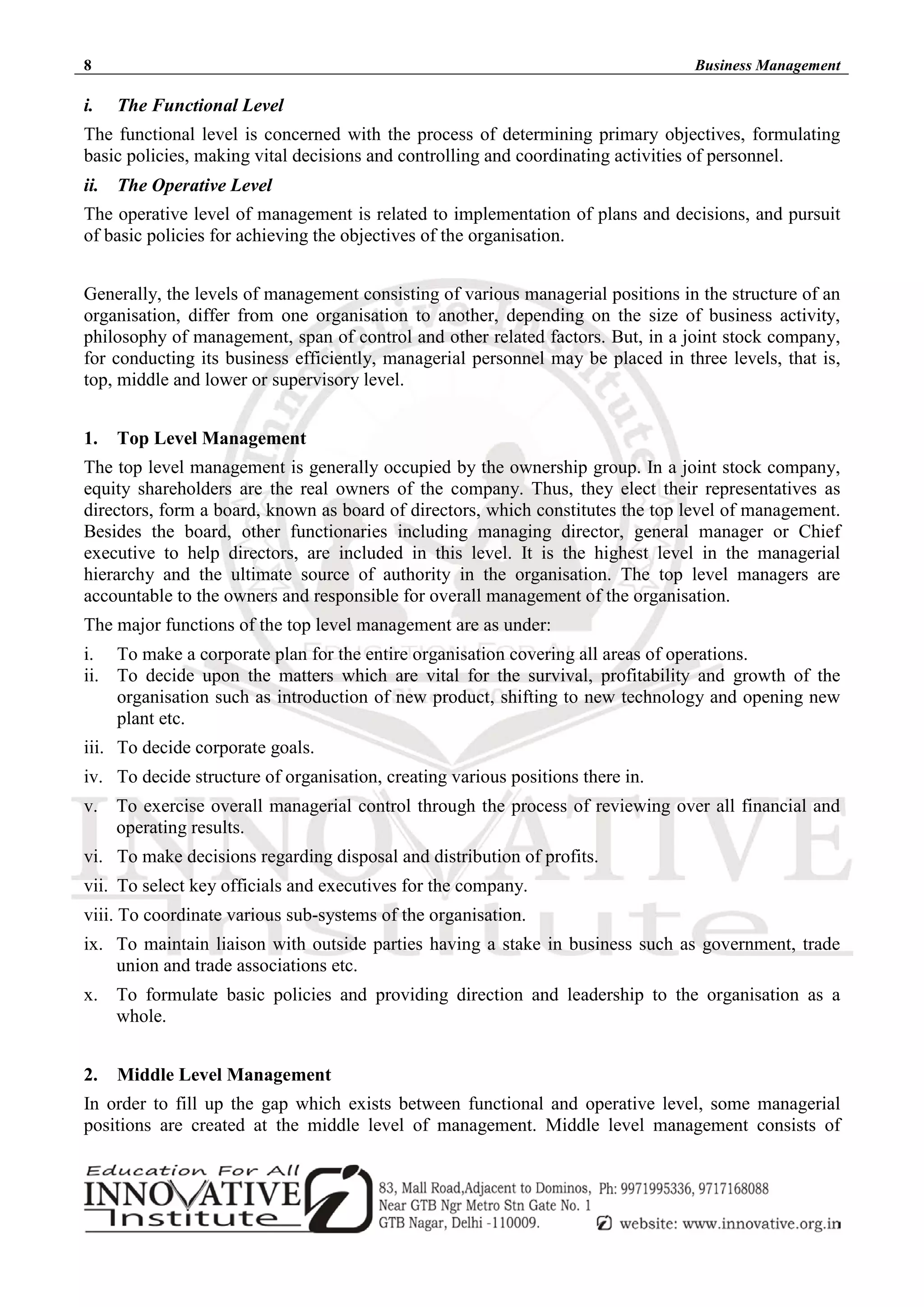
The essential elements/components of Management Process are four.
1. Planning
2. Organizing
3. Directing and
4. Controlling.
We may add some more elements in the management process. Such elements are:-
5. Motivating
6. Co-coordinating
7. Staffing and
8. Communicating.
The elements in the management process are actually the basic functions of management these
functions constitute the management process in practice. Management process is in fact,
management in practice. This process suggests what a manager is supposed to, do or the basic
functions that he has to perform while managing the job assigned to him.
gave a new formula to suggest the elements of Management Process i.e. basic
functions of management. According to him, management process may be indicated by the word
"PODSCORB”. Here,
‘P' states for 'planning'.
"O" for 'organising',
"D" for 'directing',
"S" for 'Staffing',
"CO" for 'Coordinating,
"R" for 'Reporting' and
"B" for 'Budgeting'.
Gullic coined the word "PODSCORB" to suggest seven functions of management.
Elements of Management Process
1. Planning
Planning is the primary function of management. It involves determination of a course of action
to achieve desired results/objectives. Planning is the starting point of management process and all
other functions of management are related to and dependent on planning function. Planning is the
key to success, stability and prosperity in business. It acts as a tool for solving the problems of a
business unit. Planning plays a pivotal role in business management It helps to visualize the
future problems and keeps management ready with possible solutions.
2. Organising
Organising is next to planning. It means to bring the resources (men, materials, machines, etc.)
together and use them properly for achieving the objectives. Organisation is a process as well as
it is a structure. Organising means arranging ways and means for the execution of a business
Introduction to Management 5
plan. It provides suitable administrative structure and facilitates execution of proposed plan.
Organising involves different aspects such as departmentation, span of control delegation of
authority, establishment of superior-subordinate relationship and provision of mechanism for co-
ordination of various business activities.
3. Staffing
Staffing refers to manpower required for the execution of a business plan. Staffing, as managerial
function, involves recruitment, selection, appraisal, remuneration and development of managerial
personnel. The need of staffing arises in the initial period and also from time to time for
replacement and also along with the expansion and diversification of business activities. Every
business unit needs efficient, stable and cooperative staff for the management of business
activities. Manpower is the most important asset of a business unit. In many organisations,
manpower planning and development activities are entrusted to personnel manager or HRD
manager. 'Right man for the right job' is the basic principle in staffing.
4. Directing (Leading)
Directing as a managerial function, deals with guiding and instructing people to do the work in
the right manner. Directing/leading is the responsibility of managers at all levels. They have to
work as leaders of their subordinates. Clear plans and sound organisation set the stage but it
requires a manager to direct and lead his men for achieving the objectives. Directing function is
quite comprehensive. It involves Directing as well as raising the morale of subordinates. It also
involves communicating, leading and motivating. Leadership is essential on the part of managers
for achieving organisational objectives.
5. Coordinating
Effective coordination and also integration of activities of different departments are essential for
orderly working of an Organisation. This suggests the importance of coordinating as
management function. A manager must coordinate the work for which he is accountable. Co-
ordination is rightly treated as the essence of management. It may be treated as an independent
function or as a part of organisms function. Coordination is essential at all levels of management.
It gives one clear-cut direction to the activities of individuals and departments. It also avoids
misdirection and wastages and brings unity of action in the Organisation. Co-ordination will not
come automatically or on its own Special efforts are necessary on the part of managers for
achieving such coordination.
6. Controlling
Controlling is an important function of management. It is necessary in the case of individuals and
departments so as to avoid wrong actions and activities. Controlling involves three broad aspects:
(a) establishing standards of performance, (b) measuring work in progress and interpreting results
achieved, and (c) taking corrective actions, if required. Business plans do not give positive results
automatically. Managers have to exercise effective control in order to bring success to a business
plan. Control is closely linked with other managerial functions. It is rightly treated as the soul of
management process. It is true that without planning there will be nothing to control It is equally
true that without control planning will be only an academic exercise Controlling is a continuous
activity of a supervisory nature.
7. Motivating
Motivating is one managerial function in which a manager motivates his men to give their best to
the Organisation. It means to encourage people to take more interest and initiative in the work
assigned. Organisations prosper when the employees are motivated through special efforts
including provision of facilities and incentives. Motivation is actually inspiring and encouraging
people to work more and contribute more to achieve organisational objectives. It is a
psychological process of great significance.
6 Business Management
8. Communicating
Communication (written or oral) is necessary for the exchange of facts, opinions, ideas and
information between individual’s and departments. In an organisation, communication is useful
for giving information, guidance and instructions. Managers should be good communicators.
They have to use major portion of their time on communication in order to direct, motivate and
co-ordinate activities of their subordinates. People think and act collectively through
communication. According to Louis Allen, "Communication involves a systematic and
continuing process of telling, listening and understanding".
The following figures show the management process and the elements involved:
Importance of Management
1. Optimum utilisation of resources: Management facilitates optimum utilisation of available
human and physical resources, which leads to progress and prosperity of a business enterprise.
Even wastages of all types are eliminated or minimized.
2. Competitive strength: Management develops competitive strength in an enterprise. This enables
an enterprise to develop and expand its assets and profits.
3. Cordial industrial relation: Management develops cordial industrial relations, ensures better
life and welfare to employees and raises their morale through suitable incentives.
4. Motivation of employees: It motivates employees to take more interest and initiatives in the
work assigned and contribute for raising productivity and profitability of the enterprise.
Introduction to Management 7
5. Introduction of new techniques: Management facilitates the introduction of new machines and
new methods in the conduct of business activities. It also brings useful technological
developments and innovations in the management of business activities.
6. Effective management: Society gets the benefits of efficient management in terms of industrial
development, justice to different social groups, consumer satisfaction and welfare and proper
discharge of social responsibilities.
7. Expansion of business: Expansion, growth and diversification of a business unit are possible
through efficient management.
8. Brings stability and prosperity: Efficient management brings success, stability and prosperity
to a business enterprise through cooperation among employees.
9. Develops team spirit: Management develops team spirit and raises overall efficiency of a
business enterprise.
10. Ensures effective use of managers: Management ensures effective use of managers so that the
benefits of their experience, skills and maturity are available to the enterprise.
11. Ensures smooth functioning: Management ensures smooth, orderly and continues functioning
of an enterprise over a long period. It also raises the efficiency, productivity and profitability of
an enterprise.
12. Reduces turnover and absenteeism: Efficient management reduces labour turnover and
absenteeism and ensures continuity in the business activities and operations.
13. Creates sound organisation: A dynamic and progressive management guarantees development
of sound Organisation, which can face any situation - favorable or unfavorable with ease and
confidence.
The very survival of an enterprise depends on its management. Ineffective management leads to
disastrous consequences. According to George Terry, "Ineffective management cuts at the very roots
of economy of an enterprise’s. This suggests the importance of efficient management. In brief,
management occupies a unique position in the functioning of business enterprises. Its importance and
positive role is accepted in all sector-private, public, joint and co-operative. Management is like a
human brain. It is an integral aspect of business itself.
The importance of management is not fully realised in many developing countries. The economic
progress of western countries is not merely due to abundant material resources but because they are
efficiently managed and utilised. In other countries, resources are not utilised fully and properly due
to lack of managerial skills. This suggests that management is a key factor in the working of business
enterprises. There is no substitute to efficient management. An inefficiently managed business
enterprise has no place in the present complex and competitive business world groups.
LEVELS OF MANAGEMENT
Every business organisation, irrespective of its size, has many managerial positions in its structure.
These positions are created through the process of delegation of authority from top to lower levels.
Each position is marked by authority, responsibility, functions, roles and relationships. The contents
and nature vary, depending in the level at which the position lies. As one moves upward in the
organisation, the managerial position plays an important role, larger the contribution, greater the
authority and higher the responsibility.
These managerial positions lying in the chain of command may be classified into various groups or
levels of management. Broadly speaking, an organization has two important levels of management,
as:
8 Business Management
i. The Functional Level
The functional level is concerned with the process of determining primary objectives, formulating
basic policies, making vital decisions and controlling and coordinating activities of personnel.
ii. The Operative Level
The operative level of management is related to implementation of plans and decisions, and pursuit
of basic policies for achieving the objectives of the organisation.
Generally, the levels of management consisting of various managerial positions in the structure of an
organisation, differ from one organisation to another, depending on the size of business activity,
philosophy of management, span of control and other related factors. But, in a joint stock company,
for conducting its business efficiently, managerial personnel may be placed in three levels, that is,
top, middle and lower or supervisory level.
1. Top Level Management
The top level management is generally occupied by the ownership group. In a joint stock company,
equity shareholders are the real owners of the company. Thus, they elect their representatives as
directors, form a board, known as board of directors, which constitutes the top level of management.
Besides the board, other functionaries including managing director, general manager or Chief
executive to help directors, are included in this level. It is the highest level in the managerial
hierarchy and the ultimate source of authority in the organisation. The top level managers are
accountable to the owners and responsible for overall management of the organisation.
The major functions of the top level management are as under:
i. To make a corporate plan for the entire organisation covering all areas of operations.
ii. To decide upon the matters which are vital for the survival, profitability and growth of the
organisation such as introduction of new product, shifting to new technology and opening new
plant etc.
iii. To decide corporate goals.
iv. To decide structure of organisation, creating various positions there in.
v. To exercise overall managerial control through the process of reviewing over all financial and
operating results.
vi. To make decisions regarding disposal and distribution of profits.
vii. To select key officials and executives for the company.
viii. To coordinate various sub-systems of the organisation.
ix. To maintain liaison with outside parties having a stake in business such as government, trade
union and trade associations etc.
x. To formulate basic policies and providing direction and leadership to the organisation as a
whole.
2. Middle Level Management
In order to fill up the gap which exists between functional and operative level, some managerial
positions are created at the middle level of management. Middle level management consists of
Introduction to Management 9
departmental managers, deputy managers, foreman and administrative officers etc. These executives
are mainly concerned with the overall functioning of their respective departments. They act as a link
between top and lower level managers. The activities of middle level managers‟ centres around
determining departmental goals and devising ways and means for accomplishing them.
The main functions performed by these managers are as under:
i. To prepare departmental plan covering all activities of the department within the basic
framework of the corporate plan.
ii. To establish departmental goals and to decide upon various ways and means for achieving these
goals to contribute to organizational goals.
iii. To perform all other managerial functions with regard to departmental activities for securing
smooth functioning of the entire department.
iv. To issue detailed orders and instructions to lower level managers and coordinate the activities of
various work units at lower level.
v. Middle level managers explain and interpret policy decisions made at the top level to lower level
managers.
3. Lower Level or Supervisory Level Management
Lower-level management is known as supervisory management, because it is concerned mainly with
personal oversight and direction of operative employees. It consists of factory supervisors,
superintendents, foremen, sales supervisors, accounts officers etc. They directly guide and control
the performance of rank and file workers. They issue orders and instructions and guide day to-day
activities. They also represent the grievances of the workers to the higher levels of management.
Supervisory management performs the following functions:
i. Planning of day to day work
ii. Assignment of jobs and issuing orders and instructions
iii. Supervising and guiding workers
iv. Maintaining close personal contacts with workers to ensure discipline and team-work
v. Evaluating operating performance
vi. Sending reports and statements to higher authorities
vii. Communicating the grievances and suggestions of workers to higher authorities.
MANAGERIAL SKILLS
Management job is different from
other jobs. It requires elements of
stewardship and commitment to
the purpose. It involves the
obligation to make prudent use of
human and material resources. It
requires sound judgment to handle
complex situations. Further, the
nature of the job becomes
increasingly complex at each
higher level because of the
10 Business Management
increase in the scope of authority and responsibility. Therefore, each higher level requires increased
knowledge, broader perspective and greater skills.
Robert Katz identified three managerial skills essential to successful managemen – technical, human
(employee relations skill) and conceptual skills.
1. Technical Skills
Technical skills refer to the ability to use the tools, equipment, procedures, techniques and
knowledge of a specialized field. It is primarily concerned with the ways of doing the things. It
implies proficiency in a specific field of activity. Technical skills are most important for the lower
level managers, because by nature their job involves supervision of the workers. Effective
supervision and coordination of the work of the subordinates, therefore, depends on the technical
skill possessed by the lower level manager. Any supervisor without a sound knowledge of the job
cannot make an effective supervisor. Such supervisors are not respected by the subordinates at the
shop floor. The relative importance of the technical skills as compared to the other skills diminishes
as one move up to higher levels of management.
2. Human Skills or Interpersonal Skills
Human skills are primarily concerned with “persons” in contrast to “things”. When a manager is
highly skilled in employee relations, he is aware of their attitudes, assumptions, and beliefs and
recognizes their limitations as well as their usefulness. He accepts as an important fact of life, the
existence of viewpoints and feelings, different from his own. Thus, human skills refer to the ability
of the manager to work effectively as a group member and to build cooperative effort in the team he
leads. It is the ability to work with, understand and motivate people. He understands why people
behave as they do and is able to make his own behavior understandable to them. He can foresee their
reactions to possible courses of action. His skill in working with others is natural and continuous. He
does not apply it in random or in inconsistent fashion. It is a natural ingredient of his every action.
The flair for understanding, empathizing and working with people is central to the human skills.
3. Conceptual Skills
Conceptual skills also called design and problem-solving skills involve the ability to:
i. see the organization and the various components of it as a whole;
ii. understand how its various parts and functions are related in a network fashion; and
iii. to foresee how changes in any one of these may affect the others.
Conceptual skills extend to visualizing the relation of the organization to industry, to the community
and to the political, economic and social forces of the nation as a whole and even to forces which
operate beyond the national boundaries. It is the creative force within the organization. A high
degree of conceptual skill helps in analyzing the environment and in identifying the opportunities
and threats.
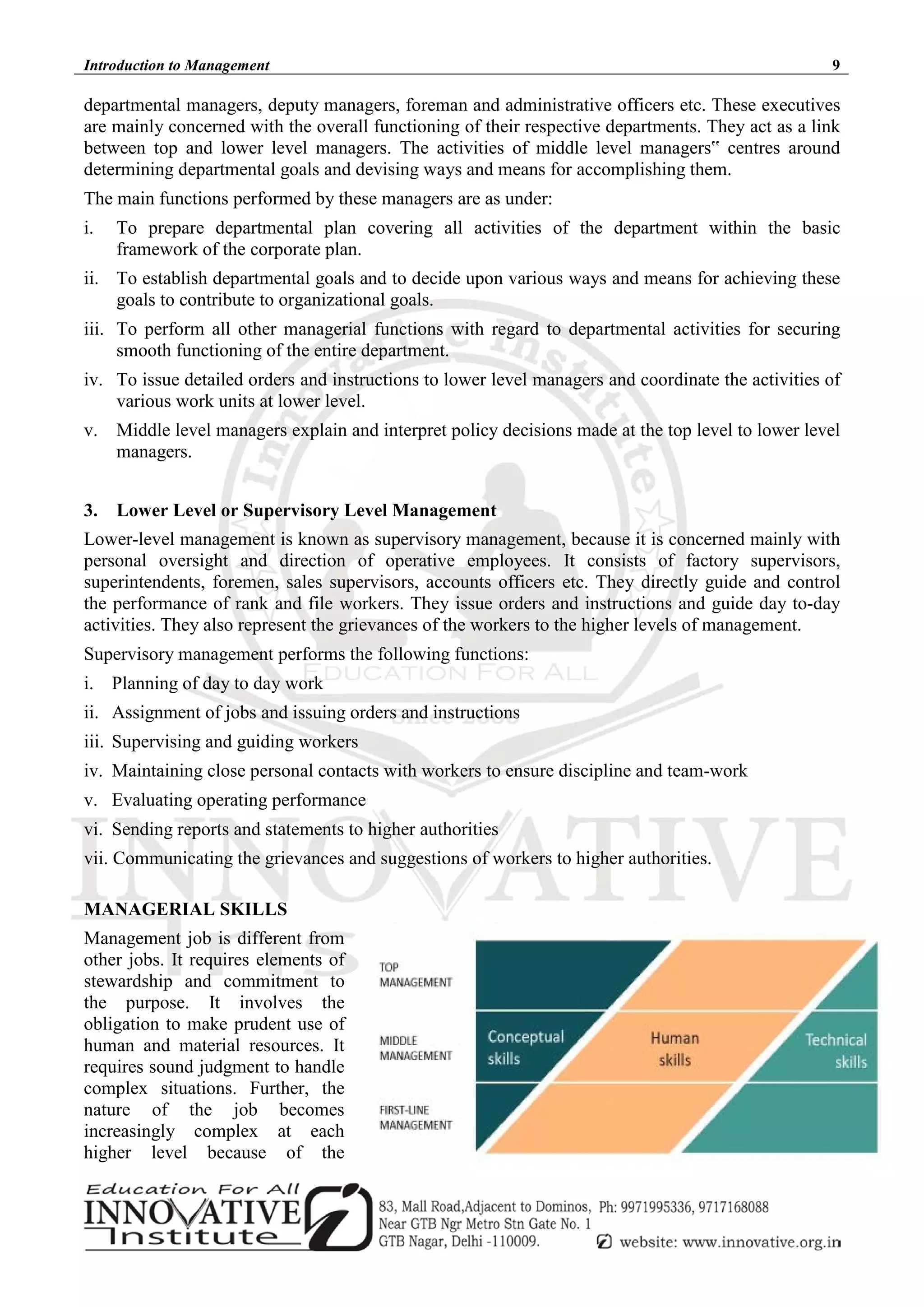
The three types of skills discussed so far are not mutually exclusive. In other words, management job
always requires all the three skills, but in different proportions depending upon the level of
management. There is a gradual shift in the emphasis from the bottom to the top of the pyramid.
Technical skills and human skill are always in great demand at the lower level of management for it
is there the productive processes and operations are carried out. It is there where you find most of the
Introduction to Management 11
people. It is there where the action takes place. In contrast, the need for conceptual skill is greatest at
the top level of management. Obviously, top managers are not often involved in the direct
application of specific methods, procedures and techniques, compared to those at the lower echelons
of management.
Hard and Soft Skills
Hard skills are those that are needed to be able to perform a particular job. These often vary
depending on the type of role one performs or the industry in which one works in. They can usually
be developed through studying and training. Examples of hard skills include an accountancy
diploma, fluency in a foreign language, knowledge of a particular software or experience in a
particular industry sector.
Soft skills on the other hand are usually self-taught and self-developed. Unlike hard skills they are
not specific to an industry or job. They’re usually picked up through life and work experiences. No
training is needed to build them. And because they can be applied to a number of roles, soft skills are
in demand in a wide range of different industries.
Examples of Soft Skills are: Interpersonal skills, Leadership, Project management, Problem solving,
A good work ethic, Team working, Adaptability, Perseverance, Communication skills etc.
MANAGEMENT IN THE FUTURE
In the next couple of decades, management theory and practice is bound to change in order to meet
the complex and ever changing environmental variables. The phenomenal growth in multinational
and transnational operations, fast changing technology, increasing complexity of decision making,
dynamic social and economic environment, globalisation of business and elastic project
organisations and task groups will significantly influence the future managerial world and
managerial tasks. There are successful business and management leaders publishing their memories
and offering their experience to the world. There is great increase in the number of business schools.
Management education is bank ably providing expertise to nonage the business and this trend is
likely to continue. Career paths are likely to be based on expertise alone. Managers will be under
pressure to develop this expertise and apply it in an ever-widening range of situations rather than
their ability to survive the bureaucratic jungle. They will have to combine their personal, professional
and operational qualities and capacities to the satisfaction of employers and the society. The future
must be considered as an opportunity and not a problem.
The future business environment will he dominated by information technology (IT), globalisation,
material and energy shortages, problems of pollution and ecological balance, consumerism, inflation
and R & D. The costs of employing expert managers are regarded as an investment for effective
business performance. Management is a designated expertise, increasingly professionalized and is
likely to progress to a highly organised status. It is assumed that young people will choose
management as an occupation and will progress from lower to middle and from middle to top
management positions. An ever-greater range of knowledge is available to all aspects of business and
management.
Some forces/factors that are likely to have an impact upon management in future are as mentioned
below:-
1. Emergence of knowledge society.
2. Development of socially concerned Humanistic society.
3. Widespread application of information technology (IT)
4. Transition from industrial to service economy.
5. Growing use of innovations and R & D.
12 Business Management
6. Social accountability of business.
7. Satisfaction of human and social values in man-machine system.
8. Liberalization and Globalisation of the business.
PREVIOUS YEARS’ QUESTIONS (UGC NET COMMERCE)
Tick the correct option.
1. Which of the management functions are closely related?
(a) Planning and organization (b) Staffing and control
(c) Planning and control (d)Planning and staffing
[2008 JUNE]
2. Assertion (A): Management is a continuous process involving the integration of all functions.
Reason (R): Managers first plan, then organise and finally perform the function of controlling.
Read the above statements and select the correct answer from the code below:
Codes:
(a) Both (A) and (R) are correct; and (R) is correct explanation of (A)
(b)Both (A) and (R) are correct, but (R) is not a correct explanation of (A)
(c) (A) is correct, but (R) is incorrect
(d)(A) is incorrect, but (R) is correct
[2010 JUNE, 2012 DEC III]
3. Assertion (A) : Management is mainly associated with economic affairs.
Reason (R) : Big business houses are the result of effective financial management.
Codes :
(a) (A) is correct and (R) is the right explanation (A)
(b)Both (A) and (R) are correct but (R) is not the right explanation of (A)
(c) (A) is incorrect but (R) is correct in isolation.
(d)Both (A) and (R) are incorrect.
[2015 JUNE II]
4. Statement-I : Management is the art of knowing what you want to do and then seeing that it is done in the
best and the cheapest way.
Statement-II: Management is the process of planning and regulating the activities of an enterprise.
(a) Statement (I) is correct, but (II) is incorrect
(b)Statement (II) is correct, but (I) is incorrect
(c) Both the statement (I) and (II) are correct
(d)Both the statement (I) and (II) are correct
[2015 JUNE III]
PREVIOUS YEARS’ QUESTIONS (UGC NET MANAGEMENT)
Tick the correct option.
1. The ability to understand, communicate with, motivate and support other people, both individually and in
groups, defines which of the following management skills?
(A) Hard Skills (B) Soft Skills
(C) Conceptual Skills (D) Political Skills
[2014 JUNE III]
2. The ability to integrate new ideas with the existing processes and to innovate on the job is a crucial _____
for today's managers.
(1) Conceptual skill (2) Human skill
(3) Soft skill (4) Technical skill
[2015 JUNE III]
3. Match the items of List – I with the items of List – II and select the correct code.
List – I List – II
Introduction to Management 13
(a) Planning (i) Getting others to get the job done.
(b) Organizing (ii) Setting standards such as sales Quotas, quality standards, etc.
(c) Leading (iii) Establishing goals and standards.
(d) Controlling (iv) Giving each subordinate a specific task.
Codes:
(a) (b) (c) (d)
(A) (ii) (i) (iv) (iii)
(B) (i) (ii) (iv) (iii)
(C) (iii) (i) (iv) (ii)
(D) (iii) (iv) (i) (ii)
[2016 JULY III]
14 Business Management

01-Introduction-to-Management.pdf

  • 1.
    1 INTRODUCTION TOMANAGEMENT MANAGEMENT The concept of management has acquired special significance in the present competitive and complex business world. Efficient and purposeful management is absolutely essential for the survival of a business unit. Management concept is comprehensive and covers all aspects of business. In simple words, management means utilising available resources in the best possible manner and also for achieving well defined objectives. It is a distinct and dynamic process involving use of different resources for achieving well defined objectives. The resources are: men, money, materials, machines, methods and markets. These are the six basic inputs in management process (six M's of management) and the output is in the form of achievement of objectives. It is the end result of inputs and is available through efficient management process. The term 'management' is used extensively in business. It is the core or life giving element in business. We expect that a business unit should be managed efficiently. This is precisely what is done in management. Management is essential for the conduct of business activity in an orderly manner. It is a vital function concerned with all aspects of working of an enterprise. Definitions of Management According to George R. Terry, "Management is a distinct process consisting of planning, organising, actuating and controlling, performed to determine and accomplish stated objectives by the use of human beings and other resources". According to Henry Fayol, "To manage is to forecast and to plan, to organise, to command, to coordinate and to control". According to Peter Drucker, "Management is a multi-purpose organ that manages business and manages managers and manages workers and work". According to Harold Koontz, "Management is the art of getting things done through and with people in formally organized groups”. According to Mary Parker Fallett, "Management is the art of getting things done through people". Characteristics of Management 1. Management is a managerial process: Management is a process and not merely a body of individuals. Those who perform this process are called managers. The managers exercise leadership by assuming authority and direct others to act within the organisation. Management process involves planning, organising, directing and unifying human efforts for the accomplishment of given tasks. 2. Management is a social process- Management takes place through people. The importance of human factor in management cannot be ignored. A manager's job is to get the things done with the support and cooperation of subordinates. It is this human element which gives management its special character. 3. Management is action-based: Management is always for achieving certain objectives in terms of sales, profit, etc. It is a result-oriented concept and not merely an abstract philosophy. It gives importance to concrete performance through suitable actions. It is an action based activity. 4. Management involves achieving results through the efforts of others: Management is the art of getting the things done through others. Managers are expected to guide and motivate
  • 2.
    2 Business Management subordinatesand get the expected performance from them. Management acts as an activating factor. 5. Management is a group activity: Management is not an isolated individual activity but it is a collective activity or an activity of a group. It aims at using group efforts for achieving objectives. Managers manage the groups and coordinate the activities of groups functioning in an organisation. 6. Management is intangible: Management is not directly visible but its presence is noticed in the form of concrete results. Management is intangible. It is like invisible spirit, which guides and motivates people working in a business unit. Management is like government, which functions but is not visible in physical form. 7. Management is aided, not replaced by computers: The computer is an extremely powerful tool of management. It helps a manager to widen his vision. The computer supplies ocean of information for important decision-making. The computer has unbelievable data processing and feedback facilities. This has enabled the manager to conduct quick analysis towards making correct decisions. A computer supports manager in his managerial work. However, it cannot replace managers in business. They were required in the past, at present and also in future. Their existence is absolutely essential in the management process. 8. Management is all pervasive: Management is comprehensive and covers all departments, activities and employees. Managers operate at different levels but their functions are identical. This indicates that management is a universal and all pervasive process. 9. Management is an art, science as well as a profession: Management is an art because certain skills, essential for good management, are unique to individuals. Management is a science because it has an organised body of knowledge. Management is also a profession because it is based on advanced and cultivated knowledge. 10. Management aims at coordination of activities: Coordination is the essence of management. It gives one clear direction to the whole organisation and brings unity and harmony in the whole business unit. For such coordination, effective communication at all levels is essential. 11. Management is innovative: Management techniques are dynamic and innovative. They need to be adjusted as per the requirements of the situations. Another manager need not repeat the decisions of one manager. Similarly, a manager has to change his decisions under different situations. 12. Management has different operational levels: Every Organization needs managers for managing business activities. The manager's job is basically the same at all levels. The managers at the higher levels have more important duties while managers at the lower levels have to perform routine functions i.e duties. 13. Management is different from ownership: Management is concerned with the management of business activities. Managers are not the owners but they manage the business on behalf of the owners. Separation of ownership and management is a special feature of modem business organisation. 14. Management has vast scope: The scope of management is quite comprehensive. It covers all aspects of business. The principles of management guide managers while managing various business activities 15. Management is dynamic: Business is influenced by changes in economic, social, political technological and human resource. Management adjusts itself to the changing atmosphere
  • 3.
    Introduction to Management3 making suitable forecasts and changes in the policies. Hence, management is treated as a dynamic activity. 16. Management aims at achieving predetermined objectives: Management is a meaningful activity. All organisations are essentially groups of individuals formed for achieving common objectives. An Organisation exists for the attainment of specific objectives. Need for Management 1. Direction, coordination and control of group efforts: In business, many persons work together. They need proper direction and guidance for raising their efficiency. In the absence of guidance, people will work as per their desire and the, orderly working of enterprise will not be possible. Management is needed for planning business activities, for guiding employees in the right direction and finally for coordinating their efforts for achieving best/most favorable results. 2. Orderly achievement of business objectives: Efficient management is needed in order to achieve the objectives of business activity in an orderly and quick manner. 3. Performance of basic managerial functions: Planning, Organising, Co-ordinating and Controlling are the basic functions of management. Management is needed as these functions are performed through the management process. 4. Effective communication at all levels: Management is needed for effective communication within and outside the Organisation. 5. Motivation of employees: Management is needed for motivating employees and also for coordinating their efforts so as to achieve business objectives quickly. 6. Success and stability of business enterprise : Efficient management is needed for success, stability and prosperity of a business enterprise. Modern business is highly competitive and needs efficient and capable management for survival and growth. Management is needed as it occupies a unique position in the smooth functioning of a business unit. This suggests the need of efficient management of business enterprises. Profitable/successful business may not he possible without efficient management. In this sense, "No management, no business" is true. Survival of a business unit in the present competitive world is possible only through efficient and competent management. MANAGEMENT PROCESS The term management is explained in different ways. For example, it is said that management is what management does. Here, management is explained with reference to its basic functions which include planning, organising, coordinating and controlling. Similarly, management is described as a process which involves various elements. Management process is a continuous one and is run by the managers functioning at different levels. Management is now recognised as a distinct process in which managers plan, organise, lead, motivate and control human efforts in order to achieve well defined goals. In fact, process means a series of activities/operations undertaken/conducted for achieving a specific objective. Process is a systematic way of doing things. For example, in a factory there is a production process. Similarly, in the management process, resources and human efforts are used in an orderly manner for achieving specific objectives. The management process suggests functions to be performed by the managers. Definitions of Management Process According to D. E. McFarland, "Management is the distinct process by which the managers create, direct, maintain and operate purposive organisation through systematic, co-coordinated and cooperative human efforts”.
  • 4.
    4 Business Management Accordingto Gemp R. Terry, "Management is a distinct process consisting of planning, organisisng, actuating, and controlling, performed to determine and accomplish objectives by the use of people and other resources". Functions of Management The essential elements/components of Management Process are four. 1. Planning 2. Organizing 3. Directing and 4. Controlling. We may add some more elements in the management process. Such elements are:- 5. Motivating 6. Co-coordinating 7. Staffing and 8. Communicating. The elements in the management process are actually the basic functions of management these functions constitute the management process in practice. Management process is in fact, management in practice. This process suggests what a manager is supposed to, do or the basic functions that he has to perform while managing the job assigned to him. gave a new formula to suggest the elements of Management Process i.e. basic functions of management. According to him, management process may be indicated by the word "PODSCORB”. Here, ‘P' states for 'planning'. "O" for 'organising', "D" for 'directing', "S" for 'Staffing', "CO" for 'Coordinating, "R" for 'Reporting' and "B" for 'Budgeting'. Gullic coined the word "PODSCORB" to suggest seven functions of management. Elements of Management Process 1. Planning Planning is the primary function of management. It involves determination of a course of action to achieve desired results/objectives. Planning is the starting point of management process and all other functions of management are related to and dependent on planning function. Planning is the key to success, stability and prosperity in business. It acts as a tool for solving the problems of a business unit. Planning plays a pivotal role in business management It helps to visualize the future problems and keeps management ready with possible solutions. 2. Organising Organising is next to planning. It means to bring the resources (men, materials, machines, etc.) together and use them properly for achieving the objectives. Organisation is a process as well as it is a structure. Organising means arranging ways and means for the execution of a business
  • 5.
    Introduction to Management5 plan. It provides suitable administrative structure and facilitates execution of proposed plan. Organising involves different aspects such as departmentation, span of control delegation of authority, establishment of superior-subordinate relationship and provision of mechanism for co- ordination of various business activities. 3. Staffing Staffing refers to manpower required for the execution of a business plan. Staffing, as managerial function, involves recruitment, selection, appraisal, remuneration and development of managerial personnel. The need of staffing arises in the initial period and also from time to time for replacement and also along with the expansion and diversification of business activities. Every business unit needs efficient, stable and cooperative staff for the management of business activities. Manpower is the most important asset of a business unit. In many organisations, manpower planning and development activities are entrusted to personnel manager or HRD manager. 'Right man for the right job' is the basic principle in staffing. 4. Directing (Leading) Directing as a managerial function, deals with guiding and instructing people to do the work in the right manner. Directing/leading is the responsibility of managers at all levels. They have to work as leaders of their subordinates. Clear plans and sound organisation set the stage but it requires a manager to direct and lead his men for achieving the objectives. Directing function is quite comprehensive. It involves Directing as well as raising the morale of subordinates. It also involves communicating, leading and motivating. Leadership is essential on the part of managers for achieving organisational objectives. 5. Coordinating Effective coordination and also integration of activities of different departments are essential for orderly working of an Organisation. This suggests the importance of coordinating as management function. A manager must coordinate the work for which he is accountable. Co- ordination is rightly treated as the essence of management. It may be treated as an independent function or as a part of organisms function. Coordination is essential at all levels of management. It gives one clear-cut direction to the activities of individuals and departments. It also avoids misdirection and wastages and brings unity of action in the Organisation. Co-ordination will not come automatically or on its own Special efforts are necessary on the part of managers for achieving such coordination. 6. Controlling Controlling is an important function of management. It is necessary in the case of individuals and departments so as to avoid wrong actions and activities. Controlling involves three broad aspects: (a) establishing standards of performance, (b) measuring work in progress and interpreting results achieved, and (c) taking corrective actions, if required. Business plans do not give positive results automatically. Managers have to exercise effective control in order to bring success to a business plan. Control is closely linked with other managerial functions. It is rightly treated as the soul of management process. It is true that without planning there will be nothing to control It is equally true that without control planning will be only an academic exercise Controlling is a continuous activity of a supervisory nature. 7. Motivating Motivating is one managerial function in which a manager motivates his men to give their best to the Organisation. It means to encourage people to take more interest and initiative in the work assigned. Organisations prosper when the employees are motivated through special efforts including provision of facilities and incentives. Motivation is actually inspiring and encouraging people to work more and contribute more to achieve organisational objectives. It is a psychological process of great significance.
  • 6.
    6 Business Management 8.Communicating Communication (written or oral) is necessary for the exchange of facts, opinions, ideas and information between individual’s and departments. In an organisation, communication is useful for giving information, guidance and instructions. Managers should be good communicators. They have to use major portion of their time on communication in order to direct, motivate and co-ordinate activities of their subordinates. People think and act collectively through communication. According to Louis Allen, "Communication involves a systematic and continuing process of telling, listening and understanding". The following figures show the management process and the elements involved: Importance of Management 1. Optimum utilisation of resources: Management facilitates optimum utilisation of available human and physical resources, which leads to progress and prosperity of a business enterprise. Even wastages of all types are eliminated or minimized. 2. Competitive strength: Management develops competitive strength in an enterprise. This enables an enterprise to develop and expand its assets and profits. 3. Cordial industrial relation: Management develops cordial industrial relations, ensures better life and welfare to employees and raises their morale through suitable incentives. 4. Motivation of employees: It motivates employees to take more interest and initiatives in the work assigned and contribute for raising productivity and profitability of the enterprise.
  • 7.
    Introduction to Management7 5. Introduction of new techniques: Management facilitates the introduction of new machines and new methods in the conduct of business activities. It also brings useful technological developments and innovations in the management of business activities. 6. Effective management: Society gets the benefits of efficient management in terms of industrial development, justice to different social groups, consumer satisfaction and welfare and proper discharge of social responsibilities. 7. Expansion of business: Expansion, growth and diversification of a business unit are possible through efficient management. 8. Brings stability and prosperity: Efficient management brings success, stability and prosperity to a business enterprise through cooperation among employees. 9. Develops team spirit: Management develops team spirit and raises overall efficiency of a business enterprise. 10. Ensures effective use of managers: Management ensures effective use of managers so that the benefits of their experience, skills and maturity are available to the enterprise. 11. Ensures smooth functioning: Management ensures smooth, orderly and continues functioning of an enterprise over a long period. It also raises the efficiency, productivity and profitability of an enterprise. 12. Reduces turnover and absenteeism: Efficient management reduces labour turnover and absenteeism and ensures continuity in the business activities and operations. 13. Creates sound organisation: A dynamic and progressive management guarantees development of sound Organisation, which can face any situation - favorable or unfavorable with ease and confidence. The very survival of an enterprise depends on its management. Ineffective management leads to disastrous consequences. According to George Terry, "Ineffective management cuts at the very roots of economy of an enterprise’s. This suggests the importance of efficient management. In brief, management occupies a unique position in the functioning of business enterprises. Its importance and positive role is accepted in all sector-private, public, joint and co-operative. Management is like a human brain. It is an integral aspect of business itself. The importance of management is not fully realised in many developing countries. The economic progress of western countries is not merely due to abundant material resources but because they are efficiently managed and utilised. In other countries, resources are not utilised fully and properly due to lack of managerial skills. This suggests that management is a key factor in the working of business enterprises. There is no substitute to efficient management. An inefficiently managed business enterprise has no place in the present complex and competitive business world groups. LEVELS OF MANAGEMENT Every business organisation, irrespective of its size, has many managerial positions in its structure. These positions are created through the process of delegation of authority from top to lower levels. Each position is marked by authority, responsibility, functions, roles and relationships. The contents and nature vary, depending in the level at which the position lies. As one moves upward in the organisation, the managerial position plays an important role, larger the contribution, greater the authority and higher the responsibility. These managerial positions lying in the chain of command may be classified into various groups or levels of management. Broadly speaking, an organization has two important levels of management, as:
  • 8.
    8 Business Management i.The Functional Level The functional level is concerned with the process of determining primary objectives, formulating basic policies, making vital decisions and controlling and coordinating activities of personnel. ii. The Operative Level The operative level of management is related to implementation of plans and decisions, and pursuit of basic policies for achieving the objectives of the organisation. Generally, the levels of management consisting of various managerial positions in the structure of an organisation, differ from one organisation to another, depending on the size of business activity, philosophy of management, span of control and other related factors. But, in a joint stock company, for conducting its business efficiently, managerial personnel may be placed in three levels, that is, top, middle and lower or supervisory level. 1. Top Level Management The top level management is generally occupied by the ownership group. In a joint stock company, equity shareholders are the real owners of the company. Thus, they elect their representatives as directors, form a board, known as board of directors, which constitutes the top level of management. Besides the board, other functionaries including managing director, general manager or Chief executive to help directors, are included in this level. It is the highest level in the managerial hierarchy and the ultimate source of authority in the organisation. The top level managers are accountable to the owners and responsible for overall management of the organisation. The major functions of the top level management are as under: i. To make a corporate plan for the entire organisation covering all areas of operations. ii. To decide upon the matters which are vital for the survival, profitability and growth of the organisation such as introduction of new product, shifting to new technology and opening new plant etc. iii. To decide corporate goals. iv. To decide structure of organisation, creating various positions there in. v. To exercise overall managerial control through the process of reviewing over all financial and operating results. vi. To make decisions regarding disposal and distribution of profits. vii. To select key officials and executives for the company. viii. To coordinate various sub-systems of the organisation. ix. To maintain liaison with outside parties having a stake in business such as government, trade union and trade associations etc. x. To formulate basic policies and providing direction and leadership to the organisation as a whole. 2. Middle Level Management In order to fill up the gap which exists between functional and operative level, some managerial positions are created at the middle level of management. Middle level management consists of
  • 9.
    Introduction to Management9 departmental managers, deputy managers, foreman and administrative officers etc. These executives are mainly concerned with the overall functioning of their respective departments. They act as a link between top and lower level managers. The activities of middle level managers‟ centres around determining departmental goals and devising ways and means for accomplishing them. The main functions performed by these managers are as under: i. To prepare departmental plan covering all activities of the department within the basic framework of the corporate plan. ii. To establish departmental goals and to decide upon various ways and means for achieving these goals to contribute to organizational goals. iii. To perform all other managerial functions with regard to departmental activities for securing smooth functioning of the entire department. iv. To issue detailed orders and instructions to lower level managers and coordinate the activities of various work units at lower level. v. Middle level managers explain and interpret policy decisions made at the top level to lower level managers. 3. Lower Level or Supervisory Level Management Lower-level management is known as supervisory management, because it is concerned mainly with personal oversight and direction of operative employees. It consists of factory supervisors, superintendents, foremen, sales supervisors, accounts officers etc. They directly guide and control the performance of rank and file workers. They issue orders and instructions and guide day to-day activities. They also represent the grievances of the workers to the higher levels of management. Supervisory management performs the following functions: i. Planning of day to day work ii. Assignment of jobs and issuing orders and instructions iii. Supervising and guiding workers iv. Maintaining close personal contacts with workers to ensure discipline and team-work v. Evaluating operating performance vi. Sending reports and statements to higher authorities vii. Communicating the grievances and suggestions of workers to higher authorities. MANAGERIAL SKILLS Management job is different from other jobs. It requires elements of stewardship and commitment to the purpose. It involves the obligation to make prudent use of human and material resources. It requires sound judgment to handle complex situations. Further, the nature of the job becomes increasingly complex at each higher level because of the
  • 10.
    10 Business Management increasein the scope of authority and responsibility. Therefore, each higher level requires increased knowledge, broader perspective and greater skills. Robert Katz identified three managerial skills essential to successful managemen – technical, human (employee relations skill) and conceptual skills. 1. Technical Skills Technical skills refer to the ability to use the tools, equipment, procedures, techniques and knowledge of a specialized field. It is primarily concerned with the ways of doing the things. It implies proficiency in a specific field of activity. Technical skills are most important for the lower level managers, because by nature their job involves supervision of the workers. Effective supervision and coordination of the work of the subordinates, therefore, depends on the technical skill possessed by the lower level manager. Any supervisor without a sound knowledge of the job cannot make an effective supervisor. Such supervisors are not respected by the subordinates at the shop floor. The relative importance of the technical skills as compared to the other skills diminishes as one move up to higher levels of management. 2. Human Skills or Interpersonal Skills Human skills are primarily concerned with “persons” in contrast to “things”. When a manager is highly skilled in employee relations, he is aware of their attitudes, assumptions, and beliefs and recognizes their limitations as well as their usefulness. He accepts as an important fact of life, the existence of viewpoints and feelings, different from his own. Thus, human skills refer to the ability of the manager to work effectively as a group member and to build cooperative effort in the team he leads. It is the ability to work with, understand and motivate people. He understands why people behave as they do and is able to make his own behavior understandable to them. He can foresee their reactions to possible courses of action. His skill in working with others is natural and continuous. He does not apply it in random or in inconsistent fashion. It is a natural ingredient of his every action. The flair for understanding, empathizing and working with people is central to the human skills. 3. Conceptual Skills Conceptual skills also called design and problem-solving skills involve the ability to: i. see the organization and the various components of it as a whole; ii. understand how its various parts and functions are related in a network fashion; and iii. to foresee how changes in any one of these may affect the others. Conceptual skills extend to visualizing the relation of the organization to industry, to the community and to the political, economic and social forces of the nation as a whole and even to forces which operate beyond the national boundaries. It is the creative force within the organization. A high degree of conceptual skill helps in analyzing the environment and in identifying the opportunities and threats. The three types of skills discussed so far are not mutually exclusive. In other words, management job always requires all the three skills, but in different proportions depending upon the level of management. There is a gradual shift in the emphasis from the bottom to the top of the pyramid. Technical skills and human skill are always in great demand at the lower level of management for it is there the productive processes and operations are carried out. It is there where you find most of the
  • 11.
    Introduction to Management11 people. It is there where the action takes place. In contrast, the need for conceptual skill is greatest at the top level of management. Obviously, top managers are not often involved in the direct application of specific methods, procedures and techniques, compared to those at the lower echelons of management. Hard and Soft Skills Hard skills are those that are needed to be able to perform a particular job. These often vary depending on the type of role one performs or the industry in which one works in. They can usually be developed through studying and training. Examples of hard skills include an accountancy diploma, fluency in a foreign language, knowledge of a particular software or experience in a particular industry sector. Soft skills on the other hand are usually self-taught and self-developed. Unlike hard skills they are not specific to an industry or job. They’re usually picked up through life and work experiences. No training is needed to build them. And because they can be applied to a number of roles, soft skills are in demand in a wide range of different industries. Examples of Soft Skills are: Interpersonal skills, Leadership, Project management, Problem solving, A good work ethic, Team working, Adaptability, Perseverance, Communication skills etc. MANAGEMENT IN THE FUTURE In the next couple of decades, management theory and practice is bound to change in order to meet the complex and ever changing environmental variables. The phenomenal growth in multinational and transnational operations, fast changing technology, increasing complexity of decision making, dynamic social and economic environment, globalisation of business and elastic project organisations and task groups will significantly influence the future managerial world and managerial tasks. There are successful business and management leaders publishing their memories and offering their experience to the world. There is great increase in the number of business schools. Management education is bank ably providing expertise to nonage the business and this trend is likely to continue. Career paths are likely to be based on expertise alone. Managers will be under pressure to develop this expertise and apply it in an ever-widening range of situations rather than their ability to survive the bureaucratic jungle. They will have to combine their personal, professional and operational qualities and capacities to the satisfaction of employers and the society. The future must be considered as an opportunity and not a problem. The future business environment will he dominated by information technology (IT), globalisation, material and energy shortages, problems of pollution and ecological balance, consumerism, inflation and R & D. The costs of employing expert managers are regarded as an investment for effective business performance. Management is a designated expertise, increasingly professionalized and is likely to progress to a highly organised status. It is assumed that young people will choose management as an occupation and will progress from lower to middle and from middle to top management positions. An ever-greater range of knowledge is available to all aspects of business and management. Some forces/factors that are likely to have an impact upon management in future are as mentioned below:- 1. Emergence of knowledge society. 2. Development of socially concerned Humanistic society. 3. Widespread application of information technology (IT) 4. Transition from industrial to service economy. 5. Growing use of innovations and R & D.
  • 12.
    12 Business Management 6.Social accountability of business. 7. Satisfaction of human and social values in man-machine system. 8. Liberalization and Globalisation of the business. PREVIOUS YEARS’ QUESTIONS (UGC NET COMMERCE) Tick the correct option. 1. Which of the management functions are closely related? (a) Planning and organization (b) Staffing and control (c) Planning and control (d)Planning and staffing [2008 JUNE] 2. Assertion (A): Management is a continuous process involving the integration of all functions. Reason (R): Managers first plan, then organise and finally perform the function of controlling. Read the above statements and select the correct answer from the code below: Codes: (a) Both (A) and (R) are correct; and (R) is correct explanation of (A) (b)Both (A) and (R) are correct, but (R) is not a correct explanation of (A) (c) (A) is correct, but (R) is incorrect (d)(A) is incorrect, but (R) is correct [2010 JUNE, 2012 DEC III] 3. Assertion (A) : Management is mainly associated with economic affairs. Reason (R) : Big business houses are the result of effective financial management. Codes : (a) (A) is correct and (R) is the right explanation (A) (b)Both (A) and (R) are correct but (R) is not the right explanation of (A) (c) (A) is incorrect but (R) is correct in isolation. (d)Both (A) and (R) are incorrect. [2015 JUNE II] 4. Statement-I : Management is the art of knowing what you want to do and then seeing that it is done in the best and the cheapest way. Statement-II: Management is the process of planning and regulating the activities of an enterprise. (a) Statement (I) is correct, but (II) is incorrect (b)Statement (II) is correct, but (I) is incorrect (c) Both the statement (I) and (II) are correct (d)Both the statement (I) and (II) are correct [2015 JUNE III] PREVIOUS YEARS’ QUESTIONS (UGC NET MANAGEMENT) Tick the correct option. 1. The ability to understand, communicate with, motivate and support other people, both individually and in groups, defines which of the following management skills? (A) Hard Skills (B) Soft Skills (C) Conceptual Skills (D) Political Skills [2014 JUNE III] 2. The ability to integrate new ideas with the existing processes and to innovate on the job is a crucial _____ for today's managers. (1) Conceptual skill (2) Human skill (3) Soft skill (4) Technical skill [2015 JUNE III] 3. Match the items of List – I with the items of List – II and select the correct code. List – I List – II
  • 13.
    Introduction to Management13 (a) Planning (i) Getting others to get the job done. (b) Organizing (ii) Setting standards such as sales Quotas, quality standards, etc. (c) Leading (iii) Establishing goals and standards. (d) Controlling (iv) Giving each subordinate a specific task. Codes: (a) (b) (c) (d) (A) (ii) (i) (iv) (iii) (B) (i) (ii) (iv) (iii) (C) (iii) (i) (iv) (ii) (D) (iii) (iv) (i) (ii) [2016 JULY III]
  • 14.