Summaries
Pituitary gland
Lies in the hypophyseal fossa connected to tuber cinerium by the infundibulum.
Divides by the hypophyseal cleft into anterior and posterior lobe.
Relations :-
 On each side : cavernous sinus + its contents
 Superiorly : Diaphragma sellea
 Inferiorly :- body of sphenoid + sphenoid air sinuses
 Anteriorly : tuberculum sellea + sphenoid air sinuses
 Posteriorly : dorsum sellea
Arterial Supply :-
Supplied by branches of ICA :
 Superior hypophyseal artery
 Inferior hypophyseal artery which supplies pars nervosa
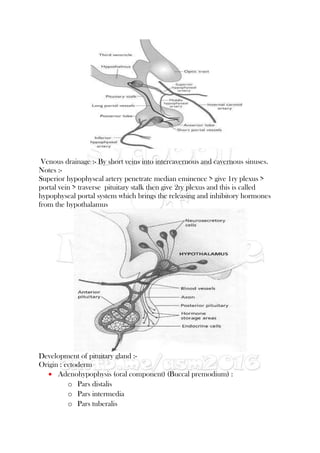
Venous drainage :- By short veins into intercavernous and cavernous sinuses.
Notes :-
Superior hypophyseal artery penetrate median eminence > give 1ry plexus >
portal vein > traverse pituitary stalk then give 2ry plexus and this is called
hypophyseal portal system which brings the releasing and inhibitory hormones
from the hypothalamus
Development of pituitary gland :-
Origin : ectoderm
 Adenohypophysis (oral component) (Buccal premodium) :
o Pars distalis
o Pars intermedia
o Pars tuberalis
 Neurohypophysis (neural component) (cranial premodium)
o Pars nervosa
o Infundibulum
o Median eminence
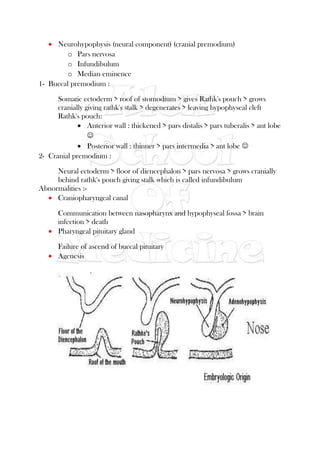
1- Buccal premodium :
Somatic ectoderm > roof of stomodium > gives Rathk's pouch > grows
cranially giving rathk's stalk > degenerates > leaving hypophyseal cleft
Rathk's pouch:
 Anterior wall : thickened > pars distalis > pars tuberalis > ant lobe

 Posterior wall : thinner > pars intermedia > ant lobe 
2- Cranial premodium :
Neural ectoderm > floor of diencephalon > pars nervosa > grows cranially
behind rathk's pouch giving stalk which is called infundibulum
Abnormalities :-
 Craniopharyngeal canal
Communication between nasopharynx and hypophyseal fossa > brain
infection > death
 Pharyngeal pituitary gland
Failure of ascend of buccal pituitary
 Agenesis
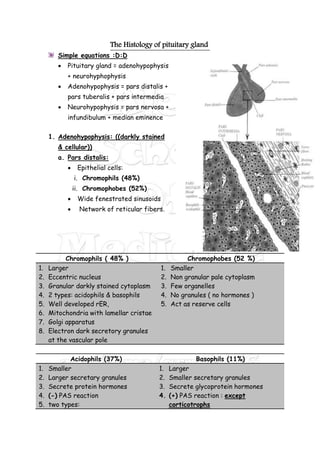
The Histology of pituitary gland
Simple equations :D:D
 Pituitary gland = adenohypophysis
+ neurohyphophysis
 Adenohypophysis = pars distalis +
pars tuberalis + pars intermedia
 Neurohypophysis = pars nervosa +
infundibulum + median eminence
1. Adenohypophysis: ((darkly stained
& cellular))
a. Pars distalis:
 Epithelial cells:
i. Chromophils (48%)
ii. Chromophobes (52%)
 Wide fenestrated sinusoids
 Network of reticular fibers.
Chromophils ( 48% ) Chromophobes (52 %)
1. Larger
2. Eccentric nucleus
3. Granular darkly stained cytoplasm
4. 2 types: acidophils & basophils
5. Well developed rER,
6. Mitochondria with lamellar cristae
7. Golgi apparatus
8. Electron dark secretory granules
at the vascular pole
1. Smaller
2. Non granular pale cytoplasm
3. Few organelles
4. No granules ( no hormones )
5. Act as reserve cells
Acidophils (37%) Basophils (11%)
1. Smaller
2. Larger secretary granules
3. Secrete protein hormones
4. (-) PAS reaction
5. two types:
1. Larger
2. Smaller secretary granules
3. Secrete glycoprotein hormones
4. (+) PAS reaction : except
corticotrophs
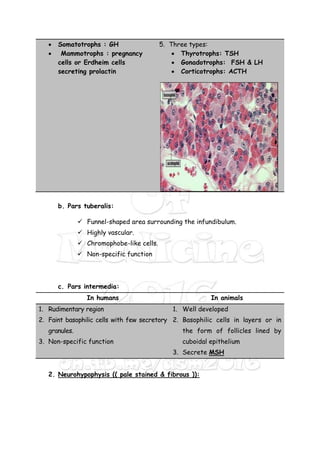
 Somatotrophs : GH
 Mammotrophs : pregnancy
cells or Erdheim cells
secreting prolactin
5. Three types:
 Thyrotrophs: TSH
 Gonadotrophs: FSH & LH
 Corticotrophs: ACTH
b. Pars tuberalis:
 Funnel-shaped area surrounding the infundibulum.
 Highly vascular.
 Chromophobe-like cells.
 Non-specific function
c. Pars intermedia:
In humans In animals
1. Rudimentary region
2. Faint basophilic cells with few secretory
granules.
3. Non-specific function
1. Well developed
2. Basophilic cells in layers or in
the form of follicles lined by
cuboidal epithelium
3. Secrete MSH
2. Neurohypophysis (( pale stained & fibrous )):
a. Pars nervosa:
4 7agat tet7afaz zay esmena :D:D
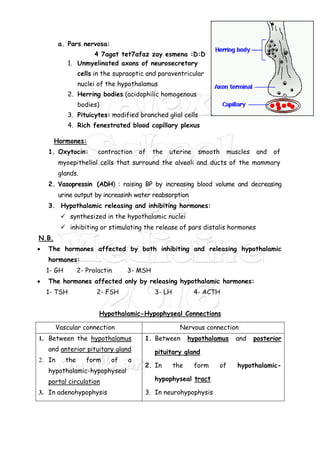
1. Unmyelinated axons of neurosecretory
cells in the supraoptic and paraventricular
nuclei of the hypothalamus
2. Herring bodies (acidophilic homogenous
bodies)
3. Pituicytes: modified branched glial cells
4. Rich fenestrated blood capillary plexus
Hormones:
1. Oxytocin: contraction of the uterine smooth muscles and of
myoepithelial cells that surround the alveoli and ducts of the mammary
glands.
2. Vasopressin (ADH) : raising BP by increasing blood volume and decreasing
urine output by increasinh water reabsorption
3. Hypothalamic releasing and inhibiting hormones:
 synthesized in the hypothalamic nuclei
 inhibiting or stimulating the release of pars distalis hormones
N.B.
 The hormones affected by both inhibiting and releasing hypothalamic
hormones:
1- GH 2- Prolactin 3- MSH
 The hormones affected only by releasing hypothalamic hormones:
1- TSH 2- FSH 3- LH 4- ACTH
Hypophyseal Connections-Hypothalamic
Vascular connection Nervous connection
1. Between the hypothalamus
and anterior pituitary gland
2. In the form of a
hypothalamic-hypophyseal
portal circulation
3. In adenohypophysis
1. Between hypothalamus and posterior
pituitary gland
2. In the form of hypothalamic-
hypophyseal tract
3. In neurohypophysis
 Body Functions are controlled by both the endocrine system and the nervous
system which are connected together through the hypothalamus.
 A hormone is: A chemical substance that is synthesized and secreted by a
specific cell. It is transported by the circulation and at very low
concentration. It elicits a specific response in distant target tissues.
 Hormone types according to site of action:
1) Endocrine.
2) Paracrine.
3) Autocrine.
 Hormone types according to chemical composition:
1) Protein and polypeptide hormones.
2) Amino-acid derivatives.
3) Steroids.
 Steroid hormones are carried in the blood bound to specific plasma proteins
and they have a longer half-life while non-steroids move freely in the blood
with short half-life.
 In addition to the main endocrine glands functioning in the body, some organs
have an endocrine function and secrete hormones that act locally or
systemically:
a) Systemic hormones:
1) Kidney: Renin,Erythropoietin.
2) Heart: ANP.
3) Adipose tissue: adipokines.
b) Local hormones:
1) Gastrointestinal hormones.
2) Chemical transmitters.
Group II HormonesGroup I Hormones
Polypeptides, proteins,
glycoproteins,
catecholamines
Steroids, T3, T4,
Calcitriol, Retinoic acid
Types
ShortLongPlasma life span
HydrophilicLipophylicSolubility
AbsentPresentCarrier
Plasma membraneIntracellularReceptor
Group Second messenger example
IIa C.Amp Epinephrine, Glucagon
IIb C.Gmp ANP, NO
IIc Ca, phosphatidyl
inositol or both
Vasopressin, 1-
adrenergic
catecholamines
IId Tyrosine kinase
phosphorylation
cascade
Insulin
Group I Hormones
Glucocortecoids
 Mechanism of action:
Hormone traverses the plasma membrane and binds to its receptor forming the
hormone receptor complex.
The hormone receptor complex migrates to the nucleus and binds to the
hormone response element (specific sequence of DNA).
This lead to increase or decrease in the transcription of mRNA
mRNA acts as a template for synthesis of specific enzyme or protein which
causes metabolic changes.
 Domains of steroid hormone receptors:
1. One w' binds the hormone.
2. One for translocation from the cytoplasm to the nucleus
3. Site w' binds to the HRE.
4. Site w' activates specific gene.
Retinol and Retinoic acid
Bind to specific nucleus receptor forming receptor-vitamin complex.
The complex interacts with a specific vitamin response element involved in
protein synthesis.
Group IIa C.amp as second messenger
N.B: G-protein is formed of a trimer (alpha, beta and gamma) where
alpha is bound by GDP.
Mechanism of action:
Hormone activates the plasma membrane receptor.
GDP in the G-protein is replaced by GTP leading to dissociation of alpha
G-GTP from the beta and gamma dimer.
The alpha GTP complex then activates adenyl cyclase which is responsible
for C.Amp production.
Increase levels of C.Amp leads to activation of the intracellular GTPase
activity which forms GDP.
GTP in the complex is then replaced by GDP and the alpha GDP complex
reassociates with the beta gamma dimer and the G-protein becomes
inactive again.
N.B: Intracellular C.Amp binds to protein kinase which activates
phosphodiestrase enzyme which breaks down C.AMP.
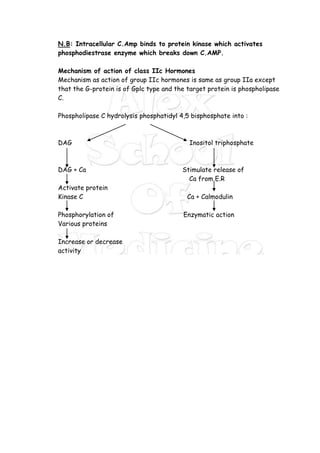
Mechanism of action of class IIc Hormones
Mechanism as action of group IIc hormones is same as group IIa except
that the G-protein is of Gplc type and the target protein is phospholipase
C.
Phospholipase C hydrolysis phosphatidyl 4,5 bisphosphate into :
DAG Inositol triphosphate
DAG + Ca Stimulate release of
Ca from E.R
Activate protein
Kinase C Ca + Calmodulin
Phosphorylation of Enzymatic action
Various proteins
Increase or decrease
activity
GLANDPITUITARY
 Adenohypophysis:
o The anterior part of the pituitary gland secretes 5 main hormones
which are: GH – Prolactin – TSH – ACTH - GnTH.
o Those hormones are controlled by releasing and inhibiting factors
released from the hypothalamus and reach the adneohypophysis
through the portal hypothalamic-hypophyseal circulation.
1) Growth Hormone:
It affects cell size and number. It acts on epiphyseal plates, muscles and
viscera.
Actions:
a) Stimulates production of somatomedins from the liver that act as
growth factors to stimulate proliferation of chondrocytes and
osteoblasts. They are required for deposition of chondroitin sulphate
and collagen (ground substance of bones).
b) Increases amino-acid transport, entry and protein synthesis in
cells. It stimulates the transcription of DNA in the nucleus causing
formation of large quantities of RNA, This promotes protein
synthesis. It also inhibits the catabolism of proteins.
c) Causes lipolysis to be used as a source of energy and spares glucose in
the blood.
d) It down regulates insulin receptors and decrease glucose entry into
the cells and at the same time causes stimulation of glycogen
synthesis to keep glycogen stores.
e) Stimulates erythropoiesis.
 Regulation of Growth Hormone Secretion:
a) Hypothalamus:
Releasing and inhibiting hormomes.
b) Feedback regulation.
c) Others:
Hypoglycemia, increased amino-acids, decreased FFA, sleep, stress,
surgery, anesthesia.
 Disorders caused by inappropriate GH production:
- Increased production:
a) Before puberty: gigantism
b) After puberty: acromegaly
- Decreased production:
Before puberty: dwarfism
 Gigantism:
o Increased height
o Infantile gonads
o Hyperglycemia
Some may develop partial hypopituitarism if they remain untreated which
may lead to death.
 Acromegaly:
o Increased bone thickness
o Enlargement of small hand and feet bone
o Kyphosis
o Soft tissue growth
o Thickened skin with increased body hair
o Enlarged nose, lower jaw, supraorbital ridges.
 Dwarfism:
o Decreased development rate
o Proportionate growth
o Decreased metabolic rate
o In some cases, dwarfs are sexually immature with infantilism.
2) Prolactin:
Actions:
a) Milk production in females which requires fat and lactose.
b) Decreases ovulation which may lead to amenorrhea.
 Regulation of Prolactin secretion:
1) Hypothalamus:
Releasing and inhibiting hormomes.
2) Feedback regulation.
3) Others
Sleep, stress, exercise.
Hormones of posterior pituitary gland
 Supraoptic & paraventricular nuclei >> release ADH & oxytocin hormone >>
with neurophyins along the axons >> herring bodies in the nerve endings
 Hypothalamic stimulation >> action potential along the axons >> induction
of hormones release from herring bodies by exocytosis >> circulation
1. ADH:
 Functions:
A. On the kidneys:
- Increase blood volume & decrease urinary output in case of
dehydration by increasing distal kidney tubules permeability leading to
increasing water reabsorption
B. On the blood vessels:
- Vasoconstriction of the arterioles >> increasing BP back to normal in
case of hemorrhage
- Under normal condition its effect is counteracted by baroreceptor
reflex
 Control:
1. Osmolality:
- The level of ADH secretion is adjusted to maintain the osmolality
close to 290 mOsm/L
- Dehydration / high salt level >> increase ADH release >> water
retention >> correction of blood volume & Osmolality
- Osmolality is detected by osmoreceptors in the hypothalamus
2. Volume depletion:
- Decreased Blood volume ( dehydration / hemorrhage) & hypotension >>
sensed by baroreceptors >> glossopharyngeal & vagus >> Cardiovascular
centers >> release of ADH >> correction of BP & volume
3. ADH release is also increased by:
- Angiotensin H
- Drugs as morphine , anesthetics & nicotine
- Exercise , surgery & stress
4. ADH release is decreased by alcohols
 Disorders:
- Cause:
Supra sellar hypothalamic lesions leads to:
a. Decreased ADH secretion >> diabetes insipidus
 Causes:
- Inflammatory and infiltrative disorders of the hypothalamus and
pituitary
- Hypothalamic surgery.
- Head injury.
- Idiopathic (sporadic or hereditary) causes.
 Symptoms:
- Polyuria >> 4-6 L per day … dilute … constant specific gravity 1002-
1006
- Polydipsia >> constant thirst due to excessive loss of urine / impaired
sense of thirst or decreased fluid intake >> dehydration ( fatal )
b. Inappropriate ADH secretion >> paraneoplastic release of ADH by
small cell carcinoma of the lung
2. Oxytocin H:
 Functions:
- Milk ejection:
Contraction of myoepithelial cells surrounding the ducts and the alveoli
of the mammary glands causing milk ejection
- Contraction of uterine smooth muscles
i. On pregnant uterus: initiate labor (( clinically used for labor induction
)) & increase during labor
ii. On non pregnant uterus: facilitate sperm transport by uterine
contraction
- In males:
Sperm discharge from seminiferous tubules and epididymis to the vas
deferens.
 Control:
i. Oxytocin release is increased by:
- Suckling reflex >> stimulation of touch receptors of nipples >>
stimulation of hypothalamus >> release of H in the blood >>
myoepithelial cells of the mammary glands >> milk ejection
- Stretching of uterine cervix during labor
- Genital stimulation
ii. Decreased by:
- Fear
- Pain
- alcohol
Therapeutic uses of anterior pituitary hormones
1. Growth Hormone:
 In children with hypopituitarism whose epiphyses have not fused, human growth
hormone is used.
 Human growth hormone has been replaced by a peptide of the same amino acid
sequence prepared by genetic engineering in bacteria (somatotropin)
(recombinant GH)
2. Thyroid stimulating hormone(TSH):
 Mostly used for diagnostic purposes (to distinguish between 1ry and 2ry
hypothyroidism).
 Preparation and Administration: Thyrotropin (Thytropar) is derived from
beef pituitaries (IM or SC).
3. Adrenocorticotrophic hormone (ACTH):
a. Diagnostic: As a test of the adrenal cortex in cases of suspected Addison's
disease and hypopituitarism.
b. Treatment:
 Stimulation of the adrenal cortex in patients who are on prolonged
glucocorticoid therapy.
 Similar uses as corticosteroids (provided that the adrenal cortex is intact).
However, being inactive when taken orally, limits its use when prolonged
therapy is intended.
4) Prolactin:
 There is no therapeutic use for prolactin.
 But inhibition of prolactin secretion can be achieved with bromocriptine
(dopamine agonist), which stimulates PIF useful in treatment of galactorrhea
and suppression of physiological lactation.
Therapeutic uses of posterior pituitary hormones
I)-ADH (vasopressin):
 The primary therapeutic use is in the management of diabetes insipidus.
 Bleeding oesophageal varices.
 Haemophilia A: It increases antihaemophilic factor VIII or Van Willibrand
factor.
 Vasoconstriction with local anaesthetic (e.g. Flypressin).
Preparation and Administration:
1.Natural Vasopressin or ADH: (Pitressin) :Available as injection for IM
administration.
2.Desmopressin Acetate:
 Is a long acting synthetic analogue of vasopressin.
 It is usually preferred for chronic treatment.
 Is present as:
a. Nasal spray: 0.1, 1.5 mg/ml solution (Nasal congestion may delay
absorption)
b. Parentral:- 4mg/ml solution for injection.
c. Oral:- 0.1, 0.2 mg/ tablet.
N.B. Vasopressin should be used cautiously in coronary disease.
II)- Oxytocin :
 To induce or support labor.
 Oxytocin and prostaglandin F2 alpha are used to induce abortion.
 Impaired milk ejection (may respond to oxytocin).
 For control of postpartum uterine haemorrhage, however, the treatment of
choice for this purpose are ergot alkaloids of which ergonovine maleate and
methyl-ergonovine maleate (Methergine) are drugs of choice, due to
sustained and prolonged action.
Preparation and Administration:
 Synthetic Oxytocin (Syntocinon): Available for parentral administration (IM
or IV).
 Oxytocin Citrate (Syntocinon spray): By mouth and nasal spray
MCQs
1. Concerning the pituitary
gland, all the following
statements are true EXCEPT :
a. The diaphragm sellae
separates it superiorly from
the optic chiasma
b. It is connected to the
thalamus by hollow conical
stalk called the infundibulum
c. It is lodged in the
hypophyseal fossa
d. It receives its blood supply
from branches of the internal
carotid artery
2. All are true regarding the
pituitary gland EXCEPT:
a. It develops from a buccal part
and cranial part
b. Its anterior lobe is formed of
pars tuberalis and pars
distalis
c. Its venous drainage is
collected into the sigmoid
sinus
d. Pharyngeal pituitary gland is
due to failure of ascend of
buccal pituitary
3. The pituitary gland is separated
from the pons by
a. Tuberculum sellae and
sphenoid air sinus
b. Diaphragma sellae
c. Body of sphenoid
d. Dorsum sellae
e. A & c
4. The pituitary gland is separated
from the optic chiasma by :
a. tuberculum sellae and sphenoid
air sinus
c. diaphragma sellae
d. body of sphenoid
e. dorsum sellae
f. b& c
5. Regarding the development of
the pituitary gland, all are
false EXCEPT:
a. Pars nervosa will adhere to
pars distalis giving the
posterior lobe
b. Rathke’s pouch grows cranially
from the cranial primordium
c. failure of degeneration of the
Rathke’s stalk results in a
condition of fatal brain
infection
d. all are false
6. Hypothalamo-hypophyseal portal
system :
a. Fine vessels connecting the
adenohypophysis to the
hypothalamus.
b. transport hormone releasing
factors from the median
eminence to the anterior lobe
of pituitary
c. all of the above
d. none of the above
7. Relating to the pituitary gland
at each side :
a. The cavernous sinuses
b. The intercavernous sinuses
c. The inferior petrosal
d. A & B
8. All are relations of the
pituitary gland except :
a. the diaphragm sellae
superiorly
b. Intercavernous sinuses
anteriorly and posteriorly
c. Cavernous sinuses at each side
d. Body of sphenoid inferiorly
9. All of the following are true
about Adenohypophysis except
a. darkly stained
b. cellular part
c. glial cells
d. anterior pituitary gland
10. ………. is composed of branching
cords of polygonal epithelial cells
surrounded by wide fenestrated
sinusoids
a. Pars Distalis
b. Pars Tuberalis
c. Pars Intermedia
d. All of the above
11. To differentiate between
chromophils and chromophopes, we
will found that chromophils are
a. Larger
b. Dark
c. Contain eccentric nuclei
d. All of the above
12. All of the following are the
general ultrastructure of protein
secreting cells except :
a. mitochondria with tubular cirstae
b. well developed rER
c. Golgi apparatus
d. secretory granules
13. ……….. in chromophils are
the structures that are stained
with acidic stains in acidophils or
basic stains in basophils
a. mitochondria with tubular cirstae
b. well developed rER
c. Golgi apparatus
d. secretory granules
14. all of the following are true
about acidophils except
a. secrete hormones of protein
nature
b. smaller than the basophils
c. PAS +ve
d. contain large secretory granules.
15. Somatotrophs & mammotrophs
are two types of basophils in
adenohypophysis
a. True
b. False
16. …….. Secrete growth hormone,
which stimulates the growth of
the epiphyseal cartilage of long
bones.
a. Mammotrophs
b. Gonadotrophs
c. Somatotrophs
d. Thyrotrophs
17. All of the following are true
about Mammotrophs in
adenohypophysis except :
a. Pregnancy cells
b. Erdheim cells
c. Secrete prolactin hormone
d. Secrete Luteinizing hormone
(LH)
18. In males, excessive
secretion of prolactin leads to
hypergonadism.
a. True
b. False
19. All of the following are true
about basophils in
adenohypophysis except
a. PAS +ve
b. smaller than the acidophils
c. secrete hormones of glycoprotein
nature
d. Represent 11 % of chromophils
20. Follicle stimulating hormone
(FSH) which acts on ovarian
follicles is secreted by
a. Mammotrophs
b. Gonadotrophs
c. Somatotrophs
d. Thyrotrophs
21. …….. stimulates secretion of
progesterone and estrogen from
the corpus luteum in the ovary
a. Luteinizing hormone (LH)
b. Adreno-corticotrophic hormone
(ACTH)
c. Follicle stimulating hormone (FSH)
22. corticotrophs which
secrete the ACTH are PAS
-ve.
a. True
b. False
23. All of the following
are true about corticotrophs
except
a. secrete the ACTH
b. PAS +ve
c. Basophils
d. Chromophils
24. Chromophils do not
secrete hormones. They are
considered as reserve cells
or degranulated
Chromophobes
a. True
b. False
25. ………. is the funnel-
shaped area surrounding the
infundibulum. It is highly
vascular. It is formed of
chromophobe-like cells.
a. Pars Distalis
b. Pars Tuberalis
c. Pars Intermedia
d. All of the above
26. In animals, Pars
intermedia is a rudimentary
region. It is made up of
cords of faint basophilic
cells with few secretory
granules.
a. True
b. False
27. All of the following
are true about Pars
Intermedia in animals except
a. Well developed
b. Contains colloid cysts
c. Secrete melanocyte-stimulating
hormone (MSH)
d. Reserve cells
28. All of the following
are true about pars nervosa
except
a. connected to the base of the
brain
b. form the hypothalamo-
hypophyseal tract
c. Rich in fenestrated blood
capillary plexus
d. Contains basophilic homogenous
bodies
29. ………. are modified
branched glial cells which
have a supporting and
nutritive function as well as
isolation in pars nervosa
a. Pituicytes
b. Herring bodies
c. colloid cysts
d. non of the above
30. ………… stimulates
contraction of the smooth
muscles of the uterine wall
and of myoepithelial cells
that surround the alveoli and
ducts of the mammary
glands
a. Vasopressin or antidiuretic
hormone (ADH)
b. Melanocyte-stimulating hormone
c. Oxytocin
d. Prolactin
31. Vasopressin or
antidiuretic hormone (ADH)
increases the permeability
of the collecting tubules to
water absorption leading to
hypotonic hypervolaemic
urine.
a. True
b. False
32. All these hormones
affected by both inhibiting
and releasing hypothalamic
hormones except
a. Prolactin
b. Melanocyte-stimulating hormone
c. FSH
d. Growth hormone
33. The hypothalamus
connects to anterior
pituitary gland in the form
of hypothalamic-hypophyseal
tract.
a. True
b. False
34. hormones that pass
through a duct to the
circulation are:
a. Endocrine hormones
b. Paracrine hormones
c. Autocrine hormones
d. None of the above
35. Prostaglandins are:
a. paracrine hormones
b. endocrine hormones
c. autocrine hormones
d. enzymes
36. The intracellular messenger
of class II hormones is:
a. phosphorylated form
b. carboxylated form
c. hormone receptor complex
d. hormone enzyme complex
37. Hormone receptors are:
a. lipid in nature
b. protein in nature
c. phospholipids
d. C H O in nature
38. The site of class I hormones
receptors is:
a. outside the cell
b. in the cytoblasm
c. inside the nucleus
d. b and c
39. All of the following are class
I hormones except:
a. steroid hormones
b. retinal
c. retinoic acid
d. T3
40. The following are properties
of class I hormones except:
a. Combine with carrier
protein
b. Have intracellular
receptors
c. Lipophobic
d. Long half live
41. The secondery messenger of
group IIa hormones is:
a. cAMP
b. cGMP
c. Calcium
d. Tyrosine kinase
phosphorylation kinase
42. Insulin is an example of:
a. IIa hormones
b. IIb hormones
c. IIc hormones
d. IId hormones
43. The following hormone has
an intanuclear receptor:
a. insulin
b. prostaglandin
c. A.N.P
d. vitamin D
44. The specific DNA region for
hormonal action is called:
a. hormone receptor complex
b. hormone responsive
element
c. hormone receptor
d. secondery messenger
45. High doses of glucocorticoids
decreases:
a. osteocalcin
b. transferrin
c. heparin
d. all of the above
46. Adenylcyclase enzyme is
activated by:
a. alpha chain G-protein
b. beta chain G-protein
c. gama chain G-protein
d. GTP
e. A and D
47. Hydrolysis of c.AMP is
done by:
a. phosphodiesterase enzyme
b. adenylcyclase enzyme
c. protein kinase enzyme
d. phospholipase c
48. The enzyme activated by
cAMP dependent protein kinase
in glycogenolysis is:
a. Adenycyclase
b. Calmodulin
c. Phosphorylase B kinase
d. None of the above
49. Formation of alpha Gs-GTP
protein is mediated by:
a. alpha 1 receptor
b. alpha 2 receptor
c. beta 2 receptor
d. all of the above
50. Methylxanthine derivatives
cause:
a. increased cAMP level
b. decreased cAMP level
c. increased ATP level
d. decreased cGMP level
51. The following substance
cause release of intracellular
calcium stores:
a. diacyleglycerol
b. IP3
c. calmodulin
d. protein kinase c
52. Calmodulin:
a. is acalcium dependent
regulatory protein
b. has 4 calcium binding sites
c. after binding to calcium, it
undergo conformational
changes
d. all of the above
53. The ligand of Gt protein is:
a. glucagon
b. norepinephrine
c. light
d. catecholamines
54. Receptor which activates
Gplc protein is:
a. Vasopressin receptor
b. Alpha 2 receptor
c. Alpha 1 receptor
d. A and C
55. The target enzyme of Gt
protein is:
a. Adenylcyclase
b. cGMP phosphodiesterase
c. Phospholipase c
d. Glycogen synthetase
56. Which type of G-protein is
involved in cation channel
closure:
a. Gt
b. Gs
c. Gi
d. G plc
57. The second messenger of Gs
protein is:
a. cAMP
b. cGMP
c. calcium
d. IP3
TRUE OR FALSE:
58. Gs protein differs from Gi
protein in beta subunit
structure. ( )
59. Calcium is an intracellular
messenger of hormonal action.
( )
60. The target enzyme of Gs
protein is cGMP
phosphodiesterase. ( )
61. The endocrinal system is
connected to the nervous
system through:
a. thalamus
b. hippocampus
c. hypothalamus
d. none of the above
62. 1-25 dihydroxy
cholecalciferol is secreted
from:
a. Adipose tissue
b. Liver
c. Kidney
d. Thyroid gland
63. An example of local
hormones:
a. Thyroxin
b. Acetylcholine
c. Gastrointestinal hormones
d. B&c
64. Derived from
cholesterol:
a. Aldosterone
b. Cortisol
c. Estrogen
d. All of the above
65. Adrenal cortex
hormones are
a. Steroids
b. Proteins
c. Tyrosine derivatives
d. None of the above
66. Adrenaline:
a. Derived from cholesterol
b. Tyrosine derivative
c. Protein
d. None of the above
67. Site of receptor of
adrenal cortex hormones :
a. the cytoplasm
b. the nucleus
c. the cell membrane
d. all of the above
68. Noradrenaline receptor
location:
a. cell membrane
b. nucleus
c. cytoplasm
d. none of the above
69. Thyroxin receptor
location:
a. the nucleus
b. the cell membrane
c. the cytoplasm
d. all of the above
70. Parathyroid hormones
are :
a. steroids
b. proteins
c. tyrosine derivatives
d. none of the above
True or false:
71. 1-25
dihydroxycholecalciferol is
secreted from the liver
a. true
b. false
72. All amino acid tyrosine
derivatives receptors are
located in the nucleus
a. true
b. false
73. Adrenal medulla
hormones are derived from
cholesterol
a. true
b. false
74. Plasma protein carriers
are secreted by the liver
a. true
b. false
75. Hormones are
transported through the
circulation at high
concentration
a. true
b. False
76. All of the following are
hormones of the anterior
pituitary gland except:
a. ACTH
b. TH
c. Oxytocin
d. FSH
77. Releasing & inhibitory
Hormones secreted from the
hypothalamus control the
secretion of all the pituitary
gland hormones
a. True
b. False
78. All of the following are
hypothalamic releasing and
inhibitory hormones except:
a. TRH
b. GHHI
c. PRF
d. GHRH
e. TIH
79. All of the following
statements concerning
Luteinizing Hormone releasing
Hormone are true except:
a. It is the same as the
hormone somatostatin
b. causes release of follicle-
stimulating hormone
c. it is also called
gonadotropin-releasing
Hormone
d. causes release of luteinizing
hormone
80. Which of the following
statements about
Somatotropin is incorrect?
a. causes growth of muscles and
viscera
b. stimulates the synthesis of
somatomedins in the liver
c. Increased concentration of
amino acid inside cells
d. Increases nitrogen excretion in
the urine
81. After epiphyseal closure
in the long bones...the effect
of Growth hormone on these
bones leads to
a. Increasing their thickness by
periosteal growth
b. Increasing the bone length
c. None of the above
d. All of the above
82. Which of the following
is one of the actions of
Growth hormone:
a. It decreases synthesis of
acetyl-Co A inside cells
b. up regulation of insulin
receptors
c. increases glycogenesis
d. None of the above
83. All of the following
statements about
Somatostatin Are incorrect
except:
a. which are called insulin like
growth factors
b. secreted mainly by the
hypothalamus, gastrointestinal
tract and the pancreas
c. stimulates the secretion of
growth hormone and TSH
d. they are synthesized mainly by
the the liver
84. All of the following are
stimuli for growth hormone
secretion except:
a. Decrease F.F.A concentration in
the blood
b. fever
c. surgery
d. Hyperglycemia
e. severe exercise
85. Hyperpituitarism in most
cases is due :
a. hyperplasia
b. Adenocarcinomas
c. Lesions of the anterior
pituitary
d. Functional adenomas
e. None of the above
86. All of the following is
true about Prolactinomas
EXCEPT:
a. They cause hyperprolactinemia
b. Galactorrhea is one of their
symptoms
c. They cause amenorrhea in
females and hypogonadism in
males
d. They block the action of
gonadotropin on the ovaries
87. Cushing syndrome is
caused by :
a. Corticotrophic cell adenomas
b. Thyrotroph adenomas
c. Prolactinomas
d. Gonadotroph adenomas
e. None of the above
88. All of the following is
incorrect about somatotrophic
cell adenomas EXCEPT:
a. They’re the most common
functioning adenoma of the
pituitary
b. They all lead to infantile gonads
c. They lead to gigantism when
arising after epyphyseal closure
d. They all lead to hyperglycemia
89. All of the following is
true about Gigantism and
Acromegaly EXCEPT :
a. Gigantism develops before
epyphyseal closure while
Acromegaly develops after
epyphyseal closure
b. Gigantism increases the length
of bones and the person
becomes a giant while
Acromegaly increases the bone
thickness and the person
cannot become taller
c. They both leads to changes in
the vertebrae ordinarily leading
to Kyphosis
d. They both leads to
hyperglycemia
90. All of the following is a
primary pituitary disorder
EXCEPT:
a. Non secretory pituitary
adenoma
b. Sheehan’s syndrome
c. Craniopharyngioma
d. Empty sella tersica
91. Which of the following
is incorrect about non
secretory pituitary adenomas
a. They are primary pituitary
disorder that may compress
and injure the pituitary
b. They cause injury to the
pituitary only if they grow
suddenly as a result of
pituitary apoplexy
c. They present as a place-
occupying lesions
d. Their clinical symptoms refer
to local mass effect
92. All of the following is
incorrect about Sheehan’s
syndrome EXCEPT:
a. It’s caused by herniation of the
subarachnoid and cerebrospinal
fluid
b. It results in compression of the
pituitary galnd
c. It’s associated with
hypotention and hemorrhage
during the peripartum period
d. It’s considered as a
hypothalamic disorder
93. In partial insufficeincy
of the pituitry the first
function to be impaired is GH
secretion then GnTH and
finally if the gland is
destroyed TSH insufficeincy
is detected.
a. True
b. False (if the gland is
destroyed adrenal insufficiency
is detected)
94. Panhypopituitarism is
characterized by :
a. Decreased production of
thyroid hormone and
glucocorticoids
b. Suppressed secretion of
gonadotrophic hormones
c. Severe pallor and loss of weight
d. Premature senility
e. All of the above
95. All of the following is
correct concerning Dwarfism
EXCEPT:
a. It’s caused by deficiency of
growth hormone during
childhood so the rate of
development is greatly reduced
b. There’s no manifestations of
thyroid or adenocortical
deficiency
c. The features of the body grows
in inappropriate to each other
d. The metabolic rate of the child
is lowered
e. It has no effect on the nervous
system so there’s no mental
retardation
96. The ADH is synthesized in
the
a. Kidney
b. Thymus
c. Post. pituitary gland
d. Hypo thalamus
97. All the following are
neurosecretion hormones except:
a. Vasopressin
b. Releasing thyroid .H
c. Prolactin
d. Oxytocin
98. All the following are true
about ADH except:
a. Released in pars nervosa
b. Act on the proximal portion of the
nephron
c. Stimulated when the osmolality is
290mosm/L
d. Alcohol increase secretion of ADH
99. Stress increase the secretion
of :
a. ADH
b. Prolactin
c. G.H
d. All the following
100. All the following are
character of diabetes insipidus
except :
a. Polyuria
b. Hyponatremia
c. Polydipsia
d. May lead to dehydration
101. Oxytocin .H is responsible
for
a. Milk ejection
b. Induction of labor
c. A,C
d. Milk formation
102. Which of the following is true
about oxytocin:
a. Its secreted in pars nervosa
b. Stimulated by stress
c. Stimulated by suckling
d. None of the above
e. A,C
103. ADH is stimulated by the
following except :-
a. Increase osmolarity of plasma
b. Hypertension
c. Angiotensin H
d. Nicotine
104. 9-The hormone which
secreted during labor
a. ADH
b. T3
c. Oxytocin
d. Prolactin
105. 10-All the following are cases
of ADH deficiency
a. Inflammation in hypothalamus
b. Hypothalamus surgery
c. Hypothalamus neoplasi
d. Idiopathic
106. In children with
hyperpituitarism whose epiphyses
have not fused, human growth
hormone is used
a. True
b. False
107. ……. Is mostly used for
diagnostic purposes to distinguish
between 1ry and 2ry
hypothyroidism
a. Growth hormone
b. Prolactin
c. TSH
d. Oxytocin
108. Adrenocorticotrophic hormone
has only a diagnostic use in
cases of suspected Addison's
disease
a. True
b. False
109. For stimulation of the adrenal
cortex in patients who are on
prolonged glucocorticoid therapy
we can use ….
a. Growth hormone
b. Prolactin
c. TSH
d. ACTH
110. In case of patient who is
suspected to have addison’s
disease , we can use ……. as
diagnostic hormone
a. Growth hormone
b. Prolactin
c. TSH
d. ACTH
111. ACTH is a drug of choice for
addison’s disease
a. True
b. False
112. …….. is useful in treatment of
Galactorrhea and symptomatic
hyperprolactinaemia
a. Bromocriptine
b. Growth hormone
c. Prolactin
d. TSH
113. All of the following are
therapeutic uses of vasopressin
except
a. management of diabetes insipidus
b. Bleeding oesophageal varices
c. control of postpartum uterine
haemorrhage
d. Haemophilia A
114. Natural Vasopressin or ADH
(Pitress ) available as
a. Oral tablets
b. IM injection
c. IV injection
d. SC injection
115. ……. Is a long acting synthetic
analogue of vasopressin
a. Pitress
b. Flypressin
c. Desmopressin Acetate
d. None of the above
116. All of the following are true
about Desmopressin Acetate
except
a. long acting synthetic analogue of
vasopressin
b. preferred for chronic treatment
c. present as Parentral:- 4mg/ml
solution for injection
d. present as Oral:- 0.1, 1.2 mg/
tablet
117. all of the following are uses
of oxytocin except
a. induce or support labor
b. control of postpartum uterine
haemorrhage
c. induce abortion
d. suppression of physiological
lactation
118. For control of postpartum
uterine haemorrhage , …… is the
drug of choice
a. Oxytocin
b. ergonovine maleate
c. Oxytocin Citrate
d. ACTH
119. Synthetic Oxytocin
(Syntocinon) Available for
a. Oral tablets
b. Nasal spray
c. IV injection
d. SC injection
120. ……. Is administrarted by
mouth or nasal spray for
impaired milk ejection
a. TSH
b. ergonovine maleate
c. Oxytocin Citrate
d. ACTH
121. One of the following is acting
on same cell secreting it :
a. Insulin
b. Prostaglandin
c. Oxytocin
d. Growth hormone
122. One of the following is a local
hormone :
a. Insulin
b. Glucagon
c. GIT hormones
d. ADH
123. Which of the following is true
about catcholamines :
a. Derived from same compound
of steroids
b. Have same original compound
like Thyroxin
c. Needs carrier protein in the
blood
d. Has long lifespan
124. Thyroxin :
a. Group II, Tyrosine derivative
with cytoplasm receptor
b. Group I , Steroid with nuclear
receptor
c. Group I , having receptor inside
cells and derived from Tyrosine
d. Group II ,, protein with
membrane receptor
125. Which of the following
hormones has the longest life
span?
a. Catecholamines
b. Retinoic acid
c. Proteins
d. Glycoproteins
126. All the following have
receptors inside the cell except :
a. ADH
b. Retinoic acid
c. Calcitriol
d. Glucocorticoids
127. In case of Beta –adrenergic
receptors ,, which of the
following is true :
a. c AMP is activated by guanyl
cyclase
b. G-protein is a tri-trimer
c. When dimer is formed in G-
protien ,, adenyl cyclase is
activated
d. Beta adrenergic receptors
stimulates Gi proteins
128. One of the following
factors decreases the
concentration of/ deactivates
cAMP inside the cell
a. Adenyl cyclase
b. Caffeine
c. Alpha 2 receptor activation
d. Beta receptor activation
129. Calcium is released by one of
the following factors :
a. Activation of Gs protein
b. Activation of PLC
c. Increase in Phosphatidyl 4,5
biphosphate
d. Inhibition of alpha 1 receptors
130. All of the following reverse
the action of phosphodiestrase
except :
a. G-transducin
b. Stimulation of beta receptors
c. Adenyl cyclase
d. Caffeine
131. Pituitary gland is connected to
which part of the brain by
infndibulum :
a. Optic Chiasma
b. Tuber cinerium
c. 4th
ventricle
d. Corpus Callosum
132. Diaphragma sallae separates
pituitary gland from :
a. Optic chiasma
b. Thalamus
c. 3rd
ventricle
d. None of the above
133. The portal circulation in
pituitary gland is formed by
which artery :
a. ECA
b. Superior Hypophyseal artery
c. Inferior Hypophyseal artery
d. Superior thyroid artery
134. All of the following arise from
cranial premordium except :
a. Pars intermedius
b. Infindibulum
c. Pars Nervosa
d. Median eminence
135. Rathke's bouch produces :
a. Rathke's stalk
b. Pars intermedius
c. Pars distalis
d. All of the above
136. One of the following anomalies
can be related to the neural
component of the pituitary gland
:
a. Agenisis
b. Pharyngeal pituitary gland
c. Craniopharyngeal canal
d. None of the above
137. The superior pole of the
lateral lobes of the thyroid gland
is related to which part of the
larynx :
a. Thyroid prominence
b. Thyroid tubercles
c. Thyroid notch
d. Oblique line
138. Which of the following
arteries is related superiorly to
the isthmus :
a. Anastomotic artery
b. Superior thyroid arteries
c. Inferior thyroid arteries
d. ECA
139. The deepest part related to
the middle part of the
anterolateral surface of the
lateral lobe is :
a. Superior belly of omohyoid
b. Sternothyroid muscle
c. Sternohyoid muscle
d. Sternomastoid muscle
140. All of the following are
related to the medial surface of
the thyroids lobes except :
a. Thoracic oesophegus
b. Larynx
c. External laryngeal nerve
d. Trachea
141. Cricothyroid muscle is
affected by thyroidectomy due
to
a. Ligature of Superior thyroid
artery
b. Ligature of Inferior thyroid
artery
c. Affection of recurrent
laryngeal nerve
d. Affection of thyroid eima
arteries
142. Choose the statement about
steroid hormones that is
incorrect.
a. Steroids are lipids with
complex ring structures.
b. Steroids can pass through their
target cell membrane and
interact with receptors in the
nucleus.
c. Steroids employ first and
second messengers that amplify
the cellular response.
d. The estrogens and
testosterone are examples of
steroid hormones.
143. Cyclic AMP functions as a(n)
_______________ for
_______________ hormones.
a. binding site; non steroid
b. membrane receptor; steroid
c. activity site; G protein
d. second messenger; non steroid
144. Which of these is not a
method the body uses to
regulate its hormonal releases?
a. negative feedback
b. direct nervous stimulation
c. release of tropic hormones
d. degradation of the endocrine
gland
145. Where are the posterior
pituitary hormones
manufactured?
a. in neurosecretory cells that
originate in the hypothalamus
b. in the posterior pituitary
c. in the anterior pituitary
d. in the brain stem
146. There are several types of
cells in the anterior pituitary.
Which ones secrete growth
hormone?
a. mammatropes
b. gonadotropes
c. corticotropes
d. somatotropes
147. Drinking alcoholic
beverages on hot days is not
safe because alcohol inhibits
the release of ____________
which normally helps to
conserve water during
dehydration.
a. antidiuretic hormone
b. oxytocin
c. thyroxine
d. triiodothyronine
148. Which of these is not an
endocrine property?
a. hormones reach targets
through the blood
b. effects are slow and cyclic
c. rapid acting effects
d. effects caused by chemicals
149. Which of these does not
belong with the others?
a. protein
b. peptide
c. amino acid
d. steroid
150. In the "second messenger"
theory, which is the first
messenger?
a. cAMP
b. hormone
c. enzyme
d. receptor
151. Which of these is not an
endocrine gland?
a. pancreas
b. testes
c. salivary gland
d. parathyroid
152. Which is not a function of the
hypothalamus?
a. affect heart rate
b. control temperature
c. affect water balance
d. secrete FSH
153. Which of these hormones is
made by the posterior pituitary?
a. FSH
b. LH
c. ACTH
d. ADH
154. Which hormone directly
affects blood pressure?
a. ADH
b. insulin
c. PTH
d. ACTH
155. The hormone _____ causes
the contractions of labor.
a. prolactin
b. estrogen
c. oxytocin
d. progesterone
156. Which hormone has the
greatest influence on the ability
to secrete milk?
a. oxytocin
b. estrogen
c. prolactin
d. progesterone
157. Which hormone causes
excessive skeletal growth or
giantism?
a. somatotropin
b. testosterone
c. insulin
d. somatostatin
158. Which of these does not
directly stimulate the gonads?
a. FSH
b. TSH
c. LH
d. ICSH
159. The cells having the upper
hand in anterior lobe of pituitary
gland is :
a. Chromophobes
b. Basophils
c. Acidophils
d. Chromophils
160. The common property between
the basophils and acidophils is :
a. Affinity to H & E
b. Density of the secretory
granules
c. Eccentric nucleus
d. Percentage
161. Which of the following cells is
smallest :
a. Mamotrophs
b. Gonadotrophs
c. Thyrotrophs
d. Corticotrophs
162. MSH in human is secreted in :
a. Pars Distalis
b. Pars Nervosa
c. Pars Intermedius
d. Not in human (so question is
wrong :P )
163. All of the following are true
about catecholamines EXCEPT:
a. Hormones of Gp.II
b. Paracrine hormones
c. Derivatives of amino acid
tyrosine
d. binds to cell membrane
receptors
e. Secreted by the adrenal
medulla
164. Gp.I hormones are
characterized by all of the
following EXCEPT:
a. It includes steroids, T3, T4,
calciferol & retinoic acid
b. They are lipophilic
c. They need a transport protein
d. They have intracellular
receptors
165. All of the following are
hormones of Gp.II EXCEPT:
a. Catecholamines
b. ACTH
c. Estrogen
d. Insulin
166. All of the following are true
about ACTH except:
a. Produced by PAS –ve cell
b. has long plasma half life
c. secreted from corticotrophs
d. bind to cell membrane receptor
167. All are true about
phosphodiesterase enzyme
EXCEPT:
a. It hydrolyse intracellular cAMP
b. used to terminate actions of
class IIa hormones
c. activated by methylated
xanthine derivatives e.g.
Caffeine
d. none of the above
168. Intracellular cAMP is
increased by all of the following
EXCEPT:
a. increased ATP
b. increased glucagon
c. increased caffeine
d. increased PDE enzyme
e. increased GTP
169. All of the following is true
about adenohypophysis EXCEPT:
a. darkly stained
b. cellular
c. derived from the floor of
stomodium
d. divided into pars distalis,
tuberalis & intermedia
170. All of the following are
functions of pituicytes EXCEPT:
a. Support
b. Nutrition
c. Isolation
d. Transport of hypothalamic
neurosecretions
171. Most common type of
functioning pituitary adenomas:
a. GH hormone adenomas
b. Prolactinomas
c. Cortichotrophs adenomas
d. Gonadotrophs adenoma
172. All are true about ADH
except:
a. carried by neurophysin
b. Secreted by pars nervosa
c. Leads to formation of hypotonic
hypovolaemic urine
d. It can greatly alter the ABP
e. c & d
173. All of the following increase
ADH except:
a. increased osmolality
b. decreased ABP
c. angiotensin
d. Alcohol
174. All of the following are stress
hormones EXCEPT:
a. GH
b. PH
c. ADH
d. all of the above
True or False:
175. Acidophils represents 37% of
chromophils.
176. Decreased ABP initiates nerve
impulses in IX & X nerves.
177. Ant. pituitary disorders are
mostly related to supra-sellar
hypothalamic lesions.
Answers
1. b
2. c
3. d
4. b
5. c
6. c
7. a
8. d
9. c
10. a
11. d
12. a
13. d
14. c
15. b
16. c
17. d
18. b
19. b
20.b
21. a
22.a
23.b
24.b
25.b
26.b
27.d
28.d
29.a
30.c
31. b
32.c
33.b
34.a
35.c
36.c
37.b
38.d
39.b
40.c
41. a
42.d
43.d
44.b
45.a
46.e
47.a
48.c
49.d
50.a
51. b
52.d
53.c
54.d
55.b
56.a
57.a
58.false
59.true
60.false
61. c
62.c
63.d
64.d
65.a
66.b
67.a
68.a
69.a
70.b
71. b
72.b
73.b
74.b
75.a
76.c
77.b
78.e
79.a
80.d
81. a
82.c
83.b
84.d
85.d
86.c
87.a
88.d
89.c
90.c
91. b
92.c
93.b
94.e
95.c
96.d
97.c
98.b
99.d
100. b
101. a
102. e
103. b
104. c
105. c
106. B
107. C
108. B
109. D
110. D
111. B
112. A
113. C
114. B
115. C
116. D
117. D
118. B
119. C
120. C
121. B
122. C
123. B
124. C
125. B
126. A
127. C
128. C
129. B
130. A
131. B
132. A
133. B
134. A
135. D
136. A
137. D
138. A
139. B
140. A
141. A
142. C
143. D
144. D
145. A
146. D
147. A
148. C
149. D
150. B
151. C
152. D
153. D
154. A
155. C
156. C
157. A
158. B
159. A
160. C
161. A
162. D
163. b
164. a
165. c
166. b
167. c
168. d
169. c
170. d
171. b
172. e
173. d
174. d
175. F
176. T
177. F
Essay
1- What is the site of the pituitary gland?
2- What are the relations of pituitary gland?
3- What is the arterial supply of the pituitary gland?
4- What is the venous drainage of the pituitary gland?
5- What are the congenital anomalies of the development of the gland?
6- Discuss the embryonic development of the pituitary gland?
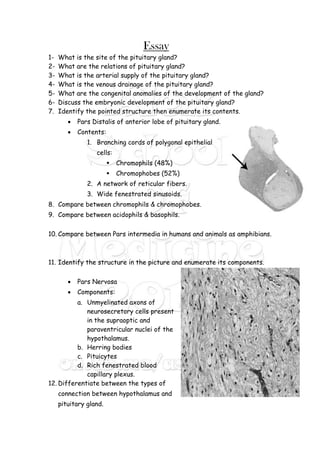
7. Identify the pointed structure then enumerate its contents.
 Pars Distalis of anterior lobe of pituitary gland.
 Contents:
1. Branching cords of polygonal epithelial
cells:
 Chromophils (48%)
 Chromophobes (52%)
2. A network of reticular fibers.
3. Wide fenestrated sinusoids.
8. Compare between chromophils & chromophobes.
9. Compare between acidophils & basophils.
10. Compare between Pars intermedia in humans and animals as amphibians.
11. Identify the structure in the picture and enumerate its components.
 Pars Nervosa
 Components:
a. Unmyelinated axons of
neurosecretory cells present
in the supraoptic and
paraventricular nuclei of the
hypothalamus.
b. Herring bodies
c. Pituicytes
d. Rich fenestrated blood
capillary plexus.
12. Differentiate between the types of
connection between hypothalamus and
pituitary gland.
13. Describe Herring bodies.
14. Give an account on Erdheim Cells.
15. Explain what’s meant by Crinophagy.
16. Describe the sources responsible for the hormones of secretion &
evacuation of milk.
17. Compare between group I, II hormones?
18. How can we classify hormones?
19. Mention the different types of group II according to the 2nd
messenger?
20.What are the functions of each domain of glucocorticoid's receptor ?
21. Mention the mechanism of action of retinoic acid ?
22.Mention mechanism of action of c AMP as 2nd messenger ?
23.Mention the structure of G – protein ?
24.Mention the mechanism of action of G – protein ?
25.Give some receptors regulating G – protein ?
26.Discuss the actions between G-protien subunits that take place when they
become activated by interaction with Beta 1 and beta2 receptors
27.Mention the effect of Gi – protien on adenyl cyclase
28.Explain the cascade of actions occurs when an alpha 1 adrenergic
receptor activates plc
29.Give an account on the effect of plc on phosphatidyl 4,5 – biphosphate
and in turn explain how this effect can regulate variety of cellular
processes
30.Discuss how DAG can regulate muscle contraction
31. Define calmodulin
32.Explain the mechanism through which calmodulin can perform its
regulatory function
33.Describe the mechanism by which Gt – protien can function in the visual
cycle
34.Define ( hormones - Target cell – Receptors)
35.Compare between the different types of hormones?
36.Enumerate the principle endocrine glands
37.Mention other endocrine organs which can secrete hormones
38.Give a short account on local hor7mones
39.Classify hormones chemically
40.7. Discuss Hormone Receptors & Their Activation
41. Mention the different sites for the different types of receptors
42.Give a short account on Hormone Transport & Inactivation
45.Enumerate the hormones of anterior pituitary gland.
46.Mention the hormone which act on each of the following gland:
 Thyroid gland
 Adrenal cortex
 Testes & ovaries
 Mammary gland
 Growth
47.Give a short account on regulation of pituitary function by the
hypothalamus?
48.Mention the function of neurohormones secreted by hypothalamus?
49.Demonstrate the pathway of hypothalamo-hypophyseal portal system.
50.Enumerate the function of releasing & inhibitory hormones.
51. Mention the hormone which responsible for:
 Release growth hormone
 Inhibition of prolactin secretion
 Increase of prolactin secretion
 Release thyroid stimulating hormone
 Release adrenocorticotropin
52.Define: Growth hormone
53.Enumerate the actions of growth hormone.
54.Demonstrate the effect of growth hormone on:
 Cartilage & bone
 Metabolic function
 RBCs
 GIT
55.Mention the effect of growth hormone on:
 Protein
 Fat
 Carbohydrates
56.Give short account on regulation of growth hormone secretion.
57.Which hormone is responsible for:
 Increase growth hormone
 Decrease growth hormone
58.Mention the effect of each of the following on growth hormone
secretion:
 Starvation
 Hyperglycemia
 Increase conc. Of FF in blood
 Decrease conc. Of FF in blood
 Deep sleep
 Moderate exercise
 Anesthesia
 Fever
59.Mention the cases can cause hyperpituitarism.
60.Compare between the somatotroph cell adenoma before and after
adolescence(excess growth hormone secretion).
61. List the criteria of diseased persons with excessive growth hormone
secretion before adolescence
62.List the criteria of diseased persons with excessive growth hormone
secretion after adolescence
63.Give a short account on (panhypopitutarism) in adults
64.Discuss Deficiency of anterior pituitary secretion during childhood
65.What is Pituitary infantilism?
66.Enumerate hormones of the posterior pituitary and mention their mode of
secretion.
67.Give an account on: Functions of Antidiuretic hormone.
68.Give an account on: Control of Antidiuretic hormone
69.Give an account on: Functions of Oxytocin hormone.
70.Discuss the control of Oxytocin secretion.
71. Compare between the causes of the two types of posterior pituitary
disorders.
72.Describe the symptoms of Diabetes Incipiuis
73.Vitamin A deficiency can cause anaemia. How ??
74.Retinol & Retinoic acid are considered hormones of the thyroid/steroid
family. Explain.
75.Mention 3 ways for termination of actions caused by cAMP.
76.cAMP & glucocorticoids are involved in 2 different methods of glucose
synthesis. Explain.
77.Give a short account on the importance of α subunit in synthesis &
termination of action of cAMP.
78.DAG & IȝP cause intracellular physiologic responses using 2 different
sources of Ca ions. Explain.
79.Mention 4 cellular processes regulated by Ca ions.
80.Mention the 4 types of G-protein with their receptors.
81. Explain the role played by G-transducin in the visual cycle.
82.Give a short account on calmodulin
83.Compare between pituitary & thyroid gland (shape, site, size, relations &
blood supply).
84.Discuss the applied anatomy of Pituitary & Thyroid glands.
85.Discuss the structure-function coupling of :
a. hypothalamo-hypophyseal connections
b. pars nervosa.
c. pars distalis
d. protein hormones secreting cells
e. steroid hormones secreting cells
86.Compare between:
a. Chromophils & Chromophobes
b. Acidophils & Basophils
c. manifestations of giantism & acromegaly
d. dwarfism & infantism
e. diabetes insipidus & diabetes mellitus (similarities & differences)
87.Discuss the role of different types of receptors in regulation of ADH
release
88.Oxytocin hormone serves during fertilization, labor & lactation stages.
Explain
89.Discuss the role played by stretch receptors initiating actions of oxytocin
during labor & lactation.

1 pituitary booklet

  • 2.
    Summaries Pituitary gland Lies inthe hypophyseal fossa connected to tuber cinerium by the infundibulum. Divides by the hypophyseal cleft into anterior and posterior lobe. Relations :-  On each side : cavernous sinus + its contents  Superiorly : Diaphragma sellea  Inferiorly :- body of sphenoid + sphenoid air sinuses  Anteriorly : tuberculum sellea + sphenoid air sinuses  Posteriorly : dorsum sellea Arterial Supply :- Supplied by branches of ICA :  Superior hypophyseal artery  Inferior hypophyseal artery which supplies pars nervosa
  • 3.
    Venous drainage :-By short veins into intercavernous and cavernous sinuses. Notes :- Superior hypophyseal artery penetrate median eminence > give 1ry plexus > portal vein > traverse pituitary stalk then give 2ry plexus and this is called hypophyseal portal system which brings the releasing and inhibitory hormones from the hypothalamus Development of pituitary gland :- Origin : ectoderm  Adenohypophysis (oral component) (Buccal premodium) : o Pars distalis o Pars intermedia o Pars tuberalis
  • 4.
     Neurohypophysis (neuralcomponent) (cranial premodium) o Pars nervosa o Infundibulum o Median eminence 1- Buccal premodium : Somatic ectoderm > roof of stomodium > gives Rathk's pouch > grows cranially giving rathk's stalk > degenerates > leaving hypophyseal cleft Rathk's pouch:  Anterior wall : thickened > pars distalis > pars tuberalis > ant lobe   Posterior wall : thinner > pars intermedia > ant lobe  2- Cranial premodium : Neural ectoderm > floor of diencephalon > pars nervosa > grows cranially behind rathk's pouch giving stalk which is called infundibulum Abnormalities :-  Craniopharyngeal canal Communication between nasopharynx and hypophyseal fossa > brain infection > death  Pharyngeal pituitary gland Failure of ascend of buccal pituitary  Agenesis
  • 5.
    The Histology ofpituitary gland Simple equations :D:D  Pituitary gland = adenohypophysis + neurohyphophysis  Adenohypophysis = pars distalis + pars tuberalis + pars intermedia  Neurohypophysis = pars nervosa + infundibulum + median eminence 1. Adenohypophysis: ((darkly stained & cellular)) a. Pars distalis:  Epithelial cells: i. Chromophils (48%) ii. Chromophobes (52%)  Wide fenestrated sinusoids  Network of reticular fibers. Chromophils ( 48% ) Chromophobes (52 %) 1. Larger 2. Eccentric nucleus 3. Granular darkly stained cytoplasm 4. 2 types: acidophils & basophils 5. Well developed rER, 6. Mitochondria with lamellar cristae 7. Golgi apparatus 8. Electron dark secretory granules at the vascular pole 1. Smaller 2. Non granular pale cytoplasm 3. Few organelles 4. No granules ( no hormones ) 5. Act as reserve cells Acidophils (37%) Basophils (11%) 1. Smaller 2. Larger secretary granules 3. Secrete protein hormones 4. (-) PAS reaction 5. two types: 1. Larger 2. Smaller secretary granules 3. Secrete glycoprotein hormones 4. (+) PAS reaction : except corticotrophs
  • 6.
     Somatotrophs :GH  Mammotrophs : pregnancy cells or Erdheim cells secreting prolactin 5. Three types:  Thyrotrophs: TSH  Gonadotrophs: FSH & LH  Corticotrophs: ACTH b. Pars tuberalis:  Funnel-shaped area surrounding the infundibulum.  Highly vascular.  Chromophobe-like cells.  Non-specific function c. Pars intermedia: In humans In animals 1. Rudimentary region 2. Faint basophilic cells with few secretory granules. 3. Non-specific function 1. Well developed 2. Basophilic cells in layers or in the form of follicles lined by cuboidal epithelium 3. Secrete MSH 2. Neurohypophysis (( pale stained & fibrous )):
  • 7.
    a. Pars nervosa: 47agat tet7afaz zay esmena :D:D 1. Unmyelinated axons of neurosecretory cells in the supraoptic and paraventricular nuclei of the hypothalamus 2. Herring bodies (acidophilic homogenous bodies) 3. Pituicytes: modified branched glial cells 4. Rich fenestrated blood capillary plexus Hormones: 1. Oxytocin: contraction of the uterine smooth muscles and of myoepithelial cells that surround the alveoli and ducts of the mammary glands. 2. Vasopressin (ADH) : raising BP by increasing blood volume and decreasing urine output by increasinh water reabsorption 3. Hypothalamic releasing and inhibiting hormones:  synthesized in the hypothalamic nuclei  inhibiting or stimulating the release of pars distalis hormones N.B.  The hormones affected by both inhibiting and releasing hypothalamic hormones: 1- GH 2- Prolactin 3- MSH  The hormones affected only by releasing hypothalamic hormones: 1- TSH 2- FSH 3- LH 4- ACTH Hypophyseal Connections-Hypothalamic Vascular connection Nervous connection 1. Between the hypothalamus and anterior pituitary gland 2. In the form of a hypothalamic-hypophyseal portal circulation 3. In adenohypophysis 1. Between hypothalamus and posterior pituitary gland 2. In the form of hypothalamic- hypophyseal tract 3. In neurohypophysis
  • 8.
     Body Functionsare controlled by both the endocrine system and the nervous system which are connected together through the hypothalamus.  A hormone is: A chemical substance that is synthesized and secreted by a specific cell. It is transported by the circulation and at very low concentration. It elicits a specific response in distant target tissues.  Hormone types according to site of action: 1) Endocrine. 2) Paracrine. 3) Autocrine.  Hormone types according to chemical composition: 1) Protein and polypeptide hormones. 2) Amino-acid derivatives. 3) Steroids.  Steroid hormones are carried in the blood bound to specific plasma proteins and they have a longer half-life while non-steroids move freely in the blood with short half-life.  In addition to the main endocrine glands functioning in the body, some organs have an endocrine function and secrete hormones that act locally or systemically:
  • 9.
    a) Systemic hormones: 1)Kidney: Renin,Erythropoietin. 2) Heart: ANP. 3) Adipose tissue: adipokines. b) Local hormones: 1) Gastrointestinal hormones. 2) Chemical transmitters. Group II HormonesGroup I Hormones Polypeptides, proteins, glycoproteins, catecholamines Steroids, T3, T4, Calcitriol, Retinoic acid Types ShortLongPlasma life span HydrophilicLipophylicSolubility AbsentPresentCarrier Plasma membraneIntracellularReceptor Group Second messenger example IIa C.Amp Epinephrine, Glucagon IIb C.Gmp ANP, NO IIc Ca, phosphatidyl inositol or both Vasopressin, 1- adrenergic catecholamines IId Tyrosine kinase phosphorylation cascade Insulin Group I Hormones Glucocortecoids  Mechanism of action: Hormone traverses the plasma membrane and binds to its receptor forming the hormone receptor complex. The hormone receptor complex migrates to the nucleus and binds to the hormone response element (specific sequence of DNA). This lead to increase or decrease in the transcription of mRNA
  • 10.
    mRNA acts asa template for synthesis of specific enzyme or protein which causes metabolic changes.  Domains of steroid hormone receptors: 1. One w' binds the hormone. 2. One for translocation from the cytoplasm to the nucleus 3. Site w' binds to the HRE. 4. Site w' activates specific gene. Retinol and Retinoic acid Bind to specific nucleus receptor forming receptor-vitamin complex. The complex interacts with a specific vitamin response element involved in protein synthesis. Group IIa C.amp as second messenger N.B: G-protein is formed of a trimer (alpha, beta and gamma) where alpha is bound by GDP. Mechanism of action: Hormone activates the plasma membrane receptor. GDP in the G-protein is replaced by GTP leading to dissociation of alpha G-GTP from the beta and gamma dimer. The alpha GTP complex then activates adenyl cyclase which is responsible for C.Amp production. Increase levels of C.Amp leads to activation of the intracellular GTPase activity which forms GDP. GTP in the complex is then replaced by GDP and the alpha GDP complex reassociates with the beta gamma dimer and the G-protein becomes inactive again.
  • 11.
    N.B: Intracellular C.Ampbinds to protein kinase which activates phosphodiestrase enzyme which breaks down C.AMP. Mechanism of action of class IIc Hormones Mechanism as action of group IIc hormones is same as group IIa except that the G-protein is of Gplc type and the target protein is phospholipase C. Phospholipase C hydrolysis phosphatidyl 4,5 bisphosphate into : DAG Inositol triphosphate DAG + Ca Stimulate release of Ca from E.R Activate protein Kinase C Ca + Calmodulin Phosphorylation of Enzymatic action Various proteins Increase or decrease activity
  • 12.
    GLANDPITUITARY  Adenohypophysis: o Theanterior part of the pituitary gland secretes 5 main hormones which are: GH – Prolactin – TSH – ACTH - GnTH. o Those hormones are controlled by releasing and inhibiting factors released from the hypothalamus and reach the adneohypophysis through the portal hypothalamic-hypophyseal circulation. 1) Growth Hormone: It affects cell size and number. It acts on epiphyseal plates, muscles and viscera. Actions: a) Stimulates production of somatomedins from the liver that act as growth factors to stimulate proliferation of chondrocytes and osteoblasts. They are required for deposition of chondroitin sulphate and collagen (ground substance of bones). b) Increases amino-acid transport, entry and protein synthesis in cells. It stimulates the transcription of DNA in the nucleus causing formation of large quantities of RNA, This promotes protein synthesis. It also inhibits the catabolism of proteins. c) Causes lipolysis to be used as a source of energy and spares glucose in the blood. d) It down regulates insulin receptors and decrease glucose entry into the cells and at the same time causes stimulation of glycogen synthesis to keep glycogen stores. e) Stimulates erythropoiesis.  Regulation of Growth Hormone Secretion: a) Hypothalamus: Releasing and inhibiting hormomes. b) Feedback regulation. c) Others: Hypoglycemia, increased amino-acids, decreased FFA, sleep, stress, surgery, anesthesia.  Disorders caused by inappropriate GH production: - Increased production: a) Before puberty: gigantism b) After puberty: acromegaly
  • 13.
    - Decreased production: Beforepuberty: dwarfism  Gigantism: o Increased height o Infantile gonads o Hyperglycemia Some may develop partial hypopituitarism if they remain untreated which may lead to death.  Acromegaly: o Increased bone thickness o Enlargement of small hand and feet bone o Kyphosis o Soft tissue growth o Thickened skin with increased body hair o Enlarged nose, lower jaw, supraorbital ridges.  Dwarfism: o Decreased development rate o Proportionate growth o Decreased metabolic rate o In some cases, dwarfs are sexually immature with infantilism. 2) Prolactin: Actions: a) Milk production in females which requires fat and lactose. b) Decreases ovulation which may lead to amenorrhea.  Regulation of Prolactin secretion: 1) Hypothalamus: Releasing and inhibiting hormomes. 2) Feedback regulation. 3) Others Sleep, stress, exercise. Hormones of posterior pituitary gland  Supraoptic & paraventricular nuclei >> release ADH & oxytocin hormone >> with neurophyins along the axons >> herring bodies in the nerve endings  Hypothalamic stimulation >> action potential along the axons >> induction of hormones release from herring bodies by exocytosis >> circulation
  • 14.
    1. ADH:  Functions: A.On the kidneys: - Increase blood volume & decrease urinary output in case of dehydration by increasing distal kidney tubules permeability leading to increasing water reabsorption B. On the blood vessels: - Vasoconstriction of the arterioles >> increasing BP back to normal in case of hemorrhage - Under normal condition its effect is counteracted by baroreceptor reflex  Control: 1. Osmolality: - The level of ADH secretion is adjusted to maintain the osmolality close to 290 mOsm/L - Dehydration / high salt level >> increase ADH release >> water retention >> correction of blood volume & Osmolality - Osmolality is detected by osmoreceptors in the hypothalamus 2. Volume depletion: - Decreased Blood volume ( dehydration / hemorrhage) & hypotension >> sensed by baroreceptors >> glossopharyngeal & vagus >> Cardiovascular centers >> release of ADH >> correction of BP & volume 3. ADH release is also increased by: - Angiotensin H - Drugs as morphine , anesthetics & nicotine - Exercise , surgery & stress 4. ADH release is decreased by alcohols  Disorders: - Cause: Supra sellar hypothalamic lesions leads to: a. Decreased ADH secretion >> diabetes insipidus  Causes: - Inflammatory and infiltrative disorders of the hypothalamus and pituitary - Hypothalamic surgery. - Head injury.
  • 15.
    - Idiopathic (sporadicor hereditary) causes.  Symptoms: - Polyuria >> 4-6 L per day … dilute … constant specific gravity 1002- 1006 - Polydipsia >> constant thirst due to excessive loss of urine / impaired sense of thirst or decreased fluid intake >> dehydration ( fatal ) b. Inappropriate ADH secretion >> paraneoplastic release of ADH by small cell carcinoma of the lung 2. Oxytocin H:  Functions: - Milk ejection: Contraction of myoepithelial cells surrounding the ducts and the alveoli of the mammary glands causing milk ejection - Contraction of uterine smooth muscles i. On pregnant uterus: initiate labor (( clinically used for labor induction )) & increase during labor ii. On non pregnant uterus: facilitate sperm transport by uterine contraction - In males: Sperm discharge from seminiferous tubules and epididymis to the vas deferens.  Control: i. Oxytocin release is increased by: - Suckling reflex >> stimulation of touch receptors of nipples >> stimulation of hypothalamus >> release of H in the blood >> myoepithelial cells of the mammary glands >> milk ejection - Stretching of uterine cervix during labor - Genital stimulation ii. Decreased by: - Fear - Pain - alcohol
  • 16.
    Therapeutic uses ofanterior pituitary hormones 1. Growth Hormone:  In children with hypopituitarism whose epiphyses have not fused, human growth hormone is used.  Human growth hormone has been replaced by a peptide of the same amino acid sequence prepared by genetic engineering in bacteria (somatotropin) (recombinant GH) 2. Thyroid stimulating hormone(TSH):  Mostly used for diagnostic purposes (to distinguish between 1ry and 2ry hypothyroidism).  Preparation and Administration: Thyrotropin (Thytropar) is derived from beef pituitaries (IM or SC). 3. Adrenocorticotrophic hormone (ACTH): a. Diagnostic: As a test of the adrenal cortex in cases of suspected Addison's disease and hypopituitarism. b. Treatment:  Stimulation of the adrenal cortex in patients who are on prolonged glucocorticoid therapy.  Similar uses as corticosteroids (provided that the adrenal cortex is intact). However, being inactive when taken orally, limits its use when prolonged therapy is intended. 4) Prolactin:  There is no therapeutic use for prolactin.  But inhibition of prolactin secretion can be achieved with bromocriptine (dopamine agonist), which stimulates PIF useful in treatment of galactorrhea and suppression of physiological lactation. Therapeutic uses of posterior pituitary hormones I)-ADH (vasopressin):  The primary therapeutic use is in the management of diabetes insipidus.  Bleeding oesophageal varices.  Haemophilia A: It increases antihaemophilic factor VIII or Van Willibrand factor.
  • 17.
     Vasoconstriction withlocal anaesthetic (e.g. Flypressin). Preparation and Administration: 1.Natural Vasopressin or ADH: (Pitressin) :Available as injection for IM administration. 2.Desmopressin Acetate:  Is a long acting synthetic analogue of vasopressin.  It is usually preferred for chronic treatment.  Is present as: a. Nasal spray: 0.1, 1.5 mg/ml solution (Nasal congestion may delay absorption) b. Parentral:- 4mg/ml solution for injection. c. Oral:- 0.1, 0.2 mg/ tablet. N.B. Vasopressin should be used cautiously in coronary disease. II)- Oxytocin :  To induce or support labor.  Oxytocin and prostaglandin F2 alpha are used to induce abortion.  Impaired milk ejection (may respond to oxytocin).  For control of postpartum uterine haemorrhage, however, the treatment of choice for this purpose are ergot alkaloids of which ergonovine maleate and methyl-ergonovine maleate (Methergine) are drugs of choice, due to sustained and prolonged action. Preparation and Administration:  Synthetic Oxytocin (Syntocinon): Available for parentral administration (IM or IV).  Oxytocin Citrate (Syntocinon spray): By mouth and nasal spray
  • 18.
    MCQs 1. Concerning thepituitary gland, all the following statements are true EXCEPT : a. The diaphragm sellae separates it superiorly from the optic chiasma b. It is connected to the thalamus by hollow conical stalk called the infundibulum c. It is lodged in the hypophyseal fossa d. It receives its blood supply from branches of the internal carotid artery 2. All are true regarding the pituitary gland EXCEPT: a. It develops from a buccal part and cranial part b. Its anterior lobe is formed of pars tuberalis and pars distalis c. Its venous drainage is collected into the sigmoid sinus d. Pharyngeal pituitary gland is due to failure of ascend of buccal pituitary 3. The pituitary gland is separated from the pons by a. Tuberculum sellae and sphenoid air sinus b. Diaphragma sellae c. Body of sphenoid d. Dorsum sellae e. A & c 4. The pituitary gland is separated from the optic chiasma by : a. tuberculum sellae and sphenoid air sinus c. diaphragma sellae d. body of sphenoid e. dorsum sellae f. b& c 5. Regarding the development of the pituitary gland, all are false EXCEPT: a. Pars nervosa will adhere to pars distalis giving the posterior lobe b. Rathke’s pouch grows cranially from the cranial primordium c. failure of degeneration of the Rathke’s stalk results in a condition of fatal brain infection d. all are false 6. Hypothalamo-hypophyseal portal system : a. Fine vessels connecting the adenohypophysis to the hypothalamus. b. transport hormone releasing factors from the median eminence to the anterior lobe of pituitary c. all of the above d. none of the above
  • 19.
    7. Relating tothe pituitary gland at each side : a. The cavernous sinuses b. The intercavernous sinuses c. The inferior petrosal d. A & B 8. All are relations of the pituitary gland except : a. the diaphragm sellae superiorly b. Intercavernous sinuses anteriorly and posteriorly c. Cavernous sinuses at each side d. Body of sphenoid inferiorly 9. All of the following are true about Adenohypophysis except a. darkly stained b. cellular part c. glial cells d. anterior pituitary gland 10. ………. is composed of branching cords of polygonal epithelial cells surrounded by wide fenestrated sinusoids a. Pars Distalis b. Pars Tuberalis c. Pars Intermedia d. All of the above 11. To differentiate between chromophils and chromophopes, we will found that chromophils are a. Larger b. Dark c. Contain eccentric nuclei d. All of the above 12. All of the following are the general ultrastructure of protein secreting cells except : a. mitochondria with tubular cirstae b. well developed rER c. Golgi apparatus d. secretory granules 13. ……….. in chromophils are the structures that are stained with acidic stains in acidophils or basic stains in basophils a. mitochondria with tubular cirstae b. well developed rER c. Golgi apparatus d. secretory granules 14. all of the following are true about acidophils except a. secrete hormones of protein nature b. smaller than the basophils c. PAS +ve d. contain large secretory granules. 15. Somatotrophs & mammotrophs are two types of basophils in adenohypophysis a. True b. False 16. …….. Secrete growth hormone, which stimulates the growth of the epiphyseal cartilage of long bones. a. Mammotrophs b. Gonadotrophs c. Somatotrophs d. Thyrotrophs
  • 20.
    17. All ofthe following are true about Mammotrophs in adenohypophysis except : a. Pregnancy cells b. Erdheim cells c. Secrete prolactin hormone d. Secrete Luteinizing hormone (LH) 18. In males, excessive secretion of prolactin leads to hypergonadism. a. True b. False 19. All of the following are true about basophils in adenohypophysis except a. PAS +ve b. smaller than the acidophils c. secrete hormones of glycoprotein nature d. Represent 11 % of chromophils 20. Follicle stimulating hormone (FSH) which acts on ovarian follicles is secreted by a. Mammotrophs b. Gonadotrophs c. Somatotrophs d. Thyrotrophs 21. …….. stimulates secretion of progesterone and estrogen from the corpus luteum in the ovary a. Luteinizing hormone (LH) b. Adreno-corticotrophic hormone (ACTH) c. Follicle stimulating hormone (FSH) 22. corticotrophs which secrete the ACTH are PAS -ve. a. True b. False 23. All of the following are true about corticotrophs except a. secrete the ACTH b. PAS +ve c. Basophils d. Chromophils 24. Chromophils do not secrete hormones. They are considered as reserve cells or degranulated Chromophobes a. True b. False 25. ………. is the funnel- shaped area surrounding the infundibulum. It is highly vascular. It is formed of chromophobe-like cells. a. Pars Distalis b. Pars Tuberalis c. Pars Intermedia d. All of the above 26. In animals, Pars intermedia is a rudimentary region. It is made up of cords of faint basophilic cells with few secretory granules. a. True b. False
  • 21.
    27. All ofthe following are true about Pars Intermedia in animals except a. Well developed b. Contains colloid cysts c. Secrete melanocyte-stimulating hormone (MSH) d. Reserve cells 28. All of the following are true about pars nervosa except a. connected to the base of the brain b. form the hypothalamo- hypophyseal tract c. Rich in fenestrated blood capillary plexus d. Contains basophilic homogenous bodies 29. ………. are modified branched glial cells which have a supporting and nutritive function as well as isolation in pars nervosa a. Pituicytes b. Herring bodies c. colloid cysts d. non of the above 30. ………… stimulates contraction of the smooth muscles of the uterine wall and of myoepithelial cells that surround the alveoli and ducts of the mammary glands a. Vasopressin or antidiuretic hormone (ADH) b. Melanocyte-stimulating hormone c. Oxytocin d. Prolactin 31. Vasopressin or antidiuretic hormone (ADH) increases the permeability of the collecting tubules to water absorption leading to hypotonic hypervolaemic urine. a. True b. False 32. All these hormones affected by both inhibiting and releasing hypothalamic hormones except a. Prolactin b. Melanocyte-stimulating hormone c. FSH d. Growth hormone 33. The hypothalamus connects to anterior pituitary gland in the form of hypothalamic-hypophyseal tract. a. True b. False 34. hormones that pass through a duct to the circulation are: a. Endocrine hormones b. Paracrine hormones c. Autocrine hormones d. None of the above 35. Prostaglandins are: a. paracrine hormones b. endocrine hormones c. autocrine hormones d. enzymes
  • 22.
    36. The intracellularmessenger of class II hormones is: a. phosphorylated form b. carboxylated form c. hormone receptor complex d. hormone enzyme complex 37. Hormone receptors are: a. lipid in nature b. protein in nature c. phospholipids d. C H O in nature 38. The site of class I hormones receptors is: a. outside the cell b. in the cytoblasm c. inside the nucleus d. b and c 39. All of the following are class I hormones except: a. steroid hormones b. retinal c. retinoic acid d. T3 40. The following are properties of class I hormones except: a. Combine with carrier protein b. Have intracellular receptors c. Lipophobic d. Long half live 41. The secondery messenger of group IIa hormones is: a. cAMP b. cGMP c. Calcium d. Tyrosine kinase phosphorylation kinase 42. Insulin is an example of: a. IIa hormones b. IIb hormones c. IIc hormones d. IId hormones 43. The following hormone has an intanuclear receptor: a. insulin b. prostaglandin c. A.N.P d. vitamin D 44. The specific DNA region for hormonal action is called: a. hormone receptor complex b. hormone responsive element c. hormone receptor d. secondery messenger 45. High doses of glucocorticoids decreases: a. osteocalcin b. transferrin c. heparin d. all of the above
  • 23.
    46. Adenylcyclase enzymeis activated by: a. alpha chain G-protein b. beta chain G-protein c. gama chain G-protein d. GTP e. A and D 47. Hydrolysis of c.AMP is done by: a. phosphodiesterase enzyme b. adenylcyclase enzyme c. protein kinase enzyme d. phospholipase c 48. The enzyme activated by cAMP dependent protein kinase in glycogenolysis is: a. Adenycyclase b. Calmodulin c. Phosphorylase B kinase d. None of the above 49. Formation of alpha Gs-GTP protein is mediated by: a. alpha 1 receptor b. alpha 2 receptor c. beta 2 receptor d. all of the above 50. Methylxanthine derivatives cause: a. increased cAMP level b. decreased cAMP level c. increased ATP level d. decreased cGMP level 51. The following substance cause release of intracellular calcium stores: a. diacyleglycerol b. IP3 c. calmodulin d. protein kinase c 52. Calmodulin: a. is acalcium dependent regulatory protein b. has 4 calcium binding sites c. after binding to calcium, it undergo conformational changes d. all of the above 53. The ligand of Gt protein is: a. glucagon b. norepinephrine c. light d. catecholamines 54. Receptor which activates Gplc protein is: a. Vasopressin receptor b. Alpha 2 receptor c. Alpha 1 receptor d. A and C 55. The target enzyme of Gt protein is: a. Adenylcyclase b. cGMP phosphodiesterase c. Phospholipase c d. Glycogen synthetase
  • 24.
    56. Which typeof G-protein is involved in cation channel closure: a. Gt b. Gs c. Gi d. G plc 57. The second messenger of Gs protein is: a. cAMP b. cGMP c. calcium d. IP3 TRUE OR FALSE: 58. Gs protein differs from Gi protein in beta subunit structure. ( ) 59. Calcium is an intracellular messenger of hormonal action. ( ) 60. The target enzyme of Gs protein is cGMP phosphodiesterase. ( ) 61. The endocrinal system is connected to the nervous system through: a. thalamus b. hippocampus c. hypothalamus d. none of the above 62. 1-25 dihydroxy cholecalciferol is secreted from: a. Adipose tissue b. Liver c. Kidney d. Thyroid gland 63. An example of local hormones: a. Thyroxin b. Acetylcholine c. Gastrointestinal hormones d. B&c 64. Derived from cholesterol: a. Aldosterone b. Cortisol c. Estrogen d. All of the above 65. Adrenal cortex hormones are a. Steroids b. Proteins c. Tyrosine derivatives d. None of the above 66. Adrenaline: a. Derived from cholesterol b. Tyrosine derivative c. Protein d. None of the above
  • 25.
    67. Site ofreceptor of adrenal cortex hormones : a. the cytoplasm b. the nucleus c. the cell membrane d. all of the above 68. Noradrenaline receptor location: a. cell membrane b. nucleus c. cytoplasm d. none of the above 69. Thyroxin receptor location: a. the nucleus b. the cell membrane c. the cytoplasm d. all of the above 70. Parathyroid hormones are : a. steroids b. proteins c. tyrosine derivatives d. none of the above True or false: 71. 1-25 dihydroxycholecalciferol is secreted from the liver a. true b. false 72. All amino acid tyrosine derivatives receptors are located in the nucleus a. true b. false 73. Adrenal medulla hormones are derived from cholesterol a. true b. false 74. Plasma protein carriers are secreted by the liver a. true b. false 75. Hormones are transported through the circulation at high concentration a. true b. False
  • 26.
    76. All ofthe following are hormones of the anterior pituitary gland except: a. ACTH b. TH c. Oxytocin d. FSH 77. Releasing & inhibitory Hormones secreted from the hypothalamus control the secretion of all the pituitary gland hormones a. True b. False 78. All of the following are hypothalamic releasing and inhibitory hormones except: a. TRH b. GHHI c. PRF d. GHRH e. TIH 79. All of the following statements concerning Luteinizing Hormone releasing Hormone are true except: a. It is the same as the hormone somatostatin b. causes release of follicle- stimulating hormone c. it is also called gonadotropin-releasing Hormone d. causes release of luteinizing hormone 80. Which of the following statements about Somatotropin is incorrect? a. causes growth of muscles and viscera b. stimulates the synthesis of somatomedins in the liver c. Increased concentration of amino acid inside cells d. Increases nitrogen excretion in the urine 81. After epiphyseal closure in the long bones...the effect of Growth hormone on these bones leads to a. Increasing their thickness by periosteal growth b. Increasing the bone length c. None of the above d. All of the above 82. Which of the following is one of the actions of Growth hormone: a. It decreases synthesis of acetyl-Co A inside cells b. up regulation of insulin receptors c. increases glycogenesis d. None of the above
  • 27.
    83. All ofthe following statements about Somatostatin Are incorrect except: a. which are called insulin like growth factors b. secreted mainly by the hypothalamus, gastrointestinal tract and the pancreas c. stimulates the secretion of growth hormone and TSH d. they are synthesized mainly by the the liver 84. All of the following are stimuli for growth hormone secretion except: a. Decrease F.F.A concentration in the blood b. fever c. surgery d. Hyperglycemia e. severe exercise 85. Hyperpituitarism in most cases is due : a. hyperplasia b. Adenocarcinomas c. Lesions of the anterior pituitary d. Functional adenomas e. None of the above 86. All of the following is true about Prolactinomas EXCEPT: a. They cause hyperprolactinemia b. Galactorrhea is one of their symptoms c. They cause amenorrhea in females and hypogonadism in males d. They block the action of gonadotropin on the ovaries 87. Cushing syndrome is caused by : a. Corticotrophic cell adenomas b. Thyrotroph adenomas c. Prolactinomas d. Gonadotroph adenomas e. None of the above 88. All of the following is incorrect about somatotrophic cell adenomas EXCEPT: a. They’re the most common functioning adenoma of the pituitary b. They all lead to infantile gonads c. They lead to gigantism when arising after epyphyseal closure d. They all lead to hyperglycemia
  • 28.
    89. All ofthe following is true about Gigantism and Acromegaly EXCEPT : a. Gigantism develops before epyphyseal closure while Acromegaly develops after epyphyseal closure b. Gigantism increases the length of bones and the person becomes a giant while Acromegaly increases the bone thickness and the person cannot become taller c. They both leads to changes in the vertebrae ordinarily leading to Kyphosis d. They both leads to hyperglycemia 90. All of the following is a primary pituitary disorder EXCEPT: a. Non secretory pituitary adenoma b. Sheehan’s syndrome c. Craniopharyngioma d. Empty sella tersica 91. Which of the following is incorrect about non secretory pituitary adenomas a. They are primary pituitary disorder that may compress and injure the pituitary b. They cause injury to the pituitary only if they grow suddenly as a result of pituitary apoplexy c. They present as a place- occupying lesions d. Their clinical symptoms refer to local mass effect 92. All of the following is incorrect about Sheehan’s syndrome EXCEPT: a. It’s caused by herniation of the subarachnoid and cerebrospinal fluid b. It results in compression of the pituitary galnd c. It’s associated with hypotention and hemorrhage during the peripartum period d. It’s considered as a hypothalamic disorder
  • 29.
    93. In partialinsufficeincy of the pituitry the first function to be impaired is GH secretion then GnTH and finally if the gland is destroyed TSH insufficeincy is detected. a. True b. False (if the gland is destroyed adrenal insufficiency is detected) 94. Panhypopituitarism is characterized by : a. Decreased production of thyroid hormone and glucocorticoids b. Suppressed secretion of gonadotrophic hormones c. Severe pallor and loss of weight d. Premature senility e. All of the above 95. All of the following is correct concerning Dwarfism EXCEPT: a. It’s caused by deficiency of growth hormone during childhood so the rate of development is greatly reduced b. There’s no manifestations of thyroid or adenocortical deficiency c. The features of the body grows in inappropriate to each other d. The metabolic rate of the child is lowered e. It has no effect on the nervous system so there’s no mental retardation 96. The ADH is synthesized in the a. Kidney b. Thymus c. Post. pituitary gland d. Hypo thalamus 97. All the following are neurosecretion hormones except: a. Vasopressin b. Releasing thyroid .H c. Prolactin d. Oxytocin 98. All the following are true about ADH except: a. Released in pars nervosa b. Act on the proximal portion of the nephron c. Stimulated when the osmolality is 290mosm/L d. Alcohol increase secretion of ADH
  • 30.
    99. Stress increasethe secretion of : a. ADH b. Prolactin c. G.H d. All the following 100. All the following are character of diabetes insipidus except : a. Polyuria b. Hyponatremia c. Polydipsia d. May lead to dehydration 101. Oxytocin .H is responsible for a. Milk ejection b. Induction of labor c. A,C d. Milk formation 102. Which of the following is true about oxytocin: a. Its secreted in pars nervosa b. Stimulated by stress c. Stimulated by suckling d. None of the above e. A,C 103. ADH is stimulated by the following except :- a. Increase osmolarity of plasma b. Hypertension c. Angiotensin H d. Nicotine 104. 9-The hormone which secreted during labor a. ADH b. T3 c. Oxytocin d. Prolactin 105. 10-All the following are cases of ADH deficiency a. Inflammation in hypothalamus b. Hypothalamus surgery c. Hypothalamus neoplasi d. Idiopathic 106. In children with hyperpituitarism whose epiphyses have not fused, human growth hormone is used a. True b. False 107. ……. Is mostly used for diagnostic purposes to distinguish between 1ry and 2ry hypothyroidism a. Growth hormone b. Prolactin c. TSH d. Oxytocin
  • 31.
    108. Adrenocorticotrophic hormone hasonly a diagnostic use in cases of suspected Addison's disease a. True b. False 109. For stimulation of the adrenal cortex in patients who are on prolonged glucocorticoid therapy we can use …. a. Growth hormone b. Prolactin c. TSH d. ACTH 110. In case of patient who is suspected to have addison’s disease , we can use ……. as diagnostic hormone a. Growth hormone b. Prolactin c. TSH d. ACTH 111. ACTH is a drug of choice for addison’s disease a. True b. False 112. …….. is useful in treatment of Galactorrhea and symptomatic hyperprolactinaemia a. Bromocriptine b. Growth hormone c. Prolactin d. TSH 113. All of the following are therapeutic uses of vasopressin except a. management of diabetes insipidus b. Bleeding oesophageal varices c. control of postpartum uterine haemorrhage d. Haemophilia A 114. Natural Vasopressin or ADH (Pitress ) available as a. Oral tablets b. IM injection c. IV injection d. SC injection 115. ……. Is a long acting synthetic analogue of vasopressin a. Pitress b. Flypressin c. Desmopressin Acetate d. None of the above 116. All of the following are true about Desmopressin Acetate except a. long acting synthetic analogue of vasopressin b. preferred for chronic treatment c. present as Parentral:- 4mg/ml solution for injection d. present as Oral:- 0.1, 1.2 mg/ tablet
  • 32.
    117. all ofthe following are uses of oxytocin except a. induce or support labor b. control of postpartum uterine haemorrhage c. induce abortion d. suppression of physiological lactation 118. For control of postpartum uterine haemorrhage , …… is the drug of choice a. Oxytocin b. ergonovine maleate c. Oxytocin Citrate d. ACTH 119. Synthetic Oxytocin (Syntocinon) Available for a. Oral tablets b. Nasal spray c. IV injection d. SC injection 120. ……. Is administrarted by mouth or nasal spray for impaired milk ejection a. TSH b. ergonovine maleate c. Oxytocin Citrate d. ACTH 121. One of the following is acting on same cell secreting it : a. Insulin b. Prostaglandin c. Oxytocin d. Growth hormone 122. One of the following is a local hormone : a. Insulin b. Glucagon c. GIT hormones d. ADH 123. Which of the following is true about catcholamines : a. Derived from same compound of steroids b. Have same original compound like Thyroxin c. Needs carrier protein in the blood d. Has long lifespan 124. Thyroxin : a. Group II, Tyrosine derivative with cytoplasm receptor b. Group I , Steroid with nuclear receptor c. Group I , having receptor inside cells and derived from Tyrosine d. Group II ,, protein with membrane receptor
  • 33.
    125. Which ofthe following hormones has the longest life span? a. Catecholamines b. Retinoic acid c. Proteins d. Glycoproteins 126. All the following have receptors inside the cell except : a. ADH b. Retinoic acid c. Calcitriol d. Glucocorticoids 127. In case of Beta –adrenergic receptors ,, which of the following is true : a. c AMP is activated by guanyl cyclase b. G-protein is a tri-trimer c. When dimer is formed in G- protien ,, adenyl cyclase is activated d. Beta adrenergic receptors stimulates Gi proteins 128. One of the following factors decreases the concentration of/ deactivates cAMP inside the cell a. Adenyl cyclase b. Caffeine c. Alpha 2 receptor activation d. Beta receptor activation 129. Calcium is released by one of the following factors : a. Activation of Gs protein b. Activation of PLC c. Increase in Phosphatidyl 4,5 biphosphate d. Inhibition of alpha 1 receptors 130. All of the following reverse the action of phosphodiestrase except : a. G-transducin b. Stimulation of beta receptors c. Adenyl cyclase d. Caffeine 131. Pituitary gland is connected to which part of the brain by infndibulum : a. Optic Chiasma b. Tuber cinerium c. 4th ventricle d. Corpus Callosum 132. Diaphragma sallae separates pituitary gland from : a. Optic chiasma b. Thalamus c. 3rd ventricle d. None of the above 133. The portal circulation in pituitary gland is formed by which artery : a. ECA
  • 34.
    b. Superior Hypophysealartery c. Inferior Hypophyseal artery d. Superior thyroid artery 134. All of the following arise from cranial premordium except : a. Pars intermedius b. Infindibulum c. Pars Nervosa d. Median eminence 135. Rathke's bouch produces : a. Rathke's stalk b. Pars intermedius c. Pars distalis d. All of the above 136. One of the following anomalies can be related to the neural component of the pituitary gland : a. Agenisis b. Pharyngeal pituitary gland c. Craniopharyngeal canal d. None of the above 137. The superior pole of the lateral lobes of the thyroid gland is related to which part of the larynx : a. Thyroid prominence b. Thyroid tubercles c. Thyroid notch d. Oblique line 138. Which of the following arteries is related superiorly to the isthmus : a. Anastomotic artery b. Superior thyroid arteries c. Inferior thyroid arteries d. ECA 139. The deepest part related to the middle part of the anterolateral surface of the lateral lobe is : a. Superior belly of omohyoid b. Sternothyroid muscle c. Sternohyoid muscle d. Sternomastoid muscle 140. All of the following are related to the medial surface of the thyroids lobes except : a. Thoracic oesophegus b. Larynx c. External laryngeal nerve d. Trachea 141. Cricothyroid muscle is affected by thyroidectomy due to a. Ligature of Superior thyroid artery b. Ligature of Inferior thyroid artery c. Affection of recurrent laryngeal nerve
  • 35.
    d. Affection ofthyroid eima arteries 142. Choose the statement about steroid hormones that is incorrect. a. Steroids are lipids with complex ring structures. b. Steroids can pass through their target cell membrane and interact with receptors in the nucleus. c. Steroids employ first and second messengers that amplify the cellular response. d. The estrogens and testosterone are examples of steroid hormones. 143. Cyclic AMP functions as a(n) _______________ for _______________ hormones. a. binding site; non steroid b. membrane receptor; steroid c. activity site; G protein d. second messenger; non steroid 144. Which of these is not a method the body uses to regulate its hormonal releases? a. negative feedback b. direct nervous stimulation c. release of tropic hormones d. degradation of the endocrine gland 145. Where are the posterior pituitary hormones manufactured? a. in neurosecretory cells that originate in the hypothalamus b. in the posterior pituitary c. in the anterior pituitary d. in the brain stem 146. There are several types of cells in the anterior pituitary. Which ones secrete growth hormone? a. mammatropes b. gonadotropes c. corticotropes d. somatotropes 147. Drinking alcoholic beverages on hot days is not safe because alcohol inhibits the release of ____________ which normally helps to conserve water during dehydration. a. antidiuretic hormone b. oxytocin c. thyroxine d. triiodothyronine 148. Which of these is not an endocrine property? a. hormones reach targets through the blood b. effects are slow and cyclic c. rapid acting effects d. effects caused by chemicals
  • 36.
    149. Which ofthese does not belong with the others? a. protein b. peptide c. amino acid d. steroid 150. In the "second messenger" theory, which is the first messenger? a. cAMP b. hormone c. enzyme d. receptor 151. Which of these is not an endocrine gland? a. pancreas b. testes c. salivary gland d. parathyroid 152. Which is not a function of the hypothalamus? a. affect heart rate b. control temperature c. affect water balance d. secrete FSH 153. Which of these hormones is made by the posterior pituitary? a. FSH b. LH c. ACTH d. ADH 154. Which hormone directly affects blood pressure? a. ADH b. insulin c. PTH d. ACTH 155. The hormone _____ causes the contractions of labor. a. prolactin b. estrogen c. oxytocin d. progesterone 156. Which hormone has the greatest influence on the ability to secrete milk? a. oxytocin b. estrogen c. prolactin d. progesterone 157. Which hormone causes excessive skeletal growth or giantism? a. somatotropin b. testosterone c. insulin d. somatostatin 158. Which of these does not directly stimulate the gonads? a. FSH b. TSH c. LH d. ICSH 159. The cells having the upper hand in anterior lobe of pituitary gland is : a. Chromophobes b. Basophils c. Acidophils d. Chromophils
  • 37.
    160. The commonproperty between the basophils and acidophils is : a. Affinity to H & E b. Density of the secretory granules c. Eccentric nucleus d. Percentage 161. Which of the following cells is smallest : a. Mamotrophs b. Gonadotrophs c. Thyrotrophs d. Corticotrophs 162. MSH in human is secreted in : a. Pars Distalis b. Pars Nervosa c. Pars Intermedius d. Not in human (so question is wrong :P ) 163. All of the following are true about catecholamines EXCEPT: a. Hormones of Gp.II b. Paracrine hormones c. Derivatives of amino acid tyrosine d. binds to cell membrane receptors e. Secreted by the adrenal medulla 164. Gp.I hormones are characterized by all of the following EXCEPT: a. It includes steroids, T3, T4, calciferol & retinoic acid b. They are lipophilic c. They need a transport protein d. They have intracellular receptors 165. All of the following are hormones of Gp.II EXCEPT: a. Catecholamines b. ACTH c. Estrogen d. Insulin 166. All of the following are true about ACTH except: a. Produced by PAS –ve cell b. has long plasma half life c. secreted from corticotrophs d. bind to cell membrane receptor 167. All are true about phosphodiesterase enzyme EXCEPT: a. It hydrolyse intracellular cAMP b. used to terminate actions of class IIa hormones c. activated by methylated xanthine derivatives e.g. Caffeine
  • 38.
    d. none ofthe above 168. Intracellular cAMP is increased by all of the following EXCEPT: a. increased ATP b. increased glucagon c. increased caffeine d. increased PDE enzyme e. increased GTP 169. All of the following is true about adenohypophysis EXCEPT: a. darkly stained b. cellular c. derived from the floor of stomodium d. divided into pars distalis, tuberalis & intermedia 170. All of the following are functions of pituicytes EXCEPT: a. Support b. Nutrition c. Isolation d. Transport of hypothalamic neurosecretions 171. Most common type of functioning pituitary adenomas: a. GH hormone adenomas b. Prolactinomas c. Cortichotrophs adenomas d. Gonadotrophs adenoma 172. All are true about ADH except: a. carried by neurophysin b. Secreted by pars nervosa c. Leads to formation of hypotonic hypovolaemic urine d. It can greatly alter the ABP e. c & d 173. All of the following increase ADH except: a. increased osmolality b. decreased ABP c. angiotensin d. Alcohol 174. All of the following are stress hormones EXCEPT: a. GH b. PH c. ADH d. all of the above True or False: 175. Acidophils represents 37% of chromophils. 176. Decreased ABP initiates nerve impulses in IX & X nerves. 177. Ant. pituitary disorders are mostly related to supra-sellar hypothalamic lesions.
  • 39.
    Answers 1. b 2. c 3.d 4. b 5. c 6. c 7. a 8. d 9. c 10. a 11. d 12. a 13. d 14. c 15. b 16. c 17. d 18. b 19. b 20.b 21. a 22.a 23.b 24.b 25.b 26.b 27.d 28.d 29.a 30.c 31. b 32.c 33.b 34.a 35.c 36.c 37.b 38.d 39.b 40.c 41. a 42.d 43.d 44.b 45.a 46.e 47.a 48.c 49.d 50.a 51. b 52.d 53.c 54.d 55.b 56.a 57.a 58.false 59.true 60.false 61. c 62.c 63.d 64.d 65.a 66.b 67.a 68.a 69.a 70.b 71. b 72.b 73.b 74.b 75.a 76.c 77.b 78.e 79.a 80.d 81. a 82.c 83.b 84.d 85.d 86.c 87.a 88.d 89.c 90.c 91. b 92.c 93.b 94.e 95.c 96.d 97.c 98.b 99.d 100. b 101. a 102. e 103. b 104. c 105. c 106. B 107. C 108. B 109. D 110. D 111. B 112. A 113. C
  • 40.
    114. B 115. C 116.D 117. D 118. B 119. C 120. C 121. B 122. C 123. B 124. C 125. B 126. A 127. C 128. C 129. B 130. A 131. B 132. A 133. B 134. A 135. D 136. A 137. D 138. A 139. B 140. A 141. A 142. C 143. D 144. D 145. A 146. D 147. A 148. C 149. D 150. B 151. C 152. D 153. D 154. A 155. C 156. C 157. A 158. B 159. A 160. C 161. A 162. D 163. b 164. a 165. c 166. b 167. c 168. d 169. c 170. d 171. b 172. e 173. d 174. d 175. F 176. T 177. F
  • 41.
    Essay 1- What isthe site of the pituitary gland? 2- What are the relations of pituitary gland? 3- What is the arterial supply of the pituitary gland? 4- What is the venous drainage of the pituitary gland? 5- What are the congenital anomalies of the development of the gland? 6- Discuss the embryonic development of the pituitary gland? 7. Identify the pointed structure then enumerate its contents.  Pars Distalis of anterior lobe of pituitary gland.  Contents: 1. Branching cords of polygonal epithelial cells:  Chromophils (48%)  Chromophobes (52%) 2. A network of reticular fibers. 3. Wide fenestrated sinusoids. 8. Compare between chromophils & chromophobes. 9. Compare between acidophils & basophils. 10. Compare between Pars intermedia in humans and animals as amphibians. 11. Identify the structure in the picture and enumerate its components.  Pars Nervosa  Components: a. Unmyelinated axons of neurosecretory cells present in the supraoptic and paraventricular nuclei of the hypothalamus. b. Herring bodies c. Pituicytes d. Rich fenestrated blood capillary plexus. 12. Differentiate between the types of connection between hypothalamus and pituitary gland.
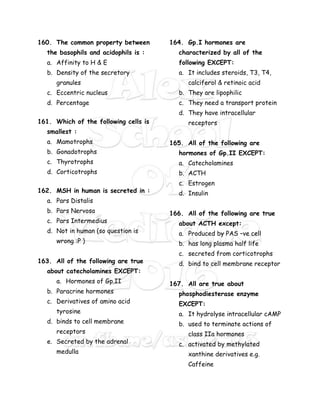
  • 42.
    13. Describe Herringbodies. 14. Give an account on Erdheim Cells. 15. Explain what’s meant by Crinophagy. 16. Describe the sources responsible for the hormones of secretion & evacuation of milk. 17. Compare between group I, II hormones? 18. How can we classify hormones? 19. Mention the different types of group II according to the 2nd messenger? 20.What are the functions of each domain of glucocorticoid's receptor ? 21. Mention the mechanism of action of retinoic acid ? 22.Mention mechanism of action of c AMP as 2nd messenger ? 23.Mention the structure of G – protein ? 24.Mention the mechanism of action of G – protein ? 25.Give some receptors regulating G – protein ? 26.Discuss the actions between G-protien subunits that take place when they become activated by interaction with Beta 1 and beta2 receptors 27.Mention the effect of Gi – protien on adenyl cyclase 28.Explain the cascade of actions occurs when an alpha 1 adrenergic receptor activates plc 29.Give an account on the effect of plc on phosphatidyl 4,5 – biphosphate and in turn explain how this effect can regulate variety of cellular processes 30.Discuss how DAG can regulate muscle contraction 31. Define calmodulin 32.Explain the mechanism through which calmodulin can perform its regulatory function 33.Describe the mechanism by which Gt – protien can function in the visual cycle 34.Define ( hormones - Target cell – Receptors) 35.Compare between the different types of hormones? 36.Enumerate the principle endocrine glands 37.Mention other endocrine organs which can secrete hormones 38.Give a short account on local hor7mones 39.Classify hormones chemically
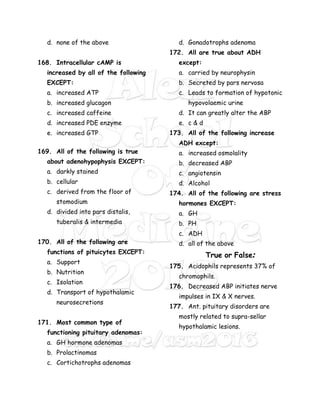
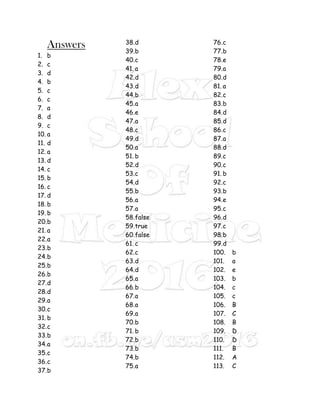
  • 43.
    40.7. Discuss HormoneReceptors & Their Activation 41. Mention the different sites for the different types of receptors 42.Give a short account on Hormone Transport & Inactivation 45.Enumerate the hormones of anterior pituitary gland. 46.Mention the hormone which act on each of the following gland:  Thyroid gland  Adrenal cortex  Testes & ovaries  Mammary gland  Growth 47.Give a short account on regulation of pituitary function by the hypothalamus? 48.Mention the function of neurohormones secreted by hypothalamus? 49.Demonstrate the pathway of hypothalamo-hypophyseal portal system. 50.Enumerate the function of releasing & inhibitory hormones. 51. Mention the hormone which responsible for:  Release growth hormone  Inhibition of prolactin secretion  Increase of prolactin secretion  Release thyroid stimulating hormone  Release adrenocorticotropin 52.Define: Growth hormone 53.Enumerate the actions of growth hormone. 54.Demonstrate the effect of growth hormone on:  Cartilage & bone  Metabolic function  RBCs  GIT 55.Mention the effect of growth hormone on:  Protein  Fat  Carbohydrates 56.Give short account on regulation of growth hormone secretion. 57.Which hormone is responsible for:  Increase growth hormone
  • 44.
     Decrease growthhormone 58.Mention the effect of each of the following on growth hormone secretion:  Starvation  Hyperglycemia  Increase conc. Of FF in blood  Decrease conc. Of FF in blood  Deep sleep  Moderate exercise  Anesthesia  Fever 59.Mention the cases can cause hyperpituitarism. 60.Compare between the somatotroph cell adenoma before and after adolescence(excess growth hormone secretion). 61. List the criteria of diseased persons with excessive growth hormone secretion before adolescence 62.List the criteria of diseased persons with excessive growth hormone secretion after adolescence 63.Give a short account on (panhypopitutarism) in adults 64.Discuss Deficiency of anterior pituitary secretion during childhood 65.What is Pituitary infantilism? 66.Enumerate hormones of the posterior pituitary and mention their mode of secretion. 67.Give an account on: Functions of Antidiuretic hormone. 68.Give an account on: Control of Antidiuretic hormone 69.Give an account on: Functions of Oxytocin hormone. 70.Discuss the control of Oxytocin secretion. 71. Compare between the causes of the two types of posterior pituitary disorders. 72.Describe the symptoms of Diabetes Incipiuis 73.Vitamin A deficiency can cause anaemia. How ?? 74.Retinol & Retinoic acid are considered hormones of the thyroid/steroid family. Explain. 75.Mention 3 ways for termination of actions caused by cAMP.
  • 45.
    76.cAMP & glucocorticoidsare involved in 2 different methods of glucose synthesis. Explain. 77.Give a short account on the importance of α subunit in synthesis & termination of action of cAMP. 78.DAG & IȝP cause intracellular physiologic responses using 2 different sources of Ca ions. Explain. 79.Mention 4 cellular processes regulated by Ca ions. 80.Mention the 4 types of G-protein with their receptors. 81. Explain the role played by G-transducin in the visual cycle. 82.Give a short account on calmodulin 83.Compare between pituitary & thyroid gland (shape, site, size, relations & blood supply). 84.Discuss the applied anatomy of Pituitary & Thyroid glands. 85.Discuss the structure-function coupling of : a. hypothalamo-hypophyseal connections b. pars nervosa. c. pars distalis d. protein hormones secreting cells e. steroid hormones secreting cells 86.Compare between: a. Chromophils & Chromophobes b. Acidophils & Basophils c. manifestations of giantism & acromegaly d. dwarfism & infantism e. diabetes insipidus & diabetes mellitus (similarities & differences) 87.Discuss the role of different types of receptors in regulation of ADH release 88.Oxytocin hormone serves during fertilization, labor & lactation stages. Explain 89.Discuss the role played by stretch receptors initiating actions of oxytocin during labor & lactation.