Computer Networks
Imran Ahmad
Course Learning Outcomes
• At the end of the course the students will be able to:
• Be able to explain key networking concepts, principles, design issues
and techniques at all protocol layers.
• Explain the services and functions provided by each layer in the
Internet protocol stack.
• Identify various internetworking devices and protocols, and their
functions in a network.
• Contrast between different types of networks (e.g., wide area
networks vs. local area networks, wired vs. wireless) in terms of their
characteristics and protocols used.
• Build Computer Network on various Topologies
DATA COMMUNICATIONS
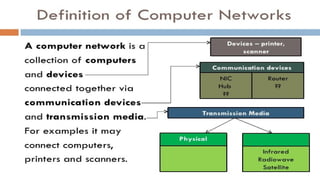
• The term telecommunication means communication at a distance.
The word data refers to information presented in whatever form is
agreed upon by the parties creating and using the data. Data
communications are the exchange of data between two devices via
some form of transmission medium such as a wire cable.
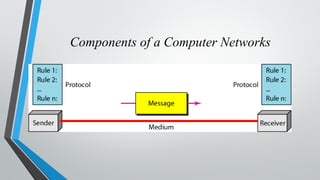
Components of a Computer Networks
Data Representation
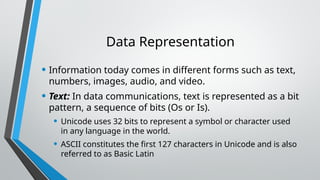
• Information today comes in different forms such as text,
numbers, images, audio, and video.
• Text: In data communications, text is represented as a bit
pattern, a sequence of bits (Os or Is).
• Unicode uses 32 bits to represent a symbol or character used
in any language in the world.
• ASCII constitutes the first 127 characters in Unicode and is also
referred to as Basic Latin
Data Representation
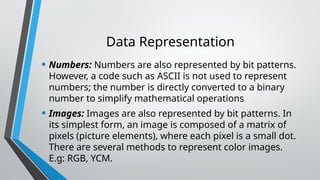
• Numbers: Numbers are also represented by bit patterns.
However, a code such as ASCII is not used to represent
numbers; the number is directly converted to a binary
number to simplify mathematical operations
• Images: Images are also represented by bit patterns. In
its simplest form, an image is composed of a matrix of
pixels (picture elements), where each pixel is a small dot.
There are several methods to represent color images.
E.g: RGB, YCM.
Data Representation
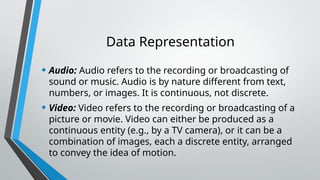
• Audio: Audio refers to the recording or broadcasting of
sound or music. Audio is by nature different from text,
numbers, or images. It is continuous, not discrete.
• Video: Video refers to the recording or broadcasting of a
picture or movie. Video can either be produced as a
continuous entity (e.g., by a TV camera), or it can be a
combination of images, each a discrete entity, arranged
to convey the idea of motion.
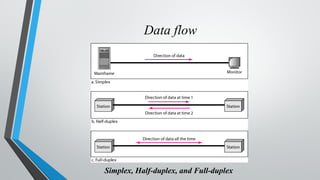
Data flow
Simplex, Half-duplex, and Full-duplex
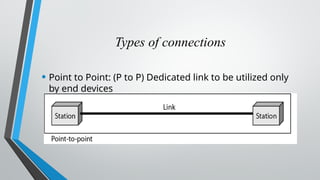
Types of connections
• Point to Point: (P to P) Dedicated link to be utilized only
by end devices
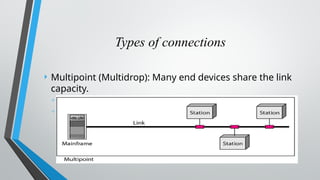
Types of connections
 Multipoint (Multidrop): Many end devices share the link
capacity.
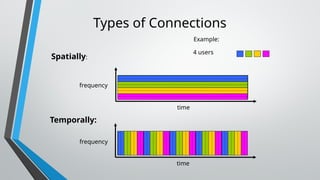
◦ Spatially
◦ Temporally
Types of Connections
Spatially:
frequency
time
Temporally:
frequency
time
4 users
Example:
PROTOCOLS
• A protocol is synonymous with rule. It consists of a set of rules
that govern data communications. It determines what is
communicated, how it is communicated and when it is
communicated. The key elements of a protocol are syntax,
semantics and timing.
Elements of a Protocol
• Syntax
• Structure or format of the data
• Indicates how to read the bits - field description
• Semantics
• Interprets the meaning of the bits
• Knows which fields define what action
• Timing
• When data should be sent and what
• Speed at which data should be sent or speed at which it is being received.
STANDARDS
• Standards are essential in creating and maintaining an open
market for equipment manufacturing and to guaranteeing national
and international interoperability of equipment's and technologies
• De facto
• By fact or by convention
• Not approved by an organized body but been adopted as standard through
widespread use
• De jure
• These have been legislated by an official recognized body
• Some standard organizations
• ISO, ITU-T, ANSI, IEEE, EIA, W3C, OMA
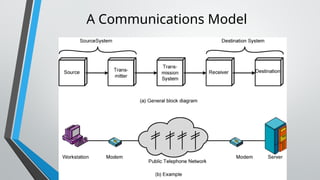
A Communications Model
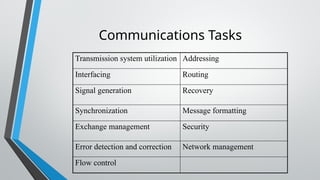
Communications Tasks
Transmission system utilization Addressing
Interfacing Routing
Signal generation Recovery
Synchronization Message formatting
Exchange management Security
Error detection and correction Network management
Flow control
Thanks

1-Network and its elements in cOMP N.pptx

  • 1.
  • 3.
    Course Learning Outcomes •At the end of the course the students will be able to: • Be able to explain key networking concepts, principles, design issues and techniques at all protocol layers. • Explain the services and functions provided by each layer in the Internet protocol stack. • Identify various internetworking devices and protocols, and their functions in a network. • Contrast between different types of networks (e.g., wide area networks vs. local area networks, wired vs. wireless) in terms of their characteristics and protocols used. • Build Computer Network on various Topologies
  • 4.
    DATA COMMUNICATIONS • Theterm telecommunication means communication at a distance. The word data refers to information presented in whatever form is agreed upon by the parties creating and using the data. Data communications are the exchange of data between two devices via some form of transmission medium such as a wire cable.
  • 5.
    Components of aComputer Networks
  • 6.
    Data Representation • Informationtoday comes in different forms such as text, numbers, images, audio, and video. • Text: In data communications, text is represented as a bit pattern, a sequence of bits (Os or Is). • Unicode uses 32 bits to represent a symbol or character used in any language in the world. • ASCII constitutes the first 127 characters in Unicode and is also referred to as Basic Latin
  • 7.
    Data Representation • Numbers:Numbers are also represented by bit patterns. However, a code such as ASCII is not used to represent numbers; the number is directly converted to a binary number to simplify mathematical operations • Images: Images are also represented by bit patterns. In its simplest form, an image is composed of a matrix of pixels (picture elements), where each pixel is a small dot. There are several methods to represent color images. E.g: RGB, YCM.
  • 8.
    Data Representation • Audio:Audio refers to the recording or broadcasting of sound or music. Audio is by nature different from text, numbers, or images. It is continuous, not discrete. • Video: Video refers to the recording or broadcasting of a picture or movie. Video can either be produced as a continuous entity (e.g., by a TV camera), or it can be a combination of images, each a discrete entity, arranged to convey the idea of motion.
  • 9.
  • 10.
    Types of connections •Point to Point: (P to P) Dedicated link to be utilized only by end devices
  • 11.
    Types of connections Multipoint (Multidrop): Many end devices share the link capacity. ◦ Spatially ◦ Temporally
  • 12.
  • 13.
    PROTOCOLS • A protocolis synonymous with rule. It consists of a set of rules that govern data communications. It determines what is communicated, how it is communicated and when it is communicated. The key elements of a protocol are syntax, semantics and timing.
  • 14.
    Elements of aProtocol • Syntax • Structure or format of the data • Indicates how to read the bits - field description • Semantics • Interprets the meaning of the bits • Knows which fields define what action • Timing • When data should be sent and what • Speed at which data should be sent or speed at which it is being received.
  • 15.
    STANDARDS • Standards areessential in creating and maintaining an open market for equipment manufacturing and to guaranteeing national and international interoperability of equipment's and technologies • De facto • By fact or by convention • Not approved by an organized body but been adopted as standard through widespread use • De jure • These have been legislated by an official recognized body • Some standard organizations • ISO, ITU-T, ANSI, IEEE, EIA, W3C, OMA
  • 16.
  • 17.
    Communications Tasks Transmission systemutilization Addressing Interfacing Routing Signal generation Recovery Synchronization Message formatting Exchange management Security Error detection and correction Network management Flow control
  • 18.

Editor's Notes

  • #4 For data communications to occur, the communicating devices must be part of a communication system made up of a combination of hardware (physical equipment) and software (programs). The effectiveness of a data communications system depends on four fundamental characteristics: delivery, accuracy, timeliness, and jitter.
  • #15 International Standards Organizations International Telecommunication Union-Telecommunications Standards Sector American National Standards Institute Institute of Electrical and Electronics Engineering Electronic Industries Association World Wide Web Consortium Open Mobile Alliance
  • #16 The fundamental purpose of a communications system is the exchange of data between two parties. This section introduces a simple model of communication, illustrated in general and by specific example in Stallings DCC8e Figure 1.2. The key elements of this model are: Source - generates data to be transmitted Transmitter - converts data into transmittable signals Transmission System - carries data from source to destination Receiver - converts received signal into data Destination - takes incoming data
  • #17 This simple narrative conceals a wealth of technical complexity. To get some idea of the scope of this complexity, Stallings DCC8e Table 1.1 lists a selection of the key tasks that must be performed in a data communications system. transmission system utilization - need to make efficient use of transmission facilities typically shared among a number of communicating devices a device must interface with the transmission system once an interface is established, signal generation is required for communication there must be synchronization between transmitter and receiver, to determine when a signal begins to arrive and when it ends there is a variety of requirements for communication between two parties that might be collected under the term exchange management Error detection and correction are required in circumstances where errors cannot be tolerated Flow control is required to assure that the source does not overwhelm the destination by sending data faster than they can be processed and absorbed addressing and routing, so a source system can indicate the identity of the intended destination, and can choose a specific route through this network Recovery allows an interrupted transaction to resume activity at the point of interruption or to condition prior to the beginning of the exchange Message formatting has to do with an agreement between two parties as to the form of the data to be exchanged or transmitted Frequently need to provide some measure of security in a data communications system Network management capabilities are needed to configure the system, monitor its status, react to failures and overloads, and plan intelligently for future growth