1
Manic Menagerie:
Malicious activity targeting web hosting providers
ACSC Report 2018-143
TLP: WHITE
2
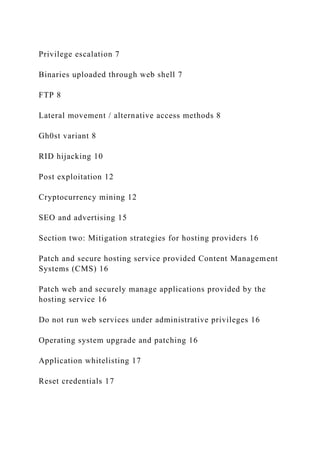
Table of Contents
Foreword: Head Australian Cyber Security Centre 4
Outline 5
Overview 5
Tools, techniques and procedures (TTP) 5
Table 1: TTPs used by the actor 6
Section one: Details of tools techniques and procedures 7
Initial access 7
Privilege escalation 7
Binaries uploaded through web shell 7
FTP 8
Lateral movement / alternative access methods 8
Gh0st variant 8
RID hijacking 10
Post exploitation 12
Cryptocurrency mining 12
SEO and advertising 15
Section two: Mitigation strategies for hosting providers 16
Patch and secure hosting service provided Content Management
Systems (CMS) 16
Patch web and securely manage applications provided by the
hosting service 16
Do not run web services under administrative privileges 16
Operating system upgrade and patching 16
Application whitelisting 17
Reset credentials 17
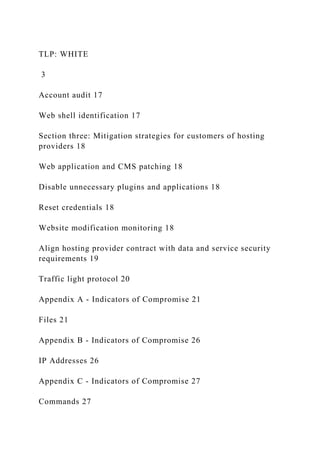
TLP: WHITE
3
Account audit 17
Web shell identification 17
Section three: Mitigation strategies for customers of hosting
providers 18
Web application and CMS patching 18
Disable unnecessary plugins and applications 18
Reset credentials 18
Website modification monitoring 18
Align hosting provider contract with data and service security
requirements 19
Traffic light protocol 20
Appendix A - Indicators of Compromise 21
Files 21
Appendix B - Indicators of Compromise 26
IP Addresses 26
Appendix C - Indicators of Compromise 27
Commands 27
4
Foreword: Head Australian Cyber Security Centre
The reach and diversity of cyber-criminal activity is expanding
and constantly evolving.
Our purpose at the Australian Cyber Security Centre (ACSC) is
to make Australia the safest place to connect online.
We are increasing our capacity to identify emerging cyber
threats and we are improving our detection capabilities.
Exposing new methods employed by criminals is one of the
important contributions we make to strengthening
defences, building resilience, trust and confidence.
Since its inception in 2014, the ACSC has lifted Government
cyber security capabilities. The Australian Government’s
2016 Cyber Security Strategy includes a continued commitment
to the ACSC:
“The ACSC, guided by whole-of-nation cyber security
priorities, will continue to bring together the
Government’s operational cyber security capabilities and build
on its world renowned cyber expertise to
support a broader range of organisations at the operational
level. In addition, ACSC outreach will be further
improved and streamlined to make it easier for the private
sector to interact.”
In July 2018, the ACSC evolved to incorporate the cyber
security capabilities from CERT Australia and the Digital
Transformation Agency and became part of the Australian
Signals Directorate. And ASD’s enabling legislation was
strengthened to include a mandate to disrupt cyber enabled
crime.
This report by our experts represents our commitment to be
more transparent in the types of malicious activity
impacting Australia.
Operation Manic Menagerie was an investigation of the
compromise of a number of Australian web hosting providers
which exposed new methods employed by criminals. It also
provided new insights for practical advice about how to
reduce the risk.
We commend the web service providers who worked with us to
enable this investigation and who have taken steps to
ensure that this threat is thwarted.
Alastair MacGibbon
Head
Australian Cyber Security Centre
TLP: WHITE
5
Outline
This report details technical findings and mitigation advice
related to the extensive compromise of at least eight
Australian web hosting providers investigated by the Australian
Cyber Security Centre (ACSC) in May 2018. The
information is designed for use by technical cyber security
officers within Australian infrastructure organisations, large
businesses and government agencies.
This report includes indicators for web hosting providers and
their customers to determine if they are victims of the
campaign, which uses simple techniques and poses a risk for
such organisations.
Overview
In 2018, the ACSC detected a previously unidentified malware
variant was being used for compromising web hosting
providers and therefore possibly the websites of their
customers.
The ACSC engaged with three hosting providers to conduct
investigations into activity involving this malware. The
purpose of the investigation was to develop an understanding of
the malware and associated tradecraft to inform
mitigation strategies.
The investigation revealed that the malware was a variant of the
well-known ‘Gh0st’ remote access tool (RAT) that had
significant modifications to the network communications
protocol.
Tools, techniques and procedures (TTP)
The actor favoured techniques such as web shells to gain initial
access, exploiting vulnerable web applications to upload
the web shells.
The actor rarely required privilege escalation but demonstrated
the capability and persistence to escalate privilege
when necessary. The actor’s privilege escalation tools were all
public proof of concepts (POC) and demonstrated an
ability to quickly use new POC exploits.
Persistence techniques varied across incidents, showing a
capability to modify tools to suit the compromised
environment.
The actor’s observed post-exploitation activity centred on
financial gain. The techniques used to achieve this included
search engine optimisation (SEO), advertising and
cryptocurrency mining.
The actor’s toolchain included a local system denial of service
(DoS) tool commonly known as a fork bomb binary.
The actor also packaged a network scanning utility into their
toolset. This tool could be used to identify other hosts for
lateral movement.
TLP: WHITE
6
Table 1: TTPs used by the actor
TTP
Initial Access Exploited vulnerable web applications with well-
known patched
vulnerabilities to upload web shells (FCKEditor, DotNetNuke)
Privilege Escalation Not required in most instances due to
misconfigured web services
• Compromised FTP credentials with root access
• Web service running as admin
Privilege escalation binaries (Slightly modified proof of concept
code)
• CVE-2018-1038 (Total Meltdown)
• CVE-2016-3225 (RottenPotatoNG)
• CVE-2016-0099
Replace Autostart services
Persistence Port redirector (HTRAN)
Web shells (China Chopper, unnamed publicly available web
shells)
Remote access tool (Gh0st variant)
Stealing credentials (Mimikatz, Quarks PWDump)
Credential manipulation (RID Hijacking tool)
Replacing system binaries (StickyKeys, Autostart services)
Remote access solutions (RDP using stolen credentials)
Post Exploitation Network Scanning
Search Engine Optimisation
Advertising injection
Cryptocurrency mining (local to hosting server)
Potential denial of service (Fork Bomb)
TLP: WHITE
7
Section one: Details of tools techniques and
procedures
Initial access
During this campaign, the actor relied on exploiting vulnerable
web applications to gain initial access to servers. This
activity was a combination of automated scanning and manual
interaction with the victim network.
Analysis of the web logs from compromised hosts indicated the
actor used a web browser to manually interact with
web sites to identify vulnerability.
Once identified, the vulnerability was manually exploited to
create a web shell on the server to enable future steps. The
actor used multiple publicly available web shells including
variants of ChinaChopper123. Once the web shell was in place,
the actor switched from using a web browser to using a
controller to perform future interactions with the web shell.
Figure 1: Timeline of exploitation
As shown in Figure 1 it took the actor less than 70 minutes to
identify the vulnerability, upload a web shell and conduct
the privilege escalation phases of their campaign.
Privilege escalation
The actor demonstrated the ability to tailor their tools to suit
the environment they were compromising, including
exploiting misconfigured services and uploading additional
binaries to assist with privilege escalation.
Binaries uploaded through web shell
The ACSC identified three privilege escalation binaries that the
actor deployed during the compromise. All three
binaries implemented proof-of-concept (POC) exploit code
available publicly on the internet.
All of the vulnerabilities, CVE-2018-10388, CVE-2016-32259
and CVE-2016-009910, used in the privilege escalation
binaries had patches issued prior to these compromises.
The POC of CVE-2018-1038, known as TotalMeltdown, was
released publicly in late April 2018 and uploaded to a web
hosting provider a few days later. This shows the actor was
quickly able to take the POC code and use it in a
compromise.
1 https://www.fireeye.com/blog/threat-
research/2013/08/breaking-down-the-china-chopper-web-shell-
part-i.html
2 https://www.fireeye.com/blog/threat-
research/2013/08/breaking-down-the-china-chopper-web-shell-
part-ii.html
3 https://www.cyber.nj.gov/threat-profiles/trojan-
variants/china-chopper
TLP: WHITE
8
FTP
In one instance, the actor used valid credentials to authenticate
and subsequently log into an FTP server as a user with
a home directory of ‘C:’. As the FTP server was configured to
run as the local administrator user, this gave the actor full
read/write access to the victim’s system drive.
Access to the FTP server was used to backup and replace the
binaries for several operating system services with
binaries which, when executed, would install the Gh0st RAT or
perform credential manipulation known as RID hijacking.
These services included:
Defender
When any of the above services restarted (or the host was
rebooted) the actor’s malware ran as the SYSTEM user. The
ACSC also identified a resource exhaustion (fork bomb) utility
that could have been used to force an administrator to
reboot the machine.
Lateral movement / alternative access methods
There was no evidence that the actor attempted to move
laterally to other hosts on the network.
The actor used their web shell access to move laterally to other
sites on the compromised server to create additional
web shells for persistence. They continued to monitor web shell
access and create alternative access methods in the
weeks following the initial compromise.
The ACSC did identify a network scanning utility that was
uploaded using the actor’s web shells. Although use of this
tool could not be confirmed, it may have indicated a desire to
perform lateral movement on a network.
Gh0st variant
Gh0st is a fully featured RAT that provides functionality such
as key logging, web cam and microphone streaming, file
upload and download as well as providing full remote control of
a host45.
The actor deployed several iterations of the Gh0st dropper using
a range of packers/protection mechanisms including
UPX and VMProtect.
In one incident, the Gh0st dropper was detected by the victim’s
anti-virus software and quarantined. The actor then
disconnected from the compromised environment only to return
several hours later to deploy a new instance of the
dropper which evaded the victim’s anti-virus.
When executed, the Gh0st dropper creates a Windows
executable with a .gif extension in a legitimate Windows
directory then registers a new service to execute the dropped
file on start-up. Every execution of the dropper results in
a binary with a different hash being generated which causes
hash-based detection to be ineffective.
Older versions of Gh0st use a relatively well-known protocol
with the first five bytes being set to ‘Gh0st” or some other
five-byte campaign ID, an example of which can be seen in
Figure 2.
4 https://resources.infosecinstitute.com/gh0st-rat-complete-
malware-analysis-part-1/
5 https://resources.infosecinstitute.com/gh0st-rat-part-2-packet-
structure-defense-measures/
TLP: WHITE
9
Figure 2: Original Gh0st header
The newly identified variant of Gh0st uses a much longer
header which closely resembles a HTTP 200 response as
shown in blue in Figure 3.
Figure 3: Modified Gh0st header
The response to this request contains a Base64 encoded string
wrapped in ‘GIF89a’ tag. The response is decoded and
then performs an ADD 0x7a followed by XOR 0x19. This
decode structure is very similar to that featured in the
Gh0st 3.6 source code.
When decoded the response contains the IP and port that the
malware is to connect to. The response can also
optionally include proxy information. An example response that
decodes to 1.2.3.4:530 is:
GIF89arr2xvbC9s6mysJ8GIF89a
The Gh0st binary was not digitally signed; however, the Gh0st
dropper was signed with an expired, stolen certificate
issued to ‘Fujian identical investment co.,Ltd’ less than one
week prior to being deployed onto the victim networks.
Details of this certificate are shown in Figure 4.
TLP: WHITE
10
Figure 4: DeliciousPi Gh0st dropper certificate
RID hijacking
In the three recently investigated compromises outlined in this
report, the ACSC identified the actor deploying a utility
that poorly implemented a technique known as RID hijacking6.
Using this utility, the actor created a new Windows user
account with the effective permissions of the local administrator
account.
RID hijacking is a relatively new technique that allows an
attacker with local administrator or higher privileges to
replace the relative identifier (RID) of one account with that of
another, resulting in the two accounts using the same
RID.
RIDs make up part of a user’s security identifier (SID), the
remainder of which is shared by all users of a system, which
Windows uses to manage security permissions on everything
from personal files to core operating system files and
registry keys. RID hijacking allows an attacker to create an
account that will not be a member of any groups but has the
permissions of the target account (for example, the local
administrator).
As RID hijacking requires read/write access to the target’s SAM
hive, the technique must be executed by either the
SYSTEM user (which has full read/write control over the SAM
hive) or a member of the Administrators group (which has
permission to change the permissions of the SAM hive and can
therefore give itself the required read/write access).
Despite the actor’s tool being run as the SYSTEM user, their
implementation modifies the permissions of the entire SAM
hive to provide the ‘Everyone’ group with the Full Control
permission. This modification allows every user account,
process and web shell to create/modify/read any user account
details (including hashes), as well as create and delete
user accounts (regardless of permission level). The output of the
actor’s RID hijacking utility is shown in Figure 5.
6 http://csl.com.co/rid-hijacking/
TLP: WHITE
11
Figure 5: Actors RID Hijack tool output
After creating an account with a hijacked RID any Windows
events generated by this account (for example logging into
a system or mounting a network share) will be recorded in the
Windows event log as having been caused by the
hijacked account. An actor could use this to make their traffic
appear as if it was coming from a legitimate Windows
account.
The RID hijacking utility used during the investigated incidents
was digitally signed with an expired, stolen certificate
issued to ‘上海域联软件技术有限公司’ (Shanghai YuLian Software
Technology co. Ltd.) less than one week prior to
being deployed onto the victim networks. Details of this
certificate are shown in Figure 6.
TLP: WHITE
12
Figure 6: RID Hijacking Utility Certificate
Post exploitation
Cryptocurrency mining
Two of the compromised hosts contained evidence of the actor
deploying software to add the hosting server itself into
a Monero mining pool7 with the wallet id
44hRSVqJicHZGpLQErsnjS3V7zgn3xsvn2Rw5e4GUSB4jHhyA
1C3Ny3cC3g3cxPhVNccFQrVdQXtS2Tcg
peB7wULKwpaYZT.
This mining pool provided statistics for any submitted worker
ID. After extracting the actor’s worker ID from their
crypto miner malware, the ACSC determined:
1. The actor received their first payment on 21 November 2017.
2. As of 18 June 2018, the actor had made a total of22.57 XMR
(Monero) with an approximate value of $3868 AUD.
3. On average, the actor was receiving a payment of 0.5 XMR
every 3-4 days, which equates to approximately $28
AUD a day.
In all incidents, the actor manually exploited servers and
deployed malware, taking them an hour or, in one case,
multiple days. The mining pool does not report the number of
hosts connected via the actor’s pool ID; it does, however,
provide the number of hashes per second, a graph of which can
be seen in
7 https://monero.org/services/mining-pools/
TLP: WHITE
13
Figure 7.
TLP: WHITE
14
Figure 7: Actor's mining pool statistics
A high-end gaming computer’s processer has a hash rate of
~500 whilst a server processor has a typical hash rate of
800-1500. The actor has a current hash rate of 19.47 KH/s or
19,470 hashes per second.
This indicates the actor still has a Monero miner installed on
between 13 and 38 machines although; as they have only
been observed targeting servers, it is likely the number of
compromised hosts is at the lower end of this range.
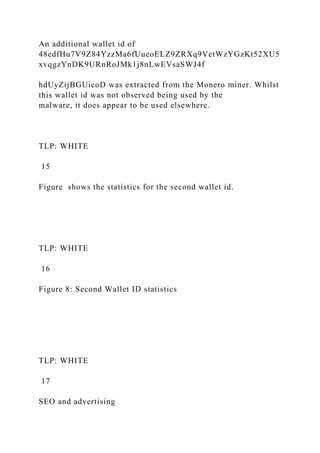
An additional wallet id of
48edfHu7V9Z84YzzMa6fUueoELZ9ZRXq9VetWzYGzKt52XU5
xvqgzYnDK9URnRoJMk1j8nLwEVsaSWJ4f
hdUyZijBGUicoD was extracted from the Monero miner. Whilst
this wallet id was not observed being used by the
malware, it does appear to be used elsewhere.
TLP: WHITE
15
Figure shows the statistics for the second wallet id.
TLP: WHITE
16
Figure 8: Second Wallet ID statistics
TLP: WHITE
17
SEO and advertising
The actor modified other sites on hosting providers to boost
SEO rankings or to redirect legitimate traffic to sites selling
illegitimate products.
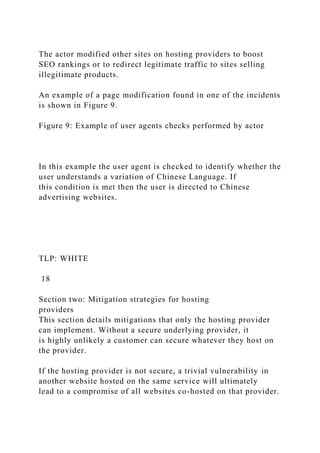
An example of a page modification found in one of the incidents
is shown in Figure 9.
Figure 9: Example of user agents checks performed by actor
In this example the user agent is checked to identify whether the
user understands a variation of Chinese Language. If
this condition is met then the user is directed to Chinese
advertising websites.
TLP: WHITE
18
Section two: Mitigation strategies for hosting
providers
This section details mitigations that only the hosting provider
can implement. Without a secure underlying provider, it
is highly unlikely a customer can secure whatever they host on
the provider.
If the hosting provider is not secure, a trivial vulnerability in
another website hosted on the same service will ultimately
lead to a compromise of all websites co-hosted on that provider.
Patch and secure hosting service provided Content Management
Systems
(CMS)
The actor exploited CMS, managed by the web service provider,
to gain initial access to hosts. CMS’ should be patched
in the shortest time possible after testing.
Where automatic patching of CMS is possible, this should be
enabled by default.
Additionally, CMS should be hardened to reduce the risk of
exploitation through misconfiguration vulnerabilities and
limit the effect of exploitation. More information can be found
in the ACSC’s Securing Content Management Systems
publication8.
Patch web and securely manage applications provided by the
hosting service
The actor exploited vulnerable web application libraries to gain
initial access to hosts.
These web applications should first be assessed to verify if they
are necessary, and uninstalled if not needed by the
customer to immediately reduce the vulnerability exposure.
Secondly, if needed, the web applications should be set to either
auto patch, or be patched in a timely manner.
Do not run web services under administrative privileges
A web service running under administrative privileges that is
exploited immediately gives full system access to the
malicious actor.
Run web-facing services under a limited privilege account,
where the minimum privileges required are given to that
service.
Operating system upgrade and patching
The ACSC investigation observed that hosting providers were
running older versions of Microsoft Operating systems,
for example Windows Server 2008, which will become
unsupported by Microsoft on 7 October 20189.
The ACSC recommends that older operating systems be
upgraded to the latest version (Windows Server 2016 at
minimum when this report was written) before this date to
receive the additional security features introduced in more
recent versions of Microsoft Server and continue receiving the
security benefits of a supported operating system.
8 https://acsc.gov.au/publications/protect/securing-cms.htm
9 https://support.microsoft.com/en-us/lifecycle/search/1163
TLP: WHITE
19
Application whitelisting
During this compromise the actor uploaded and executed
binaries on hosts. Directories containing web application files
and directories that web applications write to (such as user
upload locations) should deny all execution unless
specifically required.
To prevent the execution and spread of malicious code the
ACSC recommends the implementation of application
whitelisting. More information about application whitelisting
can be found in the ACSC’s Application Whitelisting
publication10.
Reset credentials
Tools used in this campaign were designed to steal credentials,
either through keylogging capabilities or credential
harvesting tools.
The ACSC recommends that all accounts on affected networks
have their credentials reset to prevent the actor from
reusing them to reacquire access. This includes both local and
domain credentials as well as on other systems/services
in the environment that do not rely on system or domain
accounts.
Consider changing password complexity rules to avoid reset
passwords just being a variant of the stolen credentials
that could be readily brute forced.
Account audit
The actor created new accounts using the RID hijacking tool.
Additional accounts may be abused or be an indication of
successful lateral movement or compromise of systems.
The ACSC recommends that hosting providers regularly perform
an audit of accounts on a network and verifies that all
the accounts are valid and required.
Web shell identification
Analysis shows that the actor initially created one web shell for
access and then moved onto other sites on the hosting
provider network to create alternative access methods. There
was also evidence that the actor modified other web
sites on the same server for use in SEO and product advertising.
The ACSC recommends that web hosting providers monitor
hosted sites for well-known web shells or other unwanted
webpages. This can be achieved with common anti-virus
solutions, or open source binary scanners like YARA.
10
https://www.acsc.gov.au/publications/protect/application_whitel
isting.htm
TLP: WHITE
20
Section three: Mitigation strategies for customers
of hosting providers
This section details controls a customer of a web hosting
provider should implement in order to protect their own data
and services, and additionally prevent the customer’s web
service being utilised to compromise all other co-hosted
services.
Web application and CMS patching
In each investigation the actor exploited vulnerable content
management systems and web application libraries to gain
initial access to hosted services. In some cases these were
controlled by the customer and not the hosting provider.
For web services managed by the customer, the ACSC advises
that customers keep any non-managed CMS systems up
to date. Additionally, any other non-managed frameworks used
by your web sites should be identified and upgraded to
the latest version.
For web services managed by the hosting provider, the ACSC
suggests that customers look for contracts that
demonstrate a commitment to security by the provider.
Specifically, look for hosting providers that are able to provide
a managed CMS system with a stated patching schedule that
meets the needs of the data or service at risk.
More information can be found in ACSC’s Securing Content
Management Systems publication11.
Disable unnecessary plugins and applications
Where web applications and plugins are no longer required, they
must be disabled or uninstalled.
Reset credentials
Due to the large number of stolen credentials, the ACSC highly
recommends that customers reset their credentials for
their hosting provider. Credentials may include usernames,
passwords and/or certificates used for an authentication
process. This includes credentials to manage the hosted service,
and manage the specific sites on the hosted service.
As best practice, the ACSC recommends that customers
regularly change their password and ensure it is of an
appropriately complexity.
Website modification monitoring
Analysis showed that the actor initially created one web shell
for access, then moved onto other sites on the hosting
provider network to create alternative access methods. There
was also evidence that the actor modified other web
sites on the same server for use in SEO and product advertising.
The ACSC recommends that customer regularly monitor their
websites to ensure no unauthorised modifications have
been made or web shells added. For further information
regarding detection and mitigation strategies please refer to
the ACSC publication; Web Shells - Threat Awareness and
Guidance12,
If malicious activity is discovered, the customer should:
1. Notify their hosting provider.
11 https://acsc.gov.au/publications/protect/securing-cms.htm
12 https://www.acsc.gov.au/publications/ACSC_Web_Shells.pdf
TLP: WHITE
21
2. Investigate what activity may have occurred on the system
through their own web logs.
3. Consider if a mandatory breach notification is required under
the notifiable data breaches scheme.
Align hosting provider contract with data and service security
requirements
Customers are advised to investigate if their hosting provider
will provide the underlying security the customer requires
for the sensitivity of the data or service being hosted.
https://www.oaic.gov.au/privacy-law/privacy-act/notifiable-
data-breaches-scheme
TLP: WHITE
22
Traffic light protocol
The following table lists the classification levels used in the
traffic light protocol (TLP) and describes the restrictions on
access and use for each classification level.
TLP classification Restrictions on access and use
RED Access to and use by your ACSC security contact
officer(s) only.
You must ensure that your ACSC security contact officer(s)
does not disseminate or discuss
the information with any other person, and you shall ensure that
you have appropriate
systems in place to ensure that the information cannot be
accessed or used by any person
other than your ACSC security contact officer(s).
AMBER Restricted internal access and use only.
Subject to the below, you shall only make AMBER publications
available to your employees
on a ‘need to know basis’ strictly for your internal processes
only to assist in the protection
of your ICT systems.
In some instances you may be provided with AMBER
publications which are marked to
allow you to also disclose them to your contractors or agents on
a need-to-know basis—
strictly for your internal purposes only to assist in the
protection of your ICT systems.
GREEN Restricted to closed groups and subject to
confidentiality.
You may share GREEN publications with external
organisations, information exchanges, or
individuals in the network security, information assurance or
critical network infrastructure
community that agree to maintain the confidentiality of the
information in the publication.
You may not publish or post on the web or otherwise release it
in circumstances where
confidentiality may not be maintained.
WHITE Not restricted.
WHITE publications are not confidential. They contain
information that is for public,
unrestricted dissemination, publication, web-posting or
broadcast. You may publish the
information, subject to copyright and any restrictions or rights
noted in the information.
NOT CLASSIFIED Any information received from ACSC that is
not classified in accordance with the TLP must
be treated as AMBER classified information, unless otherwise
agreed in writing ACSC.
TLP: WHITE
23
Appendix A - Indicators of Compromise
Files
Filename Path MD5 Description
bt(Random 6
numbers).dll
C:WindowsSystem32 7889a9a86d8b8145794e4b
0e30d4d8ff
StreamEx Malware - Examples: bt031151.dll, bt006504.dll -
See Regex expression below
irmonex.dll C:WindowsSystem32 7889a9a86d8b8145794e4b
0e30d4d8ff
StreamEx Malware - See Regex expression below
icmonex.acm C:WindowsSystem32 b3dd6bb66951d28efa70ba
04885d6b53
StreamEx Configuration File - See Regex expression below
TT_2015.log C:Users*AppDataLocalTemp Various Log files
for StreamEx
TT_2015.log C:WindowsTemp Various Log files for StreamEx
20k.txt C:ProgramData 8447dabffd37eb7fcb1bc1d
6c6f1d164
Htran reverse proxy malware
Htran.exe C:ProgramData
system.exe C:Users*AppDataLocalTempLow
bf93a2f9901e9b3dfca8a79
82f4a9868
This is cmd.exe
rtp.exe C:programDataxrtp 1C4F81CF86171E5A039A28
F63DE8D53C
Probable privilege escalation
x64.exe C:programdatax 402a64b5527b4f7741eab8
8e879b5b1b
Privilege esculation via CVE-2016-0099
TLP: WHITE
24
Filename Path MD5 Description
filedata.exe C:windowstemp 402a64b5527b4f7741eab8
8e879b5b1b
Privilege esculation via CVE-2016-0099
47.exe C:programdatax f237b29e054d3104aefccad
c3ffe6af7
Dropper for HGCC.GIF (Probable Gh0st variant)
Hgcc.gif
bdbc97cb9bddc7c1d8a336
3b5f96c28e
Remote access trojan dropped by 47.exe. Appears to be
variant of Gh0st malware
1.txt C:temp; c: 2055994ff75b4309eee3a49
c5749d306
Remote access trojan
svchost.exe
e4617b1c6a08f36289805b
09e4633bce
Automated enumeration tool
mimikatz.exe C:FILESimimikatz_trunkx64
Also seen as g.exe and in various locations such as C: and
C:ProgramData1
getPasswords_x64.exe C:ProgramData
Unrecoverd
cmd.txt C:ProgramData; C:Documents and SettingsAll Users;
C:Windowstemp
httpserver.exe C:programdatax
dump.exe C:programdatax
hs.com C:programdatax
mylcx.exe C:programdata 854A8E6B8B261B0BA3EEE
74C420A1077
Varient of Htran
TLP: WHITE
25
Filename Path MD5 Description
a.cEr
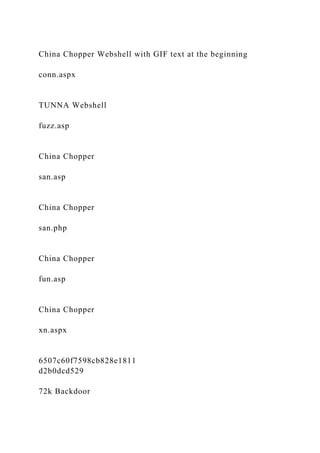
China Chopper Webshell with GIF text at the beginning
conn.aspx
TUNNA Webshell
fuzz.asp
China Chopper
san.asp
China Chopper
san.php
China Chopper
fun.asp
China Chopper
xn.aspx
6507c60f7598cb828e1811
d2b0dcd529
72k Backdoor
overflow.asp
fdd800d48f67e38f86664db
63ba37c02
Generic Webshell
EN425.gif
23f51901b1b92007da8990f
b1ad49bb7
Remote access trojan dropped by 425.exe. Appears to be a
varient of Gh0st malware
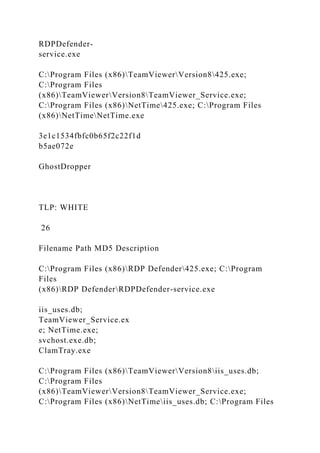
425.exe C:Program Files (x86)TeamViewerVersion8425.exe;
C:Program Files (x86)NetTime425.exe
1d5a146fd346fa7883dae66
c0a11a111
Gh0st dropper
425.exe-unpacked
878901428971796dbd35a7
d769e6f6f2
Unpacked version of Gh0st dropper
425.exe;
TeamViewer_Service.ex
e; NetTime.exe;
RDPDefender-
service.exe
C:Program Files (x86)TeamViewerVersion8425.exe;
C:Program Files
(x86)TeamViewerVersion8TeamViewer_Service.exe;
C:Program Files (x86)NetTime425.exe; C:Program Files
(x86)NetTimeNetTime.exe
3e1c1534fbfc0b65f2c22f1d
b5ae072e
GhostDropper
TLP: WHITE
26
Filename Path MD5 Description
C:Program Files (x86)RDP Defender425.exe; C:Program
Files
(x86)RDP DefenderRDPDefender-service.exe
iis_uses.db;
TeamViewer_Service.ex
e; NetTime.exe;
svchost.exe.db;
ClamTray.exe
C:Program Files (x86)TeamViewerVersion8iis_uses.db;
C:Program Files
(x86)TeamViewerVersion8TeamViewer_Service.exe;
C:Program Files (x86)NetTimeiis_uses.db; C:Program Files
(x86)NetTimeNetTime.exe; C:Program Files
(x86)NetTimesvchost.exe.db; C:Program Files
(x86)ClamWinbiniis_uses.db; C:Program Files
(x86)ClamWinbinClamTray.exe
db2926e239db24539813bc
871a55946a
RID Hijacking tool
ABC.exe C:WindowsTempABC.exe
Possible crypto miner dropper
hostdll.exe C:WindowsTemphostdll.exe
Possible Crypto miner
bcde.exe C:WindowsTempbcde.exe
16a1ae6d7f16281d9f1ee90
44481f9d1
Crypto miner dropper
hostdlls.exe C:WindowsTemphostdlls.exe;
C:phphostdlls.exe 91a4692973e68db3df0d75
53b86ceb53
Crypto miner
RegEx Expressions
^bt[0-9]{6}.dll$ C:WindowsSystem32
7889a9a86d8b8145794e4b
0e30d4d8ff
StreamEx Malware
^.*ex.dll$ C:WindowsSystem32 7889a9a86d8b8145794e4b
0e30d4d8ff
StreamEx Malware
TLP: WHITE
27
Filename Path MD5 Description
^.*ex.acm$ C:WindowsSystem32 b3dd6bb66951d28efa70ba
04885d6b53
StreamEx Config file
^[a-zA-Z0-
9]{1}.(cmd|bat|exe|vbs
)$
^[a-zA-Z0-9]{1}.exe$
TLP: WHITE
28
Appendix B - Indicators of Compromise
IP Addresses
IP
103.230.242.109
103.224.250.140
222.73.205.46
58.218.207.138
TLP: WHITE
29
Appendix C - Indicators of Compromise
Commands
Command Description
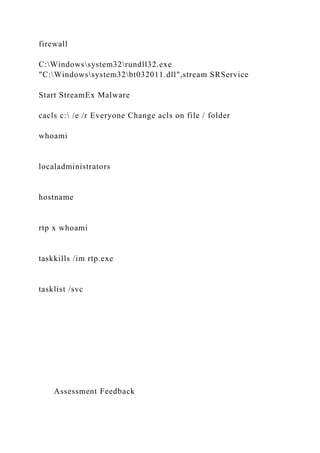
cmd.exe /c netsh firewall set opmode disable Disable local
firewall
C:Windowssystem32rundll32.exe
"C:Windowssystem32bt032011.dll",stream SRService
Start StreamEx Malware
cacls c: /e /r Everyone Change acls on file / folder
whoami
localadministrators
hostname
rtp x whoami
taskkills /im rtp.exe
tasklist /svc
Assessment Feedback
Course Code & Name: INFS 5115 Security Principles
Assessment Title: Continuous Assessment
Student Name:
Key components of this assignment Comments
Writing Style / Referencing
• Was the writing style appropriate for an executive
audience (i.e. business focus with technical terms
avoided or clearly explained)?
• Was the writing style clear and professional with
correct grammar and spelling?
• Were appropriate references used and formatted
according to the UniSA Harvard style?
Description
• Were descriptions clear and succinct with a focus
on key points?
Analysis
• Did the analysis offer insights and understanding
with reference to relevant frameworks where
appropriate?
Justification
• Were statements supported and any conclusions
and recommendations justified with supporting
references and reference to previous description
and analysis?
Summary Comment:

1 Manic Menagerie Malicious activity target.docx

  • 1.
    1 Manic Menagerie: Malicious activitytargeting web hosting providers ACSC Report 2018-143 TLP: WHITE 2 Table of Contents Foreword: Head Australian Cyber Security Centre 4 Outline 5 Overview 5 Tools, techniques and procedures (TTP) 5 Table 1: TTPs used by the actor 6 Section one: Details of tools techniques and procedures 7 Initial access 7
  • 2.
    Privilege escalation 7 Binariesuploaded through web shell 7 FTP 8 Lateral movement / alternative access methods 8 Gh0st variant 8 RID hijacking 10 Post exploitation 12 Cryptocurrency mining 12 SEO and advertising 15 Section two: Mitigation strategies for hosting providers 16 Patch and secure hosting service provided Content Management Systems (CMS) 16 Patch web and securely manage applications provided by the hosting service 16 Do not run web services under administrative privileges 16 Operating system upgrade and patching 16 Application whitelisting 17 Reset credentials 17
  • 3.
    TLP: WHITE 3 Account audit17 Web shell identification 17 Section three: Mitigation strategies for customers of hosting providers 18 Web application and CMS patching 18 Disable unnecessary plugins and applications 18 Reset credentials 18 Website modification monitoring 18 Align hosting provider contract with data and service security requirements 19 Traffic light protocol 20 Appendix A - Indicators of Compromise 21 Files 21 Appendix B - Indicators of Compromise 26 IP Addresses 26 Appendix C - Indicators of Compromise 27 Commands 27
  • 4.
    4 Foreword: Head AustralianCyber Security Centre The reach and diversity of cyber-criminal activity is expanding and constantly evolving. Our purpose at the Australian Cyber Security Centre (ACSC) is to make Australia the safest place to connect online. We are increasing our capacity to identify emerging cyber threats and we are improving our detection capabilities. Exposing new methods employed by criminals is one of the important contributions we make to strengthening defences, building resilience, trust and confidence. Since its inception in 2014, the ACSC has lifted Government cyber security capabilities. The Australian Government’s 2016 Cyber Security Strategy includes a continued commitment to the ACSC: “The ACSC, guided by whole-of-nation cyber security priorities, will continue to bring together the Government’s operational cyber security capabilities and build on its world renowned cyber expertise to support a broader range of organisations at the operational level. In addition, ACSC outreach will be further improved and streamlined to make it easier for the private sector to interact.”
  • 5.
    In July 2018,the ACSC evolved to incorporate the cyber security capabilities from CERT Australia and the Digital Transformation Agency and became part of the Australian Signals Directorate. And ASD’s enabling legislation was strengthened to include a mandate to disrupt cyber enabled crime. This report by our experts represents our commitment to be more transparent in the types of malicious activity impacting Australia. Operation Manic Menagerie was an investigation of the compromise of a number of Australian web hosting providers which exposed new methods employed by criminals. It also provided new insights for practical advice about how to reduce the risk. We commend the web service providers who worked with us to enable this investigation and who have taken steps to ensure that this threat is thwarted. Alastair MacGibbon Head Australian Cyber Security Centre TLP: WHITE 5 Outline
  • 6.
    This report detailstechnical findings and mitigation advice related to the extensive compromise of at least eight Australian web hosting providers investigated by the Australian Cyber Security Centre (ACSC) in May 2018. The information is designed for use by technical cyber security officers within Australian infrastructure organisations, large businesses and government agencies. This report includes indicators for web hosting providers and their customers to determine if they are victims of the campaign, which uses simple techniques and poses a risk for such organisations. Overview In 2018, the ACSC detected a previously unidentified malware variant was being used for compromising web hosting providers and therefore possibly the websites of their customers. The ACSC engaged with three hosting providers to conduct investigations into activity involving this malware. The purpose of the investigation was to develop an understanding of the malware and associated tradecraft to inform mitigation strategies. The investigation revealed that the malware was a variant of the well-known ‘Gh0st’ remote access tool (RAT) that had significant modifications to the network communications protocol. Tools, techniques and procedures (TTP) The actor favoured techniques such as web shells to gain initial access, exploiting vulnerable web applications to upload
  • 7.
    the web shells. Theactor rarely required privilege escalation but demonstrated the capability and persistence to escalate privilege when necessary. The actor’s privilege escalation tools were all public proof of concepts (POC) and demonstrated an ability to quickly use new POC exploits. Persistence techniques varied across incidents, showing a capability to modify tools to suit the compromised environment. The actor’s observed post-exploitation activity centred on financial gain. The techniques used to achieve this included search engine optimisation (SEO), advertising and cryptocurrency mining. The actor’s toolchain included a local system denial of service (DoS) tool commonly known as a fork bomb binary. The actor also packaged a network scanning utility into their toolset. This tool could be used to identify other hosts for lateral movement. TLP: WHITE 6 Table 1: TTPs used by the actor TTP
  • 8.
    Initial Access Exploitedvulnerable web applications with well- known patched vulnerabilities to upload web shells (FCKEditor, DotNetNuke) Privilege Escalation Not required in most instances due to misconfigured web services • Compromised FTP credentials with root access • Web service running as admin Privilege escalation binaries (Slightly modified proof of concept code) • CVE-2018-1038 (Total Meltdown) • CVE-2016-3225 (RottenPotatoNG) • CVE-2016-0099 Replace Autostart services Persistence Port redirector (HTRAN) Web shells (China Chopper, unnamed publicly available web shells) Remote access tool (Gh0st variant) Stealing credentials (Mimikatz, Quarks PWDump) Credential manipulation (RID Hijacking tool) Replacing system binaries (StickyKeys, Autostart services) Remote access solutions (RDP using stolen credentials)
  • 9.
    Post Exploitation NetworkScanning Search Engine Optimisation Advertising injection Cryptocurrency mining (local to hosting server) Potential denial of service (Fork Bomb) TLP: WHITE 7 Section one: Details of tools techniques and procedures Initial access During this campaign, the actor relied on exploiting vulnerable web applications to gain initial access to servers. This activity was a combination of automated scanning and manual interaction with the victim network. Analysis of the web logs from compromised hosts indicated the actor used a web browser to manually interact with web sites to identify vulnerability. Once identified, the vulnerability was manually exploited to create a web shell on the server to enable future steps. The actor used multiple publicly available web shells including
  • 10.
    variants of ChinaChopper123.Once the web shell was in place, the actor switched from using a web browser to using a controller to perform future interactions with the web shell. Figure 1: Timeline of exploitation As shown in Figure 1 it took the actor less than 70 minutes to identify the vulnerability, upload a web shell and conduct the privilege escalation phases of their campaign. Privilege escalation The actor demonstrated the ability to tailor their tools to suit the environment they were compromising, including exploiting misconfigured services and uploading additional binaries to assist with privilege escalation. Binaries uploaded through web shell The ACSC identified three privilege escalation binaries that the actor deployed during the compromise. All three binaries implemented proof-of-concept (POC) exploit code available publicly on the internet. All of the vulnerabilities, CVE-2018-10388, CVE-2016-32259 and CVE-2016-009910, used in the privilege escalation binaries had patches issued prior to these compromises. The POC of CVE-2018-1038, known as TotalMeltdown, was released publicly in late April 2018 and uploaded to a web hosting provider a few days later. This shows the actor was quickly able to take the POC code and use it in a compromise.
  • 11.
    1 https://www.fireeye.com/blog/threat- research/2013/08/breaking-down-the-china-chopper-web-shell- part-i.html 2 https://www.fireeye.com/blog/threat- research/2013/08/breaking-down-the-china-chopper-web-shell- part-ii.html 3https://www.cyber.nj.gov/threat-profiles/trojan- variants/china-chopper TLP: WHITE 8 FTP In one instance, the actor used valid credentials to authenticate and subsequently log into an FTP server as a user with a home directory of ‘C:’. As the FTP server was configured to run as the local administrator user, this gave the actor full read/write access to the victim’s system drive. Access to the FTP server was used to backup and replace the binaries for several operating system services with binaries which, when executed, would install the Gh0st RAT or perform credential manipulation known as RID hijacking. These services included: Defender
  • 12.
    When any ofthe above services restarted (or the host was rebooted) the actor’s malware ran as the SYSTEM user. The ACSC also identified a resource exhaustion (fork bomb) utility that could have been used to force an administrator to reboot the machine. Lateral movement / alternative access methods There was no evidence that the actor attempted to move laterally to other hosts on the network. The actor used their web shell access to move laterally to other sites on the compromised server to create additional web shells for persistence. They continued to monitor web shell access and create alternative access methods in the weeks following the initial compromise. The ACSC did identify a network scanning utility that was uploaded using the actor’s web shells. Although use of this tool could not be confirmed, it may have indicated a desire to perform lateral movement on a network. Gh0st variant Gh0st is a fully featured RAT that provides functionality such as key logging, web cam and microphone streaming, file upload and download as well as providing full remote control of a host45. The actor deployed several iterations of the Gh0st dropper using a range of packers/protection mechanisms including UPX and VMProtect.
  • 13.
    In one incident,the Gh0st dropper was detected by the victim’s anti-virus software and quarantined. The actor then disconnected from the compromised environment only to return several hours later to deploy a new instance of the dropper which evaded the victim’s anti-virus. When executed, the Gh0st dropper creates a Windows executable with a .gif extension in a legitimate Windows directory then registers a new service to execute the dropped file on start-up. Every execution of the dropper results in a binary with a different hash being generated which causes hash-based detection to be ineffective. Older versions of Gh0st use a relatively well-known protocol with the first five bytes being set to ‘Gh0st” or some other five-byte campaign ID, an example of which can be seen in Figure 2. 4 https://resources.infosecinstitute.com/gh0st-rat-complete- malware-analysis-part-1/ 5 https://resources.infosecinstitute.com/gh0st-rat-part-2-packet- structure-defense-measures/ TLP: WHITE 9 Figure 2: Original Gh0st header The newly identified variant of Gh0st uses a much longer header which closely resembles a HTTP 200 response as
  • 14.
    shown in bluein Figure 3. Figure 3: Modified Gh0st header The response to this request contains a Base64 encoded string wrapped in ‘GIF89a’ tag. The response is decoded and then performs an ADD 0x7a followed by XOR 0x19. This decode structure is very similar to that featured in the Gh0st 3.6 source code. When decoded the response contains the IP and port that the malware is to connect to. The response can also optionally include proxy information. An example response that decodes to 1.2.3.4:530 is: GIF89arr2xvbC9s6mysJ8GIF89a The Gh0st binary was not digitally signed; however, the Gh0st dropper was signed with an expired, stolen certificate issued to ‘Fujian identical investment co.,Ltd’ less than one week prior to being deployed onto the victim networks. Details of this certificate are shown in Figure 4. TLP: WHITE 10 Figure 4: DeliciousPi Gh0st dropper certificate RID hijacking
  • 15.
    In the threerecently investigated compromises outlined in this report, the ACSC identified the actor deploying a utility that poorly implemented a technique known as RID hijacking6. Using this utility, the actor created a new Windows user account with the effective permissions of the local administrator account. RID hijacking is a relatively new technique that allows an attacker with local administrator or higher privileges to replace the relative identifier (RID) of one account with that of another, resulting in the two accounts using the same RID. RIDs make up part of a user’s security identifier (SID), the remainder of which is shared by all users of a system, which Windows uses to manage security permissions on everything from personal files to core operating system files and registry keys. RID hijacking allows an attacker to create an account that will not be a member of any groups but has the permissions of the target account (for example, the local administrator). As RID hijacking requires read/write access to the target’s SAM hive, the technique must be executed by either the SYSTEM user (which has full read/write control over the SAM hive) or a member of the Administrators group (which has permission to change the permissions of the SAM hive and can therefore give itself the required read/write access). Despite the actor’s tool being run as the SYSTEM user, their implementation modifies the permissions of the entire SAM hive to provide the ‘Everyone’ group with the Full Control permission. This modification allows every user account, process and web shell to create/modify/read any user account details (including hashes), as well as create and delete
  • 16.
    user accounts (regardlessof permission level). The output of the actor’s RID hijacking utility is shown in Figure 5. 6 http://csl.com.co/rid-hijacking/ TLP: WHITE 11 Figure 5: Actors RID Hijack tool output After creating an account with a hijacked RID any Windows events generated by this account (for example logging into a system or mounting a network share) will be recorded in the Windows event log as having been caused by the hijacked account. An actor could use this to make their traffic appear as if it was coming from a legitimate Windows account. The RID hijacking utility used during the investigated incidents was digitally signed with an expired, stolen certificate issued to ‘上海域联软件技术有限公司’ (Shanghai YuLian Software Technology co. Ltd.) less than one week prior to being deployed onto the victim networks. Details of this certificate are shown in Figure 6.
  • 17.
    TLP: WHITE 12 Figure 6:RID Hijacking Utility Certificate Post exploitation Cryptocurrency mining Two of the compromised hosts contained evidence of the actor deploying software to add the hosting server itself into a Monero mining pool7 with the wallet id 44hRSVqJicHZGpLQErsnjS3V7zgn3xsvn2Rw5e4GUSB4jHhyA 1C3Ny3cC3g3cxPhVNccFQrVdQXtS2Tcg peB7wULKwpaYZT. This mining pool provided statistics for any submitted worker ID. After extracting the actor’s worker ID from their crypto miner malware, the ACSC determined: 1. The actor received their first payment on 21 November 2017. 2. As of 18 June 2018, the actor had made a total of22.57 XMR (Monero) with an approximate value of $3868 AUD. 3. On average, the actor was receiving a payment of 0.5 XMR every 3-4 days, which equates to approximately $28 AUD a day. In all incidents, the actor manually exploited servers and deployed malware, taking them an hour or, in one case, multiple days. The mining pool does not report the number of
  • 18.
    hosts connected viathe actor’s pool ID; it does, however, provide the number of hashes per second, a graph of which can be seen in 7 https://monero.org/services/mining-pools/ TLP: WHITE 13 Figure 7. TLP: WHITE 14 Figure 7: Actor's mining pool statistics A high-end gaming computer’s processer has a hash rate of ~500 whilst a server processor has a typical hash rate of 800-1500. The actor has a current hash rate of 19.47 KH/s or 19,470 hashes per second. This indicates the actor still has a Monero miner installed on between 13 and 38 machines although; as they have only been observed targeting servers, it is likely the number of compromised hosts is at the lower end of this range.
  • 19.
    An additional walletid of 48edfHu7V9Z84YzzMa6fUueoELZ9ZRXq9VetWzYGzKt52XU5 xvqgzYnDK9URnRoJMk1j8nLwEVsaSWJ4f hdUyZijBGUicoD was extracted from the Monero miner. Whilst this wallet id was not observed being used by the malware, it does appear to be used elsewhere. TLP: WHITE 15 Figure shows the statistics for the second wallet id. TLP: WHITE 16 Figure 8: Second Wallet ID statistics TLP: WHITE 17 SEO and advertising
  • 20.
    The actor modifiedother sites on hosting providers to boost SEO rankings or to redirect legitimate traffic to sites selling illegitimate products. An example of a page modification found in one of the incidents is shown in Figure 9. Figure 9: Example of user agents checks performed by actor In this example the user agent is checked to identify whether the user understands a variation of Chinese Language. If this condition is met then the user is directed to Chinese advertising websites. TLP: WHITE 18 Section two: Mitigation strategies for hosting providers This section details mitigations that only the hosting provider can implement. Without a secure underlying provider, it is highly unlikely a customer can secure whatever they host on the provider. If the hosting provider is not secure, a trivial vulnerability in another website hosted on the same service will ultimately lead to a compromise of all websites co-hosted on that provider.
  • 21.
    Patch and securehosting service provided Content Management Systems (CMS) The actor exploited CMS, managed by the web service provider, to gain initial access to hosts. CMS’ should be patched in the shortest time possible after testing. Where automatic patching of CMS is possible, this should be enabled by default. Additionally, CMS should be hardened to reduce the risk of exploitation through misconfiguration vulnerabilities and limit the effect of exploitation. More information can be found in the ACSC’s Securing Content Management Systems publication8. Patch web and securely manage applications provided by the hosting service The actor exploited vulnerable web application libraries to gain initial access to hosts. These web applications should first be assessed to verify if they are necessary, and uninstalled if not needed by the customer to immediately reduce the vulnerability exposure. Secondly, if needed, the web applications should be set to either auto patch, or be patched in a timely manner. Do not run web services under administrative privileges A web service running under administrative privileges that is exploited immediately gives full system access to the malicious actor.
  • 22.
    Run web-facing servicesunder a limited privilege account, where the minimum privileges required are given to that service. Operating system upgrade and patching The ACSC investigation observed that hosting providers were running older versions of Microsoft Operating systems, for example Windows Server 2008, which will become unsupported by Microsoft on 7 October 20189. The ACSC recommends that older operating systems be upgraded to the latest version (Windows Server 2016 at minimum when this report was written) before this date to receive the additional security features introduced in more recent versions of Microsoft Server and continue receiving the security benefits of a supported operating system. 8 https://acsc.gov.au/publications/protect/securing-cms.htm 9 https://support.microsoft.com/en-us/lifecycle/search/1163 TLP: WHITE 19 Application whitelisting During this compromise the actor uploaded and executed binaries on hosts. Directories containing web application files and directories that web applications write to (such as user upload locations) should deny all execution unless specifically required.
  • 23.
    To prevent theexecution and spread of malicious code the ACSC recommends the implementation of application whitelisting. More information about application whitelisting can be found in the ACSC’s Application Whitelisting publication10. Reset credentials Tools used in this campaign were designed to steal credentials, either through keylogging capabilities or credential harvesting tools. The ACSC recommends that all accounts on affected networks have their credentials reset to prevent the actor from reusing them to reacquire access. This includes both local and domain credentials as well as on other systems/services in the environment that do not rely on system or domain accounts. Consider changing password complexity rules to avoid reset passwords just being a variant of the stolen credentials that could be readily brute forced. Account audit The actor created new accounts using the RID hijacking tool. Additional accounts may be abused or be an indication of successful lateral movement or compromise of systems. The ACSC recommends that hosting providers regularly perform an audit of accounts on a network and verifies that all the accounts are valid and required. Web shell identification Analysis shows that the actor initially created one web shell for
  • 24.
    access and thenmoved onto other sites on the hosting provider network to create alternative access methods. There was also evidence that the actor modified other web sites on the same server for use in SEO and product advertising. The ACSC recommends that web hosting providers monitor hosted sites for well-known web shells or other unwanted webpages. This can be achieved with common anti-virus solutions, or open source binary scanners like YARA. 10 https://www.acsc.gov.au/publications/protect/application_whitel isting.htm TLP: WHITE 20 Section three: Mitigation strategies for customers of hosting providers This section details controls a customer of a web hosting provider should implement in order to protect their own data and services, and additionally prevent the customer’s web service being utilised to compromise all other co-hosted services. Web application and CMS patching In each investigation the actor exploited vulnerable content management systems and web application libraries to gain initial access to hosted services. In some cases these were controlled by the customer and not the hosting provider.
  • 25.
    For web servicesmanaged by the customer, the ACSC advises that customers keep any non-managed CMS systems up to date. Additionally, any other non-managed frameworks used by your web sites should be identified and upgraded to the latest version. For web services managed by the hosting provider, the ACSC suggests that customers look for contracts that demonstrate a commitment to security by the provider. Specifically, look for hosting providers that are able to provide a managed CMS system with a stated patching schedule that meets the needs of the data or service at risk. More information can be found in ACSC’s Securing Content Management Systems publication11. Disable unnecessary plugins and applications Where web applications and plugins are no longer required, they must be disabled or uninstalled. Reset credentials Due to the large number of stolen credentials, the ACSC highly recommends that customers reset their credentials for their hosting provider. Credentials may include usernames, passwords and/or certificates used for an authentication process. This includes credentials to manage the hosted service, and manage the specific sites on the hosted service. As best practice, the ACSC recommends that customers regularly change their password and ensure it is of an appropriately complexity. Website modification monitoring
  • 26.
    Analysis showed thatthe actor initially created one web shell for access, then moved onto other sites on the hosting provider network to create alternative access methods. There was also evidence that the actor modified other web sites on the same server for use in SEO and product advertising. The ACSC recommends that customer regularly monitor their websites to ensure no unauthorised modifications have been made or web shells added. For further information regarding detection and mitigation strategies please refer to the ACSC publication; Web Shells - Threat Awareness and Guidance12, If malicious activity is discovered, the customer should: 1. Notify their hosting provider. 11 https://acsc.gov.au/publications/protect/securing-cms.htm 12 https://www.acsc.gov.au/publications/ACSC_Web_Shells.pdf TLP: WHITE 21 2. Investigate what activity may have occurred on the system through their own web logs. 3. Consider if a mandatory breach notification is required under the notifiable data breaches scheme. Align hosting provider contract with data and service security requirements
  • 27.
    Customers are advisedto investigate if their hosting provider will provide the underlying security the customer requires for the sensitivity of the data or service being hosted. https://www.oaic.gov.au/privacy-law/privacy-act/notifiable- data-breaches-scheme TLP: WHITE 22 Traffic light protocol The following table lists the classification levels used in the traffic light protocol (TLP) and describes the restrictions on access and use for each classification level. TLP classification Restrictions on access and use RED Access to and use by your ACSC security contact officer(s) only. You must ensure that your ACSC security contact officer(s) does not disseminate or discuss the information with any other person, and you shall ensure that you have appropriate systems in place to ensure that the information cannot be accessed or used by any person other than your ACSC security contact officer(s). AMBER Restricted internal access and use only. Subject to the below, you shall only make AMBER publications
  • 28.
    available to youremployees on a ‘need to know basis’ strictly for your internal processes only to assist in the protection of your ICT systems. In some instances you may be provided with AMBER publications which are marked to allow you to also disclose them to your contractors or agents on a need-to-know basis— strictly for your internal purposes only to assist in the protection of your ICT systems. GREEN Restricted to closed groups and subject to confidentiality. You may share GREEN publications with external organisations, information exchanges, or individuals in the network security, information assurance or critical network infrastructure community that agree to maintain the confidentiality of the information in the publication. You may not publish or post on the web or otherwise release it in circumstances where confidentiality may not be maintained. WHITE Not restricted. WHITE publications are not confidential. They contain information that is for public, unrestricted dissemination, publication, web-posting or broadcast. You may publish the information, subject to copyright and any restrictions or rights noted in the information. NOT CLASSIFIED Any information received from ACSC that is not classified in accordance with the TLP must
  • 29.
    be treated asAMBER classified information, unless otherwise agreed in writing ACSC. TLP: WHITE 23 Appendix A - Indicators of Compromise Files Filename Path MD5 Description bt(Random 6 numbers).dll C:WindowsSystem32 7889a9a86d8b8145794e4b 0e30d4d8ff StreamEx Malware - Examples: bt031151.dll, bt006504.dll - See Regex expression below irmonex.dll C:WindowsSystem32 7889a9a86d8b8145794e4b 0e30d4d8ff StreamEx Malware - See Regex expression below icmonex.acm C:WindowsSystem32 b3dd6bb66951d28efa70ba 04885d6b53 StreamEx Configuration File - See Regex expression below
  • 30.
    TT_2015.log C:Users*AppDataLocalTemp VariousLog files for StreamEx TT_2015.log C:WindowsTemp Various Log files for StreamEx 20k.txt C:ProgramData 8447dabffd37eb7fcb1bc1d 6c6f1d164 Htran reverse proxy malware Htran.exe C:ProgramData system.exe C:Users*AppDataLocalTempLow bf93a2f9901e9b3dfca8a79 82f4a9868 This is cmd.exe rtp.exe C:programDataxrtp 1C4F81CF86171E5A039A28 F63DE8D53C Probable privilege escalation x64.exe C:programdatax 402a64b5527b4f7741eab8 8e879b5b1b Privilege esculation via CVE-2016-0099 TLP: WHITE 24 Filename Path MD5 Description
  • 31.
    filedata.exe C:windowstemp 402a64b5527b4f7741eab8 8e879b5b1b Privilegeesculation via CVE-2016-0099 47.exe C:programdatax f237b29e054d3104aefccad c3ffe6af7 Dropper for HGCC.GIF (Probable Gh0st variant) Hgcc.gif bdbc97cb9bddc7c1d8a336 3b5f96c28e Remote access trojan dropped by 47.exe. Appears to be variant of Gh0st malware 1.txt C:temp; c: 2055994ff75b4309eee3a49 c5749d306 Remote access trojan svchost.exe e4617b1c6a08f36289805b 09e4633bce Automated enumeration tool mimikatz.exe C:FILESimimikatz_trunkx64
  • 32.
    Also seen asg.exe and in various locations such as C: and C:ProgramData1 getPasswords_x64.exe C:ProgramData Unrecoverd cmd.txt C:ProgramData; C:Documents and SettingsAll Users; C:Windowstemp httpserver.exe C:programdatax dump.exe C:programdatax hs.com C:programdatax mylcx.exe C:programdata 854A8E6B8B261B0BA3EEE 74C420A1077 Varient of Htran TLP: WHITE 25 Filename Path MD5 Description a.cEr
  • 33.
    China Chopper Webshellwith GIF text at the beginning conn.aspx TUNNA Webshell fuzz.asp China Chopper san.asp China Chopper san.php China Chopper fun.asp China Chopper xn.aspx 6507c60f7598cb828e1811 d2b0dcd529 72k Backdoor
  • 34.
    overflow.asp fdd800d48f67e38f86664db 63ba37c02 Generic Webshell EN425.gif 23f51901b1b92007da8990f b1ad49bb7 Remote accesstrojan dropped by 425.exe. Appears to be a varient of Gh0st malware 425.exe C:Program Files (x86)TeamViewerVersion8425.exe; C:Program Files (x86)NetTime425.exe 1d5a146fd346fa7883dae66 c0a11a111 Gh0st dropper 425.exe-unpacked 878901428971796dbd35a7 d769e6f6f2 Unpacked version of Gh0st dropper 425.exe; TeamViewer_Service.ex e; NetTime.exe;
  • 35.
    RDPDefender- service.exe C:Program Files (x86)TeamViewerVersion8425.exe; C:ProgramFiles (x86)TeamViewerVersion8TeamViewer_Service.exe; C:Program Files (x86)NetTime425.exe; C:Program Files (x86)NetTimeNetTime.exe 3e1c1534fbfc0b65f2c22f1d b5ae072e GhostDropper TLP: WHITE 26 Filename Path MD5 Description C:Program Files (x86)RDP Defender425.exe; C:Program Files (x86)RDP DefenderRDPDefender-service.exe iis_uses.db; TeamViewer_Service.ex e; NetTime.exe; svchost.exe.db; ClamTray.exe C:Program Files (x86)TeamViewerVersion8iis_uses.db; C:Program Files (x86)TeamViewerVersion8TeamViewer_Service.exe; C:Program Files (x86)NetTimeiis_uses.db; C:Program Files
  • 36.
    (x86)NetTimeNetTime.exe; C:Program Files (x86)NetTimesvchost.exe.db;C:Program Files (x86)ClamWinbiniis_uses.db; C:Program Files (x86)ClamWinbinClamTray.exe db2926e239db24539813bc 871a55946a RID Hijacking tool ABC.exe C:WindowsTempABC.exe Possible crypto miner dropper hostdll.exe C:WindowsTemphostdll.exe Possible Crypto miner bcde.exe C:WindowsTempbcde.exe 16a1ae6d7f16281d9f1ee90 44481f9d1 Crypto miner dropper hostdlls.exe C:WindowsTemphostdlls.exe; C:phphostdlls.exe 91a4692973e68db3df0d75 53b86ceb53 Crypto miner RegEx Expressions ^bt[0-9]{6}.dll$ C:WindowsSystem32
  • 37.
    7889a9a86d8b8145794e4b 0e30d4d8ff StreamEx Malware ^.*ex.dll$ C:WindowsSystem327889a9a86d8b8145794e4b 0e30d4d8ff StreamEx Malware TLP: WHITE 27 Filename Path MD5 Description ^.*ex.acm$ C:WindowsSystem32 b3dd6bb66951d28efa70ba 04885d6b53 StreamEx Config file ^[a-zA-Z0- 9]{1}.(cmd|bat|exe|vbs )$ ^[a-zA-Z0-9]{1}.exe$ TLP: WHITE
  • 38.
    28 Appendix B -Indicators of Compromise IP Addresses IP 103.230.242.109 103.224.250.140 222.73.205.46 58.218.207.138 TLP: WHITE 29 Appendix C - Indicators of Compromise Commands Command Description cmd.exe /c netsh firewall set opmode disable Disable local
  • 39.
    firewall C:Windowssystem32rundll32.exe "C:Windowssystem32bt032011.dll",stream SRService Start StreamExMalware cacls c: /e /r Everyone Change acls on file / folder whoami localadministrators hostname rtp x whoami taskkills /im rtp.exe tasklist /svc Assessment Feedback
  • 40.
    Course Code &Name: INFS 5115 Security Principles Assessment Title: Continuous Assessment Student Name: Key components of this assignment Comments Writing Style / Referencing • Was the writing style appropriate for an executive audience (i.e. business focus with technical terms avoided or clearly explained)? • Was the writing style clear and professional with correct grammar and spelling? • Were appropriate references used and formatted according to the UniSA Harvard style? Description • Were descriptions clear and succinct with a focus on key points? Analysis • Did the analysis offer insights and understanding with reference to relevant frameworks where appropriate? Justification • Were statements supported and any conclusions and recommendations justified with supporting
  • 41.
    references and referenceto previous description and analysis? Summary Comment: