1
PNUR 113 – Module #1
The Language of Medicine
2
Overview
 To many, medical talk is a strange,
incomprehensible language!
 However, the language used by medical
professionals allows them to communicate
clearly with one another
 This course has a great deal of unfamiliar
language and terms that you will need to learn in
order to be able to converse with other people in
your field
 With practice, you will develop a familiarity and
facility with the language of medicine.
3
Overview, cont.
 This topic will Introduce word parts referred to as:
 Root Words
 Prefixes
 Suffixes
 Learning complex medical terms can be easier if
you know that they are usually a group of similar
component word parts — it also helps if you
understand the origin of these word parts
 Remember, repeated practice with these word
parts will help you to learn the language of
medicine!
4
Learning Outcomes
 Upon successful completion of this module, you
will be able to:
Give the meaning of common root words,
prefixes and suffixes used in medical
terminology
Combine common suffixes and prefixes with
common root words to form a variety of
medical terms
Determine the meaning of medical terms by
examining their root words, prefixes and
suffixes
5
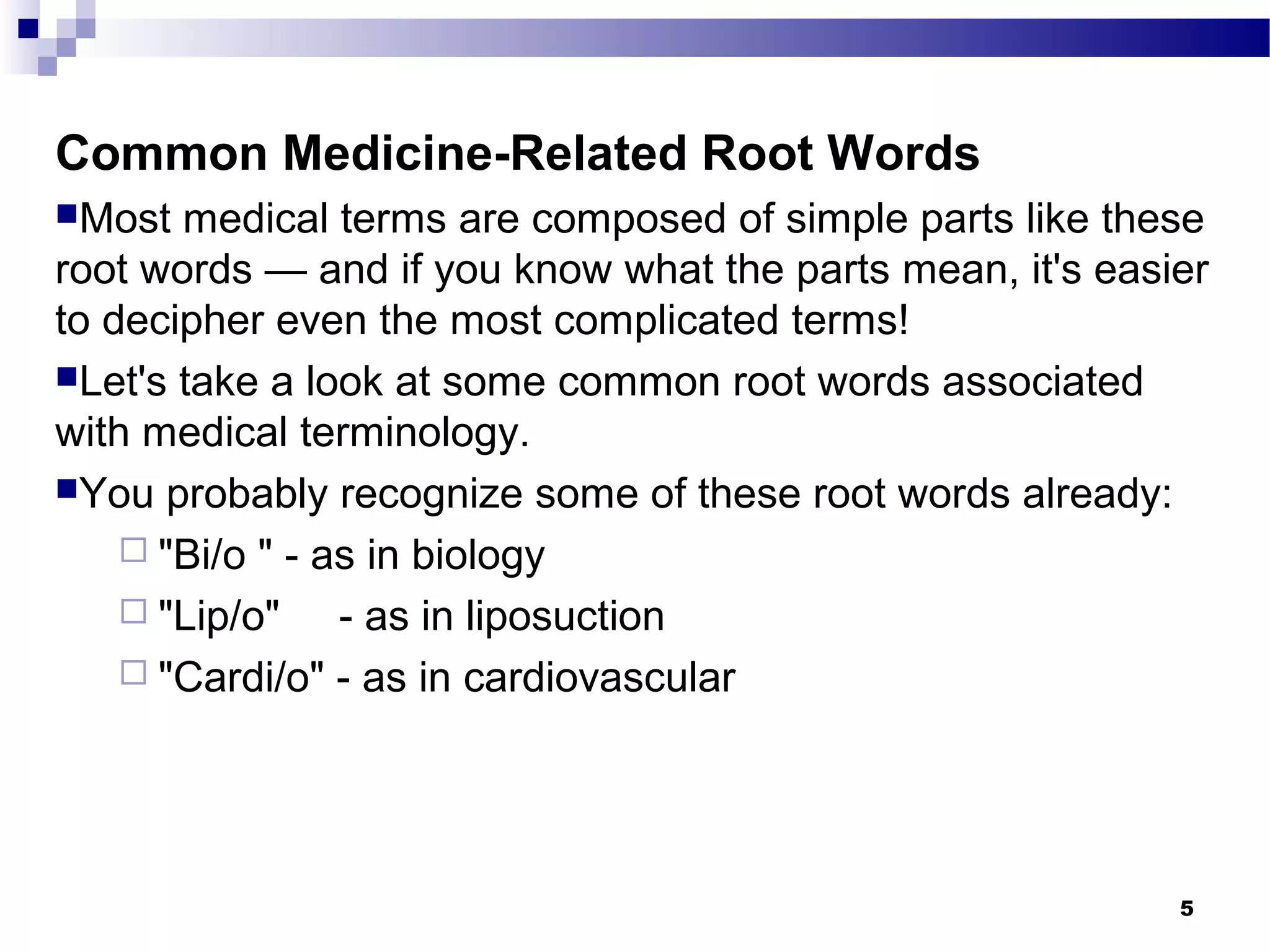
Common Medicine-Related Root Words
Most medical terms are composed of simple parts like these
root words — and if you know what the parts mean, it's easier
to decipher even the most complicated terms!
Let's take a look at some common root words associated
with medical terminology.
You probably recognize some of these root words already:
 "Bi/o " - as in biology
 "Lip/o" - as in liposuction
 "Cardi/o" - as in cardiovascular
6
Common Medicine-Related Root Words, cont.
Note that the “o” is a combining vowel used to
improve the flow of the word.
What Is Scleroderma?
If you look at the table or root words on the next
slide, you will see that:
 "scler/o" is hard
 "derma" refers to skin
Scleroderma is a disorder, caused by defective
collagen
 it gives a person very hard, scaly skin
7
Table of Root Words
Angi/o vessel Gastr/o stomach My/o, Sarc/o muscle
Arteri/o artery Glyc/o, gluc/o sugar Nephr/o, ren/o kidney
Arthr/o joint Hemat/o, hem/o blood Neur/o nerve
Aut/o self Hepat/o liver Ocul/o eye
Bi/o life, living Hist/o tissue Os, oste/o bone
Carcin/o cancer Hyster/o uterus Ot/o ear
Cardi/o heart Hydr/o water Path/o Pathology,
disease
Chondr/o cartilage Leuk/o white Phag/o to eat
Derm/o,
dermat/o
skin Lingu/o tongue Pneum/o lung, air
Dur/o hard Lip/o fat Scler/o hard
Enter/o intestine Mening/o membrane Stat/o stand still
Erythr/o red Morph/o form Therm/o heat
Perform the Root Self-Test on Moodle as many times
as you like for practice
8
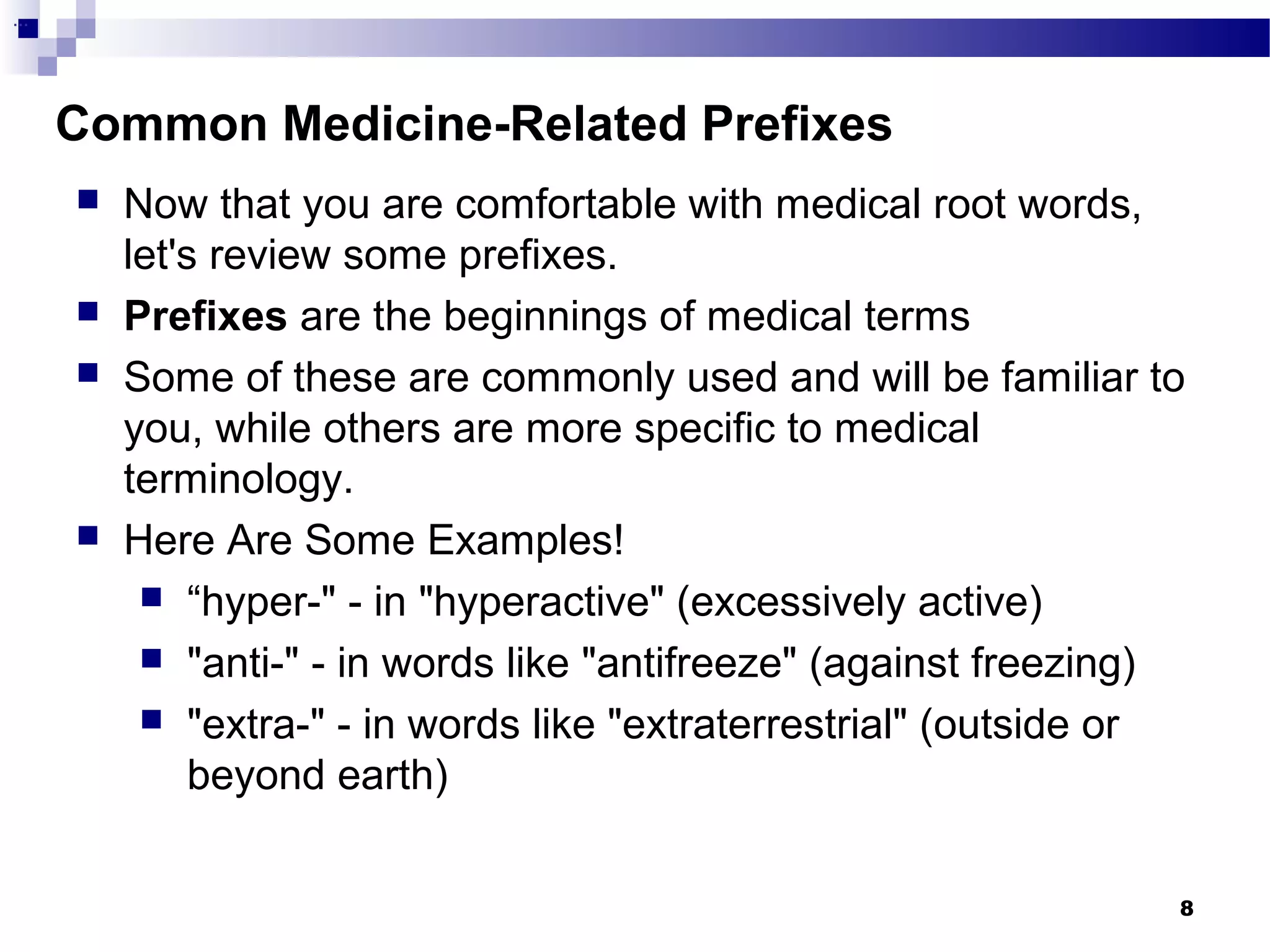
Common Medicine-Related Prefixes
...
 Now that you are comfortable with medical root words,
let's review some prefixes.
 Prefixes are the beginnings of medical terms
 Some of these are commonly used and will be familiar to
you, while others are more specific to medical
terminology.
 Here Are Some Examples!
 “hyper-" - in "hyperactive" (excessively active)
 "anti-" - in words like "antifreeze" (against freezing)
 "extra-" - in words like "extraterrestrial" (outside or
beyond earth)
9
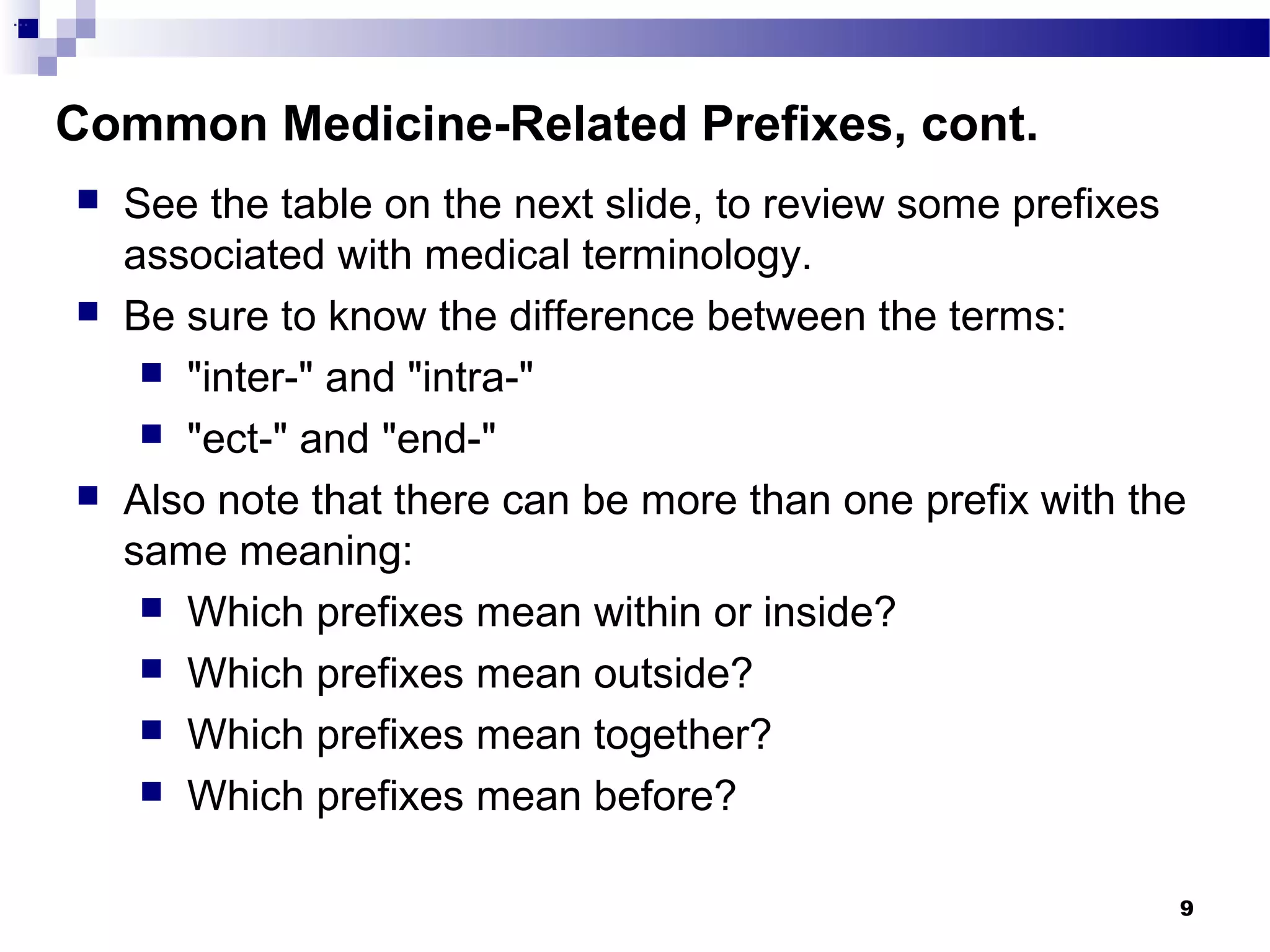
Common Medicine-Related Prefixes, cont.
...
 See the table on the next slide, to review some prefixes
associated with medical terminology.
 Be sure to know the difference between the terms:
 "inter-" and "intra-"
 "ect-" and "end-"
 Also note that there can be more than one prefix with the
same meaning:
 Which prefixes mean within or inside?
 Which prefixes mean outside?
 Which prefixes mean together?
 Which prefixes mean before?
10
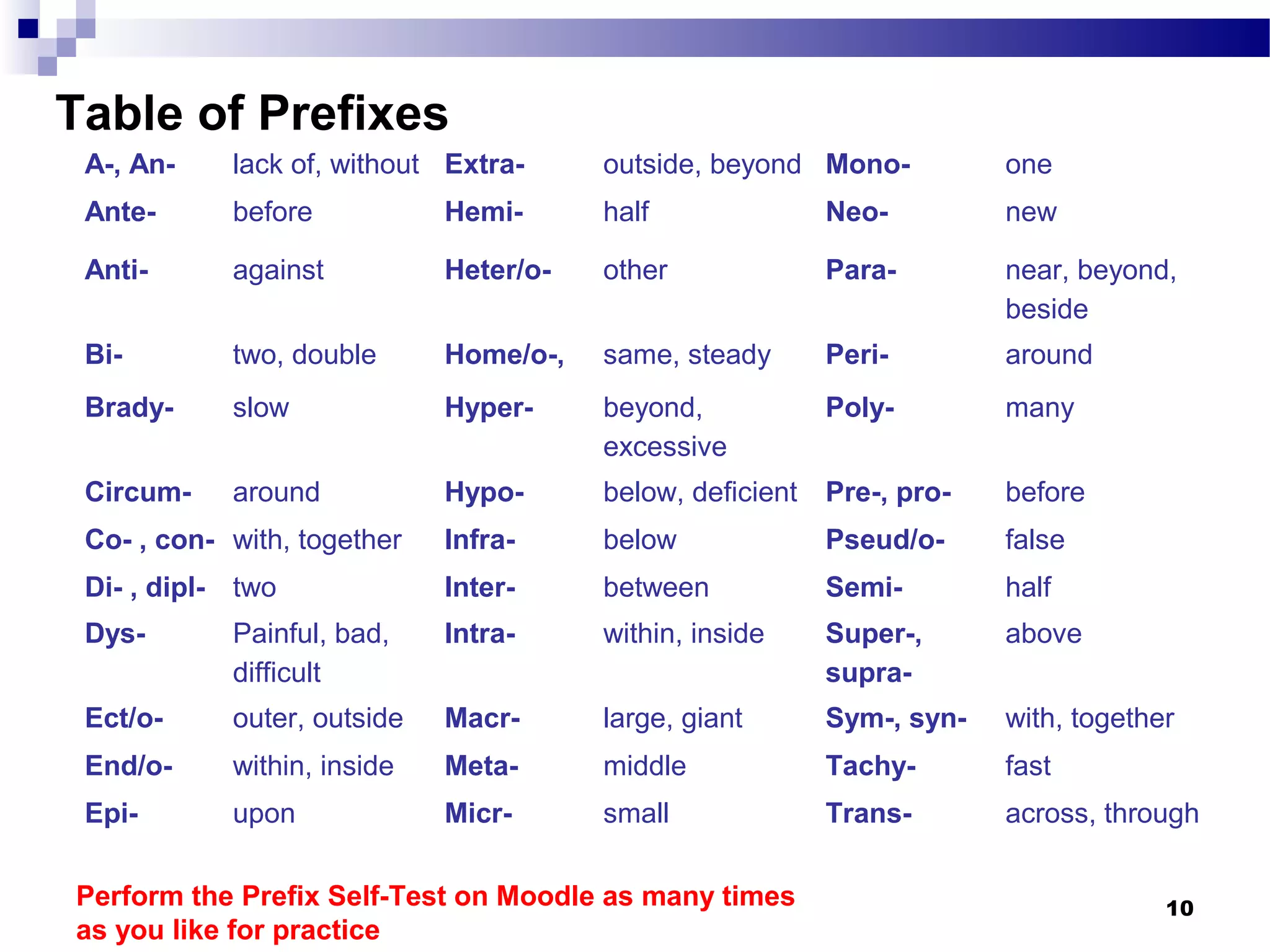
Table of Prefixes
A-, An- lack of, without Extra- outside, beyond Mono- one
Ante- before Hemi- half Neo- new
Anti- against Heter/o- other Para- near, beyond,
beside
Bi- two, double Home/o-, same, steady Peri- around
Brady- slow Hyper- beyond,
excessive
Poly- many
Circum- around Hypo- below, deficient Pre-, pro- before
Co- , con- with, together Infra- below Pseud/o- false
Di- , dipl- two Inter- between Semi- half
Dys- Painful, bad,
difficult
Intra- within, inside Super-,
supra-
above
Ect/o- outer, outside Macr- large, giant Sym-, syn- with, together
End/o- within, inside Meta- middle Tachy- fast
Epi- upon Micr- small Trans- across, through
Perform the Prefix Self-Test on Moodle as many times
as you like for practice
11
Common Medicine-Related Suffixes
...
 As well as having common beginnings (prefixes), many
medical words share common endings (suffixes):
 Some of these are found in non-medical English words,
while others are more specific to medicine
 Here Are Some Examples!
 You have probably heard of a physician (person
associated with the physical) or an appendectomy (to cut
out the appendix)
 you can link many of these suffixes to the root words you
learned earlier:
 "Hyster" + "ectomy" – hysterectomy (removal of the uterus)
 "Leuko" + "penia" – leukopenia (deficiency of white blood cells)
12
Common Medicine-Related Suffixes, cont.
...
 The suffix “-itis" is added to many root words and
prefixes, as in:
 Dermatitis
 Arthritis
 Hepatitis
...meaning inflammation of the skin, joints or
liver respectively
 The table on the next slide lists common suffixes
associated with medical terminology.
13
Table of Suffixes
-ac,-al, -ic pertaining to -mers parts
-algia painful condition -oma tumour
-asis, -osis condition or state of -ostomy create opening
-cyte cell -pathy disease
-ectomy to cut out, removal of -penia deficiency
-emia blood condition -plegia paralysis
-genic producing -pnea breath
-gram record, recording -poiesis making, forming
-ician person associated with -rrhage excessive flow
-itis inflammation of -stasis stand still, resting state
-logy, -ology science or study of -trophy relating to nutrition or growth
-lysis dissolving, separating -uria urine
Perform the Suffix Self-Test on Moodle as many times
as you like for practice
14
Discussion – Word Challenge
 Create or find 5 medical terms that incorporate
the word parts you have learned in the module
 Post your 5 words along with their definitions to the
Forum: Discussion Module 1 - Word Challenge
 Return to this discussion later to see what your
classmates have posted
 Medical terms created from the roots, prefixes
and suffixes in this module will be tested on the
Final Exam in addition to Midterm 1
You can’t open the
quiz until you have
posted to this forum!

1 language of medicine

  • 1.
    1 PNUR 113 –Module #1 The Language of Medicine
  • 2.
    2 Overview  To many,medical talk is a strange, incomprehensible language!  However, the language used by medical professionals allows them to communicate clearly with one another  This course has a great deal of unfamiliar language and terms that you will need to learn in order to be able to converse with other people in your field  With practice, you will develop a familiarity and facility with the language of medicine.
  • 3.
    3 Overview, cont.  Thistopic will Introduce word parts referred to as:  Root Words  Prefixes  Suffixes  Learning complex medical terms can be easier if you know that they are usually a group of similar component word parts — it also helps if you understand the origin of these word parts  Remember, repeated practice with these word parts will help you to learn the language of medicine!
  • 4.
    4 Learning Outcomes  Uponsuccessful completion of this module, you will be able to: Give the meaning of common root words, prefixes and suffixes used in medical terminology Combine common suffixes and prefixes with common root words to form a variety of medical terms Determine the meaning of medical terms by examining their root words, prefixes and suffixes
  • 5.
    5 Common Medicine-Related RootWords Most medical terms are composed of simple parts like these root words — and if you know what the parts mean, it's easier to decipher even the most complicated terms! Let's take a look at some common root words associated with medical terminology. You probably recognize some of these root words already:  "Bi/o " - as in biology  "Lip/o" - as in liposuction  "Cardi/o" - as in cardiovascular
  • 6.
    6 Common Medicine-Related RootWords, cont. Note that the “o” is a combining vowel used to improve the flow of the word. What Is Scleroderma? If you look at the table or root words on the next slide, you will see that:  "scler/o" is hard  "derma" refers to skin Scleroderma is a disorder, caused by defective collagen  it gives a person very hard, scaly skin
  • 7.
    7 Table of RootWords Angi/o vessel Gastr/o stomach My/o, Sarc/o muscle Arteri/o artery Glyc/o, gluc/o sugar Nephr/o, ren/o kidney Arthr/o joint Hemat/o, hem/o blood Neur/o nerve Aut/o self Hepat/o liver Ocul/o eye Bi/o life, living Hist/o tissue Os, oste/o bone Carcin/o cancer Hyster/o uterus Ot/o ear Cardi/o heart Hydr/o water Path/o Pathology, disease Chondr/o cartilage Leuk/o white Phag/o to eat Derm/o, dermat/o skin Lingu/o tongue Pneum/o lung, air Dur/o hard Lip/o fat Scler/o hard Enter/o intestine Mening/o membrane Stat/o stand still Erythr/o red Morph/o form Therm/o heat Perform the Root Self-Test on Moodle as many times as you like for practice
  • 8.
    8 Common Medicine-Related Prefixes ... Now that you are comfortable with medical root words, let's review some prefixes.  Prefixes are the beginnings of medical terms  Some of these are commonly used and will be familiar to you, while others are more specific to medical terminology.  Here Are Some Examples!  “hyper-" - in "hyperactive" (excessively active)  "anti-" - in words like "antifreeze" (against freezing)  "extra-" - in words like "extraterrestrial" (outside or beyond earth)
  • 9.
    9 Common Medicine-Related Prefixes,cont. ...  See the table on the next slide, to review some prefixes associated with medical terminology.  Be sure to know the difference between the terms:  "inter-" and "intra-"  "ect-" and "end-"  Also note that there can be more than one prefix with the same meaning:  Which prefixes mean within or inside?  Which prefixes mean outside?  Which prefixes mean together?  Which prefixes mean before?
  • 10.
    10 Table of Prefixes A-,An- lack of, without Extra- outside, beyond Mono- one Ante- before Hemi- half Neo- new Anti- against Heter/o- other Para- near, beyond, beside Bi- two, double Home/o-, same, steady Peri- around Brady- slow Hyper- beyond, excessive Poly- many Circum- around Hypo- below, deficient Pre-, pro- before Co- , con- with, together Infra- below Pseud/o- false Di- , dipl- two Inter- between Semi- half Dys- Painful, bad, difficult Intra- within, inside Super-, supra- above Ect/o- outer, outside Macr- large, giant Sym-, syn- with, together End/o- within, inside Meta- middle Tachy- fast Epi- upon Micr- small Trans- across, through Perform the Prefix Self-Test on Moodle as many times as you like for practice
  • 11.
    11 Common Medicine-Related Suffixes ... As well as having common beginnings (prefixes), many medical words share common endings (suffixes):  Some of these are found in non-medical English words, while others are more specific to medicine  Here Are Some Examples!  You have probably heard of a physician (person associated with the physical) or an appendectomy (to cut out the appendix)  you can link many of these suffixes to the root words you learned earlier:  "Hyster" + "ectomy" – hysterectomy (removal of the uterus)  "Leuko" + "penia" – leukopenia (deficiency of white blood cells)
  • 12.
    12 Common Medicine-Related Suffixes,cont. ...  The suffix “-itis" is added to many root words and prefixes, as in:  Dermatitis  Arthritis  Hepatitis ...meaning inflammation of the skin, joints or liver respectively  The table on the next slide lists common suffixes associated with medical terminology.
  • 13.
    13 Table of Suffixes -ac,-al,-ic pertaining to -mers parts -algia painful condition -oma tumour -asis, -osis condition or state of -ostomy create opening -cyte cell -pathy disease -ectomy to cut out, removal of -penia deficiency -emia blood condition -plegia paralysis -genic producing -pnea breath -gram record, recording -poiesis making, forming -ician person associated with -rrhage excessive flow -itis inflammation of -stasis stand still, resting state -logy, -ology science or study of -trophy relating to nutrition or growth -lysis dissolving, separating -uria urine Perform the Suffix Self-Test on Moodle as many times as you like for practice
  • 14.
    14 Discussion – WordChallenge  Create or find 5 medical terms that incorporate the word parts you have learned in the module  Post your 5 words along with their definitions to the Forum: Discussion Module 1 - Word Challenge  Return to this discussion later to see what your classmates have posted  Medical terms created from the roots, prefixes and suffixes in this module will be tested on the Final Exam in addition to Midterm 1 You can’t open the quiz until you have posted to this forum!