Introduction to A2 Geography June2009   08/09/11
Expectations Attend all lessons on time Use time effectively and productively Read around lessons Carry out independent research Read broadsheet newspapers Complete all home learning tasks set and hand in on time!
Overview of A2 08/09/11
Unit 3 Energy Security Biodiversity under threat Superpower Geographies Water Conflicts Bridging the development gap The technological Fix 08/09/11 Miss Green Mr Henricksen
08/09/11
A change to UMS (Uniform Marks): As we now have only 4 units, the total UMS (Uniform Marks) for Geography totals 400, not 600:   08/09/11
Award of the A*: To be awarded a grade A* at GCE A Level, a candidate must 1. achieve a grade A overall for the A Level. This can also be described as having to achieve 80% of the total uniform marks. AND 2. achieve 90% of the combined uniform mark total for the A2 units. For example: For a 4 unit A Level, a candidate must achieve at least 320 of the 400 uniform marks  and  180 of the 200 uniform marks for the A2 units. 08/09/11
Unit 3 – Contested Planet – key themes Unit 3, Contested Planet, forms the core of A2 Geography.  The unit aims to introduce key contemporary global issues and to explore the significance of these issues and examine a range of potential solutions to them.  The unit has a synoptic element, which addresses the question of ‘Managing the Contested Planet’.  This takes the form of assessing three broad themes in relation to the topic content 08/09/11
Topic 1:   ENERGY SECURITY:  A view from the USA " For too long our nation has been dependent on foreign oil. And this dependence leaves us more vulnerable to hostile regimes, and to terrorists -- who could cause huge disruptions of oil shipments, and raise the price of oil, and do great harm to our economy” President GW Bush, State of the  Union 2007. 08/09/11
Topic 2: WATER CONFLICTS – running dry 08/09/11
Topic 3: BIODIVERSITY UNDER THREAT – the alien invasion   Invasive alien species are a big threat to biodiversity   08/09/11
Topic 4: SUPERPOWER GEOGRAPHIES – who are the emerging powers?? Superpower Geographies is really about the changing Geography of power and opportunity, and divides into three parts: The past  – the Geography of the British Empire and Cold War The present  – the Geography of the world with the USA as the only superpower The future  – the Geography of the future, in an increasingly multi-polar world  The future world is likely to be the most unfamiliar. There are several good sources of information on this topic such as The World Economic Forum 08/09/11
A  superpower is a country (or grouping of countries) which has global economic, cultural, military and geographical influence. On this basis: The  USA  is clearly a superpower. The  BRICs  are emerging superpowers, especially Russia, India and China The  EU  is usually viewed as an emerging superpower  The  Middle East  has economic influence and should be viewed as an emerging power.  Some countries have more of a  regional influence , and should be viewed as regional powers such as Brazil, Japan and South Africa.   08/09/11
Technological Fix is a very new area on the spec There is no need to fear it. It is actually a very synoptic part of the Unit 3 spec and you will find that much of it is covered in the other 5 topics 08/09/11 Topic 6: TECHNOLOGICAL FIX?  –  some new terminology
In the Unit 3 exam students complete 2 questions.  This forms Section A of the Unit 3 examination. Section B is the synoptic issues analysis. There are six topics in Unit 3:  Energy security Water Conflicts Biodiversity under Threat  Superpower Geographies Bridging the Development Gap Technological Fix In each exam series, one of the 6 topics will form the basis for the synoptic issues analysis. The remaining 5 topics will each have a Section A question. Students will choose 2 of the 5 Section A questions to complete.  All students will complete Section B, based on the pre-released resources.  08/09/11
Note that the questions on the exam paper will be numbered 1-6, BUT these numbers will not correspond to the Topic numbers. However, the topics each question refers to will be indicated on the exam paper e.g. ‘Energy Security’  There will be  no order  to the topic chosen to be the basis for the pre-release issues analysis, it will be random.  Students are advised to spend 1 hr 20 mins on Section A, and 1 hour 10 mins on Section B (2 ½ hour exam in total).  08/09/11
Unit 3: Approaches to Synopticity Section B on the Unit 3 exam paper will consist of an Issues Analysis based on pre-release resources  The pre-release resources should be studied in class prior to the exam. In the exam students will be faced with a sequence of three questions (6a, 6b, 6c) totalling 40 marks.   08/09/11
In general they will follow an issues analysis sequence: Introductory question - what’s the issue / problem? Opportunities / challenges, how did the situation develop etc.  Assessment / evaluation looking at impacts, consequences, threats, needs etc.  Discursive question focussing on the future, management, role of different players, options or a range of actions.  Example below 08/09/11
Unit 4 Geographical Research   This Unit provides the opportunity to research a topic in depth.  Each of the six options falls in a different place on the human-environmental-physical geography spectrum: 08/09/11
Where does each option fit in? Although each option is an in depth research investigation, you should consider how it relates to the rest of the AS and A2 Geography course.  AS Unit 1 and A2 Unit 3 are both focused on global issues and understanding how the world works as whole system.  Unit 4 is more focused on geographical specialisms.  To fit the two approaches together each Unit 4 option has an introductory  Global Synoptic Context  which highlights where it fits into the GCE course as a whole. The introductory sections each have 3 P’s: P laces P eople P ower   08/09/11
Generating a Research Ethos at A2 08/09/11 Linked reading and cross referencing: having looked at  one source you may need another to understand it Look at the origins of an article, or who runs a web site, Be critical of sources, check for bias Collect your own articles, reports , swap with other students 1 Finding information 2 Selecting and sorting information What is the focus of your research? i.e. topic, aims Begin a search from a variety of sources: books, articles, websites….and keep a record (date, volume, author…) as you go!  Begin to filter information- not all that you read will be useful for a particular focus!  3 Synthesis and sorting information Highlight key words, technical terms, even create a glossary to help you revise  4 Create final product: This may be an essay during your course, or a report,  or a presentation, or simply notes for yourself!
Assessment for Unit 4   For the Unit 4 examination students will be required to answer  ONE  report question on their chosen option. There will only be one question per option on the exam paper.  The exam in 1 ½ hours long.  Below is an example report question 08/09/11
Candidates will be made clear what the purpose of the research focus is and what the expected  product  is.   Instructions to Candidates Select  one option , based on the research you have carried out for Unit 4.  You should use information contained in the research focus to prepare for the Unit 4 examination. The  research focus  will give you an idea of the sort of question you will need to answer in the examination for Unit 4.To help you narrow down your last minute research, the focus is divided into: Explore , meaning the background concepts, processes, theories, models involved where relevant. Research , meaning the geographical places, case studies and examples illustrating these. You will be expected to produce a  report , with clear subsections and referencing. Please consult the accompanying generic mark scheme, also to be found on the Edexcel website   08/09/11
It is important to recognise that the  product  is a  report , not an essay. This means that the student’s answer is expected to contain: Clear sub–headings and sectioning – introduction, analysis, conclusion etc.  Diagrams, especially conceptual ones such as models, but also simple maps, graphs and tables of data when appropriate  Sources and referencing – not as in a University Dissertation, but at least acknowledging key sources of information   08/09/11
08/09/11 linkage linkage linkage Analysis Section  2  Concept/case study 1 2 ……. Main structure  What needs to be included  Hitting 70? PLANNING PAGE 1 SIDE MAX spider, spectrum diagram, grid, bullets… Section 1: Introduction Discussion of title-developing a focus- by case study or concepts Accurate definitions Framework by concept/case study D 10 Analysis Section2 Concept/Case Study1 Concept/Case Study2 Concept/Case Study3 etc   ….. Research + sampling methods: range, topical, relevant  Analysis, Application+ Understanding:  linked to title (+supporting maps/diagrams if relevant)  Values/perspectives  R 15 + Sub conclusion/ evaluation +Sub conclusion/ evaluation A 20 +Sub conclusion/ evaluation Section 3 : Final Conclusion Ongoing evaluations + final summary. Shows complexity of Q C 15 Quality of written communication:  Report style, sequencing, SPAG, Geographical Vocabulary referencing/sourcing  Q 10
Energy – Does it cost the Earth? Learning Objectives: To interpret the term “Energy Security” To classify energy sources and analyse their environmental impacts PLTs objective: To work with others to rank the environmental impact of a variety of energy sources. 08/09/11
Reconnect our Learning. How does this topic, Energy security, link with Unit 1?
Topic 1= Energy Security Strand 1) Energy supply, demand and security Strand 2) The impacts of Energy Insecurity Strand 3) Energy Security and the future
Energy-Issues-Contested Planet….
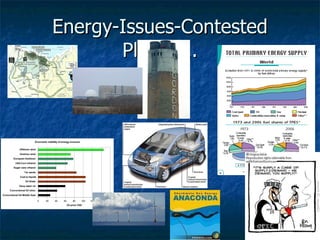
Energy-Issues-Contested Planet…. 1.  Supply-demand and security 2 . Impacts:environmental and socio economic  issues 3.  Futures- alternatives, renewables, conservation, efficiency…….. Oil exploration Arctic N slope-! Expansion nuclear power UK eg Sizewell Kingsnorth coal powerstation + Grenpeace protest Energy crisis - oil peak Alternatives for future? Renewables: wind farm Thames Estuary ARRAY and wave: Anaconda system Key supply player: OPEC Hybrid car- less energy
Task: In pairs discuss the term “Energy Security” Come up with your own definition of the term 08/09/11
What does it mean to be energy secure? To have  ENERGY SECURITY  means to have access to reliable and affordable energy sources E.g. Russia Countries that do not have this are said to be  ENERGY INSECURE
To finish… Answer question 1 p32 08/09/11
Home Learning –  08/09/11 Exam Question: Using sources of evidence assess how energy secure the UK is. Hand in date:  Monday 13 th  September

1 introductiontoa2geography

  • 1.
    Introduction to A2Geography June2009 08/09/11
  • 2.
    Expectations Attend alllessons on time Use time effectively and productively Read around lessons Carry out independent research Read broadsheet newspapers Complete all home learning tasks set and hand in on time!
  • 3.
  • 4.
    Unit 3 EnergySecurity Biodiversity under threat Superpower Geographies Water Conflicts Bridging the development gap The technological Fix 08/09/11 Miss Green Mr Henricksen
  • 5.
  • 6.
    A change toUMS (Uniform Marks): As we now have only 4 units, the total UMS (Uniform Marks) for Geography totals 400, not 600: 08/09/11
  • 7.
    Award of theA*: To be awarded a grade A* at GCE A Level, a candidate must 1. achieve a grade A overall for the A Level. This can also be described as having to achieve 80% of the total uniform marks. AND 2. achieve 90% of the combined uniform mark total for the A2 units. For example: For a 4 unit A Level, a candidate must achieve at least 320 of the 400 uniform marks and 180 of the 200 uniform marks for the A2 units. 08/09/11
  • 8.
    Unit 3 –Contested Planet – key themes Unit 3, Contested Planet, forms the core of A2 Geography. The unit aims to introduce key contemporary global issues and to explore the significance of these issues and examine a range of potential solutions to them. The unit has a synoptic element, which addresses the question of ‘Managing the Contested Planet’. This takes the form of assessing three broad themes in relation to the topic content 08/09/11
  • 9.
    Topic 1: ENERGY SECURITY: A view from the USA " For too long our nation has been dependent on foreign oil. And this dependence leaves us more vulnerable to hostile regimes, and to terrorists -- who could cause huge disruptions of oil shipments, and raise the price of oil, and do great harm to our economy” President GW Bush, State of the Union 2007. 08/09/11
  • 10.
    Topic 2: WATERCONFLICTS – running dry 08/09/11
  • 11.
    Topic 3: BIODIVERSITYUNDER THREAT – the alien invasion Invasive alien species are a big threat to biodiversity 08/09/11
  • 12.
    Topic 4: SUPERPOWERGEOGRAPHIES – who are the emerging powers?? Superpower Geographies is really about the changing Geography of power and opportunity, and divides into three parts: The past – the Geography of the British Empire and Cold War The present – the Geography of the world with the USA as the only superpower The future – the Geography of the future, in an increasingly multi-polar world The future world is likely to be the most unfamiliar. There are several good sources of information on this topic such as The World Economic Forum 08/09/11
  • 13.
    A superpoweris a country (or grouping of countries) which has global economic, cultural, military and geographical influence. On this basis: The USA is clearly a superpower. The BRICs are emerging superpowers, especially Russia, India and China The EU is usually viewed as an emerging superpower The Middle East has economic influence and should be viewed as an emerging power. Some countries have more of a regional influence , and should be viewed as regional powers such as Brazil, Japan and South Africa. 08/09/11
  • 14.
    Technological Fix isa very new area on the spec There is no need to fear it. It is actually a very synoptic part of the Unit 3 spec and you will find that much of it is covered in the other 5 topics 08/09/11 Topic 6: TECHNOLOGICAL FIX? – some new terminology
  • 15.
    In the Unit3 exam students complete 2 questions. This forms Section A of the Unit 3 examination. Section B is the synoptic issues analysis. There are six topics in Unit 3: Energy security Water Conflicts Biodiversity under Threat Superpower Geographies Bridging the Development Gap Technological Fix In each exam series, one of the 6 topics will form the basis for the synoptic issues analysis. The remaining 5 topics will each have a Section A question. Students will choose 2 of the 5 Section A questions to complete. All students will complete Section B, based on the pre-released resources. 08/09/11
  • 16.
    Note that thequestions on the exam paper will be numbered 1-6, BUT these numbers will not correspond to the Topic numbers. However, the topics each question refers to will be indicated on the exam paper e.g. ‘Energy Security’ There will be no order to the topic chosen to be the basis for the pre-release issues analysis, it will be random. Students are advised to spend 1 hr 20 mins on Section A, and 1 hour 10 mins on Section B (2 ½ hour exam in total). 08/09/11
  • 17.
    Unit 3: Approachesto Synopticity Section B on the Unit 3 exam paper will consist of an Issues Analysis based on pre-release resources The pre-release resources should be studied in class prior to the exam. In the exam students will be faced with a sequence of three questions (6a, 6b, 6c) totalling 40 marks. 08/09/11
  • 18.
    In general theywill follow an issues analysis sequence: Introductory question - what’s the issue / problem? Opportunities / challenges, how did the situation develop etc. Assessment / evaluation looking at impacts, consequences, threats, needs etc. Discursive question focussing on the future, management, role of different players, options or a range of actions. Example below 08/09/11
  • 19.
    Unit 4 GeographicalResearch This Unit provides the opportunity to research a topic in depth. Each of the six options falls in a different place on the human-environmental-physical geography spectrum: 08/09/11
  • 20.
    Where does eachoption fit in? Although each option is an in depth research investigation, you should consider how it relates to the rest of the AS and A2 Geography course. AS Unit 1 and A2 Unit 3 are both focused on global issues and understanding how the world works as whole system. Unit 4 is more focused on geographical specialisms. To fit the two approaches together each Unit 4 option has an introductory Global Synoptic Context which highlights where it fits into the GCE course as a whole. The introductory sections each have 3 P’s: P laces P eople P ower 08/09/11
  • 21.
    Generating a ResearchEthos at A2 08/09/11 Linked reading and cross referencing: having looked at one source you may need another to understand it Look at the origins of an article, or who runs a web site, Be critical of sources, check for bias Collect your own articles, reports , swap with other students 1 Finding information 2 Selecting and sorting information What is the focus of your research? i.e. topic, aims Begin a search from a variety of sources: books, articles, websites….and keep a record (date, volume, author…) as you go! Begin to filter information- not all that you read will be useful for a particular focus! 3 Synthesis and sorting information Highlight key words, technical terms, even create a glossary to help you revise 4 Create final product: This may be an essay during your course, or a report, or a presentation, or simply notes for yourself!
  • 22.
    Assessment for Unit4 For the Unit 4 examination students will be required to answer ONE report question on their chosen option. There will only be one question per option on the exam paper. The exam in 1 ½ hours long. Below is an example report question 08/09/11
  • 23.
    Candidates will bemade clear what the purpose of the research focus is and what the expected product is. Instructions to Candidates Select one option , based on the research you have carried out for Unit 4. You should use information contained in the research focus to prepare for the Unit 4 examination. The research focus will give you an idea of the sort of question you will need to answer in the examination for Unit 4.To help you narrow down your last minute research, the focus is divided into: Explore , meaning the background concepts, processes, theories, models involved where relevant. Research , meaning the geographical places, case studies and examples illustrating these. You will be expected to produce a report , with clear subsections and referencing. Please consult the accompanying generic mark scheme, also to be found on the Edexcel website 08/09/11
  • 24.
    It is importantto recognise that the product is a report , not an essay. This means that the student’s answer is expected to contain: Clear sub–headings and sectioning – introduction, analysis, conclusion etc. Diagrams, especially conceptual ones such as models, but also simple maps, graphs and tables of data when appropriate Sources and referencing – not as in a University Dissertation, but at least acknowledging key sources of information 08/09/11
  • 25.
    08/09/11 linkage linkagelinkage Analysis Section 2 Concept/case study 1 2 ……. Main structure What needs to be included Hitting 70? PLANNING PAGE 1 SIDE MAX spider, spectrum diagram, grid, bullets… Section 1: Introduction Discussion of title-developing a focus- by case study or concepts Accurate definitions Framework by concept/case study D 10 Analysis Section2 Concept/Case Study1 Concept/Case Study2 Concept/Case Study3 etc ….. Research + sampling methods: range, topical, relevant Analysis, Application+ Understanding: linked to title (+supporting maps/diagrams if relevant) Values/perspectives R 15 + Sub conclusion/ evaluation +Sub conclusion/ evaluation A 20 +Sub conclusion/ evaluation Section 3 : Final Conclusion Ongoing evaluations + final summary. Shows complexity of Q C 15 Quality of written communication: Report style, sequencing, SPAG, Geographical Vocabulary referencing/sourcing Q 10
  • 26.
    Energy – Doesit cost the Earth? Learning Objectives: To interpret the term “Energy Security” To classify energy sources and analyse their environmental impacts PLTs objective: To work with others to rank the environmental impact of a variety of energy sources. 08/09/11
  • 27.
    Reconnect our Learning.How does this topic, Energy security, link with Unit 1?
  • 28.
    Topic 1= EnergySecurity Strand 1) Energy supply, demand and security Strand 2) The impacts of Energy Insecurity Strand 3) Energy Security and the future
  • 29.
  • 30.
    Energy-Issues-Contested Planet…. 1. Supply-demand and security 2 . Impacts:environmental and socio economic issues 3. Futures- alternatives, renewables, conservation, efficiency…….. Oil exploration Arctic N slope-! Expansion nuclear power UK eg Sizewell Kingsnorth coal powerstation + Grenpeace protest Energy crisis - oil peak Alternatives for future? Renewables: wind farm Thames Estuary ARRAY and wave: Anaconda system Key supply player: OPEC Hybrid car- less energy
  • 31.
    Task: In pairsdiscuss the term “Energy Security” Come up with your own definition of the term 08/09/11
  • 32.
    What does itmean to be energy secure? To have ENERGY SECURITY means to have access to reliable and affordable energy sources E.g. Russia Countries that do not have this are said to be ENERGY INSECURE
  • 33.
    To finish… Answerquestion 1 p32 08/09/11
  • 34.
    Home Learning – 08/09/11 Exam Question: Using sources of evidence assess how energy secure the UK is. Hand in date: Monday 13 th September