Unit 1 Exam Global Challenges:
         Revision session 2!

To see what you need to revise before
             Thursday!

 To know how to be above average in
       Section A: January 2011

     To understand that there is
controversy surrounding global warming
Starter

  •Smile or not....
•What do you know?
• You still have time
     to learn it!
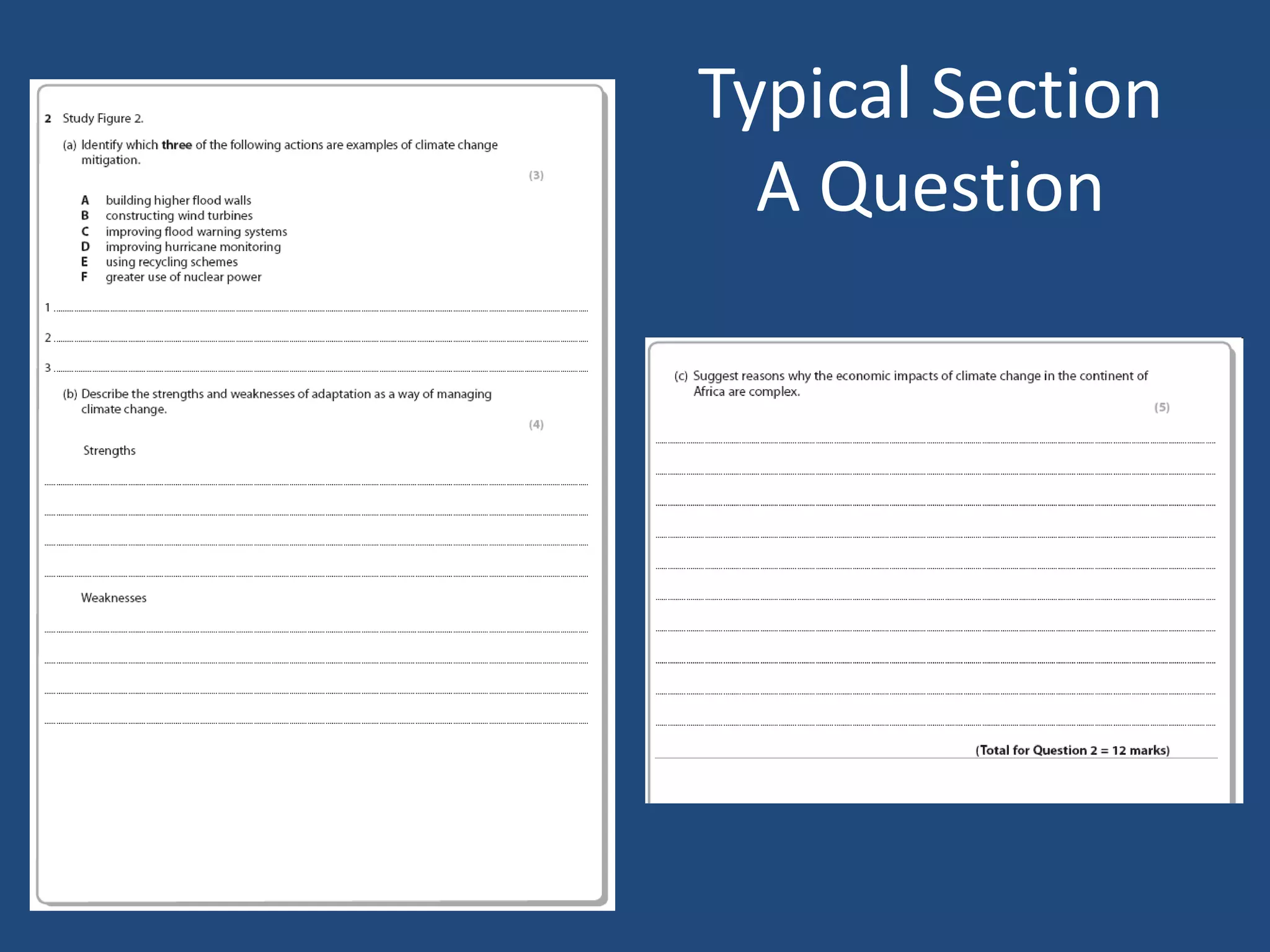
Typical Section
  A Question
Stating key factual information
• Questions worth 1 or 2 marks, test basic knowledge.
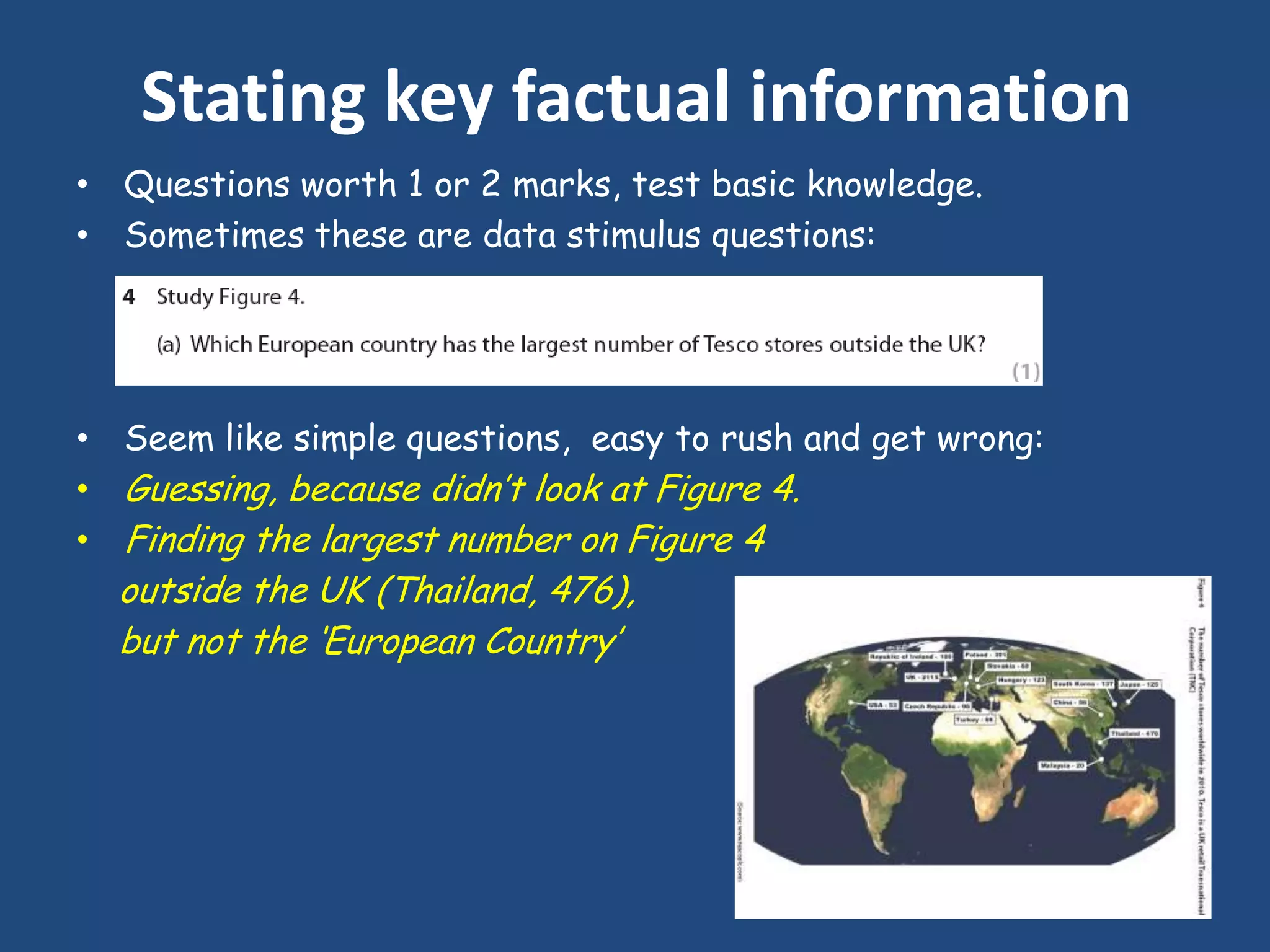
• Sometimes these are data stimulus questions:


• Seem like simple questions, easy to rush and get wrong:
• Guessing, because didn‟t look at Figure 4.
• Finding the largest number on Figure 4
  outside the UK (Thailand, 476),
  but not the „European Country‟
:

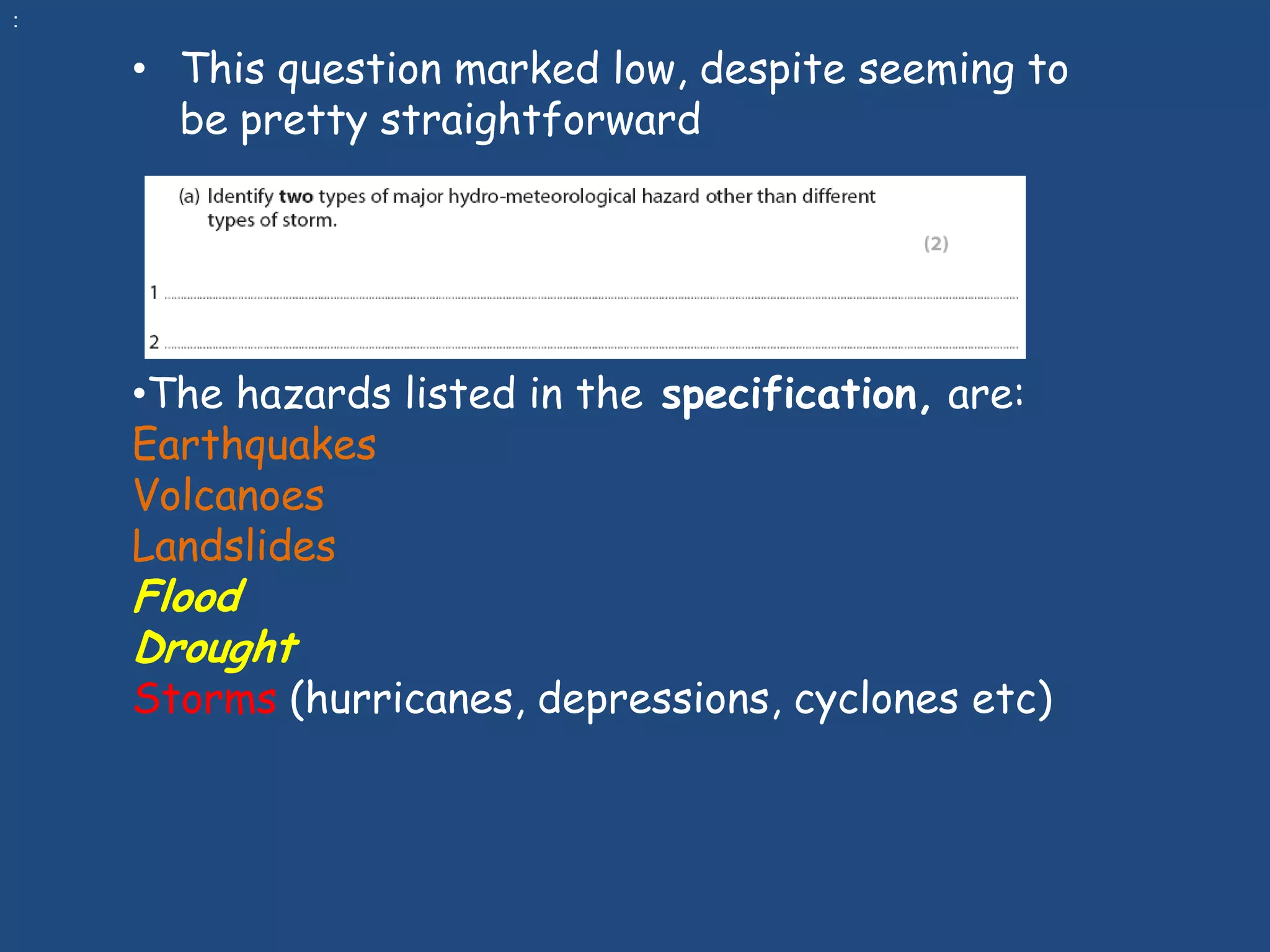
    • This question marked low, despite seeming to
      be pretty straightforward


    •The hazards listed in the specification, are:
    Earthquakes
    Volcanoes
    Landslides
    Flood
    Drought
    Storms (hurricanes, depressions, cyclones etc)
Lessons to learn?
• No substitute for basic revision
• Some questions designed to be „easy‟
• Rushing them a mistake
• Know the specification e.g. „hydro-
  meteorological‟ is not everyday language,
  but it is in the specification and will
  therefore be used in the exam paper.
Listing reasons
• These questions often have a mark tariff of 3.
• Best approach is to aim to write three different
  reasons
• Numbered / bullet points OK
Many candidates:
• Give 1 or 2 reasons, but not three
• Give 3, but actually repeat themselves
• Give too much background / generality
• Describe rather than give reasons especially if the Q
  relates to a Figure.

These are focussed questions: reason 1, reason 2,
  reason 3.
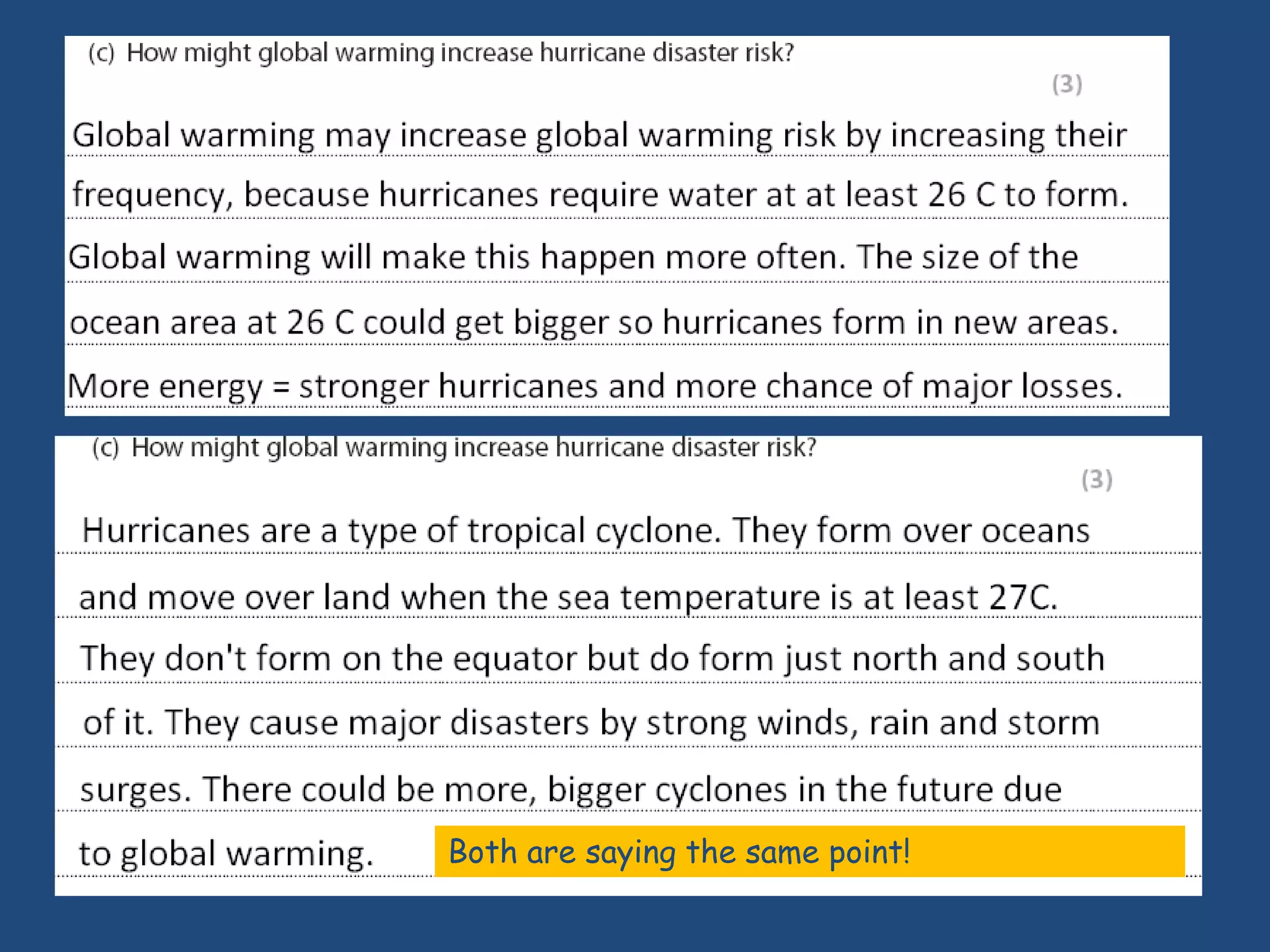
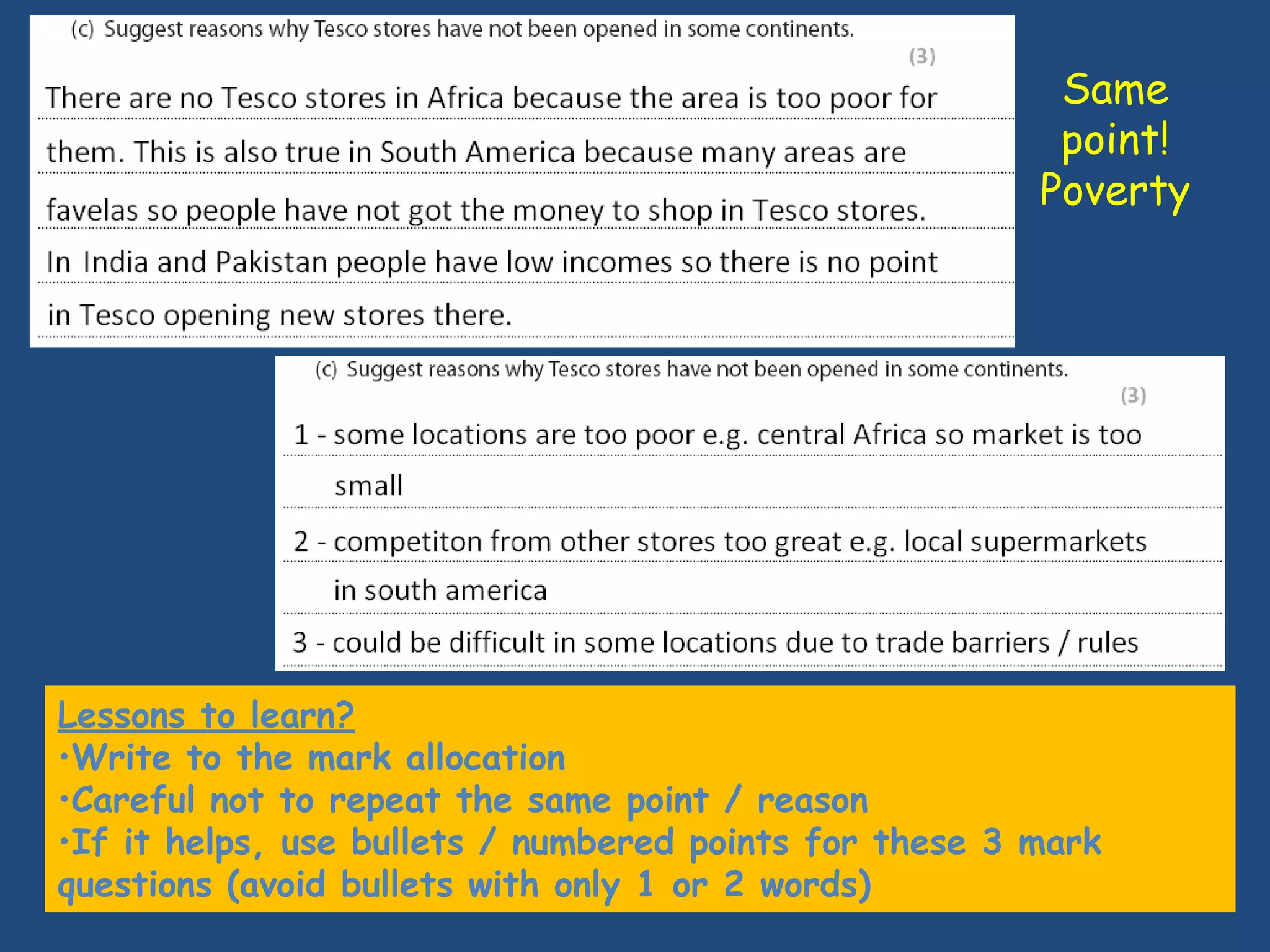
Both are saying the same point!
How might global warming increase disaster
                     risk? (3)

• Warmer ocean = more energy/higher wind speed
•  Temperature of 26-27C needed
•  More evaporation = heavier rain
• Changes to tracks and could affect more populated
  areas
• Hurricanes may increase in magnitude (saffir
  simpson scale) and frequency
• Could lead to more storm surges leading to more at
  risk.
• May affect ENSO
Same
                                                         point!
                                                        Poverty


Lessons to learn?
•Write to the mark allocation
•Careful not to repeat the same point / reason
•If it helps, use bullets / numbered points for these 3 mark
questions (avoid bullets with only 1 or 2 words)
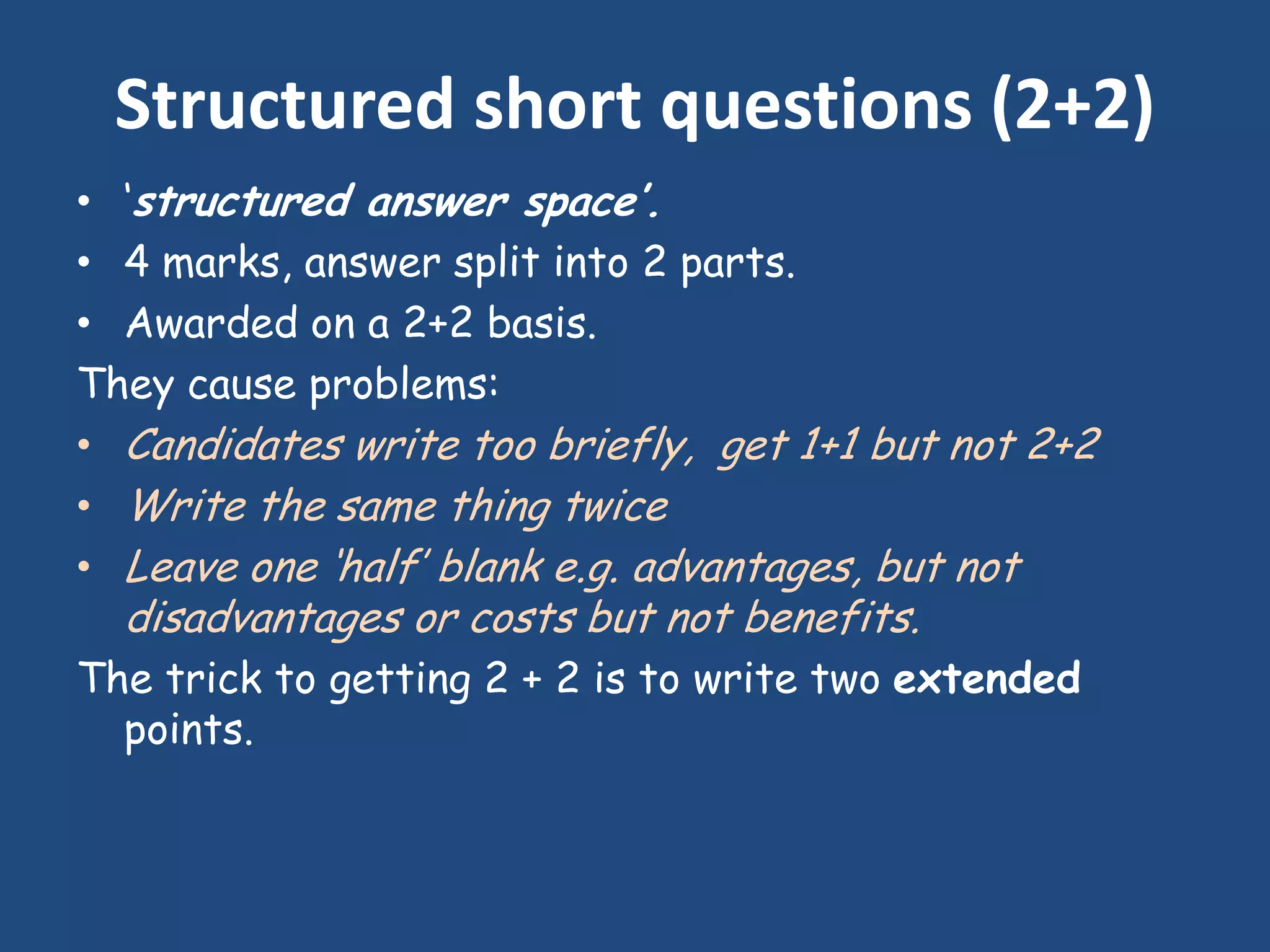
Structured short questions (2+2)
• „structured answer space’.
• 4 marks, answer split into 2 parts.
• Awarded on a 2+2 basis.
They cause problems:
• Candidates write too briefly, get 1+1 but not 2+2
• Write the same thing twice
• Leave one „half‟ blank e.g. advantages, but not
  disadvantages or costs but not benefits.
The trick to getting 2 + 2 is to write two extended
  points.
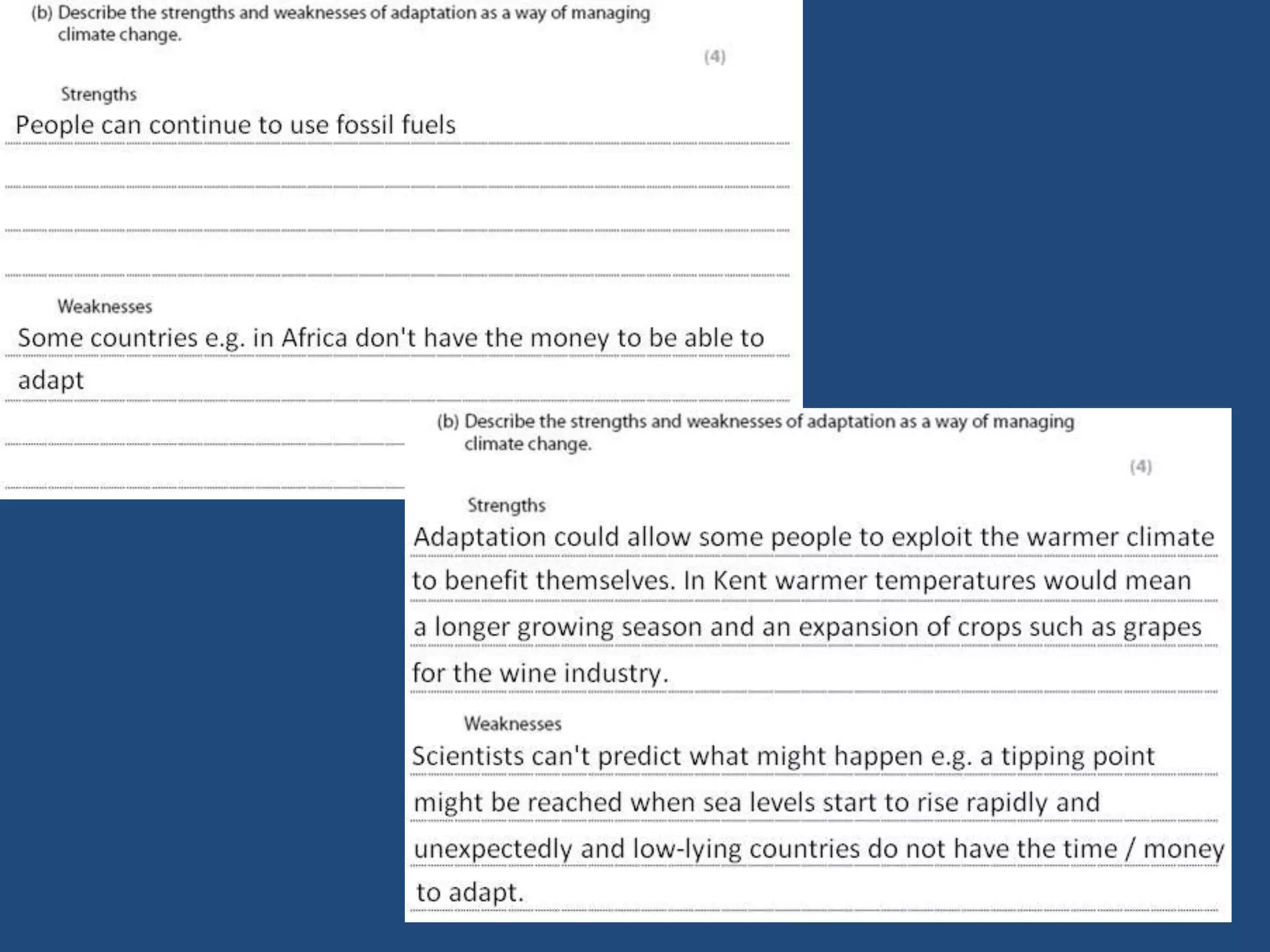
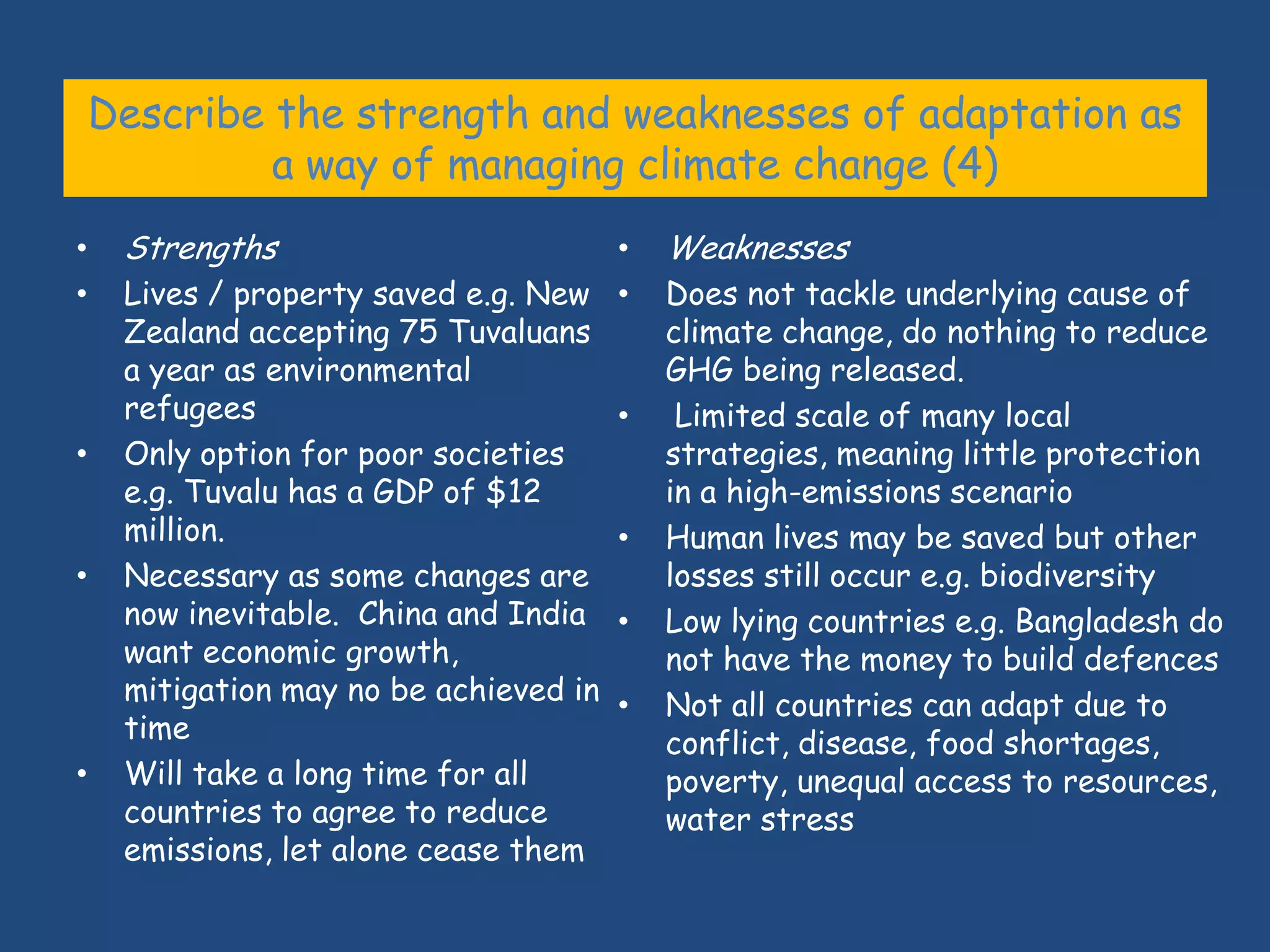
Describe the strength and weaknesses of adaptation as
             a way of managing climate change (4)
•    Strengths                        •   Weaknesses
•    Lives / property saved e.g. New •    Does not tackle underlying cause of
     Zealand accepting 75 Tuvaluans       climate change, do nothing to reduce
     a year as environmental              GHG being released.
     refugees                         •    Limited scale of many local
•    Only option for poor societies       strategies, meaning little protection
     e.g. Tuvalu has a GDP of $12         in a high-emissions scenario
     million.                         •   Human lives may be saved but other
•    Necessary as some changes are        losses still occur e.g. biodiversity
     now inevitable. China and India •    Low lying countries e.g. Bangladesh do
     want economic growth,                not have the money to build defences
     mitigation may no be achieved in •   Not all countries can adapt due to
     time                                 conflict, disease, food shortages,
•    Will take a long time for all        poverty, unequal access to resources,
     countries to agree to reduce         water stress
     emissions, let alone cease them
Lessons to learn?

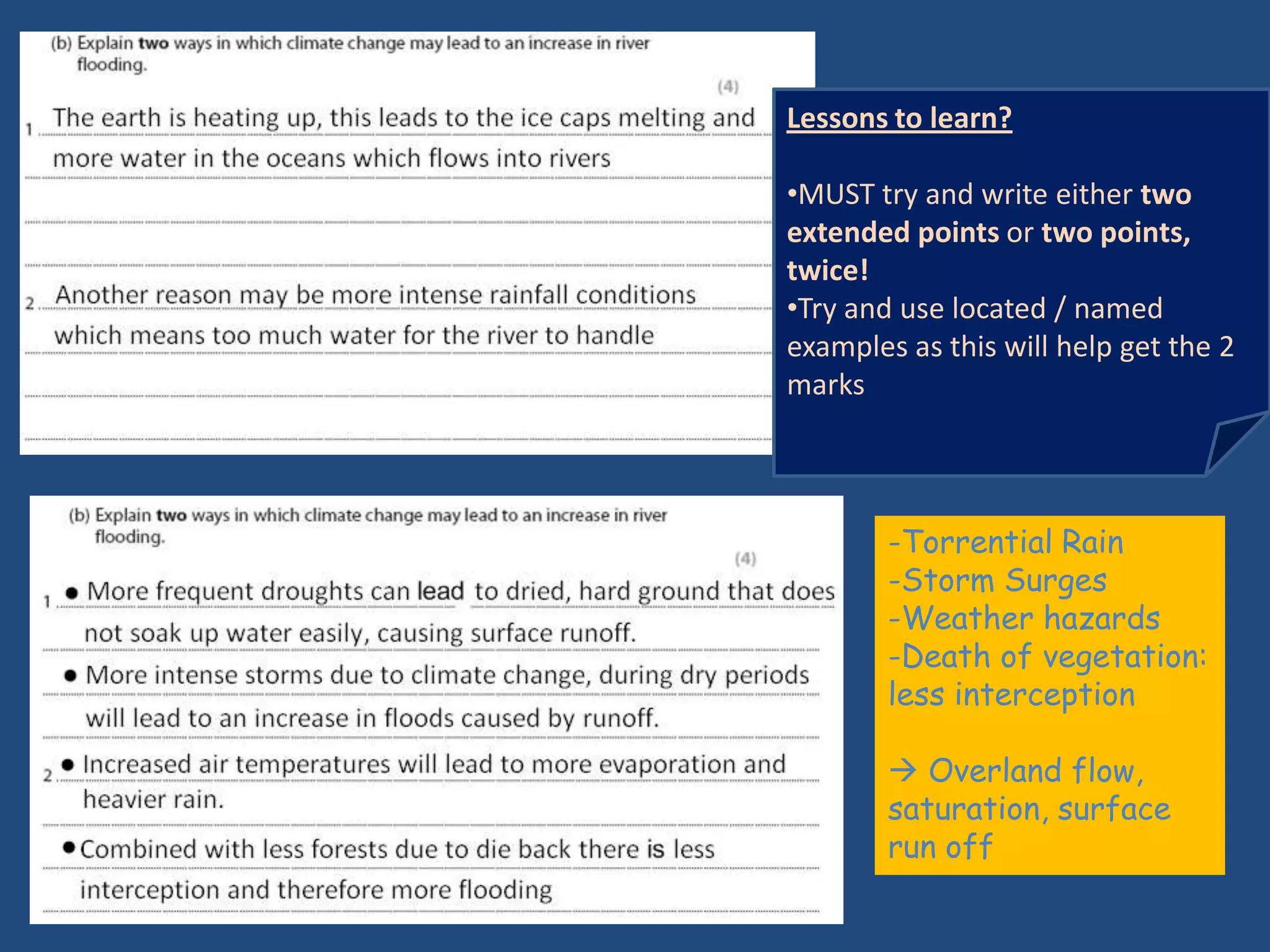
•MUST try and write either two
extended points or two points,
twice!
•Try and use located / named
examples as this will help get the 2
marks


        -Torrential Rain
        -Storm Surges
        -Weather hazards
        -Death of vegetation:
        less interception

         Overland flow,
        saturation, surface
        run off
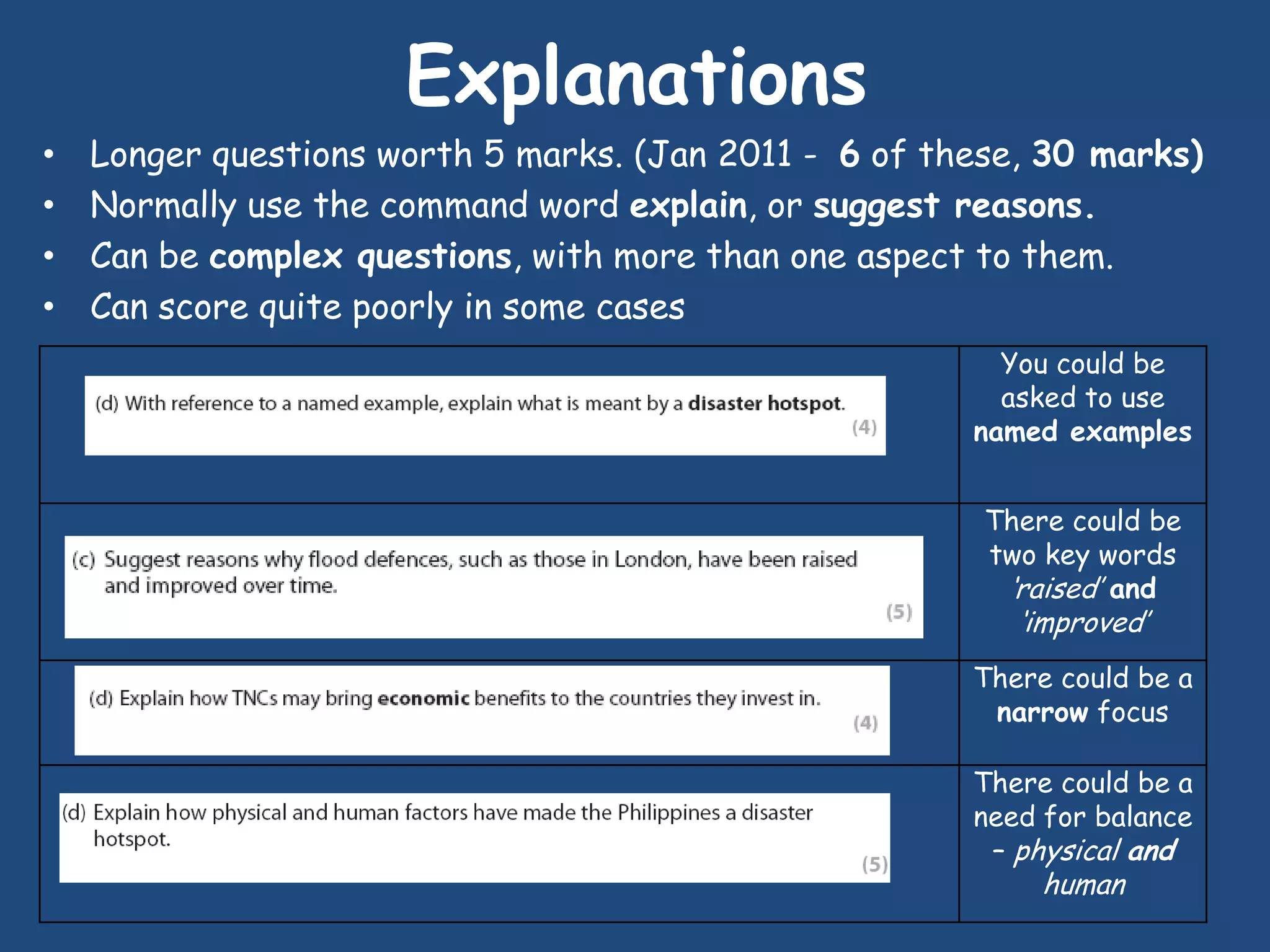
Explanations
•   Longer questions worth 5 marks. (Jan 2011 - 6 of these, 30 marks)
•   Normally use the command word explain, or suggest reasons.
•   Can be complex questions, with more than one aspect to them.
•   Can score quite poorly in some cases
                                                         You could be
                                                         asked to use
                                                       named examples


                                                        There could be
                                                        two key words
                                                         „raised‟ and
                                                          „improved‟
                                                       There could be a
                                                        narrow focus

                                                       There could be a
                                                       need for balance
                                                        – physical and
                                                            human
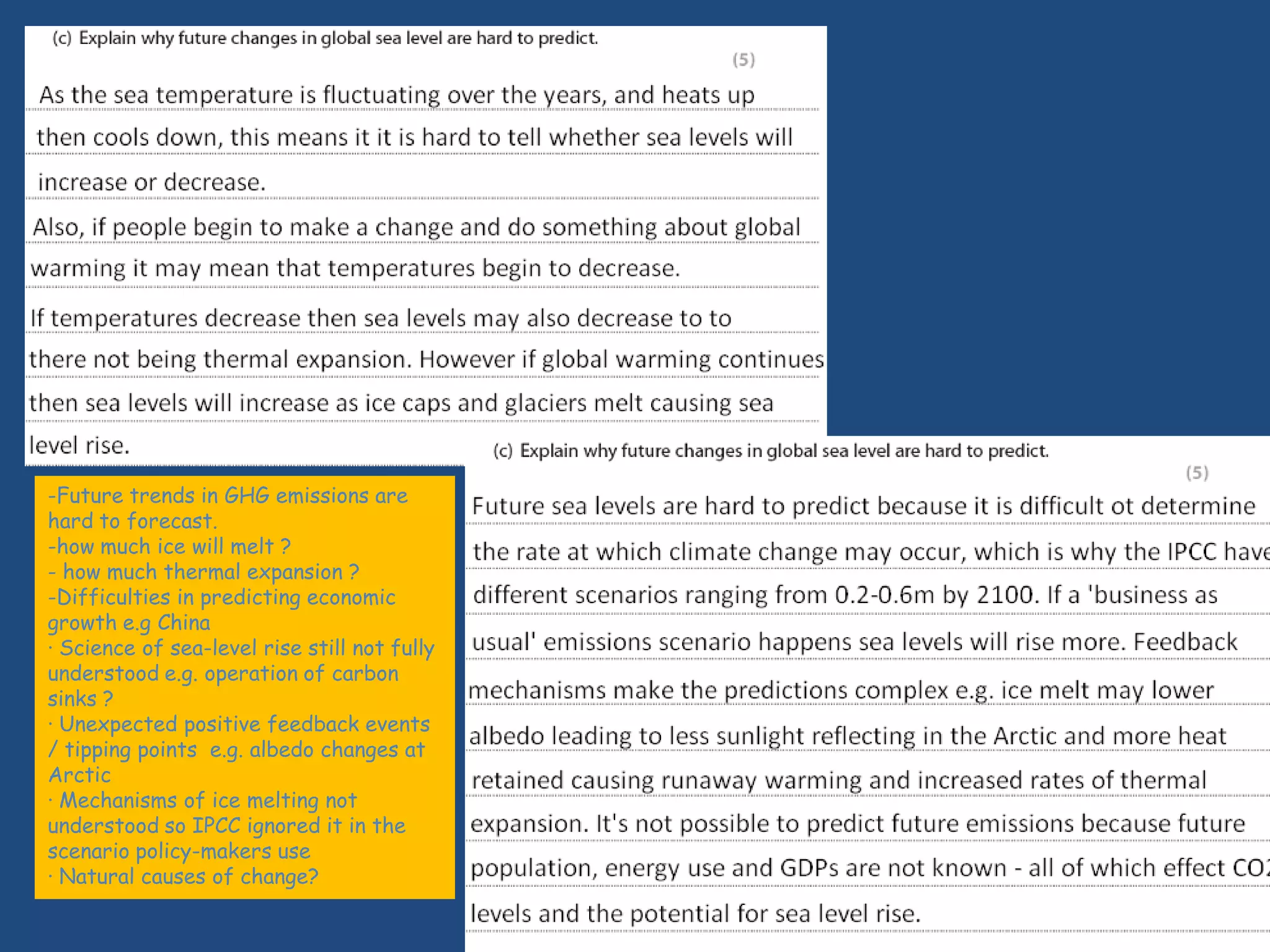
-Future trends in GHG emissions are
hard to forecast.
-how much ice will melt ?
- how much thermal expansion ?
-Difficulties in predicting economic
growth e.g China
· Science of sea-level rise still not fully
understood e.g. operation of carbon
sinks ?
· Unexpected positive feedback events
/ tipping points e.g. albedo changes at
Arctic
· Mechanisms of ice melting not
understood so IPCC ignored it in the
scenario policy-makers use
· Natural causes of change?
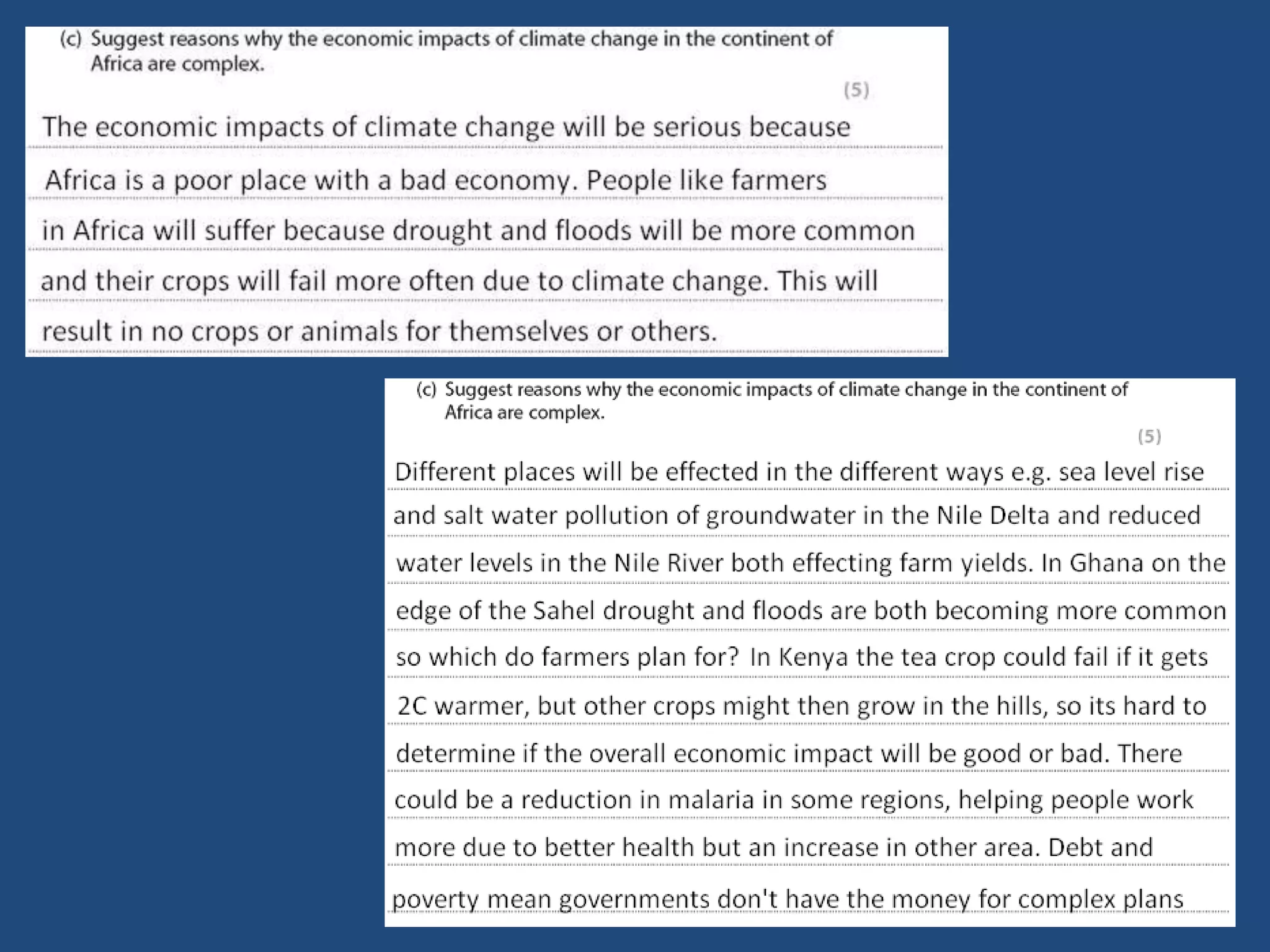
Suggest reasons why the economic impacts of climate
      change in the continent of Africa are complex (5)
•   Nile delta: 1% rise in sea level could affect 15% of habitable land ( 7 million people) .
    Salt water affects crops.
•   How to tackle dept: No money for mitigation of climate impacts and adaptive
    strategies?
•   War in Darfur in Sudan (pastoralists fighting arable farmers). Political inertia.
•   Animals may die so some farmers e.g. in semi-arid Sahel belt may have to abandon
    their way of life altogether
•   Locust plagues could threaten growth of crops: No money!
•   Crops may need to change / adopt more drought tolerant varieties which costs
    farmers money. Could face changing patterns of rainfall (E Africa wetter, W drier).
•   Farmers face problems over subsistent farming / cash crops e.g. Kenya and roses.
•   Positive benefits can be linked with increased rainfall
•   Could see loss of tourism revenues if habitats are lost e.g. Coral bleaching in
    Zanzibar
•   Movement of environmental migrants to coastal African areas puts added strain on
    local economies for jobs/food etc and areas often become overcrowded especially N
    and W e.g. Accra, Ghana; Lagos, Nigeria
Lessons to learn?
•These questions are crucial if you want a high grade.

•They are NOT essay questions

•Bullets normally don’t work – the questions are too complex

•You should use examples (places, countries, organisation, companies,
cities) as a matter of course – don‟t wait to be asked

•Watch out for difficult key words (ecological, post-colonial,
vulnerability)

•Don‟t miss important words that don‟t look important (complex,
recent years) these are often the difference between 4/5 and 5/5
marks.

•Be prepared to explain: “because” “this is why” “this causes” “the
reason is that” i.e. the language of explanation.
Is the IPCC right?
• You should be aware of some
  of the controversy
  surrounding global warming
• Recognise that some people
  do not accept it is happening
• or do not believe anything
  should be done about it.
• E.g. Big business is often
  accused of „greenwashing‟
  because drastic cuts in
  emissions do not fit their
  business model.
• On the other hand there are
  savings to be made by
  reducing energy consumption
  and waste production.
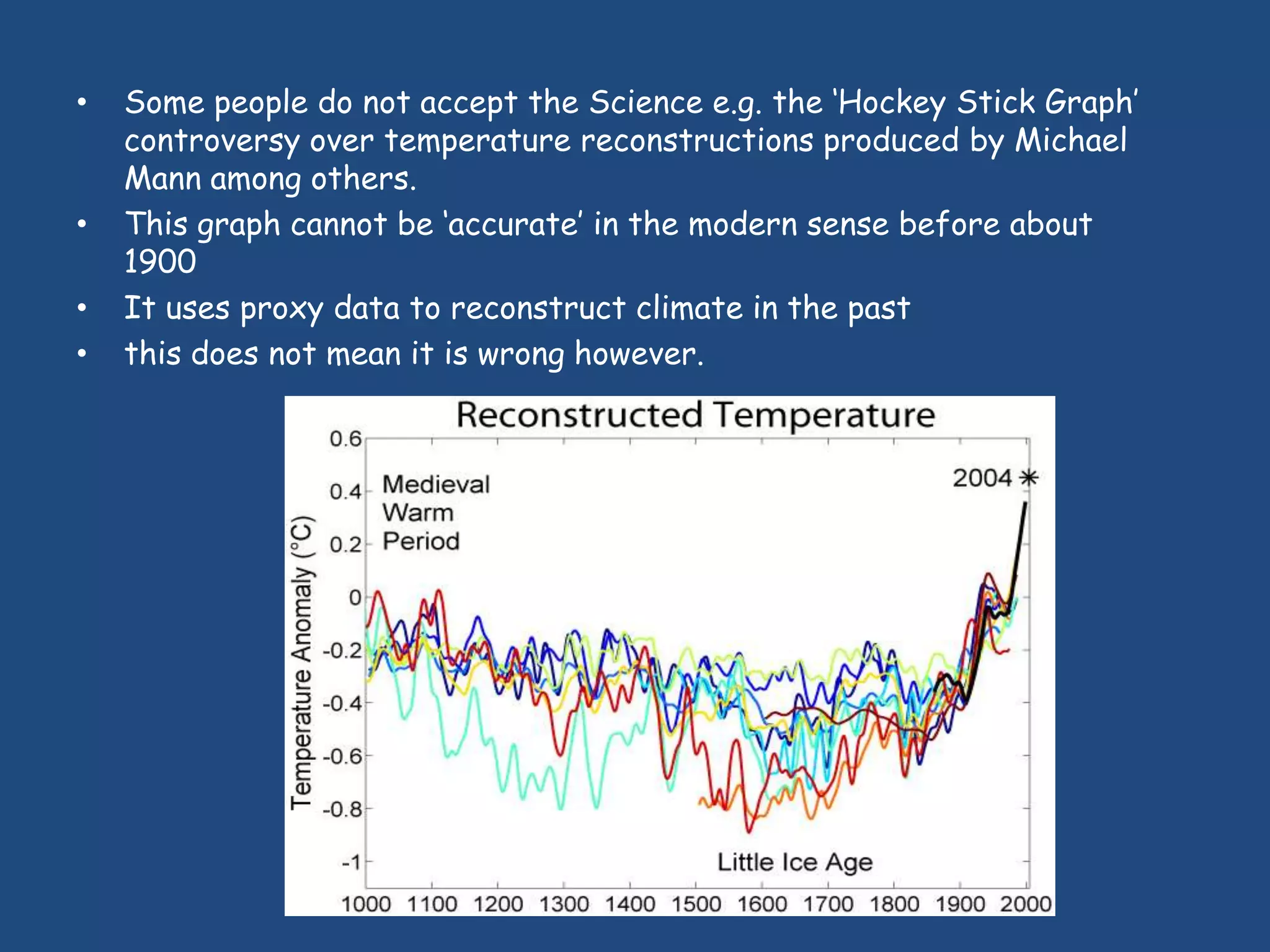
•   Some people do not accept the Science e.g. the „Hockey Stick Graph‟
    controversy over temperature reconstructions produced by Michael
    Mann among others.
•   This graph cannot be „accurate‟ in the modern sense before about
    1900
•   It uses proxy data to reconstruct climate in the past
•   this does not mean it is wrong however.
The IPCC has been criticised !
•   By the time its reports are published, the data is out of date because
    the process of writing the reports is now so complex (2500 scientists)
•   Political interference „softens‟ some of the conclusions – most notably in
    2007 that sea levels will rise 19-59cm by 2100, whereas many scientists
    think a figure of 100cm is more likely.
•   The huge nature of the reports (2007 report was in 4 volumes) making
    the message difficult to digest.
•   IPCC Himalayan glaciers error - the IPCC report in 2007 quoted a
    WWF report which used the year 2035 rather then the correct date of
    2050.                                • “Glaciers in the Himalaya are receding
                                             faster than in any other part of the world
                                             (see Table 10.9) and, if the present rate
                                             continues, the likelihood of them
                                             disappearing by the year 2035 and
                                             perhaps sooner is very high if the Earth
                                             keeps warming at the current rate. Its
                                             total area will likely shrink from the
                                             present 500,000 to 100,000 km2 by the
                                             year 2035”
Last minute cramming!
• World at risk       • Going Global
• Thursday 1 and 2:   • Thursday 3 and 4:
  U23                   Sixth form
Unit 1 Exam Global Challenges:
         Revision session 2!

To see what you need to revise before
             Thursday!

 To know how to be above average in
       Section A: January 2011

     To understand that there is
controversy surrounding global warming

Revision Powerpoint focussing on World At Risk

  • 1.
    Unit 1 ExamGlobal Challenges: Revision session 2! To see what you need to revise before Thursday! To know how to be above average in Section A: January 2011 To understand that there is controversy surrounding global warming
  • 2.
    Starter •Smileor not.... •What do you know? • You still have time to learn it!
  • 3.
    Typical Section A Question
  • 4.
    Stating key factualinformation • Questions worth 1 or 2 marks, test basic knowledge. • Sometimes these are data stimulus questions: • Seem like simple questions, easy to rush and get wrong: • Guessing, because didn‟t look at Figure 4. • Finding the largest number on Figure 4 outside the UK (Thailand, 476), but not the „European Country‟
  • 5.
    : • This question marked low, despite seeming to be pretty straightforward •The hazards listed in the specification, are: Earthquakes Volcanoes Landslides Flood Drought Storms (hurricanes, depressions, cyclones etc)
  • 6.
    Lessons to learn? •No substitute for basic revision • Some questions designed to be „easy‟ • Rushing them a mistake • Know the specification e.g. „hydro- meteorological‟ is not everyday language, but it is in the specification and will therefore be used in the exam paper.
  • 7.
    Listing reasons • Thesequestions often have a mark tariff of 3. • Best approach is to aim to write three different reasons • Numbered / bullet points OK Many candidates: • Give 1 or 2 reasons, but not three • Give 3, but actually repeat themselves • Give too much background / generality • Describe rather than give reasons especially if the Q relates to a Figure. These are focussed questions: reason 1, reason 2, reason 3.
  • 8.
    Both are sayingthe same point!
  • 9.
    How might globalwarming increase disaster risk? (3) • Warmer ocean = more energy/higher wind speed • Temperature of 26-27C needed • More evaporation = heavier rain • Changes to tracks and could affect more populated areas • Hurricanes may increase in magnitude (saffir simpson scale) and frequency • Could lead to more storm surges leading to more at risk. • May affect ENSO
  • 10.
    Same point! Poverty Lessons to learn? •Write to the mark allocation •Careful not to repeat the same point / reason •If it helps, use bullets / numbered points for these 3 mark questions (avoid bullets with only 1 or 2 words)
  • 11.
    Structured short questions(2+2) • „structured answer space’. • 4 marks, answer split into 2 parts. • Awarded on a 2+2 basis. They cause problems: • Candidates write too briefly, get 1+1 but not 2+2 • Write the same thing twice • Leave one „half‟ blank e.g. advantages, but not disadvantages or costs but not benefits. The trick to getting 2 + 2 is to write two extended points.
  • 13.
    Describe the strengthand weaknesses of adaptation as a way of managing climate change (4) • Strengths • Weaknesses • Lives / property saved e.g. New • Does not tackle underlying cause of Zealand accepting 75 Tuvaluans climate change, do nothing to reduce a year as environmental GHG being released. refugees • Limited scale of many local • Only option for poor societies strategies, meaning little protection e.g. Tuvalu has a GDP of $12 in a high-emissions scenario million. • Human lives may be saved but other • Necessary as some changes are losses still occur e.g. biodiversity now inevitable. China and India • Low lying countries e.g. Bangladesh do want economic growth, not have the money to build defences mitigation may no be achieved in • Not all countries can adapt due to time conflict, disease, food shortages, • Will take a long time for all poverty, unequal access to resources, countries to agree to reduce water stress emissions, let alone cease them
  • 14.
    Lessons to learn? •MUSTtry and write either two extended points or two points, twice! •Try and use located / named examples as this will help get the 2 marks -Torrential Rain -Storm Surges -Weather hazards -Death of vegetation: less interception  Overland flow, saturation, surface run off
  • 15.
    Explanations • Longer questions worth 5 marks. (Jan 2011 - 6 of these, 30 marks) • Normally use the command word explain, or suggest reasons. • Can be complex questions, with more than one aspect to them. • Can score quite poorly in some cases You could be asked to use named examples There could be two key words „raised‟ and „improved‟ There could be a narrow focus There could be a need for balance – physical and human
  • 16.
    -Future trends inGHG emissions are hard to forecast. -how much ice will melt ? - how much thermal expansion ? -Difficulties in predicting economic growth e.g China · Science of sea-level rise still not fully understood e.g. operation of carbon sinks ? · Unexpected positive feedback events / tipping points e.g. albedo changes at Arctic · Mechanisms of ice melting not understood so IPCC ignored it in the scenario policy-makers use · Natural causes of change?
  • 18.
    Suggest reasons whythe economic impacts of climate change in the continent of Africa are complex (5) • Nile delta: 1% rise in sea level could affect 15% of habitable land ( 7 million people) . Salt water affects crops. • How to tackle dept: No money for mitigation of climate impacts and adaptive strategies? • War in Darfur in Sudan (pastoralists fighting arable farmers). Political inertia. • Animals may die so some farmers e.g. in semi-arid Sahel belt may have to abandon their way of life altogether • Locust plagues could threaten growth of crops: No money! • Crops may need to change / adopt more drought tolerant varieties which costs farmers money. Could face changing patterns of rainfall (E Africa wetter, W drier). • Farmers face problems over subsistent farming / cash crops e.g. Kenya and roses. • Positive benefits can be linked with increased rainfall • Could see loss of tourism revenues if habitats are lost e.g. Coral bleaching in Zanzibar • Movement of environmental migrants to coastal African areas puts added strain on local economies for jobs/food etc and areas often become overcrowded especially N and W e.g. Accra, Ghana; Lagos, Nigeria
  • 19.
    Lessons to learn? •Thesequestions are crucial if you want a high grade. •They are NOT essay questions •Bullets normally don’t work – the questions are too complex •You should use examples (places, countries, organisation, companies, cities) as a matter of course – don‟t wait to be asked •Watch out for difficult key words (ecological, post-colonial, vulnerability) •Don‟t miss important words that don‟t look important (complex, recent years) these are often the difference between 4/5 and 5/5 marks. •Be prepared to explain: “because” “this is why” “this causes” “the reason is that” i.e. the language of explanation.
  • 20.
    Is the IPCCright? • You should be aware of some of the controversy surrounding global warming • Recognise that some people do not accept it is happening • or do not believe anything should be done about it. • E.g. Big business is often accused of „greenwashing‟ because drastic cuts in emissions do not fit their business model. • On the other hand there are savings to be made by reducing energy consumption and waste production.
  • 21.
    Some people do not accept the Science e.g. the „Hockey Stick Graph‟ controversy over temperature reconstructions produced by Michael Mann among others. • This graph cannot be „accurate‟ in the modern sense before about 1900 • It uses proxy data to reconstruct climate in the past • this does not mean it is wrong however.
  • 22.
    The IPCC hasbeen criticised ! • By the time its reports are published, the data is out of date because the process of writing the reports is now so complex (2500 scientists) • Political interference „softens‟ some of the conclusions – most notably in 2007 that sea levels will rise 19-59cm by 2100, whereas many scientists think a figure of 100cm is more likely. • The huge nature of the reports (2007 report was in 4 volumes) making the message difficult to digest. • IPCC Himalayan glaciers error - the IPCC report in 2007 quoted a WWF report which used the year 2035 rather then the correct date of 2050. • “Glaciers in the Himalaya are receding faster than in any other part of the world (see Table 10.9) and, if the present rate continues, the likelihood of them disappearing by the year 2035 and perhaps sooner is very high if the Earth keeps warming at the current rate. Its total area will likely shrink from the present 500,000 to 100,000 km2 by the year 2035”
  • 23.
    Last minute cramming! •World at risk • Going Global • Thursday 1 and 2: • Thursday 3 and 4: U23 Sixth form
  • 24.
    Unit 1 ExamGlobal Challenges: Revision session 2! To see what you need to revise before Thursday! To know how to be above average in Section A: January 2011 To understand that there is controversy surrounding global warming