INTRODUCTION TO PAEDIATRICS
AND CHILD HEALTH
Walesa Ikowa
Contents
• Course content and objectives
• Continuous assessment
• Definitions
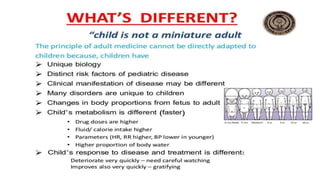
• Difference between paediatric population and adults
• Recommended literature
Course content
• Has 4 parts
• Part A : Introduction to General Paediatrics
• Part B : Introduction to Neonatology
• Part C : Child health services and diseases by systems
• Part D : Clinical skills
Objectives
•Take a detailed paediatric patient history
•Perform physical examination on a paediatric
patient
•Order and interpret investigations appropriately
•State causes of common paediatric conditions
Objectives
• Identify abnormalities of growth and development in
children
• Manage patients with paediatric conditions correctly
• List activities/components of child health services
• Demonstrate ability to manage child health services
• Give health education and promotion
Continuous assessment
• 3 end of term examinations
• 3 quizzes
• 1 final theory examination
• 1 final osce examination
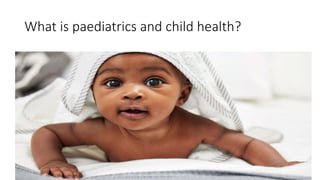
What is paediatrics and child health?
Paediatrics
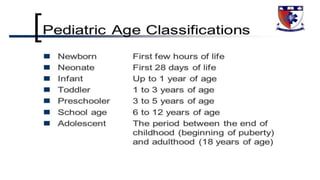
• Pediatrics is the branch of medicine dealing with the health and
medical care of infants, children, and adolescents from birth up to the
age of 18.
• The word “paediatrics” means “healer of children”
• They are derived from two Greek words: (pais = child) and (iatros =
doctor or healer)
• Age cut off is 16 years in Zambia
• Other countries go up to 18 and 21 years old.
Child health
• It includes all aspects of physical, psychological,
cognitive, and social functioning as they express
themselves in children's daily activities and behavior.
Overview of paediatrics – Areas of Importance
• Diagnosing and treating disease
• Growth and development
• Nutrition
• Immunization
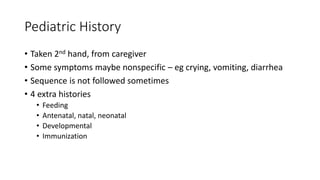
Pediatric History
• Taken 2nd hand, from caregiver
• Some symptoms maybe nonspecific – eg crying, vomiting, diarrhea
• Sequence is not followed sometimes
• 4 extra histories
• Feeding
• Antenatal, natal, neonatal
• Developmental
• Immunization
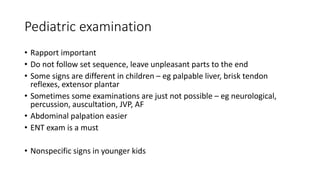
Pediatric examination
• Rapport important
• Do not follow set sequence, leave unpleasant parts to the end
• Some signs are different in children – eg palpable liver, brisk tendon
reflexes, extensor plantar
• Sometimes some examinations are just not possible – eg neurological,
percussion, auscultation, JVP, AF
• Abdominal palpation easier
• ENT exam is a must
• Nonspecific signs in younger kids
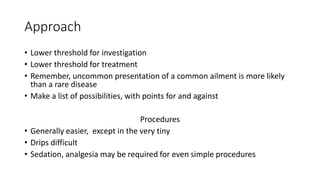
Approach
• Lower threshold for investigation
• Lower threshold for treatment
• Remember, uncommon presentation of a common ailment is more likely
than a rare disease
• Make a list of possibilities, with points for and against
Procedures
• Generally easier, except in the very tiny
• Drips difficult
• Sedation, analgesia may be required for even simple procedures
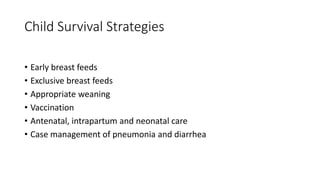
Child Survival Strategies
• Early breast feeds
• Exclusive breast feeds
• Appropriate weaning
• Vaccination
• Antenatal, intrapartum and neonatal care
• Case management of pneumonia and diarrhea
Reading Recommendations
• Behrman RE, Kliegman RM, Jenson HB (2013) Nelson’s Textbook of
Pediatrics 18th ed. Philadelphia: Sanders Publishers.
• Marcdante K, et al. (2011) Nelson Essentials of Pediatrics 6th ed.
Philadelphia: Saunders Elsevier.
• Prajapati B (2003) Essential Procedures in Pediatrics. New Delhi:
Jaypee Brothers.
• ZNPHI guidelines
• UTH Paediatrics protocols
Questions

1. Introduction to Paediatrics.pptx

  • 1.
    INTRODUCTION TO PAEDIATRICS ANDCHILD HEALTH Walesa Ikowa
  • 2.
    Contents • Course contentand objectives • Continuous assessment • Definitions • Difference between paediatric population and adults • Recommended literature
  • 3.
    Course content • Has4 parts • Part A : Introduction to General Paediatrics • Part B : Introduction to Neonatology • Part C : Child health services and diseases by systems • Part D : Clinical skills
  • 4.
    Objectives •Take a detailedpaediatric patient history •Perform physical examination on a paediatric patient •Order and interpret investigations appropriately •State causes of common paediatric conditions
  • 5.
    Objectives • Identify abnormalitiesof growth and development in children • Manage patients with paediatric conditions correctly • List activities/components of child health services • Demonstrate ability to manage child health services • Give health education and promotion
  • 6.
    Continuous assessment • 3end of term examinations • 3 quizzes • 1 final theory examination • 1 final osce examination
  • 7.
    What is paediatricsand child health?
  • 8.
    Paediatrics • Pediatrics isthe branch of medicine dealing with the health and medical care of infants, children, and adolescents from birth up to the age of 18. • The word “paediatrics” means “healer of children” • They are derived from two Greek words: (pais = child) and (iatros = doctor or healer) • Age cut off is 16 years in Zambia • Other countries go up to 18 and 21 years old.
  • 9.
    Child health • Itincludes all aspects of physical, psychological, cognitive, and social functioning as they express themselves in children's daily activities and behavior.
  • 11.
    Overview of paediatrics– Areas of Importance • Diagnosing and treating disease • Growth and development • Nutrition • Immunization
  • 13.
    Pediatric History • Taken2nd hand, from caregiver • Some symptoms maybe nonspecific – eg crying, vomiting, diarrhea • Sequence is not followed sometimes • 4 extra histories • Feeding • Antenatal, natal, neonatal • Developmental • Immunization
  • 14.
    Pediatric examination • Rapportimportant • Do not follow set sequence, leave unpleasant parts to the end • Some signs are different in children – eg palpable liver, brisk tendon reflexes, extensor plantar • Sometimes some examinations are just not possible – eg neurological, percussion, auscultation, JVP, AF • Abdominal palpation easier • ENT exam is a must • Nonspecific signs in younger kids
  • 15.
    Approach • Lower thresholdfor investigation • Lower threshold for treatment • Remember, uncommon presentation of a common ailment is more likely than a rare disease • Make a list of possibilities, with points for and against Procedures • Generally easier, except in the very tiny • Drips difficult • Sedation, analgesia may be required for even simple procedures
  • 16.
    Child Survival Strategies •Early breast feeds • Exclusive breast feeds • Appropriate weaning • Vaccination • Antenatal, intrapartum and neonatal care • Case management of pneumonia and diarrhea
  • 17.
    Reading Recommendations • BehrmanRE, Kliegman RM, Jenson HB (2013) Nelson’s Textbook of Pediatrics 18th ed. Philadelphia: Sanders Publishers. • Marcdante K, et al. (2011) Nelson Essentials of Pediatrics 6th ed. Philadelphia: Saunders Elsevier. • Prajapati B (2003) Essential Procedures in Pediatrics. New Delhi: Jaypee Brothers. • ZNPHI guidelines • UTH Paediatrics protocols
  • 18.