MTI, Khyber Teaching Hospital, Peshawar
Introduction and Overview
Infection Control Training Course
By
Rehmat Ullah
Nursing Director, MTI KTH, Peshawar
MTI, Khyber Teaching Hospital, Peshawar
Overview/Introduction MTI KTH, Peshawar
A. History of Hospital
 A state-of-the-art tertiary care teaching Hospital located in
Peshawar, Pakistan
 formerly Hayat Shaheed Teaching Hospital, was
established in 1976 as a training and biomedical research
facility
 The present capacity of beds is 1300
 Khyber Medical College, the first medical school of the
province, came into existence in February, 1954
 Khyber College of Dentistry as department of Dentistry was
created in 1964
 School of Nursing Khyber Teaching Hospital also works as
an allied institution with KTH for training of student nurses
since inception of the institution
MTI, Khyber Teaching Hospital, Peshawar
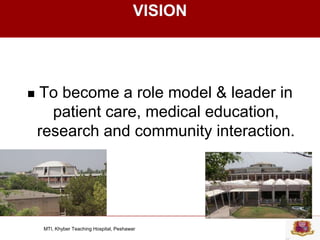
VISION
 To become a role model & leader in
patient care, medical education,
research and community interaction.
MTI, Khyber Teaching Hospital, Peshawar
Infection control Training
Infection control is important for safety of both
patients and the workers because infections
can:
 Increase the Lengthen the stay for the patients
 Increase the hospital cost/patient cost
 Can cause more pain and suffering to the
patients and may even lead to death
 Expose the workers to many germs that may
cause illness to them and their family if they get
infections from the hospital.
MTI, Khyber Teaching Hospital, Peshawar
Goals & Objectives of the Program
 Assure that licensed, registered, or certified health
professionals understand how bloodborne
pathogens may be transmitted in the work
environment: patient to healthcare worker,
healthcare worker to patient, and patient to patient
 Apply current scientifically accepted infection
prevention and control principles as appropriate for
the specific work environment.
 Minimize opportunity for transmission of pathogens
to patients and healthcare workers.
MTI, Khyber Teaching Hospital, Peshawar
Course Structure
 is based on training contents created by Joint
Commission International (JCI) presents in-depth
knowledge through three comprehensive
modules
1. Module 1: Basic Science and Principles
2. Module 2: Applications in Care Settings
3. Module 3: Special Infection Prevention Issues,
Leadership, and Patient Safety
MTI, Khyber Teaching Hospital, Peshawar
Introduction to Course
 Duration Of Course
 There will be a minimum of 2.5 months.
 Stand Alone Modules
 Each module is offered as a Competence Certificate
Short Course.
 Evaluation
 The outcome will be evaluated by successfully
completing a written exam, practical work and clinical
projects.
MTI, Khyber Teaching Hospital, Peshawar
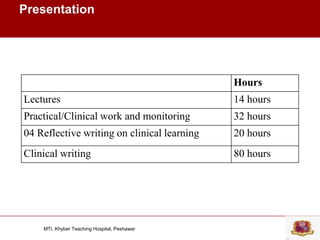
Presentation
Hours
Lectures 14 hours
Practical/Clinical work and monitoring 32 hours
04 Reflective writing on clinical learning 20 hours
Clinical writing 80 hours
MTI, Khyber Teaching Hospital, Peshawar
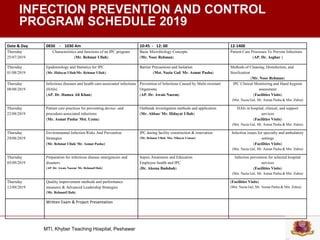
INFECTION PREVENTION AND CONTROL
PROGRAM SCHEDULE 2019
Date & Day 0830 - 1030 Am 10:45 - 12: 00 12-1400
Thursday
25/07/2019
Characteristics and functions of an IPC program
(Mr. Rehmat Ullah)
Basic Microbiology Concepts
(Mr. Noor Rehman)
Patient Care Processes To Prevent Infections
(AP. Dr. Asghar )
Thursday
01/08/2019
Epidemiology and Statistics for IPC
(Mr. Hidayat Ullah/Mr. Rehmat Ullah)
Barrier Precautions and Isolation
(Mst. Nazia Gul/ Mr. Asmat Pasha)
Methods of Cleaning, Disinfection, and
Sterilization
(Mr. Noor Rehman)
Thursday
08/08/2019
Infectious diseases and health care-associated infections
(HAIs)
(AP. Dr. Hamza Ali Khan)
Prevention of Infections Caused by Multi-resistant
Organisms
(AP. Dr. Awais Naeem)
IPC Clinical Monitoring and Hand hygiene
assessment
(Facilities Visits)
(Mst. Nazia Gul, Mr. Asmat Pasha & Mst. Zuhra)
Thursday
22/08/2019
Patient care practices for preventing device- and
procedure-associated infections
(Mr. Asmat Pasha/ Mst. Uzma)
Outbreak investigation methods and application
(Mr. Abbas/ Mr. Hidayat Ullah)
HAIs in hospital, clinical, and support
services
(Facilities Visits)
(Mst. Nazia Gul, Mr. Asmat Pasha & Mst. Zuhra)
Thursday
29/08/2019
Environmental Infection Risks And Prevention
Strategies
(Mr. Rehmat Ullah/ Mr. Asmat Pasha)
IPC during facility construction & renovation
(Mr. Rehmat Ullah/ Mst. Nihayat Usman)
Infection issues for specialty and ambulatory
settings
(Facilities Visits)
(Mst. Nazia Gul, Mr. Asmat Pasha & Mst. Zuhra)
Thursday
05/09/2019
Preparation for infectious disease emergencies and
disasters
(AP. Dr. Awais Naeem/ Mr. RehmatUllah)
Sepsis Awareness and Education
Employee health and IPC
(Dr. Aleena Badshah)
Infection prevention for selected hospital
services
(Facilities Visits)
(Mst. Nazia Gul, Mr. Asmat Pasha & Mst. Zuhra)
Thursday
12/09/2019
Quality improvement methods and performance
measures & Advanced Leadership Strategies
(Mr. RehmatUllah)
(Facilities Visits)
(Mst. Nazia Gul, Mr. Asmat Pasha & Mst. Zuhra)
Written Exam & Project Presentation
MTI, Khyber Teaching Hospital, Peshawar
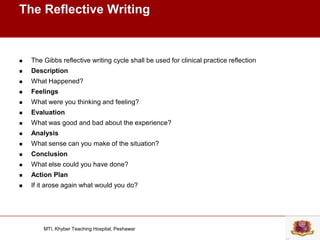
The Reflective Writing
 The Gibbs reflective writing cycle shall be used for clinical practice reflection
 Description
 What Happened?
 Feelings
 What were you thinking and feeling?
 Evaluation
 What was good and bad about the experience?
 Analysis
 What sense can you make of the situation?
 Conclusion
 What else could you have done?
 Action Plan
 If it arose again what would you do?
MTI, Khyber Teaching Hospital, Peshawar
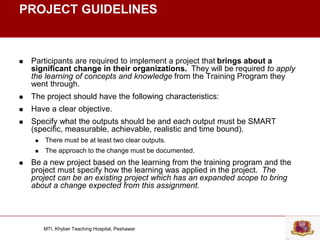
PROJECT GUIDELINES
 Participants are required to implement a project that brings about a
significant change in their organizations. They will be required to apply
the learning of concepts and knowledge from the Training Program they
went through.
 The project should have the following characteristics:
 Have a clear objective.
 Specify what the outputs should be and each output must be SMART
(specific, measurable, achievable, realistic and time bound).
 There must be at least two clear outputs.
 The approach to the change must be documented.
 Be a new project based on the learning from the training program and the
project must specify how the learning was applied in the project. The
project can be an existing project which has an expanded scope to bring
about a change expected from this assignment.
MTI, Khyber Teaching Hospital, Peshawar
Infection Control and Prevention Program in
MTI KTH, Peshawar
MTI, Khyber Teaching Hospital, Peshawar
HOSPITAL INFECTION CONTROL
PROGRAM
 Infection Control is a core part of a healthcare
organisation’s (MTI-KTH) clinical governance and
patient safety programmes.
 SCOPE
 The scope of this program extends to all areas of the
MTI-KTH, Peshawar.
MTI, Khyber Teaching Hospital, Peshawar
 SCOPE
 The scope of this program extends to all areas of the MTI-
KTH, Peshawar.
 GOAL:
1. To prevent or minimize the potential for infections to
patients and family as well as to staff
2. To provide safety for patient, family and employee,
Surveillance of infection rates, outbreaks and
implementation of control measures
3. To Identify and rectification of flaws in infection control
practices
4. To ensure compliance with best practices and regulations in
infection control.
HOSPITAL INFECTION CONTROL
PROGRAM
MTI, Khyber Teaching Hospital, Peshawar
 To develop written policies, procedures and standards for cleanliness, sanitation and
asepsis in the hospital.
 To interpret, uphold and implement the hospital infection control policies and procedures
in specific situations.
 To provide surveillance for different types of infections.
 To review and analyze infections, those occur, in order to take corrective steps.
 To develop preventive measures designed to control, prevent or minimize the risk of
nosocomial infections.
 To develop a mechanism to supervise infection control measures in all phases of
hospital activities.
 Review and update hospital infection control policies and procedures from time to time.
 Advice the Medical Director on matters related to the proper use of antibiotics, develop
antibiotic policies and recommend remedial measures when antibiotic resistant strains
are detected.
 Help to provide employee health education regarding matters related to HCAIs.
SPECIFIC OBJECTIVES OF
INFECTION CONTROL PROGRAM
MTI, Khyber Teaching Hospital, Peshawar
OVERSIGHT AND RESPONSIBILITY
FOR INFECTION CONTROL
 The Medical Director (MD) is ultimately
responsible for the infection control program.
 The MD as chairman of clinical executive board
(CEB) delegates this function to chairman ICC and
Infection Control Committee.
MTI, Khyber Teaching Hospital, Peshawar
Infection Control Committee (ICC)
 an integral component of the patient safety programme of
the health care facility,
 is responsible for establishing and maintaining
infection prevention and control, its monitoring,
surveillance, reporting, research and education.
 This committee has been granted the authority to
implement any measures necessary to prevent and control
the spread of infection and to conduct any studies in this
connection.
 All departments will facilitate in the effective functioning of
this committee.
 The committee will report to the Clinical Executive Board,
quarterly.
MTI, Khyber Teaching Hospital, Peshawar
Structure of the committee
 Chairperson: Head of the Infection Disease
 Member: Senior Microbiologist/Pathologist
 Member: Head Anesthesia and OT/ Manager OT
 Member /Secretary. Infection Control Nurse
 Members: Representation from Management/
Administration (Deans, Medical Director Hospital
Director, Nursing Director)
 Relevant Medical Faculties
 Support Services: (OT/CSSD, Housekeeping/
Sanitation, Engineering, Pharmacologist, Store Officer
/ Materials Department)
MTI, Khyber Teaching Hospital, Peshawar
Infection Control Committee (ICC)
 MEETING SCHEDULE
 Once every quarters, or more as required by the
chairman ICC.
 REPORTING AND COORDINATION
 The ICC will submit meeting minutes to ICC members,
MD, HD & ND.
 The committee shall report and submit quarterly
Infection Control Report to the Medical Director as
Chairman CEB.
MTI, Khyber Teaching Hospital, Peshawar
Responsibilities of the Infection
Control Team
 Develop a manual of policies and procedures for
aseptic, isolation and antiseptic techniques
 Carry out targeted surveillance of HCAIs, data
analysis for presentation in ICC meeting and take
corrective steps
 Advise staff on all aspects of infection control and
maintain a safe environment for patients and staff
 Supervise and monitor cleanliness and hygienic
practices
 Oversee sterilization and disinfection and monitor the
use and quality control of disinfectants
MTI, Khyber Teaching Hospital, Peshawar
Responsibilities of the Infection
Control Team
 Advise management of at risk patients and supervision of
isolation procedures
 Investigate outbreaks of infection and take corrective measures
for control and prevention of outbreak
 Waste management
 Provide relevant information on infection problems to
management.
 Assist in training of all new employees as to the importance of
infection control and the relevant policies and procedures
 Organize regular training programme for the staff to ensure
implementation of infection control practices
 Audit infection control procedures and antimicrobial usage –
Monitors Health care workers safety Programme
MTI, Khyber Teaching Hospital, Peshawar
Infection Control Nurse
 Responsibility is delegated to the infection control
Nurse (ICN) to carry out daily functions of the
infection control program.
 These functions include data management, policy
and procedure development, education, employee
health coordination, quality improvement,
consulting and investigating potential out breaks.
 The ICN is administratively part of the nursing
department/ division and reports to the infection
control committee for professional oversight and
direction.
MTI, Khyber Teaching Hospital, Peshawar
NURSING PROCEDURE FOR INFECTION
CONTROL SERVICES
MTI, Khyber Teaching Hospital, Peshawar
1. EDUCATION OF HEALTHCARE WORKERS
2. VACCINATION
3. ENVIRONMENTAL TESTING
4. SURVEILLANCE ON HOSPITAL ACQUIRED
INFECTIONS
5. ISOLATION OF INFECTIOUS PATIENTS
6. HAND HYGIENE AUDIT
7. NEEDLE STICK INJURIES
8. COMMUNICATION
9. OTHER ACTIVITIES
MTI, Khyber Teaching Hospital, Peshawar
EDUCATION OF HEALTHCARE
WORKERS
 This refers to the process of education of all health
care workers (doctors, nurses, allied)
 New joiner’s orientation session
 Infection control workshop for nurses
 sessions as a part of other programme of nurses
 Need base session with other health care worker (CSSD, OR
& Endoscopy etc.)
 Dissemination of IC&P updates
 Unit based in- service sessions
 prevention and control strategies and trends sharing
 Educational records of session
MTI, Khyber Teaching Hospital, Peshawar
VACCINATION
 vaccination against Hepatitis B
 Typhoid vaccination
 Flu vaccinations
MTI, Khyber Teaching Hospital, Peshawar
ENVIRONMENTAL TESTING
 The process of checking hospital facilities like
food, drinking water and air culture sampling
testing to make sure that the environment, food
and drinking water is safe for consumers.
MTI, Khyber Teaching Hospital, Peshawar
SURVEILLANCE ON HOSPITAL
ACQUIRED INFECTIONS
 Identification of patients as per standard
definitions for;
 Ventilator Associated Pneumonia,
 Central Line Associated Blood Stream Infection,
 Cather Associate Urinary Tract Infections,
 Bed sore,
 Surgical Site infection in Critical Care Areas
MTI, Khyber Teaching Hospital, Peshawar
ISOLATION OF INFECTIOUS
PATIENTS
 This process refers to nurse the patient in
separate room who has contagious
disease/infections like C. Diff, MRSA, Scabies,
VRE, TB, Measles, Chicken pox and others which
may spread through contact, droplet and airborne
route
MTI, Khyber Teaching Hospital, Peshawar
HAND HYGIENE AUDIT
 Hand Hygiene facilities are checked by infection
control nurses and infection control link-liners.
 Data collection by all departmental link-liner and
infection control nurse/s
 Data is analyzed by ICN, presented in ICC, CEB,
NAB, & HQI session
 Report is forwarded to all concerned head of
departments by Infection Control Nurse/s’
MTI, Khyber Teaching Hospital, Peshawar
NEEDLE STICK INJURIES
 All health care workers who get a needle stick
injury must report
 After blood results Risk Assessment is being
carried out by ICN as:
 Review of Lab reports & consult with ID physician if
needed
 Recommends follow up if required
 Reports in ICC and all concerned departments.
 Infection Control keeps the record of all NSI
MTI, Khyber Teaching Hospital, Peshawar
COMMUNICATION
 The common used ways of communication are:
 E: mails across the facility through infection control team.
 Infection Control Committee meeting
 Clinical rounds and report by ICN/S’
 Infection Control updates are being shared Clinical Executive
Board Meeting by chairman of the committee and Nursing
Advisory Board Meeting by Infection Control Nurse
 In hospital operation committee meeting by Nurse Manager
Risk Management in the presence of all HODs’/designee.
 Department infection control link linear
MTI, Khyber Teaching Hospital, Peshawar
OTHER ACTIVITIES
 Participation in annual divisional/Departmental
audit.
 Monthly risk management and infection control
clinical round.
 Monthly infection control rounds of other high risk
areas (pharmacy, pathology, etc.).
 Participates for hospital facility round.
 Education of externals, if any.
MTI, Khyber Teaching Hospital, Peshawar
THANKS
Questions

1 Introduction & Overview Program.pptx.ppt

  • 1.
    MTI, Khyber TeachingHospital, Peshawar Introduction and Overview Infection Control Training Course By Rehmat Ullah Nursing Director, MTI KTH, Peshawar
  • 2.
    MTI, Khyber TeachingHospital, Peshawar Overview/Introduction MTI KTH, Peshawar A. History of Hospital  A state-of-the-art tertiary care teaching Hospital located in Peshawar, Pakistan  formerly Hayat Shaheed Teaching Hospital, was established in 1976 as a training and biomedical research facility  The present capacity of beds is 1300  Khyber Medical College, the first medical school of the province, came into existence in February, 1954  Khyber College of Dentistry as department of Dentistry was created in 1964  School of Nursing Khyber Teaching Hospital also works as an allied institution with KTH for training of student nurses since inception of the institution
  • 3.
    MTI, Khyber TeachingHospital, Peshawar VISION  To become a role model & leader in patient care, medical education, research and community interaction.
  • 4.
    MTI, Khyber TeachingHospital, Peshawar Infection control Training Infection control is important for safety of both patients and the workers because infections can:  Increase the Lengthen the stay for the patients  Increase the hospital cost/patient cost  Can cause more pain and suffering to the patients and may even lead to death  Expose the workers to many germs that may cause illness to them and their family if they get infections from the hospital.
  • 5.
    MTI, Khyber TeachingHospital, Peshawar Goals & Objectives of the Program  Assure that licensed, registered, or certified health professionals understand how bloodborne pathogens may be transmitted in the work environment: patient to healthcare worker, healthcare worker to patient, and patient to patient  Apply current scientifically accepted infection prevention and control principles as appropriate for the specific work environment.  Minimize opportunity for transmission of pathogens to patients and healthcare workers.
  • 6.
    MTI, Khyber TeachingHospital, Peshawar Course Structure  is based on training contents created by Joint Commission International (JCI) presents in-depth knowledge through three comprehensive modules 1. Module 1: Basic Science and Principles 2. Module 2: Applications in Care Settings 3. Module 3: Special Infection Prevention Issues, Leadership, and Patient Safety
  • 7.
    MTI, Khyber TeachingHospital, Peshawar Introduction to Course  Duration Of Course  There will be a minimum of 2.5 months.  Stand Alone Modules  Each module is offered as a Competence Certificate Short Course.  Evaluation  The outcome will be evaluated by successfully completing a written exam, practical work and clinical projects.
  • 8.
    MTI, Khyber TeachingHospital, Peshawar Presentation Hours Lectures 14 hours Practical/Clinical work and monitoring 32 hours 04 Reflective writing on clinical learning 20 hours Clinical writing 80 hours
  • 9.
    MTI, Khyber TeachingHospital, Peshawar INFECTION PREVENTION AND CONTROL PROGRAM SCHEDULE 2019 Date & Day 0830 - 1030 Am 10:45 - 12: 00 12-1400 Thursday 25/07/2019 Characteristics and functions of an IPC program (Mr. Rehmat Ullah) Basic Microbiology Concepts (Mr. Noor Rehman) Patient Care Processes To Prevent Infections (AP. Dr. Asghar ) Thursday 01/08/2019 Epidemiology and Statistics for IPC (Mr. Hidayat Ullah/Mr. Rehmat Ullah) Barrier Precautions and Isolation (Mst. Nazia Gul/ Mr. Asmat Pasha) Methods of Cleaning, Disinfection, and Sterilization (Mr. Noor Rehman) Thursday 08/08/2019 Infectious diseases and health care-associated infections (HAIs) (AP. Dr. Hamza Ali Khan) Prevention of Infections Caused by Multi-resistant Organisms (AP. Dr. Awais Naeem) IPC Clinical Monitoring and Hand hygiene assessment (Facilities Visits) (Mst. Nazia Gul, Mr. Asmat Pasha & Mst. Zuhra) Thursday 22/08/2019 Patient care practices for preventing device- and procedure-associated infections (Mr. Asmat Pasha/ Mst. Uzma) Outbreak investigation methods and application (Mr. Abbas/ Mr. Hidayat Ullah) HAIs in hospital, clinical, and support services (Facilities Visits) (Mst. Nazia Gul, Mr. Asmat Pasha & Mst. Zuhra) Thursday 29/08/2019 Environmental Infection Risks And Prevention Strategies (Mr. Rehmat Ullah/ Mr. Asmat Pasha) IPC during facility construction & renovation (Mr. Rehmat Ullah/ Mst. Nihayat Usman) Infection issues for specialty and ambulatory settings (Facilities Visits) (Mst. Nazia Gul, Mr. Asmat Pasha & Mst. Zuhra) Thursday 05/09/2019 Preparation for infectious disease emergencies and disasters (AP. Dr. Awais Naeem/ Mr. RehmatUllah) Sepsis Awareness and Education Employee health and IPC (Dr. Aleena Badshah) Infection prevention for selected hospital services (Facilities Visits) (Mst. Nazia Gul, Mr. Asmat Pasha & Mst. Zuhra) Thursday 12/09/2019 Quality improvement methods and performance measures & Advanced Leadership Strategies (Mr. RehmatUllah) (Facilities Visits) (Mst. Nazia Gul, Mr. Asmat Pasha & Mst. Zuhra) Written Exam & Project Presentation
  • 10.
    MTI, Khyber TeachingHospital, Peshawar The Reflective Writing  The Gibbs reflective writing cycle shall be used for clinical practice reflection  Description  What Happened?  Feelings  What were you thinking and feeling?  Evaluation  What was good and bad about the experience?  Analysis  What sense can you make of the situation?  Conclusion  What else could you have done?  Action Plan  If it arose again what would you do?
  • 11.
    MTI, Khyber TeachingHospital, Peshawar PROJECT GUIDELINES  Participants are required to implement a project that brings about a significant change in their organizations. They will be required to apply the learning of concepts and knowledge from the Training Program they went through.  The project should have the following characteristics:  Have a clear objective.  Specify what the outputs should be and each output must be SMART (specific, measurable, achievable, realistic and time bound).  There must be at least two clear outputs.  The approach to the change must be documented.  Be a new project based on the learning from the training program and the project must specify how the learning was applied in the project. The project can be an existing project which has an expanded scope to bring about a change expected from this assignment.
  • 12.
    MTI, Khyber TeachingHospital, Peshawar Infection Control and Prevention Program in MTI KTH, Peshawar
  • 13.
    MTI, Khyber TeachingHospital, Peshawar HOSPITAL INFECTION CONTROL PROGRAM  Infection Control is a core part of a healthcare organisation’s (MTI-KTH) clinical governance and patient safety programmes.  SCOPE  The scope of this program extends to all areas of the MTI-KTH, Peshawar.
  • 14.
    MTI, Khyber TeachingHospital, Peshawar  SCOPE  The scope of this program extends to all areas of the MTI- KTH, Peshawar.  GOAL: 1. To prevent or minimize the potential for infections to patients and family as well as to staff 2. To provide safety for patient, family and employee, Surveillance of infection rates, outbreaks and implementation of control measures 3. To Identify and rectification of flaws in infection control practices 4. To ensure compliance with best practices and regulations in infection control. HOSPITAL INFECTION CONTROL PROGRAM
  • 15.
    MTI, Khyber TeachingHospital, Peshawar  To develop written policies, procedures and standards for cleanliness, sanitation and asepsis in the hospital.  To interpret, uphold and implement the hospital infection control policies and procedures in specific situations.  To provide surveillance for different types of infections.  To review and analyze infections, those occur, in order to take corrective steps.  To develop preventive measures designed to control, prevent or minimize the risk of nosocomial infections.  To develop a mechanism to supervise infection control measures in all phases of hospital activities.  Review and update hospital infection control policies and procedures from time to time.  Advice the Medical Director on matters related to the proper use of antibiotics, develop antibiotic policies and recommend remedial measures when antibiotic resistant strains are detected.  Help to provide employee health education regarding matters related to HCAIs. SPECIFIC OBJECTIVES OF INFECTION CONTROL PROGRAM
  • 16.
    MTI, Khyber TeachingHospital, Peshawar OVERSIGHT AND RESPONSIBILITY FOR INFECTION CONTROL  The Medical Director (MD) is ultimately responsible for the infection control program.  The MD as chairman of clinical executive board (CEB) delegates this function to chairman ICC and Infection Control Committee.
  • 17.
    MTI, Khyber TeachingHospital, Peshawar Infection Control Committee (ICC)  an integral component of the patient safety programme of the health care facility,  is responsible for establishing and maintaining infection prevention and control, its monitoring, surveillance, reporting, research and education.  This committee has been granted the authority to implement any measures necessary to prevent and control the spread of infection and to conduct any studies in this connection.  All departments will facilitate in the effective functioning of this committee.  The committee will report to the Clinical Executive Board, quarterly.
  • 18.
    MTI, Khyber TeachingHospital, Peshawar Structure of the committee  Chairperson: Head of the Infection Disease  Member: Senior Microbiologist/Pathologist  Member: Head Anesthesia and OT/ Manager OT  Member /Secretary. Infection Control Nurse  Members: Representation from Management/ Administration (Deans, Medical Director Hospital Director, Nursing Director)  Relevant Medical Faculties  Support Services: (OT/CSSD, Housekeeping/ Sanitation, Engineering, Pharmacologist, Store Officer / Materials Department)
  • 19.
    MTI, Khyber TeachingHospital, Peshawar Infection Control Committee (ICC)  MEETING SCHEDULE  Once every quarters, or more as required by the chairman ICC.  REPORTING AND COORDINATION  The ICC will submit meeting minutes to ICC members, MD, HD & ND.  The committee shall report and submit quarterly Infection Control Report to the Medical Director as Chairman CEB.
  • 20.
    MTI, Khyber TeachingHospital, Peshawar Responsibilities of the Infection Control Team  Develop a manual of policies and procedures for aseptic, isolation and antiseptic techniques  Carry out targeted surveillance of HCAIs, data analysis for presentation in ICC meeting and take corrective steps  Advise staff on all aspects of infection control and maintain a safe environment for patients and staff  Supervise and monitor cleanliness and hygienic practices  Oversee sterilization and disinfection and monitor the use and quality control of disinfectants
  • 21.
    MTI, Khyber TeachingHospital, Peshawar Responsibilities of the Infection Control Team  Advise management of at risk patients and supervision of isolation procedures  Investigate outbreaks of infection and take corrective measures for control and prevention of outbreak  Waste management  Provide relevant information on infection problems to management.  Assist in training of all new employees as to the importance of infection control and the relevant policies and procedures  Organize regular training programme for the staff to ensure implementation of infection control practices  Audit infection control procedures and antimicrobial usage – Monitors Health care workers safety Programme
  • 22.
    MTI, Khyber TeachingHospital, Peshawar Infection Control Nurse  Responsibility is delegated to the infection control Nurse (ICN) to carry out daily functions of the infection control program.  These functions include data management, policy and procedure development, education, employee health coordination, quality improvement, consulting and investigating potential out breaks.  The ICN is administratively part of the nursing department/ division and reports to the infection control committee for professional oversight and direction.
  • 23.
    MTI, Khyber TeachingHospital, Peshawar NURSING PROCEDURE FOR INFECTION CONTROL SERVICES
  • 24.
    MTI, Khyber TeachingHospital, Peshawar 1. EDUCATION OF HEALTHCARE WORKERS 2. VACCINATION 3. ENVIRONMENTAL TESTING 4. SURVEILLANCE ON HOSPITAL ACQUIRED INFECTIONS 5. ISOLATION OF INFECTIOUS PATIENTS 6. HAND HYGIENE AUDIT 7. NEEDLE STICK INJURIES 8. COMMUNICATION 9. OTHER ACTIVITIES
  • 25.
    MTI, Khyber TeachingHospital, Peshawar EDUCATION OF HEALTHCARE WORKERS  This refers to the process of education of all health care workers (doctors, nurses, allied)  New joiner’s orientation session  Infection control workshop for nurses  sessions as a part of other programme of nurses  Need base session with other health care worker (CSSD, OR & Endoscopy etc.)  Dissemination of IC&P updates  Unit based in- service sessions  prevention and control strategies and trends sharing  Educational records of session
  • 26.
    MTI, Khyber TeachingHospital, Peshawar VACCINATION  vaccination against Hepatitis B  Typhoid vaccination  Flu vaccinations
  • 27.
    MTI, Khyber TeachingHospital, Peshawar ENVIRONMENTAL TESTING  The process of checking hospital facilities like food, drinking water and air culture sampling testing to make sure that the environment, food and drinking water is safe for consumers.
  • 28.
    MTI, Khyber TeachingHospital, Peshawar SURVEILLANCE ON HOSPITAL ACQUIRED INFECTIONS  Identification of patients as per standard definitions for;  Ventilator Associated Pneumonia,  Central Line Associated Blood Stream Infection,  Cather Associate Urinary Tract Infections,  Bed sore,  Surgical Site infection in Critical Care Areas
  • 29.
    MTI, Khyber TeachingHospital, Peshawar ISOLATION OF INFECTIOUS PATIENTS  This process refers to nurse the patient in separate room who has contagious disease/infections like C. Diff, MRSA, Scabies, VRE, TB, Measles, Chicken pox and others which may spread through contact, droplet and airborne route
  • 30.
    MTI, Khyber TeachingHospital, Peshawar HAND HYGIENE AUDIT  Hand Hygiene facilities are checked by infection control nurses and infection control link-liners.  Data collection by all departmental link-liner and infection control nurse/s  Data is analyzed by ICN, presented in ICC, CEB, NAB, & HQI session  Report is forwarded to all concerned head of departments by Infection Control Nurse/s’
  • 31.
    MTI, Khyber TeachingHospital, Peshawar NEEDLE STICK INJURIES  All health care workers who get a needle stick injury must report  After blood results Risk Assessment is being carried out by ICN as:  Review of Lab reports & consult with ID physician if needed  Recommends follow up if required  Reports in ICC and all concerned departments.  Infection Control keeps the record of all NSI
  • 32.
    MTI, Khyber TeachingHospital, Peshawar COMMUNICATION  The common used ways of communication are:  E: mails across the facility through infection control team.  Infection Control Committee meeting  Clinical rounds and report by ICN/S’  Infection Control updates are being shared Clinical Executive Board Meeting by chairman of the committee and Nursing Advisory Board Meeting by Infection Control Nurse  In hospital operation committee meeting by Nurse Manager Risk Management in the presence of all HODs’/designee.  Department infection control link linear
  • 33.
    MTI, Khyber TeachingHospital, Peshawar OTHER ACTIVITIES  Participation in annual divisional/Departmental audit.  Monthly risk management and infection control clinical round.  Monthly infection control rounds of other high risk areas (pharmacy, pathology, etc.).  Participates for hospital facility round.  Education of externals, if any.
  • 34.
    MTI, Khyber TeachingHospital, Peshawar THANKS Questions