MID 2163 PATHOLOGY
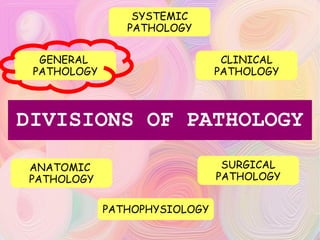
DIVISIONS OF PATHOLOGY GENERAL  PATHOLOGY SYSTEMIC PATHOLOGY CLINICAL PATHOLOGY ANATOMIC  PATHOLOGY SURGICAL PATHOLOGY PATHOPHYSIOLOGY
General Pathology Also called  investigative pathology experimental pathology theoretical pathology
General Pathology Foundation of pathology Study of the mechanisms of disease – etiology & pathogenesis The common changes in all tissues
1. INTRODUCTION TO PATHOLOGY 2. CELL INJURY & ADAPTATIONS 3. TISSUE INJURY 4. HEALING 5. HAEMODYNAMIC DISEASES 6. NEOPLASIA 7. INFECTIOUS & PARASITIC DISEASES
INTRODUCTION TO  PATHOLOGY
What is?? -PATHOLOGY- “ study of disease by scientific method” pathos : suffering or disease ~logos : study of
Objective of Pathology To identify and describe the different parts of a disease process
Disease??? Abnormal variation in structure or function of any part of body
Pathology... Explain the disease by studying the 4 aspects of the disease: Etiology Pathogenesis Morphological changes Functional derangement & clinical significance
Etiology aitia : cause ~logos : study  “ study of causation or origin of disease”
Etiology Why things occur? Factors that produce/predispose toward a certain disease or disorder Cause of disease  primary etiology: known idiopathic: unknown Help in diagnosis, understanding and treatment of disease
Etiology 2 major etiological factors Genetic: age, genes Acquired: infectious, environmental, nutritional etc Etiology is followed by pathogenesis
Pathogenesis pathos : disease genesis : creation  “ mechanism / development of disease”
Pathogenesis Process of disease Starting from the initial stimulus to the ultimate expression of disease the origin & development of disease: acute, chronic, recurrent Gross & microscopic structure, function, chemistry and molecular mechanism
Pathogenesis Types of pathogenesis include Microbial infection, inflammation, malignancy & tissue breakdown Most disease caused by multiple pathogenetical process together Example: cancer – multiple pathogenesis Pathogensis leads to morphological changes
Morphological Changes “ structural alterations”
Morphological Changes Structural alterations in cells or tissue that occur following the pathologenetic mechanisms the characteristic of disease or condition changes maybe specific to a disease thus, it help the pathologist to identify & diagnose the disease
Morphological Changes The changes can be seen with Naked eye – gross morphologic changes Under microscope – microscopic changes Morphological changes will lead to functional alteration and the clinical signs & symptoms of disease
Functional Derangement & Clinical Significance
Functional Derangements Disturbance of normal function of the organ due to the morphological changes  Determine the clinical features, course and prognosis of a disease
Clinical Significance Clinical manifestations Signs Symptoms Prognosis
Signs Objective indication of some medical fact or characteristic the characteristic of disease or condition changes maybe specific to a disease thus, it help the pathologist to identify & diagnose the disease
Symptoms Subjective – e.g: stomachache, lower back pain, fatigue = can be sensed by the patient 3 main types of symptoms Chronic :  long lasting/recurrent Relapsing :  affected by symptoms again Remitting :  symptoms improve & sometimes fade away completely
Symptoms Asymptomatic – NO symptom Asymptomatic disease condition Disease present but there ar no symptom e.g: Ca Breast Asymptomatic infection Infected person may transmit the diasease to others Cause complication that unrelatede to the infection e.g: STD – AIDS, genital warts
Prognosis Medical term to describe the likely outcome of an illness Complete prognosis include expected time, function and description of disease course Help to determine to attempt certain treatments or withold Certain test for prognostic indicator Estimators to describe prognoses =  progression-free survival ,  survival rate  &  survival time
Causes of Disease Can be caused by environmental factors, genetic factors or combination of the two
Environmental Factors Physical agents Chemicals Nutritional dificiencies & excesses Infections and infestations Immunological factors Psycogenic factors
Environmental Factors Physical agents Apply excess energy in any form to the body e.g: trauma, radiation, extreme temperature, electric power Chemicals Chemical agents = chemically induced injury Effects = toxic to all cell (cyanide), act locally at site of application (strong acids), toxic to certain organ esp liver & kidney
Environmental Factors Nutritional dificiencies & excesses Dificiencies   poor supply, interference of absorption, inefficient transport within the body or defective utilization – major class of food or essential elements Excess - obese
Environmental Factors Infections and infestations Infected by viruses, bacteria, fungi, protozoa, metazoa Cell destruction directly when infection happen – virus & protozoa Destruction from toxins by the infecting agent – diphteria, tetanus General or localize effects
Environmental Factors Immunological factors Abnormal immune system Hypersensitivity reaction : exaggerated immune response to an antigen – bronchial asthma Immunodificiency : increase susceptibility to different diseases – AIDS Autoimmunity : abnormal (exaggerated) immune reaction against self antigens - SLE
Environmental Factors Psycogenic factors Mental stress imposed by condition of life Maybe contributory factors in some group of diseases
Genetic Factors Hereditary factors that are inherited genetically from parents Mutation in chromosomes
Course of Disease “ the series of events in a disease incident in a patient” The natural history of the disease  (if no intervention from other factors)
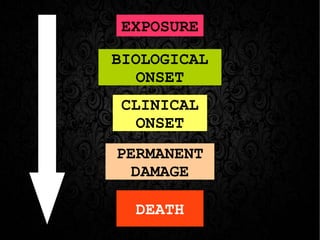
EXPOSURE BIOLOGICAL ONSET CLINICAL ONSET PERMANENT DAMAGE DEATH
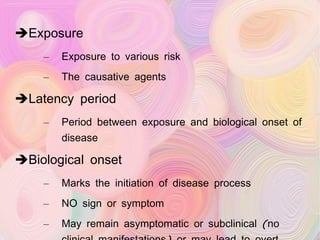
Exposure  Exposure to various risk The causative agents Latency period Period between exposure and biological onset of disease Biological onset Marks the initiation of disease process NO sign or symptom May remain asymptomatic or subclinical (no clinical manifestations) or may lead to overt clinical diasease
Incubation period Variable period of time without any obvious signs or symptoms from the time of exposure Clinical onset of disease Signs and symptoms become apparent Expression of disease may be variable in severity or in range of manifestations Onset of permanent damage Death Clinical death Biological death
Clinical Death Occurs when heart stop beating – cardiac arrest Reversible transmission between life and biological death Definition:  period of respiratory, circulatory and brain arrest during which initiation of resuscitation can lead to recovery
Clinical Death Signs No pulse or blood pressure = completely unresponsive to the most painful stimulus Pupils widely dilated Recovery can occur with resuscitation
Biological Death Sure sign of death Sets in after clinical death Irreversible state of cellular destruction Manifest with irreversible cessation of circulatory and respiratory functions all functions of the entire brain including brainstem

1 introduction

  • 1.
  • 2.
    DIVISIONS OF PATHOLOGYGENERAL PATHOLOGY SYSTEMIC PATHOLOGY CLINICAL PATHOLOGY ANATOMIC PATHOLOGY SURGICAL PATHOLOGY PATHOPHYSIOLOGY
  • 3.
    General Pathology Alsocalled investigative pathology experimental pathology theoretical pathology
  • 4.
    General Pathology Foundationof pathology Study of the mechanisms of disease – etiology & pathogenesis The common changes in all tissues
  • 5.
    1. INTRODUCTION TOPATHOLOGY 2. CELL INJURY & ADAPTATIONS 3. TISSUE INJURY 4. HEALING 5. HAEMODYNAMIC DISEASES 6. NEOPLASIA 7. INFECTIOUS & PARASITIC DISEASES
  • 6.
  • 7.
    What is?? -PATHOLOGY-“ study of disease by scientific method” pathos : suffering or disease ~logos : study of
  • 8.
    Objective of PathologyTo identify and describe the different parts of a disease process
  • 9.
    Disease??? Abnormal variationin structure or function of any part of body
  • 10.
    Pathology... Explain thedisease by studying the 4 aspects of the disease: Etiology Pathogenesis Morphological changes Functional derangement & clinical significance
  • 11.
    Etiology aitia :cause ~logos : study “ study of causation or origin of disease”
  • 12.
    Etiology Why thingsoccur? Factors that produce/predispose toward a certain disease or disorder Cause of disease primary etiology: known idiopathic: unknown Help in diagnosis, understanding and treatment of disease
  • 13.
    Etiology 2 majoretiological factors Genetic: age, genes Acquired: infectious, environmental, nutritional etc Etiology is followed by pathogenesis
  • 14.
    Pathogenesis pathos :disease genesis : creation “ mechanism / development of disease”
  • 15.
    Pathogenesis Process ofdisease Starting from the initial stimulus to the ultimate expression of disease the origin & development of disease: acute, chronic, recurrent Gross & microscopic structure, function, chemistry and molecular mechanism
  • 16.
    Pathogenesis Types ofpathogenesis include Microbial infection, inflammation, malignancy & tissue breakdown Most disease caused by multiple pathogenetical process together Example: cancer – multiple pathogenesis Pathogensis leads to morphological changes
  • 17.
    Morphological Changes “structural alterations”
  • 18.
    Morphological Changes Structuralalterations in cells or tissue that occur following the pathologenetic mechanisms the characteristic of disease or condition changes maybe specific to a disease thus, it help the pathologist to identify & diagnose the disease
  • 19.
    Morphological Changes Thechanges can be seen with Naked eye – gross morphologic changes Under microscope – microscopic changes Morphological changes will lead to functional alteration and the clinical signs & symptoms of disease
  • 20.
    Functional Derangement &Clinical Significance
  • 21.
    Functional Derangements Disturbanceof normal function of the organ due to the morphological changes Determine the clinical features, course and prognosis of a disease
  • 22.
    Clinical Significance Clinicalmanifestations Signs Symptoms Prognosis
  • 23.
    Signs Objective indicationof some medical fact or characteristic the characteristic of disease or condition changes maybe specific to a disease thus, it help the pathologist to identify & diagnose the disease
  • 24.
    Symptoms Subjective –e.g: stomachache, lower back pain, fatigue = can be sensed by the patient 3 main types of symptoms Chronic : long lasting/recurrent Relapsing : affected by symptoms again Remitting : symptoms improve & sometimes fade away completely
  • 25.
    Symptoms Asymptomatic –NO symptom Asymptomatic disease condition Disease present but there ar no symptom e.g: Ca Breast Asymptomatic infection Infected person may transmit the diasease to others Cause complication that unrelatede to the infection e.g: STD – AIDS, genital warts
  • 26.
    Prognosis Medical termto describe the likely outcome of an illness Complete prognosis include expected time, function and description of disease course Help to determine to attempt certain treatments or withold Certain test for prognostic indicator Estimators to describe prognoses = progression-free survival , survival rate & survival time
  • 27.
    Causes of DiseaseCan be caused by environmental factors, genetic factors or combination of the two
  • 28.
    Environmental Factors Physicalagents Chemicals Nutritional dificiencies & excesses Infections and infestations Immunological factors Psycogenic factors
  • 29.
    Environmental Factors Physicalagents Apply excess energy in any form to the body e.g: trauma, radiation, extreme temperature, electric power Chemicals Chemical agents = chemically induced injury Effects = toxic to all cell (cyanide), act locally at site of application (strong acids), toxic to certain organ esp liver & kidney
  • 30.
    Environmental Factors Nutritionaldificiencies & excesses Dificiencies poor supply, interference of absorption, inefficient transport within the body or defective utilization – major class of food or essential elements Excess - obese
  • 31.
    Environmental Factors Infectionsand infestations Infected by viruses, bacteria, fungi, protozoa, metazoa Cell destruction directly when infection happen – virus & protozoa Destruction from toxins by the infecting agent – diphteria, tetanus General or localize effects
  • 32.
    Environmental Factors Immunologicalfactors Abnormal immune system Hypersensitivity reaction : exaggerated immune response to an antigen – bronchial asthma Immunodificiency : increase susceptibility to different diseases – AIDS Autoimmunity : abnormal (exaggerated) immune reaction against self antigens - SLE
  • 33.
    Environmental Factors Psycogenicfactors Mental stress imposed by condition of life Maybe contributory factors in some group of diseases
  • 34.
    Genetic Factors Hereditaryfactors that are inherited genetically from parents Mutation in chromosomes
  • 35.
    Course of Disease“ the series of events in a disease incident in a patient” The natural history of the disease (if no intervention from other factors)
  • 36.
    EXPOSURE BIOLOGICAL ONSETCLINICAL ONSET PERMANENT DAMAGE DEATH
  • 37.
    Exposure Exposureto various risk The causative agents Latency period Period between exposure and biological onset of disease Biological onset Marks the initiation of disease process NO sign or symptom May remain asymptomatic or subclinical (no clinical manifestations) or may lead to overt clinical diasease
  • 38.
    Incubation period Variableperiod of time without any obvious signs or symptoms from the time of exposure Clinical onset of disease Signs and symptoms become apparent Expression of disease may be variable in severity or in range of manifestations Onset of permanent damage Death Clinical death Biological death
  • 39.
    Clinical Death Occurswhen heart stop beating – cardiac arrest Reversible transmission between life and biological death Definition: period of respiratory, circulatory and brain arrest during which initiation of resuscitation can lead to recovery
  • 40.
    Clinical Death SignsNo pulse or blood pressure = completely unresponsive to the most painful stimulus Pupils widely dilated Recovery can occur with resuscitation
  • 41.
    Biological Death Suresign of death Sets in after clinical death Irreversible state of cellular destruction Manifest with irreversible cessation of circulatory and respiratory functions all functions of the entire brain including brainstem