IT Passport Exam
 Preparation Book
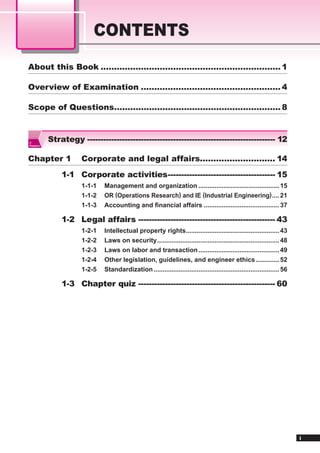
CONTENTS
About this Book ................................................................... 1

Overview of Examination .................................................... 4

Scope of Questions.............................................................. 8


IT
           Strategy ---------------------------------------------------------------------- 12
Passport


Chapter 1             Corporate and legal affairs............................ 14
               1-1 Corporate activities ---------------------------------------- 15
                      1-1-1   Management and organization ............................................. 15
                      1-1-2   OR (Operations Research) and IE (Industrial Engineering) .... 21
                      1-1-3   Accounting and financial affairs .......................................... 37

               1-2 Legal affairs --------------------------------------------------- 43
                      1-2-1   Intellectual property rights.................................................... 43
                      1-2-2   Laws on security .................................................................... 48
                      1-2-3   Laws on labor and transaction ............................................. 49
                      1-2-4   Other legislation, guidelines, and engineer ethics ............. 52
                      1-2-5   Standardization ...................................................................... 56

               1-3 Chapter quiz --------------------------------------------------- 60


                                                                                                                          i
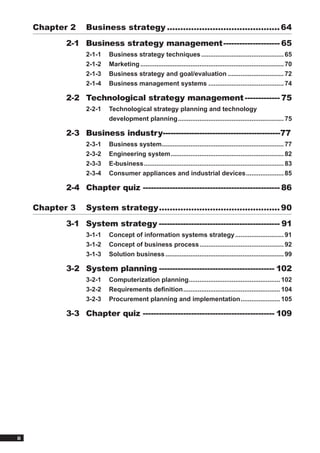
Chapter 2    Business strategy .......................................... 64
            2-1 Business strategy management --------------------- 65
                  2-1-1   Business strategy techniques .............................................. 65
                  2-1-2   Marketing ................................................................................ 70
                  2-1-3   Business strategy and goal/evaluation ............................... 72
                  2-1-4   Business management systems .......................................... 74

            2-2 Technological strategy management ------------- 75
                  2-2-1   Technological strategy planning and technology
                          development planning ........................................................... 75

            2-3 Business industry---------------------------------------------77
                  2-3-1   Business system.................................................................... 77
                  2-3-2   Engineering system ............................................................... 82
                  2-3-3   E-business .............................................................................. 83
                  2-3-4   Consumer appliances and industrial devices ..................... 85

            2-4 Chapter quiz --------------------------------------------------- 86

     Chapter 3    System strategy ............................................. 90
            3-1 System strategy --------------------------------------------- 91
                  3-1-1   Concept of information systems strategy ........................... 91
                  3-1-2   Concept of business process ............................................... 92
                  3-1-3   Solution business .................................................................. 99

            3-2 System planning ------------------------------------------- 102
                  3-2-1   Computerization planning................................................... 102
                  3-2-2   Requirements definition ...................................................... 104
                  3-2-3   Procurement planning and implementation ...................... 105

            3-3 Chapter quiz ------------------------------------------------- 109


ii
IT
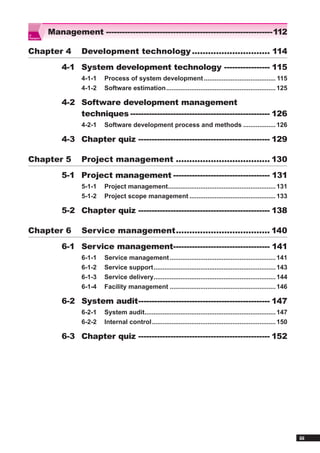
           Management --------------------------------------------------------------112
Passport


Chapter 4            Development technology ............................. 114
               4-1 System development technology ----------------- 115
                     4-1-1   Process of system development ........................................ 115
                     4-1-2   Software estimation ............................................................. 125

               4-2 Software development management
                   techniques ---------------------------------------------------- 126
                     4-2-1   Software development process and methods .................. 126

               4-3 Chapter quiz ------------------------------------------------- 129

Chapter 5            Project management ................................... 130
               5-1 Project management ------------------------------------ 131
                     5-1-1   Project management............................................................ 131
                     5-1-2   Project scope management ................................................ 133

               5-2 Chapter quiz ------------------------------------------------- 138

Chapter 6            Service management ................................... 140
               6-1 Service management------------------------------------ 141
                     6-1-1   Service management ........................................................... 141
                     6-1-2   Service support .................................................................... 143
                     6-1-3   Service delivery.................................................................... 144
                     6-1-4   Facility management ........................................................... 146

               6-2 System audit ------------------------------------------------- 147
                     6-2-1   System audit......................................................................... 147
                     6-2-2   Internal control ..................................................................... 150

               6-3 Chapter quiz ------------------------------------------------- 152


                                                                                                                          iii
IT
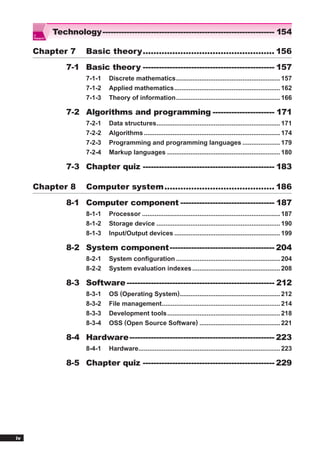
                Technology ---------------------------------------------------------------- 154
     Passport


     Chapter 7             Basic theory ................................................. 156
                    7-1 Basic theory ------------------------------------------------- 157
                           7-1-1   Discrete mathematics .......................................................... 157
                           7-1-2   Applied mathematics ........................................................... 162
                           7-1-3   Theory of information .......................................................... 166

                    7-2 Algorithms and programming ----------------------- 171
                           7-2-1   Data structures..................................................................... 171
                           7-2-2   Algorithms ............................................................................ 174
                           7-2-3   Programming and programming languages ..................... 179
                           7-2-4   Markup languages ............................................................... 180

                    7-3 Chapter quiz ------------------------------------------------- 183

     Chapter 8             Computer system ......................................... 186
                    8-1 Computer component ----------------------------------- 187
                           8-1-1   Processor ............................................................................. 187
                           8-1-2   Storage device ..................................................................... 190
                           8-1-3   Input/Output devices ........................................................... 199

                    8-2 System component --------------------------------------- 204
                           8-2-1   System configuration .......................................................... 204
                           8-2-2   System evaluation indexes ................................................. 208

                    8-3 Software ------------------------------------------------------- 212
                           8-3-1   OS (Operating System)........................................................ 212
                           8-3-2   File management.................................................................. 214
                           8-3-3   Development tools ............................................................... 218
                           8-3-4   OSS (Open Source Software) ............................................. 221

                    8-4 Hardware ------------------------------------------------------ 223
                           8-4-1   Hardware............................................................................... 223

                    8-5 Chapter quiz ------------------------------------------------- 229


iv
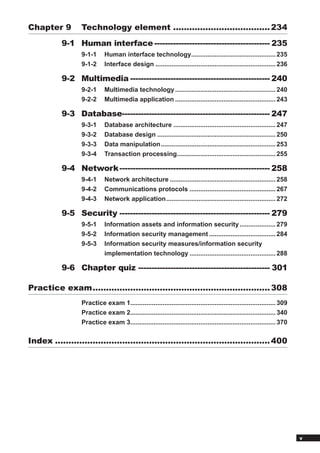
Chapter 9         Technology element .................................... 234
           9-1 Human interface ------------------------------------------- 235
                  9-1-1      Human interface technology............................................... 235
                  9-1-2      Interface design ................................................................... 236

           9-2 Multimedia ---------------------------------------------------- 240
                  9-2-1      Multimedia technology ........................................................ 240
                  9-2-2      Multimedia application ........................................................ 243

           9-3 Database------------------------------------------------------- 247
                  9-3-1      Database architecture ......................................................... 247
                  9-3-2      Database design .................................................................. 250
                  9-3-3      Data manipulation ................................................................ 253
                  9-3-4      Transaction processing....................................................... 255

           9-4 Network -------------------------------------------------------- 258
                  9-4-1      Network architecture ........................................................... 258
                  9-4-2      Communications protocols ................................................ 267
                  9-4-3      Network application ............................................................. 272

           9-5 Security -------------------------------------------------------- 279
                  9-5-1      Information assets and information security .................... 279
                  9-5-2      Information security management ..................................... 284
                  9-5-3      Information security measures/information security
                             implementation technology ................................................ 288

           9-6 Chapter quiz ------------------------------------------------- 301

Practice exam .................................................................. 308
                  Practice exam 1................................................................................. 309
                  Practice exam 2................................................................................. 340
                  Practice exam 3................................................................................. 370

Index ................................................................................ 400


                                                                                                                         v
About this Book

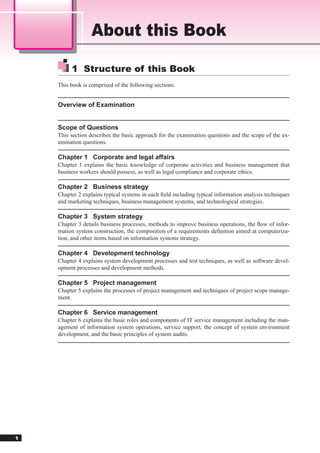
         1 Structure of this Book
    This book is comprised of the following sections.


    Overview of Examination


    Scope of Questions
    This section describes the basic approach for the examination questions and the scope of the ex-
    amination questions.

    Chapter 1 Corporate and legal affairs
    Chapter 1 explains the basic knowledge of corporate activities and business management that
    business workers should possess, as well as legal compliance and corporate ethics.

    Chapter 2 Business strategy
    Chapter 2 explains typical systems in each field including typical information analysis techniques
    and marketing techniques, business management systems, and technological strategies.

    Chapter 3 System strategy
    Chapter 3 details business processes, methods to improve business operations, the flow of infor-
    mation system construction, the composition of a requirements definition aimed at computeriza-
    tion, and other items based on information systems strategy.

    Chapter 4 Development technology
    Chapter 4 explains system development processes and test techniques, as well as software devel-
    opment processes and development methods.

    Chapter 5 Project management
    Chapter 5 explains the processes of project management and techniques of project scope manage-
    ment.

    Chapter 6 Service management
    Chapter 6 explains the basic roles and components of IT service management including the man-
    agement of information system operations, service support, the concept of system environment
    development, and the basic principles of system audits.


1
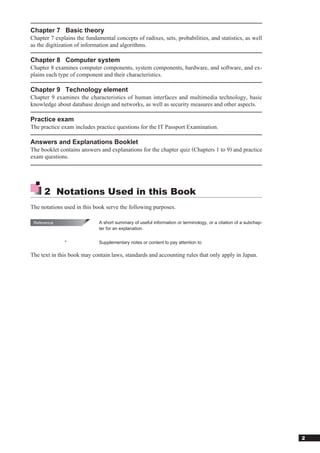
Chapter 7 Basic theory
Chapter 7 explains the fundamental concepts of radixes, sets, probabilities, and statistics, as well
as the digitization of information and algorithms.

Chapter 8 Computer system
Chapter 8 examines computer components, system components, hardware, and software, and ex-
plains each type of component and their characteristics.

Chapter 9 Technology element
Chapter 9 examines the characteristics of human interfaces and multimedia technology, basic
knowledge about database design and networks, as well as security measures and other aspects.

Practice exam
The practice exam includes practice questions for the IT Passport Examination.

Answers and Explanations Booklet
The booklet contains answers and explanations for the chapter quiz (Chapters 1 to 9) and practice
exam questions.


        2	 Notations	Used	in	this	Book
The notations used in this book serve the following purposes.

    Reference            	   A	short	summary	of	useful	information	or	terminology,	or	a	citation	of	a	subchap-
                             ter	for	an	explanation.


	               *	           Supplementary	notes	or	content	to	pay	attention	to

The text in this book may contain laws, standards and accounting rules that only apply in Japan.


                                                                                                                 2
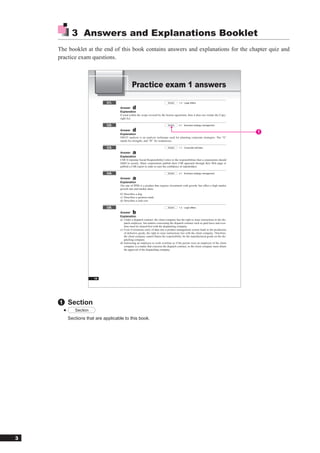
3 Answers and Explanations Booklet
    The booklet at the end of this book contains answers and explanations for the chapter quiz and
    practice exam questions.


                                              Practice exam 1 answers

                             Q1.                                               Section   1-2 Legal affairs

                                    Answer     d
                                    Explanation
                                    If used within the scope covered by the license agreement, then it does not violate the Copy-
                                    right Act.

                             Q2.                                               Section   2-1 Business strategy management

                                    Answer     d                                                                                        1
                                    Explanation
                                    SWOT analysis is an analysis technique used for planning corporate strategies. The “S”
                                    stands for strengths, and “W” for weaknesses.

                             Q3.                                               Section   1-1 Corporate activities

                                    Answer     a
                                    Explanation
                                    CSR (Corporate Social Responsibility) refers to the responsibilities that a corporations should
                                    fulfill to society. Many corporations publish their CSR approach through their Web page or
                                    publish a CSR report in order to earn the confidence of stakeholders.

                             Q4.                                               Section   2-1 Business strategy management

                                    Answer     a
                                    Explanation
                                    The star of PPM is a product that requires investment with growth, but offers a high market
                                    growth rate and market share.
                                    b): Describes a dog.
                                    c): Describes a question mark.
                                    d): Describes a cash cow.

                             Q5.                                               Section   1-2 Legal affairs

                                    Answer     b
                                    Explanation
                                    a): Under a dispatch contract, the client company has the right to issue instructions to the dis-
                                        patch employee, but matters concerning the dispatch contract such as paid leave and over-
                                        time must be cleared first with the dispatching company.
                                    c): Even if erroneous entry of data into a product management system leads to the production
                                        of defective goods, the right to issue instructions lies with the client company. Therefore,
                                        the client company cannot blame the responsibility for the manufactured goods on the dis-
                                        patching company.
                                    d): Instructing an employee to work overtime as if the person were an employee of the client
                                        company is a matter that concerns the dispatch contract, so the client company must obtain
                                        the approval of the dispatching company.


                       19


    1 Section
      ●      Section

          Sections that are applicable to this book.


3
Overview of
Examination
Overview of Exam

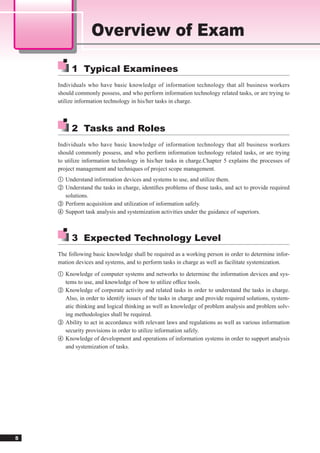
         1 Typical Examinees
    Individuals who have basic knowledge of information technology that all business workers
    should commonly possess, and who perform information technology related tasks, or are trying to
    utilize information technology in his/her tasks in charge.


         2 Tasks and Roles
    Individuals who have basic knowledge of information technology that all business workers
    should commonly possess, and who perform information technology related tasks, or are trying
    to utilize information technology in his/her tasks in charge.Chapter 5 explains the processes of
    project management and techniques of project scope management.
    ① Understand information devices and systems to use, and utilize them.
    ② Understand the tasks in charge, identifies problems of those tasks, and act to provide required
      solutions.
    ③ Perform acquisition and utilization of information safely.
    ④ Support task analysis and systemization activities under the guidance of superiors.


         3 Expected Technology Level
    The following basic knowledge shall be required as a working person in order to determine infor-
    mation devices and systems, and to perform tasks in charge as well as facilitate systemization.
    ① Knowledge of computer systems and networks to determine the information devices and sys-
      tems to use, and knowledge of how to utilize office tools.
    ② Knowledge of corporate activity and related tasks in order to understand the tasks in charge.
      Also, in order to identify issues of the tasks in charge and provide required solutions, system-
      atic thinking and logical thinking as well as knowledge of problem analysis and problem solv-
      ing methodologies shall be required.
    ③ Ability to act in accordance with relevant laws and regulations as well as various information
      security provisions in order to utilize information safely.
    ④ Knowledge of development and operations of information systems in order to support analysis
      and systemization of tasks.


5
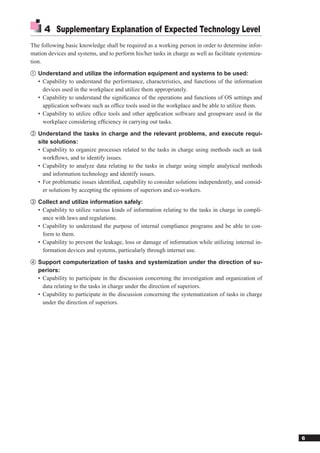
4 Supplementary Explanation of Expected Technology Level
The following basic knowledge shall be required as a working person in order to determine infor-
mation devices and systems, and to perform his/her tasks in charge as well as facilitate systemiza-
tion.
① Understand and utilize the information equipment and systems to be used:
   • Capability to understand the performance, characteristics, and functions of the information
     devices used in the workplace and utilize them appropriately.
   • Capability to understand the significance of the operations and functions of OS settings and
     application software such as office tools used in the workplace and be able to utilize them.
   • Capability to utilize office tools and other application software and groupware used in the
     workplace considering efficiency in carrying out tasks.
② Understand the tasks in charge and the relevant problems, and execute requi-
   site solutions:
   • Capability to organize processes related to the tasks in charge using methods such as task
     workflows, and to identify issues.
   • Capability to analyze data relating to the tasks in charge using simple analytical methods
     and information technology and identify issues.
   • For problematic issues identified, capability to consider solutions independently, and consid-
     er solutions by accepting the opinions of superiors and co-workers.
③ Collect and utilize information safely:
   • Capability to utilize various kinds of information relating to the tasks in charge in compli-
     ance with laws and regulations.
   • Capability to understand the purpose of internal compliance programs and be able to con-
     form to them.
   • Capability to prevent the leakage, loss or damage of information while utilizing internal in-
     formation devices and systems, particularly through internet use.
④ Support computerization of tasks and systemization under the direction of su-
   periors:
   • Capability to participate in the discussion concerning the investigation and organization of
     data relating to the tasks in charge under the direction of superiors.
   • Capability to participate in the discussion concerning the systematization of tasks in charge
     under the direction of superiors.


                                                                                                      6
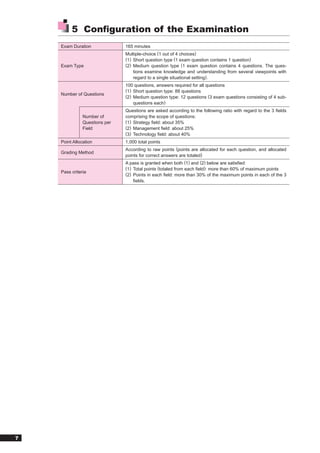
5 Configuration of the Examination
    Exam Duration              165 minutes
                               Multiple-choice (1 out of 4 choices)
                               (1) Short question type (1 exam question contains 1 question)
    Exam Type                  (2) Medium question type (1 exam question contains 4 questions. The ques-
                                   tions examine knowledge and understanding from several viewpoints with
                                   regard to a single situational setting).
                               100 questions, answers required for all questions
                               (1) Short question type: 88 questions
    Number of Questions
                               (2) Medium question type: 12 questions (3 exam questions consisting of 4 sub-
                                   questions each)
                               Questions are asked according to the following ratio with regard to the 3 fields
               Number of       comprising the scope of questions:
               Questions per   (1) Strategy field: about 35%
               Field           (2) Management field: about 25%
                               (3) Technology field: about 40%
    Point Allocation           1,000 total points
                               According to raw points (points are allocated for each question, and allocated
    Grading Method
                               points for correct answers are totaled)
                               A pass is granted when both (1) and (2) below are satisfied:
                               (1) Total points (totaled from each field): more than 60% of maximum points
    Pass criteria
                               (2) Points in each field: more than 30% of the maximum points in each of the 3
                                   fields.


7
Scope of Questions
  This section describes the basic approach for the ex-
  amination questions and the scope of the examination
  questions.
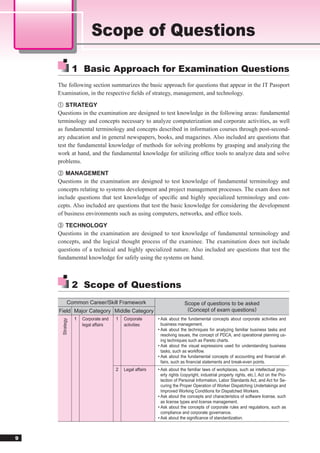
Scope of Questions

                1 Basic Approach for Examination Questions
    The following section summarizes the basic approach for questions that appear in the IT Passport
    Examination, in the respective fields of strategy, management, and technology.
    ① STRATEGY
    Questions in the examination are designed to test knowledge in the following areas: fundamental
    terminology and concepts necessary to analyze computerization and corporate activities, as well
    as fundamental terminology and concepts described in information courses through post-second-
    ary education and in general newspapers, books, and magazines. Also included are questions that
    test the fundamental knowledge of methods for solving problems by grasping and analyzing the
    work at hand, and the fundamental knowledge for utilizing office tools to analyze data and solve
    problems.
    ② MANAGEMENT
    Questions in the examination are designed to test knowledge of fundamental terminology and
    concepts relating to systems development and project management processes. The exam does not
    include questions that test knowledge of specific and highly specialized terminology and con-
    cepts. Also included are questions that test the basic knowledge for considering the development
    of business environments such as using computers, networks, and office tools.
    ③ TECHNOLOGY
    Questions in the examination are designed to test knowledge of fundamental terminology and
    concepts, and the logical thought process of the examinee. The examination does not include
    questions of a technical and highly specialized nature. Also included are questions that test the
    fundamental knowledge for safely using the systems on hand.


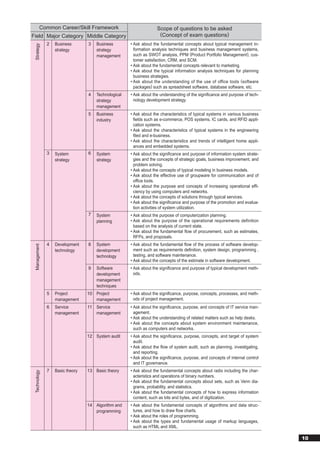
                2 Scope of Questions
           Common Career/Skill Framework                               Scope of questions to be asked
    Field Major Category Middle Category                                (Concept of exam questions)
                1   Corporate and   1   Corporate       • Ask about the fundamental concepts about corporate activities and
     Strategy


                    legal affairs       activities        business management.
                                                        • Ask about the techniques for analyzing familiar business tasks and
                                                          resolving issues, the concept of PDCA, and operational planning us-
                                                          ing techniques such as Pareto charts.
                                                        • Ask about the visual expressions used for understanding business
                                                          tasks, such as workflow.
                                                        • Ask about the fundamental concepts of accounting and financial af-
                                                          fairs, such as financial statements and break-even points.
                                    2   Legal affairs   • Ask about the familiar laws of workplaces, such as intellectual prop-
                                                          erty rights (copyright, industrial property rights, etc.), Act on the Pro-
                                                          tection of Personal Information, Labor Standards Act, and Act for Se-
                                                          curing the Proper Operation of Worker Dispatching Undertakings and
                                                          Improved Working Conditions for Dispatched Workers.
                                                        • Ask about the concepts and characteristics of software license, such
                                                          as license types and license management.
                                                        • Ask about the concepts of corporate rules and regulations, such as
                                                          compliance and corporate governance.
                                                        • Ask about the significance of standardization.


9
Common Career/Skill Framework                             Scope of questions to be asked
Field Major Category Middle Category                                (Concept of exam questions)
              2   Business       3   Business        • Ask about the fundamental concepts about typical management in-
 Strategy

                  strategy           strategy          formation analysis techniques and business management systems,
                                     management        such as SWOT analysis, PPM (Product Portfolio Management), cus-
                                                       tomer satisfaction, CRM, and SCM.
                                                     • Ask about the fundamental concepts relevant to marketing.
                                                     • Ask about the typical information analysis techniques for planning
                                                       business strategies.
                                                     • Ask about the understanding of the use of office tools (software
                                                       packages) such as spreadsheet software, database software, etc.
                                 4   Technological   • Ask about the understanding of the significance and purpose of tech-
                                     strategy          nology development strategy.
                                     management
                                 5   Business        • Ask about the characteristics of typical systems in various business
                                     industry          fields such as e-commerce, POS systems, IC cards, and RFID appli-
                                                       cation systems.
                                                     • Ask about the characteristics of typical systems in the engineering
                                                       filed and e-business.
                                                     • Ask about the characteristics and trends of intelligent home appli-
                                                       ances and embedded systems.
              3   System         6   System          • Ask about the significance and purpose of information system strate-
                  strategy           strategy          gies and the concepts of strategic goals, business improvement, and
                                                       problem solving.
                                                     • Ask about the concepts of typical modeling in business models.
                                                     • Ask about the effective use of groupware for communication and of
                                                       office tools.
                                                     • Ask about the purpose and concepts of increasing operational effi-
                                                       ciency by using computers and networks.
                                                     • Ask about the concepts of solutions through typical services.
                                                     • Ask about the significance and purpose of the promotion and evalua-
                                                       tion activities of system utilization.
                                 7   System          • Ask about the purpose of computerization planning.
                                     planning        • Ask about the purpose of the operational requirements definition
                                                       based on the analysis of current state.
                                                     • Ask about the fundamental flow of procurement, such as estimates,
                                                       RFPs, and proposals.
              4   Development    8   System          • Ask about the fundamental flow of the process of software develop-
 Management


                  technology         development       ment such as requirements definition, system design, programming ,
                                     technology        testing, and software maintenance.
                                                     • Ask about the concepts of the estimate in software development.
                                 9   Software        • Ask about the significance and purpose of typical development meth-
                                     development       ods.
                                     management
                                     techniques
              5   Project        10 Project          • Ask about the significance, purpose, concepts, processes, and meth-
                  management        management         ods of project management.
              6   Service        11 Service          • Ask about the significance, purpose, and concepts of IT service man-
                  management        management         agement.
                                                     • Ask about the understanding of related matters such as help desks.
                                                     • Ask about the concepts about system environment maintenance,
                                                       such as computers and networks.
                                 12 System audit     • Ask about the significance, purpose, concepts, and target of system
                                                       audit.
                                                     • Ask about the flow of system audit, such as planning, investigating,
                                                       and reporting.
                                                     • Ask about the significance, purpose, and concepts of internal control
                                                       and IT governance.
              7   Basic theory   13 Basic theory     • Ask about the fundamental concepts about radix including the char-
 Technology


                                                       acteristics and operations of binary numbers.
                                                     • Ask about the fundamental concepts about sets, such as Venn dia-
                                                       grams, probability, and statistics.
                                                     • Ask about the fundamental concepts of how to express information
                                                       content, such as bits and bytes, and of digitization.
                                 14 Algorithm and    • Ask about the fundamental concepts of algorithms and data struc-
                                    programming        tures, and how to draw flow charts.
                                                     • Ask about the roles of programming.
                                                     • Ask about the types and fundamental usage of markup languages,
                                                       such as HTML and XML.

                                                                                                                              10
Common Career/Skill Framework                      Scope of questions to be asked
     Field Major Category Middle Category                         (Concept of exam questions)
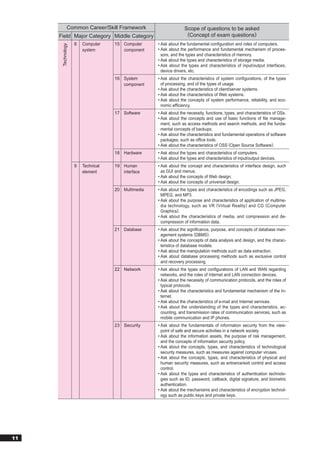
                   8   Computer    15 Computer     • Ask about the fundamental configuration and roles of computers.


      Technology
                       system         component    • Ask about the performance and fundamental mechanism of proces-
                                                     sors, and the types and characteristics of memory.
                                                   • Ask about the types and characteristics of storage media.
                                                   • Ask about the types and characteristics of input/output interfaces,
                                                     device drivers, etc.
                                   16 System       • Ask about the characteristics of system configurations, of the types
                                      component      of processing, and of the types of usage.
                                                   • Ask about the characteristics of client/server systems.
                                                   • Ask about the characteristics of Web systems.
                                                   • Ask about the concepts of system performance, reliability, and eco-
                                                     nomic efficiency.
                                   17 Software     • Ask about the necessity, functions, types, and characteristics of OSs.
                                                   • Ask about the concepts and use of basic functions of file manage-
                                                     ment, such as access methods and search methods, and the funda-
                                                     mental concepts of backups.
                                                   • Ask about the characteristics and fundamental operations of software
                                                     packages, such as office tools.
                                                   • Ask about the characteristics of OSS (Open Source Software).
                                   18 Hardware     • Ask about the types and characteristics of computers.
                                                   • Ask about the types and characteristics of input/output devices.
                   9   Technical   19 Human        • Ask about the concept and characteristics of interface design, such
                       element        interface      as GUI and menus.
                                                   • Ask about the concepts of Web design.
                                                   • Ask about the concepts of universal design.
                                   20 Multimedia   • Ask about the types and characteristics of encodings such as JPEG,
                                                     MPEG, and MP3.
                                                   • Ask about the purpose and characteristics of application of multime-
                                                     dia technology, such as VR (Virtual Reality ) and CG (Computer
                                                     Graphics).
                                                   • Ask about the characteristics of media, and compression and de-
                                                     compression of information data.
                                   21 Database     • Ask about the significance, purpose, and concepts of database man-
                                                     agement systems (DBMS).
                                                   • Ask about the concepts of data analysis and design, and the charac-
                                                     teristics of database models.
                                                   • Ask about the manipulation methods such as data extraction.
                                                   • Ask about database processing methods such as exclusive control
                                                     and recovery processing.
                                   22 Network      • Ask about the types and configurations of LAN and WAN regarding
                                                     networks, and the roles of Internet and LAN connection devices.
                                                   • Ask about the necessity of communication protocols, and the roles of
                                                     typical protocols.
                                                   • Ask about the characteristics and fundamental mechanism of the In-
                                                     ternet.
                                                   • Ask about the characteristics of e-mail and Internet services.
                                                   • Ask about the understanding of the types and characteristics, ac-
                                                     counting, and transmission rates of communication services, such as
                                                     mobile communication and IP phones.
                                   23 Security     • Ask about the fundamentals of information security from the view-
                                                     point of safe and secure activities in a network society.
                                                   • Ask about the information assets, the purpose of risk management,
                                                     and the concepts of information security policy.
                                                   • Ask about the concepts, types, and characteristics of technological
                                                     security measures, such as measures against computer viruses.
                                                   • Ask about the concepts, types, and characteristics of physical and
                                                     human security measures, such as entrance/exit control and access
                                                     control.
                                                   • Ask about the types and characteristics of authentication technolo-
                                                     gies such as ID, password, callback, digital signature, and biometric
                                                     authentication.
                                                   • Ask about the mechanisms and characteristics of encryption technol-
                                                     ogy such as public keys and private keys.


11

1 contents about_book

  • 1.
    IT Passport Exam Preparation Book
  • 2.
    CONTENTS About this Book................................................................... 1 Overview of Examination .................................................... 4 Scope of Questions.............................................................. 8 IT Strategy ---------------------------------------------------------------------- 12 Passport Chapter 1 Corporate and legal affairs............................ 14 1-1 Corporate activities ---------------------------------------- 15 1-1-1 Management and organization ............................................. 15 1-1-2 OR (Operations Research) and IE (Industrial Engineering) .... 21 1-1-3 Accounting and financial affairs .......................................... 37 1-2 Legal affairs --------------------------------------------------- 43 1-2-1 Intellectual property rights.................................................... 43 1-2-2 Laws on security .................................................................... 48 1-2-3 Laws on labor and transaction ............................................. 49 1-2-4 Other legislation, guidelines, and engineer ethics ............. 52 1-2-5 Standardization ...................................................................... 56 1-3 Chapter quiz --------------------------------------------------- 60 i
  • 3.
    Chapter 2 Business strategy .......................................... 64 2-1 Business strategy management --------------------- 65 2-1-1 Business strategy techniques .............................................. 65 2-1-2 Marketing ................................................................................ 70 2-1-3 Business strategy and goal/evaluation ............................... 72 2-1-4 Business management systems .......................................... 74 2-2 Technological strategy management ------------- 75 2-2-1 Technological strategy planning and technology development planning ........................................................... 75 2-3 Business industry---------------------------------------------77 2-3-1 Business system.................................................................... 77 2-3-2 Engineering system ............................................................... 82 2-3-3 E-business .............................................................................. 83 2-3-4 Consumer appliances and industrial devices ..................... 85 2-4 Chapter quiz --------------------------------------------------- 86 Chapter 3 System strategy ............................................. 90 3-1 System strategy --------------------------------------------- 91 3-1-1 Concept of information systems strategy ........................... 91 3-1-2 Concept of business process ............................................... 92 3-1-3 Solution business .................................................................. 99 3-2 System planning ------------------------------------------- 102 3-2-1 Computerization planning................................................... 102 3-2-2 Requirements definition ...................................................... 104 3-2-3 Procurement planning and implementation ...................... 105 3-3 Chapter quiz ------------------------------------------------- 109 ii
  • 4.
    IT Management --------------------------------------------------------------112 Passport Chapter 4 Development technology ............................. 114 4-1 System development technology ----------------- 115 4-1-1 Process of system development ........................................ 115 4-1-2 Software estimation ............................................................. 125 4-2 Software development management techniques ---------------------------------------------------- 126 4-2-1 Software development process and methods .................. 126 4-3 Chapter quiz ------------------------------------------------- 129 Chapter 5 Project management ................................... 130 5-1 Project management ------------------------------------ 131 5-1-1 Project management............................................................ 131 5-1-2 Project scope management ................................................ 133 5-2 Chapter quiz ------------------------------------------------- 138 Chapter 6 Service management ................................... 140 6-1 Service management------------------------------------ 141 6-1-1 Service management ........................................................... 141 6-1-2 Service support .................................................................... 143 6-1-3 Service delivery.................................................................... 144 6-1-4 Facility management ........................................................... 146 6-2 System audit ------------------------------------------------- 147 6-2-1 System audit......................................................................... 147 6-2-2 Internal control ..................................................................... 150 6-3 Chapter quiz ------------------------------------------------- 152 iii
  • 5.
    IT Technology ---------------------------------------------------------------- 154 Passport Chapter 7 Basic theory ................................................. 156 7-1 Basic theory ------------------------------------------------- 157 7-1-1 Discrete mathematics .......................................................... 157 7-1-2 Applied mathematics ........................................................... 162 7-1-3 Theory of information .......................................................... 166 7-2 Algorithms and programming ----------------------- 171 7-2-1 Data structures..................................................................... 171 7-2-2 Algorithms ............................................................................ 174 7-2-3 Programming and programming languages ..................... 179 7-2-4 Markup languages ............................................................... 180 7-3 Chapter quiz ------------------------------------------------- 183 Chapter 8 Computer system ......................................... 186 8-1 Computer component ----------------------------------- 187 8-1-1 Processor ............................................................................. 187 8-1-2 Storage device ..................................................................... 190 8-1-3 Input/Output devices ........................................................... 199 8-2 System component --------------------------------------- 204 8-2-1 System configuration .......................................................... 204 8-2-2 System evaluation indexes ................................................. 208 8-3 Software ------------------------------------------------------- 212 8-3-1 OS (Operating System)........................................................ 212 8-3-2 File management.................................................................. 214 8-3-3 Development tools ............................................................... 218 8-3-4 OSS (Open Source Software) ............................................. 221 8-4 Hardware ------------------------------------------------------ 223 8-4-1 Hardware............................................................................... 223 8-5 Chapter quiz ------------------------------------------------- 229 iv
  • 6.
    Chapter 9 Technology element .................................... 234 9-1 Human interface ------------------------------------------- 235 9-1-1 Human interface technology............................................... 235 9-1-2 Interface design ................................................................... 236 9-2 Multimedia ---------------------------------------------------- 240 9-2-1 Multimedia technology ........................................................ 240 9-2-2 Multimedia application ........................................................ 243 9-3 Database------------------------------------------------------- 247 9-3-1 Database architecture ......................................................... 247 9-3-2 Database design .................................................................. 250 9-3-3 Data manipulation ................................................................ 253 9-3-4 Transaction processing....................................................... 255 9-4 Network -------------------------------------------------------- 258 9-4-1 Network architecture ........................................................... 258 9-4-2 Communications protocols ................................................ 267 9-4-3 Network application ............................................................. 272 9-5 Security -------------------------------------------------------- 279 9-5-1 Information assets and information security .................... 279 9-5-2 Information security management ..................................... 284 9-5-3 Information security measures/information security implementation technology ................................................ 288 9-6 Chapter quiz ------------------------------------------------- 301 Practice exam .................................................................. 308 Practice exam 1................................................................................. 309 Practice exam 2................................................................................. 340 Practice exam 3................................................................................. 370 Index ................................................................................ 400 v
  • 7.
    About this Book 1 Structure of this Book This book is comprised of the following sections. Overview of Examination Scope of Questions This section describes the basic approach for the examination questions and the scope of the ex- amination questions. Chapter 1 Corporate and legal affairs Chapter 1 explains the basic knowledge of corporate activities and business management that business workers should possess, as well as legal compliance and corporate ethics. Chapter 2 Business strategy Chapter 2 explains typical systems in each field including typical information analysis techniques and marketing techniques, business management systems, and technological strategies. Chapter 3 System strategy Chapter 3 details business processes, methods to improve business operations, the flow of infor- mation system construction, the composition of a requirements definition aimed at computeriza- tion, and other items based on information systems strategy. Chapter 4 Development technology Chapter 4 explains system development processes and test techniques, as well as software devel- opment processes and development methods. Chapter 5 Project management Chapter 5 explains the processes of project management and techniques of project scope manage- ment. Chapter 6 Service management Chapter 6 explains the basic roles and components of IT service management including the man- agement of information system operations, service support, the concept of system environment development, and the basic principles of system audits. 1
  • 8.
    Chapter 7 Basictheory Chapter 7 explains the fundamental concepts of radixes, sets, probabilities, and statistics, as well as the digitization of information and algorithms. Chapter 8 Computer system Chapter 8 examines computer components, system components, hardware, and software, and ex- plains each type of component and their characteristics. Chapter 9 Technology element Chapter 9 examines the characteristics of human interfaces and multimedia technology, basic knowledge about database design and networks, as well as security measures and other aspects. Practice exam The practice exam includes practice questions for the IT Passport Examination. Answers and Explanations Booklet The booklet contains answers and explanations for the chapter quiz (Chapters 1 to 9) and practice exam questions. 2 Notations Used in this Book The notations used in this book serve the following purposes. Reference A short summary of useful information or terminology, or a citation of a subchap- ter for an explanation. * Supplementary notes or content to pay attention to The text in this book may contain laws, standards and accounting rules that only apply in Japan. 2
  • 9.
    3 Answers andExplanations Booklet The booklet at the end of this book contains answers and explanations for the chapter quiz and practice exam questions. Practice exam 1 answers Q1. Section 1-2 Legal affairs Answer d Explanation If used within the scope covered by the license agreement, then it does not violate the Copy- right Act. Q2. Section 2-1 Business strategy management Answer d 1 Explanation SWOT analysis is an analysis technique used for planning corporate strategies. The “S” stands for strengths, and “W” for weaknesses. Q3. Section 1-1 Corporate activities Answer a Explanation CSR (Corporate Social Responsibility) refers to the responsibilities that a corporations should fulfill to society. Many corporations publish their CSR approach through their Web page or publish a CSR report in order to earn the confidence of stakeholders. Q4. Section 2-1 Business strategy management Answer a Explanation The star of PPM is a product that requires investment with growth, but offers a high market growth rate and market share. b): Describes a dog. c): Describes a question mark. d): Describes a cash cow. Q5. Section 1-2 Legal affairs Answer b Explanation a): Under a dispatch contract, the client company has the right to issue instructions to the dis- patch employee, but matters concerning the dispatch contract such as paid leave and over- time must be cleared first with the dispatching company. c): Even if erroneous entry of data into a product management system leads to the production of defective goods, the right to issue instructions lies with the client company. Therefore, the client company cannot blame the responsibility for the manufactured goods on the dis- patching company. d): Instructing an employee to work overtime as if the person were an employee of the client company is a matter that concerns the dispatch contract, so the client company must obtain the approval of the dispatching company. 19 1 Section ● Section Sections that are applicable to this book. 3
  • 10.
  • 11.
    Overview of Exam 1 Typical Examinees Individuals who have basic knowledge of information technology that all business workers should commonly possess, and who perform information technology related tasks, or are trying to utilize information technology in his/her tasks in charge. 2 Tasks and Roles Individuals who have basic knowledge of information technology that all business workers should commonly possess, and who perform information technology related tasks, or are trying to utilize information technology in his/her tasks in charge.Chapter 5 explains the processes of project management and techniques of project scope management. ① Understand information devices and systems to use, and utilize them. ② Understand the tasks in charge, identifies problems of those tasks, and act to provide required solutions. ③ Perform acquisition and utilization of information safely. ④ Support task analysis and systemization activities under the guidance of superiors. 3 Expected Technology Level The following basic knowledge shall be required as a working person in order to determine infor- mation devices and systems, and to perform tasks in charge as well as facilitate systemization. ① Knowledge of computer systems and networks to determine the information devices and sys- tems to use, and knowledge of how to utilize office tools. ② Knowledge of corporate activity and related tasks in order to understand the tasks in charge. Also, in order to identify issues of the tasks in charge and provide required solutions, system- atic thinking and logical thinking as well as knowledge of problem analysis and problem solv- ing methodologies shall be required. ③ Ability to act in accordance with relevant laws and regulations as well as various information security provisions in order to utilize information safely. ④ Knowledge of development and operations of information systems in order to support analysis and systemization of tasks. 5
  • 12.
    4 Supplementary Explanationof Expected Technology Level The following basic knowledge shall be required as a working person in order to determine infor- mation devices and systems, and to perform his/her tasks in charge as well as facilitate systemiza- tion. ① Understand and utilize the information equipment and systems to be used: • Capability to understand the performance, characteristics, and functions of the information devices used in the workplace and utilize them appropriately. • Capability to understand the significance of the operations and functions of OS settings and application software such as office tools used in the workplace and be able to utilize them. • Capability to utilize office tools and other application software and groupware used in the workplace considering efficiency in carrying out tasks. ② Understand the tasks in charge and the relevant problems, and execute requi- site solutions: • Capability to organize processes related to the tasks in charge using methods such as task workflows, and to identify issues. • Capability to analyze data relating to the tasks in charge using simple analytical methods and information technology and identify issues. • For problematic issues identified, capability to consider solutions independently, and consid- er solutions by accepting the opinions of superiors and co-workers. ③ Collect and utilize information safely: • Capability to utilize various kinds of information relating to the tasks in charge in compli- ance with laws and regulations. • Capability to understand the purpose of internal compliance programs and be able to con- form to them. • Capability to prevent the leakage, loss or damage of information while utilizing internal in- formation devices and systems, particularly through internet use. ④ Support computerization of tasks and systemization under the direction of su- periors: • Capability to participate in the discussion concerning the investigation and organization of data relating to the tasks in charge under the direction of superiors. • Capability to participate in the discussion concerning the systematization of tasks in charge under the direction of superiors. 6
  • 13.
    5 Configuration ofthe Examination Exam Duration 165 minutes Multiple-choice (1 out of 4 choices) (1) Short question type (1 exam question contains 1 question) Exam Type (2) Medium question type (1 exam question contains 4 questions. The ques- tions examine knowledge and understanding from several viewpoints with regard to a single situational setting). 100 questions, answers required for all questions (1) Short question type: 88 questions Number of Questions (2) Medium question type: 12 questions (3 exam questions consisting of 4 sub- questions each) Questions are asked according to the following ratio with regard to the 3 fields Number of comprising the scope of questions: Questions per (1) Strategy field: about 35% Field (2) Management field: about 25% (3) Technology field: about 40% Point Allocation 1,000 total points According to raw points (points are allocated for each question, and allocated Grading Method points for correct answers are totaled) A pass is granted when both (1) and (2) below are satisfied: (1) Total points (totaled from each field): more than 60% of maximum points Pass criteria (2) Points in each field: more than 30% of the maximum points in each of the 3 fields. 7
  • 14.
    Scope of Questions This section describes the basic approach for the ex- amination questions and the scope of the examination questions.
  • 15.
    Scope of Questions 1 Basic Approach for Examination Questions The following section summarizes the basic approach for questions that appear in the IT Passport Examination, in the respective fields of strategy, management, and technology. ① STRATEGY Questions in the examination are designed to test knowledge in the following areas: fundamental terminology and concepts necessary to analyze computerization and corporate activities, as well as fundamental terminology and concepts described in information courses through post-second- ary education and in general newspapers, books, and magazines. Also included are questions that test the fundamental knowledge of methods for solving problems by grasping and analyzing the work at hand, and the fundamental knowledge for utilizing office tools to analyze data and solve problems. ② MANAGEMENT Questions in the examination are designed to test knowledge of fundamental terminology and concepts relating to systems development and project management processes. The exam does not include questions that test knowledge of specific and highly specialized terminology and con- cepts. Also included are questions that test the basic knowledge for considering the development of business environments such as using computers, networks, and office tools. ③ TECHNOLOGY Questions in the examination are designed to test knowledge of fundamental terminology and concepts, and the logical thought process of the examinee. The examination does not include questions of a technical and highly specialized nature. Also included are questions that test the fundamental knowledge for safely using the systems on hand. 2 Scope of Questions Common Career/Skill Framework Scope of questions to be asked Field Major Category Middle Category (Concept of exam questions) 1 Corporate and 1 Corporate • Ask about the fundamental concepts about corporate activities and Strategy legal affairs activities business management. • Ask about the techniques for analyzing familiar business tasks and resolving issues, the concept of PDCA, and operational planning us- ing techniques such as Pareto charts. • Ask about the visual expressions used for understanding business tasks, such as workflow. • Ask about the fundamental concepts of accounting and financial af- fairs, such as financial statements and break-even points. 2 Legal affairs • Ask about the familiar laws of workplaces, such as intellectual prop- erty rights (copyright, industrial property rights, etc.), Act on the Pro- tection of Personal Information, Labor Standards Act, and Act for Se- curing the Proper Operation of Worker Dispatching Undertakings and Improved Working Conditions for Dispatched Workers. • Ask about the concepts and characteristics of software license, such as license types and license management. • Ask about the concepts of corporate rules and regulations, such as compliance and corporate governance. • Ask about the significance of standardization. 9
  • 16.
    Common Career/Skill Framework Scope of questions to be asked Field Major Category Middle Category (Concept of exam questions) 2 Business 3 Business • Ask about the fundamental concepts about typical management in- Strategy strategy strategy formation analysis techniques and business management systems, management such as SWOT analysis, PPM (Product Portfolio Management), cus- tomer satisfaction, CRM, and SCM. • Ask about the fundamental concepts relevant to marketing. • Ask about the typical information analysis techniques for planning business strategies. • Ask about the understanding of the use of office tools (software packages) such as spreadsheet software, database software, etc. 4 Technological • Ask about the understanding of the significance and purpose of tech- strategy nology development strategy. management 5 Business • Ask about the characteristics of typical systems in various business industry fields such as e-commerce, POS systems, IC cards, and RFID appli- cation systems. • Ask about the characteristics of typical systems in the engineering filed and e-business. • Ask about the characteristics and trends of intelligent home appli- ances and embedded systems. 3 System 6 System • Ask about the significance and purpose of information system strate- strategy strategy gies and the concepts of strategic goals, business improvement, and problem solving. • Ask about the concepts of typical modeling in business models. • Ask about the effective use of groupware for communication and of office tools. • Ask about the purpose and concepts of increasing operational effi- ciency by using computers and networks. • Ask about the concepts of solutions through typical services. • Ask about the significance and purpose of the promotion and evalua- tion activities of system utilization. 7 System • Ask about the purpose of computerization planning. planning • Ask about the purpose of the operational requirements definition based on the analysis of current state. • Ask about the fundamental flow of procurement, such as estimates, RFPs, and proposals. 4 Development 8 System • Ask about the fundamental flow of the process of software develop- Management technology development ment such as requirements definition, system design, programming , technology testing, and software maintenance. • Ask about the concepts of the estimate in software development. 9 Software • Ask about the significance and purpose of typical development meth- development ods. management techniques 5 Project 10 Project • Ask about the significance, purpose, concepts, processes, and meth- management management ods of project management. 6 Service 11 Service • Ask about the significance, purpose, and concepts of IT service man- management management agement. • Ask about the understanding of related matters such as help desks. • Ask about the concepts about system environment maintenance, such as computers and networks. 12 System audit • Ask about the significance, purpose, concepts, and target of system audit. • Ask about the flow of system audit, such as planning, investigating, and reporting. • Ask about the significance, purpose, and concepts of internal control and IT governance. 7 Basic theory 13 Basic theory • Ask about the fundamental concepts about radix including the char- Technology acteristics and operations of binary numbers. • Ask about the fundamental concepts about sets, such as Venn dia- grams, probability, and statistics. • Ask about the fundamental concepts of how to express information content, such as bits and bytes, and of digitization. 14 Algorithm and • Ask about the fundamental concepts of algorithms and data struc- programming tures, and how to draw flow charts. • Ask about the roles of programming. • Ask about the types and fundamental usage of markup languages, such as HTML and XML. 10
  • 17.
    Common Career/Skill Framework Scope of questions to be asked Field Major Category Middle Category (Concept of exam questions) 8 Computer 15 Computer • Ask about the fundamental configuration and roles of computers. Technology system component • Ask about the performance and fundamental mechanism of proces- sors, and the types and characteristics of memory. • Ask about the types and characteristics of storage media. • Ask about the types and characteristics of input/output interfaces, device drivers, etc. 16 System • Ask about the characteristics of system configurations, of the types component of processing, and of the types of usage. • Ask about the characteristics of client/server systems. • Ask about the characteristics of Web systems. • Ask about the concepts of system performance, reliability, and eco- nomic efficiency. 17 Software • Ask about the necessity, functions, types, and characteristics of OSs. • Ask about the concepts and use of basic functions of file manage- ment, such as access methods and search methods, and the funda- mental concepts of backups. • Ask about the characteristics and fundamental operations of software packages, such as office tools. • Ask about the characteristics of OSS (Open Source Software). 18 Hardware • Ask about the types and characteristics of computers. • Ask about the types and characteristics of input/output devices. 9 Technical 19 Human • Ask about the concept and characteristics of interface design, such element interface as GUI and menus. • Ask about the concepts of Web design. • Ask about the concepts of universal design. 20 Multimedia • Ask about the types and characteristics of encodings such as JPEG, MPEG, and MP3. • Ask about the purpose and characteristics of application of multime- dia technology, such as VR (Virtual Reality ) and CG (Computer Graphics). • Ask about the characteristics of media, and compression and de- compression of information data. 21 Database • Ask about the significance, purpose, and concepts of database man- agement systems (DBMS). • Ask about the concepts of data analysis and design, and the charac- teristics of database models. • Ask about the manipulation methods such as data extraction. • Ask about database processing methods such as exclusive control and recovery processing. 22 Network • Ask about the types and configurations of LAN and WAN regarding networks, and the roles of Internet and LAN connection devices. • Ask about the necessity of communication protocols, and the roles of typical protocols. • Ask about the characteristics and fundamental mechanism of the In- ternet. • Ask about the characteristics of e-mail and Internet services. • Ask about the understanding of the types and characteristics, ac- counting, and transmission rates of communication services, such as mobile communication and IP phones. 23 Security • Ask about the fundamentals of information security from the view- point of safe and secure activities in a network society. • Ask about the information assets, the purpose of risk management, and the concepts of information security policy. • Ask about the concepts, types, and characteristics of technological security measures, such as measures against computer viruses. • Ask about the concepts, types, and characteristics of physical and human security measures, such as entrance/exit control and access control. • Ask about the types and characteristics of authentication technolo- gies such as ID, password, callback, digital signature, and biometric authentication. • Ask about the mechanisms and characteristics of encryption technol- ogy such as public keys and private keys. 11