Factors Affecting the Safe
 Provision of Home Telehealth
 Monitoring
Cartwright C, Shaw K, Wade R
ASLaRC Aged Services Unit
Southern Cross University, Australia
Aim of Project: This Component
ASLaRC Aged Services Unit & Baptist Community
  Services undertook a study funded by the Australian
  Dept of Health & Ageing; the study explored
  acceptance and usage of Telehealth by frail older
  clients receiving Transition Care at home, and their
  informal carers. Client safety was a major
  consideration

One component of the study investigated the reasons for
 Telehealth reading failure for study participants, and
 the relationship between Telehealth reading failure rate
 and the presence or absence of an informal carer.
Methodology
Participants:
Frail older people being discharged home from hospital & at
  risk of admission to a Residential Aged Care Facility
Exclusion Criteria included:
Lacks capacity to take daily reading on Telehealth equipment
  & no carer who could do so; home not suitable for
  Telehealth equipment
Randomisation: A stratified randomisation of participants to:
  a control group which received standard Transition Care; or
  one of 4 groups which received TC + Telehealth monitoring
  of their blood pressure, heart rate, oxygen saturations and
  body weight for a period of 6-12 or 18 -24 weeks, with or
  without a medical alarm pendant.
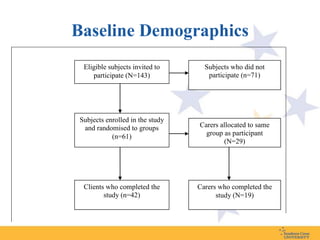
Baseline Demographics
 Eligible subjects invited to      Subjects who did not
    participate (N=143)             participate (n=71)


Subjects enrolled in the study
 and randomised to groups        Carers allocated to same
           (n=61)                  group as participant
                                         (N=29)


 Clients who completed the       Carers who completed the
        study (n=42)                   study (N=19)
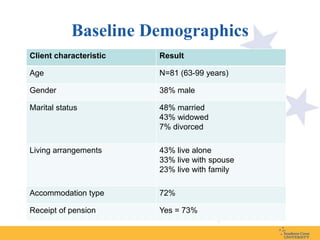
Baseline Demographics
Client characteristic   Result

Age                     N=81 (63-99 years)

Gender                  38% male

Marital status          48% married
                        43% widowed
                        7% divorced

Living arrangements     43% live alone
                        33% live with spouse
                        23% live with family

Accommodation type      72%

Receipt of pension      Yes = 73%
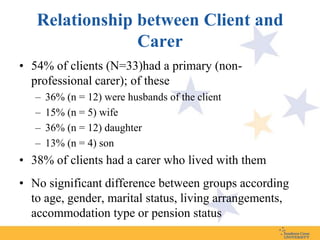
Relationship between Client and
                Carer
• 54% of clients (N=33)had a primary (non-
  professional carer); of these
   –   36% (n = 12) were husbands of the client
   –   15% (n = 5) wife
   –   36% (n = 12) daughter
   –   13% (n = 4) son
• 38% of clients had a carer who lived with them
• No significant difference between groups according
  to age, gender, marital status, living arrangements,
  accommodation type or pension status
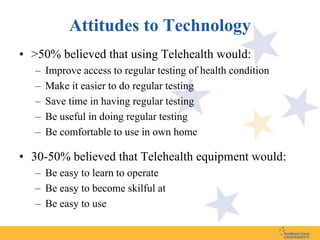
Attitudes to Technology
• >50% believed that using Telehealth would:
   –   Improve access to regular testing of health condition
   –   Make it easier to do regular testing
   –   Save time in having regular testing
   –   Be useful in doing regular testing
   –   Be comfortable to use in own home

• 30-50% believed that Telehealth equipment would:
   – Be easy to learn to operate
   – Be easy to become skilful at
   – Be easy to use
Telehealth Reading Failure Rate
For participants in groups 2-5, daily readings of 4 peripherals
  were taken for the duration of time clients received
  Transition Care (average 8 weeks or 160 readings per
  client) and for an additional 12 weeks post-Transition Care
  for participants in groups 3 & 5, resulting in 9,715 readings.
There was a 12% Telehealth reading failure rate (N=1,263)
  across the 31 participants in groups 2-5. Of those, staff not
  following up missed or incomplete readings accounted for
  33%; equipment failure 31%; participant non-compliance
  30%; and user error 6%.
There was no significant difference between clients with or
  without carers for the reading failure rate, or for each failure
  reason.
Change in Attitude to Technology
• Significant increase in agreement that the Telehealth
  equipment was easy to learn to operate.
• Other trends not statistically significant but trend
  towards clients agreeing:
   – Less strongly that Telehealth would improve access to
     regular testing, make testing easier, save time, be useful;
   – More strongly that interaction with Telehealth was clear
     and understandable, easy to become skilful, easy to use,
     comfortable to use in own home.
Carers of Clients
• The majority of carers had a positive attitude to
  technology at baseline

• Positive feedback from carers:
   – Security and safety
   – Peace of mind
   – Less stress

• Negative feedback from carers:
   – Sometimes didn’t work properly
   – Not always necessary
   – Accuracy an issue
Safety Issues
When the safety of the older person requires high
   Telehealth reading rate reliability, there are a number of
   factors to be considered:
1. The current standard of the monitoring equipment is not of a
    sufficient quality to guarantee safety. (One person in our
    study was recording a zero pulse rate, even though he was
    recording a “readable” blood pressure, because the equipment
    could not detect a pulse rate below 40 beats/min);
2. The presence of an informal carer cannot be assumed to
   improve Telehealth reading rate reliability;
3. Staff training, and working agreements, must emphasise the
   need to follow-up every missed reading, and time must be
   allowed for them to do so.

1 cartwright-ifa telehealth presentation may 2012

  • 1.
    Factors Affecting theSafe Provision of Home Telehealth Monitoring Cartwright C, Shaw K, Wade R ASLaRC Aged Services Unit Southern Cross University, Australia
  • 2.
    Aim of Project:This Component ASLaRC Aged Services Unit & Baptist Community Services undertook a study funded by the Australian Dept of Health & Ageing; the study explored acceptance and usage of Telehealth by frail older clients receiving Transition Care at home, and their informal carers. Client safety was a major consideration One component of the study investigated the reasons for Telehealth reading failure for study participants, and the relationship between Telehealth reading failure rate and the presence or absence of an informal carer.
  • 3.
    Methodology Participants: Frail older peoplebeing discharged home from hospital & at risk of admission to a Residential Aged Care Facility Exclusion Criteria included: Lacks capacity to take daily reading on Telehealth equipment & no carer who could do so; home not suitable for Telehealth equipment Randomisation: A stratified randomisation of participants to: a control group which received standard Transition Care; or one of 4 groups which received TC + Telehealth monitoring of their blood pressure, heart rate, oxygen saturations and body weight for a period of 6-12 or 18 -24 weeks, with or without a medical alarm pendant.
  • 4.
    Baseline Demographics Eligiblesubjects invited to Subjects who did not participate (N=143) participate (n=71) Subjects enrolled in the study and randomised to groups Carers allocated to same (n=61) group as participant (N=29) Clients who completed the Carers who completed the study (n=42) study (N=19)
  • 5.
    Baseline Demographics Client characteristic Result Age N=81 (63-99 years) Gender 38% male Marital status 48% married 43% widowed 7% divorced Living arrangements 43% live alone 33% live with spouse 23% live with family Accommodation type 72% Receipt of pension Yes = 73%
  • 6.
    Relationship between Clientand Carer • 54% of clients (N=33)had a primary (non- professional carer); of these – 36% (n = 12) were husbands of the client – 15% (n = 5) wife – 36% (n = 12) daughter – 13% (n = 4) son • 38% of clients had a carer who lived with them • No significant difference between groups according to age, gender, marital status, living arrangements, accommodation type or pension status
  • 7.
    Attitudes to Technology •>50% believed that using Telehealth would: – Improve access to regular testing of health condition – Make it easier to do regular testing – Save time in having regular testing – Be useful in doing regular testing – Be comfortable to use in own home • 30-50% believed that Telehealth equipment would: – Be easy to learn to operate – Be easy to become skilful at – Be easy to use
  • 8.
    Telehealth Reading FailureRate For participants in groups 2-5, daily readings of 4 peripherals were taken for the duration of time clients received Transition Care (average 8 weeks or 160 readings per client) and for an additional 12 weeks post-Transition Care for participants in groups 3 & 5, resulting in 9,715 readings. There was a 12% Telehealth reading failure rate (N=1,263) across the 31 participants in groups 2-5. Of those, staff not following up missed or incomplete readings accounted for 33%; equipment failure 31%; participant non-compliance 30%; and user error 6%. There was no significant difference between clients with or without carers for the reading failure rate, or for each failure reason.
  • 9.
    Change in Attitudeto Technology • Significant increase in agreement that the Telehealth equipment was easy to learn to operate. • Other trends not statistically significant but trend towards clients agreeing: – Less strongly that Telehealth would improve access to regular testing, make testing easier, save time, be useful; – More strongly that interaction with Telehealth was clear and understandable, easy to become skilful, easy to use, comfortable to use in own home.
  • 10.
    Carers of Clients •The majority of carers had a positive attitude to technology at baseline • Positive feedback from carers: – Security and safety – Peace of mind – Less stress • Negative feedback from carers: – Sometimes didn’t work properly – Not always necessary – Accuracy an issue
  • 11.
    Safety Issues When thesafety of the older person requires high Telehealth reading rate reliability, there are a number of factors to be considered: 1. The current standard of the monitoring equipment is not of a sufficient quality to guarantee safety. (One person in our study was recording a zero pulse rate, even though he was recording a “readable” blood pressure, because the equipment could not detect a pulse rate below 40 beats/min); 2. The presence of an informal carer cannot be assumed to improve Telehealth reading rate reliability; 3. Staff training, and working agreements, must emphasise the need to follow-up every missed reading, and time must be allowed for them to do so.