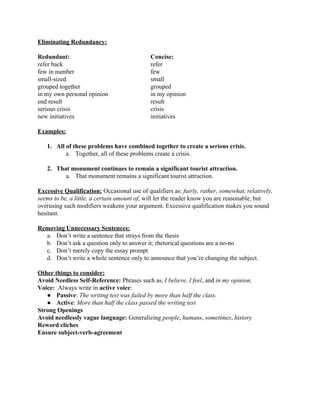
This document provides instructions for writing an academic essay. It discusses breaking down the issue, selecting a side to argue, outlining the essay in 5 paragraphs with an introduction, 3 body paragraphs with evidence, and a conclusion. It also provides tips for streamlining wordy phrases, eliminating redundancy, reducing excessive qualification, removing unnecessary sentences, and other writing best practices.


![The (E)Motions of Juan Dahlman in Jorge Luis Borges’ “The South”
The word ‘fiction’ is used to describe a narrative created in the imagination of a writer.
More importantly, we must use fiction to describe the a narrative created in the mind of a reader.
Juan Dahlman, the protagonist in Jorge Luis Borges’ short story “The South”, is a reader who
found work in the as a secretary in the “municipal library on Calle Cordoba;” one with a mind
susceptible to his imagination and apparently, to infection as well. “The South” begins with the
direct characterization of Dahlman, describing his dual lineages, his Argentine pride and his
romantic nature. While the narrator never depicts an image of Dahlman, we are given subtle and
explicit details to what kind of person he may be. The journey into his character both temporal
and spatial, as we move along with him into the South, into the past and into the illusionary
reality that began on the fateful day he received Arabian Nights. What “The South” reveals is a
man stricken with an illness that leaves him unable to decipher what is real and what is fiction of
the mind.
The mind begins to fade when one is suffering from illness, when the blood is infected
with disease, as Dahlman’s was after “his brow had caught the edge of a recently painted
casement window that somebody had forgotten to close.” Distracted by literature Dahlman
unintentionally slipped into a state of delusion. Nightmares, fevers, and nausea made him feel
like he was “somewhere on the outskirts of hell,” (175). We are told by the narrator that the
seemingly endless days Dahlman spent in the sanatorium was due to septicemia, or, bacteria in
the blood. However, what we are not told is whether the events that follow his release from the
sanatorium are the fictitious constructions of the writer or perhaps the illusions of the character,
Dahlman. In the midst of his journey to the South, his identity, along with his reality, has
blended in with the stories read, heard of, and created, choosing his own “romantic death.”
“Reality is partial to symmetries and slight anachronisms;” (175) the narrator states, and
we find that Dahlman’s reality is not only divided into “two men at once: the man gliding along
through the autumn day and the geography of his native land, and the other man, imprisoned in a
sanatorium and subjected to methodical attentions,” but also divided between the present and the
past. His nostalgia is unveiled in his desire to escape into the South, where “by crossing the
[Avenida] Rivadavia one entered an older and more stable world.” The illusions of space and
time are illustrated in Dahlman’s interactions with the world around him. His thoughts often
question his memories, his knowledge and his altered perception of reality. As soon as Dahlman
steps onto the train, reality is separated by a pane of glass, much like the pane of glass which
separated himself from the cat. “Man lives in time, in successiveness, while the magical animal
lives in the present, in the eternity of the instant,” (176177).
The train becomes a metaphor, a vehicle which transports Dahlman from his present state
into the past, into the deliriums of his sickness, into the romantic landscape of the South, which
is embellished by stories that he has read or been told. The momentum of the train not only
moves through space, but through time, and “Dahlman almost suspected that he was traveling
not only into the South but into the past,” (177). The sight of the city unraveling suggests that his](https://image.slidesharecdn.com/1-160818220554/85/1-academic-writing-student-outline-3-320.jpg)
![perceptions of reality are unraveling as well and as readers we might begin to question his
credibility as a character. Can we believe that what he is experiencing is real, or perhaps he has
constructed for us a fictitious version of the life he wished he had lived. “[H]e saw horsemen on
the clodstrewn roads; he saw ditches and lakes and pastures; he saw long glowing clouds that
seemed made of marble, and all these things were fortuitous, like some dream of the flat
prairies.”
Dahlman believes that he remembers the landscape he passes, the trees and crops that he
couldn’t have possibly known by name, “his direct knowledge of the country was considerably
inferior to his nostalgic literary knowledge,” (177). This indirect characterization, revealed
through Dahlman’s private thoughts and feelings, affirms that his mind is in fact clouded by his
nostalgic desires and his deep connection to literature. Novels such as Arabian Nights and Paul
et Virginie help him construct this false reality and “to block out reality”, as he travels further
into the South and into his mind. After the train drops him off in a desolate town, he enters a
store and “thought he recognized the owner; then he realized that he’d been fooled by the man’s
resemblance to one of the employees at the sanatorium,” (178). Once again, Dahlman is
conflicted by his two opposing realities: the dying man in the sanatorium, and the adventurous
traveler of the South. He choses the later reality in order to die a romantic death:
As he crossed the threshold, he felt that on that first night in the
sanatorium, when they’d stuck that needle in him, dying in a knife
fight under the open sky, grappling with his adversary, would have
been a liberation, a joy, and a fiesta. He sensed that had he been
able to choose or dream his death that night, this is the death he
would have dreamed or chosen. (179)
So perhaps Juan Dahlman is a character whose physical body is still imprisoned on his
deathbed in the sanatorium, but his emotional, romantic being allows his mind to travel to the
South, where the wild terrain satisfies the nostalgia which infected him before the fatal bacteria
ever did. He constructs this alternate reality to save himself from the pain and humiliation of his
unfortunate death, in order to follow in the footsteps of his brave maternal grandfather “who died
on the border of Buenos Aires from a spear wielded by the Indians under Catriel.” Since “his
work, and perhaps his indolence, held him in the city,” (174) Dahlman was only ever able to
escape in his mind, through literature, and then through the delirious final moments of his life.
Borges’ construct of Dahlman created a fiction within a fiction, traveling through time and space
by means of rhetoric and a metaphorical train. Once set in (e)motion, it became the vehicle of
Dahlman’s adventurous imagination.](https://image.slidesharecdn.com/1-160818220554/85/1-academic-writing-student-outline-4-320.jpg)


