Digest
March
2015
CRISIS BIOGRAPHIES:
STAGE 1
June
2015
2
Methodology
PERSONAL STORIES IN THE ATMOSPHERE OF CHANGES IN SOCIETY AND ON THE CONSUMER
MARKET
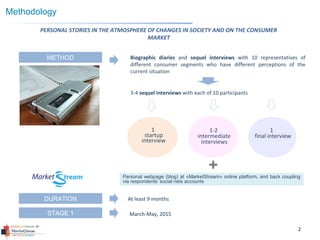
At least 9 months
Biographic diaries and sequel interviews with 10 representatives of
different consumer segments who have different perceptions of the
current situation
3-4 sequel interviews with each of 10 participants
DURATION
METHOD
Personal webpage (blog) at «MarketStream» online platform, and back coupling
via respondents’ social nets accounts
+
March-May, 2015STAGE 1
1
final interview
1-2
intermediate
interviews
1
startup
interview
3
Participants
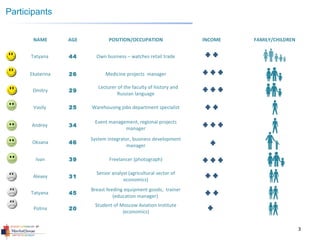
NAME AGE POSITION/OCCUPATION INCOME FAMILY/CHILDREN
Tatyana 44 Own business – watches retail trade
Ekaterina 26 Medicine projects manager
Dmitry 29
Lecturer of the faculty of history and
Russian language
Vasily 25 Warehousing jobs department specialist
Andrey 34
Event management, regional projects
manager
Oksana 46
System integrator, business development
manager
Ivan 39 Freelancer (photograph)
Alexey 31
Senior analyst (agricultural sector of
economics)
Tatyana 45
Breast feeding equipment goods, trainer
(education manager)
Polina 20
Student of Moscow Aviation Institute
(economics)
4
• It’s hard to find a real pessimist. According to the data of public survey polls, most of the
Russians are generally satisfied with their life level, despite the crisis.
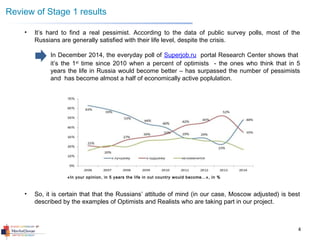
• In December 2014, the everyday poll of Superjob.ru portal Research Center shows that
it’s the 1st
time since 2010 when a percent of optimists - the ones who think that in 5
years the life in Russia would become better – has surpassed the number of pessimists
and has become almost a half of economically active poplulation.
Review of Stage 1 results
«In your opinion, in 5 years the life in out country would become...», in %
• So, it is certain that that the Russians’ attitude of mind (in our case, Moscow adjusted) is best
described by the examples of Optimists and Realists who are taking part in our project.
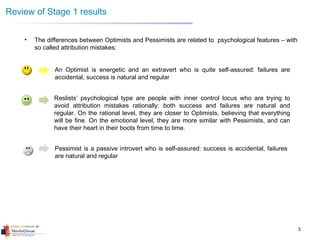
5
• The differences between Optimists and Pessimists are related to psychological features – with
so called attribution mistakes:
• An Optimist is energetic and an extravert who is quite self-assured: failures are
accidental, success is natural and regular
• Pessimist is a passive introvert who is self-assured: success is accidental, failures
are natural and regular
• Reslists’ psychological type are people with inner control locus who are trying to
avoid attribution mistakes rationally: both success and failures are natural and
regular. On the rational level, they are closer to Optimists, believing that everything
will be fine. On the emotional level, they are more similar with Pessimists, and can
have their heart in their boots from time to time.
Review of Stage 1 results
Less expenses
on leisure and
hobbies
Ищу бесплатный
контент в
Интернете
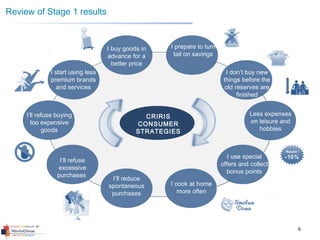
6
Review of Stage 1 results
CRIRIS
CONSUMER
STRATEGIES
I use special
offers and collect
bonus points
I cook at home
more often
I’ll refuse
excessive
purchases
I start using less
premium brands
and services
I don’t buy new
things before the
old reserves are
finished
I prepare to turn
tail on savings
I buy goods in
advance for a
better price
I’ll refuse buying
too expensive
goods
I’ll reduce
spontaneous
purchases
7
Review of Stage 1 results
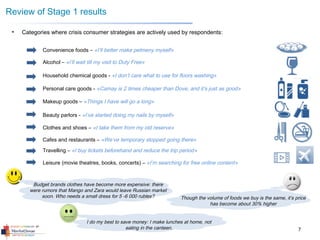
Though the volume of foods we buy is the same, it’s price
has become about 30% higher
I do my best to save money: I make lunches at home, not
eating in the canteen.
Budget brands clothes have become more expensive: there
were rumors that Mango and Zara would leave Russian market
soon. Who needs a small dress for 5 -6 000 rubles?
Convenience foods – «I’ll better make pelmeny myself»
Alcohol – «I’ll wait till my visit to Duty Free»
Household chemical goods - «I don’t care what to use for floors washing»
Personal care goods - «Camay is 2 times cheaper than Dove, and it’s just as good»
Makeup goods – «Things I have will go a long»
Beauty parlors - «I’ve started doing my nails by myself»
Clothes and shoes – «I take them from my old reserve»
Cafes and restaurants – «We’ve temporary stopped going there»
Travelling – «I buy tickets beforehand and reduce the trip period»
Leisure (movie theatres, books, concerts) – «I’m searching for free online content»
• Categories where crisis consumer strategies are actively used by respondents:
8
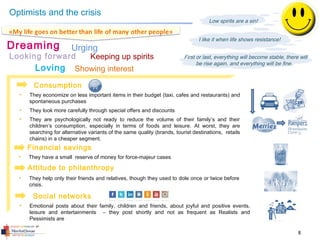
• They economize on less important items in their budget (taxi, cafes and restaurants) and
spontaneous purchases
• They look more carefully through special offers and discounts
• They are psychologically not ready to reduce the volume of their family’s and their
children’s consumption, especially in terms of foods and leisure. At worst, they are
searching for alternative variants of the same quality (brands, tourist destinations, retails
chains) in a cheaper segment.
Consumption
Optimists and the crisis
First or last, everything will become stable, there will
be rise again, and everything will be fine.
Looking forward
Dreaming
Showing interest
Keeping up spirits
Loving
Urging
Low spirits are a sin!
I like it when life shows resistance!
• Emotional posts about their family, children and friends, about joyful and positive events,
leisure and entertainments – they post shortly and not as frequent as Realists and
Pessimists are
Social networks
Financial savings
Attitude to philanthropy
• They help only their friends and relatives, though they used to dole once or twice before
crisis.
• They have a small reserve of money for force-majeur cases
9
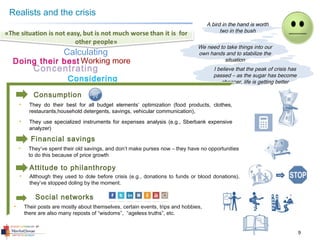
• They do their best for all budget elements’ optimization (food products, clothes,
restaurants,household detergents, savings, vehicular communication),
• They use specialized instruments for expenses analysis (e.g., Sberbank expensive
analyzer)
Consumption
Realists and the crisis
I believe that the peak of crisis has
passed – as the sugar has become
cheaper, life is getting better
Concentrating
Doing their best Working more
Considering
Calculating
A bird in the hand is worth
two in the bush
We need to take things into our
own hands and to stabilize the
situation
• Their posts are mostly about themselves, certain events, trips and hobbies,
there are also many reposts of “wisdoms”, “ageless truths”, etc.
Social networks
Financial savings
• They’ve spent their old savings, and don’t make purses now – they have no opportunities
to do this because of price growth
Attitude to philanthropy
• Although they used to dole before crisis (e.g., donations to funds or blood donations),
they’ve stopped doling by the moment.
10
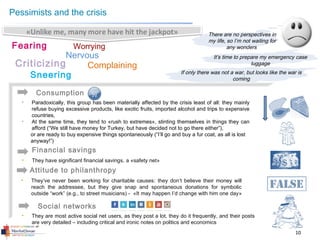
• Paradoxically, this group has been materially affected by the crisis least of all: they mainly
refuse buying excessive products, like exotic fruits, imported alcohol and trips to expensive
countries,
• At the same time, they tend to «rush to extremes», stinting themselves in things they can
afford (“We still have money for Turkey, but have decided not to go there either”),
or are ready to buy expensive things spontaneously (“I’ll go and buy a fur coat, as all is lost
anyway!”)
Consumption
Pessimists and the crisis
If only there was not a war, but looks like the war is
coming
Criticizing
Fearing
Complaining
Worrying
Sneering
Nervous
There are no perspectives in
my life, so I’m not waiting for
any wonders
It’s time to prepare my emergency case
luggage
• They are most active social net users, as they post a lot, they do it frequently, and their posts
are very detailed – including critical and ironic notes on politics and economics
Social networks
Financial savings
• They have significant financial savings, a «safety net»
Attitude to philanthropy
• They’ve never been working for charitable causes: they don’t believe their money will
reach the addressee, but they give snap and spontaneous donations for symbolic
outside “work” (e.g., to street musicians) - «It may happen I’d change with him one day»
THE REVIEW OF STAGE 2: SUMMER RESULTS
(JUNE-AUGUST 2015)
WILL BE PROVIDED IN SEPTEMBER

1 этап весна 2015 eng

  • 1.
  • 2.
    2 Methodology PERSONAL STORIES INTHE ATMOSPHERE OF CHANGES IN SOCIETY AND ON THE CONSUMER MARKET At least 9 months Biographic diaries and sequel interviews with 10 representatives of different consumer segments who have different perceptions of the current situation 3-4 sequel interviews with each of 10 participants DURATION METHOD Personal webpage (blog) at «MarketStream» online platform, and back coupling via respondents’ social nets accounts + March-May, 2015STAGE 1 1 final interview 1-2 intermediate interviews 1 startup interview
  • 3.
    3 Participants NAME AGE POSITION/OCCUPATIONINCOME FAMILY/CHILDREN Tatyana 44 Own business – watches retail trade Ekaterina 26 Medicine projects manager Dmitry 29 Lecturer of the faculty of history and Russian language Vasily 25 Warehousing jobs department specialist Andrey 34 Event management, regional projects manager Oksana 46 System integrator, business development manager Ivan 39 Freelancer (photograph) Alexey 31 Senior analyst (agricultural sector of economics) Tatyana 45 Breast feeding equipment goods, trainer (education manager) Polina 20 Student of Moscow Aviation Institute (economics)
  • 4.
    4 • It’s hardto find a real pessimist. According to the data of public survey polls, most of the Russians are generally satisfied with their life level, despite the crisis. • In December 2014, the everyday poll of Superjob.ru portal Research Center shows that it’s the 1st time since 2010 when a percent of optimists - the ones who think that in 5 years the life in Russia would become better – has surpassed the number of pessimists and has become almost a half of economically active poplulation. Review of Stage 1 results «In your opinion, in 5 years the life in out country would become...», in % • So, it is certain that that the Russians’ attitude of mind (in our case, Moscow adjusted) is best described by the examples of Optimists and Realists who are taking part in our project.
  • 5.
    5 • The differencesbetween Optimists and Pessimists are related to psychological features – with so called attribution mistakes: • An Optimist is energetic and an extravert who is quite self-assured: failures are accidental, success is natural and regular • Pessimist is a passive introvert who is self-assured: success is accidental, failures are natural and regular • Reslists’ psychological type are people with inner control locus who are trying to avoid attribution mistakes rationally: both success and failures are natural and regular. On the rational level, they are closer to Optimists, believing that everything will be fine. On the emotional level, they are more similar with Pessimists, and can have their heart in their boots from time to time. Review of Stage 1 results
  • 6.
    Less expenses on leisureand hobbies Ищу бесплатный контент в Интернете 6 Review of Stage 1 results CRIRIS CONSUMER STRATEGIES I use special offers and collect bonus points I cook at home more often I’ll refuse excessive purchases I start using less premium brands and services I don’t buy new things before the old reserves are finished I prepare to turn tail on savings I buy goods in advance for a better price I’ll refuse buying too expensive goods I’ll reduce spontaneous purchases
  • 7.
    7 Review of Stage1 results Though the volume of foods we buy is the same, it’s price has become about 30% higher I do my best to save money: I make lunches at home, not eating in the canteen. Budget brands clothes have become more expensive: there were rumors that Mango and Zara would leave Russian market soon. Who needs a small dress for 5 -6 000 rubles? Convenience foods – «I’ll better make pelmeny myself» Alcohol – «I’ll wait till my visit to Duty Free» Household chemical goods - «I don’t care what to use for floors washing» Personal care goods - «Camay is 2 times cheaper than Dove, and it’s just as good» Makeup goods – «Things I have will go a long» Beauty parlors - «I’ve started doing my nails by myself» Clothes and shoes – «I take them from my old reserve» Cafes and restaurants – «We’ve temporary stopped going there» Travelling – «I buy tickets beforehand and reduce the trip period» Leisure (movie theatres, books, concerts) – «I’m searching for free online content» • Categories where crisis consumer strategies are actively used by respondents:
  • 8.
    8 • They economizeon less important items in their budget (taxi, cafes and restaurants) and spontaneous purchases • They look more carefully through special offers and discounts • They are psychologically not ready to reduce the volume of their family’s and their children’s consumption, especially in terms of foods and leisure. At worst, they are searching for alternative variants of the same quality (brands, tourist destinations, retails chains) in a cheaper segment. Consumption Optimists and the crisis First or last, everything will become stable, there will be rise again, and everything will be fine. Looking forward Dreaming Showing interest Keeping up spirits Loving Urging Low spirits are a sin! I like it when life shows resistance! • Emotional posts about their family, children and friends, about joyful and positive events, leisure and entertainments – they post shortly and not as frequent as Realists and Pessimists are Social networks Financial savings Attitude to philanthropy • They help only their friends and relatives, though they used to dole once or twice before crisis. • They have a small reserve of money for force-majeur cases
  • 9.
    9 • They dotheir best for all budget elements’ optimization (food products, clothes, restaurants,household detergents, savings, vehicular communication), • They use specialized instruments for expenses analysis (e.g., Sberbank expensive analyzer) Consumption Realists and the crisis I believe that the peak of crisis has passed – as the sugar has become cheaper, life is getting better Concentrating Doing their best Working more Considering Calculating A bird in the hand is worth two in the bush We need to take things into our own hands and to stabilize the situation • Their posts are mostly about themselves, certain events, trips and hobbies, there are also many reposts of “wisdoms”, “ageless truths”, etc. Social networks Financial savings • They’ve spent their old savings, and don’t make purses now – they have no opportunities to do this because of price growth Attitude to philanthropy • Although they used to dole before crisis (e.g., donations to funds or blood donations), they’ve stopped doling by the moment.
  • 10.
    10 • Paradoxically, thisgroup has been materially affected by the crisis least of all: they mainly refuse buying excessive products, like exotic fruits, imported alcohol and trips to expensive countries, • At the same time, they tend to «rush to extremes», stinting themselves in things they can afford (“We still have money for Turkey, but have decided not to go there either”), or are ready to buy expensive things spontaneously (“I’ll go and buy a fur coat, as all is lost anyway!”) Consumption Pessimists and the crisis If only there was not a war, but looks like the war is coming Criticizing Fearing Complaining Worrying Sneering Nervous There are no perspectives in my life, so I’m not waiting for any wonders It’s time to prepare my emergency case luggage • They are most active social net users, as they post a lot, they do it frequently, and their posts are very detailed – including critical and ironic notes on politics and economics Social networks Financial savings • They have significant financial savings, a «safety net» Attitude to philanthropy • They’ve never been working for charitable causes: they don’t believe their money will reach the addressee, but they give snap and spontaneous donations for symbolic outside “work” (e.g., to street musicians) - «It may happen I’d change with him one day»
  • 11.
    THE REVIEW OFSTAGE 2: SUMMER RESULTS (JUNE-AUGUST 2015) WILL BE PROVIDED IN SEPTEMBER