Leading Cultures that Deliver
High Quality Care
National Health Care Conference, Dublin 2013
Michael West
The King’s Fund,
Lancaster University Management School, AstonOD
1
Leading cultures for high quality care
1. Prioritising an inspirational vision and narrative –
focused on quality
2. Clear aligned goals and objectives at every level
3. Good people management and employee
engagement
4. Continuous learning and quality improvement
5. Team-working, cooperation and integration
6. Via a values-based, collective leadership strategy
1. Vision, values and strategy
Vision sets out clear ambition for the future, to
guide and inspire the whole organisation
1. It is forward looking
2. Makes clear commitments
3. Is inspiring to and welcomed by stakeholders
‘To deliver continuously
improving, high quality and
compassionate care to all in
our community’
2. Clear aligned goals at every level
• Clear objectives linked to quality improvement
• Aligned, measureable and challenging …
at every level and feedback on performance
BMJ Quality and Safety,
Sept 2013
http://www.lums.lancs.a
c.uk/nhs-quality
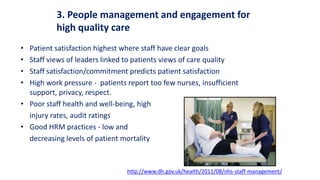
3. People management and engagement for
high quality care
• Patient satisfaction highest where staff have clear goals
• Staff views of leaders linked to patients views of care quality
• Staff satisfaction/commitment predicts patient satisfaction
• High work pressure - patients report too few nurses, insufficient
support, privacy, respect.
• Poor staff health and well-being, high
injury rates, audit ratings
• Good HRM practices - low and
decreasing levels of patient mortality
http://www.dh.gov.uk/health/2011/08/nhs-staff-management/
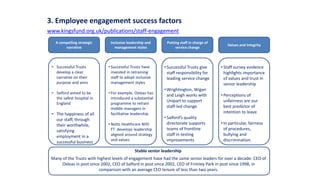
3. Employee engagement success factors
www.kingsfund.org.uk/publications/staff-engagement
A compelling strategic
narrative
Inclusive leadership and
management styles
Putting staff in charge of
service change
• Successful Trusts
develop a clear
narrative on their
purpose and aims
• Salford aimed to be
the safest hospital in
England
• The happiness of all
our staff, through
their worthwhile,
satisfying
employment in a
successful business
Values and Integrity
• Successful Trusts have
invested in retraining
staff to adopt inclusive
management styles
• For example, Oxleas has
introduced a substantial
programme to retrain
middle managers in
facilitative leadership
• Notts Healthcare NHS
FT develops leadership
aligned around strategy
and values
•Successful Trusts give
staff responsibility for
leading service change
•Wrightington, Wigan
and Leigh works with
Unipart to support
staff-led change
•Salford’s quality
directorate supports
teams of frontline
staff in testing
improvements
•Staff survey evidence
highlights importance
of values and trust in
senior leadership
•Perceptions of
unfairness are our
best predictor of
intention to leave
•In particular, fairness
of procedures,
bullying and
discrimination.
Stable senior leadership
Many of the Trusts with highest levels of engagement have had the same senior leaders for over a decade: CEO of
Oxleas in post since 2002, CEO of Salford in post since 2002, CEO of Frimley Park in post since 1998, in
comparison with an average CEO tenure of less than two years.
4. Learning, QI and Innovation
Learning organizations facilitate the learning of all staff and the
organization to continuously improve high quality, compassionate
care.
1. Learning organizations are characterised by systems thinking;
information systems that measure performance; and continuous
quality improvement
2. Staff are encouraged and motivated to focus on improving quality
3. Team learning and cross boundary cooperation, trust, and openness
4. High levels of dialogue and discussion end to end and top to bottom
4. Learning and innovation
A promise to learn – A commitment to act
• Staff focused on continually improving patient care
• Staff focused on ensuring zero harm
• Reflective practice and learning endemic
• All staff are accountable
• Staff enabled at all levels to learn about best practice
• Effective schemes to promote responsible, safe innovation – lean, QI
• Recognition and reward for QI and innovation at every level and in every
department/team/function
Chassin & Loeb (2013). High reliability health care. Millbank Quarterly, 91, 459-490.
5. Team working, cooperation and integration
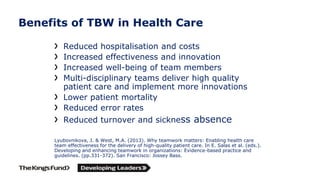
Benefits of TBW in Health Care
Reduced hospitalisation and costs
Increased effectiveness and innovation
Increased well-being of team members
Multi-disciplinary teams deliver high quality
patient care and implement more innovations
Lower patient mortality
Reduced error rates
Reduced turnover and sickness absence
Lyubovnikova, J. & West, M.A. (2013). Why teamwork matters: Enabling health care
team effectiveness for the delivery of high-quality patient care. In E. Salas et al. (eds.).
Developing and enhancing teamwork in organizations: Evidence-based practice and
guidelines. (pp.331-372). San Francisco: Jossey Bass.
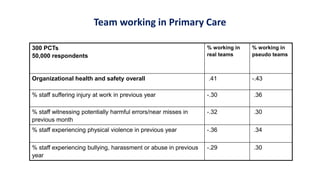
Team working in Primary Care
300 PCTs
50,000 respondents
% working in
real teams
% working in
pseudo teams
Organizational health and safety overall .41 -.43
% staff suffering injury at work in previous year -.30 .36
% staff witnessing potentially harmful errors/near misses in
previous month
-.32 .30
% staff experiencing physical violence in previous year -.36 .34
% staff experiencing bullying, harassment or abuse in previous
year
-.29 .30
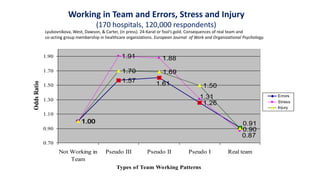
Working in Team and Errors, Stress and Injury
(170 hospitals, 120,000 respondents)
1.00
1.57
1.26
1.00
1.91 1.88
1.00
1.70 1.69
1.501.61
0.91
1.31
0.87
0.90
0.70
0.90
1.10
1.30
1.50
1.70
1.90
Not Working in
Team
Pseudo III Pseudo II Pseudo I Real team
Types of Team Working Patterns
OddsRatio
Errors
Stress
Injury
Lyubovnikova, West, Dawson, & Carter, (in press). 24-Karat or fool’s gold. Consequences of real team and
co-acting group membership in healthcare organizations. European Journal of Work and Organizational Psychology.
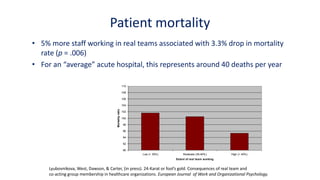
Patient mortality
• 5% more staff working in real teams associated with 3.3% drop in mortality
rate (p = .006)
• For an “average” acute hospital, this represents around 40 deaths per year
90
92
94
96
98
100
102
104
106
108
110
Low (< 35%) Moderate (35-40%) High (> 40%)
Extent of real team working
Mortalityratio
Lyubovnikova, West, Dawson, & Carter, (in press). 24-Karat or fool’s gold. Consequences of real team and
co-acting group membership in healthcare organizations. European Journal of Work and Organizational Psychology.
Team Leadership
• Offer an inspiring vision and clear direction
• Ensure regular and positive team meetings
• Encourage positive, supportive relationships
• Resolve and prevent intense conflicts
• Positive group attitudes towards diversity
• Be attentive and listen carefully to the team
• Lead inter-team cooperation
• Nurture team learning, improvement & innovation
6. Collective Leadership
Leadership the responsibility of all - anyone with expertise taking
responsibility when appropriate
Shared leadership in teams
Interdependent, collaborative leadership - working together to ensure
high quality health and social care
Leaders and teams prioritising quality of care across the
system/organisation
Shared approach to leadership within the leadership community
http://www.kingsfund.org.uk/publications/developing-collective-leadership-health-
care
West, M. A., Lyubovnikova, J., Eckert, R., & Denis, J.L. , (2014),Collective leadership for cultures of
high quality health care. Journal of Organizational Effectiveness: People and Performance, 1, 240 –
260. http://dx.doi.org/10.1108/JOEPP-07-2014-0039
e.mail m.west@kingsfund.org.uk
Twitter @westm61
@astonod
Thank you

0905 michael west dublin 2805 main

  • 1.
    Leading Cultures thatDeliver High Quality Care National Health Care Conference, Dublin 2013 Michael West The King’s Fund, Lancaster University Management School, AstonOD 1
  • 2.
    Leading cultures forhigh quality care 1. Prioritising an inspirational vision and narrative – focused on quality 2. Clear aligned goals and objectives at every level 3. Good people management and employee engagement 4. Continuous learning and quality improvement 5. Team-working, cooperation and integration 6. Via a values-based, collective leadership strategy
  • 3.
    1. Vision, valuesand strategy Vision sets out clear ambition for the future, to guide and inspire the whole organisation 1. It is forward looking 2. Makes clear commitments 3. Is inspiring to and welcomed by stakeholders ‘To deliver continuously improving, high quality and compassionate care to all in our community’
  • 4.
    2. Clear alignedgoals at every level • Clear objectives linked to quality improvement • Aligned, measureable and challenging … at every level and feedback on performance BMJ Quality and Safety, Sept 2013 http://www.lums.lancs.a c.uk/nhs-quality
  • 5.
    3. People managementand engagement for high quality care • Patient satisfaction highest where staff have clear goals • Staff views of leaders linked to patients views of care quality • Staff satisfaction/commitment predicts patient satisfaction • High work pressure - patients report too few nurses, insufficient support, privacy, respect. • Poor staff health and well-being, high injury rates, audit ratings • Good HRM practices - low and decreasing levels of patient mortality http://www.dh.gov.uk/health/2011/08/nhs-staff-management/
  • 6.
    3. Employee engagementsuccess factors www.kingsfund.org.uk/publications/staff-engagement A compelling strategic narrative Inclusive leadership and management styles Putting staff in charge of service change • Successful Trusts develop a clear narrative on their purpose and aims • Salford aimed to be the safest hospital in England • The happiness of all our staff, through their worthwhile, satisfying employment in a successful business Values and Integrity • Successful Trusts have invested in retraining staff to adopt inclusive management styles • For example, Oxleas has introduced a substantial programme to retrain middle managers in facilitative leadership • Notts Healthcare NHS FT develops leadership aligned around strategy and values •Successful Trusts give staff responsibility for leading service change •Wrightington, Wigan and Leigh works with Unipart to support staff-led change •Salford’s quality directorate supports teams of frontline staff in testing improvements •Staff survey evidence highlights importance of values and trust in senior leadership •Perceptions of unfairness are our best predictor of intention to leave •In particular, fairness of procedures, bullying and discrimination. Stable senior leadership Many of the Trusts with highest levels of engagement have had the same senior leaders for over a decade: CEO of Oxleas in post since 2002, CEO of Salford in post since 2002, CEO of Frimley Park in post since 1998, in comparison with an average CEO tenure of less than two years.
  • 7.
    4. Learning, QIand Innovation Learning organizations facilitate the learning of all staff and the organization to continuously improve high quality, compassionate care. 1. Learning organizations are characterised by systems thinking; information systems that measure performance; and continuous quality improvement 2. Staff are encouraged and motivated to focus on improving quality 3. Team learning and cross boundary cooperation, trust, and openness 4. High levels of dialogue and discussion end to end and top to bottom
  • 8.
    4. Learning andinnovation A promise to learn – A commitment to act • Staff focused on continually improving patient care • Staff focused on ensuring zero harm • Reflective practice and learning endemic • All staff are accountable • Staff enabled at all levels to learn about best practice • Effective schemes to promote responsible, safe innovation – lean, QI • Recognition and reward for QI and innovation at every level and in every department/team/function Chassin & Loeb (2013). High reliability health care. Millbank Quarterly, 91, 459-490.
  • 9.
    5. Team working,cooperation and integration
  • 10.
    Benefits of TBWin Health Care Reduced hospitalisation and costs Increased effectiveness and innovation Increased well-being of team members Multi-disciplinary teams deliver high quality patient care and implement more innovations Lower patient mortality Reduced error rates Reduced turnover and sickness absence Lyubovnikova, J. & West, M.A. (2013). Why teamwork matters: Enabling health care team effectiveness for the delivery of high-quality patient care. In E. Salas et al. (eds.). Developing and enhancing teamwork in organizations: Evidence-based practice and guidelines. (pp.331-372). San Francisco: Jossey Bass.
  • 11.
    Team working inPrimary Care 300 PCTs 50,000 respondents % working in real teams % working in pseudo teams Organizational health and safety overall .41 -.43 % staff suffering injury at work in previous year -.30 .36 % staff witnessing potentially harmful errors/near misses in previous month -.32 .30 % staff experiencing physical violence in previous year -.36 .34 % staff experiencing bullying, harassment or abuse in previous year -.29 .30
  • 12.
    Working in Teamand Errors, Stress and Injury (170 hospitals, 120,000 respondents) 1.00 1.57 1.26 1.00 1.91 1.88 1.00 1.70 1.69 1.501.61 0.91 1.31 0.87 0.90 0.70 0.90 1.10 1.30 1.50 1.70 1.90 Not Working in Team Pseudo III Pseudo II Pseudo I Real team Types of Team Working Patterns OddsRatio Errors Stress Injury Lyubovnikova, West, Dawson, & Carter, (in press). 24-Karat or fool’s gold. Consequences of real team and co-acting group membership in healthcare organizations. European Journal of Work and Organizational Psychology.
  • 13.
    Patient mortality • 5%more staff working in real teams associated with 3.3% drop in mortality rate (p = .006) • For an “average” acute hospital, this represents around 40 deaths per year 90 92 94 96 98 100 102 104 106 108 110 Low (< 35%) Moderate (35-40%) High (> 40%) Extent of real team working Mortalityratio Lyubovnikova, West, Dawson, & Carter, (in press). 24-Karat or fool’s gold. Consequences of real team and co-acting group membership in healthcare organizations. European Journal of Work and Organizational Psychology.
  • 14.
    Team Leadership • Offeran inspiring vision and clear direction • Ensure regular and positive team meetings • Encourage positive, supportive relationships • Resolve and prevent intense conflicts • Positive group attitudes towards diversity • Be attentive and listen carefully to the team • Lead inter-team cooperation • Nurture team learning, improvement & innovation
  • 15.
    6. Collective Leadership Leadershipthe responsibility of all - anyone with expertise taking responsibility when appropriate Shared leadership in teams Interdependent, collaborative leadership - working together to ensure high quality health and social care Leaders and teams prioritising quality of care across the system/organisation Shared approach to leadership within the leadership community http://www.kingsfund.org.uk/publications/developing-collective-leadership-health- care West, M. A., Lyubovnikova, J., Eckert, R., & Denis, J.L. , (2014),Collective leadership for cultures of high quality health care. Journal of Organizational Effectiveness: People and Performance, 1, 240 – 260. http://dx.doi.org/10.1108/JOEPP-07-2014-0039
  • 16.