The Boards Role in Leading for Quality and Safety - A Regional Approach 
Lesley Massey, Director 
14.10.2014
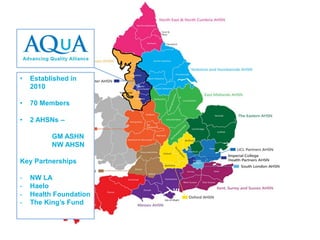
•Established in 2010 
•70 Members 
•2 AHSNs – GM ASHN NW AHSN Key Partnerships 
-NW LA 
-Haelo 
-Health Foundation 
-The King’s Fund
3 
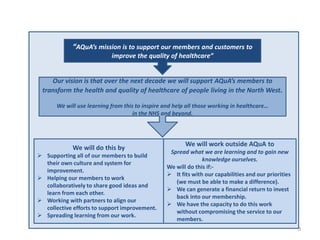
“AQuA’s mission is to support our members and customers to 
improve the quality of healthcare” 
Our vision is that over the next decade we will support AQuA’s members to transform the health and quality of healthcare of people living in the North West. We will use learning from this to inspire and help all those working in healthcare… in the NHS and beyond. 
We will do this by 
Supporting all of our members to build their own culture and system for improvement. 
Helping our members to work collaboratively to share good ideas and learn from each other. 
Working with partners to align our collective efforts to support improvement. 
Spreading learning from our work. 
We will work outside AQuA to Spread what we are learning and to gain new knowledge ourselves. We will do this if:- 
It fits with our capabilities and our priorities (we must be able to make a difference). 
We can generate a financial return to invest back into our membership. 
We have the capacity to do this work without compromising the service to our members.
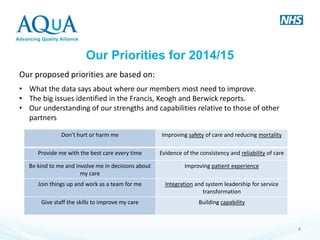
Our Priorities for 2014/15 
Our proposed priorities are based on: 
•What the data says about where our members most need to improve. 
•The big issues identified in the Francis, Keogh and Berwick reports. 
•Our understanding of our strengths and capabilities relative to those of other partners 
4 
Don’t hurt or harm me 
Improving safety of care and reducing mortality 
Provide me with the best care every time 
Evidence of the consistency and reliability of care 
Be kind to me and involve me in decisions about my care 
Improving patient experience 
Join things up and work as a team for me 
Integration and system leadership for service transformation 
Give staff the skills to improve my care 
Building capability
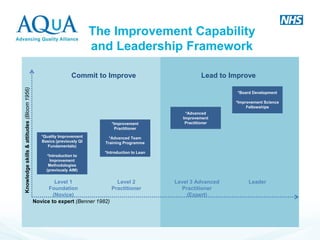
The Improvement Capability and Leadership Framework 
Novice to expert (Benner 1982) 
Knowledge skills & attitudes (Bloom 1956) 
Commit to Improve 
Lead to Improve 
*Quality Improvement Basics (previously QI Fundamentals) 
*Introduction to Improvement Methodologies (previously AIM) 
*Improvement Practitioner 
*Advanced Team Training Programme 
*Introduction to Lean 
*Advanced Improvement Practitioner 
*Board Development 
*Improvement Science Fellowships 
Level 1 Foundation (Novice) 
Level 2 
Practitioner 
Level 3 Advanced Practitioner (Expert) 
Leader
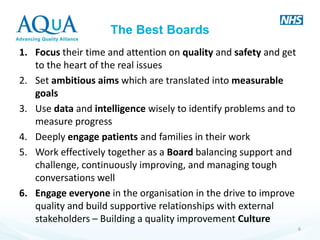
The Best Boards 
1.Focus their time and attention on quality and safety and get to the heart of the real issues 
2.Set ambitious aims which are translated into measurable goals 
3.Use data and intelligence wisely to identify problems and to measure progress 
4.Deeply engage patients and families in their work 
5.Work effectively together as a Board balancing support and challenge, continuously improving, and managing tough conversations well 
6.Engage everyone in the organisation in the drive to improve quality and build supportive relationships with external stakeholders – Building a quality improvement Culture 
6
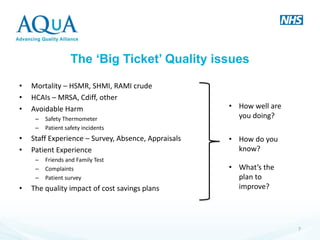
The ‘Big Ticket’ Quality issues 
•Mortality – HSMR, SHMI, RAMI crude 
•HCAIs – MRSA, Cdiff, other 
•Avoidable Harm 
–Safety Thermometer 
–Patient safety incidents 
•Staff Experience – Survey, Absence, Appraisals 
•Patient Experience 
–Friends and Family Test 
–Complaints 
–Patient survey 
•The quality impact of cost savings plans 
7 
•How well are you doing? 
•How do you know? 
•What’s the plan to improve?
8 
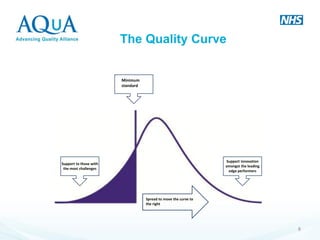
The Quality Curve 
Spread to move the curve to the right 
Minimum standard 
Support innovation amongst the leading edge performers 
Support to those with the most challenges
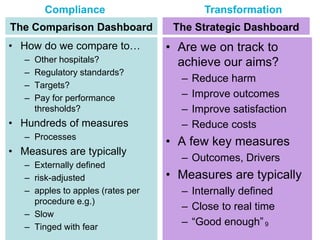
The Comparison Dashboard 
•How do we compare to… 
–Other hospitals? 
–Regulatory standards? 
–Targets? 
–Pay for performance thresholds? 
•Hundreds of measures 
–Processes 
•Measures are typically 
–Externally defined 
–risk-adjusted 
–apples to apples (rates per procedure e.g.) 
–Slow 
–Tinged with fear 
The Strategic Dashboard 
•Are we on track to achieve our aims? 
–Reduce harm 
–Improve outcomes 
–Improve satisfaction 
–Reduce costs 
•A few key measures 
–Outcomes, Drivers 
•Measures are typically 
–Internally defined 
–Close to real time 
–“Good enough” 
Compliance 
Transformation 
9
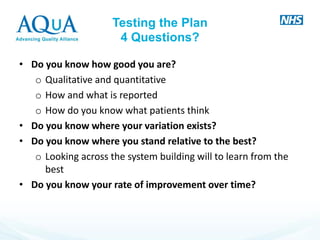
Testing the Plan 4 Questions? 
•Do you know how good you are? 
oQualitative and quantitative 
oHow and what is reported 
oHow do you know what patients think 
•Do you know where your variation exists? 
•Do you know where you stand relative to the best? 
oLooking across the system building will to learn from the best 
•Do you know your rate of improvement over time?
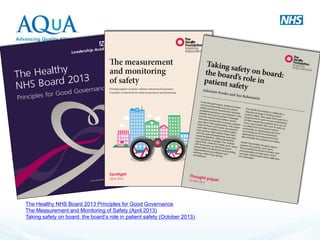
The Healthy NHS Board 2013 Principles for Good Governance The Measurement and Monitoring of Safety (April 2013) Taking safety on board: the board’s role in patient safety (October 2013)
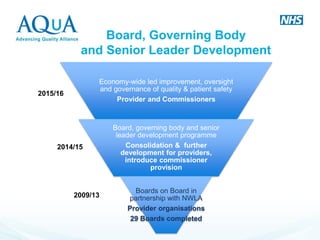
Board, Governing Body and Senior Leader Development 
Economy-wide led improvement, oversight and governance of quality & patient safety Provider and Commissioners 
Board, governing body and senior leader development programme Consolidation & further development for providers, introduce commissioner provision 
Boards on Board in partnership with NWLA 
Provider organisations 
29 Boards completed 
2009/13 
2014/15 
2015/16
Next Phase 
New programme design, pilot and test phase 
Aligned to the ‘Sign Up to Safety’ Campaign 
2- day advanced board programme on quality and safety for provider trusts 
Masterclass on Human Factors aimed at Exec teams & senior leaders 
Clinical Leaders development day. Scenario based 
AQuA faculty development
Cont’d 
•Addressing needs of the ‘safe’ domain - CQC 
How Safe is your organisation’s care? 
•Content covering: 
Track record on safety “past harm”- (Lagging Indicators) 
Lessons learnt, and improved safety standards adopted 
Reliable systems, processes and practices 
Assessing and monitoring safety in real time 
Risk anticipation and advanced planning (Leading Indicators) 
•Coming away with new or improved safety strategy 
(Measurement and Monitoring of Safety Framework 
Charles Vincent et al.)

lesley massey collaborative launch

  • 1.
    The Boards Rolein Leading for Quality and Safety - A Regional Approach Lesley Massey, Director 14.10.2014
  • 2.
    •Established in 2010 •70 Members •2 AHSNs – GM ASHN NW AHSN Key Partnerships -NW LA -Haelo -Health Foundation -The King’s Fund
  • 3.
    3 “AQuA’s missionis to support our members and customers to improve the quality of healthcare” Our vision is that over the next decade we will support AQuA’s members to transform the health and quality of healthcare of people living in the North West. We will use learning from this to inspire and help all those working in healthcare… in the NHS and beyond. We will do this by Supporting all of our members to build their own culture and system for improvement. Helping our members to work collaboratively to share good ideas and learn from each other. Working with partners to align our collective efforts to support improvement. Spreading learning from our work. We will work outside AQuA to Spread what we are learning and to gain new knowledge ourselves. We will do this if:- It fits with our capabilities and our priorities (we must be able to make a difference). We can generate a financial return to invest back into our membership. We have the capacity to do this work without compromising the service to our members.
  • 4.
    Our Priorities for2014/15 Our proposed priorities are based on: •What the data says about where our members most need to improve. •The big issues identified in the Francis, Keogh and Berwick reports. •Our understanding of our strengths and capabilities relative to those of other partners 4 Don’t hurt or harm me Improving safety of care and reducing mortality Provide me with the best care every time Evidence of the consistency and reliability of care Be kind to me and involve me in decisions about my care Improving patient experience Join things up and work as a team for me Integration and system leadership for service transformation Give staff the skills to improve my care Building capability
  • 5.
    The Improvement Capabilityand Leadership Framework Novice to expert (Benner 1982) Knowledge skills & attitudes (Bloom 1956) Commit to Improve Lead to Improve *Quality Improvement Basics (previously QI Fundamentals) *Introduction to Improvement Methodologies (previously AIM) *Improvement Practitioner *Advanced Team Training Programme *Introduction to Lean *Advanced Improvement Practitioner *Board Development *Improvement Science Fellowships Level 1 Foundation (Novice) Level 2 Practitioner Level 3 Advanced Practitioner (Expert) Leader
  • 6.
    The Best Boards 1.Focus their time and attention on quality and safety and get to the heart of the real issues 2.Set ambitious aims which are translated into measurable goals 3.Use data and intelligence wisely to identify problems and to measure progress 4.Deeply engage patients and families in their work 5.Work effectively together as a Board balancing support and challenge, continuously improving, and managing tough conversations well 6.Engage everyone in the organisation in the drive to improve quality and build supportive relationships with external stakeholders – Building a quality improvement Culture 6
  • 7.
    The ‘Big Ticket’Quality issues •Mortality – HSMR, SHMI, RAMI crude •HCAIs – MRSA, Cdiff, other •Avoidable Harm –Safety Thermometer –Patient safety incidents •Staff Experience – Survey, Absence, Appraisals •Patient Experience –Friends and Family Test –Complaints –Patient survey •The quality impact of cost savings plans 7 •How well are you doing? •How do you know? •What’s the plan to improve?
  • 8.
    8 The QualityCurve Spread to move the curve to the right Minimum standard Support innovation amongst the leading edge performers Support to those with the most challenges
  • 9.
    The Comparison Dashboard •How do we compare to… –Other hospitals? –Regulatory standards? –Targets? –Pay for performance thresholds? •Hundreds of measures –Processes •Measures are typically –Externally defined –risk-adjusted –apples to apples (rates per procedure e.g.) –Slow –Tinged with fear The Strategic Dashboard •Are we on track to achieve our aims? –Reduce harm –Improve outcomes –Improve satisfaction –Reduce costs •A few key measures –Outcomes, Drivers •Measures are typically –Internally defined –Close to real time –“Good enough” Compliance Transformation 9
  • 10.
    Testing the Plan4 Questions? •Do you know how good you are? oQualitative and quantitative oHow and what is reported oHow do you know what patients think •Do you know where your variation exists? •Do you know where you stand relative to the best? oLooking across the system building will to learn from the best •Do you know your rate of improvement over time?
  • 11.
    The Healthy NHSBoard 2013 Principles for Good Governance The Measurement and Monitoring of Safety (April 2013) Taking safety on board: the board’s role in patient safety (October 2013)
  • 12.
    Board, Governing Bodyand Senior Leader Development Economy-wide led improvement, oversight and governance of quality & patient safety Provider and Commissioners Board, governing body and senior leader development programme Consolidation & further development for providers, introduce commissioner provision Boards on Board in partnership with NWLA Provider organisations 29 Boards completed 2009/13 2014/15 2015/16
  • 13.
    Next Phase Newprogramme design, pilot and test phase Aligned to the ‘Sign Up to Safety’ Campaign 2- day advanced board programme on quality and safety for provider trusts Masterclass on Human Factors aimed at Exec teams & senior leaders Clinical Leaders development day. Scenario based AQuA faculty development
  • 14.
    Cont’d •Addressing needsof the ‘safe’ domain - CQC How Safe is your organisation’s care? •Content covering: Track record on safety “past harm”- (Lagging Indicators) Lessons learnt, and improved safety standards adopted Reliable systems, processes and practices Assessing and monitoring safety in real time Risk anticipation and advanced planning (Leading Indicators) •Coming away with new or improved safety strategy (Measurement and Monitoring of Safety Framework Charles Vincent et al.)