Abstract Classes and Interfaces


               OOSSE - Programming with Java
                         Lecture 8


Dec 21, 2012    OOSSE - Java Lecture 8     1
Objectives
 In this lecture, we will
 • Discuss Abstract classes
 • Build class hierarchies based on abstract classes
 • Introduce interfaces
 • Discuss implementing and extending within a single class


Dec 21, 2012    OOSSE - Java Lecture 8        2
Introduction
 • The concept of an abstract class will be introduced
   through a simple example
 • Consider designing a simple drawing package
 • Initially the package must be able to draw simple objects
   such as
     – Rectangles
     – Filled rectangles
 • An obvious place to start is identifying candidates for
   classes and corresponding attributes and methods
     – a rectangle class
     – a size, a position
     – a constructor, a draw method


Dec 21, 2012      OOSSE - Java Lecture 8         3
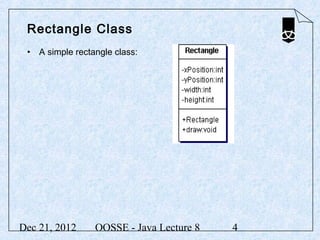
Rectangle Class
 • A simple rectangle class:


Dec 21, 2012     OOSSE - Java Lecture 8   4
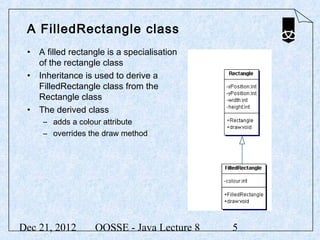
A FilledRectangle class
 • A filled rectangle is a specialisation
   of the rectangle class
 • Inheritance is used to derive a
   FilledRectangle class from the
   Rectangle class
 • The derived class
     – adds a colour attribute
     – overrides the draw method


Dec 21, 2012       OOSSE - Java Lecture 8   5
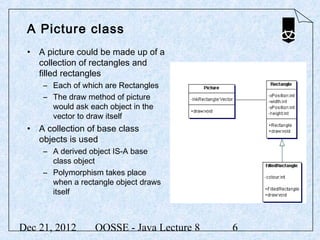
A Picture class
 • A picture could be made up of a
   collection of rectangles and
   filled rectangles
     – Each of which are Rectangles
     – The draw method of picture
       would ask each object in the
       vector to draw itself
 • A collection of base class
   objects is used
     – A derived object IS-A base
       class object
     – Polymorphism takes place
       when a rectangle object draws
       itself


Dec 21, 2012      OOSSE - Java Lecture 8   6
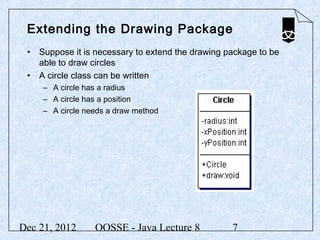
Extending the Drawing Package
 • Suppose it is necessary to extend the drawing package to be
   able to draw circles
 • A circle class can be written
     – A circle has a radius
     – A circle has a position
     – A circle needs a draw method


Dec 21, 2012      OOSSE - Java Lecture 8          7
Circles and the Picture class
 • A Picture holds a collection of rectangles and filled
   rectangles
 • A circle is not a rectangle therefore is not easy to work
   with a combination of circles, rectangles and filled
   rectangles
 • However, circles and rectangles have some common
   features
     – Each has an xPostion and a yPosition
     – Each knows how to draw itself
 • These common features could be abstracted out to form a
   new class
     – A base class for both rectangles and circles


Dec 21, 2012      OOSSE - Java Lecture 8              8
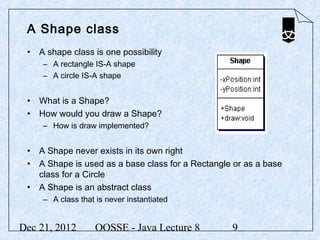
A Shape class
 • A shape class is one possibility
     – A rectangle IS-A shape
     – A circle IS-A shape


 • What is a Shape?
 • How would you draw a Shape?
     – How is draw implemented?


 • A Shape never exists in its own right
 • A Shape is used as a base class for a Rectangle or as a base
   class for a Circle
 • A Shape is an abstract class
     – A class that is never instantiated


Dec 21, 2012        OOSSE - Java Lecture 8        9
Abstract Classes in Java
 • Java allows abstract classes to be defined using the
   keyword abstract
     – public abstract class Shape ….
 • An abstract class
     – Cannot be directly instantiated
     – Contains at least one abstract method

 • An abstract method is defined with the keyword abstract
     – public abstract void draw() ;
 • An abstract method must be overridden in derived classes
     – Implemented in the derived class
     – Unless the derived class is itself abstract


Dec 21, 2012      OOSSE - Java Lecture 8             10
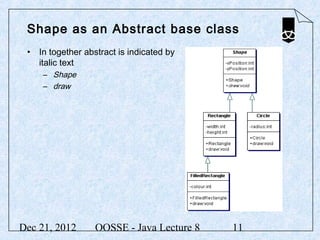
Shape as an Abstract base class
 • In together abstract is indicated by
   italic text
     – Shape
     – draw


Dec 21, 2012      OOSSE - Java Lecture 8   11
References to Abstract classes
 • Although abstract classes cannot be instantiated it is
   possible to use variables that hold references to abstract
   classes
 • For example:
     – Shape theShape;
 • What types of objects can theShape refer to?
     – Any instances of classes derived from Shape
 • For example:
     – Circle myCircle = new Circle ( 40, 50, 50 );
     – theShape = myCircle;
 • What affect does the following code have?
     – theShape.draw( );


Dec 21, 2012      OOSSE - Java Lecture 8              12
Interfaces
 • A class specifies
     – Member variables
     – Member methods
 • The methods contain code that defines how to carry out
   the operations defined by the methods
     – Implementation


 • Sometimes it is useful to separate what an object can do
   from how it does it
 • An interface specifies what an object should be able to do
   without specifying how or what the object is


Dec 21, 2012    OOSSE - Java Lecture 8          13
Interfaces
 • This allows us to consider each of the following in class
   design


 • Inheritance
     – The IS-A relationship
 • Containment
     – The HAS-A relationship
 • Interface
     – Used to specify that an object is able to do something


Dec 21, 2012      OOSSE - Java Lecture 8             14
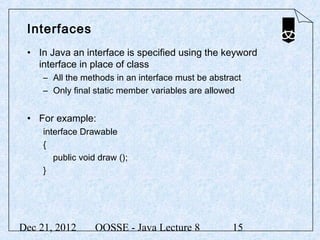
Interfaces
 • In Java an interface is specified using the keyword
   interface in place of class
     – All the methods in an interface must be abstract
     – Only final static member variables are allowed


 • For example:
     interface Drawable
     {
        public void draw ();
     }


Dec 21, 2012       OOSSE - Java Lecture 8           15
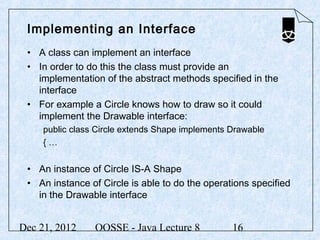
Implementing an Interface
 • A class can implement an interface
 • In order to do this the class must provide an
   implementation of the abstract methods specified in the
   interface
 • For example a Circle knows how to draw so it could
   implement the Drawable interface:
     public class Circle extends Shape implements Drawable
     {…


 • An instance of Circle IS-A Shape
 • An instance of Circle is able to do the operations specified
   in the Drawable interface


Dec 21, 2012     OOSSE - Java Lecture 8           16
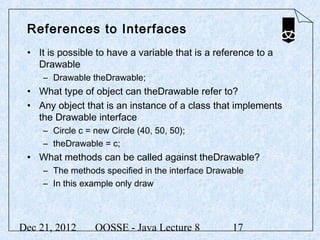
References to Interfaces
 • It is possible to have a variable that is a reference to a
   Drawable
     – Drawable theDrawable;
 • What type of object can theDrawable refer to?
 • Any object that is an instance of a class that implements
   the Drawable interface
     – Circle c = new Circle (40, 50, 50);
     – theDrawable = c;
 • What methods can be called against theDrawable?
     – The methods specified in the interface Drawable
     – In this example only draw


Dec 21, 2012      OOSSE - Java Lecture 8           17
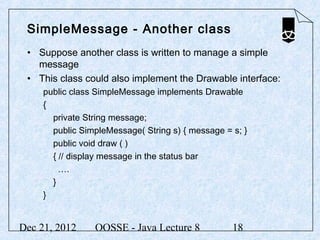
SimpleMessage - Another class
 • Suppose another class is written to manage a simple
   message
 • This class could also implement the Drawable interface:
     public class SimpleMessage implements Drawable
     {
       private String message;
       public SimpleMessage( String s) { message = s; }
       public void draw ( )
       { // display message in the status bar
         ….
       }
     }


Dec 21, 2012     OOSSE - Java Lecture 8            18
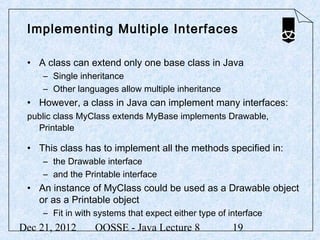
Implementing Multiple Interfaces

 • A class can extend only one base class in Java
     – Single inheritance
     – Other languages allow multiple inheritance
 • However, a class in Java can implement many interfaces:
 public class MyClass extends MyBase implements Drawable,
   Printable

 • This class has to implement all the methods specified in:
     – the Drawable interface
     – and the Printable interface
 • An instance of MyClass could be used as a Drawable object
   or as a Printable object
     – Fit in with systems that expect either type of interface
Dec 21, 2012      OOSSE - Java Lecture 8               19
Summary
 In this lecture we have:
 • Discussed Abstract classes
 • Built class hierarchies based on abstract classes
 • Introduced interfaces
 • Discussed implementing and extending within a single
    class


Dec 21, 2012   OOSSE - Java Lecture 8         20

09 abstract classesandinterfaces

  • 1.
    Abstract Classes andInterfaces OOSSE - Programming with Java Lecture 8 Dec 21, 2012 OOSSE - Java Lecture 8 1
  • 2.
    Objectives In thislecture, we will • Discuss Abstract classes • Build class hierarchies based on abstract classes • Introduce interfaces • Discuss implementing and extending within a single class Dec 21, 2012 OOSSE - Java Lecture 8 2
  • 3.
    Introduction • Theconcept of an abstract class will be introduced through a simple example • Consider designing a simple drawing package • Initially the package must be able to draw simple objects such as – Rectangles – Filled rectangles • An obvious place to start is identifying candidates for classes and corresponding attributes and methods – a rectangle class – a size, a position – a constructor, a draw method Dec 21, 2012 OOSSE - Java Lecture 8 3
  • 4.
    Rectangle Class •A simple rectangle class: Dec 21, 2012 OOSSE - Java Lecture 8 4
  • 5.
    A FilledRectangle class • A filled rectangle is a specialisation of the rectangle class • Inheritance is used to derive a FilledRectangle class from the Rectangle class • The derived class – adds a colour attribute – overrides the draw method Dec 21, 2012 OOSSE - Java Lecture 8 5
  • 6.
    A Picture class • A picture could be made up of a collection of rectangles and filled rectangles – Each of which are Rectangles – The draw method of picture would ask each object in the vector to draw itself • A collection of base class objects is used – A derived object IS-A base class object – Polymorphism takes place when a rectangle object draws itself Dec 21, 2012 OOSSE - Java Lecture 8 6
  • 7.
    Extending the DrawingPackage • Suppose it is necessary to extend the drawing package to be able to draw circles • A circle class can be written – A circle has a radius – A circle has a position – A circle needs a draw method Dec 21, 2012 OOSSE - Java Lecture 8 7
  • 8.
    Circles and thePicture class • A Picture holds a collection of rectangles and filled rectangles • A circle is not a rectangle therefore is not easy to work with a combination of circles, rectangles and filled rectangles • However, circles and rectangles have some common features – Each has an xPostion and a yPosition – Each knows how to draw itself • These common features could be abstracted out to form a new class – A base class for both rectangles and circles Dec 21, 2012 OOSSE - Java Lecture 8 8
  • 9.
    A Shape class • A shape class is one possibility – A rectangle IS-A shape – A circle IS-A shape • What is a Shape? • How would you draw a Shape? – How is draw implemented? • A Shape never exists in its own right • A Shape is used as a base class for a Rectangle or as a base class for a Circle • A Shape is an abstract class – A class that is never instantiated Dec 21, 2012 OOSSE - Java Lecture 8 9
  • 10.
    Abstract Classes inJava • Java allows abstract classes to be defined using the keyword abstract – public abstract class Shape …. • An abstract class – Cannot be directly instantiated – Contains at least one abstract method • An abstract method is defined with the keyword abstract – public abstract void draw() ; • An abstract method must be overridden in derived classes – Implemented in the derived class – Unless the derived class is itself abstract Dec 21, 2012 OOSSE - Java Lecture 8 10
  • 11.
    Shape as anAbstract base class • In together abstract is indicated by italic text – Shape – draw Dec 21, 2012 OOSSE - Java Lecture 8 11
  • 12.
    References to Abstractclasses • Although abstract classes cannot be instantiated it is possible to use variables that hold references to abstract classes • For example: – Shape theShape; • What types of objects can theShape refer to? – Any instances of classes derived from Shape • For example: – Circle myCircle = new Circle ( 40, 50, 50 ); – theShape = myCircle; • What affect does the following code have? – theShape.draw( ); Dec 21, 2012 OOSSE - Java Lecture 8 12
  • 13.
    Interfaces • Aclass specifies – Member variables – Member methods • The methods contain code that defines how to carry out the operations defined by the methods – Implementation • Sometimes it is useful to separate what an object can do from how it does it • An interface specifies what an object should be able to do without specifying how or what the object is Dec 21, 2012 OOSSE - Java Lecture 8 13
  • 14.
    Interfaces • Thisallows us to consider each of the following in class design • Inheritance – The IS-A relationship • Containment – The HAS-A relationship • Interface – Used to specify that an object is able to do something Dec 21, 2012 OOSSE - Java Lecture 8 14
  • 15.
    Interfaces • InJava an interface is specified using the keyword interface in place of class – All the methods in an interface must be abstract – Only final static member variables are allowed • For example: interface Drawable { public void draw (); } Dec 21, 2012 OOSSE - Java Lecture 8 15
  • 16.
    Implementing an Interface • A class can implement an interface • In order to do this the class must provide an implementation of the abstract methods specified in the interface • For example a Circle knows how to draw so it could implement the Drawable interface: public class Circle extends Shape implements Drawable {… • An instance of Circle IS-A Shape • An instance of Circle is able to do the operations specified in the Drawable interface Dec 21, 2012 OOSSE - Java Lecture 8 16
  • 17.
    References to Interfaces • It is possible to have a variable that is a reference to a Drawable – Drawable theDrawable; • What type of object can theDrawable refer to? • Any object that is an instance of a class that implements the Drawable interface – Circle c = new Circle (40, 50, 50); – theDrawable = c; • What methods can be called against theDrawable? – The methods specified in the interface Drawable – In this example only draw Dec 21, 2012 OOSSE - Java Lecture 8 17
  • 18.
    SimpleMessage - Anotherclass • Suppose another class is written to manage a simple message • This class could also implement the Drawable interface: public class SimpleMessage implements Drawable { private String message; public SimpleMessage( String s) { message = s; } public void draw ( ) { // display message in the status bar …. } } Dec 21, 2012 OOSSE - Java Lecture 8 18
  • 19.
    Implementing Multiple Interfaces • A class can extend only one base class in Java – Single inheritance – Other languages allow multiple inheritance • However, a class in Java can implement many interfaces: public class MyClass extends MyBase implements Drawable, Printable • This class has to implement all the methods specified in: – the Drawable interface – and the Printable interface • An instance of MyClass could be used as a Drawable object or as a Printable object – Fit in with systems that expect either type of interface Dec 21, 2012 OOSSE - Java Lecture 8 19
  • 20.
    Summary In thislecture we have: • Discussed Abstract classes • Built class hierarchies based on abstract classes • Introduced interfaces • Discussed implementing and extending within a single class Dec 21, 2012 OOSSE - Java Lecture 8 20

Editor's Notes

  • #2 Part of this lecture will be reserved for working through solutions to selected exercises from last week. Notes relating to this do not appear in the slides.