The Information Age
What is the Information Age?
People, Information & Societies that chronicle
the birth and growth of electronic information --
from ancient times to Samuel Morse's invention
of the telegraph in the 1830s, through the
development of the telephone, radio, television,
and computer.
http://www.tcf.ua.edu/AZ/ITHistoryOutline.htm
Four Periods of The Information Age
 Pre-Mechanical - 3000 B.C.-1450 A.D.
 Mechanical - 1450-1840
 Electro-Mechanical - 1840-1940
 Electronic/Information -1940-Present
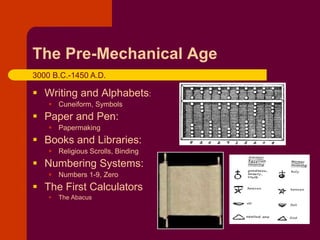
The Pre-Mechanical Age
 Writing and Alphabets:
 Cuneiform, Symbols
 Paper and Pen:
 Papermaking
 Books and Libraries:
 Religious Scrolls, Binding
 Numbering Systems:
 Numbers 1-9, Zero
 The First Calculators
 The Abacus
3000 B.C.-1450 A.D.
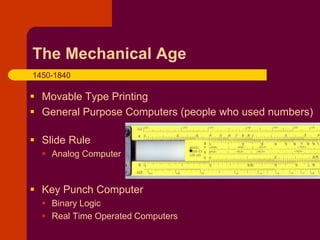
The Mechanical Age
 Movable Type Printing
 General Purpose Computers (people who used numbers)
 Slide Rule
 Analog Computer
 Key Punch Computer
 Binary Logic
 Real Time Operated Computers
1450-1840
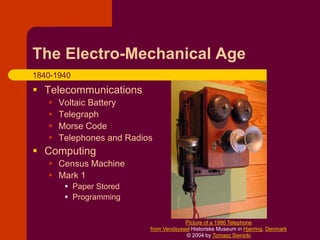
The Electro-Mechanical Age
 Telecommunications
 Voltaic Battery
 Telegraph
 Morse Code
 Telephones and Radios
 Computing
 Census Machine
 Mark 1
 Paper Stored
 Programming
1840-1940
Picture of a 1986 Telephone
from Vendsyssel Historiske Museum in Hjørring, Denmark
© 2004 by Tomasz Sienicki
Information Age
 Electronic Vacuum Tubes
 Electronic Numerical Integrator and Computer
 Manchester Mark 1
 First Computer for Commercial Use
1840-Present
Computer Generations
 First Generation (1951-1958)
 Main Logic Elements
 Externally Stored Information
 Machine and Assembly
Language
 Compilers
 Second Generation (1959-
1963)
 Transistors
 Semi-Conductors
 High-Level Programming
 Fortran/Cobol
 Third Generation (1964-
1978)
 Integrated Circuits
 Magnetic Tape and Disk
 Operating Systems
 BASIC
 Fourth Generation (1979-)
 Large Scale Circuits
 Central Processing Units
 Apple II/Apple Mac
 IBM/MS-DOS/GUI
 MS Windows
Pioneers in Information Technology
 John Mauchly
 J. Prosper Eckert
 John Von Neumann
 Blaise Pascal
 William Oughtred
 Gottfried von Leibniz
 Charles Babbage
 Augusta Ada Byron
 Alexander Graham Bell
 Herman Hollerith
 Howard Aiken
 Max Newman
 Maurice Wilkes
 Steven Wozniak
 Steven Jobs
 Bill Gates

08_The Information Age.pptx

  • 1.
  • 2.
    What is theInformation Age? People, Information & Societies that chronicle the birth and growth of electronic information -- from ancient times to Samuel Morse's invention of the telegraph in the 1830s, through the development of the telephone, radio, television, and computer. http://www.tcf.ua.edu/AZ/ITHistoryOutline.htm
  • 3.
    Four Periods ofThe Information Age  Pre-Mechanical - 3000 B.C.-1450 A.D.  Mechanical - 1450-1840  Electro-Mechanical - 1840-1940  Electronic/Information -1940-Present
  • 4.
    The Pre-Mechanical Age Writing and Alphabets:  Cuneiform, Symbols  Paper and Pen:  Papermaking  Books and Libraries:  Religious Scrolls, Binding  Numbering Systems:  Numbers 1-9, Zero  The First Calculators  The Abacus 3000 B.C.-1450 A.D.
  • 5.
    The Mechanical Age Movable Type Printing  General Purpose Computers (people who used numbers)  Slide Rule  Analog Computer  Key Punch Computer  Binary Logic  Real Time Operated Computers 1450-1840
  • 6.
    The Electro-Mechanical Age Telecommunications  Voltaic Battery  Telegraph  Morse Code  Telephones and Radios  Computing  Census Machine  Mark 1  Paper Stored  Programming 1840-1940 Picture of a 1986 Telephone from Vendsyssel Historiske Museum in Hjørring, Denmark © 2004 by Tomasz Sienicki
  • 7.
    Information Age  ElectronicVacuum Tubes  Electronic Numerical Integrator and Computer  Manchester Mark 1  First Computer for Commercial Use 1840-Present
  • 8.
    Computer Generations  FirstGeneration (1951-1958)  Main Logic Elements  Externally Stored Information  Machine and Assembly Language  Compilers  Second Generation (1959- 1963)  Transistors  Semi-Conductors  High-Level Programming  Fortran/Cobol  Third Generation (1964- 1978)  Integrated Circuits  Magnetic Tape and Disk  Operating Systems  BASIC  Fourth Generation (1979-)  Large Scale Circuits  Central Processing Units  Apple II/Apple Mac  IBM/MS-DOS/GUI  MS Windows
  • 9.
    Pioneers in InformationTechnology  John Mauchly  J. Prosper Eckert  John Von Neumann  Blaise Pascal  William Oughtred  Gottfried von Leibniz  Charles Babbage  Augusta Ada Byron  Alexander Graham Bell  Herman Hollerith  Howard Aiken  Max Newman  Maurice Wilkes  Steven Wozniak  Steven Jobs  Bill Gates