The	
  Structure	
  of	
  the	
  Yesterday’s	
  Public	
  
                                                       Internet	
  

The

20  Century Internet
   th

Peering Ecosystem

                          ©2012	
  DrPeering	
  Interna>onal	
  
                          Licensed	
  material	
  –	
  sales@DrPeering.net	
  
                          hDp://DrPeering.net	
  
3	


                                                                THE	
  EARLY	
  INTERNET	
  PEERING	
  
                                                                ECOSYSTEM	


                                                       Provide	
  a	
  historical	
  perspec>ve	
  on	
  how	
  Internet	
  Peering	
  evolved	


                                                                                                                                                                 2	
  
Why	
  should	
  we	
  care	
  about	
  
the	
  history	
  of	
  peering?	
  About	
  
these	
  “peering	
  ecosystems?”	


                                                3	
  
My	
  Airplane	
  Story	


•  NWA	
  Flight	
  DTW-­‐LAX	
  DelayàCancel	
  
•  Rebook,	
  go	
  to	
  gate	
  34	
  (short	
  walk)	
  
•  On	
  plane.	
  Boarding	
  disgruntles	
  
•  Flight	
  aDendant:	
  “sit	
  anywhere”	
  
•  Delayed…	
  Palpable	
  Anger	
  	
  
What	
  happened?	


                                                              4	
  
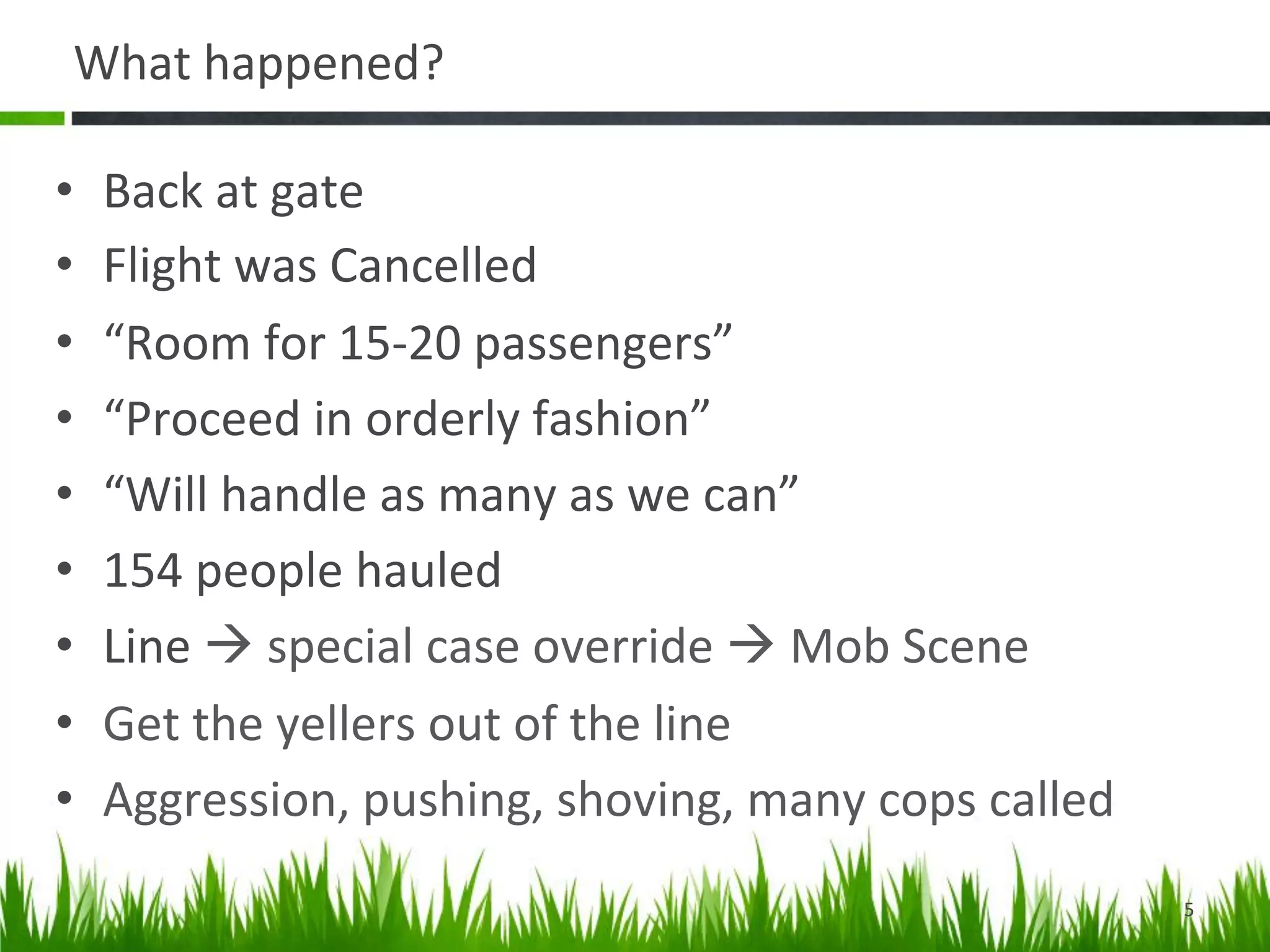
What	
  happened?	
  

•    Back	
  at	
  gate	
  
•    Flight	
  was	
  Cancelled	
  
•    “Room	
  for	
  15-­‐20	
  passengers”	
  
•    “Proceed	
  in	
  orderly	
  fashion”	
  
•    “Will	
  handle	
  as	
  many	
  as	
  we	
  can”	
  
•    154	
  people	
  hauled	
  
•    Line	
  à	
  special	
  case	
  override	
  à	
  Mob	
  Scene	
  
•    Get	
  the	
  yellers	
  out	
  of	
  the	
  line	
  
•    Aggression,	
  pushing,	
  shoving,	
  many	
  cops	
  called	
  	
  
                                                                             5	
  
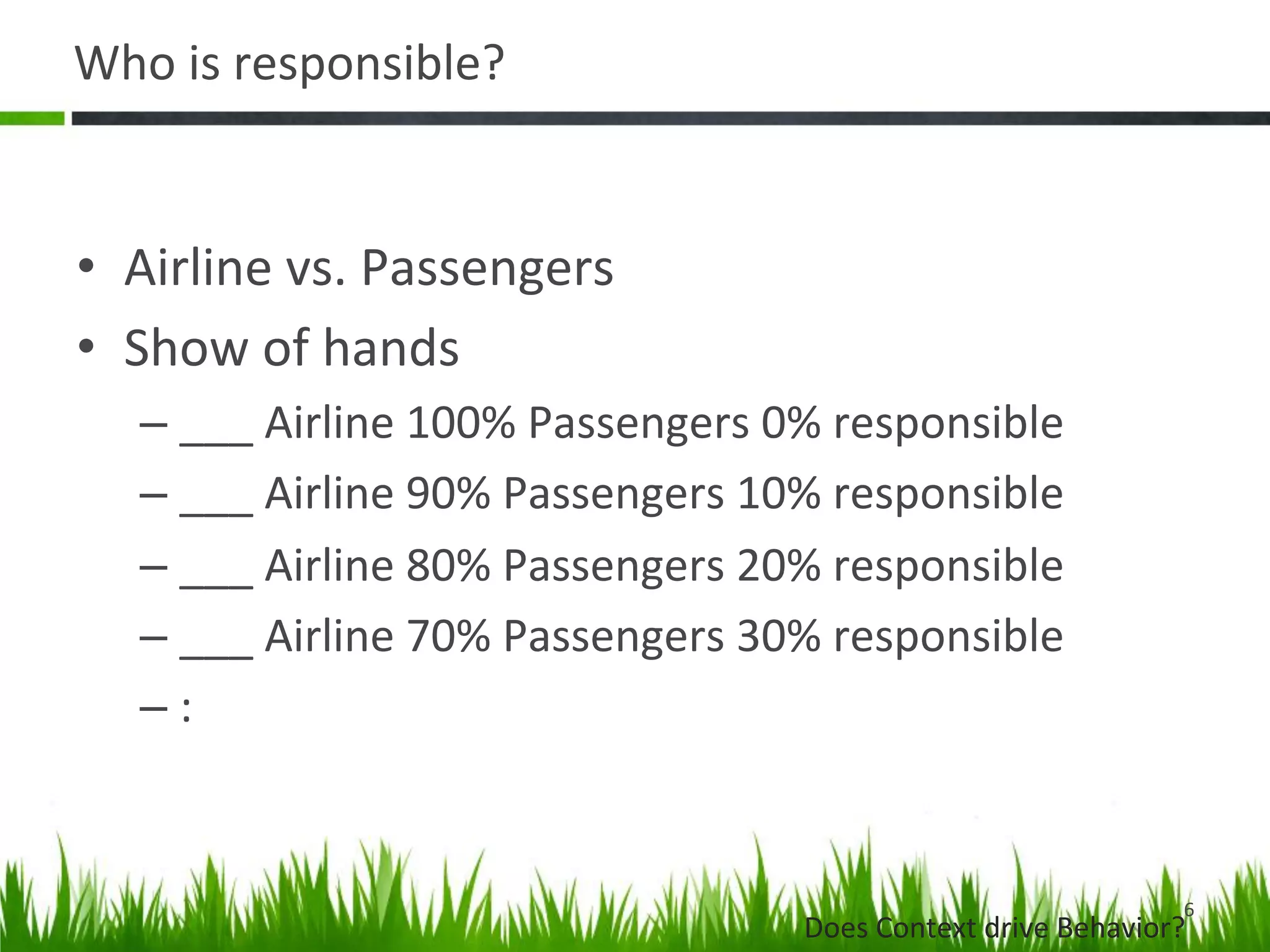
Who	
  is	
  responsible?	


•  Airline	
  vs.	
  Passengers	
  
•  Show	
  of	
  hands	
  
    –  ___	
  Airline	
  100%	
  Passengers	
  0%	
  responsible	
  
    –  ___	
  Airline	
  90%	
  Passengers	
  10%	
  responsible	
  
    –  ___	
  Airline	
  80%	
  Passengers	
  20%	
  responsible	
  
    –  ___	
  Airline	
  70%	
  Passengers	
  30%	
  responsible	
  
    –  :	


                                                                                         6	
  
                                                 Does	
  Context	
  drive	
  Behavior?	
  
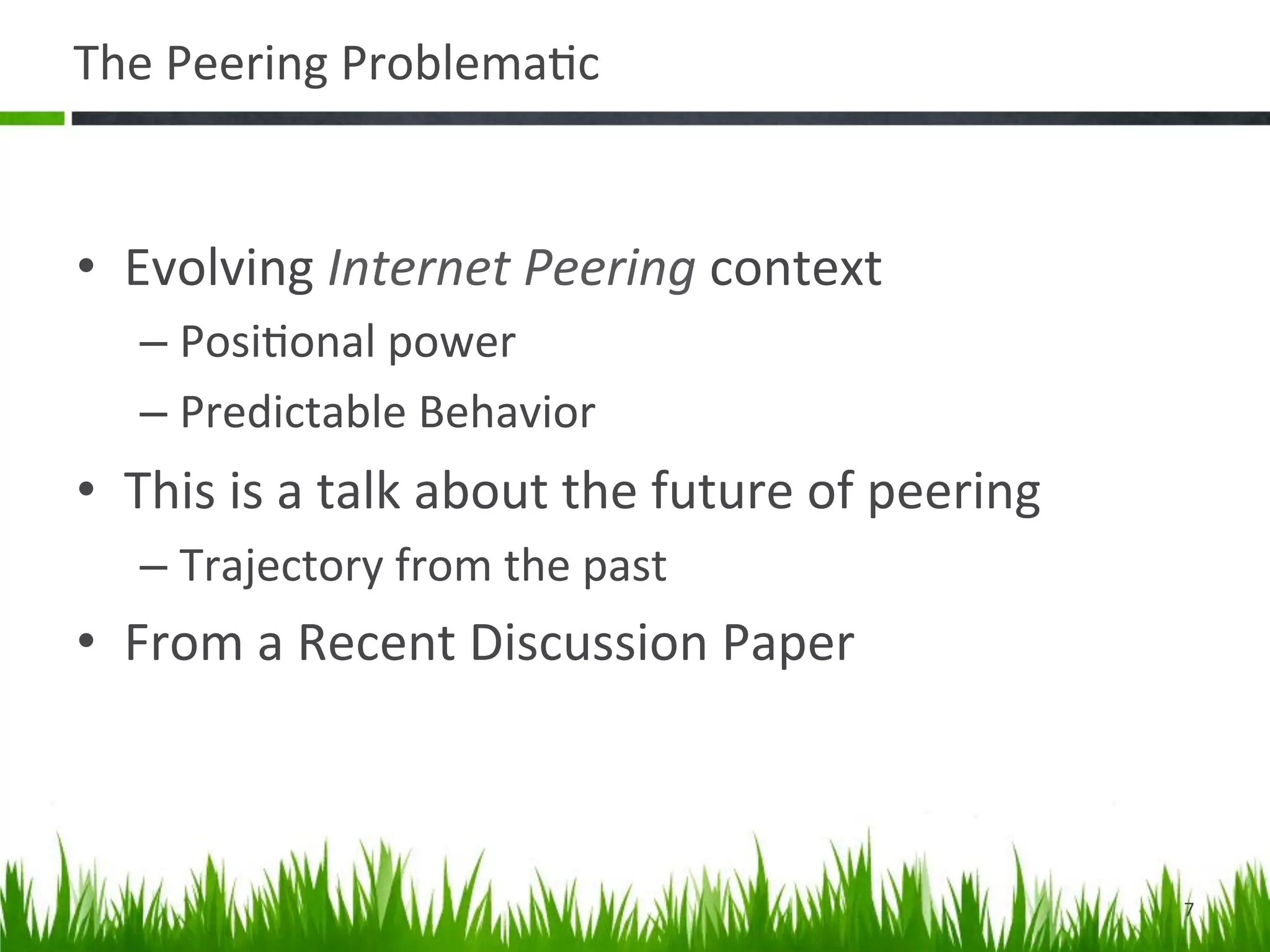
The	
  Peering	
  Problema>c	


•  Evolving	
  Internet	
  Peering	
  context	
  
    –  Posi>onal	
  power	
  
    –  Predictable	
  Behavior	
  
•  This	
  is	
  a	
  talk	
  about	
  the	
  future	
  of	
  peering	
  
    –  Trajectory	
  from	
  the	
  past	
  
•  From	
  a	
  Recent	
  Discussion	
  Paper	


                                                                            7	
  
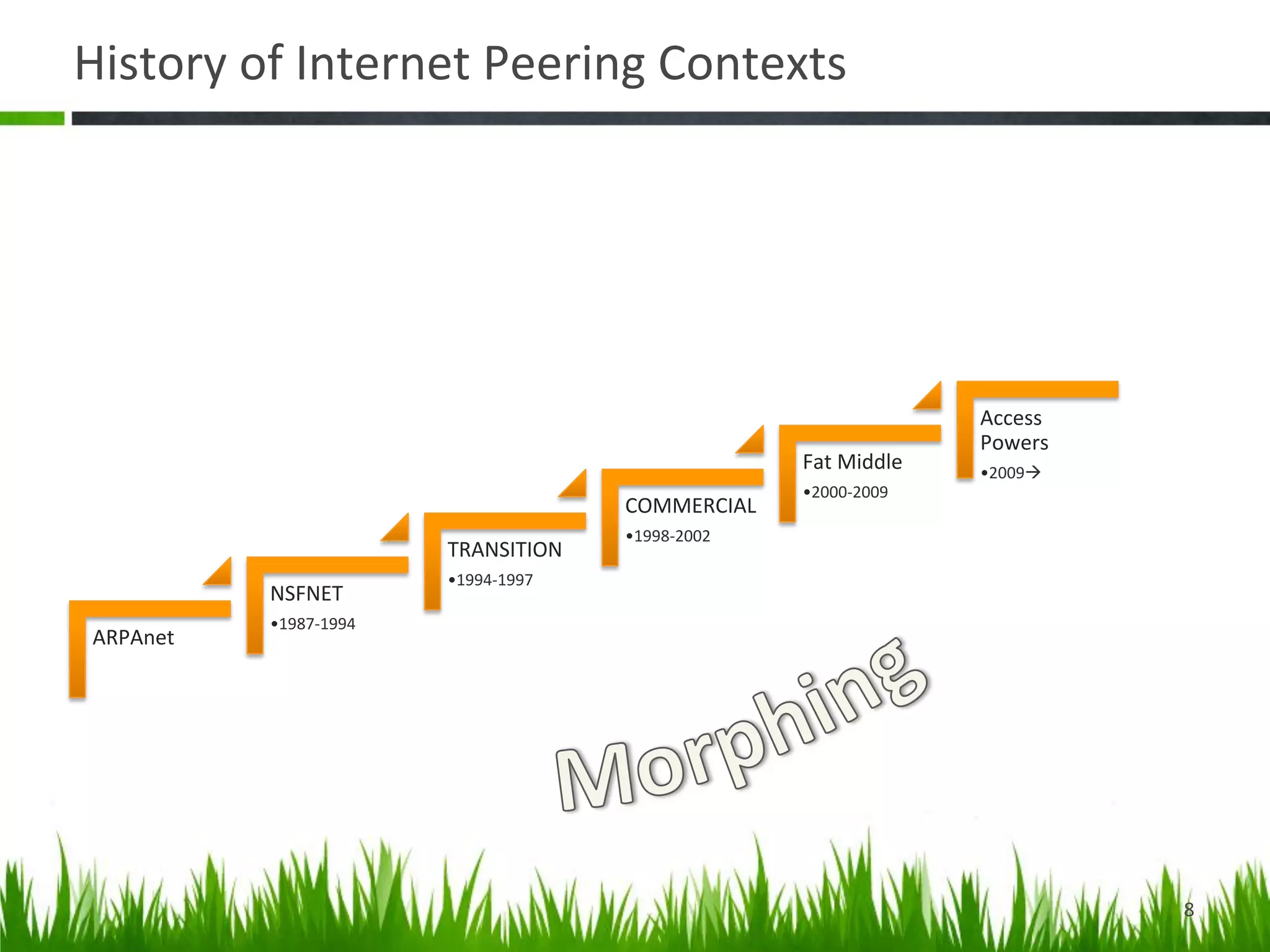
History	
  of	
  Internet	
  Peering	
  Contexts	


                                                                                               Access	
  
                                                                                               Powers	
  
                                                                           Fat	
  Middle	
     • 2009à	
  
                                                                           • 2000-­‐2009	
  
                                                       COMMERCIAL	
  
                                                       • 1998-­‐2002	
  
                                   TRANSITION	
  
                                   • 1994-­‐1997	
  
               NSFNET	
  
               • 1987-­‐1994	
  
 ARPAnet	


                                                                                                              8	
  
1st	
  Peering:	
  ARPANET	
  80’s	
  

•    USENET/BITNET/X.25	
  could	
  not	
  connect	
  
•    ARPAnet	
  limited	
  to	
  gov’t	
  &	
  contractors	
  
•    CSNet-­‐NSF	
  project	
  to	
  connect	
  all	
  CS	
  depts	
  
•    Spotlighted	
  AUP	
  problem	
  
•    Bureaucra>c	
  complexity	
  
       –  SeDlement	
  of	
  financial,	
  admin,	
  contract	
  etc.	
  
•  Peering	
  is	
  “interconnec>on	
  without	
  explicit	
  
   accoun>ng	
  or	
  seDlement”	
  
     Source:	
  hDp://www.interisle.net/sub/ISP%20Interconnec>on.pdf	
  	
  
     hDp://drpeering.net/AskDrPeering/blog/ar>cles/Ask_DrPeering/Entries/2010/10/22_Origins_of_Internet_Peering.html	


                                                                                                                               9	
  
Reference:	
  The	
  First	
  Peering	


•  “This	
  disconnect	
  persisted	
  as	
  both	
  sides	
  assumed	
  that	
  any	
  
   agreement	
  to	
  exchange	
  traffic	
  would	
  necessarily	
  involve	
  the	
  
   seDlement	
  of	
  administra>ve,	
  financial,	
  contractual,	
  and	
  a	
  host	
  
   of	
  other	
  issues,	
  the	
  bureaucra>c	
  complexity	
  of	
  which	
  daunted	
  
   even	
  the	
  most	
  fervent	
  advocates	
  of	
  interconnec>on	
  –	
  un>l	
  
   CSNet	
  managers	
  came	
  up	
  with	
  the	
  idea	
  we	
  now	
  call	
  ‘peering’,	
  
   or	
  the	
  interconnec>on	
  without	
  explicit	
  accoun>ng	
  or	
  
   seDlement.”	
  
Source:	
  hDp://interisle.net/sub/ISP	
  Interconnec>on.pdf	


                                                                                             10	
  
NSFNET	
  –	
  ‘87-­‐’94	
                                    GrowthàTime	
  to	
  priva>ze	


The	
  Internet	
  	
  
Core	
  
                                                        Coopera>ve	
  Agreement	
  (Merit,IBM,MCI,…)	
  
                                                        Open	
  Regional	
  Techs	
  Mee>ngs	
  
                   NSF	
  sponsored	
  aDachments	
  
                                                        Announce/celebrate	
  new	
  aDachments	
  
                                                                                                          11	
  
NSFNET	
  Transi>on	
  –	
  ’94-­‐’96	


                                           NSFNET	
  TransiBon	
  Model	
  
                                           Network	
  Service	
  Providers	
  (NSPs)	
  
                                           Network	
  Access	
  Points	
  (NAPs)	
  
                                           Rou>ng	
  Arbiter	
  (RA)	
  	
  
                                           Route	
  Servers	
  (RSes)	


                                           Na>onal	
  Science	
  Founda>on	
  (NSF)	
  
                                           Would	
  fund	
  regionals	
  to	
  connect	
  	
  
                                           to	
  NSPs	
  that	
  connected	
  to	
  NAPs	
  
   PacBell	
  NAP	
         AADS	
  NAP	
                 MAE-­‐East*	
       Sprint	
  NAP	
  
Strong	
  NANOG	
  Chair	
  model	
                                Interconnect	
  became	
  “a	
  private	
  ma>er”	
  
              Chair	
  &	
  commercial	
  interests	


                                                                                                                12	
  
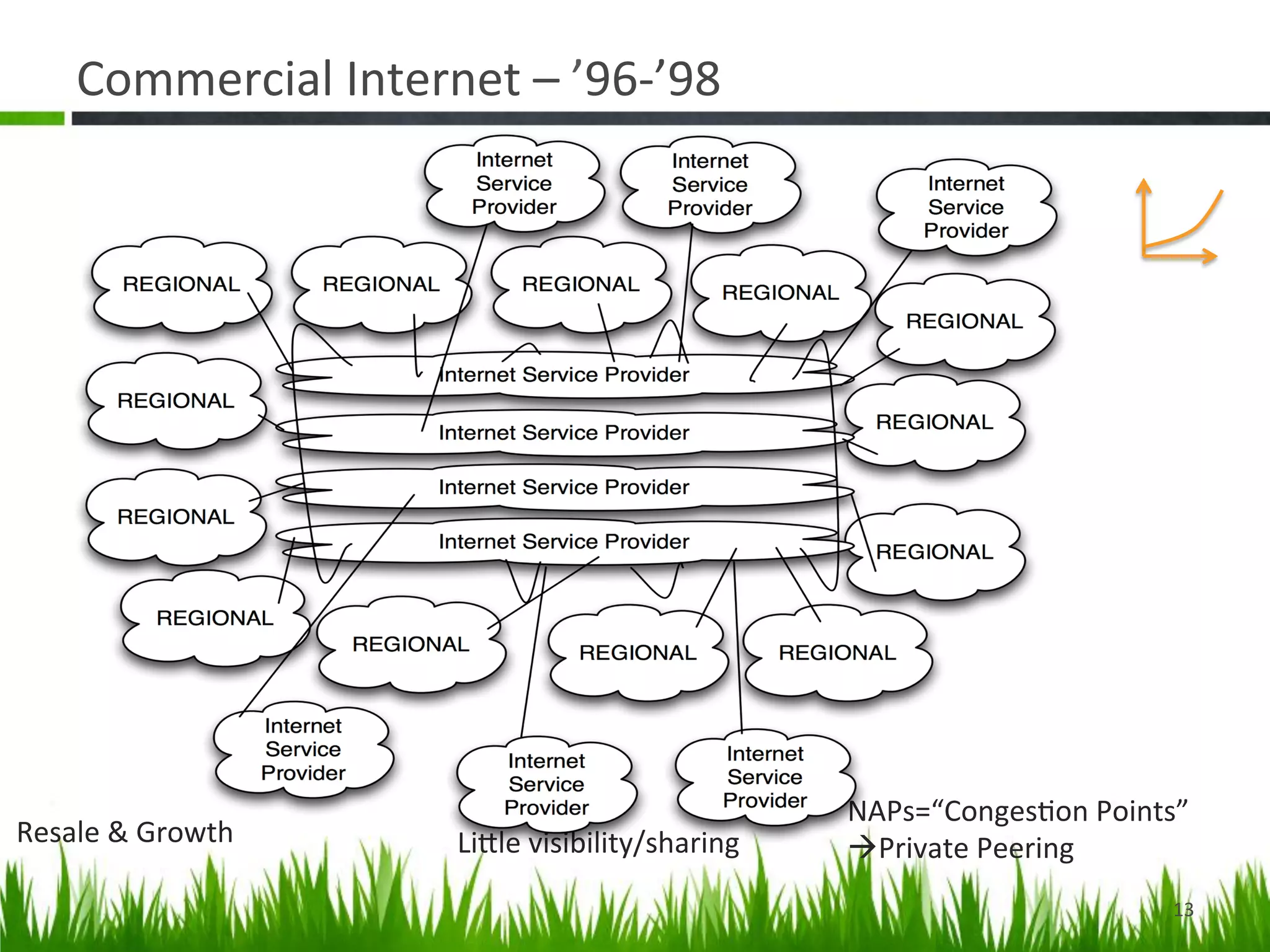
Commercial	
  Internet	
  –	
  ’96-­‐’98	


                                                                 NAPs=“Conges>on	
  Points”	
  
Resale	
  &	
  Growth	
        LiDle	
  visibility/sharing	
     àPrivate	
  Peering	
  
                                                                                            13	
  
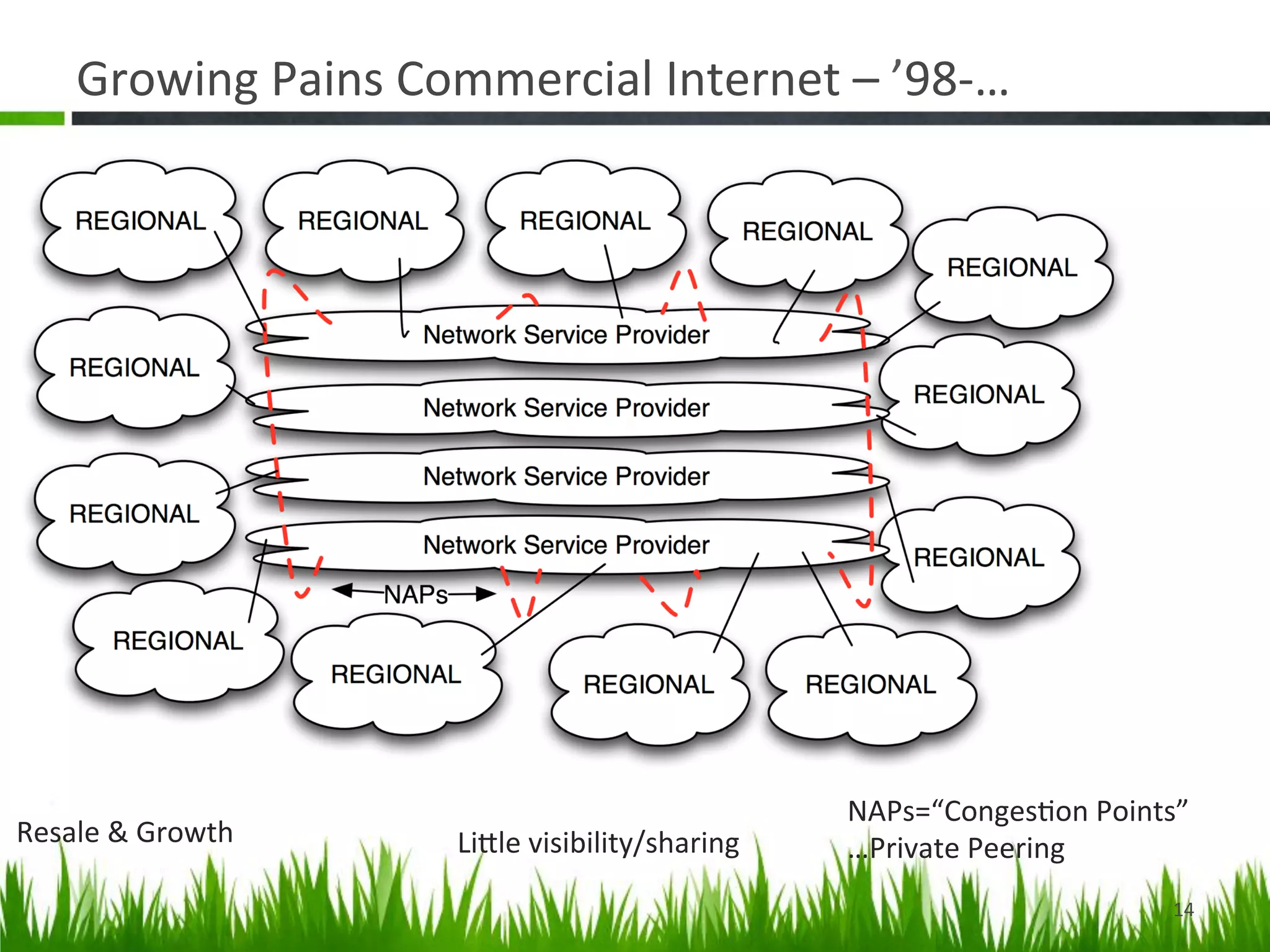
Growing	
  Pains	
  Commercial	
  Internet	
  –	
  ’98-­‐…	


                                                                NAPs=“Conges>on	
  Points”	
  
Resale	
  &	
  Growth	
       LiDle	
  visibility/sharing	
     …Private	
  Peering	
  
                                                                                           14	
  
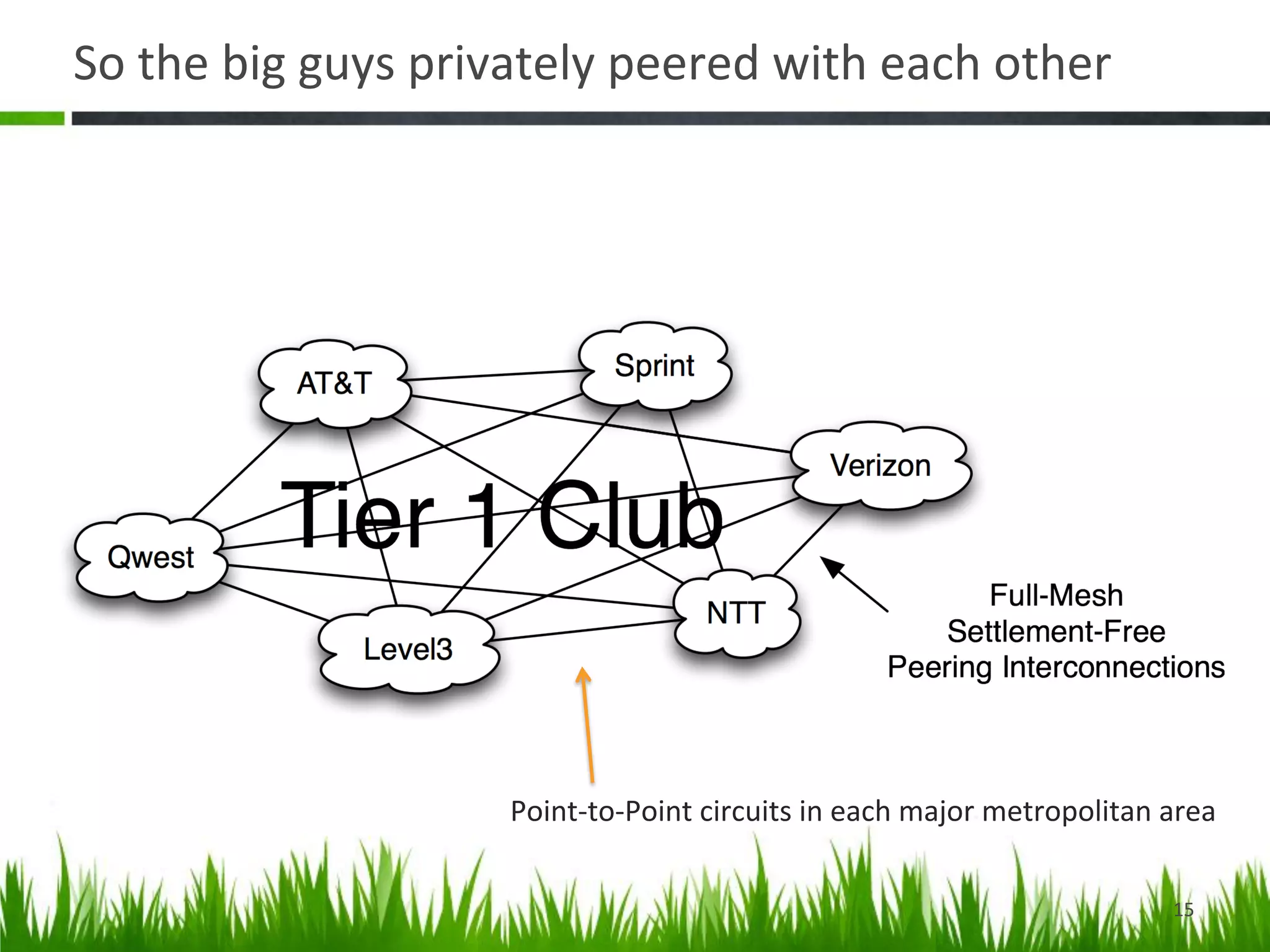
So	
  the	
  big	
  guys	
  privately	
  peered	
  with	
  each	
  other	


                               Point-­‐to-­‐Point	
  circuits	
  in	
  each	
  major	
  metropolitan	
  area	


                                                                                                          15	
  
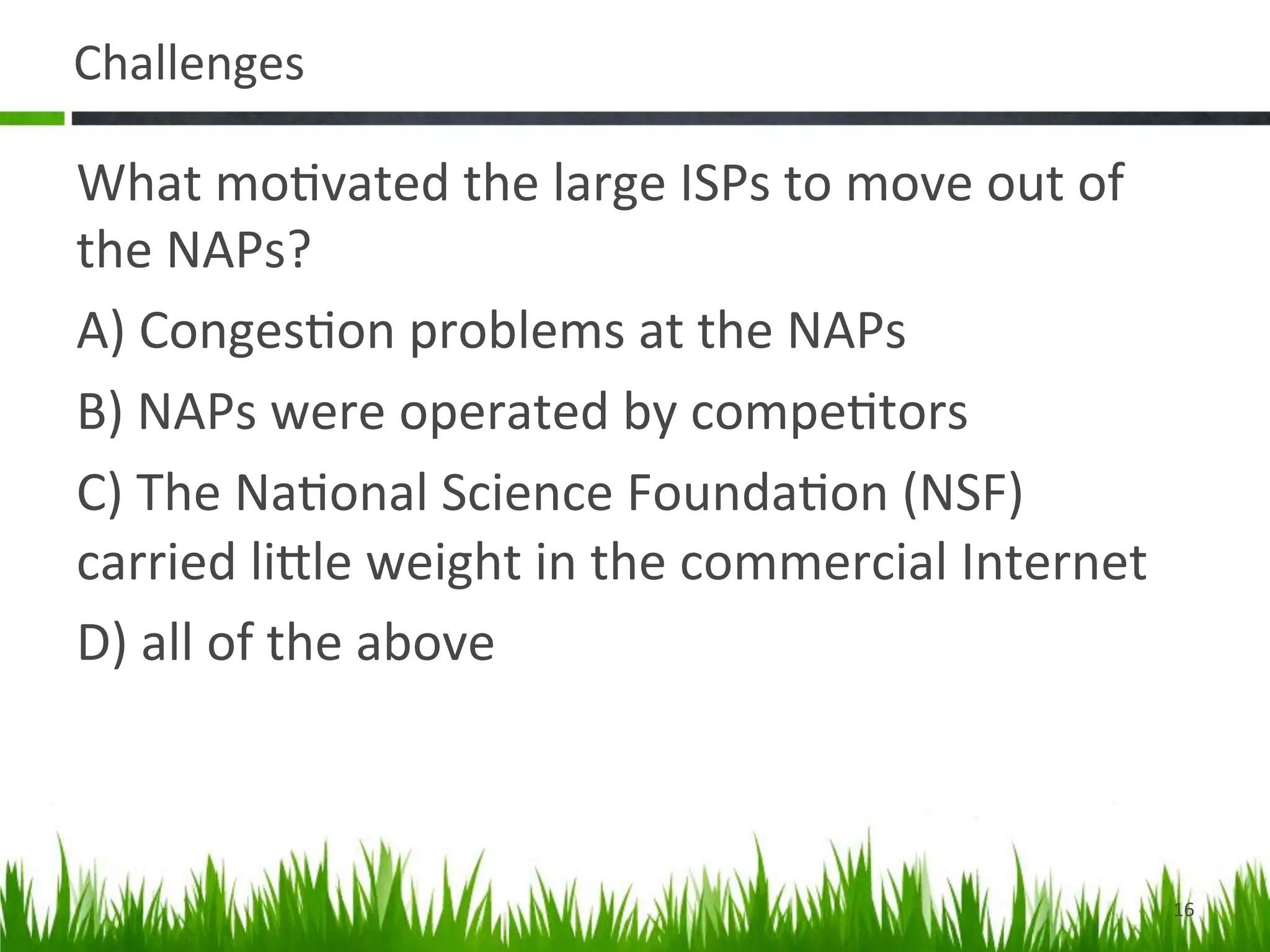
Challenges	
  

What	
  mo>vated	
  the	
  large	
  ISPs	
  to	
  move	
  out	
  of	
  
the	
  NAPs?	
  
A)	
  Conges>on	
  problems	
  at	
  the	
  NAPs	
  
B)	
  NAPs	
  were	
  operated	
  by	
  compe>tors	
  
C)	
  The	
  Na>onal	
  Science	
  Founda>on	
  (NSF)	
  
carried	
  liDle	
  weight	
  in	
  the	
  commercial	
  Internet	
  
D)	
  all	
  of	
  the	
  above	


                                                                          16	
  
This	
  led	
  to	
  the	
  Global	
  Internet	
  Peering	
  Ecosystem	


•  Players	
  independently	
  act	
  in	
  their	
  own	
  
   interests	
  
•  No	
  U.S.	
  Government	
  operated	
  backbone	
  
•  Not	
  U.S.	
  Government	
  controlled	
  Internet	


                                                                             17	
  

08 the 20th-century-internet-peering-ecosystem

  • 1.
    The  Structure  of  the  Yesterday’s  Public   Internet   The 20 Century Internet th Peering Ecosystem ©2012  DrPeering  Interna>onal   Licensed  material  –  sales@DrPeering.net   hDp://DrPeering.net  
  • 2.
    3                                           THE  EARLY  INTERNET  PEERING   ECOSYSTEM   Provide  a  historical  perspec>ve  on  how  Internet  Peering  evolved               2  
  • 3.
    Why  should  we  care  about   the  history  of  peering?  About   these  “peering  ecosystems?”   3  
  • 4.
    My  Airplane  Story   •  NWA  Flight  DTW-­‐LAX  DelayàCancel   •  Rebook,  go  to  gate  34  (short  walk)   •  On  plane.  Boarding  disgruntles   •  Flight  aDendant:  “sit  anywhere”   •  Delayed…  Palpable  Anger     What  happened?   4  
  • 5.
    What  happened?   •  Back  at  gate   •  Flight  was  Cancelled   •  “Room  for  15-­‐20  passengers”   •  “Proceed  in  orderly  fashion”   •  “Will  handle  as  many  as  we  can”   •  154  people  hauled   •  Line  à  special  case  override  à  Mob  Scene   •  Get  the  yellers  out  of  the  line   •  Aggression,  pushing,  shoving,  many  cops  called     5  
  • 6.
    Who  is  responsible?   •  Airline  vs.  Passengers   •  Show  of  hands   –  ___  Airline  100%  Passengers  0%  responsible   –  ___  Airline  90%  Passengers  10%  responsible   –  ___  Airline  80%  Passengers  20%  responsible   –  ___  Airline  70%  Passengers  30%  responsible   –  :   6   Does  Context  drive  Behavior?  
  • 7.
    The  Peering  Problema>c   •  Evolving  Internet  Peering  context   –  Posi>onal  power   –  Predictable  Behavior   •  This  is  a  talk  about  the  future  of  peering   –  Trajectory  from  the  past   •  From  a  Recent  Discussion  Paper   7  
  • 8.
    History  of  Internet  Peering  Contexts   Access   Powers   Fat  Middle   • 2009à   • 2000-­‐2009   COMMERCIAL   • 1998-­‐2002   TRANSITION   • 1994-­‐1997   NSFNET   • 1987-­‐1994   ARPAnet   8  
  • 9.
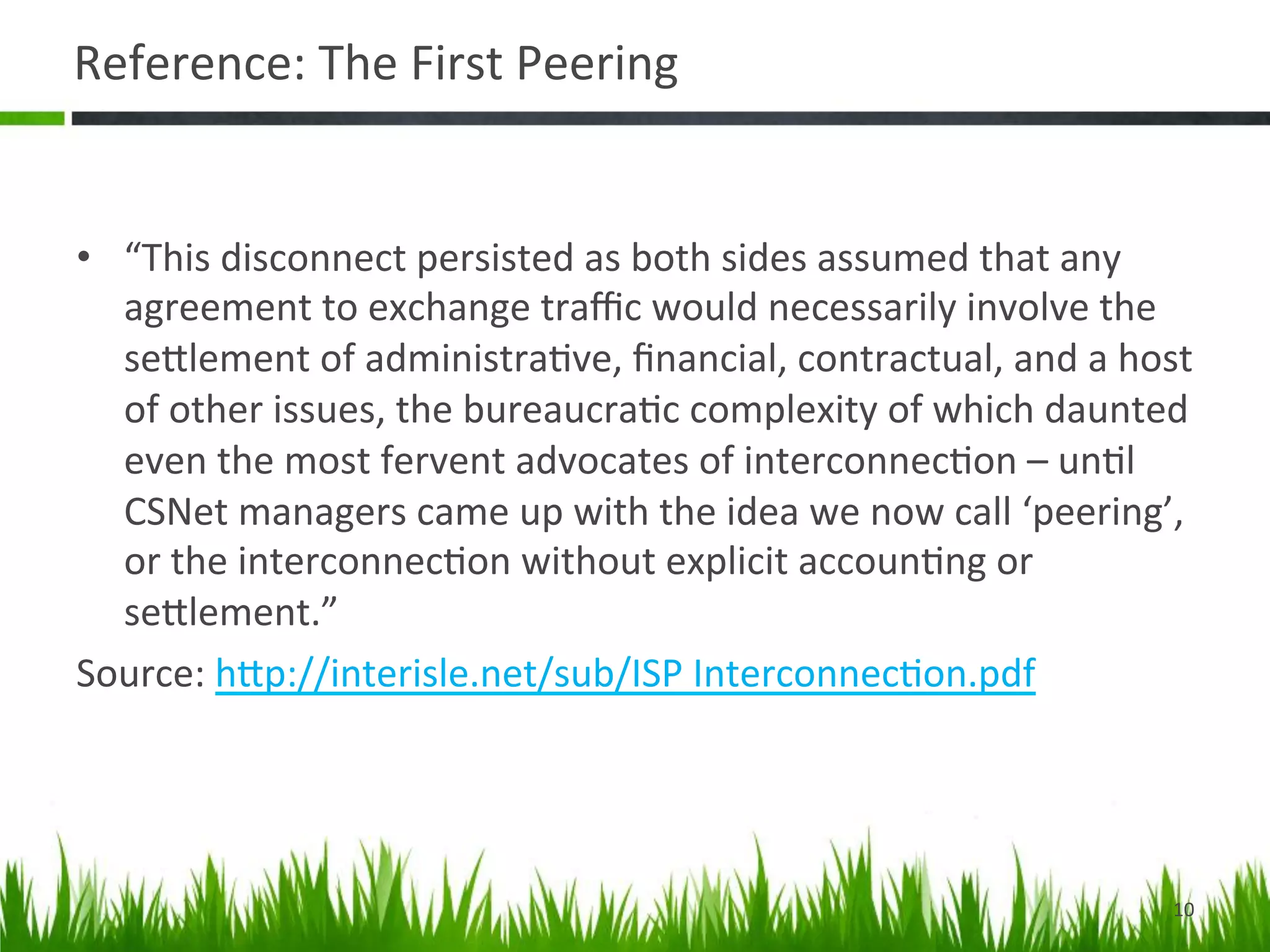
    1st  Peering:  ARPANET  80’s   •  USENET/BITNET/X.25  could  not  connect   •  ARPAnet  limited  to  gov’t  &  contractors   •  CSNet-­‐NSF  project  to  connect  all  CS  depts   •  Spotlighted  AUP  problem   •  Bureaucra>c  complexity   –  SeDlement  of  financial,  admin,  contract  etc.   •  Peering  is  “interconnec>on  without  explicit   accoun>ng  or  seDlement”   Source:  hDp://www.interisle.net/sub/ISP%20Interconnec>on.pdf     hDp://drpeering.net/AskDrPeering/blog/ar>cles/Ask_DrPeering/Entries/2010/10/22_Origins_of_Internet_Peering.html       9  
  • 10.
    Reference:  The  First  Peering   •  “This  disconnect  persisted  as  both  sides  assumed  that  any   agreement  to  exchange  traffic  would  necessarily  involve  the   seDlement  of  administra>ve,  financial,  contractual,  and  a  host   of  other  issues,  the  bureaucra>c  complexity  of  which  daunted   even  the  most  fervent  advocates  of  interconnec>on  –  un>l   CSNet  managers  came  up  with  the  idea  we  now  call  ‘peering’,   or  the  interconnec>on  without  explicit  accoun>ng  or   seDlement.”   Source:  hDp://interisle.net/sub/ISP  Interconnec>on.pdf   10  
  • 11.
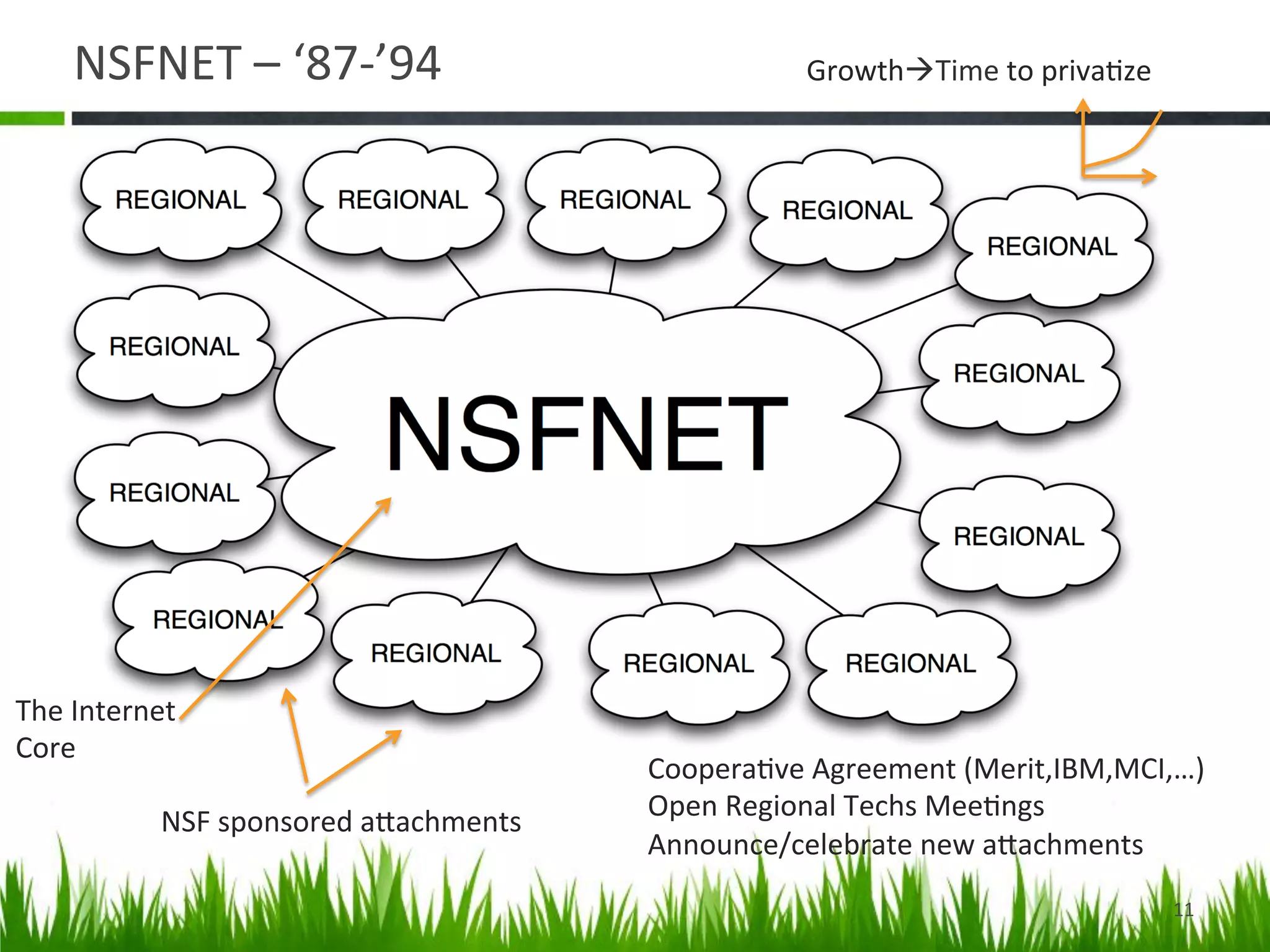
    NSFNET  –  ‘87-­‐’94   GrowthàTime  to  priva>ze   The  Internet     Core   Coopera>ve  Agreement  (Merit,IBM,MCI,…)   Open  Regional  Techs  Mee>ngs   NSF  sponsored  aDachments   Announce/celebrate  new  aDachments   11  
  • 12.
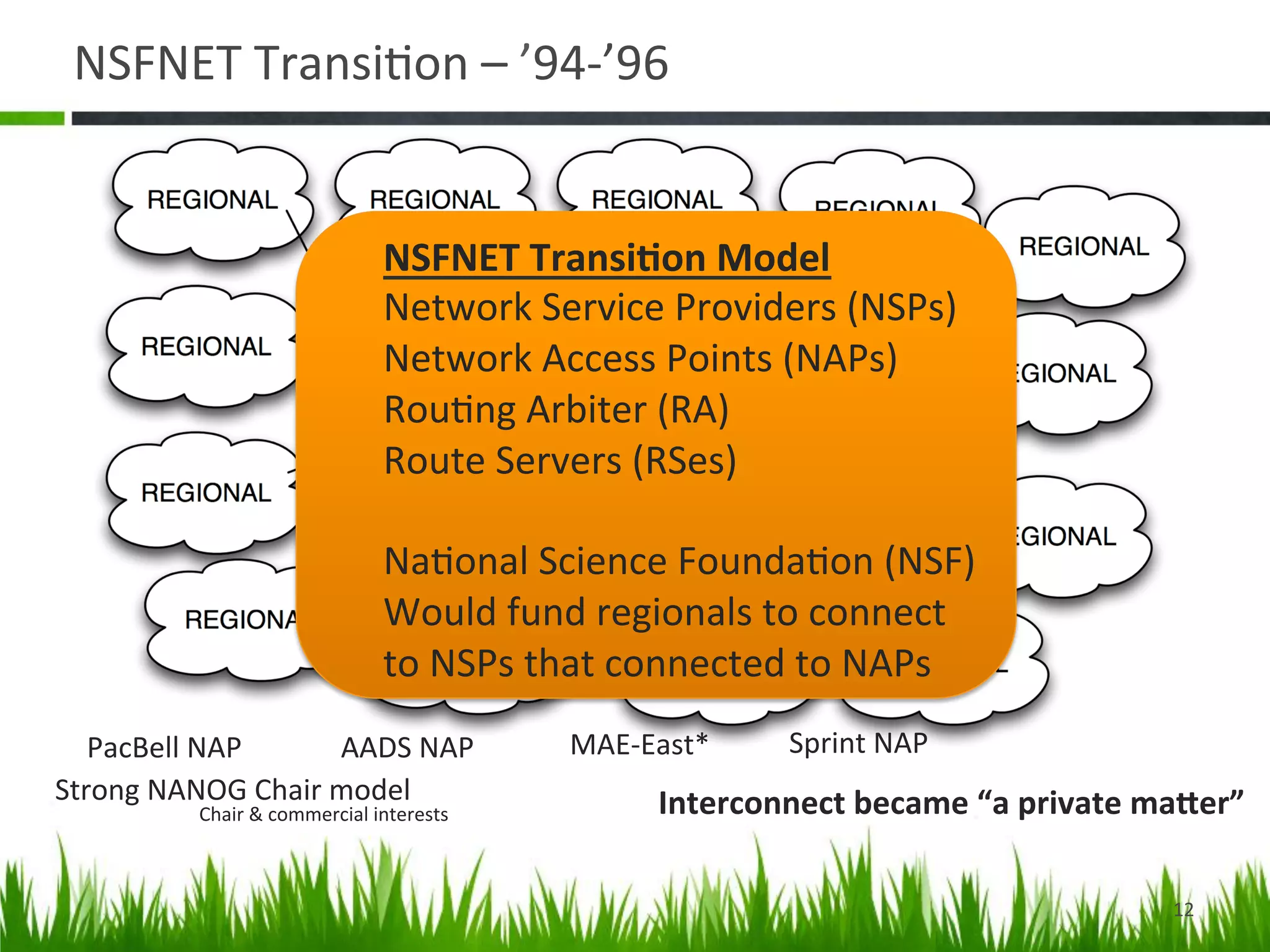
    NSFNET  Transi>on  –  ’94-­‐’96   NSFNET  TransiBon  Model   Network  Service  Providers  (NSPs)   Network  Access  Points  (NAPs)   Rou>ng  Arbiter  (RA)     Route  Servers  (RSes)     Na>onal  Science  Founda>on  (NSF)   Would  fund  regionals  to  connect     to  NSPs  that  connected  to  NAPs   PacBell  NAP   AADS  NAP   MAE-­‐East*   Sprint  NAP   Strong  NANOG  Chair  model   Interconnect  became  “a  private  ma>er”   Chair  &  commercial  interests   12  
  • 13.
    Commercial  Internet  –  ’96-­‐’98   NAPs=“Conges>on  Points”   Resale  &  Growth   LiDle  visibility/sharing   àPrivate  Peering   13  
  • 14.
    Growing  Pains  Commercial  Internet  –  ’98-­‐…   NAPs=“Conges>on  Points”   Resale  &  Growth   LiDle  visibility/sharing   …Private  Peering   14  
  • 15.
    So  the  big  guys  privately  peered  with  each  other   Point-­‐to-­‐Point  circuits  in  each  major  metropolitan  area   15  
  • 16.
    Challenges   What  mo>vated  the  large  ISPs  to  move  out  of   the  NAPs?   A)  Conges>on  problems  at  the  NAPs   B)  NAPs  were  operated  by  compe>tors   C)  The  Na>onal  Science  Founda>on  (NSF)   carried  liDle  weight  in  the  commercial  Internet   D)  all  of  the  above   16  
  • 17.
    This  led  to  the  Global  Internet  Peering  Ecosystem   •  Players  independently  act  in  their  own   interests   •  No  U.S.  Government  operated  backbone   •  Not  U.S.  Government  controlled  Internet   17