JAPANESE ART
Scenes from everyday life.
Narrative scenes crowded
with figures and
details .
JAPANESE PAINTINGS
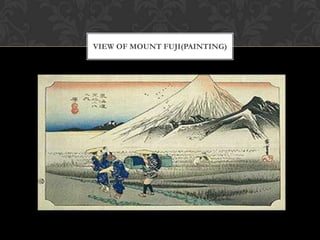
VIEW OF MOUNT FUJI(PAINTING)
Woodblock printing is a technique for
printing text, images or patterns used.
This method was adapted in Japan
during the Edo period (1603-1867) and
became one of their oldest and most
highly developed visual arts.
WOOD BLOCK PRINTING
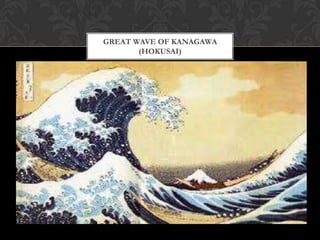
GREAT WAVE OF KANAGAWA
(HOKUSAI)
The best known and most popular style of
Japanese art is Ukiyo-e, which is Japanese for
"pictures of the floating world”.
Ukiyo-e art was produced in a diversity of
different media, including painting and became an art domain of
the upper classes and royalty but later was also produced by the
common people.
JAPANESE UKIYO-E
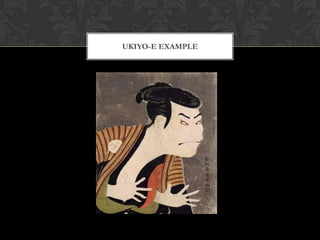
UKIYO-E EXAMPLE
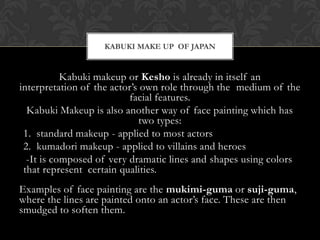
Kabuki makeup or Kesho is already in itself an
interpretation of the actor’s own role through the medium of the
facial features.
Kabuki Makeup is also another way of face painting which has
two types:
1. standard makeup - applied to most actors
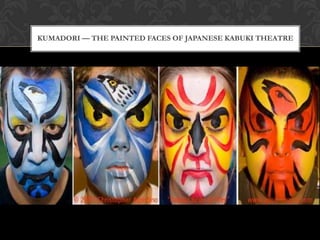
2. kumadori makeup - applied to villains and heroes
-It is composed of very dramatic lines and shapes using colors
that represent certain qualities.
Examples of face painting are the mukimi-guma or suji-guma,
where the lines are painted onto an actor’s face. These are then
smudged to soften them.
KABUKI MAKE UP OF JAPAN
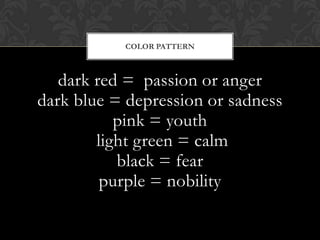
dark red = passion or anger
dark blue = depression or sadness
pink = youth
light green = calm
black = fear
purple = nobility
COLOR PATTERN
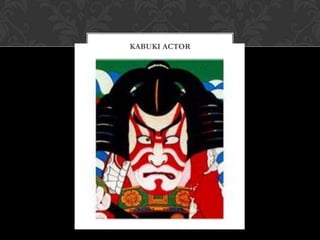
KABUKI ACTOR
KUMADORI — THE PAINTED FACES OF JAPANESE KABUKI THEATRE
The term Origami came from “ori” meaning "folding", and
“kami” meaning "paper".
Started in the 17th century AD and was
popularized internationally in the mid-1900s.
Flowers, animals, birds, fish, geometric shapes and dolls are the
common models used in Japanese Origami.
Origami butterflies were used during the celebration of Shinto
weddings to
represent the bride and groom,
It was known since the Heian period (794-1185) in Japanese
history.
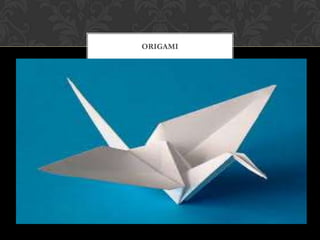
The best known Origami is the “Paper Crane”
ORIGAMI
ORIGAMI
In Japan, knot tying is called
Hanamusubi.
It emphasize on braids and
focuses on individual knots.
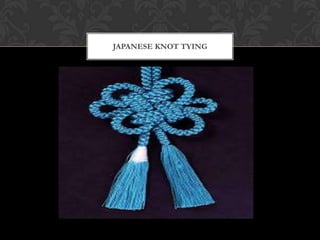
JAPANESE KNOT TYING
JAPANESE KNOT TYING

Japanese art

  • 1.
  • 2.
    Scenes from everydaylife. Narrative scenes crowded with figures and details . JAPANESE PAINTINGS
  • 3.
    VIEW OF MOUNTFUJI(PAINTING)
  • 4.
    Woodblock printing isa technique for printing text, images or patterns used. This method was adapted in Japan during the Edo period (1603-1867) and became one of their oldest and most highly developed visual arts. WOOD BLOCK PRINTING
  • 5.
    GREAT WAVE OFKANAGAWA (HOKUSAI)
  • 6.
    The best knownand most popular style of Japanese art is Ukiyo-e, which is Japanese for "pictures of the floating world”. Ukiyo-e art was produced in a diversity of different media, including painting and became an art domain of the upper classes and royalty but later was also produced by the common people. JAPANESE UKIYO-E
  • 7.
  • 8.
    Kabuki makeup orKesho is already in itself an interpretation of the actor’s own role through the medium of the facial features. Kabuki Makeup is also another way of face painting which has two types: 1. standard makeup - applied to most actors 2. kumadori makeup - applied to villains and heroes -It is composed of very dramatic lines and shapes using colors that represent certain qualities. Examples of face painting are the mukimi-guma or suji-guma, where the lines are painted onto an actor’s face. These are then smudged to soften them. KABUKI MAKE UP OF JAPAN
  • 9.
    dark red =passion or anger dark blue = depression or sadness pink = youth light green = calm black = fear purple = nobility COLOR PATTERN
  • 10.
  • 11.
    KUMADORI — THEPAINTED FACES OF JAPANESE KABUKI THEATRE
  • 12.
    The term Origamicame from “ori” meaning "folding", and “kami” meaning "paper". Started in the 17th century AD and was popularized internationally in the mid-1900s. Flowers, animals, birds, fish, geometric shapes and dolls are the common models used in Japanese Origami. Origami butterflies were used during the celebration of Shinto weddings to represent the bride and groom, It was known since the Heian period (794-1185) in Japanese history. The best known Origami is the “Paper Crane” ORIGAMI
  • 13.
  • 14.
    In Japan, knottying is called Hanamusubi. It emphasize on braids and focuses on individual knots. JAPANESE KNOT TYING
  • 15.