Lesson 7
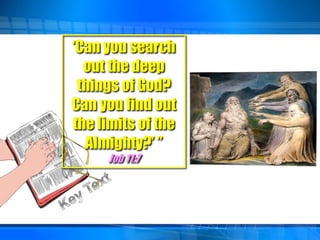
‘Can you search
out the deep
things of God?
Can you find out
the limits of the
Almighty?’ ”
Job 11:7
 Retributive punishment according to Bildad. Job 8.
 Retributive punishment according to Zophar. Job 11.
 Retributive punishment according to God:
 The Flood. Gn. 6:5-8.
 Sodom and Gomorrah. Gn. 19:24-25.
 Korah, Dathan and Abiram. Nm. 16:1-33.
 The second death. 2P. 3:5-7.
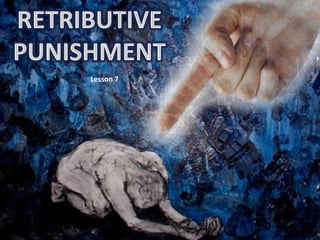
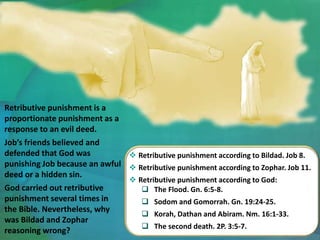
Retributive punishment is a
proportionate punishment as a
response to an evil deed.
Job’s friends believed and
defended that God was
punishing Job because an awful
deed or a hidden sin.
God carried out retributive
punishment several times in
the Bible. Nevertheless, why
was Bildad and Zophar
reasoning wrong?
“When your children sinned against him, he gave them over to the penalty of
their sin.” (Job 8:4 NIV)
Which were the main points of Bildad’s speech (Job 8)?
“When your children
sinned against him, he
gave them over to the
penalty of their sin.”
(v. 4)
“For the wages of sin
is death.”
(Romans 6:23)
“For we were born
yesterday, and know
nothing, because our
days on earth are a
shadow.” (v. 9)
“What is your life? You
are a mist that
appears for a little
while and then
vanishes.”
(James 4:14)
“What they trust in is
fragile; what they rely
on is a spider’s web.”
(v. 14)
“Cursed is the one
who trusts in man,
who draws strength
from mere flesh and
whose heart turns
away from the Lord.”
(Jeremiah 17:5)
All that Bildad said was based on the Bible. Then why was he wrong?
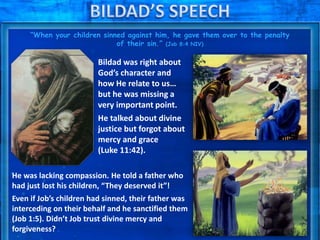
“When your children sinned against him, he gave them over to the penalty
of their sin.” (Job 8:4 NIV)
Bildad was right about
God’s character and
how He relate to us…
but he was missing a
very important point.
He talked about divine
justice but forgot about
mercy and grace
(Luke 11:42).
He was lacking compassion. He told a father who
had just lost his children, “They deserved it”!
Even if Job’s children had sinned, their father was
interceding on their behalf and he sanctified them
(Job 1:5). Didn’t Job trust divine mercy and
forgiveness?
God should reveal His
wisdom to Job (v. 5-6)
“Where were you
when I laid the
earth’s foundation?
Tell me, if you
understand.”
(Job 38:4)
God has punished you
less than you deserve
(v. 6)
“The Lord has
chastened me
severely, but he has
not given me over to
death.”
(Psalm 118:18)
No one can know as
much as God does
(v. 7-9)
“Whom did the Lord
consult to enlighten him,
and who taught him the
right way? Who was it
that taught him
knowledge, or showed
him the path of
understanding?”
(Isaiah 40:14)
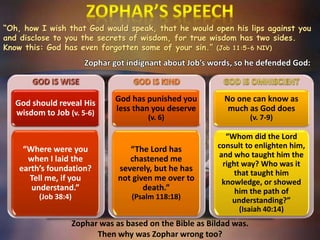
“Oh, how I wish that God would speak, that he would open his lips against you
and disclose to you the secrets of wisdom, for true wisdom has two sides.
Know this: God has even forgotten some of your sin.” (Job 11:5-6 NIV)
Zophar got indignant about Job’s words, so he defended God:
Zophar was as based on the Bible as Bildad was.
Then why was Zophar wrong too?
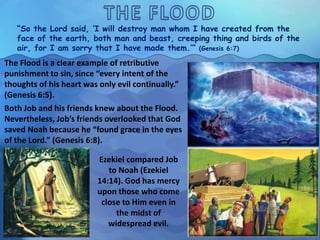
“So the Lord said, ‘I will destroy man whom I have created from the
face of the earth, both man and beast, creeping thing and birds of the
air, for I am sorry that I have made them.’” (Genesis 6:7)
The Flood is a clear example of retributive
punishment to sin, since “every intent of the
thoughts of his heart was only evil continually.”
(Genesis 6:5).
Both Job and his friends knew about the Flood.
Nevertheless, Job’s friends overlooked that God
saved Noah because he “found grace in the eyes
of the Lord.” (Genesis 6:8).
Ezekiel compared Job
to Noah (Ezekiel
14:14). God has mercy
upon those who come
close to Him even in
the midst of
widespread evil.
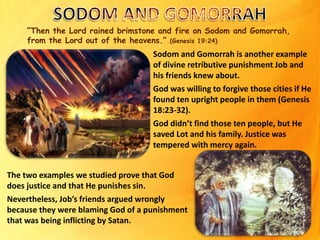
“Then the Lord rained brimstone and fire on Sodom and Gomorrah,
from the Lord out of the heavens.” (Genesis 19:24)
Sodom and Gomorrah is another example
of divine retributive punishment Job and
his friends knew about.
God was willing to forgive those cities if He
found ten upright people in them (Genesis
18:23-32).
God didn’t find those ten people, but He
saved Lot and his family. Justice was
tempered with mercy again.
The two examples we studied prove that God
does justice and that He punishes sin.
Nevertheless, Job’s friends argued wrongly
because they were blaming God of a punishment
that was being inflicting by Satan.
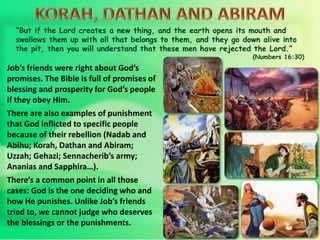
“But if the Lord creates a new thing, and the earth opens its mouth and
swallows them up with all that belongs to them, and they go down alive into
the pit, then you will understand that these men have rejected the Lord.”
(Numbers 16:30)
Job’s friends were right about God’s
promises. The Bible is full of promises of
blessing and prosperity for God’s people
if they obey Him.
There are also examples of punishment
that God inflicted to specific people
because of their rebellion (Nadab and
Abihu; Korah, Dathan and Abiram;
Uzzah; Gehazi; Sennacherib’s army;
Ananias and Sapphira…).
There’s a common point in all those
cases: God is the one deciding who and
how He punishes. Unlike Job’s friends
tried to, we cannot judge who deserves
the blessings or the punishments.
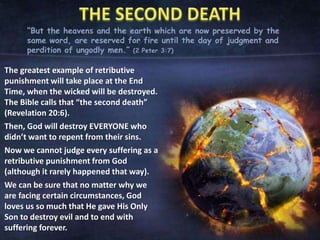
“But the heavens and the earth which are now preserved by the
same word, are reserved for fire until the day of judgment and
perdition of ungodly men.” (2 Peter 3:7)
The greatest example of retributive
punishment will take place at the End
Time, when the wicked will be destroyed.
The Bible calls that “the second death”
(Revelation 20:6).
Then, God will destroy EVERYONE who
didn’t want to repent from their sins.
Now we cannot judge every suffering as a
retributive punishment from God
(although it rarely happened that way).
We can be sure that no matter why we
are facing certain circumstances, God
loves us so much that He gave His Only
Son to destroy evil and to end with
suffering forever.
“Job’s professed friends were miserable comforters,
making his case more bitter and unbearable, and
Job was not guilty as they supposed…
Most pitiable is the condition of one who is
suffering under remorse; he is as one stunned,
staggering, sinking into the dust. And many who
suppose themselves to be righteous, become
exasperating comforters; they deal harshly with
these souls. In manifesting this hardness of heart in
offending and oppressing, they are doing the very
same work which Satan delights in doing. The tried,
tempted soul cannot see anything clearly. The mind
is confused; he knows not just what steps to take.
Oh, then, let no word be spoken to cause deeper
pain!”
E.G.W. (Testimonies to Ministers and Gospel Workers, cp.14, p. 350)
Slideshare.net/chucho1943
We invite you to download and
study each one of the 13 lessons
about this serie
THE BOOK OF JOB
THIS SERVICE IS FREE
AND YOU CAN USE IT

07 retributive punisment

  • 1.
  • 2.
    ‘Can you search outthe deep things of God? Can you find out the limits of the Almighty?’ ” Job 11:7
  • 3.
     Retributive punishmentaccording to Bildad. Job 8.  Retributive punishment according to Zophar. Job 11.  Retributive punishment according to God:  The Flood. Gn. 6:5-8.  Sodom and Gomorrah. Gn. 19:24-25.  Korah, Dathan and Abiram. Nm. 16:1-33.  The second death. 2P. 3:5-7. Retributive punishment is a proportionate punishment as a response to an evil deed. Job’s friends believed and defended that God was punishing Job because an awful deed or a hidden sin. God carried out retributive punishment several times in the Bible. Nevertheless, why was Bildad and Zophar reasoning wrong?
  • 4.
    “When your childrensinned against him, he gave them over to the penalty of their sin.” (Job 8:4 NIV) Which were the main points of Bildad’s speech (Job 8)? “When your children sinned against him, he gave them over to the penalty of their sin.” (v. 4) “For the wages of sin is death.” (Romans 6:23) “For we were born yesterday, and know nothing, because our days on earth are a shadow.” (v. 9) “What is your life? You are a mist that appears for a little while and then vanishes.” (James 4:14) “What they trust in is fragile; what they rely on is a spider’s web.” (v. 14) “Cursed is the one who trusts in man, who draws strength from mere flesh and whose heart turns away from the Lord.” (Jeremiah 17:5) All that Bildad said was based on the Bible. Then why was he wrong?
  • 5.
    “When your childrensinned against him, he gave them over to the penalty of their sin.” (Job 8:4 NIV) Bildad was right about God’s character and how He relate to us… but he was missing a very important point. He talked about divine justice but forgot about mercy and grace (Luke 11:42). He was lacking compassion. He told a father who had just lost his children, “They deserved it”! Even if Job’s children had sinned, their father was interceding on their behalf and he sanctified them (Job 1:5). Didn’t Job trust divine mercy and forgiveness?
  • 6.
    God should revealHis wisdom to Job (v. 5-6) “Where were you when I laid the earth’s foundation? Tell me, if you understand.” (Job 38:4) God has punished you less than you deserve (v. 6) “The Lord has chastened me severely, but he has not given me over to death.” (Psalm 118:18) No one can know as much as God does (v. 7-9) “Whom did the Lord consult to enlighten him, and who taught him the right way? Who was it that taught him knowledge, or showed him the path of understanding?” (Isaiah 40:14) “Oh, how I wish that God would speak, that he would open his lips against you and disclose to you the secrets of wisdom, for true wisdom has two sides. Know this: God has even forgotten some of your sin.” (Job 11:5-6 NIV) Zophar got indignant about Job’s words, so he defended God: Zophar was as based on the Bible as Bildad was. Then why was Zophar wrong too?
  • 7.
    “So the Lordsaid, ‘I will destroy man whom I have created from the face of the earth, both man and beast, creeping thing and birds of the air, for I am sorry that I have made them.’” (Genesis 6:7) The Flood is a clear example of retributive punishment to sin, since “every intent of the thoughts of his heart was only evil continually.” (Genesis 6:5). Both Job and his friends knew about the Flood. Nevertheless, Job’s friends overlooked that God saved Noah because he “found grace in the eyes of the Lord.” (Genesis 6:8). Ezekiel compared Job to Noah (Ezekiel 14:14). God has mercy upon those who come close to Him even in the midst of widespread evil.
  • 8.
    “Then the Lordrained brimstone and fire on Sodom and Gomorrah, from the Lord out of the heavens.” (Genesis 19:24) Sodom and Gomorrah is another example of divine retributive punishment Job and his friends knew about. God was willing to forgive those cities if He found ten upright people in them (Genesis 18:23-32). God didn’t find those ten people, but He saved Lot and his family. Justice was tempered with mercy again. The two examples we studied prove that God does justice and that He punishes sin. Nevertheless, Job’s friends argued wrongly because they were blaming God of a punishment that was being inflicting by Satan.
  • 9.
    “But if theLord creates a new thing, and the earth opens its mouth and swallows them up with all that belongs to them, and they go down alive into the pit, then you will understand that these men have rejected the Lord.” (Numbers 16:30) Job’s friends were right about God’s promises. The Bible is full of promises of blessing and prosperity for God’s people if they obey Him. There are also examples of punishment that God inflicted to specific people because of their rebellion (Nadab and Abihu; Korah, Dathan and Abiram; Uzzah; Gehazi; Sennacherib’s army; Ananias and Sapphira…). There’s a common point in all those cases: God is the one deciding who and how He punishes. Unlike Job’s friends tried to, we cannot judge who deserves the blessings or the punishments.
  • 10.
    “But the heavensand the earth which are now preserved by the same word, are reserved for fire until the day of judgment and perdition of ungodly men.” (2 Peter 3:7) The greatest example of retributive punishment will take place at the End Time, when the wicked will be destroyed. The Bible calls that “the second death” (Revelation 20:6). Then, God will destroy EVERYONE who didn’t want to repent from their sins. Now we cannot judge every suffering as a retributive punishment from God (although it rarely happened that way). We can be sure that no matter why we are facing certain circumstances, God loves us so much that He gave His Only Son to destroy evil and to end with suffering forever.
  • 11.
    “Job’s professed friendswere miserable comforters, making his case more bitter and unbearable, and Job was not guilty as they supposed… Most pitiable is the condition of one who is suffering under remorse; he is as one stunned, staggering, sinking into the dust. And many who suppose themselves to be righteous, become exasperating comforters; they deal harshly with these souls. In manifesting this hardness of heart in offending and oppressing, they are doing the very same work which Satan delights in doing. The tried, tempted soul cannot see anything clearly. The mind is confused; he knows not just what steps to take. Oh, then, let no word be spoken to cause deeper pain!” E.G.W. (Testimonies to Ministers and Gospel Workers, cp.14, p. 350)
  • 12.
    Slideshare.net/chucho1943 We invite youto download and study each one of the 13 lessons about this serie THE BOOK OF JOB THIS SERVICE IS FREE AND YOU CAN USE IT