McGraw-Hill © 2003 The McGraw-Hill Companies, Inc. All rights reserved.
1 - 1
McGraw-Hill © 2003 The McGraw-Hill Companies, Inc. All rights reserved.
1 - 2
Chapter
1 Managing
McGraw-Hill © 2003 The McGraw-Hill Companies, Inc. All rights reserved.
1 - 3
Learning Objectives
Learning Objectives
ïŹ After studying Chapter 1, you will know:
ïŹ the major challenges of managing in the new era
ïŹ the drivers of competitive advantage for your company
ïŹ the functions of management and how they are evolving in
today’s business environment
ïŹ the nature of management at different organizational levels
ïŹ the skills you need to be an effective manager
ïŹ what to strive for as you manage your career
McGraw-Hill © 2003 The McGraw-Hill Companies, Inc. All rights reserved.
1 - 4
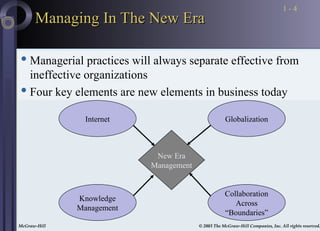
New Era
Management
Internet
Collaboration
Across
“Boundaries”
Knowledge
Management
Globalization
Managing In The New Era
ïŹ Managerial practices will always separate effective from
ineffective organizations
ïŹ Four key elements are new elements in business today
McGraw-Hill © 2003 The McGraw-Hill Companies, Inc. All rights reserved.
1 - 5
Managing In The New Era (cont.)
ïŹ The Internet
ïŹ communication technologies are driving massive change
ïŹ initial enthusiasm for e-business has dwindled
ïŹ 25% of publicly-held Web companies became profitable in 2002
ïŹ most profitable Web companies sell information-based
products that don’t require shipping
ïŹ old economy types now using the Internet as a tool to solidify
their future
McGraw-Hill © 2003 The McGraw-Hill Companies, Inc. All rights reserved.
1 - 6
Managing In The New Era (cont.)
ïŹ Globalization
ïŹ far more than in the past, enterprises are global
ïŹ competing globally is not easy
ïŹ companies often overestimate the attractiveness of foreign
markets
ïŹ even small firms that do not operate on a global scale must
make strategic decisions based on international considerations
ïŹ face intense competition from high-quality foreign producers
McGraw-Hill © 2003 The McGraw-Hill Companies, Inc. All rights reserved.
1 - 7
Managing In The New Era (cont.)
ïŹ Knowledge management
ïŹ practices aimed at discovering and harnessing an
organization’s intellectual resources
ïŹ unlock people’s expertise, skills, wisdom, and relationships
ïŹ intellectual capital is the collective brainpower of the
organization
ïŹ Collaboration across “boundaries”
ïŹ capitalize on the ideas of people outside the traditional
company “boundaries”
ïŹ occurs between as well as within organizations
ïŹ e.g., must effectively capitalize on customers’ brains
McGraw-Hill © 2003 The McGraw-Hill Companies, Inc. All rights reserved.
1 - 8
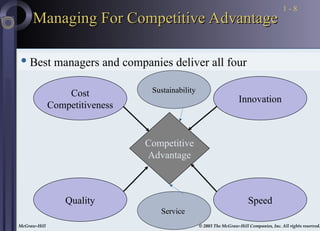
Competitive
Advantage
Cost
Competitiveness
Speed
Quality
Innovation
Managing For Competitive Advantage
ïŹ Best managers and companies deliver all four
Sustainability
Service
McGraw-Hill © 2003 The McGraw-Hill Companies, Inc. All rights reserved.
1 - 9
Managing For Competitive Advantage
(cont.)
(cont.)
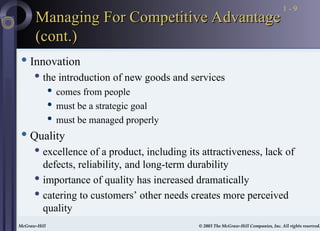
ïŹ Innovation
ïŹ the introduction of new goods and services
ïŹ comes from people
ïŹ must be a strategic goal
ïŹ must be managed properly
ïŹ Quality
ïŹ excellence of a product, including its attractiveness, lack of
defects, reliability, and long-term durability
ïŹ importance of quality has increased dramatically
ïŹ catering to customers’ other needs creates more perceived
quality
McGraw-Hill © 2003 The McGraw-Hill Companies, Inc. All rights reserved.
1 - 10
Managing For Competitive Advantage
(cont.)
(cont.)
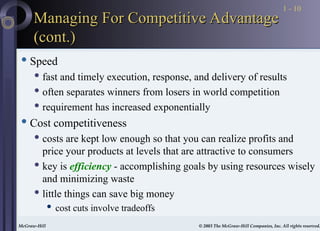
ïŹ Speed
ïŹ fast and timely execution, response, and delivery of results
ïŹ often separates winners from losers in world competition
ïŹ requirement has increased exponentially
ïŹ Cost competitiveness
ïŹ costs are kept low enough so that you can realize profits and
price your products at levels that are attractive to consumers
ïŹ key is efficiency - accomplishing goals by using resources wisely
and minimizing waste
ïŹ little things can save big money
ïŹ cost cuts involve tradeoffs
McGraw-Hill © 2003 The McGraw-Hill Companies, Inc. All rights reserved.
1 - 11
Managing For Competitive
Advantage (cont.)
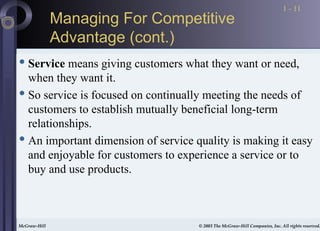
ïŹ Service means giving customers what they want or need,
when they want it.
ïŹ So service is focused on continually meeting the needs of
customers to establish mutually beneficial long-term
relationships.
ïŹ An important dimension of service quality is making it easy
and enjoyable for customers to experience a service or to
buy and use products.
McGraw-Hill © 2003 The McGraw-Hill Companies, Inc. All rights reserved.
1 - 12
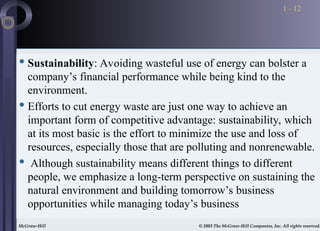
ïŹ Sustainability: Avoiding wasteful use of energy can bolster a
company’s financial performance while being kind to the
environment.
ïŹ Efforts to cut energy waste are just one way to achieve an
important form of competitive advantage: sustainability, which
at its most basic is the effort to minimize the use and loss of
resources, especially those that are polluting and nonrenewable.
ïŹ Although sustainability means different things to different
people, we emphasize a long-term perspective on sustaining the
natural environment and building tomorrow’s business
opportunities while managing today’s business
McGraw-Hill © 2003 The McGraw-Hill Companies, Inc. All rights reserved.
1 - 13
The Functions Of Management
ïŹ Management
ïŹ the process of working with people and resources to
accomplish organizational goals
ïŹ good managers must be:
ïŹ effective - achieve organizational goals
ïŹ efficient - achieve goals with minimum waste of resources
ïŹ there are timeless principles of management
ïŹ still important for making managers and companies great
ïŹ must add fresh thinking and new approaches
McGraw-Hill © 2003 The McGraw-Hill Companies, Inc. All rights reserved.
1 - 14
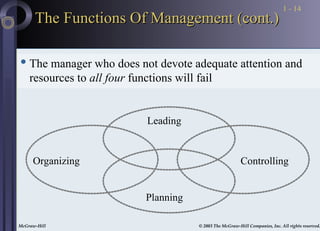
Planning
Leading
Controlling
The Functions Of Management (cont.)
Organizing
ïŹ The manager who does not devote adequate attention and
resources to all four functions will fail
McGraw-Hill © 2003 The McGraw-Hill Companies, Inc. All rights reserved.
1 - 15
The Functions Of Management (cont.)
ïŹ Planning
ïŹ specifying the goals to be achieved and deciding in advance
the appropriate actions taken to achieve those goals
ïŹ delivering strategic value - planning function for the new era
ïŹ a dynamic process in which the organization uses the brains of
its members and of stakeholders to identify opportunities to
maintain and increase competitive advantage
ïŹ process intended to create more value for the customer
McGraw-Hill © 2003 The McGraw-Hill Companies, Inc. All rights reserved.
1 - 16
The Functions Of Management (cont.)
ïŹ Organizing
ïŹ assembling and coordinating the human, financial, physical,
informational, and other resources needed to achieve goals
ïŹ building a dynamic organization - organizing function for the
new era
ïŹ viewing people as the most valuable resource
ïŹ the future requires building flexible organizations
McGraw-Hill © 2003 The McGraw-Hill Companies, Inc. All rights reserved.
1 - 17
The Functions Of Management (cont.)
ïŹ Leading
ïŹ stimulating people to be high performers
ïŹ in the new era, managers must be good at mobilizing people to
contribute their ideas
ïŹ Controlling
ïŹ monitoring progress and implementing necessary changes
ïŹ makes sure that goals are met
ïŹ new technology makes it possible to achieve more effective
controls
ïŹ for the future, will have to be able to monitor continuous
learning and changing
McGraw-Hill © 2003 The McGraw-Hill Companies, Inc. All rights reserved.
1 - 18
Management Levels
Management Levels
ïŹ Top-level managers (strategic managers)
ïŹ senior executives responsible for the overall management and
effectiveness of the organization
ïŹ focus on long-term issues
ïŹ emphasize the survival, growth, and effectiveness of the firm
ïŹ concerned with the interaction between the organization and
its external environment
ïŹ titles include Chief Executive Officer (CEO), Chief Operating
Officer (COO), company presidents and vice presidents
McGraw-Hill © 2003 The McGraw-Hill Companies, Inc. All rights reserved.
1 - 19
Management Levels (cont.)
ïŹ Middle-level managers (tactical managers)
ïŹ located between top-level and frontline managers in the
organizational hierarchy
ïŹ responsible for translating strategic goals and plans into more
specific objectives and activities
ïŹ traditional role was that of an administrative controller who
bridged the gap between higher and lower levels
ïŹ provide operating skills and practical problem solving the
keep the company working
McGraw-Hill © 2003 The McGraw-Hill Companies, Inc. All rights reserved.
1 - 20
Management Levels (cont.)
ïŹ Frontline managers (operational managers)
ïŹ lower-level managers who supervise the operational activities
of the organization
ïŹ directly involved with nonmanagement employees
ïŹ increasingly being called on to be innovative and
entrepreneurial
ïŹ titles include supervisor or sales manager
ïŹ Working leaders with broad responsibilities
ïŹ in small firms and large firms that have adapted to the times,
managers have strategic, tactical, and operational
responsibilities
McGraw-Hill © 2003 The McGraw-Hill Companies, Inc. All rights reserved.
1 - 21
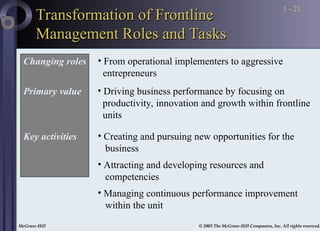
Transformation of Frontline
Management Roles and Tasks
‱ From operational implementers to aggressive
entrepreneurs
‱ Driving business performance by focusing on
productivity, innovation and growth within frontline
units
Changing roles
Primary value
Key activities ‱ Creating and pursuing new opportunities for the
business
‱ Attracting and developing resources and
competencies
‱ Managing continuous performance improvement
within the unit
McGraw-Hill © 2003 The McGraw-Hill Companies, Inc. All rights reserved.
1 - 22
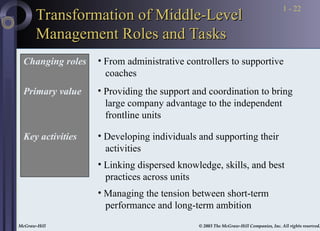
Transformation of Middle-Level
Management Roles and Tasks
‱ From administrative controllers to supportive
coaches
‱ Providing the support and coordination to bring
large company advantage to the independent
frontline units
‱ Developing individuals and supporting their
activities
‱ Linking dispersed knowledge, skills, and best
practices across units
‱ Managing the tension between short-term
performance and long-term ambition
Changing roles
Primary value
Key activities
McGraw-Hill © 2003 The McGraw-Hill Companies, Inc. All rights reserved.
1 - 23
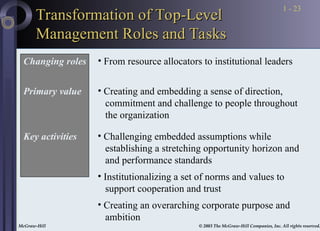
Transformation of Top-Level
Management Roles and Tasks
‱ From resource allocators to institutional leaders
‱ Creating and embedding a sense of direction,
commitment and challenge to people throughout
the organization
‱ Challenging embedded assumptions while
establishing a stretching opportunity horizon and
and performance standards
‱ Institutionalizing a set of norms and values to
support cooperation and trust
‱ Creating an overarching corporate purpose and
ambition
Changing roles
Primary value
Key activities
McGraw-Hill © 2003 The McGraw-Hill Companies, Inc. All rights reserved.
1 - 24
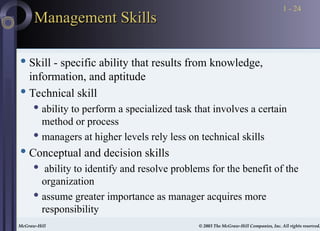
Management Skills
Management Skills
ïŹ Skill - specific ability that results from knowledge,
information, and aptitude
ïŹ Technical skill
ïŹ ability to perform a specialized task that involves a certain
method or process
ïŹ managers at higher levels rely less on technical skills
ïŹ Conceptual and decision skills
ïŹ ability to identify and resolve problems for the benefit of the
organization
ïŹ assume greater importance as manager acquires more
responsibility
McGraw-Hill © 2003 The McGraw-Hill Companies, Inc. All rights reserved.
1 - 25
Management Skills (cont.)
ïŹ Interpersonal and communication skills
ïŹ ability to lead, motivate, and communicate effectively with
others
ïŹ people skills
ïŹ important throughout your career at every level of
management
McGraw-Hill © 2003 The McGraw-Hill Companies, Inc. All rights reserved.
1 - 26
You And Your Career
You And Your Career
ïŹ Jobs are no longer as secure for managers as they used to be
ïŹ organizations still try to develop and retain good employees
ïŹ employee loyalty and commitment are still important
ïŹ Companies offering “employability” to workers tend to be
more successful
ïŹ provide training and other learning experiences
ïŹ employees perform work with greater responsibility
McGraw-Hill © 2003 The McGraw-Hill Companies, Inc. All rights reserved.
1 - 27
ïŹ Be both a specialist and generalist
ïŹ specialist - expert in something
ïŹ provide concrete, identifiable value to the firm
ïŹ generalist - knowing about a variety of business functions so
that you can understand work with different perspectives
ïŹ Be self-reliant
ïŹ take responsibility for yourself, your actions, and your career
regardless of where you work
ïŹ think and act like an entrepreneur
ïŹ look for opportunities to contribute in new ways
ïŹ generate constructive change
You And Your Career (cont.)
McGraw-Hill © 2003 The McGraw-Hill Companies, Inc. All rights reserved.
1 - 28
You And Your Career (cont.)
ïŹ Be connected
ïŹ establish many good working relationships
ïŹ be a team player with strong interpersonal skills
ïŹ all business is a function of human relationships
ïŹ competitive advantage depends upon you and other people
McGraw-Hill © 2003 The McGraw-Hill Companies, Inc. All rights reserved.
1 - 29
Keys to Career Management
1. Think of yourself as a business.
2. Define your product: What is your area of expertise?
3. Know your target market: To whom are you going to sell this?
4. Be clear on why your customer buys from you. What is your
“value proposition” - what are you offering that causes him to
use you?
5. As in any business, strive for quality and customer satisfaction, even
if your customer is just someone else in your organization - like
your boss.
6. Know your profession or field and what’s going on there.
7. Invest in your own growth and development, the way a company
invests in research and development. What new products will you
be able to provide?
8. Be willing to consider changing your career.
McGraw-Hill © 2003 The McGraw-Hill Companies, Inc. All rights reserved.
1 - 30
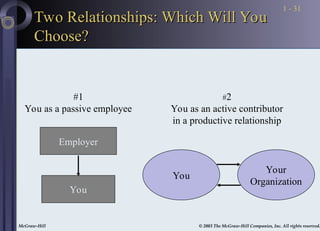
ïŹ Actively manage your relationship with your organization
ïŹ two ways to think about the nature of the relationships
between you and your employer
ïŹ view yourself as an employee
ïŹ model for just getting by
ïŹ contributions likely to be minimal
ïŹ two-way, mutually-beneficial exchange relationship
ïŹ think about how you can contribute and act accordingly
ïŹ figure out new ways to add value
ïŹ organization likely provide full and fair rewards, support further
personal development, and offer more gratifying work environment
You And Your Career (cont.)
McGraw-Hill © 2003 The McGraw-Hill Companies, Inc. All rights reserved.
1 - 31
Two Relationships: Which Will You
Choose?
Choose?
#2
You as an active contributor
in a productive relationship
You
Your
Organization
#1
You as a passive employee
Employer
You
McGraw-Hill © 2003 The McGraw-Hill Companies, Inc. All rights reserved.
1 - 32
Managerial Action Is Your Opportunity
To Contribute
To Contribute
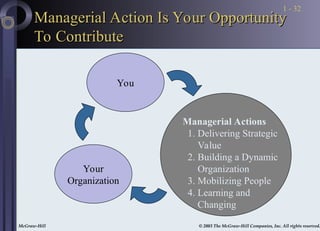
You
Your
Organization
Managerial Actions
1. Delivering Strategic
Value
2. Building a Dynamic
Organization
3. Mobilizing People
4. Learning and
Changing
McGraw-Hill © 2003 The McGraw-Hill Companies, Inc. All rights reserved.
1 - 33
ïŹ Survive and thrive
ïŹ be prepared to move from project to project, team to team
ïŹ be a master at something that the world values
ïŹ develop a strong network of colleagues who can help with
current and future projects
ïŹ have entrepreneurial skills that help you act as if you were
running your own business
ïŹ love technology
ïŹ market yourself
ïŹ be willing to constantly improve and even reinvent yourself
You And Your Career (cont.)

management by bateman and snell chapter 1

  • 1.
    McGraw-Hill © 2003The McGraw-Hill Companies, Inc. All rights reserved. McGraw-Hill © 2003 The McGraw-Hill Companies, Inc. All rights reserved. 1 - 1
  • 2.
    McGraw-Hill © 2003The McGraw-Hill Companies, Inc. All rights reserved. McGraw-Hill © 2003 The McGraw-Hill Companies, Inc. All rights reserved. 1 - 2 Chapter 1 Managing
  • 3.
    McGraw-Hill © 2003The McGraw-Hill Companies, Inc. All rights reserved. McGraw-Hill © 2003 The McGraw-Hill Companies, Inc. All rights reserved. 1 - 3 Learning Objectives Learning Objectives ïŹ After studying Chapter 1, you will know: ïŹ the major challenges of managing in the new era ïŹ the drivers of competitive advantage for your company ïŹ the functions of management and how they are evolving in today’s business environment ïŹ the nature of management at different organizational levels ïŹ the skills you need to be an effective manager ïŹ what to strive for as you manage your career
  • 4.
    McGraw-Hill © 2003The McGraw-Hill Companies, Inc. All rights reserved. McGraw-Hill © 2003 The McGraw-Hill Companies, Inc. All rights reserved. 1 - 4 New Era Management Internet Collaboration Across “Boundaries” Knowledge Management Globalization Managing In The New Era Managing In The New Era ïŹ Managerial practices will always separate effective from ineffective organizations ïŹ Four key elements are new elements in business today
  • 5.
    McGraw-Hill © 2003The McGraw-Hill Companies, Inc. All rights reserved. McGraw-Hill © 2003 The McGraw-Hill Companies, Inc. All rights reserved. 1 - 5 Managing In The New Era (cont.) Managing In The New Era (cont.) ïŹ The Internet ïŹ communication technologies are driving massive change ïŹ initial enthusiasm for e-business has dwindled ïŹ 25% of publicly-held Web companies became profitable in 2002 ïŹ most profitable Web companies sell information-based products that don’t require shipping ïŹ old economy types now using the Internet as a tool to solidify their future
  • 6.
    McGraw-Hill © 2003The McGraw-Hill Companies, Inc. All rights reserved. McGraw-Hill © 2003 The McGraw-Hill Companies, Inc. All rights reserved. 1 - 6 Managing In The New Era (cont.) Managing In The New Era (cont.) ïŹ Globalization ïŹ far more than in the past, enterprises are global ïŹ competing globally is not easy ïŹ companies often overestimate the attractiveness of foreign markets ïŹ even small firms that do not operate on a global scale must make strategic decisions based on international considerations ïŹ face intense competition from high-quality foreign producers
  • 7.
    McGraw-Hill © 2003The McGraw-Hill Companies, Inc. All rights reserved. McGraw-Hill © 2003 The McGraw-Hill Companies, Inc. All rights reserved. 1 - 7 Managing In The New Era (cont.) Managing In The New Era (cont.) ïŹ Knowledge management ïŹ practices aimed at discovering and harnessing an organization’s intellectual resources ïŹ unlock people’s expertise, skills, wisdom, and relationships ïŹ intellectual capital is the collective brainpower of the organization ïŹ Collaboration across “boundaries” ïŹ capitalize on the ideas of people outside the traditional company “boundaries” ïŹ occurs between as well as within organizations ïŹ e.g., must effectively capitalize on customers’ brains
  • 8.
    McGraw-Hill © 2003The McGraw-Hill Companies, Inc. All rights reserved. McGraw-Hill © 2003 The McGraw-Hill Companies, Inc. All rights reserved. 1 - 8 Competitive Advantage Cost Competitiveness Speed Quality Innovation Managing For Competitive Advantage Managing For Competitive Advantage ïŹ Best managers and companies deliver all four Sustainability Service
  • 9.
    McGraw-Hill © 2003The McGraw-Hill Companies, Inc. All rights reserved. McGraw-Hill © 2003 The McGraw-Hill Companies, Inc. All rights reserved. 1 - 9 Managing For Competitive Advantage Managing For Competitive Advantage (cont.) (cont.) ïŹ Innovation ïŹ the introduction of new goods and services ïŹ comes from people ïŹ must be a strategic goal ïŹ must be managed properly ïŹ Quality ïŹ excellence of a product, including its attractiveness, lack of defects, reliability, and long-term durability ïŹ importance of quality has increased dramatically ïŹ catering to customers’ other needs creates more perceived quality
  • 10.
    McGraw-Hill © 2003The McGraw-Hill Companies, Inc. All rights reserved. McGraw-Hill © 2003 The McGraw-Hill Companies, Inc. All rights reserved. 1 - 10 Managing For Competitive Advantage Managing For Competitive Advantage (cont.) (cont.) ïŹ Speed ïŹ fast and timely execution, response, and delivery of results ïŹ often separates winners from losers in world competition ïŹ requirement has increased exponentially ïŹ Cost competitiveness ïŹ costs are kept low enough so that you can realize profits and price your products at levels that are attractive to consumers ïŹ key is efficiency - accomplishing goals by using resources wisely and minimizing waste ïŹ little things can save big money ïŹ cost cuts involve tradeoffs
  • 11.
    McGraw-Hill © 2003The McGraw-Hill Companies, Inc. All rights reserved. McGraw-Hill © 2003 The McGraw-Hill Companies, Inc. All rights reserved. 1 - 11 Managing For Competitive Advantage (cont.) ïŹ Service means giving customers what they want or need, when they want it. ïŹ So service is focused on continually meeting the needs of customers to establish mutually beneficial long-term relationships. ïŹ An important dimension of service quality is making it easy and enjoyable for customers to experience a service or to buy and use products.
  • 12.
    McGraw-Hill © 2003The McGraw-Hill Companies, Inc. All rights reserved. McGraw-Hill © 2003 The McGraw-Hill Companies, Inc. All rights reserved. 1 - 12 ïŹ Sustainability: Avoiding wasteful use of energy can bolster a company’s financial performance while being kind to the environment. ïŹ Efforts to cut energy waste are just one way to achieve an important form of competitive advantage: sustainability, which at its most basic is the effort to minimize the use and loss of resources, especially those that are polluting and nonrenewable. ïŹ Although sustainability means different things to different people, we emphasize a long-term perspective on sustaining the natural environment and building tomorrow’s business opportunities while managing today’s business
  • 13.
    McGraw-Hill © 2003The McGraw-Hill Companies, Inc. All rights reserved. McGraw-Hill © 2003 The McGraw-Hill Companies, Inc. All rights reserved. 1 - 13 The Functions Of Management The Functions Of Management ïŹ Management ïŹ the process of working with people and resources to accomplish organizational goals ïŹ good managers must be: ïŹ effective - achieve organizational goals ïŹ efficient - achieve goals with minimum waste of resources ïŹ there are timeless principles of management ïŹ still important for making managers and companies great ïŹ must add fresh thinking and new approaches
  • 14.
    McGraw-Hill © 2003The McGraw-Hill Companies, Inc. All rights reserved. McGraw-Hill © 2003 The McGraw-Hill Companies, Inc. All rights reserved. 1 - 14 Planning Leading Controlling The Functions Of Management (cont.) The Functions Of Management (cont.) Organizing ïŹ The manager who does not devote adequate attention and resources to all four functions will fail
  • 15.
    McGraw-Hill © 2003The McGraw-Hill Companies, Inc. All rights reserved. McGraw-Hill © 2003 The McGraw-Hill Companies, Inc. All rights reserved. 1 - 15 The Functions Of Management (cont.) The Functions Of Management (cont.) ïŹ Planning ïŹ specifying the goals to be achieved and deciding in advance the appropriate actions taken to achieve those goals ïŹ delivering strategic value - planning function for the new era ïŹ a dynamic process in which the organization uses the brains of its members and of stakeholders to identify opportunities to maintain and increase competitive advantage ïŹ process intended to create more value for the customer
  • 16.
    McGraw-Hill © 2003The McGraw-Hill Companies, Inc. All rights reserved. McGraw-Hill © 2003 The McGraw-Hill Companies, Inc. All rights reserved. 1 - 16 The Functions Of Management (cont.) The Functions Of Management (cont.) ïŹ Organizing ïŹ assembling and coordinating the human, financial, physical, informational, and other resources needed to achieve goals ïŹ building a dynamic organization - organizing function for the new era ïŹ viewing people as the most valuable resource ïŹ the future requires building flexible organizations
  • 17.
    McGraw-Hill © 2003The McGraw-Hill Companies, Inc. All rights reserved. McGraw-Hill © 2003 The McGraw-Hill Companies, Inc. All rights reserved. 1 - 17 The Functions Of Management (cont.) The Functions Of Management (cont.) ïŹ Leading ïŹ stimulating people to be high performers ïŹ in the new era, managers must be good at mobilizing people to contribute their ideas ïŹ Controlling ïŹ monitoring progress and implementing necessary changes ïŹ makes sure that goals are met ïŹ new technology makes it possible to achieve more effective controls ïŹ for the future, will have to be able to monitor continuous learning and changing
  • 18.
    McGraw-Hill © 2003The McGraw-Hill Companies, Inc. All rights reserved. McGraw-Hill © 2003 The McGraw-Hill Companies, Inc. All rights reserved. 1 - 18 Management Levels Management Levels ïŹ Top-level managers (strategic managers) ïŹ senior executives responsible for the overall management and effectiveness of the organization ïŹ focus on long-term issues ïŹ emphasize the survival, growth, and effectiveness of the firm ïŹ concerned with the interaction between the organization and its external environment ïŹ titles include Chief Executive Officer (CEO), Chief Operating Officer (COO), company presidents and vice presidents
  • 19.
    McGraw-Hill © 2003The McGraw-Hill Companies, Inc. All rights reserved. McGraw-Hill © 2003 The McGraw-Hill Companies, Inc. All rights reserved. 1 - 19 Management Levels (cont.) Management Levels (cont.) ïŹ Middle-level managers (tactical managers) ïŹ located between top-level and frontline managers in the organizational hierarchy ïŹ responsible for translating strategic goals and plans into more specific objectives and activities ïŹ traditional role was that of an administrative controller who bridged the gap between higher and lower levels ïŹ provide operating skills and practical problem solving the keep the company working
  • 20.
    McGraw-Hill © 2003The McGraw-Hill Companies, Inc. All rights reserved. McGraw-Hill © 2003 The McGraw-Hill Companies, Inc. All rights reserved. 1 - 20 Management Levels (cont.) Management Levels (cont.) ïŹ Frontline managers (operational managers) ïŹ lower-level managers who supervise the operational activities of the organization ïŹ directly involved with nonmanagement employees ïŹ increasingly being called on to be innovative and entrepreneurial ïŹ titles include supervisor or sales manager ïŹ Working leaders with broad responsibilities ïŹ in small firms and large firms that have adapted to the times, managers have strategic, tactical, and operational responsibilities
  • 21.
    McGraw-Hill © 2003The McGraw-Hill Companies, Inc. All rights reserved. McGraw-Hill © 2003 The McGraw-Hill Companies, Inc. All rights reserved. 1 - 21 Transformation of Frontline Transformation of Frontline Management Roles and Tasks Management Roles and Tasks ‱ From operational implementers to aggressive entrepreneurs ‱ Driving business performance by focusing on productivity, innovation and growth within frontline units Changing roles Primary value Key activities ‱ Creating and pursuing new opportunities for the business ‱ Attracting and developing resources and competencies ‱ Managing continuous performance improvement within the unit
  • 22.
    McGraw-Hill © 2003The McGraw-Hill Companies, Inc. All rights reserved. McGraw-Hill © 2003 The McGraw-Hill Companies, Inc. All rights reserved. 1 - 22 Transformation of Middle-Level Transformation of Middle-Level Management Roles and Tasks Management Roles and Tasks ‱ From administrative controllers to supportive coaches ‱ Providing the support and coordination to bring large company advantage to the independent frontline units ‱ Developing individuals and supporting their activities ‱ Linking dispersed knowledge, skills, and best practices across units ‱ Managing the tension between short-term performance and long-term ambition Changing roles Primary value Key activities
  • 23.
    McGraw-Hill © 2003The McGraw-Hill Companies, Inc. All rights reserved. McGraw-Hill © 2003 The McGraw-Hill Companies, Inc. All rights reserved. 1 - 23 Transformation of Top-Level Transformation of Top-Level Management Roles and Tasks Management Roles and Tasks ‱ From resource allocators to institutional leaders ‱ Creating and embedding a sense of direction, commitment and challenge to people throughout the organization ‱ Challenging embedded assumptions while establishing a stretching opportunity horizon and and performance standards ‱ Institutionalizing a set of norms and values to support cooperation and trust ‱ Creating an overarching corporate purpose and ambition Changing roles Primary value Key activities
  • 24.
    McGraw-Hill © 2003The McGraw-Hill Companies, Inc. All rights reserved. McGraw-Hill © 2003 The McGraw-Hill Companies, Inc. All rights reserved. 1 - 24 Management Skills Management Skills ïŹ Skill - specific ability that results from knowledge, information, and aptitude ïŹ Technical skill ïŹ ability to perform a specialized task that involves a certain method or process ïŹ managers at higher levels rely less on technical skills ïŹ Conceptual and decision skills ïŹ ability to identify and resolve problems for the benefit of the organization ïŹ assume greater importance as manager acquires more responsibility
  • 25.
    McGraw-Hill © 2003The McGraw-Hill Companies, Inc. All rights reserved. McGraw-Hill © 2003 The McGraw-Hill Companies, Inc. All rights reserved. 1 - 25 Management Skills (cont.) Management Skills (cont.) ïŹ Interpersonal and communication skills ïŹ ability to lead, motivate, and communicate effectively with others ïŹ people skills ïŹ important throughout your career at every level of management
  • 26.
    McGraw-Hill © 2003The McGraw-Hill Companies, Inc. All rights reserved. McGraw-Hill © 2003 The McGraw-Hill Companies, Inc. All rights reserved. 1 - 26 You And Your Career You And Your Career ïŹ Jobs are no longer as secure for managers as they used to be ïŹ organizations still try to develop and retain good employees ïŹ employee loyalty and commitment are still important ïŹ Companies offering “employability” to workers tend to be more successful ïŹ provide training and other learning experiences ïŹ employees perform work with greater responsibility
  • 27.
    McGraw-Hill © 2003The McGraw-Hill Companies, Inc. All rights reserved. McGraw-Hill © 2003 The McGraw-Hill Companies, Inc. All rights reserved. 1 - 27 ïŹ Be both a specialist and generalist ïŹ specialist - expert in something ïŹ provide concrete, identifiable value to the firm ïŹ generalist - knowing about a variety of business functions so that you can understand work with different perspectives ïŹ Be self-reliant ïŹ take responsibility for yourself, your actions, and your career regardless of where you work ïŹ think and act like an entrepreneur ïŹ look for opportunities to contribute in new ways ïŹ generate constructive change You And Your Career (cont.) You And Your Career (cont.)
  • 28.
    McGraw-Hill © 2003The McGraw-Hill Companies, Inc. All rights reserved. McGraw-Hill © 2003 The McGraw-Hill Companies, Inc. All rights reserved. 1 - 28 You And Your Career (cont.) You And Your Career (cont.) ïŹ Be connected ïŹ establish many good working relationships ïŹ be a team player with strong interpersonal skills ïŹ all business is a function of human relationships ïŹ competitive advantage depends upon you and other people
  • 29.
    McGraw-Hill © 2003The McGraw-Hill Companies, Inc. All rights reserved. McGraw-Hill © 2003 The McGraw-Hill Companies, Inc. All rights reserved. 1 - 29 Keys to Career Management Keys to Career Management 1. Think of yourself as a business. 2. Define your product: What is your area of expertise? 3. Know your target market: To whom are you going to sell this? 4. Be clear on why your customer buys from you. What is your “value proposition” - what are you offering that causes him to use you? 5. As in any business, strive for quality and customer satisfaction, even if your customer is just someone else in your organization - like your boss. 6. Know your profession or field and what’s going on there. 7. Invest in your own growth and development, the way a company invests in research and development. What new products will you be able to provide? 8. Be willing to consider changing your career.
  • 30.
    McGraw-Hill © 2003The McGraw-Hill Companies, Inc. All rights reserved. McGraw-Hill © 2003 The McGraw-Hill Companies, Inc. All rights reserved. 1 - 30 ïŹ Actively manage your relationship with your organization ïŹ two ways to think about the nature of the relationships between you and your employer ïŹ view yourself as an employee ïŹ model for just getting by ïŹ contributions likely to be minimal ïŹ two-way, mutually-beneficial exchange relationship ïŹ think about how you can contribute and act accordingly ïŹ figure out new ways to add value ïŹ organization likely provide full and fair rewards, support further personal development, and offer more gratifying work environment You And Your Career (cont.) You And Your Career (cont.)
  • 31.
    McGraw-Hill © 2003The McGraw-Hill Companies, Inc. All rights reserved. McGraw-Hill © 2003 The McGraw-Hill Companies, Inc. All rights reserved. 1 - 31 Two Relationships: Which Will You Two Relationships: Which Will You Choose? Choose? #2 You as an active contributor in a productive relationship You Your Organization #1 You as a passive employee Employer You
  • 32.
    McGraw-Hill © 2003The McGraw-Hill Companies, Inc. All rights reserved. McGraw-Hill © 2003 The McGraw-Hill Companies, Inc. All rights reserved. 1 - 32 Managerial Action Is Your Opportunity Managerial Action Is Your Opportunity To Contribute To Contribute You Your Organization Managerial Actions 1. Delivering Strategic Value 2. Building a Dynamic Organization 3. Mobilizing People 4. Learning and Changing
  • 33.
    McGraw-Hill © 2003The McGraw-Hill Companies, Inc. All rights reserved. McGraw-Hill © 2003 The McGraw-Hill Companies, Inc. All rights reserved. 1 - 33 ïŹ Survive and thrive ïŹ be prepared to move from project to project, team to team ïŹ be a master at something that the world values ïŹ develop a strong network of colleagues who can help with current and future projects ïŹ have entrepreneurial skills that help you act as if you were running your own business ïŹ love technology ïŹ market yourself ïŹ be willing to constantly improve and even reinvent yourself You And Your Career (cont.) You And Your Career (cont.)