1449/1 – 1 hour 15 minutes
40 objective questions
1449/2 – subjective
Section A - 11 compulsory
            questions
Section B - 4 out of 5
            questions
2 Hours 30 minutes
       SCIENTIFIC CALCULATOR
          GEOMETRIC AL SET
3 marks
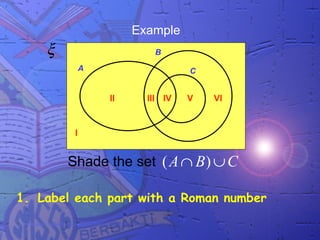
Example
    ξ                    B

             A                   C


                 II     III IV   V   VI


         I


        Shade the set ( A ∩ B ) ∪ C

1. Label each part with a Roman number
ξ                                 B

               A                              C


                        II          III IV   V      VI


           I


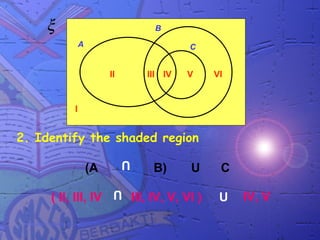
2. Identify the shaded region
                             U
                   (A                 B)      U      C
                         U
     ( II, III, IV               III, IV, V, VI )    U   IV, V
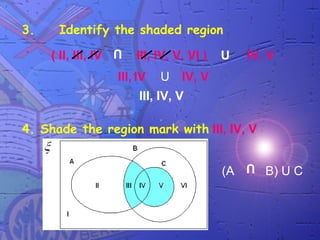
3.     Identify the shaded region
                     U
     ( II, III, IV       III, IV, V, VI )   U    IV, V
                     III, IV   U IV, V
                          III, IV, V

4. Shade the region mark with III, IV, V

                                                 U
                                            (A       B) U C
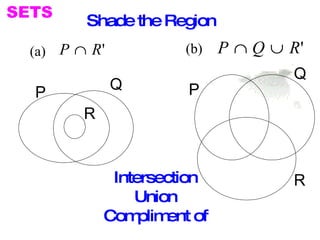
SETS
          Shade the Region
  (a) P ∩ R '          (b)   P ∩ Q ∪ R'
                                     Q
                Q      P
  P
         R


              Intersection           R
                 Union
             Com  plim of
                      ent
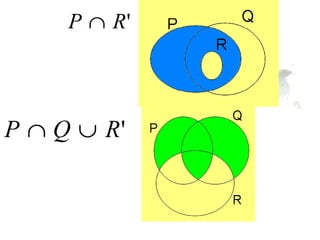
P ∩ R'


P ∩ Q ∪ R'
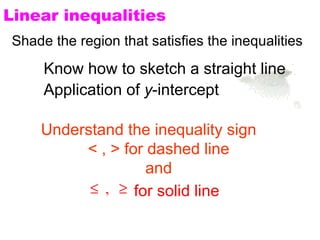
Linear inequalities
Shade the region that satisfies the inequalities
     Know how to sketch a straight line
     Application of y-intercept

    Understand the inequality sign
         < , > for dashed line
                   and
          ≤ , ≥ for solid line
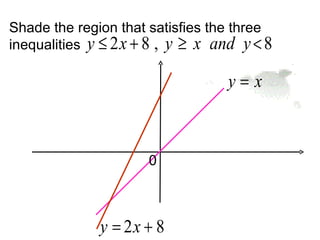
Shade the region that satisfies the three
inequalities y ≤ 2 x + 8 , y ≥ x and y < 8

                                  y=x


                      0


              y = 2x + 8
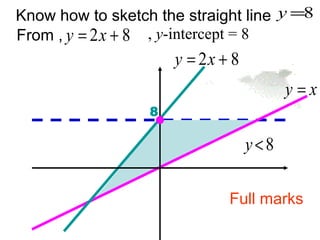
Know how to sketch the straight line y =8
From , y = 2 x + 8 , y-intercept = 8
                      y = 2x + 8
                                         y=x
                  8

                                   y<8

                              Full marks
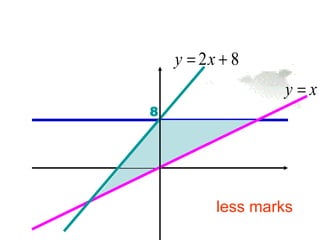
y = 2x + 8
                   y=x
8


          less marks
4 marks
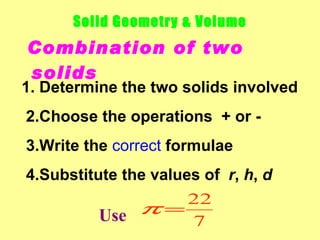
Solid Geometry & Volume
Combination of two
solids
1. Determine the two solids involved
2.Choose the operations + or -
3.Write the correct formulae
4.Substitute the values of r, h, d
                      22
          Use  π=
                      7
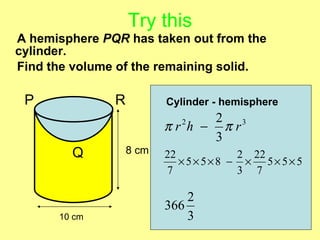
Try this
A hemisphere PQR has taken out from the
cylinder.
Find the volume of the remaining solid.

 P             R          Cylinder - hemisphere
                                2 3
                          πr h − πr
                            2

                                3
        Q          8 cm   22          2 22
                             ×5× 5×8 − × 5× 5× 5
                          7           3 7

                              2
                          366
      10 cm                   3
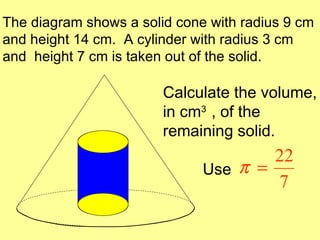
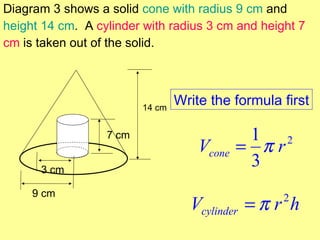
The diagram shows a solid cone with radius 9 cm
and height 14 cm. A cylinder with radius 3 cm
and height 7 cm is taken out of the solid.

                        Calculate the volume,
                        in cm3 , of the
                        remaining solid.
                                      22
                              Use π =
                                      7
Diagram 3 shows a solid cone with radius 9 cm and
height 14 cm. A cylinder with radius 3 cm and height 7
cm is taken out of the solid.


                         14 cm
                                 Write the formula first

                  7 cm                        1 2
                                     Vcone   = πr
      3 cm
                                              3
     9 cm
                                   Vcylinder = π r h
                                                   2
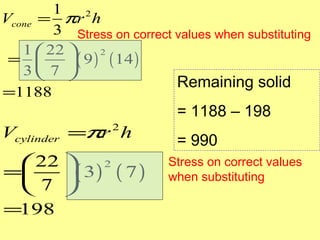
1
Vcone = πr 2 h
        3 Stress on correct values when substituting
   1  22 
          ( 9 ) ( 14 )
                2
 = 
   3 7 
                            Remaining solid
=1188
                             = 1188 – 198
Vcylinder =πr h   2
                             = 990
  22                      Stress on correct values
      ( 3 ) ( 7 )
            2
=                          when substituting
  7 
=198
Lines and Planes
      in 3D

    4 marks
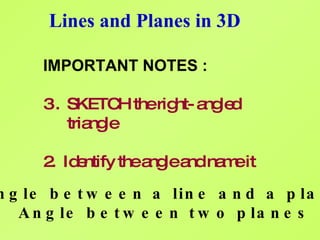
Lines and Planes in 3D

      IMPORTANT NOTES :

      3. SKETC therig a le
                H    ht- ng d
         tria le
             ng

      2 Id ntify thea lea na eit
       . e           ng nd m
n g le b e t w e e n a lin e a n d a p la
   A n g le b e t w e e n t w o p la n e s
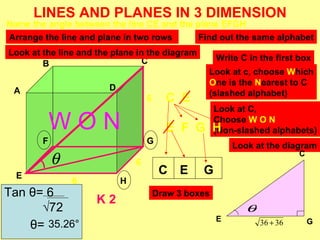
LINES AND PLANES IN 3 DIMENSION
Name the angle between the line CE and the plane EFGH
Arrange the line and plane in two rows      Find out the same alphabet
Look at the line and the plane in the diagram
                                 C                     Write C in the first box
        B
                                                   Look at c, choose Which
                                                   One is the Nearest to C
 A                      D
                                                   (slashed alphabet)
                                    6     C E
                                                       Look at C,
            WON                           E F G
                                                       Choose W O N
                                                       H
                                                       (Non-slashed alphabets)
        F                           G
                                                           Look at the diagram
            θ                   6
                                                                            C

  E                                      C E      G
                6           H
Tan θ= 6                                Draw 3 boxes
                     K2
      √72                                                     θ
                                                       E          36 + 36       G
    θ= 35.26°
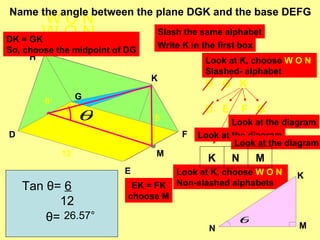
Name the angle between the plane DGK and the base DEFG
        WON
DK = GKW O N
                                Slash the same alphabet
                                Write K in the first box
So, choose the midpoint of DG
     H                                      Look at K, choose W O N
                                            Slashed- alphabet
                                K
                                            D G K
        8            G
                                            D E       F G
            N
                     θ          6                  Look at the diagram
D                                      F   Look at the diagram
                                                    Look at the diagram
                12              M
                                             K    N     M
                          E           Look at K, choose W O N    K
    Tan θ= 6                EK = FK   Non-slashed alphabets
                           choose M
          12
        θ= 26.57°                                   θ
                                             N                    M
V

WON
WON
Non-slash alphabet
Slash alphabet
                                                      6

                         D
                                                      C
                                              θ
                                                  8

          A                  10           B
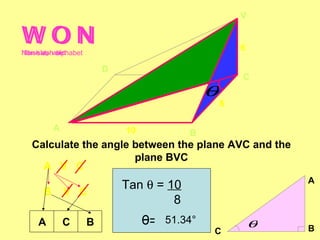
   Calculate the angle between the plane AVC and the
                       plane BVC
     A V C
                                                              A
                             Tan θ = 10
      B       V C
                                      8
    A         C      B            θ= 51.34°               θ
                                              C               B
A                  B

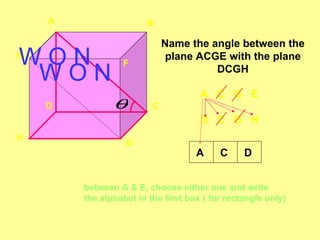
                             Name the angle between the
WON
E
                 F
                              plane ACGE with the plane
 WON                                   DCGH

                                     A C G E
    D          θ         C
                                     D C G H
H
                  G
                                    A     C     D


        between A & E, choose either one and write
        the alphabet in the first box ( for rectangle only)
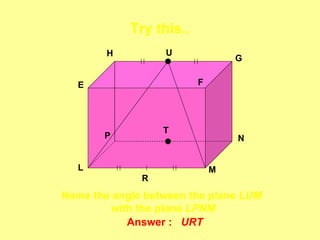
Try this..
        H         U
                                 G


  E                      F


                  T
       P                         N


  L                          M
              R

Name the angle between the plane LUM
         with the plane LPNM
            Answer : URT
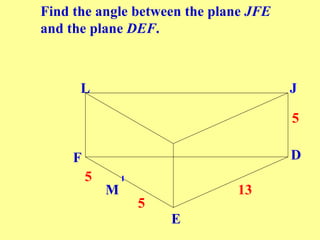
Find the angle between the plane JFE
and the plane DEF.


      L                                J

                                       5

     F                                 D
         5
             M                13
                 5
                     E
L                           J

                                5

   F                            D
        5
            M              13
                5
                    E


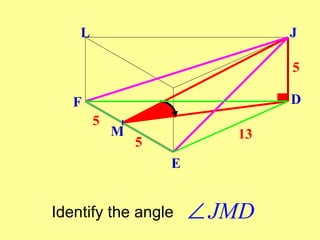
Identify the angle      ∠ JMD
5
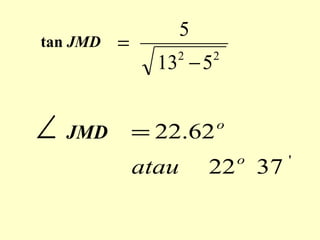
tan JMD   =
                13 − 5
                  2      2


∠   JMD       = 22.62    o

                             o   '
              atau       22 37
5M A R K S
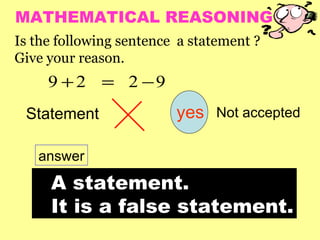
MATHEMATICAL REASONING
Is the following sentence a statement ?
Give your reason.
     9 + 2 = 2 −9
 Statement               yes    Not accepted


   answer

     A statement.
     It is a false statement.
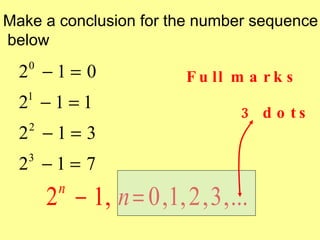
Make a conclusion for the number sequence
below

  2 −1= 0
   0
                          F u ll m a r k s
  2 −1=1
   1
                                  3 d o ts
  2 −1= 3
   2


  2 −1= 7
   3


       2 − 1, n = 0 ,1, 2 , 3 , ...
        n
n
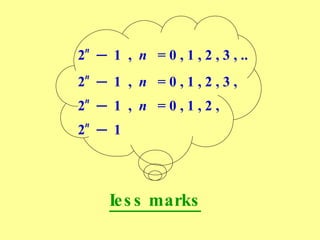
2 ─ 1 , n = 0 , 1 , 2 , 3 , ..
 n
2 ─ 1 , n =0,1,2,3,
 n
2 ─ 1 , n =0,1,2,
 n
2 ─ 1


     Ie s s marks
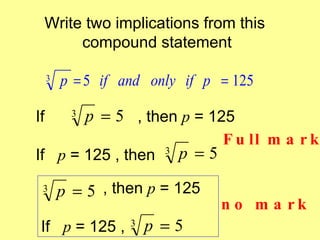
Write two implications from this
          compound statement

     3   p = 5 if and only if p = 125

If         3   p = 5 , then p = 125
                                      F u ll m a r k
If p = 125 , then          3   p =5
 3       p = 5 , then p = 125
                                      n o m a rk
 If p = 125 ,        3   p =5
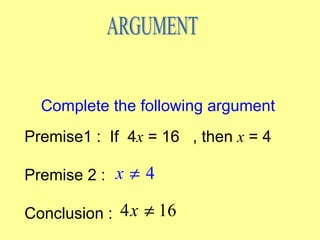
Complete the following argument
Premise1 : If 4x = 16 , then x = 4

Premise 2 : x ≠ 4

Conclusion : 4 x ≠ 16
SIMULTANEOUS LINEAR
     EQUATIONS
   Elimination method

   Substitution method

     Matrix method

     4 M AR KS
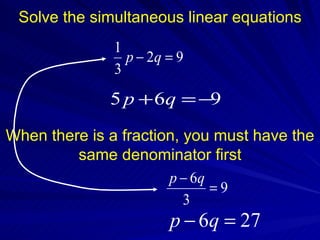
Solve the simultaneous linear equations
               1
                 p − 2q = 9
               3
              5 p + 6q = −9

When there is a fraction, you must have the
         same denominator first
                       p − 6q
                              =9
                          3
                        p − 6q = 27
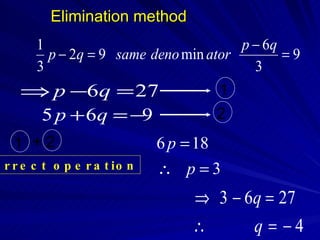
Elimination method
      1                               p − 6q
        p − 2q = 9 same deno min ator        =9
      3                                 3
   ⇒ p −6q = 27                     1
    5 p + 6q = −9                   2
 1 +2                        6 p = 18
r r e c t o p e r a t io n   ∴ p=3
                                 ⇒ 3 − 6q = 27
                                 ∴      q = −4
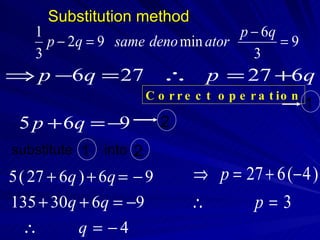
Substitution method
    1                               p − 6q
      p − 2q = 9 same deno min ator        =9
    3                                 3
⇒ p −6q = 27 ∴                      p = 27 +6q
                        C o r r e c t o p e r a t io n
                                                         1
 5 p + 6q = −9             2
substitute 1   into 2
5 ( 27 + 6q ) + 6q = − 9        ⇒ p = 27 + 6 (− 4 )
135 + 30q + 6q = −9             ∴      p=3
  ∴        q = −4
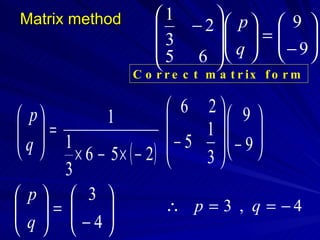
Matrix method        1      p  9 
                        − 2
                               = 
                      3     q   − 9
                      5 6    
                 C o r r e c t m a t r ix f o r m


 p        1            6 2 9 
 =                          
                             1  
q  1                  − 5 − 9 
     × 6 − 5 × ( − 2)     3
     3
 p  3 
 =                 ∴ p = 3 , q = −4
 q   −4
       
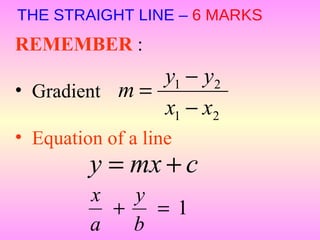
THE STRAIGHT LINE – 6 MARKS
REMEMBER :
               y1 − y2
• Gradient m =
               x1 − x2
• Equation of a line
         y = mx + c
         x   y
           +   = 1
         a   b
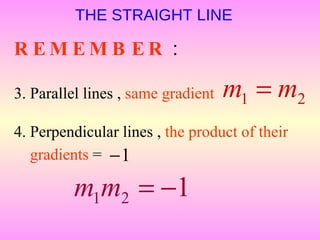
THE STRAIGHT LINE

REMEMB ER :

3. Parallel lines , same gradient   m1 = m2
4. Perpendicular lines , the product of their
   gradients = − 1

         m1m2 = −1
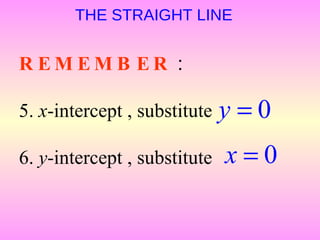
THE STRAIGHT LINE


REMEMB ER :

5. x-intercept , substitute   y=0
6. y-intercept , substitute   x=0
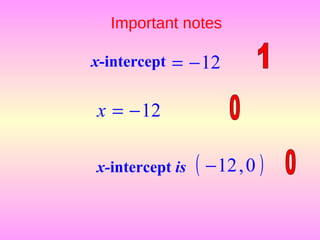
Important notes
x-intercept   = − 12

x = − 12

x-intercept is   ( − 12 , 0 )
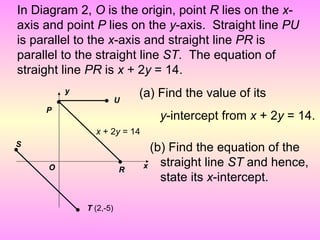
In Diagram 2, O is the origin, point R lies on the x-
axis and point P lies on the y-axis. Straight line PU
is parallel to the x-axis and straight line PR is
parallel to the straight line ST. The equation of
straight line PR is x + 2y = 14.
             y                      (a) Find the value of its
         •                •     U
     P
                                        y-intercept from x + 2y = 14.
                       x + 2y = 14
S
•                                      (b) Find the equation of the
     O                          •
                                R
                                     x   straight line ST and hence,
                                         state its x-intercept.

                 •   T (2,-5)
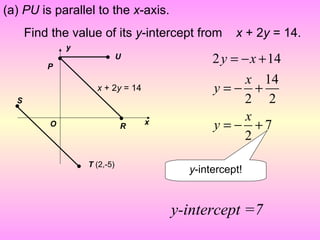
(a) PU is parallel to the x-axis.
      Find the value of its y-intercept from              x + 2y = 14.
                  y

          P
              •                •     U               2 y = − x + 14
                                                            x 14
                            x + 2y = 14              y=− +
  S                                                        2 2
  •
                                     •                      x
          O                          R
                                          x
                                                     y = − +7
                                                           2

                      •   T (2,-5)
                                                y-intercept!


                                              y-intercept =7
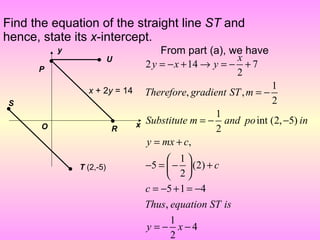
Find the equation of the straight line ST and
hence, state its x-intercept.
               y                               From part (a), we have
           •                •     U                              x
      P
                                           2 y = − x + 14 → y = − + 7
                                                                 2
                                                                            1
                         x + 2y = 14       Therefore, gradient ST , m = −
S                                                                           2
•                                                          1
                                  •    x   Substitute m = − and po int (2, −5) in
       O                          R                        2
                                           y = mx + c,
                                                 1
                                           −5 =  −  (2) + c
                   •   T (2,-5)
                                                 2
                                           c = −5 + 1 = −4
                                           Thus, equation ST is
                                                1
                                           y = − x−4
                                                2
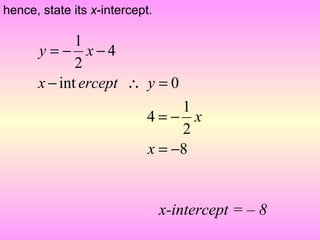
hence, state its x-intercept.

             1
      y = − x−4
             2
      x − int ercept ∴ y = 0
                                1
                           4=− x
                                2
                           x = −8


                                x-intercept = – 8
QUADRATIC EQUATIONS

      4 MARKS
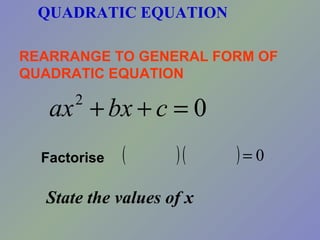
QUADRATIC EQUATION

REARRANGE TO GENERAL FORM OF
QUADRATIC EQUATION

   ax + bx + c = 0
      2


  Factorise   (     )(    )=0
  State the values of x
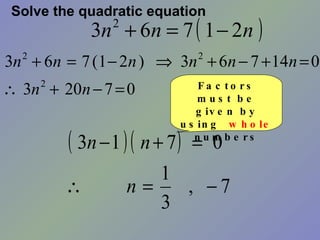
Solve the quadratic equation
              3n + 6n = 7 ( 1 − 2n )
                 2


3n + 6n = 7 (1 − 2n ) ⇒ 3n + 6n − 7 + 14n = 0
  2                              2


∴ 3n + 20n − 7 = 0
      2                          Fa c to rs
                                 mus t be
                                 g iv e n b y
                             u s in g w h o le
          ( 3n − 1 ) ( n + 7 )   = 0
                                n u m b e rs


                        1
          ∴          n=   , −7
                        3
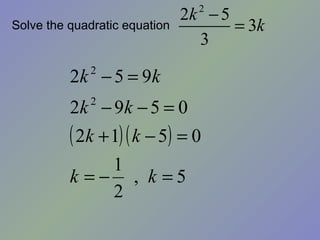
2k − 5
                                 2
Solve the quadratic equation          = 3k
                                 3

          2k − 5 = 9k
             2


          2k − 9k − 5 = 0
             2


          ( 2k + 1) ( k − 5) = 0
              1
          k =− , k =5
              2
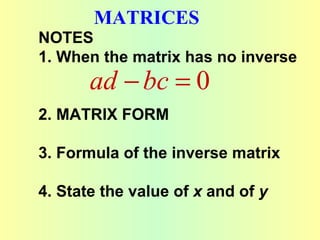
MATRICES
NOTES
1. When the matrix has no inverse
       ad − bc = 0
2. MATRIX FORM

3. Formula of the inverse matrix

4. State the value of x and of y
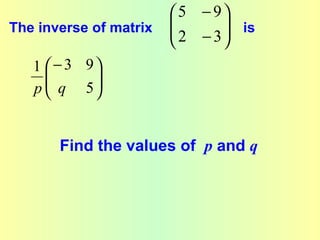
 5 − 9
The inverse of matrix   
                         2 − 3  is
                                
                               
   1  − 3 9
     
      q 5 
   p       


       Find the values of p and q
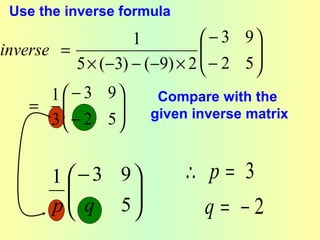
Use the inverse formula
                     1           − 3 9
inverse =                             
                                 − 2 5
            5 × (−3) − (−9) × 2       
       1  − 3 9        Compare with the
    =    − 2 5      given inverse matrix
       3         


       1  − 3 9           ∴ p= 3
         
          q 5 
       p                     q= −2
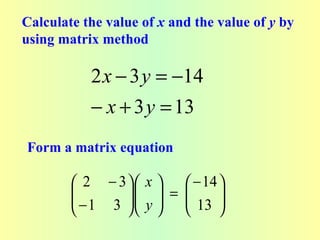
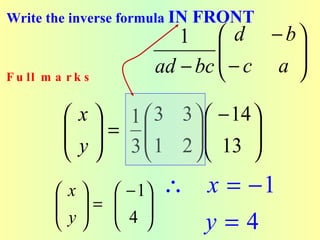
Calculate the value of x and the value of y by
using matrix method

           2 x − 3 y = −14
           − x + 3 y = 13
Form a matrix equation

         2 − 3  x      − 14 
        
         − 1 3   y  =  13 
                             
                            
Write the inverse formula IN   FRONT
                           1  d − b
                                      
                                − c a 
F u ll m a r k s
                        ad − bc       

            x  1  3 3   − 14 
            =         
            y  3  1 2   13  
                             
          x   − 1   ∴ x = −1
          =  
          y  4 
                      y=4
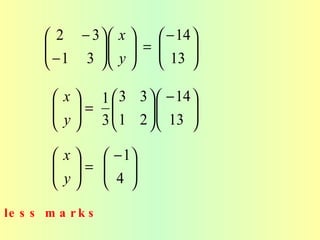
 2 − 3  x   − 14 
               = 
        −1 3   y   13  
                        

         x  1  3 3   − 14 
         = 
         y  3  1 2   13 
                             
                          

         x   − 1
         =  
         y  4 
           
le s s m a r k s
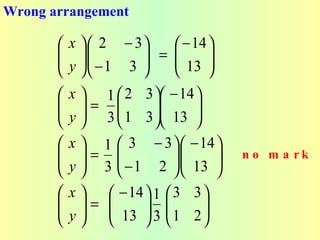
Wrong arrangement

        x   2 − 3     − 14 
        
        y   − 1 3  =  13 
                              
                           
        x  1  2 3  − 14 
        =           
        y  3  1 3  13   
                         
        x  1  3 − 3   − 14 
        = 
        y  3  − 1 2   13 
                                   n o m a rk
                             
       x     − 14  1  3 3 
        = 
        y    13  3  1 2 
                              
                           
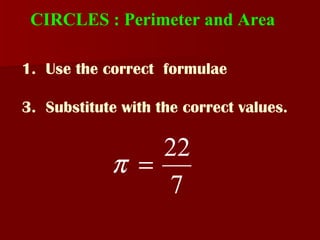
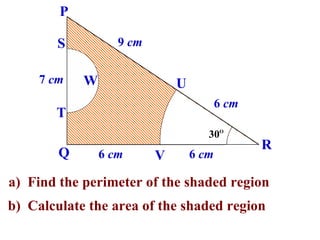
CIRCLES : Perimeter and Area

1. Use the correct formulae

3. Substitute with the correct values.

                22
            π =
                7
P

        S          9 cm

     7 cm   W                 U
                                         6 cm
       T
                                     30O
                                                R
        Q       6 cm      V       6 cm

a) Find the perimeter of the shaded region
b) Calculate the area of the shaded region
P

       S          9 cm

    7 cm   W                 U
                                        6 cm
       T
                                    30O
                                               R
       Q       6 cm      V       6 cm

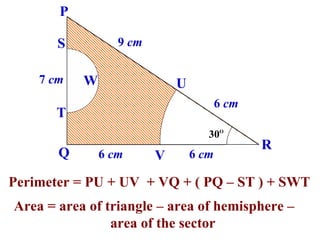
Perimeter = PU + UV + VQ + ( PQ – ST ) + SWT
Area = area of triangle – area of hemisphere –
                area of the sector
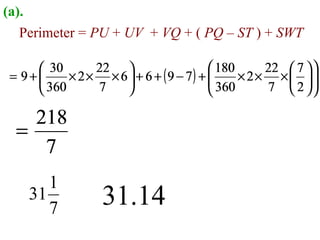
(a).
   Perimeter = PU + UV + VQ + ( PQ – ST ) + SWT

      30       22                      180       22  7  
 = 9+     × 2 × × 6  + 6 + ( 9 − 7) + 
                                         360 × 2 × 7 ×  2  
                                                              
      360      7                                      

    218
  =
     7
       1
    31
       7           31.14
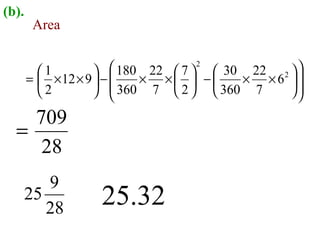
(b).
        Area


         1            180 22  7  2  30 22 2  
       =  × 12 × 9  −      × ×  −       × × 6 
         2           360 7  2   360 7
                                                  
    709
  =
     28
          9
       25
          28       25.32
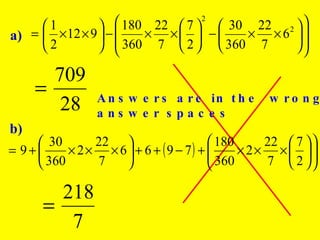
1            180 22  7  2  30 22 2  
a) =  × 12 × 9  −     × ×  −       × × 6 
     2           360 7  2   360 7        
       709
     =           A n s w e r s a r e in t h e       w ro n g
        28       a ns w e r s pa c e s
b)
     30       22                      180       22  7  
= 9+     × 2 × × 6  + 6 + ( 9 − 7) + 
                                        360 × 2 × 7 ×  2  
                                                             
     360      7                                      

        218
      =
         7
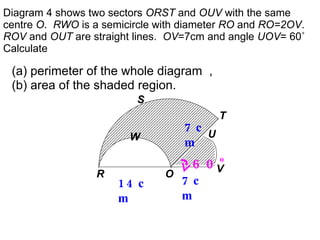
Diagram 4 shows two sectors ORST and OUV with the same
centre O. RWO is a semicircle with diameter RO and RO=2OV.
ROV and OUT are straight lines. OV=7cm and angle UOV= 60˚
Calculate

 (a) perimeter of the whole diagram ,
 (b) area of the shaded region.
                         S
                                           T
                                   7 c U
                        W
                                   m
                                           o
                                    6 0V
                 R             O
                      14 c         7 c
                      m            m
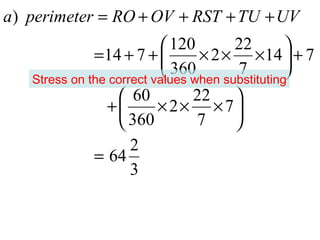
a ) perimeter = RO + OV + RST + TU + UV
                            120       22        
              =14 + 7 +         × 2 × ×14  + 7
                            360        7
   Stress on the correct values when substituting
                                                 
                    60         22 
                +        × 2× × 7
                    360         7     
                     2
              = 64
                     3
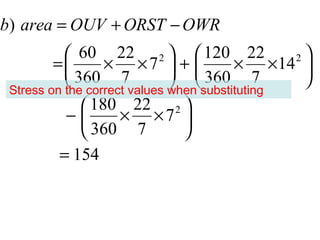
b) area = OUV + ORST − OWR
            60 22 2   120 22                 2
         =       × ×7  +              × × 14 
            360 7              360 7          
 Stress on the correct values when substituting
               180 22 2 
           −        × ×7 
               360 7           
          = 154
4 marks
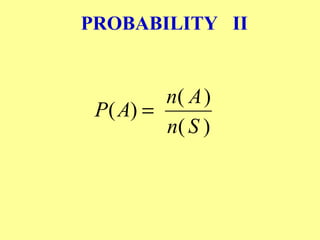
PROBABILITY II


         n( A )
 P( A) =
         n( S )
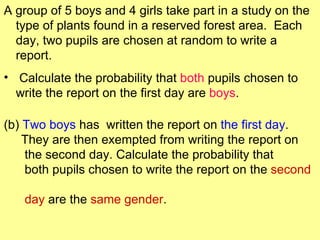
A group of 5 boys and 4 girls take part in a study on the
  type of plants found in a reserved forest area. Each
  day, two pupils are chosen at random to write a
  report.
• Calculate the probability that both pupils chosen to
  write the report on the first day are boys.

(b) Two boys has written the report on the first day.
    They are then exempted from writing the report on
    the second day. Calculate the probability that
    both pupils chosen to write the report on the second

   day are the same gender.
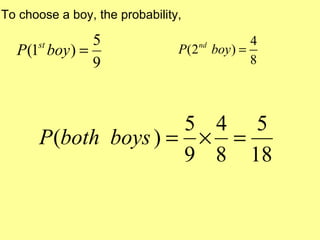
To choose a boy, the probability,

               5                             4
  P (1 boy ) =
      st
                                P (2 boy ) =
                                    nd

               9                             8


                      5 4 5
      P (both boys ) = × =
                      9 8 18
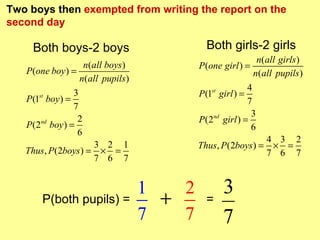
Two boys then exempted from writing the report on the
second day

     Both boys-2 boys                         Both girls-2 girls
                                                               n(all girls )
                    n(all boys )            P (one girl ) =
   P (one boy ) =                                             n(all pupils )
                   n(all pupils )
                                                           4
                 3                          P (1 girl ) =
                                               st
   P (1 boy ) =
       st
                                                           7
                 7
                                                            3
                  2                         P (2nd girl ) =
   P (2nd boy ) =                                           6
                  6
                                                             4 3 2
                      3 2 1                 Thus, P(2boys ) = × =
   Thus, P(2boys ) = × =                                     7 6 7
                      7 6 7


                                    1   2           3
       P(both pupils) =               +       =
                                    7   7           7
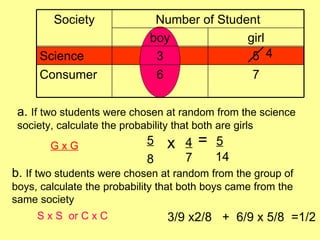
Society                Number of Student
                               boy             girl
      Science                   3               5 4
      Consumer                  6               7

 a. If two students were chosen at random from the science
 society, calculate the probability that both are girls
        GxG                   5    x   4   =   5
                              8        7       14
b. If two students were chosen at random from the group of
boys, calculate the probability that both boys came from the
same society
     S x S or C x C                3/9 x2/8 + 6/9 x 5/8 =1/2
5 marks
GRADIENT AND AREA UNDER A
                  GRAPH

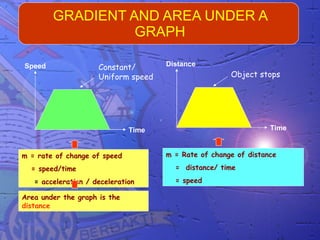
                                     Distance
Speed                Constant/
                     Uniform speed                    Object stops


                              Time                               Time


m = rate of change of speed          m = Rate of change of distance
  = speed/time                         = distance/ time
   = acceleration / deceleration       = speed

Area under the graph is the
distance
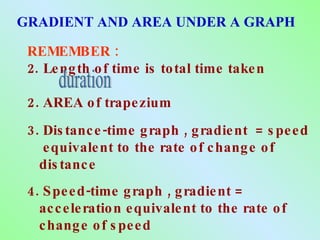
GRADIENT AND AREA UNDER A GRAPH

 REMEMBER :
 2. Le ng th o f time is to tal time take n

 2. AREA o f trape zium
 3. Dis tanc e -time g raph , g radie nt = s pe e d
    e quivale nt to the rate o f c hang e o f
   dis tanc e
 4. S pe e d -time g raph , g radie nt =
   ac c e le ratio n e quivale nt to the rate o f
   c hang e o f s pe e d
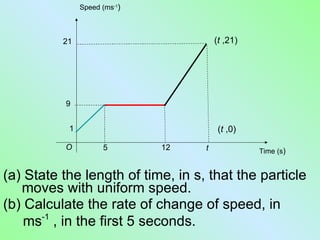
Speed (ms-1)


          21                           (t ,21)


          9


           1                            (t ,0)
          O          5        12   t             Time (s)


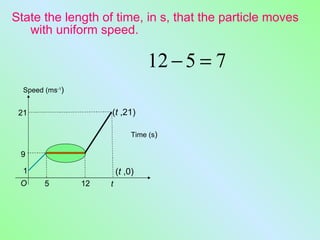
(a) State the length of time, in s, that the particle
   moves with uniform speed.
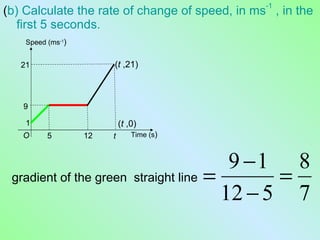
(b) Calculate the rate of change of speed, in
    ms-1 , in the first 5 seconds.
State the length of time, in s, that the particle moves
   with uniform speed.

                                    12 − 5 = 7
  Speed (ms-1)


 21                   (t ,21)

                               Time (s)

 9

  1                       (t ,0)
 O      5        12   t
-1
(b) Calculate the rate of change of speed, in ms , in the
   first 5 seconds.
    Speed (ms-1)


   21                   (t ,21)


   9

    1                       (t ,0)
   O      5        12   t       Time (s)


                                                  9 −1 8
 gradient of the green           straight line =       =
                                                 12 − 5 7
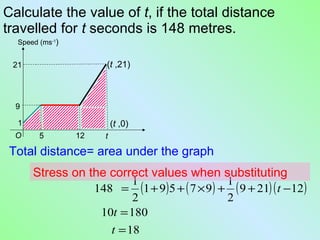
Calculate the value of t, if the total distance
travelled for t seconds is 148 metres.
  Speed (ms-1)


 21                      (t ,21)


  9

  1                         (t ,0)
  O     5        12     t

 Total distance= area under the graph
      Stress on the correct values when substituting
                              1                     1
                      148 = (1 + 9 ) 5 + ( 7 × 9 ) + ( 9 + 21) ( t −12 )
                              2                     2
                       10t = 180
                         t = 18
SUGGESTED TIME


 15 – 20 MINUTES
  PER QUESTION
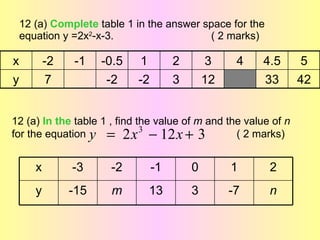
12 (a) Complete table 1 in the answer space for the
    equation y =2x2-x-3.                   ( 2 marks)

x          -2   -1    -0.5    1        2        3    4   4.5      5
y          7           -2    -2        3       12        33      42


12 (a) In the table 1 , find the value of m and the value of n
for the equation y = 2 x 3 − 12 x + 3             ( 2 marks)


       x        -3     -2         -1       0        1     2
       y        -15    m      13           3        -7    n
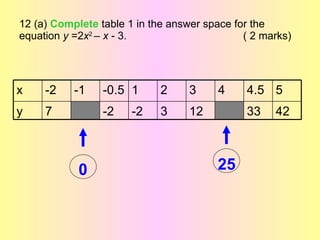
12 (a) Complete table 1 in the answer space for the
equation y =2x2 – x - 3.                      ( 2 marks)


x    -2    -1    -0.5 1      2     3    4     4.5 5
y    7           -2    -2    3     12         33    42


            0                           25
12
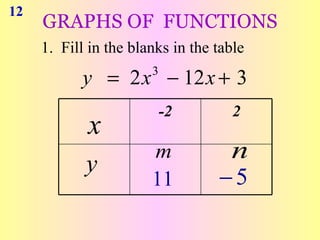
     GRAPHS OF FUNCTIONS
     1. Fill in the blanks in the table
           y = 2 x − 12 x + 3
                       3


                           -2        2
            x
                       m           n
            y
                       11         −5
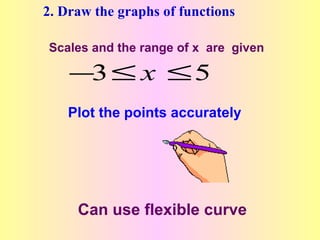
2. Draw the graphs of functions

Scales and the range of x are given

    −3 ≤ x ≤ 5
    Plot the points accurately


     Can use flexible curve
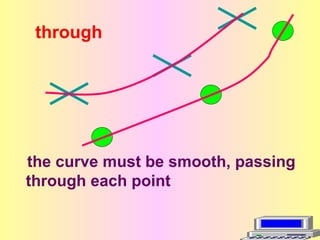
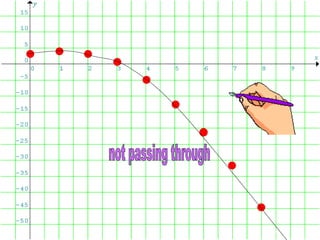
through


the curve must be smooth, passing
through each point
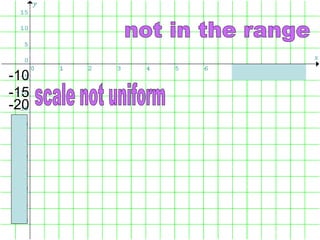
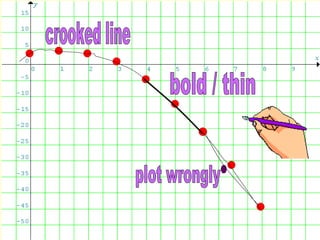
losing marks


Using your own scale
 12 marks – 1 mark
-10
-15
-20
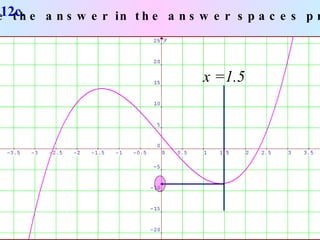
e12c. e a n s w e r in t h e a n s w e r s p a c e s p r
   th


                                   x =1.5
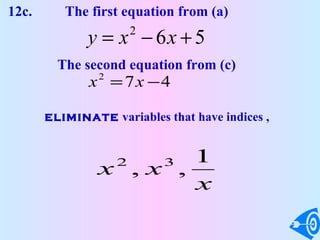
12c.      The first equation from (a)
              y = x − 6x + 5
                        2

         The second equation from (c)
              x = 7x −4
                2


       eliminate variables that have indices ,


                    2  1    3
                x ,x ,
                       x
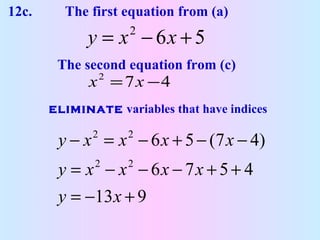
12c.     The first equation from (a)
             y = x − 6x + 5
                      2

        The second equation from (c)
             x = 7x −4
                  2


       eliminate variables that have indices

        y − x = x − 6 x + 5 − (7 x − 4)
              2       2


        y = x − x − 6x − 7x + 5 + 4
              2       2


        y = −13 x + 9
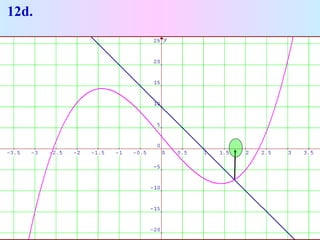
12d.
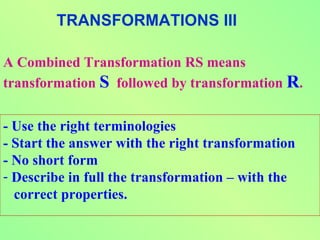
TRANSFORMATIONS III

A Combined Transformation RS means
transformation S followed by transformation R.


- Use the right terminologies
- Start the answer with the right transformation
- No short form
- Describe in full the transformation – with the
  correct properties.
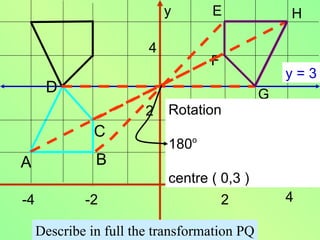
y      E                  H

                        4
                                   F
                                                      y=3
      D                                       G
                        2   Rotation
               C
                            180o
A              B                                  o

                            centre ( 0,3 )
-4           -2                        2              4

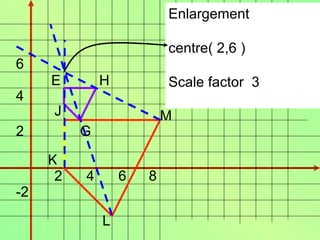
     Describe in full the transformation PQ
Enlargement

                          centre( 2,6 )
6
     E        H           Scale factor 3
4
     J                    M
2         G

     K
      2   4       6   8
-2

              L
losing marks


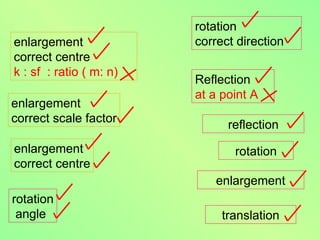
       Please use the right term
rotation
enlargement              correct direction
correct centre
k : sf : ratio ( m: n)
                         Reflection
                         at a point A
enlargement
correct scale factor
                               reflection
enlargement                     rotation
correct centre
                             enlargement
rotation
 angle                        translation
STATISTICS spm

2006 FREQUENCY
POLYGON
2005 HISTOGRAM
2004 HISTOGRAM
2003 OGIVE
STATISTICS


Mean , median , modal class
2.Frequency Polygon
3.Histogram
4.Ogive
5.Information of the graph
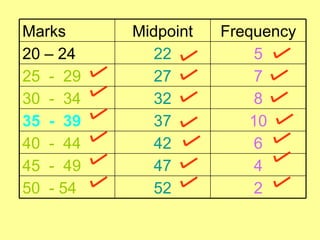
Marks     Midpoint   Frequency
20 – 24      22          5
25 - 29      27          7
30 - 34      32          8
35 - 39      37          10
40 - 44      42          6
45 - 49      47          4
50 - 54      52          2
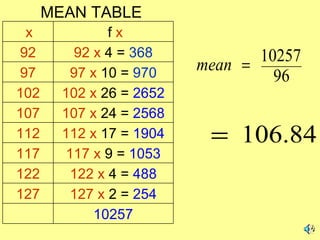
MEAN TABLE
 x             fx
92       92 x 4 = 368            10257
97       97 x 10 = 970
                          mean =
                                   96
102     102 x 26 = 2652
107     107 x 24 = 2568
112     112 x 17 = 1904    = 106.84
117     117 x 9 = 1053
122      122 x 4 = 488
127      127 x 2 = 254
             10257
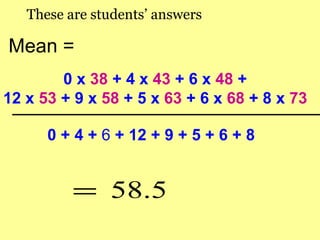
These are students’ answers

Mean =
        0 x 38 + 4 x 43 + 6 x 48 +
12 x 53 + 9 x 58 + 5 x 63 + 6 x 68 + 8 x 73

      0 + 4 + 6 + 12 + 9 + 5 + 6 + 8


          = 58.5
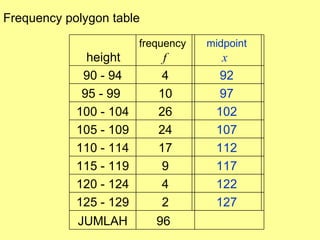
Frequency polygon table
                        frequency   midpoint
              height        f         x
             90 - 94        4         92
             95 - 99       10         97
            100 - 104      26        102
            105 - 109      24        107
            110 - 114      17        112
            115 - 119       9        117
            120 - 124       4        122
            125 - 129       2        127
            JUMLAH         96
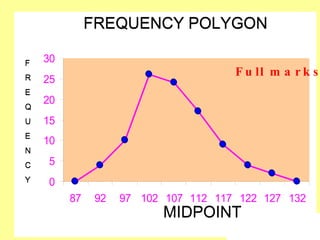
FREQUENCY POLYGON
                        POLIGON KEKERAPAN

F           30
R
                                              F u ll m a r k s
            25
KEKERAPAN


E
            20
Q
U           15
E
            10
N
C           5
Y           0
                 87    92   97 102 107 112 117 122 127 132
                                   MIDPOINT
                                              TITIK TENGAH
POLIGON KEKERAPAN
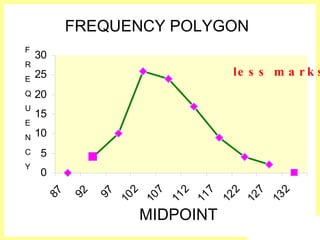
                  FREQUENCY POLYGON
      F
            30
      R
      E     25                                        le s s m a r k s
KEKERAPAN


      Q     20
      U
            15
      E
      N     10
      C     5
      Y
            0
                                 7


                                               7

                                                      2


                                                                    2
                          2


                                        2


                                                             7
             87

                  92

                        97


                                                   12


                                                                 13
                       10

                              10

                                     11

                                            11


                                                          12
                              MIDPOINT
                                                            MARKAH
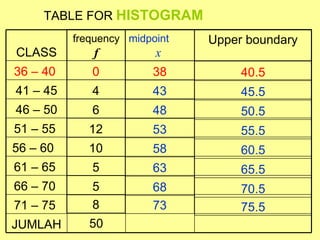
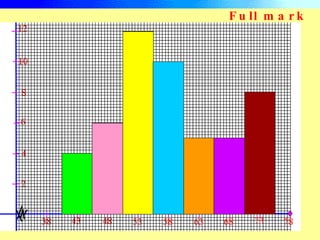
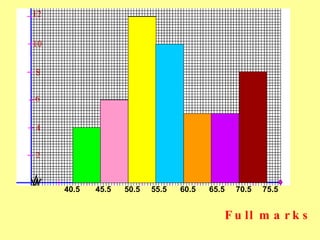
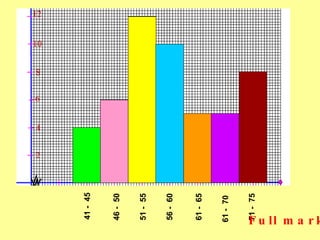
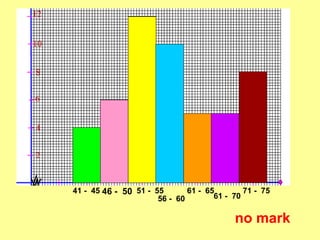
TABLE FOR HISTOGRAM
          frequency midpoint   Upper boundary
CLASS        f           x
36 – 40      0          38          40.5
41 – 45      4          43          45.5
46 – 50      6          48          50.5
51 – 55      12         53          55.5
56 – 60      10         58          60.5
61 – 65      5          63          65.5
66 – 70      5          68          70.5
71 – 75      8          73          75.5
JUMLAH       50
F u ll m a r k
40.5   45.5   50.5   55.5   60.5   65.5   70.5   75.5


                                      F u ll m a r k s
41 - 45


      46 - 50


      51 - 55


      56 - 60


      61 - 65


    61 - 70


      71 - 75
F u ll m a r k
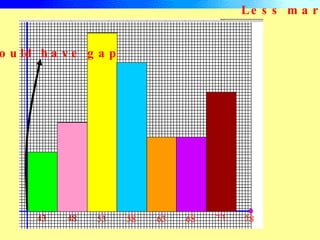
Le s s m a r


o u ld h a v e g a p
41 - 45 46 - 50 51 - 55       61 - 65        71 - 75
                      56 - 60        61 - 70


                                          no mark
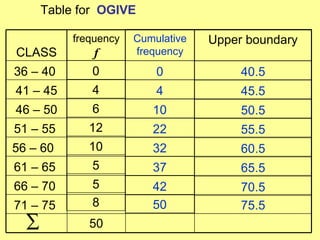
Table for OGIVE

           frequency   Cumulative   Upper boundary
CLASS         f        frequency
36 – 40       0            0             40.5
41 – 45       4            4             45.5
46 – 50       6           10             50.5
51 – 55       12          22             55.5
56 – 60       10          32             60.5
61 – 65       5           37             65.5
66 – 70       5           42             70.5
71 – 75       8           50             75.5
  ∑           50
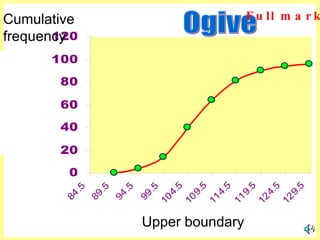
Cumulative                             F u ll m a r k
       120
frequency          OGIF
             100
 LONGGOKAN
 KEKERAPAN


              80

              60
              40

              20
               0           5

                           5

                           5

                           5

                           5

                           5
                 .5

                 .5

                 .5

                          .5

                         4.

                         9.

                         4.

                         9.

                         4.

                         9.
              84

              89

              94

                       99

                      10

                      10

                      11

                      11

                      12

                      12
                      SEMPADAN ATAS
                      Upper boundary
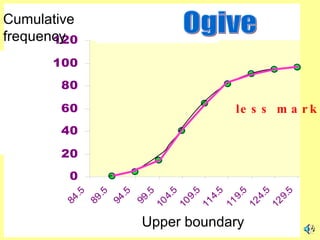
Cumulative
frequency
       120         OGIF
             100
 LONGGOKAN
 KEKERAPAN


              80

              60                le s s m a r k
              40

              20
               0
                   5

                   5

                   5

                   5

                   5
                   5
                  .5

                  .5

                  .5

                  .5

                 4.

                 9.

                 4.

                 9.

                 4.

                 9.
               84

               89

               94

               99


              10

              11

              11

              12
              10


              12
                    SEMPADAN ATAS
                    Upper boundary
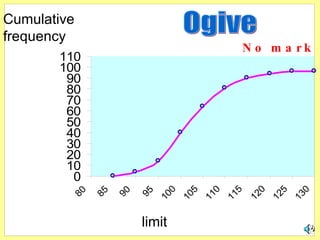
Cumulative                    OGIF
frequency
                                                           N o m a rk
              110
              100
  LONGGOKAN
  KEKERAPAN


               90
               80
               70
               60
               50
               40
               30
               20
               10
                0
                                     0


                                                 0


                                                             0


                                                                         0
                                           5


                                                       5


                                                                   5
               80


                         90
                    85


                              95

                                   10

                                         10

                                               11

                                                     11

                                                           12

                                                                 12

                                                                       13
                              limit MARKAH
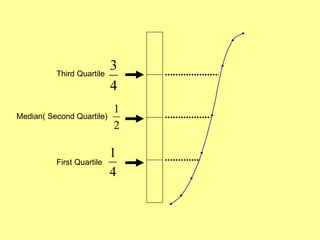
Third Quartile
                           3
                           4
                           1
Median( Second Quartile)
                           2

                           1
          First Quartile
                           4
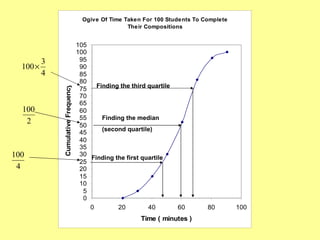
Ogive Of Time Taken For 100 Students To Complete
                                                     Their Compositions


                                    105
                                    100
         3                           95
  100×                               90
         4                           85
                                     80
                                          Finding the third quartile
             Cumulative Frequency


                                     75
                                     70
                                     65
  100                                60
                                     55     Finding the median
   2                                 50
                                            (second quartile)
                                     45
                                     40
                                     35
100                                  30
                                        Finding the first quartile
                                     25
 4                                   20
                                     15
                                     10
                                      5
                                      0
                                        0        20         40         60      80        100
                                                          Time ( minutes )
INTERQUARTILE
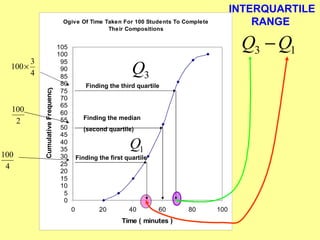
                                     Ogive Of Time Taken For 100 Students To Complete             RANGE
                                                    Their Compositions


                                    105
                                    100
                                                                                               Q3 − Q1
         3
                                                                  Q3
                                     95
  100×                               90
         4                           85
                                     80          Finding the third quartile
             Cumulative Frequency


                                     75
                                     70
                                     65
  100                                60
                                                Finding the median
   2                                 55
                                     50         (second quartile)
                                     45
                                     40
                                     35                          Q1
100                                  30       Finding the first quartile
 4                                   25
                                     20
                                     15
                                     10
                                      5
                                      0
                                          0           20         40        60    80     100
                                                              Time ( minutes )
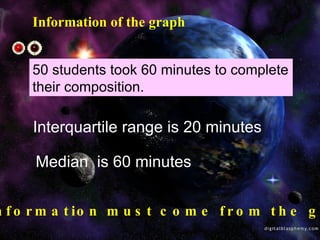
Information of the graph


     50 students took 60 minutes to complete
     their composition.

      Interquartile range is 20 minutes

      Median is 60 minutes


n f o r m a t io n m u s t c o m e f r o m t h e g
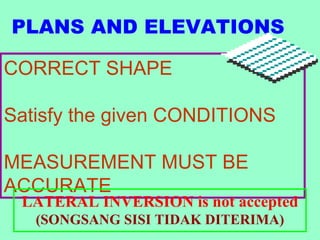
PLANS AND ELEVATIONS

CORRECT SHAPE

Satisfy the given CONDITIONS

MEASUREMENT MUST BE
ACCURATE
 LATERAL INVERSION is not accepted
   (SONGSANG SISI TIDAK DITERIMA)
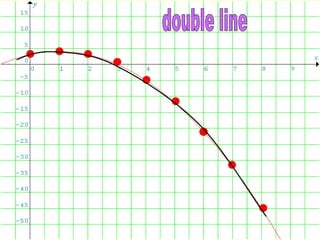
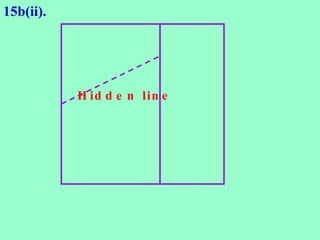
15b(ii).


           H id d e n lin e
losing marks
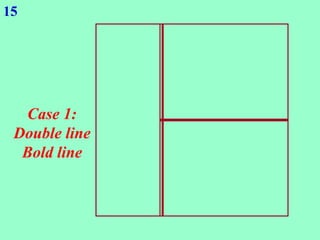
15


  Case 1:
 Double line
  Bold line
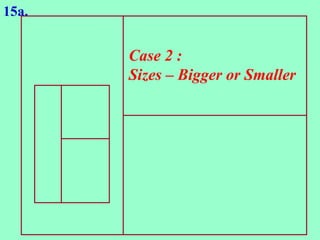
15a.


       Case 2 :
       Sizes – Bigger or Smaller
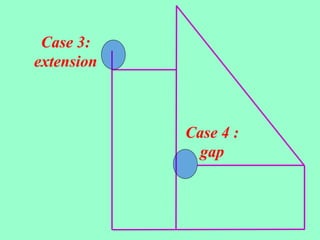
Case 3:
extension


            Case 4 :
             gap
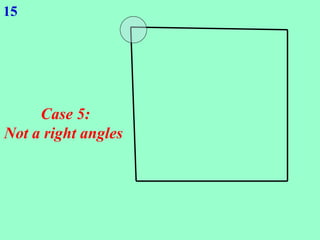
15


     Case 5:
Not a right angles
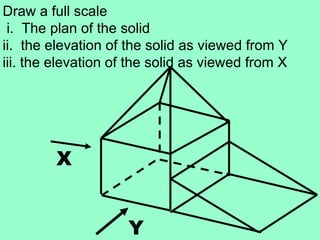
Draw a full scale
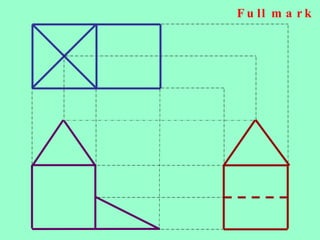
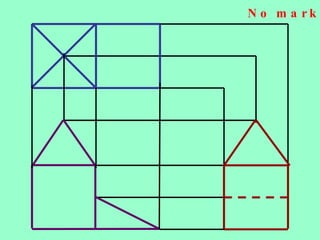
 i. The plan of the solid
ii. the elevation of the solid as viewed from Y
iii. the elevation of the solid as viewed from X


         X


                     Y
F u ll m a r k
N o m a rk
EARTH
AS A SPHERE
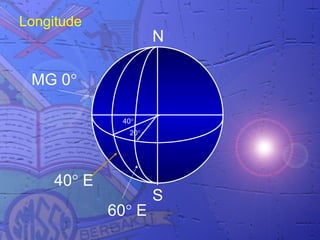
Longitude
                     N

 MG 0°

              40°
               20°


     40° E
                     S
             60° E
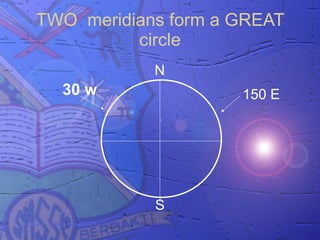
TWO meridians form a GREAT
          circle
            N
  30 w               150 E


            S
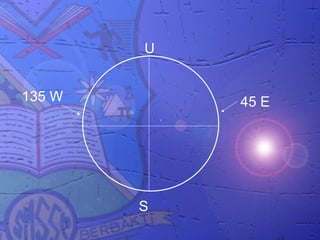
U


135 W       45 E


        S
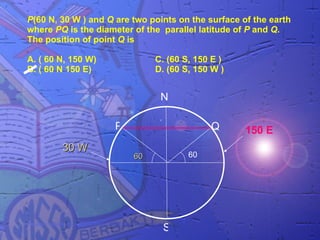
P(60 N, 30 W ) and Q are two points on the surface of the earth
where PQ is the diameter of the parallel latitude of P and Q.
The position of point Q is

A. ( 60 N, 150 W)             C. (60 S, 150 E )
B. ( 60 N 150 E)              D. (60 S, 150 W )


                               N

                     P                     Q        150 E
        30 W
                         60           60


                                S
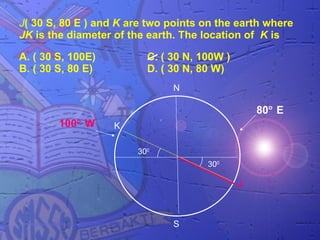
J( 30 S, 80 E ) and K are two points on the earth where
JK is the diameter of the earth. The location of K is

A. ( 30 S, 100E)         C. ( 30 N, 100W )
B. ( 30 S, 80 E)         D. ( 30 N, 80 W)
                              N

                                                 80° E
        100° W     K

                       300
                                     300

                                             J


                              S
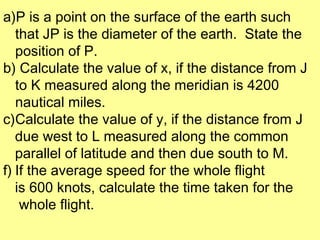
a)P is a point on the surface of the earth such
   that JP is the diameter of the earth. State the
   position of P.
b) Calculate the value of x, if the distance from J
   to K measured along the meridian is 4200
   nautical miles.
c)Calculate the value of y, if the distance from J
   due west to L measured along the common
   parallel of latitude and then due south to M.
f) If the average speed for the whole flight
   is 600 knots, calculate the time taken for the
    whole flight.
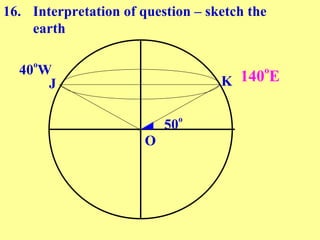
16. Interpretation of question – sketch the
    earth

    o
  40 W                                    o
      J                             K 140 E

                                o
                           50
                       O
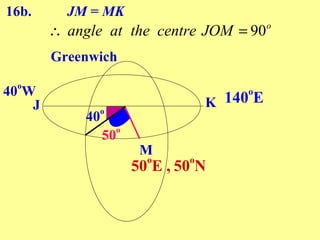
16b.      JM = MK
        ∴ angle at the centre JOM = 90 o
        Greenwich
 o
40 W                                        o
    J             o
                                       K 140 E
             40
                       o
                  50
                            M
                             o     o
                           50 E , 50 N
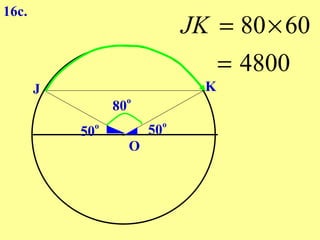
16c.
                                      JK = 80 × 60
                                         = 4800
       J                                K
                         o
                    80
                o                 o
           50                50
                         O
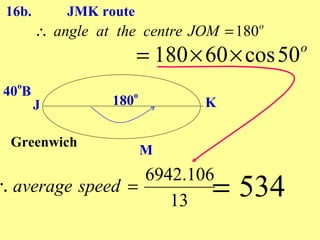
16b.       JMK route
        ∴ angle at the centre JOM = 180   o


                        = 180 × 60 × cos 50   o

   o
 40 B                   o
        J         180           K

  Greenwich
                            M
                  6942.106
∴ average speed =
                     13
                                = 534
Reminders
   Calculate , find , solve ,
    – all steps are clearly shown

   State – only the answer is required

   Unit / label
    – must be correct if written
Reminders
Basic Mathematical Skills such as
 addition, division, subtraction,
 multiplication.
Algebraic and Trigonometric skills
Formulae and its applications,
 Formulae and its substitutions.
Round off only at the last answer
 line.
Reminders
 Allsteps must be clearly shown.
 Read the instructions and questions very
  carefully .
 The answer must be in the lowest form, to
   4 significant figures and to 2 decimal
  places.
 Master the calculator
 Do not sleep during the exam!
Mathematics Keynotes 2

Mathematics Keynotes 2

  • 1.
    1449/1 – 1hour 15 minutes 40 objective questions 1449/2 – subjective Section A - 11 compulsory questions Section B - 4 out of 5 questions 2 Hours 30 minutes SCIENTIFIC CALCULATOR GEOMETRIC AL SET
  • 2.
  • 3.
    Example ξ B A C II III IV V VI I Shade the set ( A ∩ B ) ∪ C 1. Label each part with a Roman number
  • 4.
    ξ B A C II III IV V VI I 2. Identify the shaded region U (A B) U C U ( II, III, IV III, IV, V, VI ) U IV, V
  • 5.
    3. Identify the shaded region U ( II, III, IV III, IV, V, VI ) U IV, V III, IV U IV, V III, IV, V 4. Shade the region mark with III, IV, V U (A B) U C
  • 6.
    SETS Shade the Region (a) P ∩ R ' (b) P ∩ Q ∪ R' Q Q P P R Intersection R Union Com plim of ent
  • 7.
    P ∩ R' P∩ Q ∪ R'
  • 8.
    Linear inequalities Shade theregion that satisfies the inequalities Know how to sketch a straight line Application of y-intercept Understand the inequality sign < , > for dashed line and ≤ , ≥ for solid line

  • 9.
    Shade the regionthat satisfies the three inequalities y ≤ 2 x + 8 , y ≥ x and y < 8 y=x 0 y = 2x + 8
  • 10.
    Know how tosketch the straight line y =8 From , y = 2 x + 8 , y-intercept = 8 y = 2x + 8 y=x 8 y<8 Full marks
  • 11.
    y = 2x+ 8 y=x 8 less marks
  • 12.
  • 13.
    Solid Geometry &Volume Combination of two solids 1. Determine the two solids involved 2.Choose the operations + or - 3.Write the correct formulae 4.Substitute the values of r, h, d 22 Use π= 7
  • 14.
    Try this A hemispherePQR has taken out from the cylinder. Find the volume of the remaining solid. P R Cylinder - hemisphere 2 3 πr h − πr 2 3 Q 8 cm 22 2 22 ×5× 5×8 − × 5× 5× 5 7 3 7 2 366 10 cm 3
  • 15.
    The diagram showsa solid cone with radius 9 cm and height 14 cm. A cylinder with radius 3 cm and height 7 cm is taken out of the solid. Calculate the volume, in cm3 , of the remaining solid. 22 Use π = 7
  • 16.
    Diagram 3 showsa solid cone with radius 9 cm and height 14 cm. A cylinder with radius 3 cm and height 7 cm is taken out of the solid. 14 cm Write the formula first 7 cm 1 2 Vcone = πr 3 cm 3 9 cm Vcylinder = π r h 2
  • 17.
    1 Vcone = πr2 h 3 Stress on correct values when substituting 1  22  ( 9 ) ( 14 ) 2 =  3 7  Remaining solid =1188 = 1188 – 198 Vcylinder =πr h 2 = 990  22  Stress on correct values ( 3 ) ( 7 ) 2 = when substituting  7  =198
  • 18.
    Lines and Planes in 3D 4 marks
  • 19.
    Lines and Planesin 3D IMPORTANT NOTES : 3. SKETC therig a le H ht- ng d tria le ng 2 Id ntify thea lea na eit . e ng nd m n g le b e t w e e n a lin e a n d a p la A n g le b e t w e e n t w o p la n e s
  • 20.
    LINES AND PLANESIN 3 DIMENSION Name the angle between the line CE and the plane EFGH Arrange the line and plane in two rows Find out the same alphabet Look at the line and the plane in the diagram C Write C in the first box B Look at c, choose Which One is the Nearest to C A D (slashed alphabet) 6 C E Look at C, WON E F G Choose W O N H (Non-slashed alphabets) F G Look at the diagram θ 6 C E C E G 6 H Tan θ= 6 Draw 3 boxes K2 √72 θ E 36 + 36 G θ= 35.26°
  • 21.
    Name the anglebetween the plane DGK and the base DEFG WON DK = GKW O N Slash the same alphabet Write K in the first box So, choose the midpoint of DG H Look at K, choose W O N Slashed- alphabet K D G K 8 G D E F G N θ 6 Look at the diagram D F Look at the diagram Look at the diagram 12 M K N M E Look at K, choose W O N K Tan θ= 6 EK = FK Non-slashed alphabets choose M 12 θ= 26.57° θ N M
  • 22.
    V WON WON Non-slash alphabet Slash alphabet 6 D C θ 8 A 10 B Calculate the angle between the plane AVC and the plane BVC A V C A Tan θ = 10 B V C 8 A C B θ= 51.34° θ C B
  • 23.
    A B Name the angle between the WON E F plane ACGE with the plane WON DCGH A C G E D θ C D C G H H G A C D between A & E, choose either one and write the alphabet in the first box ( for rectangle only)
  • 24.
    Try this.. H U G E F T P N L M R Name the angle between the plane LUM with the plane LPNM Answer : URT
  • 25.
    Find the anglebetween the plane JFE and the plane DEF. L J 5 F D 5 M 13 5 E
  • 26.
    L J 5 F D 5 M 13 5 E Identify the angle ∠ JMD
  • 27.
    5 tan JMD = 13 − 5 2 2 ∠ JMD = 22.62 o o ' atau 22 37
  • 28.
    5M A RK S
  • 29.
    MATHEMATICAL REASONING Is thefollowing sentence a statement ? Give your reason. 9 + 2 = 2 −9 Statement yes Not accepted answer A statement. It is a false statement.
  • 30.
    Make a conclusionfor the number sequence below 2 −1= 0 0 F u ll m a r k s 2 −1=1 1 3 d o ts 2 −1= 3 2 2 −1= 7 3 2 − 1, n = 0 ,1, 2 , 3 , ... n
  • 31.
    n 2 ─ 1, n = 0 , 1 , 2 , 3 , .. n 2 ─ 1 , n =0,1,2,3, n 2 ─ 1 , n =0,1,2, n 2 ─ 1 Ie s s marks
  • 32.
    Write two implicationsfrom this compound statement 3 p = 5 if and only if p = 125 If 3 p = 5 , then p = 125 F u ll m a r k If p = 125 , then 3 p =5 3 p = 5 , then p = 125 n o m a rk If p = 125 , 3 p =5
  • 33.
    Complete the followingargument Premise1 : If 4x = 16 , then x = 4 Premise 2 : x ≠ 4 Conclusion : 4 x ≠ 16
  • 34.
    SIMULTANEOUS LINEAR EQUATIONS Elimination method Substitution method Matrix method 4 M AR KS
  • 35.
    Solve the simultaneouslinear equations 1 p − 2q = 9 3 5 p + 6q = −9 When there is a fraction, you must have the same denominator first p − 6q =9 3 p − 6q = 27
  • 36.
    Elimination method 1 p − 6q p − 2q = 9 same deno min ator =9 3 3 ⇒ p −6q = 27 1 5 p + 6q = −9 2 1 +2 6 p = 18 r r e c t o p e r a t io n ∴ p=3 ⇒ 3 − 6q = 27 ∴ q = −4
  • 37.
    Substitution method 1 p − 6q p − 2q = 9 same deno min ator =9 3 3 ⇒ p −6q = 27 ∴ p = 27 +6q C o r r e c t o p e r a t io n 1 5 p + 6q = −9 2 substitute 1 into 2 5 ( 27 + 6q ) + 6q = − 9 ⇒ p = 27 + 6 (− 4 ) 135 + 30q + 6q = −9 ∴ p=3 ∴ q = −4
  • 38.
    Matrix method 1  p  9   − 2  =   3  q   − 9  5 6     C o r r e c t m a t r ix f o r m  p 1  6 2 9   =    1   q  1 − 5 − 9    × 6 − 5 × ( − 2)  3 3  p  3   =   ∴ p = 3 , q = −4  q   −4    
  • 39.
    THE STRAIGHT LINE– 6 MARKS REMEMBER : y1 − y2 • Gradient m = x1 − x2 • Equation of a line y = mx + c x y + = 1 a b
  • 40.
    THE STRAIGHT LINE REMEMBER : 3. Parallel lines , same gradient m1 = m2 4. Perpendicular lines , the product of their gradients = − 1 m1m2 = −1
  • 41.
    THE STRAIGHT LINE REMEMBER : 5. x-intercept , substitute y=0 6. y-intercept , substitute x=0
  • 42.
    Important notes x-intercept = − 12 x = − 12 x-intercept is ( − 12 , 0 )
  • 43.
    In Diagram 2,O is the origin, point R lies on the x- axis and point P lies on the y-axis. Straight line PU is parallel to the x-axis and straight line PR is parallel to the straight line ST. The equation of straight line PR is x + 2y = 14. y (a) Find the value of its • • U P y-intercept from x + 2y = 14. x + 2y = 14 S • (b) Find the equation of the O • R x straight line ST and hence, state its x-intercept. • T (2,-5)
  • 44.
    (a) PU isparallel to the x-axis. Find the value of its y-intercept from x + 2y = 14. y P • • U 2 y = − x + 14 x 14 x + 2y = 14 y=− + S 2 2 • • x O R x y = − +7 2 • T (2,-5) y-intercept! y-intercept =7
  • 45.
    Find the equationof the straight line ST and hence, state its x-intercept. y From part (a), we have • • U x P 2 y = − x + 14 → y = − + 7 2 1 x + 2y = 14 Therefore, gradient ST , m = − S 2 • 1 • x Substitute m = − and po int (2, −5) in O R 2 y = mx + c,  1 −5 =  −  (2) + c • T (2,-5)  2 c = −5 + 1 = −4 Thus, equation ST is 1 y = − x−4 2
  • 46.
    hence, state itsx-intercept. 1 y = − x−4 2 x − int ercept ∴ y = 0 1 4=− x 2 x = −8 x-intercept = – 8
  • 47.
  • 48.
    QUADRATIC EQUATION REARRANGE TOGENERAL FORM OF QUADRATIC EQUATION ax + bx + c = 0 2 Factorise ( )( )=0 State the values of x
  • 49.
    Solve the quadraticequation 3n + 6n = 7 ( 1 − 2n ) 2 3n + 6n = 7 (1 − 2n ) ⇒ 3n + 6n − 7 + 14n = 0 2 2 ∴ 3n + 20n − 7 = 0 2 Fa c to rs mus t be g iv e n b y u s in g w h o le ( 3n − 1 ) ( n + 7 ) = 0 n u m b e rs 1 ∴ n= , −7 3
  • 50.
    2k − 5 2 Solve the quadratic equation = 3k 3 2k − 5 = 9k 2 2k − 9k − 5 = 0 2 ( 2k + 1) ( k − 5) = 0 1 k =− , k =5 2
  • 51.
    MATRICES NOTES 1. When thematrix has no inverse ad − bc = 0 2. MATRIX FORM 3. Formula of the inverse matrix 4. State the value of x and of y
  • 52.
     5 −9 The inverse of matrix   2 − 3  is    1  − 3 9   q 5  p  Find the values of p and q
  • 53.
    Use the inverseformula 1  − 3 9 inverse =    − 2 5 5 × (−3) − (−9) × 2   1  − 3 9 Compare with the =   − 2 5  given inverse matrix 3  1  − 3 9 ∴ p= 3   q 5  p  q= −2
  • 54.
    Calculate the valueof x and the value of y by using matrix method 2 x − 3 y = −14 − x + 3 y = 13 Form a matrix equation  2 − 3  x   − 14    − 1 3   y  =  13          
  • 55.
    Write the inverseformula IN FRONT 1  d − b   − c a  F u ll m a r k s ad − bc    x  1  3 3   − 14   =    y  3  1 2   13         x   − 1 ∴ x = −1  =    y  4      y=4
  • 56.
     2 −3  x   − 14     =   −1 3   y   13         x  1  3 3   − 14   =   y  3  1 2   13          x   − 1  =    y  4      le s s m a r k s
  • 57.
    Wrong arrangement  x   2 − 3  − 14     y   − 1 3  =  13           x  1  2 3  − 14   =    y  3  1 3  13         x  1  3 − 3   − 14   =   y  3  − 1 2   13    n o m a rk      x  − 14  1  3 3   =   y  13  3  1 2          
  • 58.
    CIRCLES : Perimeterand Area 1. Use the correct formulae 3. Substitute with the correct values. 22 π = 7
  • 59.
    P S 9 cm 7 cm W U 6 cm T 30O R Q 6 cm V 6 cm a) Find the perimeter of the shaded region b) Calculate the area of the shaded region
  • 60.
    P S 9 cm 7 cm W U 6 cm T 30O R Q 6 cm V 6 cm Perimeter = PU + UV + VQ + ( PQ – ST ) + SWT Area = area of triangle – area of hemisphere – area of the sector
  • 61.
    (a). Perimeter = PU + UV + VQ + ( PQ – ST ) + SWT  30 22   180 22  7   = 9+ × 2 × × 6  + 6 + ( 9 − 7) +   360 × 2 × 7 ×  2     360 7     218 = 7 1 31 7 31.14
  • 62.
    (b). Area 1    180 22  7  2  30 22 2   =  × 12 × 9  − × ×  − × × 6  2   360 7  2   360 7   709 = 28 9 25 28 25.32
  • 63.
    1    180 22  7  2  30 22 2   a) =  × 12 × 9  −  × ×  − × × 6  2   360 7  2   360 7  709 = A n s w e r s a r e in t h e w ro n g 28 a ns w e r s pa c e s b)  30 22   180 22  7   = 9+ × 2 × × 6  + 6 + ( 9 − 7) +   360 × 2 × 7 ×  2     360 7     218 = 7
  • 64.
    Diagram 4 showstwo sectors ORST and OUV with the same centre O. RWO is a semicircle with diameter RO and RO=2OV. ROV and OUT are straight lines. OV=7cm and angle UOV= 60˚ Calculate (a) perimeter of the whole diagram , (b) area of the shaded region. S T 7 c U W m o 6 0V R O 14 c 7 c m m
  • 65.
    a ) perimeter= RO + OV + RST + TU + UV  120 22  =14 + 7 +  × 2 × ×14  + 7  360 7 Stress on the correct values when substituting   60 22  + × 2× × 7  360 7  2 = 64 3
  • 66.
    b) area =OUV + ORST − OWR  60 22 2   120 22 2 = × ×7  +  × × 14   360 7   360 7  Stress on the correct values when substituting  180 22 2  − × ×7   360 7  = 154
  • 67.
  • 68.
    PROBABILITY II n( A ) P( A) = n( S )
  • 69.
    A group of5 boys and 4 girls take part in a study on the type of plants found in a reserved forest area. Each day, two pupils are chosen at random to write a report. • Calculate the probability that both pupils chosen to write the report on the first day are boys. (b) Two boys has written the report on the first day. They are then exempted from writing the report on the second day. Calculate the probability that both pupils chosen to write the report on the second day are the same gender.
  • 70.
    To choose aboy, the probability, 5 4 P (1 boy ) = st P (2 boy ) = nd 9 8 5 4 5 P (both boys ) = × = 9 8 18
  • 71.
    Two boys thenexempted from writing the report on the second day Both boys-2 boys Both girls-2 girls n(all girls ) n(all boys ) P (one girl ) = P (one boy ) = n(all pupils ) n(all pupils ) 4 3 P (1 girl ) = st P (1 boy ) = st 7 7 3 2 P (2nd girl ) = P (2nd boy ) = 6 6 4 3 2 3 2 1 Thus, P(2boys ) = × = Thus, P(2boys ) = × = 7 6 7 7 6 7 1 2 3 P(both pupils) = + = 7 7 7
  • 72.
    Society Number of Student boy girl Science 3 5 4 Consumer 6 7 a. If two students were chosen at random from the science society, calculate the probability that both are girls GxG 5 x 4 = 5 8 7 14 b. If two students were chosen at random from the group of boys, calculate the probability that both boys came from the same society S x S or C x C 3/9 x2/8 + 6/9 x 5/8 =1/2
  • 73.
  • 74.
    GRADIENT AND AREAUNDER A GRAPH Distance Speed Constant/ Uniform speed Object stops Time Time m = rate of change of speed m = Rate of change of distance = speed/time = distance/ time = acceleration / deceleration = speed Area under the graph is the distance
  • 75.
    GRADIENT AND AREAUNDER A GRAPH REMEMBER : 2. Le ng th o f time is to tal time take n 2. AREA o f trape zium 3. Dis tanc e -time g raph , g radie nt = s pe e d e quivale nt to the rate o f c hang e o f dis tanc e 4. S pe e d -time g raph , g radie nt = ac c e le ratio n e quivale nt to the rate o f c hang e o f s pe e d
  • 76.
    Speed (ms-1) 21 (t ,21) 9 1 (t ,0) O 5 12 t Time (s) (a) State the length of time, in s, that the particle moves with uniform speed. (b) Calculate the rate of change of speed, in ms-1 , in the first 5 seconds.
  • 77.
    State the lengthof time, in s, that the particle moves with uniform speed. 12 − 5 = 7 Speed (ms-1) 21 (t ,21) Time (s) 9 1 (t ,0) O 5 12 t
  • 78.
    -1 (b) Calculate therate of change of speed, in ms , in the first 5 seconds. Speed (ms-1) 21 (t ,21) 9 1 (t ,0) O 5 12 t Time (s) 9 −1 8 gradient of the green straight line = = 12 − 5 7
  • 79.
    Calculate the valueof t, if the total distance travelled for t seconds is 148 metres. Speed (ms-1) 21 (t ,21) 9 1 (t ,0) O 5 12 t Total distance= area under the graph Stress on the correct values when substituting 1 1 148 = (1 + 9 ) 5 + ( 7 × 9 ) + ( 9 + 21) ( t −12 ) 2 2 10t = 180 t = 18
  • 80.
    SUGGESTED TIME 15– 20 MINUTES PER QUESTION
  • 81.
    12 (a) Completetable 1 in the answer space for the equation y =2x2-x-3. ( 2 marks) x -2 -1 -0.5 1 2 3 4 4.5 5 y 7 -2 -2 3 12 33 42 12 (a) In the table 1 , find the value of m and the value of n for the equation y = 2 x 3 − 12 x + 3 ( 2 marks) x -3 -2 -1 0 1 2 y -15 m 13 3 -7 n
  • 82.
    12 (a) Completetable 1 in the answer space for the equation y =2x2 – x - 3. ( 2 marks) x -2 -1 -0.5 1 2 3 4 4.5 5 y 7 -2 -2 3 12 33 42 0 25
  • 83.
    12 GRAPHS OF FUNCTIONS 1. Fill in the blanks in the table y = 2 x − 12 x + 3 3 -2 2 x m n y 11 −5
  • 84.
    2. Draw thegraphs of functions Scales and the range of x are given −3 ≤ x ≤ 5 Plot the points accurately Can use flexible curve
  • 85.
    through the curve mustbe smooth, passing through each point
  • 86.
    losing marks Using yourown scale 12 marks – 1 mark
  • 87.
  • 91.
    e12c. e an s w e r in t h e a n s w e r s p a c e s p r th x =1.5
  • 92.
    12c. The first equation from (a) y = x − 6x + 5 2 The second equation from (c) x = 7x −4 2 eliminate variables that have indices , 2 1 3 x ,x , x
  • 93.
    12c. The first equation from (a) y = x − 6x + 5 2 The second equation from (c) x = 7x −4 2 eliminate variables that have indices y − x = x − 6 x + 5 − (7 x − 4) 2 2 y = x − x − 6x − 7x + 5 + 4 2 2 y = −13 x + 9
  • 94.
  • 95.
    TRANSFORMATIONS III A CombinedTransformation RS means transformation S followed by transformation R. - Use the right terminologies - Start the answer with the right transformation - No short form - Describe in full the transformation – with the correct properties.
  • 96.
    y E H 4 F y=3 D G 2 Rotation C 180o A B o centre ( 0,3 ) -4 -2 2 4 Describe in full the transformation PQ
  • 97.
    Enlargement centre( 2,6 ) 6 E H Scale factor 3 4 J M 2 G K 2 4 6 8 -2 L
  • 98.
    losing marks Please use the right term
  • 99.
    rotation enlargement correct direction correct centre k : sf : ratio ( m: n) Reflection at a point A enlargement correct scale factor reflection enlargement rotation correct centre enlargement rotation angle translation
  • 100.
    STATISTICS spm 2006 FREQUENCY POLYGON 2005HISTOGRAM 2004 HISTOGRAM 2003 OGIVE
  • 101.
    STATISTICS Mean , median, modal class 2.Frequency Polygon 3.Histogram 4.Ogive 5.Information of the graph
  • 102.
    Marks Midpoint Frequency 20 – 24 22 5 25 - 29 27 7 30 - 34 32 8 35 - 39 37 10 40 - 44 42 6 45 - 49 47 4 50 - 54 52 2
  • 103.
    MEAN TABLE x fx 92 92 x 4 = 368 10257 97 97 x 10 = 970 mean = 96 102 102 x 26 = 2652 107 107 x 24 = 2568 112 112 x 17 = 1904 = 106.84 117 117 x 9 = 1053 122 122 x 4 = 488 127 127 x 2 = 254 10257
  • 104.
    These are students’answers Mean = 0 x 38 + 4 x 43 + 6 x 48 + 12 x 53 + 9 x 58 + 5 x 63 + 6 x 68 + 8 x 73 0 + 4 + 6 + 12 + 9 + 5 + 6 + 8 = 58.5
  • 105.
    Frequency polygon table frequency midpoint height f x 90 - 94 4 92 95 - 99 10 97 100 - 104 26 102 105 - 109 24 107 110 - 114 17 112 115 - 119 9 117 120 - 124 4 122 125 - 129 2 127 JUMLAH 96
  • 106.
    FREQUENCY POLYGON POLIGON KEKERAPAN F 30 R F u ll m a r k s 25 KEKERAPAN E 20 Q U 15 E 10 N C 5 Y 0 87 92 97 102 107 112 117 122 127 132 MIDPOINT TITIK TENGAH
  • 107.
    POLIGON KEKERAPAN FREQUENCY POLYGON F 30 R E 25 le s s m a r k s KEKERAPAN Q 20 U 15 E N 10 C 5 Y 0 7 7 2 2 2 2 7 87 92 97 12 13 10 10 11 11 12 MIDPOINT MARKAH
  • 108.
    TABLE FOR HISTOGRAM frequency midpoint Upper boundary CLASS f x 36 – 40 0 38 40.5 41 – 45 4 43 45.5 46 – 50 6 48 50.5 51 – 55 12 53 55.5 56 – 60 10 58 60.5 61 – 65 5 63 65.5 66 – 70 5 68 70.5 71 – 75 8 73 75.5 JUMLAH 50
  • 109.
    F u llm a r k
  • 110.
    40.5 45.5 50.5 55.5 60.5 65.5 70.5 75.5 F u ll m a r k s
  • 111.
    41 - 45 46 - 50 51 - 55 56 - 60 61 - 65 61 - 70 71 - 75 F u ll m a r k
  • 112.
    Le s sm a r o u ld h a v e g a p
  • 113.
    41 - 4546 - 50 51 - 55 61 - 65 71 - 75 56 - 60 61 - 70 no mark
  • 114.
    Table for OGIVE frequency Cumulative Upper boundary CLASS f frequency 36 – 40 0 0 40.5 41 – 45 4 4 45.5 46 – 50 6 10 50.5 51 – 55 12 22 55.5 56 – 60 10 32 60.5 61 – 65 5 37 65.5 66 – 70 5 42 70.5 71 – 75 8 50 75.5 ∑ 50
  • 115.
    Cumulative F u ll m a r k 120 frequency OGIF 100 LONGGOKAN KEKERAPAN 80 60 40 20 0 5 5 5 5 5 5 .5 .5 .5 .5 4. 9. 4. 9. 4. 9. 84 89 94 99 10 10 11 11 12 12 SEMPADAN ATAS Upper boundary
  • 116.
    Cumulative frequency 120 OGIF 100 LONGGOKAN KEKERAPAN 80 60 le s s m a r k 40 20 0 5 5 5 5 5 5 .5 .5 .5 .5 4. 9. 4. 9. 4. 9. 84 89 94 99 10 11 11 12 10 12 SEMPADAN ATAS Upper boundary
  • 117.
    Cumulative OGIF frequency N o m a rk 110 100 LONGGOKAN KEKERAPAN 90 80 70 60 50 40 30 20 10 0 0 0 0 0 5 5 5 80 90 85 95 10 10 11 11 12 12 13 limit MARKAH
  • 118.
    Third Quartile 3 4 1 Median( Second Quartile) 2 1 First Quartile 4
  • 119.
    Ogive Of TimeTaken For 100 Students To Complete Their Compositions 105 100 3 95 100× 90 4 85 80 Finding the third quartile Cumulative Frequency 75 70 65 100 60 55 Finding the median 2 50 (second quartile) 45 40 35 100 30 Finding the first quartile 25 4 20 15 10 5 0 0 20 40 60 80 100 Time ( minutes )
  • 120.
    INTERQUARTILE Ogive Of Time Taken For 100 Students To Complete RANGE Their Compositions 105 100 Q3 − Q1 3 Q3 95 100× 90 4 85 80 Finding the third quartile Cumulative Frequency 75 70 65 100 60 Finding the median 2 55 50 (second quartile) 45 40 35 Q1 100 30 Finding the first quartile 4 25 20 15 10 5 0 0 20 40 60 80 100 Time ( minutes )
  • 121.
    Information of thegraph 50 students took 60 minutes to complete their composition. Interquartile range is 20 minutes Median is 60 minutes n f o r m a t io n m u s t c o m e f r o m t h e g
  • 122.
    PLANS AND ELEVATIONS CORRECTSHAPE Satisfy the given CONDITIONS MEASUREMENT MUST BE ACCURATE LATERAL INVERSION is not accepted (SONGSANG SISI TIDAK DITERIMA)
  • 123.
    15b(ii). H id d e n lin e
  • 124.
  • 125.
    15 Case1: Double line Bold line
  • 126.
    15a. Case 2 : Sizes – Bigger or Smaller
  • 127.
    Case 3: extension Case 4 : gap
  • 128.
    15 Case 5: Not a right angles
  • 129.
    Draw a fullscale i. The plan of the solid ii. the elevation of the solid as viewed from Y iii. the elevation of the solid as viewed from X X Y
  • 130.
    F u llm a r k
  • 131.
    N o ma rk
  • 132.
  • 133.
    Longitude N MG 0° 40° 20° 40° E S 60° E
  • 134.
    TWO meridians forma GREAT circle N 30 w 150 E S
  • 135.
    U 135 W 45 E S
  • 136.
    P(60 N, 30W ) and Q are two points on the surface of the earth where PQ is the diameter of the parallel latitude of P and Q. The position of point Q is A. ( 60 N, 150 W) C. (60 S, 150 E ) B. ( 60 N 150 E) D. (60 S, 150 W ) N P Q 150 E 30 W 60 60 S
  • 137.
    J( 30 S,80 E ) and K are two points on the earth where JK is the diameter of the earth. The location of K is A. ( 30 S, 100E) C. ( 30 N, 100W ) B. ( 30 S, 80 E) D. ( 30 N, 80 W) N 80° E 100° W K 300 300 J S
  • 138.
    a)P is apoint on the surface of the earth such that JP is the diameter of the earth. State the position of P. b) Calculate the value of x, if the distance from J to K measured along the meridian is 4200 nautical miles. c)Calculate the value of y, if the distance from J due west to L measured along the common parallel of latitude and then due south to M. f) If the average speed for the whole flight is 600 knots, calculate the time taken for the whole flight.
  • 139.
    16. Interpretation ofquestion – sketch the earth o 40 W o J K 140 E o 50 O
  • 140.
    16b. JM = MK ∴ angle at the centre JOM = 90 o Greenwich o 40 W o J o K 140 E 40 o 50 M o o 50 E , 50 N
  • 141.
    16c. JK = 80 × 60 = 4800 J K o 80 o o 50 50 O
  • 142.
    16b. JMK route ∴ angle at the centre JOM = 180 o = 180 × 60 × cos 50 o o 40 B o J 180 K Greenwich M 6942.106 ∴ average speed = 13 = 534
  • 143.
    Reminders  Calculate , find , solve , – all steps are clearly shown  State – only the answer is required  Unit / label – must be correct if written
  • 144.
    Reminders Basic Mathematical Skillssuch as addition, division, subtraction, multiplication. Algebraic and Trigonometric skills Formulae and its applications, Formulae and its substitutions. Round off only at the last answer line.
  • 145.
    Reminders  Allsteps mustbe clearly shown.  Read the instructions and questions very carefully .  The answer must be in the lowest form, to 4 significant figures and to 2 decimal places.  Master the calculator  Do not sleep during the exam!