More on Market Power

     April 10, 2013
Announcements
• Problem Set 2 is now posted on the website.
• PS2 due at the beginning of Monday’s class.
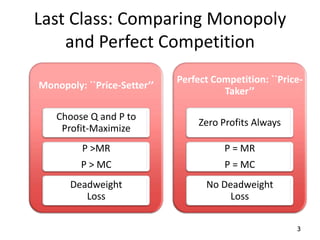
Last Class: Comparing Monopoly
    and Perfect Competition
                             Perfect Competition: ``Price-
Monopoly: ``Price-Setter’’
                                       Taker’’

    Choose Q and P to
                                  Zero Profits Always
     Profit-Maximize
         P >MR                         P = MR
         P > MC                         P = MC
       Deadweight                  No Deadweight
          Loss                          Loss

                                                        3
Learning Goals for Today
• Expertly derive:
  – Monopoly profit-maximizing conditions
  – Monopoly profits
  – Surplus in a market with monopoly
• Derive surplus when monopoly can price
  discriminate
• Compare and contrast oligopoly and
  monopolistic competition with pure monopoly
Verizon is the only supplier of cable in
   a given city because no other can
afford to lay down cable. What type of
 monopoly is it / what is the source of
            its market power?

A.   Exclusive control of inputs.
B.   Patents and copyrights.
C.   Government licenses.
D.   Network economies.
E.   Natural monopoly.
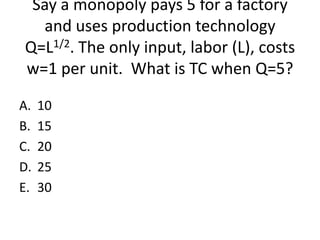
Say a monopoly pays 5 for a factory
  and uses production technology
Q=L1/2. The only input, labor (L), costs
w=1 per unit. What is TC when Q=5?

A.   10
B.   15
C.   20
D.   25
E.   30
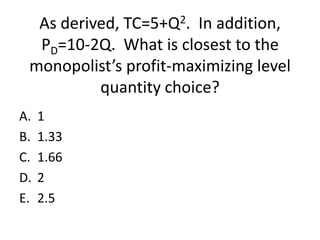
As derived, TC=5+Q2. In addition,
  PD=10-2Q. What is closest to the
 monopolist’s profit-maximizing level
          quantity choice?
A.   1
B.   1.33
C.   1.66
D.   2
E.   2.5
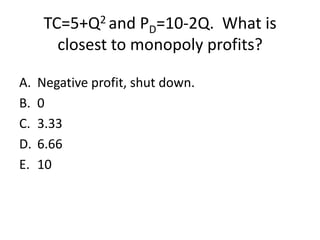
TC=5+Q2 and PD=10-2Q. What is
        closest to monopoly profits?

A.   Negative profit, shut down.
B.   0
C.   3.33
D.   6.66
E.   10
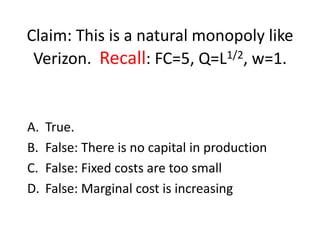
Claim: This is a natural monopoly like
 Verizon. Recall: FC=5, Q=L1/2, w=1.


A.   True.
B.   False: There is no capital in production
C.   False: Fixed costs are too small
D.   False: Marginal cost is increasing
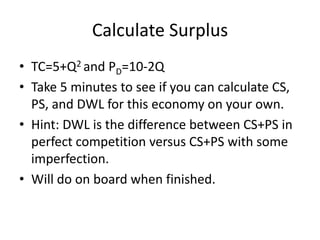
Calculate Surplus
• TC=5+Q2 and PD=10-2Q
• Take 5 minutes to see if you can calculate CS,
  PS, and DWL for this economy on your own.
• Hint: DWL is the difference between CS+PS in
  perfect competition versus CS+PS with some
  imperfection.
• Will do on board when finished.
General Form of Monopoly Problems
• Given:
  –   Fixed Costs
  –   Production Function: Generally Q=KaL1-a
  –   Variable Costs: w for L and r for K
  –   Demand
• Derive:
  – TC, ATC, MC given Fixed Costs, Prod Func, and Var
    costs
  – MR given Demand
  – Profit-max. condition and Profit given the above
  – Surplus
• Write your own using Q=K1/2 and r=1.
Now let’s switch gears
• Price discrimination
• Monopolistic competition
• Oligopoly
  – All of these points are of secondary importance to
    monopoly for now.
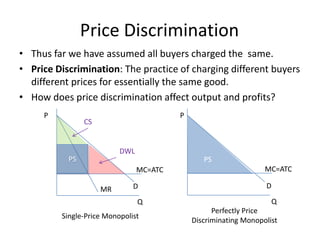
Price Discrimination
• Thus far we have assumed all buyers charged the same.
• Price Discrimination: The practice of charging different buyers
  different prices for essentially the same good.
• How does price discrimination affect output and profits?
     P                                   P
                CS


                          DWL
           PS                                   PS
                                MC=ATC                            MC=ATC

                     MR       D                                   D

                                Q                                   Q
                                                   Perfectly Price
         Single-Price Monopolist
                                             Discriminating Monopolist
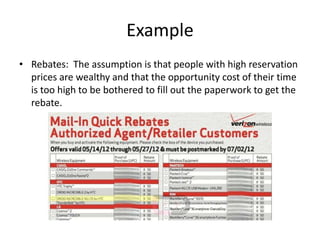
Example
• Rebates: The assumption is that people with high reservation
  prices are wealthy and that the opportunity cost of their time
  is too high to be bothered to fill out the paperwork to get the
  rebate.
Which of the following is price
        discrimination in this case?

A.   Efficient
B.   Good
C.   Inefficient
D.   Bad
E.   Can’t Say
Other types of Imperfect Competition
          Besides Monopoly
Monopolistic Competition:
                 A market in which a large number of
                 firms sell products that are close (but
                 not perfect) substitutes.
   Examples?

   Have some ability to raise price in the short-run, but free entry will lead to
   zero (economic) profits in the long run.

   Most important strategic decision: how to differentiate products from
   rivals’ products?

   Markup
Types of Imperfect Competition
3. Oligopoly:
        A market in which a small number of large firms sell
        products that are either close or perfect substitutes.
   Examples?


   Usually arise because of cost advantages of being large—
   thus, no presumption that free entry will drive profits to
   zero, but no guarantee that oligopolists will earn zero profits.
Next Class
• We’ll begin with a clicker quiz on the material
  covered this week (if I can figure that out.)
• It’s not graded, it’s for you to gauge your
  understanding.
• If works out well, will make Friday mornings
  clicker quizzes from here out.

041013

  • 1.
    More on MarketPower April 10, 2013
  • 2.
    Announcements • Problem Set2 is now posted on the website. • PS2 due at the beginning of Monday’s class.
  • 3.
    Last Class: ComparingMonopoly and Perfect Competition Perfect Competition: ``Price- Monopoly: ``Price-Setter’’ Taker’’ Choose Q and P to Zero Profits Always Profit-Maximize P >MR P = MR P > MC P = MC Deadweight No Deadweight Loss Loss 3
  • 4.
    Learning Goals forToday • Expertly derive: – Monopoly profit-maximizing conditions – Monopoly profits – Surplus in a market with monopoly • Derive surplus when monopoly can price discriminate • Compare and contrast oligopoly and monopolistic competition with pure monopoly
  • 5.
    Verizon is theonly supplier of cable in a given city because no other can afford to lay down cable. What type of monopoly is it / what is the source of its market power? A. Exclusive control of inputs. B. Patents and copyrights. C. Government licenses. D. Network economies. E. Natural monopoly.
  • 6.
    Say a monopolypays 5 for a factory and uses production technology Q=L1/2. The only input, labor (L), costs w=1 per unit. What is TC when Q=5? A. 10 B. 15 C. 20 D. 25 E. 30
  • 7.
    As derived, TC=5+Q2.In addition, PD=10-2Q. What is closest to the monopolist’s profit-maximizing level quantity choice? A. 1 B. 1.33 C. 1.66 D. 2 E. 2.5
  • 8.
    TC=5+Q2 and PD=10-2Q.What is closest to monopoly profits? A. Negative profit, shut down. B. 0 C. 3.33 D. 6.66 E. 10
  • 9.
    Claim: This isa natural monopoly like Verizon. Recall: FC=5, Q=L1/2, w=1. A. True. B. False: There is no capital in production C. False: Fixed costs are too small D. False: Marginal cost is increasing
  • 10.
    Calculate Surplus • TC=5+Q2and PD=10-2Q • Take 5 minutes to see if you can calculate CS, PS, and DWL for this economy on your own. • Hint: DWL is the difference between CS+PS in perfect competition versus CS+PS with some imperfection. • Will do on board when finished.
  • 11.
    General Form ofMonopoly Problems • Given: – Fixed Costs – Production Function: Generally Q=KaL1-a – Variable Costs: w for L and r for K – Demand • Derive: – TC, ATC, MC given Fixed Costs, Prod Func, and Var costs – MR given Demand – Profit-max. condition and Profit given the above – Surplus • Write your own using Q=K1/2 and r=1.
  • 12.
    Now let’s switchgears • Price discrimination • Monopolistic competition • Oligopoly – All of these points are of secondary importance to monopoly for now.
  • 13.
    Price Discrimination • Thusfar we have assumed all buyers charged the same. • Price Discrimination: The practice of charging different buyers different prices for essentially the same good. • How does price discrimination affect output and profits? P P CS DWL PS PS MC=ATC MC=ATC MR D D Q Q Perfectly Price Single-Price Monopolist Discriminating Monopolist
  • 14.
    Example • Rebates: Theassumption is that people with high reservation prices are wealthy and that the opportunity cost of their time is too high to be bothered to fill out the paperwork to get the rebate.
  • 15.
    Which of thefollowing is price discrimination in this case? A. Efficient B. Good C. Inefficient D. Bad E. Can’t Say
  • 16.
    Other types ofImperfect Competition Besides Monopoly Monopolistic Competition: A market in which a large number of firms sell products that are close (but not perfect) substitutes. Examples? Have some ability to raise price in the short-run, but free entry will lead to zero (economic) profits in the long run. Most important strategic decision: how to differentiate products from rivals’ products? Markup
  • 17.
    Types of ImperfectCompetition 3. Oligopoly: A market in which a small number of large firms sell products that are either close or perfect substitutes. Examples? Usually arise because of cost advantages of being large— thus, no presumption that free entry will drive profits to zero, but no guarantee that oligopolists will earn zero profits.
  • 18.
    Next Class • We’llbegin with a clicker quiz on the material covered this week (if I can figure that out.) • It’s not graded, it’s for you to gauge your understanding. • If works out well, will make Friday mornings clicker quizzes from here out.