Vocabulary Questions
SKILL 8
Find Definitions from Structural Clues
When being asked to determine the meaning of a word in the
Reading Comprehension section of TOEFL test:

The passage provides information about the meaning
of the word.

There are structural clues to tell you that the
definition of a word is included in the passage.
How to Identify?

What is … ?

What is the
meaning of … ?

What is true
about … ?
Type of Clues
Punctuation

• comma, parentheses, dashes

Restatement

• or, that is, in other words, etc.

Examples

• such as, for example, etc.
SKILL 9
Determine Meanings from Word Parts
A Short List of Word Parts
PART

MEANING

EXAMPLE

PART

MEANING

EXAMPLE

CONTRA

(against)

Contrast

DIC

(say)

Dictate

MAL

(bad)

Malcontent

DOMIN

(master)

Dominant

MIS

(error)

Mistake

JUD

(judge)

Judgment

SUB

(under)

Subway

MOR

(death)

Mortal

DEC

(ten)

Decade

SPEC

(see)

Spectator

MULTI

(many)

Multiple

TERR

(earth)

Territory

SOL

(one)

Solo

VER

(turn)

Divert

TRI

(three)

Triple

VIV

(live)

Revive
SKILL 10
Use Context to Determine
Meanings of Difficult Words
Example:

A line in the passage:
… The barges headed across the lake …
The question:
A “barge” is probably which of the following?
A. A train
B. A plane
C. A bicycle
D. A boat
Not being
expected to know
the meaning of
“barge”

Instead,
understand from
the context

It is probably a
type of BOAT

The “barge” went
across a lake
How to Identify?
What is the meaning … ?

Which of the following is closest
in meaning to … ?
The word is a difficult word, one
that you probably do not know.
SKILL 11
Use Context to Determine Meanings
of Simple Words
Example:
A line from the passage:
… He put his answer this way …
The question:
The word “put” is closest in meaning to which of the following?
A. Placed
B. Set
C. Expressed
D. Handed
You have to understand that “put” is a normal, everyday word.

You will NOT be asked to give the regular meaning of a normal,
everyday word.

The primary meaning of “to put” is to place, answer A is incorrect.

You cannot place an answer or set an answer or hand an answer.
Word Endings

Word endings in English often tell
you how a word is used
grammatically in English.

If you recognize a word ending on
a word that you do not know, you
can tell how the word should be
used grammatically.
Noun (Thing) Endings
-ism socialism

-ment government

-nce excellence

-ty beauty

-ness sadness

-age marriage

-ion information

-ship friendship

Noun (Person) Endings
-er employer

-ist tourist

-or actor

-cian musician
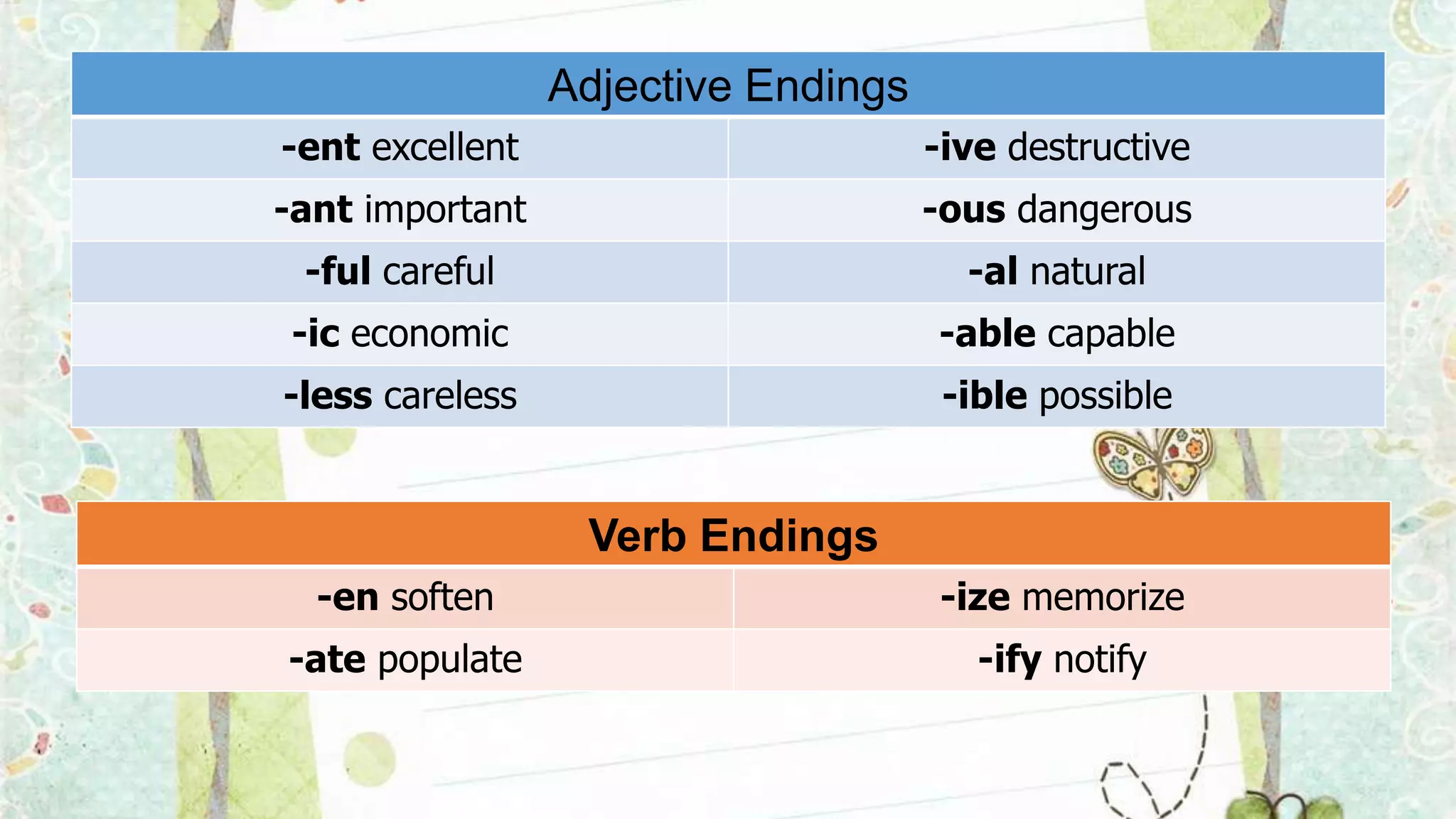
Adjective Endings
-ent excellent

-ive destructive

-ant important

-ous dangerous

-ful careful

-al natural

-ic economic

-able capable

-less careless

-ible possible

Verb Endings
-en soften

-ize memorize

-ate populate

-ify notify
Heighten

Desertification

Speechless

Forgetful

Submissive

Tremendously

Imperialism

Nocturnal

Liability

Effusively

Establishment

Counselor

Cashier

Impertinent

Civic

Columnist

Impertinently

Sensitize

Aggravate

Togetherness

Ambiance

Glamorous

Pharmacist

Justification

Vintage

Craftsmanship

Interpretive

Statistician

Manageable

Personify

05. vocabulary questions