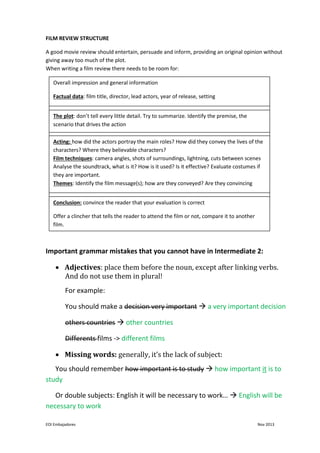
FILM REVIEW STRUCTURE
A good movie review should entertain, persuade and inform, providing an original opinion without
giving away too much of the plot.
When writing a film review there needs to be room for:
Overall impression and general information
Factual data: film title, director, lead actors, year of release, setting
The plot: don’t tell every little detail. Try to summarize. Identify the premise, the
scenario that drives the action
Acting: how did the actors portray the main roles? How did they convey the lives of the
characters? Where they believable characters?
Film techniques: camera angles, shots of surroundings, lightning, cuts between scenes
Analyse the soundtrack, what is it? How is it used? Is it effective? Evaluate costumes if
they are important.
Themes: Identify the film message(s); how are they conveyed? Are they convincing
Conclusion: convince the reader that your evaluation is correct
Offer a clincher that tells the reader to attend the film or not, compare it to another
film.

Important grammar mistakes that you cannot have in Intermediate 2:
 Adjectives: place them before the noun, except after linking verbs.
And do not use them in plural!
For example:
You should make a decision very important  a very important decision
others countries  other countries
Differents films -> different films
 Missing words: generally, it’s the lack of subject:
You should remember how important is to study  how important it is to
study
Or double subjects: English it will be necessary to work…  English will be
necessary to work
EOI Embajadores

Nov 2013
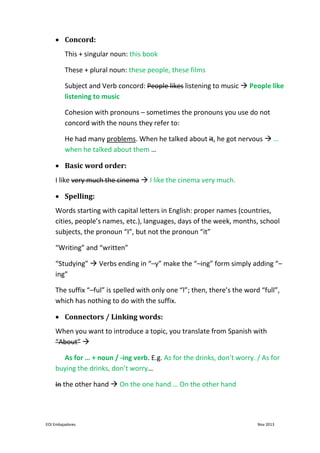
 Concord:
This + singular noun: this book
These + plural noun: these people, these films
Subject and Verb concord: People likes listening to music  People like
listening to music
Cohesion with pronouns – sometimes the pronouns you use do not
concord with the nouns they refer to:
He had many problems. When he talked about it, he got nervous  …
when he talked about them …
 Basic word order:
I like very much the cinema  I like the cinema very much.
 Spelling:
Words starting with capital letters in English: proper names (countries,
cities, people’s names, etc.), languages, days of the week, months, school
subjects, the pronoun “I”, but not the pronoun “it”
“Writing” and “written”
“Studying”  Verbs ending in “–y” make the “–ing” form simply adding “–
ing”
The suffix “–ful” is spelled with only one “l”; then, there’s the word “full”,
which has nothing to do with the suffix.
 Connectors / Linking words:
When you want to introduce a topic, you translate from Spanish with
“About” 
As for … + noun / -ing verb. E.g. As for the drinks, don’t worry. / As for
buying the drinks, don’t worry…
In the other hand  On the one hand … On the other hand

EOI Embajadores

Nov 2013

Film review feedback

  • 1.
    FILM REVIEW STRUCTURE Agood movie review should entertain, persuade and inform, providing an original opinion without giving away too much of the plot. When writing a film review there needs to be room for: Overall impression and general information Factual data: film title, director, lead actors, year of release, setting The plot: don’t tell every little detail. Try to summarize. Identify the premise, the scenario that drives the action Acting: how did the actors portray the main roles? How did they convey the lives of the characters? Where they believable characters? Film techniques: camera angles, shots of surroundings, lightning, cuts between scenes Analyse the soundtrack, what is it? How is it used? Is it effective? Evaluate costumes if they are important. Themes: Identify the film message(s); how are they conveyed? Are they convincing Conclusion: convince the reader that your evaluation is correct Offer a clincher that tells the reader to attend the film or not, compare it to another film. Important grammar mistakes that you cannot have in Intermediate 2:  Adjectives: place them before the noun, except after linking verbs. And do not use them in plural! For example: You should make a decision very important  a very important decision others countries  other countries Differents films -> different films  Missing words: generally, it’s the lack of subject: You should remember how important is to study  how important it is to study Or double subjects: English it will be necessary to work…  English will be necessary to work EOI Embajadores Nov 2013
  • 2.
     Concord: This +singular noun: this book These + plural noun: these people, these films Subject and Verb concord: People likes listening to music  People like listening to music Cohesion with pronouns – sometimes the pronouns you use do not concord with the nouns they refer to: He had many problems. When he talked about it, he got nervous  … when he talked about them …  Basic word order: I like very much the cinema  I like the cinema very much.  Spelling: Words starting with capital letters in English: proper names (countries, cities, people’s names, etc.), languages, days of the week, months, school subjects, the pronoun “I”, but not the pronoun “it” “Writing” and “written” “Studying”  Verbs ending in “–y” make the “–ing” form simply adding “– ing” The suffix “–ful” is spelled with only one “l”; then, there’s the word “full”, which has nothing to do with the suffix.  Connectors / Linking words: When you want to introduce a topic, you translate from Spanish with “About”  As for … + noun / -ing verb. E.g. As for the drinks, don’t worry. / As for buying the drinks, don’t worry… In the other hand  On the one hand … On the other hand EOI Embajadores Nov 2013