Medicinal Chemistry I
IInd
Module
Pharmacokinetics and related topics
Medicinal Chemistry Page 2
INTRODUCTION
In order to produce its intended effect, a drug must be present at an appropriate
concentration in the fluid surrounding the effect site, that is, the biophase. Only
rarely can drugs be applied directly to the biophase; in most cases drugs need to be
transferred from the site of administration to the biophase. Usually, this translocation
involves two steps: absorption and distribution. During absorption, the drug
passes from its site of administration into the systemic circulation. Subsequently, the
drug is distributed via the circulating blood plasma (the fluid portion of the blood) to
the different parts of the organism, including the organ(s) in which the biophase for
the drug is localized. Each drug molecule that reaches the target site can add to the
intended pharmacological effect of the drug. However, at all times a portion of the
drug molecules in the body is also distributed to organs and tissues that account for
an irreversible loss of drug molecules from the body (drug elimination) by either
biotransformation (the conversion of one chemical entity to another) or excretion.
This causes a decrease in the concentration of the drug in the body and,
consequently, also in the biophase.
Medicinal Chemistry Page 3
INTRODUCTION
A schematic representation of the processes involved in the journey of a drug
molecule through the human body is shown in the left Figure. In the right Figure is
shows a more detailed scheme of the main routes of drug absorption, distribution
and elimination. Pharmacokinetics is the study of the drug concentrations in the
different parts of the organism as a function of time. These concentrations depend
on the dose administered and upon the rate and extent of absorption, distribution
and elimination.
Medicinal Chemistry Page 4
Pharmacodynamics and Pharmacokinetics
Previously, we looked at the molecular targets for drugs and the mechanisms by
which drugs interact with these targets. Later, we shall look at how drugs can be
designed to optimize binding interactions with their targets. This is an area of
medicinal chemistry known as pharmacodynamics.
However, the compound with the best binding interactions for a target is not
necessarily the best drug to use in medicine. This is because a clinically useful drug
has to travel through the body in order to reach its target. There are many barriers
and hurdles in its way and, as far as the drug is concerned, it is a long and arduous
journey. The study of how a drug reaches it target, and what happens to it during
that journey, is known as pharmacokinetics.
When carrying out a drug design programme, it is important to study
pharmacokinetics alongside pharmacodynamics.
There is no point perfecting a compound with superb drug-target interactions if it
has no chance of reaching its target. The four main topics to consider in
pharmacokinetics are absorption, distribution, metabolism and excretion (often
abbreviated to ADME) (and toxicology) → ADMET
Medicinal Chemistry Page 5
PASSAGE OF DRUGS THROUGH BIOLOGICAL BARRIERS
On its journey through the body, a drug needs to cross different biological barriers.
These barriers can be a single layer of cells (e.g. the intestinal epithelium), several
layers of cells (e.g. in the skin), or the cell membrane itself (e.g. to reach an
intracellular receptor). A drug can cross a cell layer either by traveling through the
cells (transcellular drug transport) or through gaps between the cells (paracellular
drug transport).
Transcellular drug transport
In order to travel through a cell or to reach a target inside a cell, a drug molecule
must be able to traverse the cell membrane.
The cell membrane (also called plasma membrane) is a lipid bilayer interspersed with
carbohydrates and proteins.
Although cell membranes largely vary in their permeability characteristics depending
on the tissue, the main mechanisms of drugs passing through the cell membrane are
passive diffusion, carrier-mediated processes and vesicular transport.
Medicinal Chemistry Page 6
Passive diffusion
Passive diffusion is the process by which molecules spontaneously diffuse from a
region of higher concentration (e.g. outside of the cell) to a region of lower
concentra- tion (e.g. inside the cell), and it is the main mechanism for passage of
drugs through membranes. Lipid-soluble drugs penetrate the lipid cell membrane
with ease, and can pass the cell membrane by passive diffusion. Polar molecules
and ionized compounds, on the other hand, partition poorly into lipids and are not
able to diffuse through the cell membrane or do so at a much lower rate. Also, large
molecules, such as proteins and protein-bound drugs, cannot diffuse through the
cell membrane.
Transmembrane diffusion is driven by the concentration gradient of the drug over
the cell membrane. The rate of diffusion depends, apart from the lipid/water partition
coefficient of the drug (P) and the concentration gradient (C_out - C_in), on
membrane properties such as the membrane area (A) and thickness (h), and the
diffusion coefficient (D) of the drug in the membrane, according to Fick's law:
Medicinal Chemistry Page 7
Passive diffusion
Many drugs are acidic or basic compounds, which are ionized to a certain degree in aqueous medium.
Their degree of ionization depends on their dissociation constant (pka) and the pH of the solution,
according to the Henderson-Hasselbach equation:
Very weak acids with pKa values higher than 7.5, are essentially unionized at physiological pH values. For
these drugs diffusion over the cell membrane is rapid and independent of pH changes within the body,
provided the unionized form of the drug is lipid soluble. For acidic drugs with a pKa value between 3.0 and
7.5, the fraction of unionized drug varies with the changes in pH encountered in the organism. For these
drugs the pH of the extracellular environment is critical in determining the diffusion across the cell
membrane. For acidic drugs with a pKa lower than 2.5, the fraction of unionized drug is low at any
physiological pH, resulting in very slow diffusion across membranes. A similar analysis can be made for
bases.
At the diffusion equilibrium, the concentrations of unionized molecules on both sides of a biological barrier
are equal. If the pH on both sides of the barrier is equal, then the concentration of ionized molecules and,
consequently, the total concentration of the molecules, will be the same on both sides of the barrier.
However, if there is a difference in pH, as e.g. between blood plasma (pH 7.4) and stomach contents (pH 1-
3), the concentration of the ionized molecules at equilibrium, and, therefore, the total concentration, will be
much higher on one side of the barrier than on the other. This phenomenon is called ion trapping.
Medicinal Chemistry Page 8
Carrier-mediated processes
Many cell membranes possess specialized transport mechanisms that regulate entry and exit of
physiologically important molecules and drugs.
Such transport systems involve a carrier molecule, that is, a transmembrane protein that binds one
or more molecules and releases them on the other side of the membrane. Such systems may
operate passively (without any energy source) and along a concentration gradient; this is called
"facilitated diffusion." However, facilitated diffusion seems to play only a minor role in drug
transport. An example is the transport of vitamin B12 across the GI membrane.
Alternatively, the system may spend energy (obtained from the energy rich molecule adenosine
triphosphate (ATP) required to pump molecules against a concentration gradient; this mechanism is
called "active transport."
At high drug concentrations the carrier sites become saturated, and the rate of transport does not
further increase with concentration. Furthermore, competitive inhibition of transport can occur if
another substrate for this carrier is present. In recent years, several transporters have been
described to be present in various organs and tissues throughout the body and to determine
absorption, distribution and elimination of compounds that are substrates for these transporters.
Although some transporters mediate the uptake of compounds in the cell (influx transporters), others
may mediate secretion back out of the cell (efflux transporters). Transporters in the intestinal
membrane affect the absorption of drugs, while transporters in the liver and kidney influence
elimination by mediating transport into and out of cells responsible for biotransformation
(hepatocytes) or excretion (e.g. renal tubule cells in the kidneys). Furthermore, efflux transporters
may limit the penetration of compounds into certain areas of the body, such as the cerebrospinal
fluid and blood cells.
Medicinal Chemistry Page 9
Vesicular transport
During vesicular transport the cell membrane forms a small cavity that gradually
surrounds particles or macromolecules, thereby internalizing them into the cell in the
form of a vesicle or vacuole. Vesicular transport is the proposed process for the
absorption of orally administered Sabin polio vaccine and of various large proteins. It
is called endocytosis when moving a macromolecule into a cell, exocytosis when
moving a macromolecule out of a cell, and transcytosis when moving a
macromolecule across a cell.
Paracellular drug transport
Drugs can also cross a cell layer through the small aqueous contact points (cell
junctions) between cells. This paracellular drug transport can be initiated by a
concentration gradient over the cell layer (passive diffusion), or by a hydrostatic
pressure gradient across the cell layer (filtration). The size and characteristics of cell
junctions widely vary between different barriers to drug transport. For example, the
endothelium of glomerular capillaries in the kidney forms a leaky barrier, which is
very rich in intercellular pores. Therefore, this membrane is very permeable and
permits filtration of water and solutes. On the other hand, endothelial cells of brain
capillaries are sealed together by tight junctions, practically eliminating the possibility
of paracellular drug transport.
Medicinal Chemistry Page 10
Drug absorption
Absorption can be defined as the passage of a drug from its site of administration
into the systemic circulation.
If a drug is administered directly into the systemic circulation by intravenous (i.v.)
administration, absorption is not needed.
Drugs can be administered by enteral and parenteral routes. Enteral administration
occurs through the GI tract, by contact of the drug with the mucosa in the mouth
(buccal or sublingual), by swallowing (oral) or by rectal administration.
In parenteral administration the GI tract is bypassed; examples are the i.v. (direct
injection in the systemic circulation) and intramuscular (injection into a muscle)
routes.
Drugs can also be absorbed through the skin or through the mucosa of various
organs (e.g. bronchi, nose, and vagina). In some cases, a drug is applied for a local
effect, and no absorption is intended (e.g. antacids that neutralize stomach acid). In
this chapter, we will describe drug administration by the oral route, which is the most
common and popular route of drug dosing.
Medicinal Chemistry Page 11
Common Routes of Drug Administration
Medicinal Chemistry Page 12
Common Routes of Drug Administration
Medicinal Chemistry Page 13
Common Routes of Drug Administration
Medicinal Chemistry Page 14
Drug absorption
Drug absorption refers to the route or method by which a drug reaches the
blood supply.
This in turn depends on how the drug is administered.
The most common and preferred method of administering drugs is the oral
route and so we shall first concentrate on the various barriers and problems
associated with oral delivery.
An orally taken drug enters the gastrointestinal tract (GIT), which comprises
the mouth, throat, stomach, and the upper and lower intestines.
A certain amount of the drug may be absorbed through the mucosal
membranes of the mouth, but most passes down into the stomach where it
encounters gastric juices and hydrochloric acid.
These chemicals aid in the digestion of food and will treat drugs in a similar
fashion if the drug is susceptible to breakdown.
For example, the first penicillin used clinically was broken down in the stomach
and had to be administered by injection.
Other acid-labile drugs, such as local anaesthetics or insulin, cannot be given orally.
Medicinal Chemistry Page 15
Drug absorption
If the drug does survive the stomach, it enters the upper intestine where it
encounters digestive enzymes that serve to break down food.
Assuming the drug survives this attack, it then has to pass through the cells lining
the intestinal or gut wall.
This means that the drug has to pass through a cell membrane on two occasions,
first to enter the cell and then to exit it on the other side.
Once the drug has passed through the cells of the gut wall, it can enter the blood
supply relatively easily as the cells lining the blood vessels have pores between
them through which most drugs can pass. In other words, drugs enter the blood
vessels by passing between cells rather than through them.
The drug is now transported in the blood to the body's 'customs office': the liver.
The liver contains enzymes which are ready and waiting to intercept foreign
chemicals, and modify them such that they are more easily excreted: a process
called drug metabolism.
Medicinal Chemistry Page 16
Drug absorption
It can be seen that stringent demands are
made on any orally taken drug.
The drug must be chemically stable to
survive the stomach acids, and
metabolically stable to survive the
digestive enzymes in the GIT as well as
the metabolic enzymes in the liver.
It must also have the correct balance of
water versus fat solubility.
If the drug is too polar (hydrophilic), it will
fail to pass through the fatty cell
membranes of the gut wall.
On the other hand, if the drug is too fatty
(hydrophobic), it will be poorly soluble in
the gut and will dissolve in fat globules.
This means that there will be poor surface
contact with the gut wall, resulting in poor
absorption.
Medicinal Chemistry Page 17
Drug absorption
It is noticeable how many drugs contain an amine functional group.
There are good reasons for this. Amines are often involved in a drug's binding
interactions with its target.
However, they are also an answer to the problem of balancing the dual
requirements of water and fat solubility.
Amines are weak bases, and it is found that many of the most effective drugs are
amines having a pKa value in the range 6-8.
In other words, they are partially ionized at blood pH (~7.4) and can easily
equilibrate between their ionized and non-ionized forms. This allows them to cross
cell membranes in the non-ionized form, while the presence of the ionized form
gives the drug good water solubility and permits good binding interactions with its
target binding site.
Medicinal Chemistry Page 18
Henderson-Hasselbalch equation
The extent of ionization at a particular pH can be determined
by the Henderson-Hasselbalch equation:
where [RNH2] is the concentration of the free base and [RNH3+] is the
concentration of the ionized amine. Ka is the equilibrium constant for the equilibrium
shown, and the Henderson-Hasselbalch equation can be derived from the
equilibrium constant.
Note that when the concentration of the ionized and unionized amines are identical
(i.e. when [RNH2 = [RNH3+]), the ratio ([RNH2/[RNH3+]) is 1. Since log 1 = 0, the
Henderson-Hasselbalch equation will simplify to pH = pKa.
In other words, when the amine is 50% ionized, pH = pKa.
Therefore, drugs with a pKa of 6-8 are approximately 50% ionized at blood pH (7.4).
Medicinal Chemistry Page 19
Lipinski's rule of five
The hydrophilic-hydrophobic character of the drug is the crucial factor affecting
absorption through the gut wall, and the molecular weight of the drug should in
theory be irrelevant. For example, cidosporin is successfully absorbed through cell
membranes, although it has a molecular weight of about 1200. In practice, however,
larger molecules tend to be poorly absorbed, because they are likely to contain a
large number of polar functional groups. As a rule of thumb, orally absorbed drugs
tend to obey what is known as Lipinski's rule of five. The rule of five was derived
from an analysis of compounds from the World Drugs Index database, aimed at
identifying features that were important in making a drug orally active. It was found
that the factors concerned involved numbers that are multiples of 5:
• a molecular weight less than 500
• no more than 5 hydrogen bond donor groups
• no more than 10 hydrogen bond acceptor groups
• a calculated log P value less than + 5
(log P is a measure of a drug's hydrophobicity)
Medicinal Chemistry Page 20
Lipinski's rule of five failures
The rule of five has been an extremely useful rule of thumb for
many years, but it is neither quantitative nor foolproof.
For example, orally active drugs such as atorvastatin,
rosuvastatin, cidosporin and vinorelbine do not obey the
rule of five.
It has also been demonstrated that a high molecular weight
does not in itself cause poor oral bioavailability.
One of the reasons that the molecular weight appears to be
important is that larger molecules invariably have too many
functional groups capable of forming hydrogen bonds.
Therefore, further research has been carried out to find
guidelines that are independent of molecular weight.
Medicinal Chemistry Page 21
Other rules
Work carried out by Veber et al. in 2002, demonstrated the rather surprising finding that
molecular flexibility (as measured by the number of freely rotatable bonds present in the
structure) plays an important role in oral bioavailability. The more flexible the molecule,
the less likely it is to be orally active. Less surprisingly, the analysis showed that the
polar surface area of the molecule could be used as a factor instead of the number of
hydrogen bonding groups.
These findings led to the following parameters for acceptable oral activity.
Either:
• a polar surface area ≤ 140 Å and ≤ 10 rotatable bonds
or
• ≤ 12 hydrogen bond donors and acceptors in total and ≤ 10 rotatable bonds,
Some researchers set the limit of rotatable bonds to ≤ 7 since the analysis shows a
marked improvement in oral bioavailability for such molecules.
Medicinal Chemistry Page 22
Other rules
These rules are independent of molecular weight and open the way to studying larger
structures that have been 'shelved' up to now. Unfortunately, structures having a molecular
weight larger than 500 are quite likely to have more than 10 rotatable bonds.
However, the new rules suggest that rigidifying the structures to reduce the number of
rotatable bonds would be beneficial.
Rigidification tactics will be described as a strategy to improve a drug's pharmacodynamic
properties, but these same tactics could also be used to improve pharmacokinetic properties.
Polar drugs that break the above rules are usually poorly absorbed and have to be
administered by injection.
Nevertheless, some highly polar drugs can be absorbed from the digestive system. For
example, there are polar drugs that can 'hijack' specific transport proteins in the cell
membrane. Transport proteins are essential to a cells survival, as they transport the highly
polar building blocks required for various biosynthetic pathways.
If the drug bears a structural resemblance to one of these building blocks, then it too may be
smuggled into the cell. For example, levodopa is transported by the transport protein for the
amino acid phenylalanine, and fluorouracil is transported by transport proteins for the nucleic
acid bases thymine and uracil. The antihypertensive agent lisinopril is transported by
transport proteins for dipeptides, and the anticancer agent methotrexate and the antibiotic
erythromycin are also absorbed by means of transport proteins.
Medicinal Chemistry Page 23
Drug absorption of polar drugs
Other highly polar drugs can be absorbed into the blood supply if they have
a low molecular weight (less than 200), as they can then pass through
small pores between the cells lining the gut wall.
Occasionally, polar drugs with high molecular weight can cross the cells of
the gut wall without actually passing through the membrane. This involves
a process known as pinocytosis where the drug is engulfed by the cell
membrane and a membrane-bound vesicle is pinched off to carry the drug
across the cell. The vesicle then fuses with the membrane to release the
drug on the other side of the cell.
Sometimes, drugs are deliberately designed to be highly polar so that they
are not absorbed from the GIT. These are usually antibacterial agents
targeted against gut infections. Making them highly polar ensures that the
drug reaches the site of infection in higher concentration.
Medicinal Chemistry Page 24
Key Points on Drug Absorption
• Pharmacodynamics is the study of how drugs interact with a molecular target, whereas
pharmacokinetics is the study of how a drug reaches its target in the body and how it is affected
on that journey.
• The four main issues in pharmacokinetics are absorption, distribution, metabolism, and
excretion.
• Orally taken drugs have to be chemically stable to survive the acidic conditions of the stomach,
and metabolically stable to survive digestive and metabolic enzymes.
• Orally taken drugs must be sufficiently polar to dissolve in the git and blood supply, but
sufficiently fatty to pass through cell membranes.
• Most orally taken drugs obey Lipinski's rule of five and have no more than seven rotatable
bonds.
• Highly polar drugs can be orally active if they are small enough to pass between the cells of the
gut wall, are recognized by carrier proteins, or are taken across the gut wall by pinocytosis.
• Distribution round the blood supply is rapid. Distribution to the interstitial fluid surrounding
tissues and organs is rapid if the drug Is not bound to plasma proteins.
• Some drugs have to enter cells in order to reach their target.
• A certain oercentage of a drug may be absorbed into fatty tissue and/or bound to
macromolecules.
• Drugs entering the CNS have to cross the blood-brain barrier. Polar drugs are unable to cross
this barrier unless they make use of carrier proteins or are taken across by pinocytosis.
• Some drugs cross the placental barrier into the fetus and may harm development or prove toxic
in newborn babies
Medicinal Chemistry Page 25
Drug Metabolism
When drugs enter the body, they are subject to attack from a range of metabolic
enzymes.
The role of these enzymes is to degrade or modify the foreign structure, such that it
can be more easily excreted.
As a result, most drugs undergo some form of metabolic reaction resulting in
structures known as metabolites. Very often these metabolites lose the activity of
the original drug, but in some cases they may retain a certain level of activity. Some
metabolites may possess a different activity from the parent drugs, resulting in side
effects or toxicity.
A knowledge of drug metabolism and its possible consequences can aid the
medicinal chemist in designing new drugs which do not form unacceptable
metabolites.
Equally, it is possible to take advantage of drug metabolism to activate drugs in the
body. This is known as a prodrug strategy.
It is now a requirement to identify all the metabolites of a new drug before it can be
approved. The structure and stereochemistry of each metabolite has to be
determined and the metabolite must be tested for biological activity.
Medicinal Chemistry Page 26
Biotransformation
As was described above, most drugs need to pass through biological membranes to
reach their site of action. Therefore, most drugs have lipophilic characteristics and
are only partially ionized at the pH values encountered in the organism. These
characteristics also favor reabsorption from the renal tubules after glomerular
filtration. As a consequence, renal excretion often plays only a modest role in the
total elimination of therapeutic agents from the body. For these compounds,
biotransformation into metabolites that are more hydrophilic in nature is essential,
because it allows their excretion by the kidneys.
Biotransformation reactions take place mainly in the liver (hepatic biotransformation),
but can also occur in intestinal mucosa, lungs, kidneys, skin, placenta and plasma.
Within a given cell, most of the biotransformation enzymes are found in the
endoplasmic reticulum (a network of folded membranes inside the cell) and the
cytosol (the fluid inside the cell).
When liver tissue (or any other tissue) is homogenized and differential centrifugation
is applied, the endoplasmic reticulum of the cells breaks up. Fragments of the
endoplasmic reticulum then form microvesicles, called microsomes . Therefore, the
biotransformation enzymes in the endoplasmic reticulum are often referred to as
microsomal enzymes.
Medicinal Chemistry Page 27
Biotransformation
For hepatic biotransformation to occur, a drug must enter the hepatocytes that
contain the biotransformation enzymes. Polar molecules do this more slowly than
non-polar molecules, except where specific transport mecha- nisms exist. As a
consequence, hepatic metabolism is, in general, more important for lipid-soluble
drugs than for polar drugs.
Renal excretion and biotransformation can therefore be regarded as two additional
and synergistic elimination pathways, guaranteeing an efficient elimination of a
whole range of hydrophilic as well as lipophilic substances from the body.
Biotransformation usually inactivates a drug, but in some cases metabolites with
biologi- cal activity or toxic properties are formed.
For some drugs, the activity may reside wholly in one or more metabolites: drugs
that only become active after biotransformation are termed "prodrugs."
Prodrugs are sometimes developed to improve absorption, often because of better
lipid solubility than the active metabolite. After absorption, these prodrugs are
rapidly converted to the active metabolite in the gut wall or in the liver. An example
is pivampicillin, an ester of ampicillin, which is rapidly and completely hydrolyzed to
ampicillin during absorption.
Medicinal Chemistry Page 28
Biotransformation
Two phases can be distinguished in the pathways of biotransformation. Phase I involves
addition of functionally reactive groups by oxidation, reduction or hydrolysis. These products
are sometimes more chemically reactive, and therefore more toxic than the parent drug. The
Cytochrome P450 (CYP) enzyme family is involved in most (but not all) Phase I reactions. It
comprises a large group of enzymes localized in the endoplasmic reticulum of numerous
tissues. The CYP-enzymes are grouped in families denoted by an arabic numeral (e.g. the
CYP3 fam- ily), within which the amino acid sequence homology is higher than 40%. Each
P450 family is further divided into subfamilies denoted by a capital letter (e.g. the CYP3A
subfamily), with greater than 55% amino acid sequence homology. Finally, another arabic
numeral represents the individual enzyme (e.g. CYP3A4). The main CYP enzymes involved
in drug metabolism are: CYP1A2, CYP2A6, CYP2C9, CYP2C19, CYP2D6, CYP2E1 and
CYP3A4. CYP3A4 accounts for 30% of total P450 enzyme in the liver and is clinically the
most important isoenzyme present in the liver. Nearly 50% of all clinically used medications
are metabolized by CYP3A4.
Phase II biotransformation consists of conjugation of reactive groups, present either in the
parent molecule or after Phase I transformation. Phase II conjugates are usually
pharmacologically inactive; they are more hydrophilic than the parent compounds and are
easily excreted by the kidneys or the bile. Phase I and Phase II reactions often, though not
invariably, occur sequentially.
Medicinal Chemistry Page 29
Biotransformation
The metabolism of drugs and other xenobiotics is often a biphasic process in which
the compound may first undergo a functionalization reaction (phase I reaction) of
oxidation, reduction or hydrolysis. This introduces or unveils a functional group such
as a hydroxyl or amino group suitable for coupling with an endogenous molecule or
moiety in a second metabolic step known as a conjugation reaction (phase II
reaction). In a number of cases, phase I metabolites may be excreted prior to
conjugation, while many xenobiotics can be directly conjugated. Furthermore,
reactions of functionalization may follow some reactions of conjugation, e.g. some
conjugates are hydrolyzed and/or oxidized prior to their excretion.
The major function of xenobiotic metabolism is the elimination of physiologically
useless compounds, some of which may be harmful; witness the many toxins
produced by plants. This evolutionary function justifies the designation of
detoxification originally given to reactions of xenobiotic metabolism. However,
numerous xenobiotics and even a marked number of drugs are known to yields
toxic metabolites, a situation known as toxification.
Medicinal Chemistry Page 30
Biotransformation
In pharmacological terms, a drug may or may
not have active metabolites. The former case
is rather frequent, especially with phase I
metabolites. Drugs that do not yield any
active metabolite are, for example, the soft
drugs. The reverse case is that of prodrugs,
namely, inactive therapeutic agents whose
clinical activity is due to an active metabolite.
As an example of a metabolic scheme, Figure
presents the biotransformation of propranolol
(1) in humans. There are relatively few
studies as comprehensive and clinically
relevant as this one, which remains as
current today as it was when published in
1985. Indeed, over 90% of a dose was
accounted for and consisted mainly in
products of oxidation and conjugation. The
missing 10% may represent other minor and
presumably quite numerous metabolites, e.g.
those resulting from ring hydroxylation at
other positions or from the progressive
breakdown of glutathione (GSH) conjugates.
Medicinal Chemistry Page 31
Phase I Reactions
Drugs are foreign substances as far as the body is concerned, and the body has its
own method of getting rid of such chemical invaders. If the drug is polar, it will be
quickly excreted by the kidneys. However, non-polar drugs are not easily excreted
and the purpose of drug metabolism is to convert such compounds into more polar
molecules that can be easily excreted.
Non-specific enzymes (particularly cytochrome P450 enzymes in the liver) are able
to add polar functional groups to a wide variety of drugs. Once the polar functional
group has been added, the overall drug is more polar and water soluble, and is
more likely to be excreted when it passes through the kidneys. An alternative set of
enzymatic reactions can reveal masked polar functional groups which might already
be present in a drug. For example, there are enzymes which can demethylate a
methyl ether to reveal a more polar hydroxyl group.
Once again, the more polar product (metabolite) is excreted more efficiently.
These reactions are classed as phase I reactions and generally involve oxidation,
reduction, and hydrolysis. Most of these reactions occur in the liver but some (such
as the hydrolysis of esters and amides) can also occur in the gut wall, blood plasma,
and other tissues.
Medicinal Chemistry Page 32
Phase I Reactions
Some of the structures most prone to oxidation are N-methyl groups, aromatic rings, the
terminal positions of alkyl chains, and the least hindered positions of alicyclic rings.
Nitro, azo, and carbonyl groups are prone to reduction by reductases, while amides and
esters are prone to hydrolysis by esterases. For some drugs, two or more metabolic
reactions might occur, resulting in different metabolites; other drugs may not be
metabolized at all.
A knowledge of the metabolic reactions that are possible for different functional, groups
allows the medicinal chemist to predict the likely metabolic products for any given drug,
but only drug metabolism studies will establish whether these metabolites are really
formed.
Drug metabolism has important implications when it comes to using chiral drugs,
especially if the drug is to be used as a racemate. The enzymes involved in catalysing
metabolic reactions will often distinguish between the two enantiomers of a chiral drug,
such that one enantiomer undergoes different metabolic reactions from the other.
As a result, both enantiomers of a chiral drug have to be tested separately to see what
metabolites are formed.
In practice, it is usually preferable to use a single enantiomer in medicine, or design the
drug such that it is not asymmetric.
Medicinal Chemistry Page 33
Phase I Reactions
Medicinal Chemistry Page 34
Phase II Reactions
A series of metabolic reactions classed as phase II reactions also occur,
mainly in the liver. Most of these reactions are conjugation reactions,
whereby a polar molecule is attached to a suitable polar 'handle' that is
already present on the drug or has been introduced by a phase I reaction.
The resulting conjugate has greatly increased polarity, thus increasing its
excretion rate in urine or bile even further.
Both phase I and phase II reactions can be species specific, which has
implications for in vivo metabolic studies.
In other words, the metabolites formed in an experimental animal may not
necessarily be those formed in humans.
A good knowledge of how metabolic reactions differ from species to species is important in
determining which test animals are relevant for drug metabolism tests.
Both sets of reactions can also be regioselective and stereoselective. This means that metabolic
enzymes can distinguish between identical functional groups or alkyl groups located at different
parts of the molecule (regioselectivity) as well as between different stereoisomers of chiral
molecules (stereoselectivity).
Medicinal Chemistry Page 35
Phase II Reactions
Medicinal Chemistry Page 36
Phase II Reactions
Medicinal Chemistry Page 37
Phase I transformations catalysed by cytochrome P450 enzymes
The enzymes that constitute the cytochrome P450 family are the most
important metabolic enzymes and are located in liver cells. They are
haemoproteins (containing haem and iron) and they catalyse a reaction
that splits molecular oxygen, such that one of the oxygen atoms is
introduced into the drug and the other ends up in water. As a result they
belong to a general class of enzymes called the monooxygenases.
There are at least 33 different cytochrome P450 enzymes, grouped into
four main families CYP1-CYP4. Within each family there are various
subfamilies designated by a letter, and each enzyme within that subfamily
is designated by a number.
For example, CYP3A4 is enzyme 4 in the subfamily A of the main family 3.
Most drugs in current use are metabolized by five primary CYP enzymes
(CYP3A, CYP2D6, CYP2C9, CYP1A2 and CYP2E1). The isozyme
CYP3A4 is particularly important in drug metabolism, and is responsible for
the metabolism of most drugs.
Medicinal Chemistry Page 38
Phase I transformations catalysed by cytochrome P450 enzymes
Cytochrome P450 is the major drug-metabolizing enzyme system, playing a key role
in detoxification and toxification and is of additional significance in medicinal
chemistry because several CYP enzymes are drug targets, e.g. thromboxane
synthase (CYP5A1) and aromatase (CYP19A1).
The CYPs are encoded by the CYP gene superfamily and are classified in families
and subfamilies.
A total of 57 human CYP genes are known to date. The three CYP families mostly
involved in xenobiotic metabolism are CYP1-CYP3.
The endobiotic-metabolizing CYPs are in families 4, 5, 7, 8, 11, 17, 19-21, 24, 26,
27, 39, 46 and 51.
Medicinal Chemistry Page 39
Phase I transformations catalysed by cytochrome P450 enzymes
Medicinal Chemistry Page 40
Phase I transformations catalysed by cytochrome P450 enzymes
An understanding of the regiospecificity and broad reactivity of cytochrome P450
requires a presentation of its catalytic cycle. The enzyme in its ferric (oxidized) form
exists in equilibrium between two spin states, a hexacoordinated low-spin form
whose reduction requires a high-energy level, and a pentacoordinated high-spin
form. Binding of the substrate to enzyme induces a shift to the reducible high-spin
form (reaction a). The first electron then enters the enzyme-substrate complex
(reaction b), reducing the enzyme to its ferrous form, which has a high affinity for
diatomic gases such as CO (a strong inhibitor of cyto- chrome P450) and dioxygen
(reaction c). The cycle continues with a second electron entering via either FP1 or
FP2 and reducing the ternary complex (reaction d). Electron transfer within the
ternary complex generates bound peroxide anion (O2
2-) . The bound peroxide anion
is split by the addition of two protons, liberating H2O (reaction e). The remaining
oxygen atom is equivalent to an oxene species, a neutral electrophilic species
having only six electrons in its outer shell, stabilized by electron density from the
iron. This is the reactive form of oxygen that will attack the substrate. The binary
enzyme-product complex dissociates, thereby regenerating the initial state of
cytochrome P450 (reaction f).
Medicinal Chemistry Page 41
Phase I transformations catalysed by cytochrome P450 enzymes
Medicinal Chemistry Page 42
Phase I transformations catalysed by cytochrome P450 enzymes
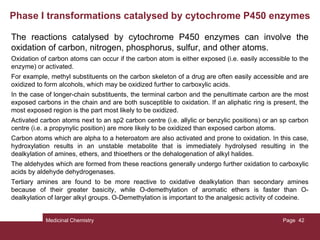
The reactions catalysed by cytochrome P450 enzymes can involve the
oxidation of carbon, nitrogen, phosphorus, sulfur, and other atoms.
Oxidation of carbon atoms can occur if the carbon atom is either exposed (i.e. easily accessible to the
enzyme) or activated.
For example, methyl substituents on the carbon skeleton of a drug are often easily accessible and are
oxidized to form alcohols, which may be oxidized further to carboxylic acids.
In the case of longer-chain substituents, the terminal carbon and the penultimate carbon are the most
exposed carbons in the chain and are both susceptible to oxidation. If an aliphatic ring is present, the
most exposed region is the part most likely to be oxidized.
Activated carbon atoms next to an sp2 carbon centre (i.e. allylic or benzylic positions) or an sp carbon
centre (i.e. a propynylic position) are more likely to be oxidized than exposed carbon atoms.
Carbon atoms which are alpha to a heteroatom are also activated and prone to oxidation. In this case,
hydroxylation results in an unstable metabolite that is immediately hydrolysed resulting in the
dealkylation of amines, ethers, and thioethers or the dehalogenation of alkyl halides.
The aldehydes which are formed from these reactions generally undergo further oxidation to carboxylic
acids by aldehyde dehydrogenases.
Tertiary amines are found to be more reactive to oxidative dealkylation than secondary amines
because of their greater basicity, while O-demethylation of aromatic ethers is faster than O-
dealkylation of larger alkyl groups. O-Demethylation is important to the analgesic activity of codeine.
Medicinal Chemistry Page 43
Phase I transformations catalysed by cytochrome P450 enzymes
Medicinal Chemistry Page 44
Phase I transformations catalysed by cytochrome P450 enzymes
Cytochrome P450 enzymes can catalyse the oxidation of unsaturated sp2 and sp
carbon centres present in alkenes, alkynes, and aromatic rings.
In the case of alkenes, a reactive epoxide is formed which is deactivated by the
enzyme epoxide hydrolase to form a diol. In some cases, the epoxide may evade
the enzyme.
If this happens, it can act as an alkylating agent and react with nucleophilic groups
present in proteins or nucleic acids, leading to toxicity.
The oxidation of an aromatic ring results in a similarly reactive epoxide intermediate
which can have several possible fates. It may undergo a rearrangement reaction
involving a hydride transfer to form a phenol, normally at the para position.
Alternatively, it may be deactivated by epoxide hydrolase to form a diol or react with
glutathione S-transferase to form a conjugate. If the epoxide intermediate evades
these enzymes, it may act as an alkylating agent and prove toxic.
Electron-rich aromatic rings are likely to be epoxidized more quickly than those with
electron- withdrawing substituents, and this has consequences for drug design
Medicinal Chemistry Page 45
Phase I transformations catalysed by cytochrome P450 enzymes
Medicinal Chemistry Page 46
Phase I transformations catalysed by cytochrome P450 enzymes
Medicinal Chemistry Page 47
Phase I transformations catalysed by cytochrome P450 enzymes
Tertiary amines are oxidized to N-oxides as long as the alkyl groups are not
sterically demanding.
Primary and secondary amines are also oxidized to N-oxides, but these are rapidly
converted to hydroxylamines and beyond.
Aromatic primary amines are also oxidized in stages to aromatic nitro groups: a
process which is related to the toxicity of aromatic amines since highly electrophilic
intermediates are formed which can alkylate proteins or nucleic acids.
Aromatic primary amines can also be methylated in a phase II reaction to a
secondary amine which can then undergo phase I oxidation to produce
formaldehyde and primary hydroxylamines.
Primary and secondary amides can be oxidized to hydroxylamides. These functional
groups have also been linked with toxicity and carcinogenicity.
Thiols can be oxidized to disulfides. There is evidence that thiols can be methylated
to methyl sulfides, which are then oxidized to sulfides and sulfones.
Medicinal Chemistry Page 48
Phase I transformations catalysed by flavin-containing monooxygenases
Another group of metabolic enzymes
present in the endoplasmic reticulum of
liver cells is the flavin-containing
monooxygenases.
These enzymes are chiefly responsible
for etabolic reactions involving oxidation
at nucleophilic nitrogen, sulfur, and
phosphorus atoms rather than at carbon
atoms. Many of these reactions are also
catalysed by cytochrome P450
enzymes.
Medicinal Chemistry Page 49
Phase I transformations catalysed by other enzymes
There are several oxidative enzymes in various tissues around the body that are
involved in the metabolism of endogenous compounds, but can also play a role in
drug metabolism. For example, monoamine oxidases are involved in the
deamination of catecholamines, but have been observed to oxidize some drugs.
Other important oxidative enzymes include alcohol dehydrogenases and aldehyde
dehydrogenases. The aldehydes formed by the action of alcohol dehydrogenases
on primary alcohols are usually not observed, as they are con- verted to carboxylic
acids by aldehyde dehydrogenases.
Medicinal Chemistry Page 50
Phase I transformations catalysed by other enzymes
Reductive phase I reactions are less
common than oxidative reactions, but
reductions of aldehyde, ketone, azo, and
nilro functional groups have been
observed in specific drugs. Many of the
oxidation reactions described for
heteroatoms are reversible, and are
catalysed by reductase enzymes.
Cytochrome P450 enzymes are involved
in catalysing some of these reactions.
Remember that enzymes can catalyse a
reaction in bodi directions, depending on
the nature of the substrate, and so
although cytochrome P450 enzymes are
predominantly oxidative enzymes, it is
possible for them to catalyse some
reductions.
Medicinal Chemistry Page 51
Phase I transformations catalysed by other enzymes
The hydrolysis of esters and amides is a common metabolic reaction, catalysed by
esterases and peptidases respectively. These enzymes are present in various
organs of the body including the liver.
Amides tend to be hydrolysed more slowly than esters, The presence of electron-
withdrawing groups can increase the susceptibility of both amides and esters to
hydrolysis.
Medicinal Chemistry Page 52
Phase II transformations
Most phase II reactions are conjugation reactions catalysed by transferase
enzymes, the resulting conjugates are usually inactive, but there are exceptions to
this rule. Glucuronic acid conjugation is the most common of these reactions.
Phenols, alcohols, hydroxylamines and carboxylic acids form O-glucuronides by
reaction with UDFP-glucuronate such that a highly polar glucuronic acid molecule is
attached to the drug. The resulting conjugate is excreted in the urine, but may also
be excreted in the bile if the molecular weight is over 300.
Medicinal Chemistry Page 53
Phase II transformations
A variety of other functional groups such as sulfonamides, amides, amines, and
thiols can react to form N- or S-glucuronides. C-Glucuronides are also possible in
situations where there is an activated carbon centre next to carbonyl groups.
Medicinal Chemistry Page 54
Phase II transformations
Another form of conjugation is sulfate conjugation. This is less common than
glucuronation and is restricted mainly to phenols, alcohols, arylamines, and N-
hydroxy compounds. The reaction is catalysed by sulfotransferases using the
cofactor 3'-phosphoadenosine 5'-phosphosulfate as the sulfate source. Primary
amines, secondary amines, secondary alcohols, and phenols form stable
conjugates, whereas primary alcohols form reactive sulfates which can act as toxic
alkylating agents. Aromatic hydroxylamines and hydroxylamides also form unstable
sulfate conjugates that can be toxic.
Medicinal Chemistry Page 55
Phase II transformations
Drugs bearing a carboxylic acid group can become conjugated to amino acids by
the formation of a peptide link. In most animals, glycine conjugates are generally
formed, but L-glutamine is the most common amino acid used for conjugation in
primates. The carboxylic acid present in the drug is first activated by formation of a
coenzyme A thioester which is then linked to the amino acid.
Medicinal Chemistry Page 56
Phase II transformations
Electrophilic functional groups such as epoxides, alkyl halides, sulfonates,
disulfides, and radical species can react with the nucleophilic thiol group of the
tripeptide glutathione to give glutathione conjugates which can be subsequently
transformed to mercapturic acids.
Medicinal Chemistry Page 57
Phase II transformations
The glutathione conjugation reaction can take place in most cells, especially
those in the liver and kidney, and is catalysed by glutathione transferase.
This conjugation reaction is important in detoxifying potentially dangerous
environmental toxins or electrophilic alkylating agents formed by phase I reactions.
Glutathione conjugates are often excreted in the bile but are more usually converted
to mercapturic acid conjugates before excretion.
Medicinal Chemistry Page 58
Phase II transformations
Not all phase II reactions result in increased polarity. Methylation and acetylation are
important phase II reactions which usually decrease the polarity of the drug.
An important exception is the methylation of pyridine rings, which leads to polar
quaternary salts.
The functional groups that are susceptible to methylation are phenols, amines, and
thiols. Primary amines are also susceptible to acetylation.
The enzyme cofactors involved in contributing the methyl group or acetyl group are S-
adenosyl methionine and acetyl SCoA respectively, Several methyl transferase enzymes
are involved in the methylation reactions.
The most important enzyme for O-methylations is catechol O-methyltransferase, which
preferentially methylates the meta position of catechols. It should be pointed out,
however, that methylation occurs less frequently than other conjugation reactions and is
more important in biosynthetic pathways or the metabolism of endogenous compounds.
It is possible for drugs bearing carboxylic acids to become conjugated with cholesterol.
Cholesterol conjugates can also be formed with drugs bearing an ester by means of a
transesterification reaction. Some drugs with an alcohol functional group form conjugates
with fatty acids by means of an ester link.
Medicinal Chemistry Page 59
Phase II transformations
Medicinal Chemistry Page 60
Metabolic Stability
Ideally a drug should be resistant to drug metabolism because the production of metabolites
complicates drug therapy. For example, the metabolites formed will usually have different
properties from the original drug.
In some cases, activity may be lost. In others, the metabolite may prove to be toxic. For
example, the metabolites of paracetamol cause liver toxicity, and the carcinogenic properties
of some polycyclic hydrocarbons are due to the formation of epoxides.
Another problem arises from the fact that the activity of metabolic enzymes varies from
individual to indi- vidual. This is especially true of the cytochrome P450 enzymes with at least
a 10-fold variability for the most important isoform CYP3A4. Individuals may even lack
particular isoforms. For example, 8% of Americans lack the CYP2D6 isoform, which means
that drugs normally metabolized by this enzyme can rise to toxic levels.
Examples of drugs that are normally metabolized by this isozyme are desipramine,
haloperidol and tramadol. Some prodrugs require metabolism by CYP2D6 in order to be
effective.
For example, the analgesic effects of codeine are due to its metabolism by CYP2D6 to
morphine. Therefore, codeine is ineffective in patients lacking this isozyme.
The profile of these enzymes in different patients can vary resulting in a difference in the way a
drug is metabolized. As a result, the amount of drug that can be safely administered also
varies.
Medicinal Chemistry Page 61
Metabolic Stability
Differences across populations can be quite significant resulting in different countries having
different recommended dose levels for particular drugs. For example, the rate at which the
antibacterial agent isoniazid is acetylated and deactivated varies amongst populations. Asian
populations acylate the drug at a fast rate whereas 45-65% of Europeans and North Americans
have a slow rate of acylation. Pharmacogenomics is the study of genetic variations between
individuals and how these affect individual responses to drugs. In the future, it is possible that
'fingerprints' of an individuals genome may allow better prediction of which drugs would be suitable
for that individual, and which drugs might produce unacceptable side effects. This in turn may avoid
drugs having to be withdrawn from the market as a result of rare toxic side effects.
Another complication involving drug metabolism and drug therapy relates to the fact that cytochrome
P450 activity can be affected by other chemicals. For example, certain foods have an influence,
Brussels sprouts and cigarette smoke enhance activity, whereas grapefruit juice inhibits it. This can
have a significant effect on the activity of drugs metabolized by cytochrome P450 enzymes, For
example, the immunosuppressant drug ciclosporin and the dihydropyridine hypotensive agents are
more efficient when taken with grapefruit juice, as their metabolism is reduced. However, serious
toxic effects can arise if the antihistamine agent terfenadine is taken with grapefruit juice.
Terfenadine is actually inactive, but it is metabolized to an active form called fexofenadine. If
metabolism is inhibited by grapefruit juice, terfenadine persists in the body and can cause serious
cardiac toxicity. As a result, fexofenadine itself is now favoured over terfenadine and is marketed as
Allegra.
Medicinal Chemistry Page 62
Metabolic Stability
Certain drugs are also capable of inhibiting or promoting cytochrome P450 enzymes, leading
to a phenomenon known as drug-drug interaction, where the presence of one drug affects the
activity of another. For example, several antibiotics can act as cytochrome P450 inhibitors and
will slow the metabolism of drugs metabolized by these enzymes. Other examples are the
drug-drug interactions that occur between the anticoagulant warfarin and the barbiturate
phenobarbital, or between warfarin and the antiulcer drug cimetidine.
Phenobarbital stimulates cytochrome P450 enzymes and accelerates the metabolism of
warfarin, making it less effective. On the other hand, cimetidine inhibits cytochrome P450
enzymes, thus slowing the metabolism of warfarin. Such drug-drug interactions affect the
plasma levels of warfarin and could cause, serious problems if the levels move outwith the
normal therapeutic range.
Herbal medicine is not immune from this problem either. St John's wort is a popular remedy
used for mild to moderate depression. However, it promotes the activ- ity of cytochrome P450
enzymes and decreases the effectiveness of contraceptives and warfarin.
Because of the problems caused by cytochrome P450 activation or inhibition, new drugs are
usually tested to check whether they have any effect on cytochrome P450 activity or are
metabolized themselves by these enzymes.
Indeed, an important goal in many projects is to ensure that such properties are lacking.
Medicinal Chemistry Page 63
Metabolic Stability
Medicinal Chemistry Page 64
Hard and Soft Drugs
Drugs can be defined as hard or soft with respect to their metabolic
susceptibility.
In this context, hard drugs are those that are resistant to metabolism and
remain unchanged in the body.
Soft drugs are designed to have a predictable, controlled metabolism
where they are inactivated to non-toxic metabolites and excreted. A group
is normally incorporated which is susceptible to metabolism, but will ensure
that the drug survives sufficiently long to achieve what it is meant to do
before it is metabolized and excreted.
Drugs such as these are also called antedrugs.
Medicinal Chemistry Page 65
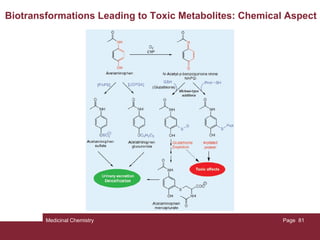
Biotransformations Leading to Toxic Metabolites: Chemical Aspect
As drugs are usually foreign chemicals, history of concern for the biotransformations of drugs
leading to toxic metabolites formation is intrinsically linked to the history of xenobiotic metabolism
studies. The International Society for the Study of Xenobiotics (ISSX) website (http://www.issx.org)
presents an overview of the field history where some key figures may be pointed out.
One is probably Richard Tecwyn Williams who intro- duced the Phase I and II classification of
xenobiotics metab- olism reactions. Although his emblematic book1 was called "Detoxication
mechanisms," he estimated that, in some cases, metabolism may increase toxicity. He also
considered that this "bioactivation" may occur during the Phase II reactions (usually considered as
detoxication reactions), and not only that of Phase I (functionalization reactions).
Quite at the same time, Bernard Brodie studied the antimalarial atabrine (quinacrine) metabolism
in order to avoid the toxic side effects of the drug. He also developed some new analytical
methodologies, necessary for metabolic studies. Then he put together a group of researchers
(including Julius Axelrod, James Gillette and many others) in this field, and they published many
studies of great importance related to drug metabolism, most famous probably concerning
acetaminophen.
Medicinal Chemistry Page 66
Biotransformations Leading to Toxic Metabolites: Chemical Aspect
Among these works, these scientists developed the covalent binding theory
concept, which provides an explanation for the toxic side effects of drugs. Following
the work of James and Elizabeth Miller on covalent binding of polycyclic aromatic hydrocarbon
electrophilic metabolites on DNA in the 1940s, Brodie et al. suggested that in vivo bioactivation may lead
to the formation of electrophilic entities, which are capable of linking with biological macromolecules, thus
inducing disturbances in cellular functions.
The discovery of mixed function oxidases during the 1950s and the
characterization of cytochrome P450 by Omura and Satoi were a "revolution"
in the field of xenobiotic metabolism.
Remmer discovered that cytochrome P450 may be induced by phenobarbital, and Conney characterized
the induction with 3-methyl cholanthrene. These works were of great importance for mechanistic studies
of drug metabolism. A new step was done in 1999 with the first crystallization of a mammalian
cytochrome P450 by Johnson, which provided new perspectives in safer drug design.
Induction of cytochrome P450 synthesis suggests that xenobiotics may exert
an effect on the genome: the use of genomics and proteomics represents a
new challenge for predictive toxicology in drug design.
Medicinal Chemistry Page 67
Biotransformations Leading to Toxic Metabolites: Chemical Aspect
Toxicity is the result of the more or less harmful action of chemicals on a living organism.
Toxicology, the study of toxicity, is situated at the border of chemistry, biology, and in some
cases, physics. Molecular toxicology tries to elucidate the mechanisms by which chemicals
exert their toxic effects. Because many foreign chemicals enter the body in inert but
unexcretable forms, biotransformations are an important aspect of the fate of xenobiotics. In
the case of drugs, metabolic conversions may be required for therapeutic effect ("prodrugs").
In other cases, metabolism results in a loss of the biological activity. Sometimes,
biotransformations produce toxic metabolites. The last process is called toxification or
bioactivation. It should be emphasized that the general principles of pharmacology embrace
the occurrence of toxic events: although biotransformation processes are often referred to as
detoxification, the metabolic products are, in a number of cases, more toxic than the parent
compounds. For drugs, whether biotransformations lead to the formation of toxic metabolites
or to variations in therapeutic effects depends on intrinsic (such as the genetic polymorphism
of some metabolism pathways) and extrinsic (such as the dose, the route or the duration)
factors. The biochemical conversions are usually of an enzymatic nature and yield reactive
intermediates, which may be implicated in the toxicity as far as the final metabolites. The
primary events, which constitute the beginning of the toxic effect may result, after metabolism,
from an inhibition of a specific (and in most cases enzymatic) cellular function, an alkylating
attack or an oxidative stress.
Medicinal Chemistry Page 68
Biotransformations Leading to Toxic Metabolites: Chemical Aspect
With regard to the toxicity arising from metabolites ("indirect
toxicity"), three cases may be distinguished:
A) Biotransformation begins with the transient formation of a reactive intermediate, whose lifetime
is long enough to allow an attack on cellular components. This occurs when a reactive
intermediate (generally radicals or electrophiles such as a carbonium ion) is formed and reacts
rapidly with cellular macromolecules (such as unsaturated lipids, proteins, nucleic acids...), thus
leading to their degradation and finally to cellular necrosis.
B) The first step of the metabolic process yields a primary metabolite, which can, in some cases,
accumulate in the cell and react with cellular components before being transformed.
C) The final metabolites, when in excess, may accumulate and react with cellular macromolecules.
Medicinal Chemistry Page 69
Biotransformations Leading to Toxic Metabolites: Chemical Aspect
Usually, metabolic conversions are divided into two major types of reactions. Phase I
reactions, or functionalization reactions, involve the introduction of a polar functionality such as
a hydroxyl group into the xenobiotic structure. During Phase II reactions, this group is
subsequently coupled (or conjugated) with an endogenous cofactor, which contains a
functional group that is usually ionized at physiological pH. This ionic functional group
facilitates active excretion into the urinary and/or hepatobiliary system. The elimination by
transport mechanism is sometimes also called " Phase III."
Because bioactivation is mainly an activation of xeno- biotics to electrophilic forms, which are
entities capable of reacting irreversibly with tissue nucleophiles, biotransformations leading
to toxic metabolites are in most cases Phase I reactions. But Phase II reactions may also
give rise to toxic phenomena, for example, when conjugation produces a toxic metabolite, or
when it is responsible for a specific target organ toxicity by acting as a delivery form to
particular sites in the body where it is hydrolyzed and exerts a localized effect. Also, the final
toxic metabolite may be formed by combinations of several Phase I and Phase II reactions.
Because of the increasing understanding of drug metabolizing enzymes, some authors claim
that Williams "Phases I and II" classification is now inaccurate and even misleading.
Pointing out the fact that Williams only introduced the classification at the end of his book and
did not use it in his monograph, they consider it would be now wiser to avoid using any special
category.
Medicinal Chemistry Page 70
Biotransformations Leading to Toxic Metabolites: Chemical Aspect
Medicinal Chemistry Page 71
Biotransformations Leading to Toxic Metabolites: Chemical Aspect
Medicinal Chemistry Page 72
Biotransformations Leading to Toxic Metabolites: Chemical Aspect
Medicinal Chemistry Page 73
Biotransformations Leading to Toxic Metabolites: Chemical Aspect
Medicinal Chemistry Page 74
Biotransformations Leading to Toxic Metabolites: Chemical Aspect
Medicinal Chemistry Page 75
Biotransformations Leading to Toxic Metabolites: Chemical Aspect
Medicinal Chemistry Page 76
Biotransformations Leading to Toxic Metabolites: Chemical Aspect
Medicinal Chemistry Page 77
Biotransformations Leading to Toxic Metabolites: Chemical Aspect
Medicinal Chemistry Page 78
Biotransformations Leading to Toxic Metabolites: Chemical Aspect
Medicinal Chemistry Page 79
Biotransformations Leading to Toxic Metabolites: Chemical Aspect
Medicinal Chemistry Page 80
Biotransformations Leading to Toxic Metabolites: Chemical Aspect
Medicinal Chemistry Page 81
Biotransformations Leading to Toxic Metabolites: Chemical Aspect
Medicinal Chemistry Page 82
The first pass effect
Drugs that are taken orally pass directly to the
liver once they enter the blood supply.
Here, they are exposed to drug metabolism
before they are distributed around the rest of the
body, and so a certain percentage of the drug is
transformed before it has the chance to reach its
target.
This is known as the first pass effect.
Drugs that are administered in a different fashion
(e.g. injection or inhalation) avoid the first pass
effect and are distributed around the body before
reaching the liver.
Indeed, a certain proportion of the drug may not
pass through the liver at all, but may be taken up
in other tissues and organs en route.
Besides the hepatic first-pass effect,
biotransformation during absorption can also
occur in the lumen of the intestine and by
enzymes that are present in the gut wall.
Medicinal Chemistry Page 83
Drug excretion
Drugs and their metabolites can be excreted from the body by a number of routes. Volatile
or gaseous drugs are excreted through the lungs. Such drugs pass out of the capillaries that
line the air sacs (alveoli) of the lungs, then diffuse through the cell membranes of the alveoli
into the air sacs, from where they are exhaled. Gaseous general anaesthetics are excreted
in this way and move down a concentration gradient from the blood supply into the lungs.
They are also administered through the lungs, in which case the concentration gradient is in
the opposite direction and the gas moves from the lungs to the blood supply.
The bile duct travels from the liver to the intestines and carries a greenish fluid called bile
which contains bile acids and salts that are important to the digestion process. A small
number of drugs are diverted from the blood supply back into the intestines by this route.
Since this happens from the liver, any drug eliminated in this way has not been distributed
round the body. Therefore, the amount of drug distributed is less than that absorbed.
However, once the drug has entered the intestine, it can be reabsorbed so it has another
chance.
Medicinal Chemistry Page 84
Drug excretion
It is possible for as much as 10-15% of a drug to be lost through the skin in sweat. Drugs can
also be excreted through saliva and breast milk, but these are minor excretion routes
compared with the kidneys. Ihere are concerns, however, that mothers may be pass- ing on
drugs such as nicotine to their baby through breast milk.
The kidneys are the principal route by which drugs and their metabolites are excreted. The
kidneys filter the blood of waste chemicals and these chemicals are subsequently removed in
the urine, Drugs and their metabolites are excreted by the same mechanism.
Blood enters the kidneys by means of the renal artery. This divides into a large number of
capillaries, each one of which forms a knotted structure called a glomerulus that fits into the
opening of a duct called a nephron. The blood entering these glomeruli is under pressure, and
so plasma is forced through the pores in the capillary walls into the nephron, carrying with it
any drugs and metabolites that might be present. Any compounds that are too big to pass
through the pores, such as plasma proteins and red blood cells, remain in the capillaries with
the remaining plasma. Note that this is a filtration process, so it does not matter whether the
drug is polar or hydrophobic; all drugs and drug metabolites will be passed equally efficiently
into the nephron. However, this does not mean that every compound will be excreted equally
efficiently, because there is more to the process than simple filtration.
Medicinal Chemistry Page 85
Drug excretion (facilitated transport)
The filtered plasma and chemicals now pass through the nephron on their route to the bladder.
However, only a small proportion of what starts that journey actually finishes it. This is
because the nephron is surrounded by a rich network of blood vessels carrying the filtered
blood away from the glomerulus, permitting much of the contents of the nephron to be
reabsorbed into the blood supply. Most of the water that was filtered into the nephron is quickly
reabsorbed through pores in the nephron cell membrane which are specific for water
molecules, and bar the passage of ions or other molecules. These pores are made up of
protein molecules called aquaporins. As water is reabsorbed, drugs and other agents are
concentrated in the nephron and a concentration gradient is set up. There is now a driving
force for compounds to move back into the blood supply down the concentration gradient.
However, this can only happen if the drug is sufficiently hydrophobic to pass through the cell
membranes of the nephron. This means that hydrophobic compounds are efficiently
reabsorbed back into the blood, whereas polar compounds are not and are excreted. This
process of excretion explains the importance of drug metabolism to drug excretion. Drug
metabolism makes a drug more polar so that it is less likely to he reabsorbed from the
nephrons.
Some drugs are actively transported from blood vessels into the nephrons. This process is
called facilitated transport, and is important in the excretion of penicillins
Medicinal Chemistry Page 86
Drug excretion

04.pharmacokinetics(1)

  • 1.
  • 2.
    Medicinal Chemistry Page2 INTRODUCTION In order to produce its intended effect, a drug must be present at an appropriate concentration in the fluid surrounding the effect site, that is, the biophase. Only rarely can drugs be applied directly to the biophase; in most cases drugs need to be transferred from the site of administration to the biophase. Usually, this translocation involves two steps: absorption and distribution. During absorption, the drug passes from its site of administration into the systemic circulation. Subsequently, the drug is distributed via the circulating blood plasma (the fluid portion of the blood) to the different parts of the organism, including the organ(s) in which the biophase for the drug is localized. Each drug molecule that reaches the target site can add to the intended pharmacological effect of the drug. However, at all times a portion of the drug molecules in the body is also distributed to organs and tissues that account for an irreversible loss of drug molecules from the body (drug elimination) by either biotransformation (the conversion of one chemical entity to another) or excretion. This causes a decrease in the concentration of the drug in the body and, consequently, also in the biophase.
  • 3.
    Medicinal Chemistry Page3 INTRODUCTION A schematic representation of the processes involved in the journey of a drug molecule through the human body is shown in the left Figure. In the right Figure is shows a more detailed scheme of the main routes of drug absorption, distribution and elimination. Pharmacokinetics is the study of the drug concentrations in the different parts of the organism as a function of time. These concentrations depend on the dose administered and upon the rate and extent of absorption, distribution and elimination.
  • 4.
    Medicinal Chemistry Page4 Pharmacodynamics and Pharmacokinetics Previously, we looked at the molecular targets for drugs and the mechanisms by which drugs interact with these targets. Later, we shall look at how drugs can be designed to optimize binding interactions with their targets. This is an area of medicinal chemistry known as pharmacodynamics. However, the compound with the best binding interactions for a target is not necessarily the best drug to use in medicine. This is because a clinically useful drug has to travel through the body in order to reach its target. There are many barriers and hurdles in its way and, as far as the drug is concerned, it is a long and arduous journey. The study of how a drug reaches it target, and what happens to it during that journey, is known as pharmacokinetics. When carrying out a drug design programme, it is important to study pharmacokinetics alongside pharmacodynamics. There is no point perfecting a compound with superb drug-target interactions if it has no chance of reaching its target. The four main topics to consider in pharmacokinetics are absorption, distribution, metabolism and excretion (often abbreviated to ADME) (and toxicology) → ADMET
  • 5.
    Medicinal Chemistry Page5 PASSAGE OF DRUGS THROUGH BIOLOGICAL BARRIERS On its journey through the body, a drug needs to cross different biological barriers. These barriers can be a single layer of cells (e.g. the intestinal epithelium), several layers of cells (e.g. in the skin), or the cell membrane itself (e.g. to reach an intracellular receptor). A drug can cross a cell layer either by traveling through the cells (transcellular drug transport) or through gaps between the cells (paracellular drug transport). Transcellular drug transport In order to travel through a cell or to reach a target inside a cell, a drug molecule must be able to traverse the cell membrane. The cell membrane (also called plasma membrane) is a lipid bilayer interspersed with carbohydrates and proteins. Although cell membranes largely vary in their permeability characteristics depending on the tissue, the main mechanisms of drugs passing through the cell membrane are passive diffusion, carrier-mediated processes and vesicular transport.
  • 6.
    Medicinal Chemistry Page6 Passive diffusion Passive diffusion is the process by which molecules spontaneously diffuse from a region of higher concentration (e.g. outside of the cell) to a region of lower concentra- tion (e.g. inside the cell), and it is the main mechanism for passage of drugs through membranes. Lipid-soluble drugs penetrate the lipid cell membrane with ease, and can pass the cell membrane by passive diffusion. Polar molecules and ionized compounds, on the other hand, partition poorly into lipids and are not able to diffuse through the cell membrane or do so at a much lower rate. Also, large molecules, such as proteins and protein-bound drugs, cannot diffuse through the cell membrane. Transmembrane diffusion is driven by the concentration gradient of the drug over the cell membrane. The rate of diffusion depends, apart from the lipid/water partition coefficient of the drug (P) and the concentration gradient (C_out - C_in), on membrane properties such as the membrane area (A) and thickness (h), and the diffusion coefficient (D) of the drug in the membrane, according to Fick's law:
  • 7.
    Medicinal Chemistry Page7 Passive diffusion Many drugs are acidic or basic compounds, which are ionized to a certain degree in aqueous medium. Their degree of ionization depends on their dissociation constant (pka) and the pH of the solution, according to the Henderson-Hasselbach equation: Very weak acids with pKa values higher than 7.5, are essentially unionized at physiological pH values. For these drugs diffusion over the cell membrane is rapid and independent of pH changes within the body, provided the unionized form of the drug is lipid soluble. For acidic drugs with a pKa value between 3.0 and 7.5, the fraction of unionized drug varies with the changes in pH encountered in the organism. For these drugs the pH of the extracellular environment is critical in determining the diffusion across the cell membrane. For acidic drugs with a pKa lower than 2.5, the fraction of unionized drug is low at any physiological pH, resulting in very slow diffusion across membranes. A similar analysis can be made for bases. At the diffusion equilibrium, the concentrations of unionized molecules on both sides of a biological barrier are equal. If the pH on both sides of the barrier is equal, then the concentration of ionized molecules and, consequently, the total concentration of the molecules, will be the same on both sides of the barrier. However, if there is a difference in pH, as e.g. between blood plasma (pH 7.4) and stomach contents (pH 1- 3), the concentration of the ionized molecules at equilibrium, and, therefore, the total concentration, will be much higher on one side of the barrier than on the other. This phenomenon is called ion trapping.
  • 8.
    Medicinal Chemistry Page8 Carrier-mediated processes Many cell membranes possess specialized transport mechanisms that regulate entry and exit of physiologically important molecules and drugs. Such transport systems involve a carrier molecule, that is, a transmembrane protein that binds one or more molecules and releases them on the other side of the membrane. Such systems may operate passively (without any energy source) and along a concentration gradient; this is called "facilitated diffusion." However, facilitated diffusion seems to play only a minor role in drug transport. An example is the transport of vitamin B12 across the GI membrane. Alternatively, the system may spend energy (obtained from the energy rich molecule adenosine triphosphate (ATP) required to pump molecules against a concentration gradient; this mechanism is called "active transport." At high drug concentrations the carrier sites become saturated, and the rate of transport does not further increase with concentration. Furthermore, competitive inhibition of transport can occur if another substrate for this carrier is present. In recent years, several transporters have been described to be present in various organs and tissues throughout the body and to determine absorption, distribution and elimination of compounds that are substrates for these transporters. Although some transporters mediate the uptake of compounds in the cell (influx transporters), others may mediate secretion back out of the cell (efflux transporters). Transporters in the intestinal membrane affect the absorption of drugs, while transporters in the liver and kidney influence elimination by mediating transport into and out of cells responsible for biotransformation (hepatocytes) or excretion (e.g. renal tubule cells in the kidneys). Furthermore, efflux transporters may limit the penetration of compounds into certain areas of the body, such as the cerebrospinal fluid and blood cells.
  • 9.
    Medicinal Chemistry Page9 Vesicular transport During vesicular transport the cell membrane forms a small cavity that gradually surrounds particles or macromolecules, thereby internalizing them into the cell in the form of a vesicle or vacuole. Vesicular transport is the proposed process for the absorption of orally administered Sabin polio vaccine and of various large proteins. It is called endocytosis when moving a macromolecule into a cell, exocytosis when moving a macromolecule out of a cell, and transcytosis when moving a macromolecule across a cell. Paracellular drug transport Drugs can also cross a cell layer through the small aqueous contact points (cell junctions) between cells. This paracellular drug transport can be initiated by a concentration gradient over the cell layer (passive diffusion), or by a hydrostatic pressure gradient across the cell layer (filtration). The size and characteristics of cell junctions widely vary between different barriers to drug transport. For example, the endothelium of glomerular capillaries in the kidney forms a leaky barrier, which is very rich in intercellular pores. Therefore, this membrane is very permeable and permits filtration of water and solutes. On the other hand, endothelial cells of brain capillaries are sealed together by tight junctions, practically eliminating the possibility of paracellular drug transport.
  • 10.
    Medicinal Chemistry Page10 Drug absorption Absorption can be defined as the passage of a drug from its site of administration into the systemic circulation. If a drug is administered directly into the systemic circulation by intravenous (i.v.) administration, absorption is not needed. Drugs can be administered by enteral and parenteral routes. Enteral administration occurs through the GI tract, by contact of the drug with the mucosa in the mouth (buccal or sublingual), by swallowing (oral) or by rectal administration. In parenteral administration the GI tract is bypassed; examples are the i.v. (direct injection in the systemic circulation) and intramuscular (injection into a muscle) routes. Drugs can also be absorbed through the skin or through the mucosa of various organs (e.g. bronchi, nose, and vagina). In some cases, a drug is applied for a local effect, and no absorption is intended (e.g. antacids that neutralize stomach acid). In this chapter, we will describe drug administration by the oral route, which is the most common and popular route of drug dosing.
  • 11.
    Medicinal Chemistry Page11 Common Routes of Drug Administration
  • 12.
    Medicinal Chemistry Page12 Common Routes of Drug Administration
  • 13.
    Medicinal Chemistry Page13 Common Routes of Drug Administration
  • 14.
    Medicinal Chemistry Page14 Drug absorption Drug absorption refers to the route or method by which a drug reaches the blood supply. This in turn depends on how the drug is administered. The most common and preferred method of administering drugs is the oral route and so we shall first concentrate on the various barriers and problems associated with oral delivery. An orally taken drug enters the gastrointestinal tract (GIT), which comprises the mouth, throat, stomach, and the upper and lower intestines. A certain amount of the drug may be absorbed through the mucosal membranes of the mouth, but most passes down into the stomach where it encounters gastric juices and hydrochloric acid. These chemicals aid in the digestion of food and will treat drugs in a similar fashion if the drug is susceptible to breakdown. For example, the first penicillin used clinically was broken down in the stomach and had to be administered by injection. Other acid-labile drugs, such as local anaesthetics or insulin, cannot be given orally.
  • 15.
    Medicinal Chemistry Page15 Drug absorption If the drug does survive the stomach, it enters the upper intestine where it encounters digestive enzymes that serve to break down food. Assuming the drug survives this attack, it then has to pass through the cells lining the intestinal or gut wall. This means that the drug has to pass through a cell membrane on two occasions, first to enter the cell and then to exit it on the other side. Once the drug has passed through the cells of the gut wall, it can enter the blood supply relatively easily as the cells lining the blood vessels have pores between them through which most drugs can pass. In other words, drugs enter the blood vessels by passing between cells rather than through them. The drug is now transported in the blood to the body's 'customs office': the liver. The liver contains enzymes which are ready and waiting to intercept foreign chemicals, and modify them such that they are more easily excreted: a process called drug metabolism.
  • 16.
    Medicinal Chemistry Page16 Drug absorption It can be seen that stringent demands are made on any orally taken drug. The drug must be chemically stable to survive the stomach acids, and metabolically stable to survive the digestive enzymes in the GIT as well as the metabolic enzymes in the liver. It must also have the correct balance of water versus fat solubility. If the drug is too polar (hydrophilic), it will fail to pass through the fatty cell membranes of the gut wall. On the other hand, if the drug is too fatty (hydrophobic), it will be poorly soluble in the gut and will dissolve in fat globules. This means that there will be poor surface contact with the gut wall, resulting in poor absorption.
  • 17.
    Medicinal Chemistry Page17 Drug absorption It is noticeable how many drugs contain an amine functional group. There are good reasons for this. Amines are often involved in a drug's binding interactions with its target. However, they are also an answer to the problem of balancing the dual requirements of water and fat solubility. Amines are weak bases, and it is found that many of the most effective drugs are amines having a pKa value in the range 6-8. In other words, they are partially ionized at blood pH (~7.4) and can easily equilibrate between their ionized and non-ionized forms. This allows them to cross cell membranes in the non-ionized form, while the presence of the ionized form gives the drug good water solubility and permits good binding interactions with its target binding site.
  • 18.
    Medicinal Chemistry Page18 Henderson-Hasselbalch equation The extent of ionization at a particular pH can be determined by the Henderson-Hasselbalch equation: where [RNH2] is the concentration of the free base and [RNH3+] is the concentration of the ionized amine. Ka is the equilibrium constant for the equilibrium shown, and the Henderson-Hasselbalch equation can be derived from the equilibrium constant. Note that when the concentration of the ionized and unionized amines are identical (i.e. when [RNH2 = [RNH3+]), the ratio ([RNH2/[RNH3+]) is 1. Since log 1 = 0, the Henderson-Hasselbalch equation will simplify to pH = pKa. In other words, when the amine is 50% ionized, pH = pKa. Therefore, drugs with a pKa of 6-8 are approximately 50% ionized at blood pH (7.4).
  • 19.
    Medicinal Chemistry Page19 Lipinski's rule of five The hydrophilic-hydrophobic character of the drug is the crucial factor affecting absorption through the gut wall, and the molecular weight of the drug should in theory be irrelevant. For example, cidosporin is successfully absorbed through cell membranes, although it has a molecular weight of about 1200. In practice, however, larger molecules tend to be poorly absorbed, because they are likely to contain a large number of polar functional groups. As a rule of thumb, orally absorbed drugs tend to obey what is known as Lipinski's rule of five. The rule of five was derived from an analysis of compounds from the World Drugs Index database, aimed at identifying features that were important in making a drug orally active. It was found that the factors concerned involved numbers that are multiples of 5: • a molecular weight less than 500 • no more than 5 hydrogen bond donor groups • no more than 10 hydrogen bond acceptor groups • a calculated log P value less than + 5 (log P is a measure of a drug's hydrophobicity)
  • 20.
    Medicinal Chemistry Page20 Lipinski's rule of five failures The rule of five has been an extremely useful rule of thumb for many years, but it is neither quantitative nor foolproof. For example, orally active drugs such as atorvastatin, rosuvastatin, cidosporin and vinorelbine do not obey the rule of five. It has also been demonstrated that a high molecular weight does not in itself cause poor oral bioavailability. One of the reasons that the molecular weight appears to be important is that larger molecules invariably have too many functional groups capable of forming hydrogen bonds. Therefore, further research has been carried out to find guidelines that are independent of molecular weight.
  • 21.
    Medicinal Chemistry Page21 Other rules Work carried out by Veber et al. in 2002, demonstrated the rather surprising finding that molecular flexibility (as measured by the number of freely rotatable bonds present in the structure) plays an important role in oral bioavailability. The more flexible the molecule, the less likely it is to be orally active. Less surprisingly, the analysis showed that the polar surface area of the molecule could be used as a factor instead of the number of hydrogen bonding groups. These findings led to the following parameters for acceptable oral activity. Either: • a polar surface area ≤ 140 Å and ≤ 10 rotatable bonds or • ≤ 12 hydrogen bond donors and acceptors in total and ≤ 10 rotatable bonds, Some researchers set the limit of rotatable bonds to ≤ 7 since the analysis shows a marked improvement in oral bioavailability for such molecules.
  • 22.
    Medicinal Chemistry Page22 Other rules These rules are independent of molecular weight and open the way to studying larger structures that have been 'shelved' up to now. Unfortunately, structures having a molecular weight larger than 500 are quite likely to have more than 10 rotatable bonds. However, the new rules suggest that rigidifying the structures to reduce the number of rotatable bonds would be beneficial. Rigidification tactics will be described as a strategy to improve a drug's pharmacodynamic properties, but these same tactics could also be used to improve pharmacokinetic properties. Polar drugs that break the above rules are usually poorly absorbed and have to be administered by injection. Nevertheless, some highly polar drugs can be absorbed from the digestive system. For example, there are polar drugs that can 'hijack' specific transport proteins in the cell membrane. Transport proteins are essential to a cells survival, as they transport the highly polar building blocks required for various biosynthetic pathways. If the drug bears a structural resemblance to one of these building blocks, then it too may be smuggled into the cell. For example, levodopa is transported by the transport protein for the amino acid phenylalanine, and fluorouracil is transported by transport proteins for the nucleic acid bases thymine and uracil. The antihypertensive agent lisinopril is transported by transport proteins for dipeptides, and the anticancer agent methotrexate and the antibiotic erythromycin are also absorbed by means of transport proteins.
  • 23.
    Medicinal Chemistry Page23 Drug absorption of polar drugs Other highly polar drugs can be absorbed into the blood supply if they have a low molecular weight (less than 200), as they can then pass through small pores between the cells lining the gut wall. Occasionally, polar drugs with high molecular weight can cross the cells of the gut wall without actually passing through the membrane. This involves a process known as pinocytosis where the drug is engulfed by the cell membrane and a membrane-bound vesicle is pinched off to carry the drug across the cell. The vesicle then fuses with the membrane to release the drug on the other side of the cell. Sometimes, drugs are deliberately designed to be highly polar so that they are not absorbed from the GIT. These are usually antibacterial agents targeted against gut infections. Making them highly polar ensures that the drug reaches the site of infection in higher concentration.
  • 24.
    Medicinal Chemistry Page24 Key Points on Drug Absorption • Pharmacodynamics is the study of how drugs interact with a molecular target, whereas pharmacokinetics is the study of how a drug reaches its target in the body and how it is affected on that journey. • The four main issues in pharmacokinetics are absorption, distribution, metabolism, and excretion. • Orally taken drugs have to be chemically stable to survive the acidic conditions of the stomach, and metabolically stable to survive digestive and metabolic enzymes. • Orally taken drugs must be sufficiently polar to dissolve in the git and blood supply, but sufficiently fatty to pass through cell membranes. • Most orally taken drugs obey Lipinski's rule of five and have no more than seven rotatable bonds. • Highly polar drugs can be orally active if they are small enough to pass between the cells of the gut wall, are recognized by carrier proteins, or are taken across the gut wall by pinocytosis. • Distribution round the blood supply is rapid. Distribution to the interstitial fluid surrounding tissues and organs is rapid if the drug Is not bound to plasma proteins. • Some drugs have to enter cells in order to reach their target. • A certain oercentage of a drug may be absorbed into fatty tissue and/or bound to macromolecules. • Drugs entering the CNS have to cross the blood-brain barrier. Polar drugs are unable to cross this barrier unless they make use of carrier proteins or are taken across by pinocytosis. • Some drugs cross the placental barrier into the fetus and may harm development or prove toxic in newborn babies
  • 25.
    Medicinal Chemistry Page25 Drug Metabolism When drugs enter the body, they are subject to attack from a range of metabolic enzymes. The role of these enzymes is to degrade or modify the foreign structure, such that it can be more easily excreted. As a result, most drugs undergo some form of metabolic reaction resulting in structures known as metabolites. Very often these metabolites lose the activity of the original drug, but in some cases they may retain a certain level of activity. Some metabolites may possess a different activity from the parent drugs, resulting in side effects or toxicity. A knowledge of drug metabolism and its possible consequences can aid the medicinal chemist in designing new drugs which do not form unacceptable metabolites. Equally, it is possible to take advantage of drug metabolism to activate drugs in the body. This is known as a prodrug strategy. It is now a requirement to identify all the metabolites of a new drug before it can be approved. The structure and stereochemistry of each metabolite has to be determined and the metabolite must be tested for biological activity.
  • 26.
    Medicinal Chemistry Page26 Biotransformation As was described above, most drugs need to pass through biological membranes to reach their site of action. Therefore, most drugs have lipophilic characteristics and are only partially ionized at the pH values encountered in the organism. These characteristics also favor reabsorption from the renal tubules after glomerular filtration. As a consequence, renal excretion often plays only a modest role in the total elimination of therapeutic agents from the body. For these compounds, biotransformation into metabolites that are more hydrophilic in nature is essential, because it allows their excretion by the kidneys. Biotransformation reactions take place mainly in the liver (hepatic biotransformation), but can also occur in intestinal mucosa, lungs, kidneys, skin, placenta and plasma. Within a given cell, most of the biotransformation enzymes are found in the endoplasmic reticulum (a network of folded membranes inside the cell) and the cytosol (the fluid inside the cell). When liver tissue (or any other tissue) is homogenized and differential centrifugation is applied, the endoplasmic reticulum of the cells breaks up. Fragments of the endoplasmic reticulum then form microvesicles, called microsomes . Therefore, the biotransformation enzymes in the endoplasmic reticulum are often referred to as microsomal enzymes.
  • 27.
    Medicinal Chemistry Page27 Biotransformation For hepatic biotransformation to occur, a drug must enter the hepatocytes that contain the biotransformation enzymes. Polar molecules do this more slowly than non-polar molecules, except where specific transport mecha- nisms exist. As a consequence, hepatic metabolism is, in general, more important for lipid-soluble drugs than for polar drugs. Renal excretion and biotransformation can therefore be regarded as two additional and synergistic elimination pathways, guaranteeing an efficient elimination of a whole range of hydrophilic as well as lipophilic substances from the body. Biotransformation usually inactivates a drug, but in some cases metabolites with biologi- cal activity or toxic properties are formed. For some drugs, the activity may reside wholly in one or more metabolites: drugs that only become active after biotransformation are termed "prodrugs." Prodrugs are sometimes developed to improve absorption, often because of better lipid solubility than the active metabolite. After absorption, these prodrugs are rapidly converted to the active metabolite in the gut wall or in the liver. An example is pivampicillin, an ester of ampicillin, which is rapidly and completely hydrolyzed to ampicillin during absorption.
  • 28.
    Medicinal Chemistry Page28 Biotransformation Two phases can be distinguished in the pathways of biotransformation. Phase I involves addition of functionally reactive groups by oxidation, reduction or hydrolysis. These products are sometimes more chemically reactive, and therefore more toxic than the parent drug. The Cytochrome P450 (CYP) enzyme family is involved in most (but not all) Phase I reactions. It comprises a large group of enzymes localized in the endoplasmic reticulum of numerous tissues. The CYP-enzymes are grouped in families denoted by an arabic numeral (e.g. the CYP3 fam- ily), within which the amino acid sequence homology is higher than 40%. Each P450 family is further divided into subfamilies denoted by a capital letter (e.g. the CYP3A subfamily), with greater than 55% amino acid sequence homology. Finally, another arabic numeral represents the individual enzyme (e.g. CYP3A4). The main CYP enzymes involved in drug metabolism are: CYP1A2, CYP2A6, CYP2C9, CYP2C19, CYP2D6, CYP2E1 and CYP3A4. CYP3A4 accounts for 30% of total P450 enzyme in the liver and is clinically the most important isoenzyme present in the liver. Nearly 50% of all clinically used medications are metabolized by CYP3A4. Phase II biotransformation consists of conjugation of reactive groups, present either in the parent molecule or after Phase I transformation. Phase II conjugates are usually pharmacologically inactive; they are more hydrophilic than the parent compounds and are easily excreted by the kidneys or the bile. Phase I and Phase II reactions often, though not invariably, occur sequentially.
  • 29.
    Medicinal Chemistry Page29 Biotransformation The metabolism of drugs and other xenobiotics is often a biphasic process in which the compound may first undergo a functionalization reaction (phase I reaction) of oxidation, reduction or hydrolysis. This introduces or unveils a functional group such as a hydroxyl or amino group suitable for coupling with an endogenous molecule or moiety in a second metabolic step known as a conjugation reaction (phase II reaction). In a number of cases, phase I metabolites may be excreted prior to conjugation, while many xenobiotics can be directly conjugated. Furthermore, reactions of functionalization may follow some reactions of conjugation, e.g. some conjugates are hydrolyzed and/or oxidized prior to their excretion. The major function of xenobiotic metabolism is the elimination of physiologically useless compounds, some of which may be harmful; witness the many toxins produced by plants. This evolutionary function justifies the designation of detoxification originally given to reactions of xenobiotic metabolism. However, numerous xenobiotics and even a marked number of drugs are known to yields toxic metabolites, a situation known as toxification.
  • 30.
    Medicinal Chemistry Page30 Biotransformation In pharmacological terms, a drug may or may not have active metabolites. The former case is rather frequent, especially with phase I metabolites. Drugs that do not yield any active metabolite are, for example, the soft drugs. The reverse case is that of prodrugs, namely, inactive therapeutic agents whose clinical activity is due to an active metabolite. As an example of a metabolic scheme, Figure presents the biotransformation of propranolol (1) in humans. There are relatively few studies as comprehensive and clinically relevant as this one, which remains as current today as it was when published in 1985. Indeed, over 90% of a dose was accounted for and consisted mainly in products of oxidation and conjugation. The missing 10% may represent other minor and presumably quite numerous metabolites, e.g. those resulting from ring hydroxylation at other positions or from the progressive breakdown of glutathione (GSH) conjugates.
  • 31.
    Medicinal Chemistry Page31 Phase I Reactions Drugs are foreign substances as far as the body is concerned, and the body has its own method of getting rid of such chemical invaders. If the drug is polar, it will be quickly excreted by the kidneys. However, non-polar drugs are not easily excreted and the purpose of drug metabolism is to convert such compounds into more polar molecules that can be easily excreted. Non-specific enzymes (particularly cytochrome P450 enzymes in the liver) are able to add polar functional groups to a wide variety of drugs. Once the polar functional group has been added, the overall drug is more polar and water soluble, and is more likely to be excreted when it passes through the kidneys. An alternative set of enzymatic reactions can reveal masked polar functional groups which might already be present in a drug. For example, there are enzymes which can demethylate a methyl ether to reveal a more polar hydroxyl group. Once again, the more polar product (metabolite) is excreted more efficiently. These reactions are classed as phase I reactions and generally involve oxidation, reduction, and hydrolysis. Most of these reactions occur in the liver but some (such as the hydrolysis of esters and amides) can also occur in the gut wall, blood plasma, and other tissues.
  • 32.
    Medicinal Chemistry Page32 Phase I Reactions Some of the structures most prone to oxidation are N-methyl groups, aromatic rings, the terminal positions of alkyl chains, and the least hindered positions of alicyclic rings. Nitro, azo, and carbonyl groups are prone to reduction by reductases, while amides and esters are prone to hydrolysis by esterases. For some drugs, two or more metabolic reactions might occur, resulting in different metabolites; other drugs may not be metabolized at all. A knowledge of the metabolic reactions that are possible for different functional, groups allows the medicinal chemist to predict the likely metabolic products for any given drug, but only drug metabolism studies will establish whether these metabolites are really formed. Drug metabolism has important implications when it comes to using chiral drugs, especially if the drug is to be used as a racemate. The enzymes involved in catalysing metabolic reactions will often distinguish between the two enantiomers of a chiral drug, such that one enantiomer undergoes different metabolic reactions from the other. As a result, both enantiomers of a chiral drug have to be tested separately to see what metabolites are formed. In practice, it is usually preferable to use a single enantiomer in medicine, or design the drug such that it is not asymmetric.
  • 33.
    Medicinal Chemistry Page33 Phase I Reactions
  • 34.
    Medicinal Chemistry Page34 Phase II Reactions A series of metabolic reactions classed as phase II reactions also occur, mainly in the liver. Most of these reactions are conjugation reactions, whereby a polar molecule is attached to a suitable polar 'handle' that is already present on the drug or has been introduced by a phase I reaction. The resulting conjugate has greatly increased polarity, thus increasing its excretion rate in urine or bile even further. Both phase I and phase II reactions can be species specific, which has implications for in vivo metabolic studies. In other words, the metabolites formed in an experimental animal may not necessarily be those formed in humans. A good knowledge of how metabolic reactions differ from species to species is important in determining which test animals are relevant for drug metabolism tests. Both sets of reactions can also be regioselective and stereoselective. This means that metabolic enzymes can distinguish between identical functional groups or alkyl groups located at different parts of the molecule (regioselectivity) as well as between different stereoisomers of chiral molecules (stereoselectivity).
  • 35.
    Medicinal Chemistry Page35 Phase II Reactions
  • 36.
    Medicinal Chemistry Page36 Phase II Reactions
  • 37.
    Medicinal Chemistry Page37 Phase I transformations catalysed by cytochrome P450 enzymes The enzymes that constitute the cytochrome P450 family are the most important metabolic enzymes and are located in liver cells. They are haemoproteins (containing haem and iron) and they catalyse a reaction that splits molecular oxygen, such that one of the oxygen atoms is introduced into the drug and the other ends up in water. As a result they belong to a general class of enzymes called the monooxygenases. There are at least 33 different cytochrome P450 enzymes, grouped into four main families CYP1-CYP4. Within each family there are various subfamilies designated by a letter, and each enzyme within that subfamily is designated by a number. For example, CYP3A4 is enzyme 4 in the subfamily A of the main family 3. Most drugs in current use are metabolized by five primary CYP enzymes (CYP3A, CYP2D6, CYP2C9, CYP1A2 and CYP2E1). The isozyme CYP3A4 is particularly important in drug metabolism, and is responsible for the metabolism of most drugs.
  • 38.
    Medicinal Chemistry Page38 Phase I transformations catalysed by cytochrome P450 enzymes Cytochrome P450 is the major drug-metabolizing enzyme system, playing a key role in detoxification and toxification and is of additional significance in medicinal chemistry because several CYP enzymes are drug targets, e.g. thromboxane synthase (CYP5A1) and aromatase (CYP19A1). The CYPs are encoded by the CYP gene superfamily and are classified in families and subfamilies. A total of 57 human CYP genes are known to date. The three CYP families mostly involved in xenobiotic metabolism are CYP1-CYP3. The endobiotic-metabolizing CYPs are in families 4, 5, 7, 8, 11, 17, 19-21, 24, 26, 27, 39, 46 and 51.
  • 39.
    Medicinal Chemistry Page39 Phase I transformations catalysed by cytochrome P450 enzymes
  • 40.
    Medicinal Chemistry Page40 Phase I transformations catalysed by cytochrome P450 enzymes An understanding of the regiospecificity and broad reactivity of cytochrome P450 requires a presentation of its catalytic cycle. The enzyme in its ferric (oxidized) form exists in equilibrium between two spin states, a hexacoordinated low-spin form whose reduction requires a high-energy level, and a pentacoordinated high-spin form. Binding of the substrate to enzyme induces a shift to the reducible high-spin form (reaction a). The first electron then enters the enzyme-substrate complex (reaction b), reducing the enzyme to its ferrous form, which has a high affinity for diatomic gases such as CO (a strong inhibitor of cyto- chrome P450) and dioxygen (reaction c). The cycle continues with a second electron entering via either FP1 or FP2 and reducing the ternary complex (reaction d). Electron transfer within the ternary complex generates bound peroxide anion (O2 2-) . The bound peroxide anion is split by the addition of two protons, liberating H2O (reaction e). The remaining oxygen atom is equivalent to an oxene species, a neutral electrophilic species having only six electrons in its outer shell, stabilized by electron density from the iron. This is the reactive form of oxygen that will attack the substrate. The binary enzyme-product complex dissociates, thereby regenerating the initial state of cytochrome P450 (reaction f).
  • 41.
    Medicinal Chemistry Page41 Phase I transformations catalysed by cytochrome P450 enzymes
  • 42.
    Medicinal Chemistry Page42 Phase I transformations catalysed by cytochrome P450 enzymes The reactions catalysed by cytochrome P450 enzymes can involve the oxidation of carbon, nitrogen, phosphorus, sulfur, and other atoms. Oxidation of carbon atoms can occur if the carbon atom is either exposed (i.e. easily accessible to the enzyme) or activated. For example, methyl substituents on the carbon skeleton of a drug are often easily accessible and are oxidized to form alcohols, which may be oxidized further to carboxylic acids. In the case of longer-chain substituents, the terminal carbon and the penultimate carbon are the most exposed carbons in the chain and are both susceptible to oxidation. If an aliphatic ring is present, the most exposed region is the part most likely to be oxidized. Activated carbon atoms next to an sp2 carbon centre (i.e. allylic or benzylic positions) or an sp carbon centre (i.e. a propynylic position) are more likely to be oxidized than exposed carbon atoms. Carbon atoms which are alpha to a heteroatom are also activated and prone to oxidation. In this case, hydroxylation results in an unstable metabolite that is immediately hydrolysed resulting in the dealkylation of amines, ethers, and thioethers or the dehalogenation of alkyl halides. The aldehydes which are formed from these reactions generally undergo further oxidation to carboxylic acids by aldehyde dehydrogenases. Tertiary amines are found to be more reactive to oxidative dealkylation than secondary amines because of their greater basicity, while O-demethylation of aromatic ethers is faster than O- dealkylation of larger alkyl groups. O-Demethylation is important to the analgesic activity of codeine.
  • 43.
    Medicinal Chemistry Page43 Phase I transformations catalysed by cytochrome P450 enzymes
  • 44.
    Medicinal Chemistry Page44 Phase I transformations catalysed by cytochrome P450 enzymes Cytochrome P450 enzymes can catalyse the oxidation of unsaturated sp2 and sp carbon centres present in alkenes, alkynes, and aromatic rings. In the case of alkenes, a reactive epoxide is formed which is deactivated by the enzyme epoxide hydrolase to form a diol. In some cases, the epoxide may evade the enzyme. If this happens, it can act as an alkylating agent and react with nucleophilic groups present in proteins or nucleic acids, leading to toxicity. The oxidation of an aromatic ring results in a similarly reactive epoxide intermediate which can have several possible fates. It may undergo a rearrangement reaction involving a hydride transfer to form a phenol, normally at the para position. Alternatively, it may be deactivated by epoxide hydrolase to form a diol or react with glutathione S-transferase to form a conjugate. If the epoxide intermediate evades these enzymes, it may act as an alkylating agent and prove toxic. Electron-rich aromatic rings are likely to be epoxidized more quickly than those with electron- withdrawing substituents, and this has consequences for drug design
  • 45.
    Medicinal Chemistry Page45 Phase I transformations catalysed by cytochrome P450 enzymes
  • 46.
    Medicinal Chemistry Page46 Phase I transformations catalysed by cytochrome P450 enzymes
  • 47.
    Medicinal Chemistry Page47 Phase I transformations catalysed by cytochrome P450 enzymes Tertiary amines are oxidized to N-oxides as long as the alkyl groups are not sterically demanding. Primary and secondary amines are also oxidized to N-oxides, but these are rapidly converted to hydroxylamines and beyond. Aromatic primary amines are also oxidized in stages to aromatic nitro groups: a process which is related to the toxicity of aromatic amines since highly electrophilic intermediates are formed which can alkylate proteins or nucleic acids. Aromatic primary amines can also be methylated in a phase II reaction to a secondary amine which can then undergo phase I oxidation to produce formaldehyde and primary hydroxylamines. Primary and secondary amides can be oxidized to hydroxylamides. These functional groups have also been linked with toxicity and carcinogenicity. Thiols can be oxidized to disulfides. There is evidence that thiols can be methylated to methyl sulfides, which are then oxidized to sulfides and sulfones.
  • 48.
    Medicinal Chemistry Page48 Phase I transformations catalysed by flavin-containing monooxygenases Another group of metabolic enzymes present in the endoplasmic reticulum of liver cells is the flavin-containing monooxygenases. These enzymes are chiefly responsible for etabolic reactions involving oxidation at nucleophilic nitrogen, sulfur, and phosphorus atoms rather than at carbon atoms. Many of these reactions are also catalysed by cytochrome P450 enzymes.
  • 49.
    Medicinal Chemistry Page49 Phase I transformations catalysed by other enzymes There are several oxidative enzymes in various tissues around the body that are involved in the metabolism of endogenous compounds, but can also play a role in drug metabolism. For example, monoamine oxidases are involved in the deamination of catecholamines, but have been observed to oxidize some drugs. Other important oxidative enzymes include alcohol dehydrogenases and aldehyde dehydrogenases. The aldehydes formed by the action of alcohol dehydrogenases on primary alcohols are usually not observed, as they are con- verted to carboxylic acids by aldehyde dehydrogenases.
  • 50.
    Medicinal Chemistry Page50 Phase I transformations catalysed by other enzymes Reductive phase I reactions are less common than oxidative reactions, but reductions of aldehyde, ketone, azo, and nilro functional groups have been observed in specific drugs. Many of the oxidation reactions described for heteroatoms are reversible, and are catalysed by reductase enzymes. Cytochrome P450 enzymes are involved in catalysing some of these reactions. Remember that enzymes can catalyse a reaction in bodi directions, depending on the nature of the substrate, and so although cytochrome P450 enzymes are predominantly oxidative enzymes, it is possible for them to catalyse some reductions.
  • 51.
    Medicinal Chemistry Page51 Phase I transformations catalysed by other enzymes The hydrolysis of esters and amides is a common metabolic reaction, catalysed by esterases and peptidases respectively. These enzymes are present in various organs of the body including the liver. Amides tend to be hydrolysed more slowly than esters, The presence of electron- withdrawing groups can increase the susceptibility of both amides and esters to hydrolysis.
  • 52.
    Medicinal Chemistry Page52 Phase II transformations Most phase II reactions are conjugation reactions catalysed by transferase enzymes, the resulting conjugates are usually inactive, but there are exceptions to this rule. Glucuronic acid conjugation is the most common of these reactions. Phenols, alcohols, hydroxylamines and carboxylic acids form O-glucuronides by reaction with UDFP-glucuronate such that a highly polar glucuronic acid molecule is attached to the drug. The resulting conjugate is excreted in the urine, but may also be excreted in the bile if the molecular weight is over 300.
  • 53.
    Medicinal Chemistry Page53 Phase II transformations A variety of other functional groups such as sulfonamides, amides, amines, and thiols can react to form N- or S-glucuronides. C-Glucuronides are also possible in situations where there is an activated carbon centre next to carbonyl groups.
  • 54.
    Medicinal Chemistry Page54 Phase II transformations Another form of conjugation is sulfate conjugation. This is less common than glucuronation and is restricted mainly to phenols, alcohols, arylamines, and N- hydroxy compounds. The reaction is catalysed by sulfotransferases using the cofactor 3'-phosphoadenosine 5'-phosphosulfate as the sulfate source. Primary amines, secondary amines, secondary alcohols, and phenols form stable conjugates, whereas primary alcohols form reactive sulfates which can act as toxic alkylating agents. Aromatic hydroxylamines and hydroxylamides also form unstable sulfate conjugates that can be toxic.
  • 55.
    Medicinal Chemistry Page55 Phase II transformations Drugs bearing a carboxylic acid group can become conjugated to amino acids by the formation of a peptide link. In most animals, glycine conjugates are generally formed, but L-glutamine is the most common amino acid used for conjugation in primates. The carboxylic acid present in the drug is first activated by formation of a coenzyme A thioester which is then linked to the amino acid.
  • 56.
    Medicinal Chemistry Page56 Phase II transformations Electrophilic functional groups such as epoxides, alkyl halides, sulfonates, disulfides, and radical species can react with the nucleophilic thiol group of the tripeptide glutathione to give glutathione conjugates which can be subsequently transformed to mercapturic acids.
  • 57.
    Medicinal Chemistry Page57 Phase II transformations The glutathione conjugation reaction can take place in most cells, especially those in the liver and kidney, and is catalysed by glutathione transferase. This conjugation reaction is important in detoxifying potentially dangerous environmental toxins or electrophilic alkylating agents formed by phase I reactions. Glutathione conjugates are often excreted in the bile but are more usually converted to mercapturic acid conjugates before excretion.
  • 58.
    Medicinal Chemistry Page58 Phase II transformations Not all phase II reactions result in increased polarity. Methylation and acetylation are important phase II reactions which usually decrease the polarity of the drug. An important exception is the methylation of pyridine rings, which leads to polar quaternary salts. The functional groups that are susceptible to methylation are phenols, amines, and thiols. Primary amines are also susceptible to acetylation. The enzyme cofactors involved in contributing the methyl group or acetyl group are S- adenosyl methionine and acetyl SCoA respectively, Several methyl transferase enzymes are involved in the methylation reactions. The most important enzyme for O-methylations is catechol O-methyltransferase, which preferentially methylates the meta position of catechols. It should be pointed out, however, that methylation occurs less frequently than other conjugation reactions and is more important in biosynthetic pathways or the metabolism of endogenous compounds. It is possible for drugs bearing carboxylic acids to become conjugated with cholesterol. Cholesterol conjugates can also be formed with drugs bearing an ester by means of a transesterification reaction. Some drugs with an alcohol functional group form conjugates with fatty acids by means of an ester link.
  • 59.
    Medicinal Chemistry Page59 Phase II transformations
  • 60.
    Medicinal Chemistry Page60 Metabolic Stability Ideally a drug should be resistant to drug metabolism because the production of metabolites complicates drug therapy. For example, the metabolites formed will usually have different properties from the original drug. In some cases, activity may be lost. In others, the metabolite may prove to be toxic. For example, the metabolites of paracetamol cause liver toxicity, and the carcinogenic properties of some polycyclic hydrocarbons are due to the formation of epoxides. Another problem arises from the fact that the activity of metabolic enzymes varies from individual to indi- vidual. This is especially true of the cytochrome P450 enzymes with at least a 10-fold variability for the most important isoform CYP3A4. Individuals may even lack particular isoforms. For example, 8% of Americans lack the CYP2D6 isoform, which means that drugs normally metabolized by this enzyme can rise to toxic levels. Examples of drugs that are normally metabolized by this isozyme are desipramine, haloperidol and tramadol. Some prodrugs require metabolism by CYP2D6 in order to be effective. For example, the analgesic effects of codeine are due to its metabolism by CYP2D6 to morphine. Therefore, codeine is ineffective in patients lacking this isozyme. The profile of these enzymes in different patients can vary resulting in a difference in the way a drug is metabolized. As a result, the amount of drug that can be safely administered also varies.
  • 61.
    Medicinal Chemistry Page61 Metabolic Stability Differences across populations can be quite significant resulting in different countries having different recommended dose levels for particular drugs. For example, the rate at which the antibacterial agent isoniazid is acetylated and deactivated varies amongst populations. Asian populations acylate the drug at a fast rate whereas 45-65% of Europeans and North Americans have a slow rate of acylation. Pharmacogenomics is the study of genetic variations between individuals and how these affect individual responses to drugs. In the future, it is possible that 'fingerprints' of an individuals genome may allow better prediction of which drugs would be suitable for that individual, and which drugs might produce unacceptable side effects. This in turn may avoid drugs having to be withdrawn from the market as a result of rare toxic side effects. Another complication involving drug metabolism and drug therapy relates to the fact that cytochrome P450 activity can be affected by other chemicals. For example, certain foods have an influence, Brussels sprouts and cigarette smoke enhance activity, whereas grapefruit juice inhibits it. This can have a significant effect on the activity of drugs metabolized by cytochrome P450 enzymes, For example, the immunosuppressant drug ciclosporin and the dihydropyridine hypotensive agents are more efficient when taken with grapefruit juice, as their metabolism is reduced. However, serious toxic effects can arise if the antihistamine agent terfenadine is taken with grapefruit juice. Terfenadine is actually inactive, but it is metabolized to an active form called fexofenadine. If metabolism is inhibited by grapefruit juice, terfenadine persists in the body and can cause serious cardiac toxicity. As a result, fexofenadine itself is now favoured over terfenadine and is marketed as Allegra.
  • 62.
    Medicinal Chemistry Page62 Metabolic Stability Certain drugs are also capable of inhibiting or promoting cytochrome P450 enzymes, leading to a phenomenon known as drug-drug interaction, where the presence of one drug affects the activity of another. For example, several antibiotics can act as cytochrome P450 inhibitors and will slow the metabolism of drugs metabolized by these enzymes. Other examples are the drug-drug interactions that occur between the anticoagulant warfarin and the barbiturate phenobarbital, or between warfarin and the antiulcer drug cimetidine. Phenobarbital stimulates cytochrome P450 enzymes and accelerates the metabolism of warfarin, making it less effective. On the other hand, cimetidine inhibits cytochrome P450 enzymes, thus slowing the metabolism of warfarin. Such drug-drug interactions affect the plasma levels of warfarin and could cause, serious problems if the levels move outwith the normal therapeutic range. Herbal medicine is not immune from this problem either. St John's wort is a popular remedy used for mild to moderate depression. However, it promotes the activ- ity of cytochrome P450 enzymes and decreases the effectiveness of contraceptives and warfarin. Because of the problems caused by cytochrome P450 activation or inhibition, new drugs are usually tested to check whether they have any effect on cytochrome P450 activity or are metabolized themselves by these enzymes. Indeed, an important goal in many projects is to ensure that such properties are lacking.
  • 63.
    Medicinal Chemistry Page63 Metabolic Stability
  • 64.
    Medicinal Chemistry Page64 Hard and Soft Drugs Drugs can be defined as hard or soft with respect to their metabolic susceptibility. In this context, hard drugs are those that are resistant to metabolism and remain unchanged in the body. Soft drugs are designed to have a predictable, controlled metabolism where they are inactivated to non-toxic metabolites and excreted. A group is normally incorporated which is susceptible to metabolism, but will ensure that the drug survives sufficiently long to achieve what it is meant to do before it is metabolized and excreted. Drugs such as these are also called antedrugs.
  • 65.
    Medicinal Chemistry Page65 Biotransformations Leading to Toxic Metabolites: Chemical Aspect As drugs are usually foreign chemicals, history of concern for the biotransformations of drugs leading to toxic metabolites formation is intrinsically linked to the history of xenobiotic metabolism studies. The International Society for the Study of Xenobiotics (ISSX) website (http://www.issx.org) presents an overview of the field history where some key figures may be pointed out. One is probably Richard Tecwyn Williams who intro- duced the Phase I and II classification of xenobiotics metab- olism reactions. Although his emblematic book1 was called "Detoxication mechanisms," he estimated that, in some cases, metabolism may increase toxicity. He also considered that this "bioactivation" may occur during the Phase II reactions (usually considered as detoxication reactions), and not only that of Phase I (functionalization reactions). Quite at the same time, Bernard Brodie studied the antimalarial atabrine (quinacrine) metabolism in order to avoid the toxic side effects of the drug. He also developed some new analytical methodologies, necessary for metabolic studies. Then he put together a group of researchers (including Julius Axelrod, James Gillette and many others) in this field, and they published many studies of great importance related to drug metabolism, most famous probably concerning acetaminophen.
  • 66.
    Medicinal Chemistry Page66 Biotransformations Leading to Toxic Metabolites: Chemical Aspect Among these works, these scientists developed the covalent binding theory concept, which provides an explanation for the toxic side effects of drugs. Following the work of James and Elizabeth Miller on covalent binding of polycyclic aromatic hydrocarbon electrophilic metabolites on DNA in the 1940s, Brodie et al. suggested that in vivo bioactivation may lead to the formation of electrophilic entities, which are capable of linking with biological macromolecules, thus inducing disturbances in cellular functions. The discovery of mixed function oxidases during the 1950s and the characterization of cytochrome P450 by Omura and Satoi were a "revolution" in the field of xenobiotic metabolism. Remmer discovered that cytochrome P450 may be induced by phenobarbital, and Conney characterized the induction with 3-methyl cholanthrene. These works were of great importance for mechanistic studies of drug metabolism. A new step was done in 1999 with the first crystallization of a mammalian cytochrome P450 by Johnson, which provided new perspectives in safer drug design. Induction of cytochrome P450 synthesis suggests that xenobiotics may exert an effect on the genome: the use of genomics and proteomics represents a new challenge for predictive toxicology in drug design.
  • 67.
    Medicinal Chemistry Page67 Biotransformations Leading to Toxic Metabolites: Chemical Aspect Toxicity is the result of the more or less harmful action of chemicals on a living organism. Toxicology, the study of toxicity, is situated at the border of chemistry, biology, and in some cases, physics. Molecular toxicology tries to elucidate the mechanisms by which chemicals exert their toxic effects. Because many foreign chemicals enter the body in inert but unexcretable forms, biotransformations are an important aspect of the fate of xenobiotics. In the case of drugs, metabolic conversions may be required for therapeutic effect ("prodrugs"). In other cases, metabolism results in a loss of the biological activity. Sometimes, biotransformations produce toxic metabolites. The last process is called toxification or bioactivation. It should be emphasized that the general principles of pharmacology embrace the occurrence of toxic events: although biotransformation processes are often referred to as detoxification, the metabolic products are, in a number of cases, more toxic than the parent compounds. For drugs, whether biotransformations lead to the formation of toxic metabolites or to variations in therapeutic effects depends on intrinsic (such as the genetic polymorphism of some metabolism pathways) and extrinsic (such as the dose, the route or the duration) factors. The biochemical conversions are usually of an enzymatic nature and yield reactive intermediates, which may be implicated in the toxicity as far as the final metabolites. The primary events, which constitute the beginning of the toxic effect may result, after metabolism, from an inhibition of a specific (and in most cases enzymatic) cellular function, an alkylating attack or an oxidative stress.
  • 68.
    Medicinal Chemistry Page68 Biotransformations Leading to Toxic Metabolites: Chemical Aspect With regard to the toxicity arising from metabolites ("indirect toxicity"), three cases may be distinguished: A) Biotransformation begins with the transient formation of a reactive intermediate, whose lifetime is long enough to allow an attack on cellular components. This occurs when a reactive intermediate (generally radicals or electrophiles such as a carbonium ion) is formed and reacts rapidly with cellular macromolecules (such as unsaturated lipids, proteins, nucleic acids...), thus leading to their degradation and finally to cellular necrosis. B) The first step of the metabolic process yields a primary metabolite, which can, in some cases, accumulate in the cell and react with cellular components before being transformed. C) The final metabolites, when in excess, may accumulate and react with cellular macromolecules.
  • 69.
    Medicinal Chemistry Page69 Biotransformations Leading to Toxic Metabolites: Chemical Aspect Usually, metabolic conversions are divided into two major types of reactions. Phase I reactions, or functionalization reactions, involve the introduction of a polar functionality such as a hydroxyl group into the xenobiotic structure. During Phase II reactions, this group is subsequently coupled (or conjugated) with an endogenous cofactor, which contains a functional group that is usually ionized at physiological pH. This ionic functional group facilitates active excretion into the urinary and/or hepatobiliary system. The elimination by transport mechanism is sometimes also called " Phase III." Because bioactivation is mainly an activation of xeno- biotics to electrophilic forms, which are entities capable of reacting irreversibly with tissue nucleophiles, biotransformations leading to toxic metabolites are in most cases Phase I reactions. But Phase II reactions may also give rise to toxic phenomena, for example, when conjugation produces a toxic metabolite, or when it is responsible for a specific target organ toxicity by acting as a delivery form to particular sites in the body where it is hydrolyzed and exerts a localized effect. Also, the final toxic metabolite may be formed by combinations of several Phase I and Phase II reactions. Because of the increasing understanding of drug metabolizing enzymes, some authors claim that Williams "Phases I and II" classification is now inaccurate and even misleading. Pointing out the fact that Williams only introduced the classification at the end of his book and did not use it in his monograph, they consider it would be now wiser to avoid using any special category.
  • 70.
    Medicinal Chemistry Page70 Biotransformations Leading to Toxic Metabolites: Chemical Aspect
  • 71.
    Medicinal Chemistry Page71 Biotransformations Leading to Toxic Metabolites: Chemical Aspect
  • 72.
    Medicinal Chemistry Page72 Biotransformations Leading to Toxic Metabolites: Chemical Aspect
  • 73.
    Medicinal Chemistry Page73 Biotransformations Leading to Toxic Metabolites: Chemical Aspect
  • 74.
    Medicinal Chemistry Page74 Biotransformations Leading to Toxic Metabolites: Chemical Aspect
  • 75.
    Medicinal Chemistry Page75 Biotransformations Leading to Toxic Metabolites: Chemical Aspect
  • 76.
    Medicinal Chemistry Page76 Biotransformations Leading to Toxic Metabolites: Chemical Aspect
  • 77.
    Medicinal Chemistry Page77 Biotransformations Leading to Toxic Metabolites: Chemical Aspect
  • 78.
    Medicinal Chemistry Page78 Biotransformations Leading to Toxic Metabolites: Chemical Aspect
  • 79.
    Medicinal Chemistry Page79 Biotransformations Leading to Toxic Metabolites: Chemical Aspect
  • 80.
    Medicinal Chemistry Page80 Biotransformations Leading to Toxic Metabolites: Chemical Aspect
  • 81.
    Medicinal Chemistry Page81 Biotransformations Leading to Toxic Metabolites: Chemical Aspect
  • 82.
    Medicinal Chemistry Page82 The first pass effect Drugs that are taken orally pass directly to the liver once they enter the blood supply. Here, they are exposed to drug metabolism before they are distributed around the rest of the body, and so a certain percentage of the drug is transformed before it has the chance to reach its target. This is known as the first pass effect. Drugs that are administered in a different fashion (e.g. injection or inhalation) avoid the first pass effect and are distributed around the body before reaching the liver. Indeed, a certain proportion of the drug may not pass through the liver at all, but may be taken up in other tissues and organs en route. Besides the hepatic first-pass effect, biotransformation during absorption can also occur in the lumen of the intestine and by enzymes that are present in the gut wall.
  • 83.
    Medicinal Chemistry Page83 Drug excretion Drugs and their metabolites can be excreted from the body by a number of routes. Volatile or gaseous drugs are excreted through the lungs. Such drugs pass out of the capillaries that line the air sacs (alveoli) of the lungs, then diffuse through the cell membranes of the alveoli into the air sacs, from where they are exhaled. Gaseous general anaesthetics are excreted in this way and move down a concentration gradient from the blood supply into the lungs. They are also administered through the lungs, in which case the concentration gradient is in the opposite direction and the gas moves from the lungs to the blood supply. The bile duct travels from the liver to the intestines and carries a greenish fluid called bile which contains bile acids and salts that are important to the digestion process. A small number of drugs are diverted from the blood supply back into the intestines by this route. Since this happens from the liver, any drug eliminated in this way has not been distributed round the body. Therefore, the amount of drug distributed is less than that absorbed. However, once the drug has entered the intestine, it can be reabsorbed so it has another chance.
  • 84.
    Medicinal Chemistry Page84 Drug excretion It is possible for as much as 10-15% of a drug to be lost through the skin in sweat. Drugs can also be excreted through saliva and breast milk, but these are minor excretion routes compared with the kidneys. Ihere are concerns, however, that mothers may be pass- ing on drugs such as nicotine to their baby through breast milk. The kidneys are the principal route by which drugs and their metabolites are excreted. The kidneys filter the blood of waste chemicals and these chemicals are subsequently removed in the urine, Drugs and their metabolites are excreted by the same mechanism. Blood enters the kidneys by means of the renal artery. This divides into a large number of capillaries, each one of which forms a knotted structure called a glomerulus that fits into the opening of a duct called a nephron. The blood entering these glomeruli is under pressure, and so plasma is forced through the pores in the capillary walls into the nephron, carrying with it any drugs and metabolites that might be present. Any compounds that are too big to pass through the pores, such as plasma proteins and red blood cells, remain in the capillaries with the remaining plasma. Note that this is a filtration process, so it does not matter whether the drug is polar or hydrophobic; all drugs and drug metabolites will be passed equally efficiently into the nephron. However, this does not mean that every compound will be excreted equally efficiently, because there is more to the process than simple filtration.
  • 85.
    Medicinal Chemistry Page85 Drug excretion (facilitated transport) The filtered plasma and chemicals now pass through the nephron on their route to the bladder. However, only a small proportion of what starts that journey actually finishes it. This is because the nephron is surrounded by a rich network of blood vessels carrying the filtered blood away from the glomerulus, permitting much of the contents of the nephron to be reabsorbed into the blood supply. Most of the water that was filtered into the nephron is quickly reabsorbed through pores in the nephron cell membrane which are specific for water molecules, and bar the passage of ions or other molecules. These pores are made up of protein molecules called aquaporins. As water is reabsorbed, drugs and other agents are concentrated in the nephron and a concentration gradient is set up. There is now a driving force for compounds to move back into the blood supply down the concentration gradient. However, this can only happen if the drug is sufficiently hydrophobic to pass through the cell membranes of the nephron. This means that hydrophobic compounds are efficiently reabsorbed back into the blood, whereas polar compounds are not and are excreted. This process of excretion explains the importance of drug metabolism to drug excretion. Drug metabolism makes a drug more polar so that it is less likely to he reabsorbed from the nephrons. Some drugs are actively transported from blood vessels into the nephrons. This process is called facilitated transport, and is important in the excretion of penicillins
  • 86.
    Medicinal Chemistry Page86 Drug excretion