Center for Vulnerable
Plaque Research
CVPR
UT- HoustonTexasHeart Institute
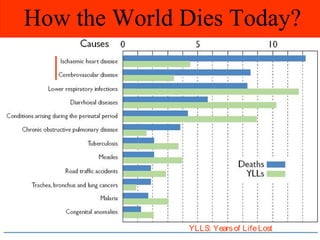
How the World Dies Today?
YLLS: Yearsof LifeLost
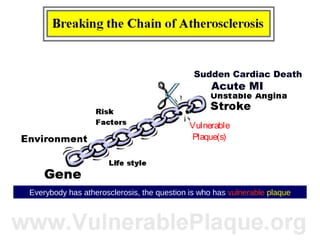
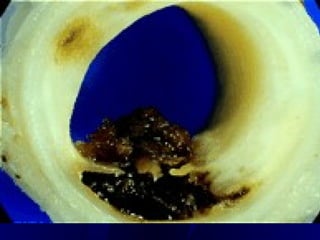
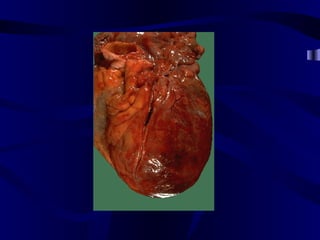
Everybody has atherosclerosis, the question is who has vulnerable plaque
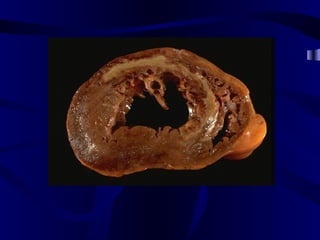
Sudden Cardiac Death
Acute MI
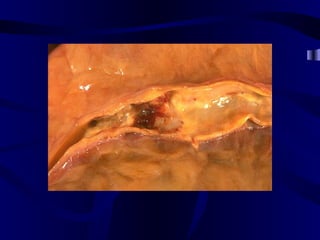
Vulnerable
Plaque(s)
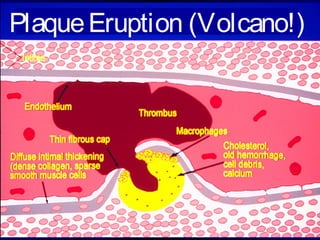
PlaqueEruption (Volcano!)
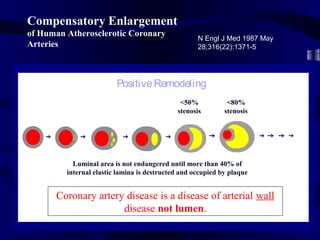
Compensatory Enlargement
of Human Atherosclerotic Coronary
Arteries
N Engl J Med 1987 May
28;316(22):1371-5
<50%
stenosis
Luminal area is not endangered until more than 40% of
internal elastic lamina is destructed and occupied by plaque
Coronary artery disease is a disease of arterial wall
disease not lumen.
PositiveRemodeling
<80%
stenosis
How important is
detection of
vulnerable plaque?
In 50-70% of cases the first
symptom of having a vulnerable
plaque is sudden death out-of-
hospital.
Kill It Before It Kills You!
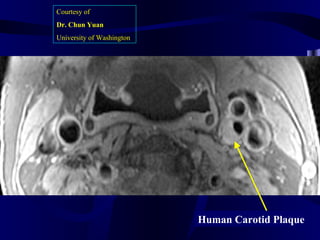
Human Carotid Plaque
Courtesy of
Dr. Chun Yuan
University of Washington
We need MRI with vulnerable plaque
targeted contrast media that identifies:
1- Inflammation (macrophage infiltration),
2- Fissured/Permeable Cap,
3- Leaking Angiogenesis and
4- Intra-Plaque Hemorrhage
5- …?
SuperparamagneticSuperparamagnetic
andand
Ultra-superparamagneticUltra-superparamagnetic
Iron OxideIron Oxide
lBlood pool magnetic resonance (MR)
imaging contrast media with a central
core of iron oxide generally coated by a
polysaccharide layer
lShortening MR relaxation time
lEngulfed by and accumulated in cells
with phagocytic activity
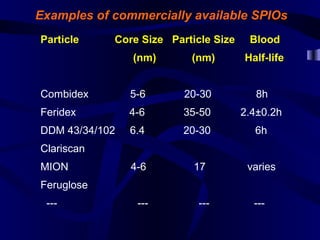
Particle Core Size Particle Size Blood
(nm) (nm) Half-life
Combidex 5-6 20-30 8h
Feridex 4-6 35-50 2.4±0.2h
DDM 43/34/102 6.4 20-30 6h
Clariscan
MION 4-6 17 varies
Feruglose
--- --- --- ---
Examples of commercially available SPIOs
Current applications of SPIO in MR imaging:
-Detection of Hepatic Lesions
(primary and metastatic cancers)
-Experimental Nephritic syndrome in Laboratory animals
-Monitoring rejection of transplanted heart or kidney in
the animal model of allograft transplantation.
-Experimental detection of CNS lesions in laboratory
animals.
USPIOs Enter the AtheroscleroticUSPIOs Enter the Atherosclerotic
Plaque ThroughPlaque Through
l-Macrophages that engulfed
them
l-Fissured or thin cap
l-Extensive angiogenesis
l-vasa vasorum leakage
l-Intra plaque hemorrhage
In-vitro Study of Macrophage
SPIO Uptake
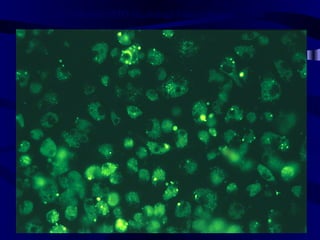
 In a series of in-vitro studies we have tested
the rate of SPIO uptake by human activated
monocytes in different conditions regarding
incubation time and concentration of SPIO.
All SPIO were labeled by a fluorescent dye
(DCFA).
FL-labeled SPIO Incubated Macrophages 24hr
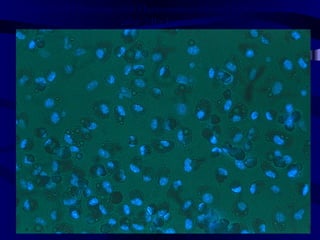
Double DAPI Staining with Fluorescence-labeled SPIO Macrophages
after 24hr Incubation
HypothesisHypothesis
Active macrophages residing inside
the inflamed vulnerable plaques can
be visualized following injection of
SPIO or USPIOs into the systemic
circulation by virtue of a decrease in
the magnetic resonance signal
intensity of the plaque,and correlate
with histopathologic characteristics of
vulnerability to rupture.
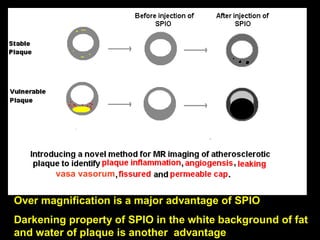
vasa vasorum
Over magnification is a major advantage of SPIO
Darkening property of SPIO in the white background of fat
and water of plaque is another advantage
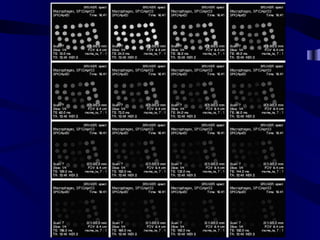
SPIO and T2 Effect
In-vitro study to show the effect of
macrophage SPIO uptake on their
T2 relaxation time
0
10
20
30
40
50
60
70
80
90
50 250 control
20 min
60 min
6 hours
24 hours
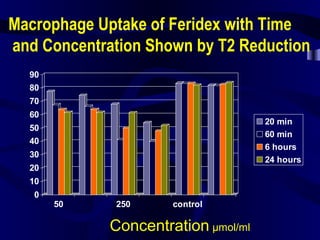
Macrophage Uptake of Feridex with Time
and Concentration Shown by T2 Reduction
Concentration µmol/ml
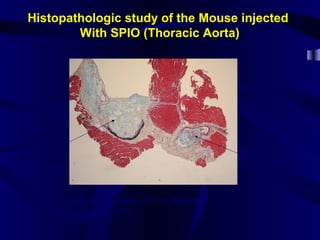
Histopathologic study of the Mouse injected
With SPIO (Thoracic Aorta)
ApoE KO mouse, Movat staining,
proximal aorta
Coronary
Cross section
Atherosclerosis
plaque
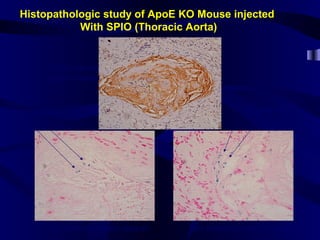
Histopathologic study of ApoE KO Mouse injected
With SPIO (Thoracic Aorta)
CD68 staining
(aortic plaque)
Iron Staining (aortic plaque) Iron Staining (coronary section)
Iron particles Iron particles
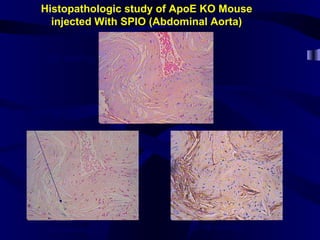
Histopathologic study of ApoE KO Mouse
injected With SPIO (Abdominal Aorta)
H&E staining
Iron Staining CD 68 staining
Iron particles
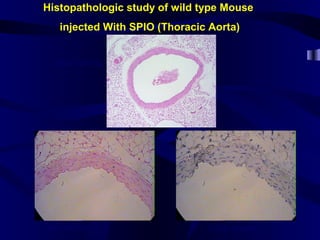
Histopathologic study of wild type Mouse
injected With SPIO (Thoracic Aorta)
H&E staining
CD68 stainingIron staining
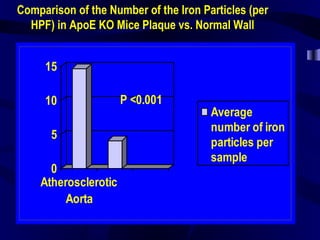
Comparison of the Number of the Iron Particles (per
HPF) in ApoE KO Mice Plaque vs. Normal Wall
0
5
10
15
Atherosclerotic
Aorta
Average
number of iron
particles per
sample
P <0.001
Iron Staining H&E Staining
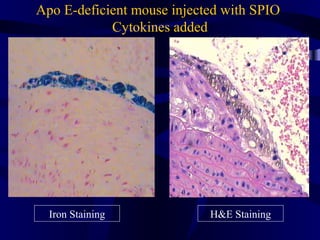
Apo E-deficient mouse injected with SPIO
Cytokines added
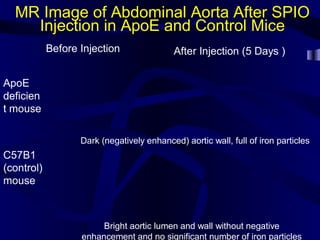
MR Image of Abdominal Aorta After SPIO
Injection in ApoE and Control Mice
ApoE
deficien
t mouse
C57B1
(control)
mouse
Before Injection After Injection (5 Days )
Dark (negatively enhanced) aortic wall, full of iron particles
Bright aortic lumen and wall without negative
enhancement and no significant number of iron particles
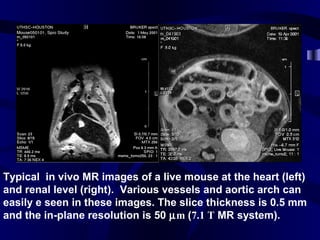
Typical in vivo MR images of a live mouse at the heart (left)
and renal level (right). Various vessels and aortic arch can
easily e seen in these images. The slice thickness is 0.5 mm
and the in-plane resolution is 50 µm (7.1 T MR system).
We chose Watanabe Hereditary Hypercholesterolemic rabbits (WHHR) and
New Zealand White rabbits (NZW) for this study.
We injected them with SPIO (Feridex) 1 mMol Fe/kg and obtained baseline
as well as 5-day post-SPIO injection MR images of the aorta (1.5 Tesla
MRI system at the University of Texas, MD Anderson,Houston,Texas).
Then we compared the images in hypercholesterolemic rabbits with
the normal,wild type NZW rabbits.
Rabbit ex-vivo MRI studies:
After the in-vivo MR images, we sacrificed the animals and excised the aorta.
Then we put the isolated aorta in a gel medium, clamped both ends and any
side branches and injected gadolinium inside the lumen.
We did the same procedure for all rabbits.
We also used 2 more rabbits, one WHHR and one NZW that were not injected
with SPIO, as control, in the ex-vivo MR study.
SPIO-Enhanced MRI study in rabbits
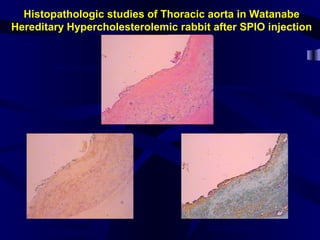
Histopathologic studies of Thoracic aorta in Watanabe
Hereditary Hypercholesterolemic rabbit after SPIO injection
H&E staining
Iron staining
Iron staining
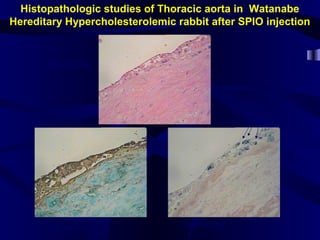
Histopathologic studies of Thoracic aorta in Watanabe
Hereditary Hypercholesterolemic rabbit after SPIO injection
H&E staining
Iron staining Iron staining
Iron particles
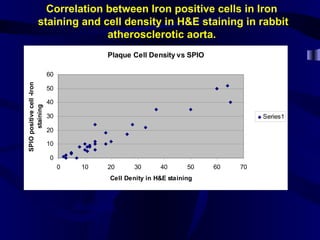
Plaque Cell Density vs SPIO
0
10
20
30
40
50
60
0 10 20 30 40 50 60 70
Cell Denity in H&E staining
SPIOpositivecell-Iron
staining
Series1
R=0.956
Correlation between Iron positive cells in Iron
staining and cell density in H&E staining in rabbit
atherosclerotic aorta.
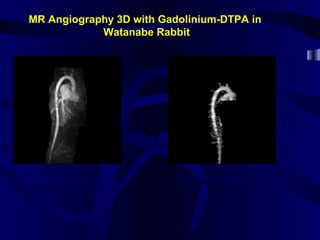
MR Angiography 3D with Gadolinium-DTPA in
Watanabe Rabbit
Before SPIO injection After SPIO injection
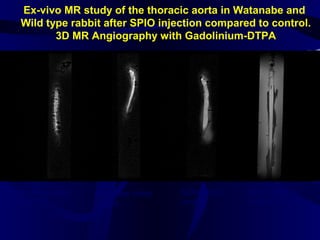
Ex-vivo MR study of the thoracic aorta in Watanabe and
Wild type rabbit after SPIO injection compared to control.
3D MR Angiography with Gadolinium-DTPA
Watanabe rabbit
Post-SPIO
Watanabe rabbit
control
NZW rabbit
control
NZW rabbit
Post-SPIO
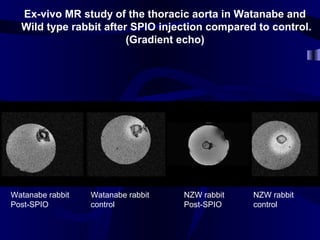
Ex-vivo MR study of the thoracic aorta in Watanabe and
Wild type rabbit after SPIO injection compared to control.
(Gradient echo)
Watanabe rabbit
Post-SPIO
Watanabe rabbit
control
NZW rabbit
Post-SPIO
NZW rabbit
control
040 center for vulnerable plaque research

040 center for vulnerable plaque research

  • 1.
    Center for Vulnerable PlaqueResearch CVPR UT- HoustonTexasHeart Institute
  • 2.
    How the WorldDies Today? YLLS: Yearsof LifeLost
  • 6.
    Everybody has atherosclerosis,the question is who has vulnerable plaque Sudden Cardiac Death Acute MI Vulnerable Plaque(s)
  • 14.
  • 15.
    Compensatory Enlargement of HumanAtherosclerotic Coronary Arteries N Engl J Med 1987 May 28;316(22):1371-5 <50% stenosis Luminal area is not endangered until more than 40% of internal elastic lamina is destructed and occupied by plaque Coronary artery disease is a disease of arterial wall disease not lumen. PositiveRemodeling <80% stenosis
  • 16.
    How important is detectionof vulnerable plaque?
  • 17.
    In 50-70% ofcases the first symptom of having a vulnerable plaque is sudden death out-of- hospital. Kill It Before It Kills You!
  • 18.
    Human Carotid Plaque Courtesyof Dr. Chun Yuan University of Washington
  • 19.
    We need MRIwith vulnerable plaque targeted contrast media that identifies: 1- Inflammation (macrophage infiltration), 2- Fissured/Permeable Cap, 3- Leaking Angiogenesis and 4- Intra-Plaque Hemorrhage 5- …?
  • 20.
    SuperparamagneticSuperparamagnetic andand Ultra-superparamagneticUltra-superparamagnetic Iron OxideIron Oxide lBloodpool magnetic resonance (MR) imaging contrast media with a central core of iron oxide generally coated by a polysaccharide layer lShortening MR relaxation time lEngulfed by and accumulated in cells with phagocytic activity
  • 21.
    Particle Core SizeParticle Size Blood (nm) (nm) Half-life Combidex 5-6 20-30 8h Feridex 4-6 35-50 2.4±0.2h DDM 43/34/102 6.4 20-30 6h Clariscan MION 4-6 17 varies Feruglose --- --- --- --- Examples of commercially available SPIOs
  • 22.
    Current applications ofSPIO in MR imaging: -Detection of Hepatic Lesions (primary and metastatic cancers) -Experimental Nephritic syndrome in Laboratory animals -Monitoring rejection of transplanted heart or kidney in the animal model of allograft transplantation. -Experimental detection of CNS lesions in laboratory animals.
  • 23.
    USPIOs Enter theAtheroscleroticUSPIOs Enter the Atherosclerotic Plaque ThroughPlaque Through l-Macrophages that engulfed them l-Fissured or thin cap l-Extensive angiogenesis l-vasa vasorum leakage l-Intra plaque hemorrhage
  • 24.
    In-vitro Study ofMacrophage SPIO Uptake  In a series of in-vitro studies we have tested the rate of SPIO uptake by human activated monocytes in different conditions regarding incubation time and concentration of SPIO. All SPIO were labeled by a fluorescent dye (DCFA).
  • 25.
    FL-labeled SPIO IncubatedMacrophages 24hr
  • 26.
    Double DAPI Stainingwith Fluorescence-labeled SPIO Macrophages after 24hr Incubation
  • 27.
    HypothesisHypothesis Active macrophages residinginside the inflamed vulnerable plaques can be visualized following injection of SPIO or USPIOs into the systemic circulation by virtue of a decrease in the magnetic resonance signal intensity of the plaque,and correlate with histopathologic characteristics of vulnerability to rupture.
  • 28.
    vasa vasorum Over magnificationis a major advantage of SPIO Darkening property of SPIO in the white background of fat and water of plaque is another advantage
  • 29.
    SPIO and T2Effect In-vitro study to show the effect of macrophage SPIO uptake on their T2 relaxation time
  • 31.
    0 10 20 30 40 50 60 70 80 90 50 250 control 20min 60 min 6 hours 24 hours Macrophage Uptake of Feridex with Time and Concentration Shown by T2 Reduction Concentration µmol/ml
  • 32.
    Histopathologic study ofthe Mouse injected With SPIO (Thoracic Aorta) ApoE KO mouse, Movat staining, proximal aorta Coronary Cross section Atherosclerosis plaque
  • 33.
    Histopathologic study ofApoE KO Mouse injected With SPIO (Thoracic Aorta) CD68 staining (aortic plaque) Iron Staining (aortic plaque) Iron Staining (coronary section) Iron particles Iron particles
  • 34.
    Histopathologic study ofApoE KO Mouse injected With SPIO (Abdominal Aorta) H&E staining Iron Staining CD 68 staining Iron particles
  • 35.
    Histopathologic study ofwild type Mouse injected With SPIO (Thoracic Aorta) H&E staining CD68 stainingIron staining
  • 36.
    Comparison of theNumber of the Iron Particles (per HPF) in ApoE KO Mice Plaque vs. Normal Wall 0 5 10 15 Atherosclerotic Aorta Average number of iron particles per sample P <0.001
  • 37.
    Iron Staining H&EStaining Apo E-deficient mouse injected with SPIO Cytokines added
  • 38.
    MR Image ofAbdominal Aorta After SPIO Injection in ApoE and Control Mice ApoE deficien t mouse C57B1 (control) mouse Before Injection After Injection (5 Days ) Dark (negatively enhanced) aortic wall, full of iron particles Bright aortic lumen and wall without negative enhancement and no significant number of iron particles
  • 39.
    Typical in vivoMR images of a live mouse at the heart (left) and renal level (right). Various vessels and aortic arch can easily e seen in these images. The slice thickness is 0.5 mm and the in-plane resolution is 50 µm (7.1 T MR system).
  • 40.
    We chose WatanabeHereditary Hypercholesterolemic rabbits (WHHR) and New Zealand White rabbits (NZW) for this study. We injected them with SPIO (Feridex) 1 mMol Fe/kg and obtained baseline as well as 5-day post-SPIO injection MR images of the aorta (1.5 Tesla MRI system at the University of Texas, MD Anderson,Houston,Texas). Then we compared the images in hypercholesterolemic rabbits with the normal,wild type NZW rabbits. Rabbit ex-vivo MRI studies: After the in-vivo MR images, we sacrificed the animals and excised the aorta. Then we put the isolated aorta in a gel medium, clamped both ends and any side branches and injected gadolinium inside the lumen. We did the same procedure for all rabbits. We also used 2 more rabbits, one WHHR and one NZW that were not injected with SPIO, as control, in the ex-vivo MR study. SPIO-Enhanced MRI study in rabbits
  • 41.
    Histopathologic studies ofThoracic aorta in Watanabe Hereditary Hypercholesterolemic rabbit after SPIO injection H&E staining Iron staining Iron staining
  • 42.
    Histopathologic studies ofThoracic aorta in Watanabe Hereditary Hypercholesterolemic rabbit after SPIO injection H&E staining Iron staining Iron staining Iron particles
  • 43.
    Plaque Cell Densityvs SPIO 0 10 20 30 40 50 60 0 10 20 30 40 50 60 70 Cell Denity in H&E staining SPIOpositivecell-Iron staining Series1 R=0.956 Correlation between Iron positive cells in Iron staining and cell density in H&E staining in rabbit atherosclerotic aorta.
  • 44.
    MR Angiography 3Dwith Gadolinium-DTPA in Watanabe Rabbit Before SPIO injection After SPIO injection
  • 45.
    Ex-vivo MR studyof the thoracic aorta in Watanabe and Wild type rabbit after SPIO injection compared to control. 3D MR Angiography with Gadolinium-DTPA Watanabe rabbit Post-SPIO Watanabe rabbit control NZW rabbit control NZW rabbit Post-SPIO
  • 46.
    Ex-vivo MR studyof the thoracic aorta in Watanabe and Wild type rabbit after SPIO injection compared to control. (Gradient echo) Watanabe rabbit Post-SPIO Watanabe rabbit control NZW rabbit Post-SPIO NZW rabbit control