Challenging responsibility:
How to make RRI work in a sustainable manner
Ulrike Felt
Department of Science and Technology Studies
Head of the Research Platform
“Responsible Research and Innovation in Academic Practice”
University of Vienna
ulrike.felt@univie.ac.at
http://sts.univie.ac.at
RRI Tools—Final Conference, Brussels, 21 November 2016
Department of Science and
Technology Studies
Challenging responsibility
questions of responsibility are challenging
us, while we have to continuously
challenge the very meaning and practices
of responsibility
Department of Science and
Technology Studies
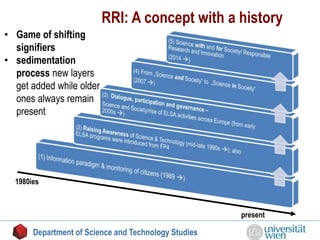
1980ies
present
Department of Science and Technology Studies
• Game of shifting
signifiers
• sedimentation
process new layers
get added while older
ones always remain
present
RRI: A concept with a history
Responsibility discourse in a wider
environment of change
• Innovation discourse, with speed and constant flow of
innovations is a key element
• anticipation  trajectory thinking combined with a wish of
early planning (efficiency);
• notions of efficiency, relevance and excellence play an
important role in restructuring research – not necessarily in any
clearly related manner
• Simultaneously concerns about
o (certain) innovations/science more genereally are not sufficiently
embraced by society (e.g., imaginary of a lack of being an innovation-
friendly society)
o growing fraud, crossing of boundaries or more generally, about a
dysfunctional research systems
Department of Science and
Technology Studies
In what kind of society are we living?
“experimental society”
„social practices increasingly present themselves
as experiments via a willingness to remain open to
new forms of experience.“
(Gross/Krohn 2005)
we need to deal with openness and surprise, and
simultaneously with uncertainty and the fact that
we cannot control the interface of science and
society
Department of Science and
Technology Studies
Connect RRI to mundane lives in research/innovation
• turbulent times: points at the fact that the novel
challenge lies in the fact that rapid, simultaneous
and continuous changes come with turbulences
 need to learn how to live with, accompany and
govern such sociotechnical change processes.
• caring for our futures
 stronger process orientation when engaging with
technoscientific and societal change;
 stretch our attention to the whole knowledge
generation process from education, over lives in
research to more concrete innovation processes;
 consideration of diversity of values;
 attention to the direction of innovation and not
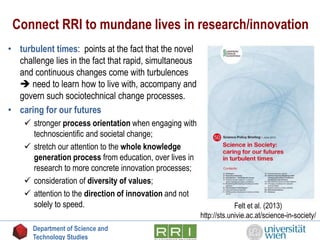
solely to speed. Felt et al. (2013)
http://sts.univie.ac.at/science-in-society/
Department of Science and
Technology Studies
Making sense of RRI:
Reflecting the narrative infrastructures into which RRI is embedded
• Narrative infrastructure: a network of temporally stabilised
narratives through which meanings and values of academic
knowledge/work and its relation to society can be articulated,
circulated and exchanged across space and time
• these narratives can take different forms, including assessments,
reconfigurations of past developments, future-oriented accounts
voicing promises and improvements but also potential threats, and
moral reflections of what is good science and innovation and how
a good researcher should be
• they perform specific temporalities, identify preferred directions of
development, and point at specific vulnerabilities
==> narratives are not innocent; they are key actors in the tacit
governance of science, innovation and society
Department of Science and
Technology Studies
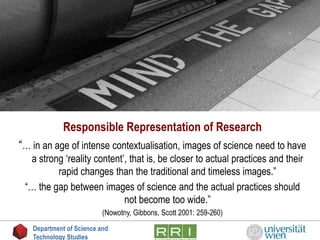
Responsible Representation of Research
“… in an age of intense contextualisation, images of science need to have
a strong ‘reality content’, that is, be closer to actual practices and their
rapid changes than the traditional and timeless images.”
“… the gap between images of science and the actual practices should
not become too wide.”
(Nowotny, Gibbons, Scott 2001: 259-260)
Department of Science and
Technology Studies
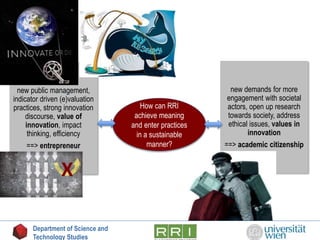
new public management,
indicator driven (e)valuation
practices, strong innovation
discourse, value of
innovation, impact
thinking, efficiency
==> entrepreneur
new demands for more
engagement with societal
actors, open up research
towards society, address
ethical issues, values in
innovation
==> academic citizenship
How can RRI
achieve meaning
and enter practices
in a sustainable
manner?
X
Department of Science and
Technology Studies
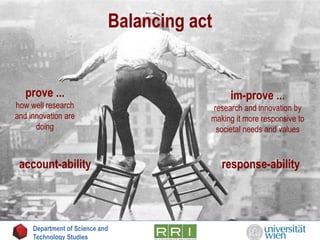
Balancing act
account-ability response-ability
prove ...
how well research
and innovation are
doing
im-prove ...
research and innovation by
making it more responsive to
societal needs and values
Department of Science and
Technology Studies
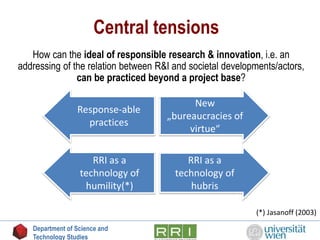
Central tensions
How can the ideal of responsible research & innovation, i.e. an
addressing of the relation between R&I and societal developments/actors,
can be practiced beyond a project base?
New
„bureaucracies of
virtue“
Response-able
practices
RRI as a
technology of
humility(*)
RRI as a
technology of
hubris
(*) Jasanoff (2003)
Department of Science and
Technology Studies
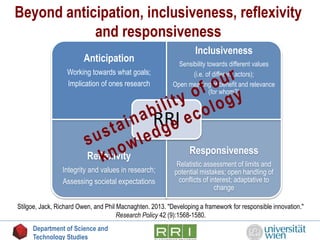
Beyond anticipation, inclusiveness, reflexivity
and responsiveness
Anticipation
Working towards what goals;
Implication of ones research
Inclusiveness
Sensibility towards different values
(i.e. of different actors);
Open meaning of benefit and relevance
(for whom?)
Reflexivity
Integrity and values in research;
Assessing societal expectations
Responsiveness
Relatistic assessment of limits and
potential mistakes; open handling of
conflicts of interest; adaptative to
change
RRI
Stilgoe, Jack, Richard Owen, and Phil Macnaghten. 2013. "Developing a framework for responsible innovation."
Research Policy 42 (9):1568-1580.
Department of Science and
Technology Studies
Challenging responsibility
• danger of “projectification” of responsibility
• lack of a detailled understanding of the different work
environments/practices in which knowledge and
innovations take shape – e.g. narrative infrastructures and
values expressed through them
• even though it seems like a rather convenient solution
(even though it would be better in terms of the
accountability logic), it is essential to avoid the formation of
a “new bureaucracy of virtues” (ritual performances of
having taken care of RRI)
Department of Science and
Technology Studies

Challenging responsibility: How to make RRI work in a sustainable manner. By Ulrike Felt

  • 1.
    Challenging responsibility: How tomake RRI work in a sustainable manner Ulrike Felt Department of Science and Technology Studies Head of the Research Platform “Responsible Research and Innovation in Academic Practice” University of Vienna ulrike.felt@univie.ac.at http://sts.univie.ac.at RRI Tools—Final Conference, Brussels, 21 November 2016 Department of Science and Technology Studies
  • 2.
    Challenging responsibility questions ofresponsibility are challenging us, while we have to continuously challenge the very meaning and practices of responsibility Department of Science and Technology Studies
  • 3.
    1980ies present Department of Scienceand Technology Studies • Game of shifting signifiers • sedimentation process new layers get added while older ones always remain present RRI: A concept with a history
  • 4.
    Responsibility discourse ina wider environment of change • Innovation discourse, with speed and constant flow of innovations is a key element • anticipation  trajectory thinking combined with a wish of early planning (efficiency); • notions of efficiency, relevance and excellence play an important role in restructuring research – not necessarily in any clearly related manner • Simultaneously concerns about o (certain) innovations/science more genereally are not sufficiently embraced by society (e.g., imaginary of a lack of being an innovation- friendly society) o growing fraud, crossing of boundaries or more generally, about a dysfunctional research systems Department of Science and Technology Studies
  • 5.
    In what kindof society are we living? “experimental society” „social practices increasingly present themselves as experiments via a willingness to remain open to new forms of experience.“ (Gross/Krohn 2005) we need to deal with openness and surprise, and simultaneously with uncertainty and the fact that we cannot control the interface of science and society Department of Science and Technology Studies
  • 6.
    Connect RRI tomundane lives in research/innovation • turbulent times: points at the fact that the novel challenge lies in the fact that rapid, simultaneous and continuous changes come with turbulences  need to learn how to live with, accompany and govern such sociotechnical change processes. • caring for our futures  stronger process orientation when engaging with technoscientific and societal change;  stretch our attention to the whole knowledge generation process from education, over lives in research to more concrete innovation processes;  consideration of diversity of values;  attention to the direction of innovation and not solely to speed. Felt et al. (2013) http://sts.univie.ac.at/science-in-society/ Department of Science and Technology Studies
  • 7.
    Making sense ofRRI: Reflecting the narrative infrastructures into which RRI is embedded • Narrative infrastructure: a network of temporally stabilised narratives through which meanings and values of academic knowledge/work and its relation to society can be articulated, circulated and exchanged across space and time • these narratives can take different forms, including assessments, reconfigurations of past developments, future-oriented accounts voicing promises and improvements but also potential threats, and moral reflections of what is good science and innovation and how a good researcher should be • they perform specific temporalities, identify preferred directions of development, and point at specific vulnerabilities ==> narratives are not innocent; they are key actors in the tacit governance of science, innovation and society Department of Science and Technology Studies
  • 8.
    Responsible Representation ofResearch “… in an age of intense contextualisation, images of science need to have a strong ‘reality content’, that is, be closer to actual practices and their rapid changes than the traditional and timeless images.” “… the gap between images of science and the actual practices should not become too wide.” (Nowotny, Gibbons, Scott 2001: 259-260) Department of Science and Technology Studies
  • 9.
    new public management, indicatordriven (e)valuation practices, strong innovation discourse, value of innovation, impact thinking, efficiency ==> entrepreneur new demands for more engagement with societal actors, open up research towards society, address ethical issues, values in innovation ==> academic citizenship How can RRI achieve meaning and enter practices in a sustainable manner? X Department of Science and Technology Studies
  • 10.
    Balancing act account-ability response-ability prove... how well research and innovation are doing im-prove ... research and innovation by making it more responsive to societal needs and values Department of Science and Technology Studies
  • 11.
    Central tensions How canthe ideal of responsible research & innovation, i.e. an addressing of the relation between R&I and societal developments/actors, can be practiced beyond a project base? New „bureaucracies of virtue“ Response-able practices RRI as a technology of humility(*) RRI as a technology of hubris (*) Jasanoff (2003) Department of Science and Technology Studies
  • 12.
    Beyond anticipation, inclusiveness,reflexivity and responsiveness Anticipation Working towards what goals; Implication of ones research Inclusiveness Sensibility towards different values (i.e. of different actors); Open meaning of benefit and relevance (for whom?) Reflexivity Integrity and values in research; Assessing societal expectations Responsiveness Relatistic assessment of limits and potential mistakes; open handling of conflicts of interest; adaptative to change RRI Stilgoe, Jack, Richard Owen, and Phil Macnaghten. 2013. "Developing a framework for responsible innovation." Research Policy 42 (9):1568-1580. Department of Science and Technology Studies
  • 13.
    Challenging responsibility • dangerof “projectification” of responsibility • lack of a detailled understanding of the different work environments/practices in which knowledge and innovations take shape – e.g. narrative infrastructures and values expressed through them • even though it seems like a rather convenient solution (even though it would be better in terms of the accountability logic), it is essential to avoid the formation of a “new bureaucracy of virtues” (ritual performances of having taken care of RRI) Department of Science and Technology Studies

Editor's Notes

  • #9 BREXIT conform image