Modeling Science, Technology,
and Innovation
Katy Börner
Victor H. Yngve Distinguished Professor of Information Science
Director, Cyberinfrastructure for Network Science Center
School of Informatics and Computing (SOIC) and
Indiana University Network Science Institute (IUNI)
Indiana University, USA
Blue Sky Conference
Ghent, Belgium
September 19, 2016
Staša Milojević, Johan Bollen, David Crandall, Damion Junk, Ying Ding (SOIC,
IU), James Evans (U Chicago), Susan Fitzpatrick (President, James S.
McDonnell Foundation), Richard B. Freeman (Harvard U), Jerome Glenn (The
Millennium Project), Caroline Wagner (OSU), Bruce Edmonds (UK), and
Andrea Scharnhorst (KNAW, NL)
COLLABORATORS
Models of Science, Technology,
and Innovation (STI)
STI models use qualitative and quantitative data
about scholars, papers, patents, grants, jobs,
news, etc. to describe and predict the probable
structure and/or dynamics of STI itself.
They are developed in economics, science policy,
social science, scientometrics and bibliometrics,
information science, physics, and other domains.
2
Modelling Advantage
Models are widely used in the construction of
scientific theories as they help
• Make assumptions explicit
• Describe the structure and dynamics of systems
• Communicate and explain systems
• Suggest possible interventions
• Identify new questions
3
5
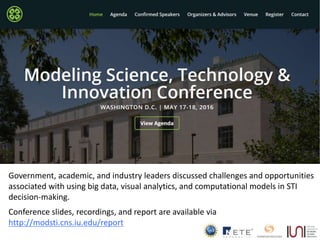
Government, academic, and industry leaders discussed challenges and opportunities
associated with using big data, visual analytics, and computational models in STI
decision-making.
Conference slides, recordings, and report are available via
http://modsti.cns.iu.edu/report
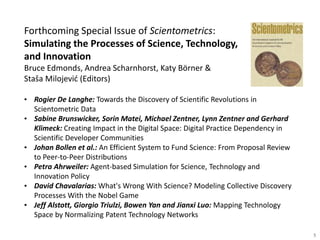
Forthcoming Special Issue of Scientometrics:
Simulating the Processes of Science, Technology,
and Innovation
Bruce Edmonds, Andrea Scharnhorst, Katy Börner &
Staša Milojević (Editors)
• Rogier De Langhe: Towards the Discovery of Scientific Revolutions in
Scientometric Data
• Sabine Brunswicker, Sorin Matei, Michael Zentner, Lynn Zentner and Gerhard
Klimeck: Creating Impact in the Digital Space: Digital Practice Dependency in
Scientific Developer Communities
• Johan Bollen et al.: An Efficient System to Fund Science: From Proposal Review
to Peer-to-Peer Distributions
• Petra Ahrweiler: Agent-based Simulation for Science, Technology and
Innovation Policy
• David Chavalarias: What's Wrong With Science? Modeling Collective Discovery
Processes With the Nobel Game
• Jeff Alstott, Giorgio Triulzi, Bowen Yan and Jianxi Luo: Mapping Technology
Space by Normalizing Patent Technology Networks
5
Modelling Opportunities:
Data-Driven Decision Making
Now available:
• high-quality, high coverage, interlinked data
• cost-effective storage and computation
• validated, scalable algorithms
• visualization and animations capabilities
6
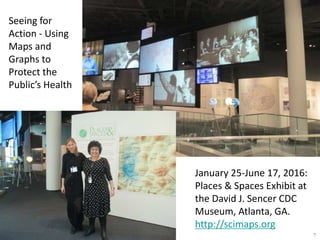
January 25-June 17, 2016:
Places & Spaces Exhibit at
the David J. Sencer CDC
Museum, Atlanta, GA.
http://scimaps.org
Seeing for
Action - Using
Maps and
Graphs to
Protect the
Public’s Health
7
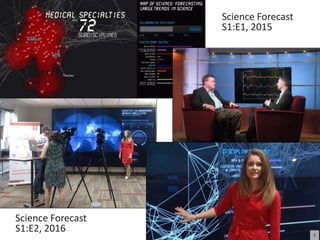
Science Forecast
S1:E1, 2015
8
Science Forecast
S1:E2, 2016

Borner - Modelling science technology and innovation

  • 1.
    Modeling Science, Technology, andInnovation Katy Börner Victor H. Yngve Distinguished Professor of Information Science Director, Cyberinfrastructure for Network Science Center School of Informatics and Computing (SOIC) and Indiana University Network Science Institute (IUNI) Indiana University, USA Blue Sky Conference Ghent, Belgium September 19, 2016 Staša Milojević, Johan Bollen, David Crandall, Damion Junk, Ying Ding (SOIC, IU), James Evans (U Chicago), Susan Fitzpatrick (President, James S. McDonnell Foundation), Richard B. Freeman (Harvard U), Jerome Glenn (The Millennium Project), Caroline Wagner (OSU), Bruce Edmonds (UK), and Andrea Scharnhorst (KNAW, NL) COLLABORATORS
  • 3.
    Models of Science,Technology, and Innovation (STI) STI models use qualitative and quantitative data about scholars, papers, patents, grants, jobs, news, etc. to describe and predict the probable structure and/or dynamics of STI itself. They are developed in economics, science policy, social science, scientometrics and bibliometrics, information science, physics, and other domains. 2
  • 4.
    Modelling Advantage Models arewidely used in the construction of scientific theories as they help • Make assumptions explicit • Describe the structure and dynamics of systems • Communicate and explain systems • Suggest possible interventions • Identify new questions 3
  • 5.
    5 Government, academic, andindustry leaders discussed challenges and opportunities associated with using big data, visual analytics, and computational models in STI decision-making. Conference slides, recordings, and report are available via http://modsti.cns.iu.edu/report
  • 6.
    Forthcoming Special Issueof Scientometrics: Simulating the Processes of Science, Technology, and Innovation Bruce Edmonds, Andrea Scharnhorst, Katy Börner & Staša Milojević (Editors) • Rogier De Langhe: Towards the Discovery of Scientific Revolutions in Scientometric Data • Sabine Brunswicker, Sorin Matei, Michael Zentner, Lynn Zentner and Gerhard Klimeck: Creating Impact in the Digital Space: Digital Practice Dependency in Scientific Developer Communities • Johan Bollen et al.: An Efficient System to Fund Science: From Proposal Review to Peer-to-Peer Distributions • Petra Ahrweiler: Agent-based Simulation for Science, Technology and Innovation Policy • David Chavalarias: What's Wrong With Science? Modeling Collective Discovery Processes With the Nobel Game • Jeff Alstott, Giorgio Triulzi, Bowen Yan and Jianxi Luo: Mapping Technology Space by Normalizing Patent Technology Networks 5
  • 7.
    Modelling Opportunities: Data-Driven DecisionMaking Now available: • high-quality, high coverage, interlinked data • cost-effective storage and computation • validated, scalable algorithms • visualization and animations capabilities 6
  • 8.
    January 25-June 17,2016: Places & Spaces Exhibit at the David J. Sencer CDC Museum, Atlanta, GA. http://scimaps.org Seeing for Action - Using Maps and Graphs to Protect the Public’s Health 7
  • 9.