
Prospects and opportunities in 
a changing marine science and 
policy landscape 
Dr Luis Valdés 
Head Ocean Sciences 
Intergovernmental Oceanographic 
Commission of UNESCO
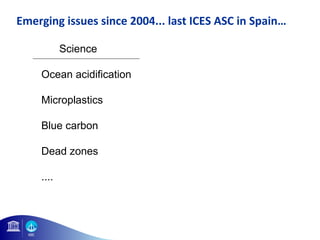
Emerging issues since 2004... last ICES ASC in Spain: 
Ocean Acidification peer review papers & authors per year
Emerging issues since 2004... last ICES ASC in Spain… 
Science Language 
Ocean acidification Governance 
Microplastics Ocean Literacy 
Blue carbon Human dimension 
Dead zones Blue growth 
.... ....
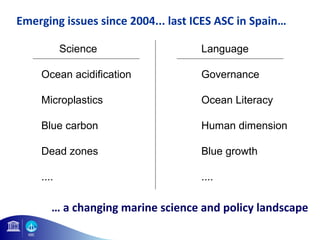
Emerging issues since 2004... last ICES ASC in Spain… 
Science Language 
Ocean acidification Governance 
Microplastics Ocean Literacy 
Blue carbon Human dimension 
Dead zones Blue growth 
.... .... 
… a changing marine science and policy landscape
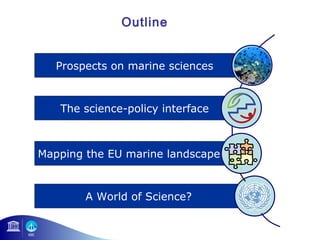
Outline 
Prospects on marine sciences 
The science-policy interface 
Mapping the EU marine landscape 
A World of Science?
Outline 
Prospects on marine sciences 
The science-policy interface 
Mapping the EU marine landscape 
A World of Science?
Outline 
Prospects on marine sciences 
New scientific knowledge 
Science for sustainability 
Science and innovation
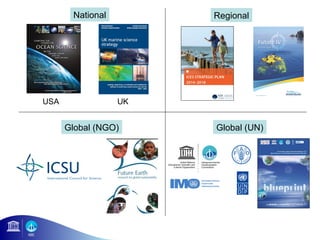
National Regional 
USA UK 
Global (NGO) Global (UN)
Outline 
Prospects on marine sciences 
New scientific knowledge 
Science for sustainability 
Science and innovation
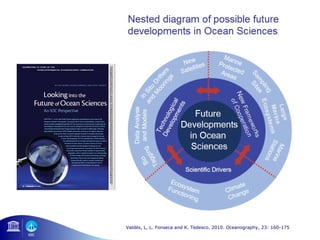
Valdés, L, L. Fonseca and K. Tedesco. 2010. Oceanography, 23: 160-175
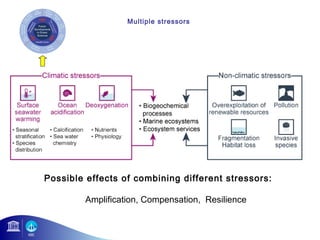
Multiple stressors 
Possible effects of combining different stressors: 
Amplification, Compensation, Resilience
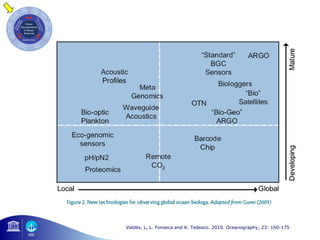
Valdés, L, L. Fonseca and K. Tedesco. 2010. Oceanography, 23: 160-175
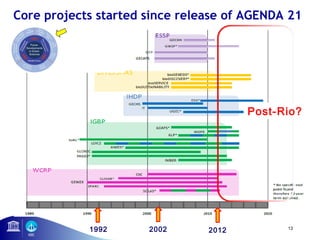
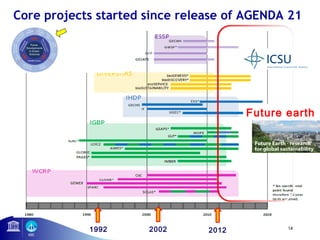
Core projects started since release of AGENDA 21 
13 
1992 2002 2012 
Post-Rio?
Core projects started since release of AGENDA 21 
Future earth 
1992 2002 2012 14
Outline 
Prospects on marine sciences 
New scientific knowledge 
Science for sustainability 
Science and innovation
11999922 
From Rio 1992 to Rio+20 
• UN Conference on Environment and Development 
(UNCED) 
22000022 • World Summit on Sustainable Development (WSSD) 
22001122 • UN Conference on Sustainable Development (UNCSD)
Economy 
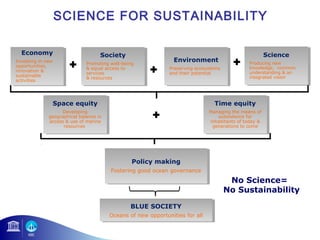
SCIENCE FOR SUSTAINABILITY 
Economy 
Investing in new 
opportunities, 
innovation & 
sustainable 
activities 
Investing in new 
opportunities, 
innovation & 
sustainable 
activities 
Society 
Society 
Promoting well-being 
& equal access to 
services 
& resources 
Promoting well-being 
& equal access to 
services 
& resources 
Environment 
Preserving ecosystems 
and their potential 
Environment 
Preserving ecosystems 
and their potential 
Science 
Science 
Producing new 
knowledge, common 
understanding & an 
integrated vision 
Producing new 
knowledge, common 
understanding & an 
integrated vision 
Space equity 
Space equity 
Developing 
Developing 
geographical balance in 
access & use of marine 
geographical balance in 
access & use of marine 
resources 
resources 
Time equity 
Time equity 
Managing the means of 
subsistence for 
subsistence for 
inhabitants of today & 
generations to come 
inhabitants of today & 
generations to come 
Policy making 
Policy making 
Fostering good ocean governance 
BLUE SOCIETY 
BLUE SOCIETY 
Oceans of new opportunities for all 
No Science= 
No Sustainability
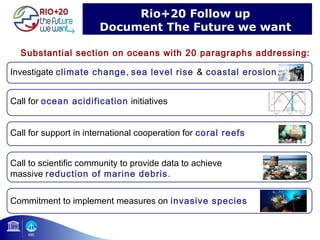
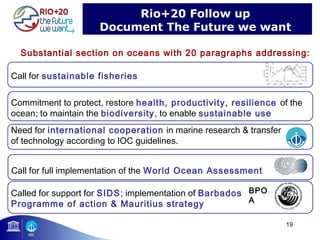
Rio+20 Follow up 
Document The Future we want 
Substantial section on oceans with 20 paragraphs addressing: 
18 
Investigate climate change, sea level rise & coastal erosion. 
Call for ocean acidification initiatives 
Call for support in international cooperation for coral reefs 
Call to scientific community to provide data to achieve 
massive reduction of marine debris. 
Commitment to implement measures on invasive species
Rio+20 Follow up 
Document The Future we want 
Substantial section on oceans with 20 paragraphs addressing: 
Commitment to protect, restore health, productivity, resilience of the 
ocean; to maintain the biodiversity, to enable sustainable use 
19 
Call for sustainable fisheries 
Need for international cooperation in marine research & transfer 
of technology according to IOC guidelines. 
Call for full implementation of the World Ocean Assessment 
Called for support for SIDS; implementation of Barbados 
Programme of action & Mauritius strategy 
BPO 
A
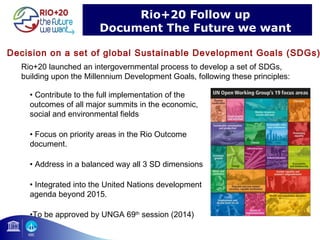
Rio+20 Follow up 
Document The Future we want 
Decision on a set of global Sustainable Development Goals (SDGs) 
Rio+20 launched an intergovernmental process to develop a set of SDGs, 
building upon the Millennium Development Goals, following these principles: 
• Contribute to the full implementation of the 
outcomes of all major summits in the economic, 
social and environmental fields 
• Focus on priority areas in the Rio Outcome 
document. 
• Address in a balanced way all 3 SD dimensions 
• Integrated into the United Nations development 
agenda beyond 2015. 
•To be approved by UNGA 69th session (2014)
Outline 
Prospects on marine sciences 
New scientific knowledge 
Science for sustainability 
Science and innovation
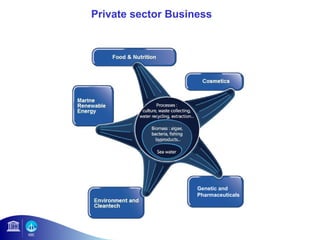
Private sector Business 
Genetic and 
Pharmaceuticals
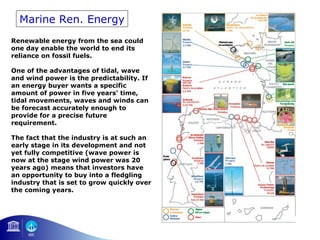
Marine Ren. Energy 
Renewable energy from the sea could 
one day enable the world to end its 
reliance on fossil fuels. 
One of the advantages of tidal, wave 
and wind power is the predictability. If 
an energy buyer wants a specific 
amount of power in five years' time, 
tidal movements, waves and winds can 
be forecast accurately enough to 
provide for a precise future 
requirement. 
The fact that the industry is at such an 
early stage in its development and not 
yet fully competitive (wave power is 
now at the stage wind power was 20 
years ago) means that investors have 
an opportunity to buy into a fledgling 
industry that is set to grow quickly over 
the coming years.
Prospects and opportunities 
In future, oceans will be continuously subject to natural and to human 
pressures for change. Global warming is a fact confirmed by scientific evidence 
and it will be, it is being, the central environmental concern of our times. More and 
new research has to be done to fully understand and evaluate the impacts of 
climate change in the oceans and to internationally cooperate to monitor the effects of 
CC and Ocean acidification. 
Societies are demanding from policymakers proactive positions towards respecting the 
sustainable use and management of natural resources and mitigate the impacts 
of global warming. Sustainable development will depend on our ability to 
manage future ocean changes. In the next 10 years, social pressure will encourage 
policymakers to reach agreements regarding limits on carbon emissions and set up 
planetary boundaries for other anthropogenic impacts. 
Future Earth (ICSU) and the UN Sustainable Development Goals are providing 
the ground to establish some new large international research programmes 
following the legacy of other past successful initiatives. 
The blue economy/growth is underpinning in science and innovation. The 
private sector needs to work closely with the marine scientific community to maximize 
the opportunities.
Outline 
Prospects on marine sciences 
The science-policy interface 
Mapping the EU marine landscape 
A World of Science?
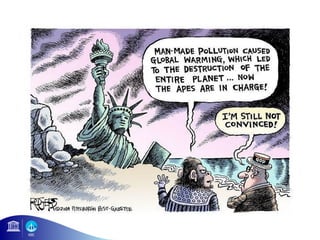
Setting the scene (science) 
Environmental Policy has been generally been driven by science 
(e.g. side effects of pesticides, thinning of ozone, health effects of 
mercury, CO2 for climate change). 
Science is key to generating acceptance and legitimising policy 
intervention. 
Scientists feature among the voices more «trusted» by 
citizens. 
Environmental indicators and trends need to rest on solid 
scientific evidence. 
The entire policy cycle from ideas to policy implementation & 
review must rest on a firm technical and (constantly evolving) 
scientific base.
Setting the scene (policy) 
Democracy depends upon the policymakers having the best 
knowledge of the consequences of their decisions. 
Research has shown that politicians are generally 
scientifically illiterate and therefore have to depend upon 
scientific expert committees to obtain this knowledge. 
Membership of these committees is not democratic and this 
introduces bias. 
Over time, environment policies have evolved from being very 
targeted to being more holistic which implies more 
knowledge demands, in particular to characterise the added 
complexities and uncertainties of integrated issues having 
long term consequences.
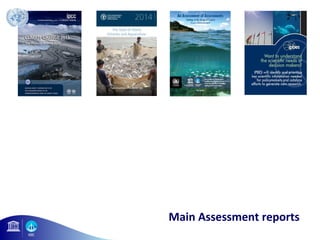
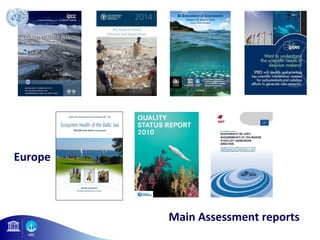
Main Assessment reports
Main Assessment reports 
Europe
The field of knowledge is the common 
property of all mankind, and any 
discoveries we can make in it will be for 
the benefit . . . of every other nation, 
as well as our own. 
Thomas Jefferson (1807) 
Main Assessment reports 
Europe
Scientific knowledge and policy interface 
IPCC 
IPBES 
WOA 
SOFIA 
MSFD 
Science-policy interfaces 
Scientific 
Programmes 
(translating science into the advisory process) 
Conventions 
IOC 
WMO 
FAO 
IMO 
UNEP 
EC-EU 
GOOS, IOCCP 
WCRP, IGBP, 
DIVERSITAS 
UNFCCC, CBD 
LC, BALLAST, 
OSPAR, MSFD
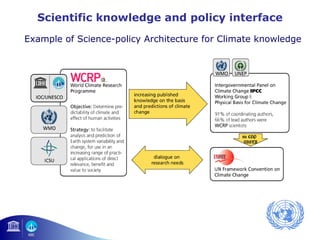
Scientific knowledge and policy interface 
Example of Science-policy Architecture for Climate knowledge 
via COP 
SBSTA
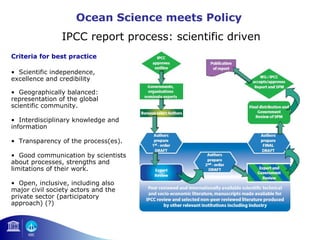
Ocean Science meets Policy 
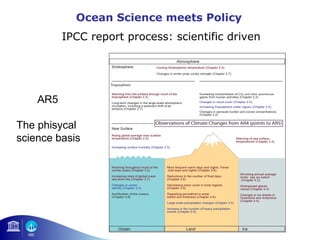
IPCC report process: scientific driven 
Criteria for best practice 
• Scientific independence, 
excellence and credibility 
• Geographically balanced: 
representation of the global 
scientific community. 
• Interdisciplinary knowledge and 
information 
• Transparency of the process(es). 
• Good communication by scientists 
about processes, strengths and 
limitations of their work. 
• Open, inclusive, including also 
major civil society actors and the 
private sector (participatory 
approach) (?)
Ocean Science meets Policy 
IPCC report process: scientific driven 
AR5 
The phisycal 
science basis
Prospects and opportunities 
There is a need for increasing translation of scientific knowledge on links 
between ocean health, ecosystem services and human well-being into specific 
policy action. However, there is a long time gap between scientific findings 
and policy responses. 
It is necessary to continue develop strategic interfaces (e.g. MSFD, WOA, 
IPBES, IPCC) to strengthening science-policy links among organisations (e.g. 
IOC, FAO, WMO, EC, etc.) and Convention/multilateral 
environmental/sustainable development agreements (e.g. CBD, UNFCCC) at 
the regional and global levels. 
It is a must to follow “best practice” to ensure high quality, independent, 
policy relevant, and “geo-politically” legitimate scientific information and 
advice.
Outline 
Prospects on marine sciences 
The science-policy interface 
Mapping the EU marine landscape 
A World of Science?
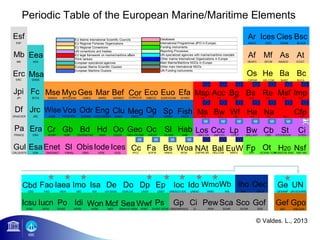
Periodic Table of the European Marine/Maritime Elements 
Ar Ices Cies Bsc 
Af Mf As At 
Os He Ba Bc 
MseMyoGes Mar Bef Cor Eco Euo Efa 
EMSEA MYOCEAN GMES MARS MARBEF CORIOLIS EMECO EUROCEAN EFARO 
Wise Vos Odr Eng Clu Meg Og Sp Fish 
WISE Vol ob ship ECORD OCE ENERGY ENMC EMEC OGP CMASV RACS 
Cr Gb Bd Hd Oo Geo Oc Sl Hab 
Msp Acc Bg Bs Re Msf Imp 
EU EU EU EU EU EU EU 
Ms Bw Wf Ha Na Cfp 
EU EU EU EU EU EU EU 
Los Ccc Lp Bw Cb St Ci 
UNCLOS UNFCCC LC/LP BALLAST CBD STOCKOLM CITES 
Esf 
Mb 
Erc 
Era 
Cbd Fao Iaea Imo Isa De Do Dp Ep Ioc Ido WmoWb Iho Oec Ge UN 
Icsu Iucn Po Idi Won Mcf SeaWwf Ps Gp Ci PewSca Sco Gof Gef Gpo 
© Valdes. L., 2013 
EU Marine International Scientific Councils 
EU Regional Fisheries Organizations 
EU Regional Conventions 
UN conventions and treaties 
EU legal framework on marine/maritime affairs 
Think tankers 
European specialized agencies 
European Marine Scientific Clusters 
European Maritime Clusters 
Databases 
International Programmes (IPO in Europe) 
Funding instruments 
Reporting Processes 
UN specialized agencies with marine/maritime mandate 
Other marine International Organizations in Europe 
Main Marine/Maritime NGOs in Europe 
Other main International NGOs 
UN Funding instruments 
GESAMP UN-OCEANS 
GEF WB-GOP 
UNESCO-IOC UNIDO WMO WB IHO OECD 
GREENPEACE CI PEW SCAR SCOR GOF 
CBD FAO IAEA IMO ISA UN-DESA DOALOS UNDP UNEP 
ICSU IUCN POGO IDDRI WON MCF SEAS AT RISK WWF PLAST SOUP 
ARCIC ICES CIESM BLACK 
NEAFC GFCM NASCO ICCAT 
OSPAR HELCOM BARC BUCA 
ESF 
MB 
ERC 
EEA 
EMSA 
JPI 
DRAEGER 
PRINCE 
CALOUSTE 
EFCA 
JRC 
ERA 
ESA 
WCRP IGBP DIVERSITAS IHDP GOOS GEO-GEOSS IOCCP GLOSS HAB 
EMODNET PSMSL OBIS IODE ICES IPCC SOFIA IPBES WOA FP7 OCEAN TOMHORIZON 2020 NSF-MS 
Jpi 
Df 
Pa 
Gul 
Eea 
Msa 
Fc 
Jrc 
Esa 
Enet Sl ObisIode Ices Cc Fa Bs Woa Fp Ot H20 Nsf 
OSPAR SR HELCOM MSFD NAt Bal EuW
41 
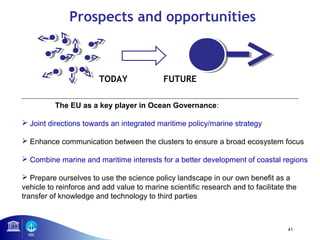
Prospects and opportunities 
TODAY FUTURE 
The EU as a key player in Ocean Governance: 
 Joint directions towards an integrated maritime policy/marine strategy 
 Enhance communication between the clusters to ensure a broad ecosystem focus 
 Combine marine and maritime interests for a better development of coastal regions 
 Prepare ourselves to use the science policy landscape in our own benefit as a 
vehicle to reinforce and add value to marine scientific research and to facilitate the 
transfer of knowledge and technology to third parties
Outline 
Prospects on marine sciences 
The science-policy interface 
Mapping the EU marine landscape 
A World of Science?
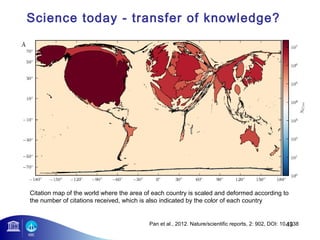
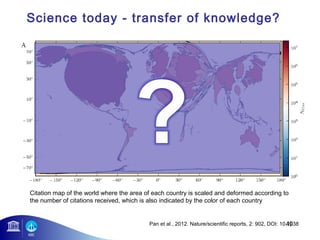
Science today - transfer of knowledge? 
Citation map of the world where the area of each country is scaled and deformed according to 
the number of citations received, which is also indicated by the color of each country 
43 
Pan et al., 2012. Nature/scientific reports, 2: 902, DOI: 10.1038
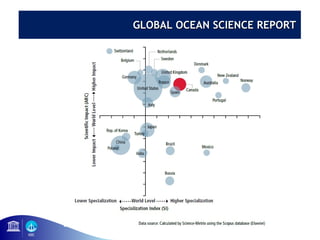
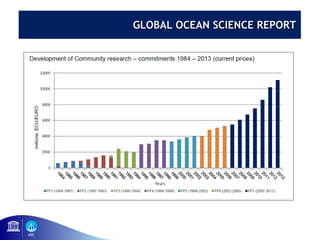
GLOBAL OOCCEEAANN SSCCIIEENNCCEE RREEPPOORRTT 
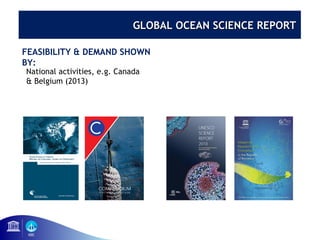
FEASIBILITY & DEMAND SHOWN 
BY: 
National activities, e.g. Canada 
& Belgium (2013)
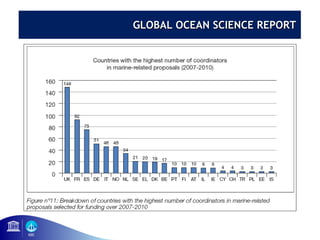
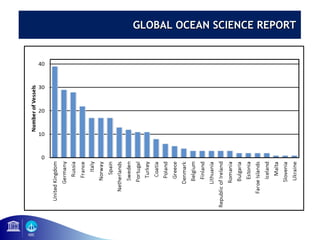
GLOBAL OOCCEEAANN SSCCIIEENNCCEE RREEPPOORRTT
Science today - transfer of knowledge? 
Citation map of the world where the area of each country is scaled and deformed according to 
the number of citations received, which is also indicated by the color of each country 
49 
Pan et al., 2012. Nature/scientific reports, 2: 902, DOI: 10.1038
…Protect our Oceans…together 
¡Thank you! 
www.ioc-unesco.org
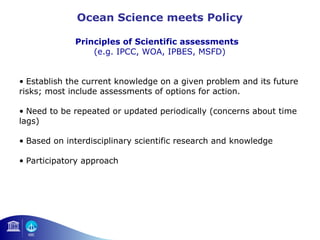
Ocean Science meets Policy 
Principles of Scientific assessments 
(e.g. IPCC, WOA, IPBES, MSFD) 
• Establish the current knowledge on a given problem and its future 
risks; most include assessments of options for action. 
• Need to be repeated or updated periodically (concerns about time 
lags) 
• Based on interdisciplinary scientific research and knowledge 
• Participatory approach
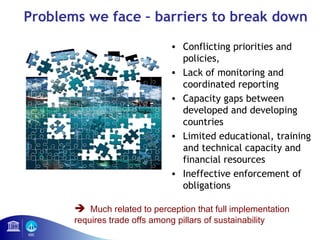
Problems we face – barriers to break down 
• Conflicting priorities and 
policies, 
• Lack of monitoring and 
coordinated reporting 
• Capacity gaps between 
developed and developing 
countries 
• Limited educational, training 
and technical capacity and 
financial resources 
• Ineffective enforcement of 
obligations 
 Much related to perception that full implementation 
requires trade offs among pillars of sustainability
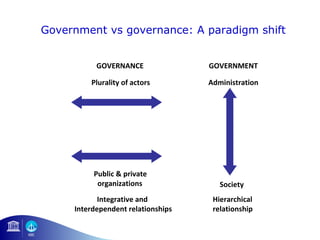
Government vs governance: A paradigm shift 
GOVERNMENT 
Administration 
Society 
Hierarchical 
relationship 
GOVERNANCE 
Plurality of actors 
Public & private 
organizations 
Integrative and 
Interdependent relationships
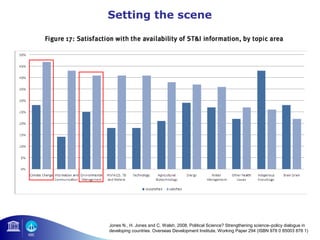
Setting the scene 
Jones N., H. Jones and C. Walsh. 2008. Political Science? Strengthening science–policy dialogue in 
developing countries. Overseas Development Institute, Working Paper 294 (ISBN 978 0 85003 878 1)

Prospects and opportunities in a changing marine science and policy landscape

  • 1.
    Prospects and opportunitiesin a changing marine science and policy landscape Dr Luis Valdés Head Ocean Sciences Intergovernmental Oceanographic Commission of UNESCO
  • 2.
    Emerging issues since2004... last ICES ASC in Spain: Ocean Acidification peer review papers & authors per year
  • 3.
    Emerging issues since2004... last ICES ASC in Spain… Science Language Ocean acidification Governance Microplastics Ocean Literacy Blue carbon Human dimension Dead zones Blue growth .... ....
  • 4.
    Emerging issues since2004... last ICES ASC in Spain… Science Language Ocean acidification Governance Microplastics Ocean Literacy Blue carbon Human dimension Dead zones Blue growth .... .... … a changing marine science and policy landscape
  • 5.
    Outline Prospects onmarine sciences The science-policy interface Mapping the EU marine landscape A World of Science?
  • 6.
    Outline Prospects onmarine sciences The science-policy interface Mapping the EU marine landscape A World of Science?
  • 7.
    Outline Prospects onmarine sciences New scientific knowledge Science for sustainability Science and innovation
  • 8.
    National Regional USAUK Global (NGO) Global (UN)
  • 9.
    Outline Prospects onmarine sciences New scientific knowledge Science for sustainability Science and innovation
  • 10.
    Valdés, L, L.Fonseca and K. Tedesco. 2010. Oceanography, 23: 160-175
  • 11.
    Multiple stressors Possibleeffects of combining different stressors: Amplification, Compensation, Resilience
  • 12.
    Valdés, L, L.Fonseca and K. Tedesco. 2010. Oceanography, 23: 160-175
  • 13.
    Core projects startedsince release of AGENDA 21 13 1992 2002 2012 Post-Rio?
  • 14.
    Core projects startedsince release of AGENDA 21 Future earth 1992 2002 2012 14
  • 15.
    Outline Prospects onmarine sciences New scientific knowledge Science for sustainability Science and innovation
  • 16.
    11999922 From Rio1992 to Rio+20 • UN Conference on Environment and Development (UNCED) 22000022 • World Summit on Sustainable Development (WSSD) 22001122 • UN Conference on Sustainable Development (UNCSD)
  • 17.
    Economy SCIENCE FORSUSTAINABILITY Economy Investing in new opportunities, innovation & sustainable activities Investing in new opportunities, innovation & sustainable activities Society Society Promoting well-being & equal access to services & resources Promoting well-being & equal access to services & resources Environment Preserving ecosystems and their potential Environment Preserving ecosystems and their potential Science Science Producing new knowledge, common understanding & an integrated vision Producing new knowledge, common understanding & an integrated vision Space equity Space equity Developing Developing geographical balance in access & use of marine geographical balance in access & use of marine resources resources Time equity Time equity Managing the means of Managing the means of subsistence for subsistence for inhabitants of today & generations to come inhabitants of today & generations to come Policy making Policy making Fostering good ocean governance Fostering good ocean governance BLUE SOCIETY BLUE SOCIETY Oceans of new opportunities for all Oceans of new opportunities for all No Science= No Sustainability
  • 18.
    Rio+20 Follow up Document The Future we want Substantial section on oceans with 20 paragraphs addressing: 18 Investigate climate change, sea level rise & coastal erosion. Call for ocean acidification initiatives Call for support in international cooperation for coral reefs Call to scientific community to provide data to achieve massive reduction of marine debris. Commitment to implement measures on invasive species
  • 19.
    Rio+20 Follow up Document The Future we want Substantial section on oceans with 20 paragraphs addressing: Commitment to protect, restore health, productivity, resilience of the ocean; to maintain the biodiversity, to enable sustainable use 19 Call for sustainable fisheries Need for international cooperation in marine research & transfer of technology according to IOC guidelines. Call for full implementation of the World Ocean Assessment Called for support for SIDS; implementation of Barbados Programme of action & Mauritius strategy BPO A
  • 20.
    Rio+20 Follow up Document The Future we want Decision on a set of global Sustainable Development Goals (SDGs) Rio+20 launched an intergovernmental process to develop a set of SDGs, building upon the Millennium Development Goals, following these principles: • Contribute to the full implementation of the outcomes of all major summits in the economic, social and environmental fields • Focus on priority areas in the Rio Outcome document. • Address in a balanced way all 3 SD dimensions • Integrated into the United Nations development agenda beyond 2015. •To be approved by UNGA 69th session (2014)
  • 21.
    Outline Prospects onmarine sciences New scientific knowledge Science for sustainability Science and innovation
  • 23.
    Private sector Business Genetic and Pharmaceuticals
  • 24.
    Marine Ren. Energy Renewable energy from the sea could one day enable the world to end its reliance on fossil fuels. One of the advantages of tidal, wave and wind power is the predictability. If an energy buyer wants a specific amount of power in five years' time, tidal movements, waves and winds can be forecast accurately enough to provide for a precise future requirement. The fact that the industry is at such an early stage in its development and not yet fully competitive (wave power is now at the stage wind power was 20 years ago) means that investors have an opportunity to buy into a fledgling industry that is set to grow quickly over the coming years.
  • 25.
    Prospects and opportunities In future, oceans will be continuously subject to natural and to human pressures for change. Global warming is a fact confirmed by scientific evidence and it will be, it is being, the central environmental concern of our times. More and new research has to be done to fully understand and evaluate the impacts of climate change in the oceans and to internationally cooperate to monitor the effects of CC and Ocean acidification. Societies are demanding from policymakers proactive positions towards respecting the sustainable use and management of natural resources and mitigate the impacts of global warming. Sustainable development will depend on our ability to manage future ocean changes. In the next 10 years, social pressure will encourage policymakers to reach agreements regarding limits on carbon emissions and set up planetary boundaries for other anthropogenic impacts. Future Earth (ICSU) and the UN Sustainable Development Goals are providing the ground to establish some new large international research programmes following the legacy of other past successful initiatives. The blue economy/growth is underpinning in science and innovation. The private sector needs to work closely with the marine scientific community to maximize the opportunities.
  • 26.
    Outline Prospects onmarine sciences The science-policy interface Mapping the EU marine landscape A World of Science?
  • 28.
    Setting the scene(science) Environmental Policy has been generally been driven by science (e.g. side effects of pesticides, thinning of ozone, health effects of mercury, CO2 for climate change). Science is key to generating acceptance and legitimising policy intervention. Scientists feature among the voices more «trusted» by citizens. Environmental indicators and trends need to rest on solid scientific evidence. The entire policy cycle from ideas to policy implementation & review must rest on a firm technical and (constantly evolving) scientific base.
  • 29.
    Setting the scene(policy) Democracy depends upon the policymakers having the best knowledge of the consequences of their decisions. Research has shown that politicians are generally scientifically illiterate and therefore have to depend upon scientific expert committees to obtain this knowledge. Membership of these committees is not democratic and this introduces bias. Over time, environment policies have evolved from being very targeted to being more holistic which implies more knowledge demands, in particular to characterise the added complexities and uncertainties of integrated issues having long term consequences.
  • 30.
  • 31.
  • 32.
    The field ofknowledge is the common property of all mankind, and any discoveries we can make in it will be for the benefit . . . of every other nation, as well as our own. Thomas Jefferson (1807) Main Assessment reports Europe
  • 33.
    Scientific knowledge andpolicy interface IPCC IPBES WOA SOFIA MSFD Science-policy interfaces Scientific Programmes (translating science into the advisory process) Conventions IOC WMO FAO IMO UNEP EC-EU GOOS, IOCCP WCRP, IGBP, DIVERSITAS UNFCCC, CBD LC, BALLAST, OSPAR, MSFD
  • 34.
    Scientific knowledge andpolicy interface Example of Science-policy Architecture for Climate knowledge via COP SBSTA
  • 35.
    Ocean Science meetsPolicy IPCC report process: scientific driven Criteria for best practice • Scientific independence, excellence and credibility • Geographically balanced: representation of the global scientific community. • Interdisciplinary knowledge and information • Transparency of the process(es). • Good communication by scientists about processes, strengths and limitations of their work. • Open, inclusive, including also major civil society actors and the private sector (participatory approach) (?)
  • 36.
    Ocean Science meetsPolicy IPCC report process: scientific driven AR5 The phisycal science basis
  • 37.
    Prospects and opportunities There is a need for increasing translation of scientific knowledge on links between ocean health, ecosystem services and human well-being into specific policy action. However, there is a long time gap between scientific findings and policy responses. It is necessary to continue develop strategic interfaces (e.g. MSFD, WOA, IPBES, IPCC) to strengthening science-policy links among organisations (e.g. IOC, FAO, WMO, EC, etc.) and Convention/multilateral environmental/sustainable development agreements (e.g. CBD, UNFCCC) at the regional and global levels. It is a must to follow “best practice” to ensure high quality, independent, policy relevant, and “geo-politically” legitimate scientific information and advice.
  • 38.
    Outline Prospects onmarine sciences The science-policy interface Mapping the EU marine landscape A World of Science?
  • 40.
    Periodic Table ofthe European Marine/Maritime Elements Ar Ices Cies Bsc Af Mf As At Os He Ba Bc MseMyoGes Mar Bef Cor Eco Euo Efa EMSEA MYOCEAN GMES MARS MARBEF CORIOLIS EMECO EUROCEAN EFARO Wise Vos Odr Eng Clu Meg Og Sp Fish WISE Vol ob ship ECORD OCE ENERGY ENMC EMEC OGP CMASV RACS Cr Gb Bd Hd Oo Geo Oc Sl Hab Msp Acc Bg Bs Re Msf Imp EU EU EU EU EU EU EU Ms Bw Wf Ha Na Cfp EU EU EU EU EU EU EU Los Ccc Lp Bw Cb St Ci UNCLOS UNFCCC LC/LP BALLAST CBD STOCKOLM CITES Esf Mb Erc Era Cbd Fao Iaea Imo Isa De Do Dp Ep Ioc Ido WmoWb Iho Oec Ge UN Icsu Iucn Po Idi Won Mcf SeaWwf Ps Gp Ci PewSca Sco Gof Gef Gpo © Valdes. L., 2013 EU Marine International Scientific Councils EU Regional Fisheries Organizations EU Regional Conventions UN conventions and treaties EU legal framework on marine/maritime affairs Think tankers European specialized agencies European Marine Scientific Clusters European Maritime Clusters Databases International Programmes (IPO in Europe) Funding instruments Reporting Processes UN specialized agencies with marine/maritime mandate Other marine International Organizations in Europe Main Marine/Maritime NGOs in Europe Other main International NGOs UN Funding instruments GESAMP UN-OCEANS GEF WB-GOP UNESCO-IOC UNIDO WMO WB IHO OECD GREENPEACE CI PEW SCAR SCOR GOF CBD FAO IAEA IMO ISA UN-DESA DOALOS UNDP UNEP ICSU IUCN POGO IDDRI WON MCF SEAS AT RISK WWF PLAST SOUP ARCIC ICES CIESM BLACK NEAFC GFCM NASCO ICCAT OSPAR HELCOM BARC BUCA ESF MB ERC EEA EMSA JPI DRAEGER PRINCE CALOUSTE EFCA JRC ERA ESA WCRP IGBP DIVERSITAS IHDP GOOS GEO-GEOSS IOCCP GLOSS HAB EMODNET PSMSL OBIS IODE ICES IPCC SOFIA IPBES WOA FP7 OCEAN TOMHORIZON 2020 NSF-MS Jpi Df Pa Gul Eea Msa Fc Jrc Esa Enet Sl ObisIode Ices Cc Fa Bs Woa Fp Ot H20 Nsf OSPAR SR HELCOM MSFD NAt Bal EuW
  • 41.
    41 Prospects andopportunities TODAY FUTURE The EU as a key player in Ocean Governance:  Joint directions towards an integrated maritime policy/marine strategy  Enhance communication between the clusters to ensure a broad ecosystem focus  Combine marine and maritime interests for a better development of coastal regions  Prepare ourselves to use the science policy landscape in our own benefit as a vehicle to reinforce and add value to marine scientific research and to facilitate the transfer of knowledge and technology to third parties
  • 42.
    Outline Prospects onmarine sciences The science-policy interface Mapping the EU marine landscape A World of Science?
  • 43.
    Science today -transfer of knowledge? Citation map of the world where the area of each country is scaled and deformed according to the number of citations received, which is also indicated by the color of each country 43 Pan et al., 2012. Nature/scientific reports, 2: 902, DOI: 10.1038
  • 44.
    GLOBAL OOCCEEAANN SSCCIIEENNCCEERREEPPOORRTT FEASIBILITY & DEMAND SHOWN BY: National activities, e.g. Canada & Belgium (2013)
  • 45.
  • 46.
  • 47.
  • 48.
  • 49.
    Science today -transfer of knowledge? Citation map of the world where the area of each country is scaled and deformed according to the number of citations received, which is also indicated by the color of each country 49 Pan et al., 2012. Nature/scientific reports, 2: 902, DOI: 10.1038
  • 50.
    …Protect our Oceans…together ¡Thank you! www.ioc-unesco.org
  • 52.
    Ocean Science meetsPolicy Principles of Scientific assessments (e.g. IPCC, WOA, IPBES, MSFD) • Establish the current knowledge on a given problem and its future risks; most include assessments of options for action. • Need to be repeated or updated periodically (concerns about time lags) • Based on interdisciplinary scientific research and knowledge • Participatory approach
  • 53.
    Problems we face– barriers to break down • Conflicting priorities and policies, • Lack of monitoring and coordinated reporting • Capacity gaps between developed and developing countries • Limited educational, training and technical capacity and financial resources • Ineffective enforcement of obligations  Much related to perception that full implementation requires trade offs among pillars of sustainability
  • 56.
    Government vs governance:A paradigm shift GOVERNMENT Administration Society Hierarchical relationship GOVERNANCE Plurality of actors Public & private organizations Integrative and Interdependent relationships
  • 57.
    Setting the scene Jones N., H. Jones and C. Walsh. 2008. Political Science? Strengthening science–policy dialogue in developing countries. Overseas Development Institute, Working Paper 294 (ISBN 978 0 85003 878 1)

Editor's Notes

  • #21 The final outcome document of Rio+20 ‘the future we want’ stressed the critical role the ocean plays in all three pillars of sustainable development, and “commit[ed] to protect, and restore, the health, productivity and resilience of the ocean and marine ecosystems, and to maintain their biodiversity, enabling their conservation and sustainable use for present and future generations.” It contains 20 paragraphs in a dedicated section on the ocean and seas, and an additional three paragraphs on small island developing States (SIDS).