4 questions about ICES advice
Mark Dickey-Collas
Chair of ICES Advisory Committee (ACOM)
@DickeyCollas
4 questions
What is ICES advice?
Who can ask ICES for advice?
Why do they ask ICES?
How do we give advice?
1.
What is ICES advice?
ICES advice
…by employing the knowledge of ICES to
effectively meet the societal needs for impartial
evidence, and to generate state-of-the-art advice
on meeting conservation, management and
sustainability goals.
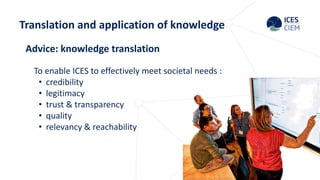
Translation and application of knowledge
Science: knowledge creation Advice: knowledge translation
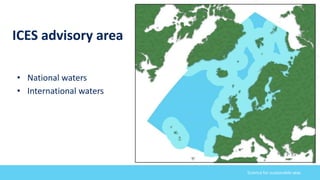
ICES advisory area
• National waters
• International waters
Science for sustainable seas
Examples
• What are the consequences of catching fish?
• What are the trends in bird populations?
• What is the footprint of the trawl fishery?
• Do my analytical methods meet international standards?
• Where are the biodiversity hotspots?
http://www.ices.dk/community/advisory-process/Pages/Latest-Advice.aspx
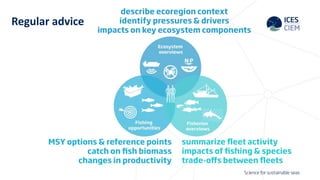
Regular advice
2.
Who can ask ICES for advice?
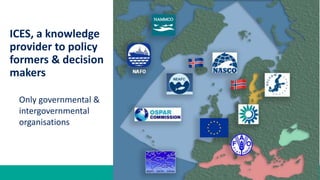
ICES, a knowledge
provider to policy
formers & decision
makers
Only governmental &
intergovernmental
organisations
ICES advice is used for
• Policy development and revision
• Management of marine activities
• Assessing the state of the marine ecosystem
• Monitoring effectiveness of management measures
• Exploring conservation objectives
• Ensuring international standards are met
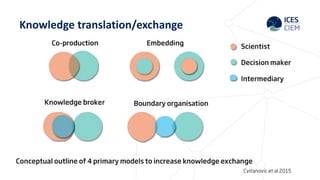
Knowledge translation/exchange
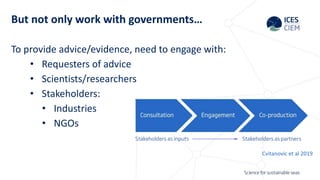
But not only work with governments…
To provide advice/evidence, need to engage with:
• Requesters of advice
• Scientists/researchers
• Stakeholders:
• Industries
• NGOs
Cvitanovic et al 2019
3.
Why do they ask ICES?
Translation and application of knowledge
Advice: knowledge translation
To enable ICES to effectively meet societal needs :
• credibility
• legitimacy
• trust & transparency
• quality
• relevancy & reachability
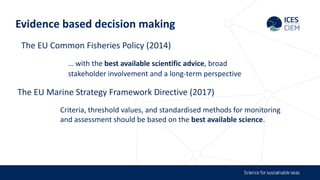
Evidence based decision making
The EU Common Fisheries Policy (2014)
… with the best available scientific advice, broad
stakeholder involvement and a long-term perspective
Criteria, threshold values, and standardised methods for monitoring
and assessment should be based on the best available science.
The EU Marine Strategy Framework Directive (2017)
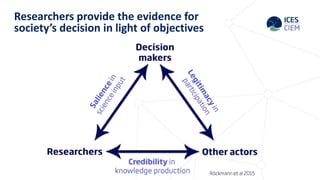
Researchers provide the evidence for
society’s decision in light of objectives
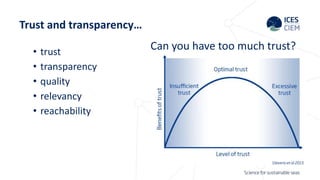
Trust and transparency…
• trust
• transparency
• quality
• relevancy
• reachability
Can you have too much trust?
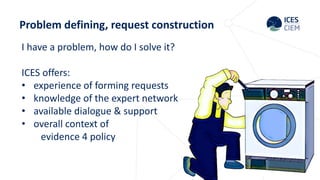
Problem defining, request construction
I have a problem, how do I solve it?
ICES offers:
• experience of forming requests
• knowledge of the expert network
• available dialogue & support
• overall context of
evidence 4 policy
4.
How do we give advice?
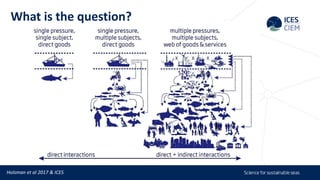
Holsman et al 2017 & ICES
What is the question?
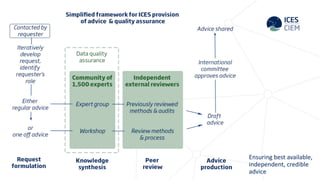
Ensuring best available,
independent, credible
advice
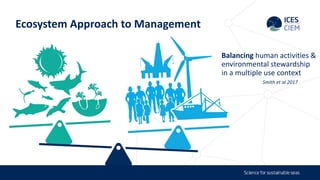
Balancing human activities &
environmental stewardship
in a multiple use context
Smith et al 2017
Ecosystem Approach to Management
Thank you

Four questions about ICES advice

  • 1.
    4 questions aboutICES advice Mark Dickey-Collas Chair of ICES Advisory Committee (ACOM) @DickeyCollas
  • 2.
    4 questions What isICES advice? Who can ask ICES for advice? Why do they ask ICES? How do we give advice?
  • 3.
  • 4.
    ICES advice …by employingthe knowledge of ICES to effectively meet the societal needs for impartial evidence, and to generate state-of-the-art advice on meeting conservation, management and sustainability goals.
  • 5.
    Translation and applicationof knowledge Science: knowledge creation Advice: knowledge translation
  • 6.
    ICES advisory area •National waters • International waters Science for sustainable seas
  • 7.
    Examples • What arethe consequences of catching fish? • What are the trends in bird populations? • What is the footprint of the trawl fishery? • Do my analytical methods meet international standards? • Where are the biodiversity hotspots? http://www.ices.dk/community/advisory-process/Pages/Latest-Advice.aspx
  • 8.
  • 9.
    2. Who can askICES for advice?
  • 10.
    ICES, a knowledge providerto policy formers & decision makers Only governmental & intergovernmental organisations
  • 11.
    ICES advice isused for • Policy development and revision • Management of marine activities • Assessing the state of the marine ecosystem • Monitoring effectiveness of management measures • Exploring conservation objectives • Ensuring international standards are met
  • 12.
  • 13.
    But not onlywork with governments… To provide advice/evidence, need to engage with: • Requesters of advice • Scientists/researchers • Stakeholders: • Industries • NGOs Cvitanovic et al 2019
  • 14.
    3. Why do theyask ICES?
  • 15.
    Translation and applicationof knowledge Advice: knowledge translation To enable ICES to effectively meet societal needs : • credibility • legitimacy • trust & transparency • quality • relevancy & reachability
  • 16.
    Evidence based decisionmaking The EU Common Fisheries Policy (2014) … with the best available scientific advice, broad stakeholder involvement and a long-term perspective Criteria, threshold values, and standardised methods for monitoring and assessment should be based on the best available science. The EU Marine Strategy Framework Directive (2017)
  • 17.
    Researchers provide theevidence for society’s decision in light of objectives
  • 18.
    Trust and transparency… •trust • transparency • quality • relevancy • reachability Can you have too much trust?
  • 19.
    Problem defining, requestconstruction I have a problem, how do I solve it? ICES offers: • experience of forming requests • knowledge of the expert network • available dialogue & support • overall context of evidence 4 policy
  • 20.
    4. How do wegive advice?
  • 21.
    Holsman et al2017 & ICES What is the question?
  • 22.
  • 23.
    Balancing human activities& environmental stewardship in a multiple use context Smith et al 2017 Ecosystem Approach to Management
  • 24.