Enterprise Strategy/AW/02a

             Arj Wignaraja
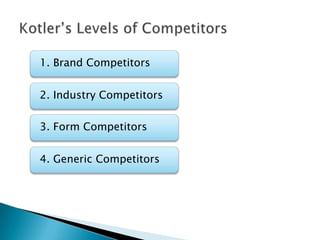
1. Brand Competitors


2. Industry Competitors

3. Form Competitors


4. Generic Competitors
Food & Entertainment

                Movie
                theaters
                                Video
                                rentals

Grocery         Full service                  Prepared Food
stores          Restaurant

     Prepared                      Grocery
     meals                         store
                                   Deli


                                             Fast Food


                                   Burgers
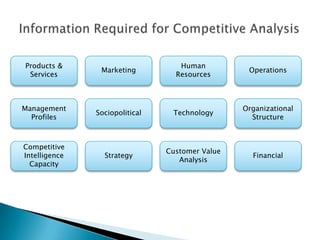
Products &                         Human
                Marketing                         Operations
 Services                         Resources


Management                                       Organizational
               Sociopolitical    Technology
  Profiles                                         Structure


Competitive
                                Customer Value
Intelligence     Strategy                          Financial
                                   Analysis
  Capacity
Recorded Data         Observable Data          Opportunistic Data

• Annual report &      • Pricing / price lists   • Meetings with
  accounts             • Advertising               suppliers
• Press releases         campaigns               • Trade shows
• Newspaper articles   • Promotions              • Sales force meetings
• Analysts reports     • Tenders                 • Seminars /
• Regulatory reports   • Patent applications       conferences
• Government reports                             • Recruiting ex-
• Presentations /                                  employees
  speeches                                       • Discussion with
                                                   shared distributors
                                                 • Social contacts with
                                                   competitors
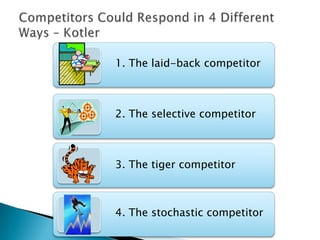
1. The laid-back competitor


2. The selective competitor


3. The tiger competitor


4. The stochastic competitor
High fixed
                    costs


High unit costs                  High exit costs


                  Intensity of
                  competitive
                   response
Firm strategy,
             structure, and
                 rivalry


  Factor                       Demand
conditions                    conditions


               Related &
              supporting
               industries
Is
                 advantage      Yes   Compete in
                   world                global
                   class?              markets
Cluster giving
 competitive
                       No
  advantage

                 Find a niche
                  market at
                    home
02a e3 competitive environment lecture notes

02a e3 competitive environment lecture notes

  • 1.
  • 2.
    1. Brand Competitors 2.Industry Competitors 3. Form Competitors 4. Generic Competitors
  • 3.
    Food & Entertainment Movie theaters Video rentals Grocery Full service Prepared Food stores Restaurant Prepared Grocery meals store Deli Fast Food Burgers
  • 4.
    Products & Human Marketing Operations Services Resources Management Organizational Sociopolitical Technology Profiles Structure Competitive Customer Value Intelligence Strategy Financial Analysis Capacity
  • 5.
    Recorded Data Observable Data Opportunistic Data • Annual report & • Pricing / price lists • Meetings with accounts • Advertising suppliers • Press releases campaigns • Trade shows • Newspaper articles • Promotions • Sales force meetings • Analysts reports • Tenders • Seminars / • Regulatory reports • Patent applications conferences • Government reports • Recruiting ex- • Presentations / employees speeches • Discussion with shared distributors • Social contacts with competitors
  • 6.
    1. The laid-backcompetitor 2. The selective competitor 3. The tiger competitor 4. The stochastic competitor
  • 7.
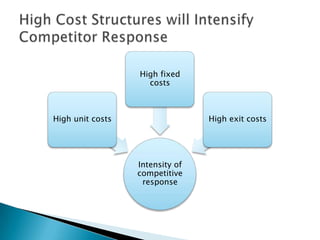
    High fixed costs High unit costs High exit costs Intensity of competitive response
  • 8.
    Firm strategy, structure, and rivalry Factor Demand conditions conditions Related & supporting industries
  • 9.
    Is advantage Yes Compete in world global class? markets Cluster giving competitive No advantage Find a niche market at home

Editor's Notes

  • #3 PhilipKotler, marketing guru from Kellogg, 1997.Brand competitors: Firms who offer similar products to the same customers we serve and who have a similar sizeand structure of organisation as ourselves. Examples: Pepsi & Coke, Unilever and Proctor & GambleIndustry competitors: Suppliers who produce similar goods but who are not necessarily the same size or structure as ourselves, or who compete in a more limited area or product range. Examples: Nestle & Cadbury, British Airways and Singapore AirlinesForm competitors: Suppliers whose products satisfy the same needs as ours, although they are technically quite different. Examples: Speed boats and sports cars, Book publishers and software manufacturersGeneric competitors: Competitors who compete for the same income as the company. Examples: Vacation and brand new car, home improvements and golf clubs
  • #6 Davidson (1997) described how the sources of competitor information can be neatly grouped into three categories: • Recorded data: this is easily available in published form either internally or externally. Good examples include competitor annual reports and product brochures; • Observable data: this has to be actively sought and often assembled from several sources. A good example is competitor pricing; • Opportunistic data: to get hold of this kind of data requires a lot of planning and organisation. Much of it is “anecdotal”, coming from discussions with suppliers, customers and, perhaps, previous management of competitors
  • #7 1. The laid-back competitor does not respond to competitive moves.2. The selective competitor reacts to attacks on certain markets but not in others, or certain types of attack (e.g. to price cuts but not to promotion offensives).3. The tiger competitor always responds aggressively to any threat, in order to send a message to all contenders that it will retaliate.4. The stochastic competitor does not have any predictable pattern to responses. This type of competitor often does not respond to moves and then on one occasion decides to retaliate.Kotler advises management to consider the reasons why a competitor does or does not have a track record of responding. For example, the following might be reasons to think again about taking advantage of an apparently docile rival: (a)They believe the market is not worth defending any more. (b)They know the market is one in which it will be hard to dislodge customers. (c)The management have their eyes on sequel products and so do not care if their present one is knocked out.
  • #8 High fixed costs:Rivals will respond more aggressively to threats to their sales volumes. This is because their high operational gearing means that any fall in revenues will cause drastic cuts in profits. Such costs tend to characterise: (a)vertically integrated firms. (b)firms employing capital-intensive production technologies. (c)firms in industries with fixed supply schedules which must be maintained regardless of demand (e.g. scheduled transportation, football clubs, broadcasting).High unit costs: These make it impossible for the rival to effectively respond to price cuts. These are often masked by high prices based on high market positioning. Cutting prices is impossible without damaging this positioning.High exit costs: These are the one-off costs of leaving an unprofitable industry.Examples of exit costs include: (a) dedicated assets which cannot be used elsewhere. (b)costs of redundancies. (c)decommissioning costs such as making former storage and workings safe. (d) danger of the stigma of failure attracting rivals to attack in other parts of its business.Where the rival cannot exit easily they are forced to stay and fight in the hope that something can be salvaged. Their response will be aggressive.
  • #9 Classical theories of international trade propose that comparative advantage resides in the factor endowments that a country may befortunate enough to inherit. Factor endowments include land, natural resources, labor, and the size of the local population.Michael Porter argued that a nation can create new advanced factor endowments such as skilled labor, a strong technology and knowledge base, government support, and culture. Porter used a diamond shaped diagram as the basis of a framework to illustrate the determinants of national advantage. This diamond represents the national playing field that countries establish for their industriesIn his book The Competitive Advantage of Nations (1992), Porter sets out to provide answers to the following questions:1. Why do certain nations house so many successful international firms? 2. How do these firms sustain superior performance in a global market? 3. What are the implications of this for government policy and competitive strategy? Porter concludes that entire nations do not have particular competitive advantages. Rather, he argues, it is specific industries or firms within them that seem able to use their national backgrounds to lever world-class competitive advantages.Model developed after a four year study of ten major trading nations and 100 industries that covered 50% of total world exports in 1985.
  • #10 Porter suggests that the firm identifies its most promising strategy in the following ways:Identify which clusters in the home country give a competitive advantage. 1. Permitting lower costs of production than global rivals2.Allowing a differentiated productIf these advantages are likely to be world class, the firm should compete in global markets. If these advantages are not world class, the firm should find a niche market at home or abroad where it can use its available strength.