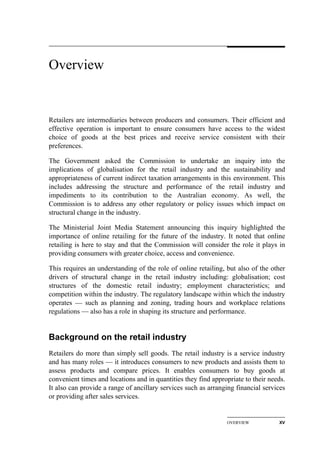
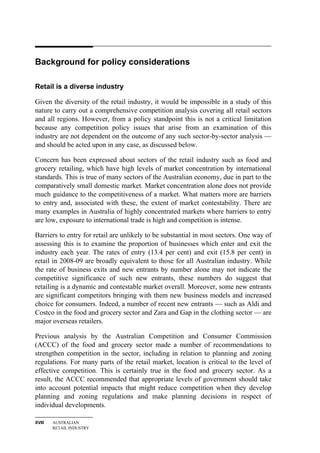
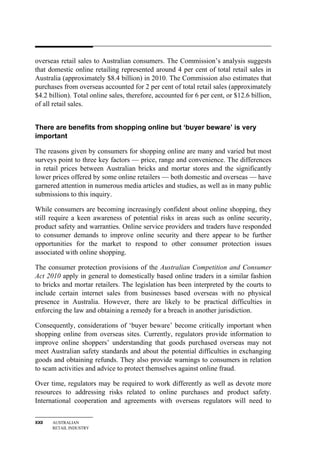
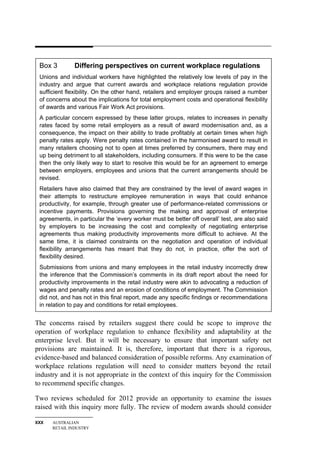
OVERVIEW
Key points
     There are almost 140 000 retail businesses in Australia, accounting for 4.1 per cent
      of GDP and 10.7 per cent of employment.
     The retail industry exhibits great diversity by: size of business, region, retail format,
      competition within sectors and in the nature of goods sold. Both current trading
      conditions and longer term trends are challenging. Retail sales growth has trended
      down over the past half decade as consumers save more of their rising incomes and
      their spending is increasingly directed towards a range of non-retail services.
     The retail industry has met many competitive challenges in the past. Online retailing
      and the entry of new innovative global retailers are just the latest. The intensified
      competition is good for consumers, but is challenging for the industry which, as a
      whole, does not compare favourably in terms of productivity with many overseas
      countries. And the productivity gap appears to have widened over time.
     Australia also appears to lag a number of comparable countries in its development of
      online retailing. The Commission’s best estimate is that online retailing represents
      6 per cent of total Australian retail sales — made up of 4 per cent domestic online
      ($8.4 billion) and 2 per cent from overseas ($4.2 billion). In some other countries,
      online sales figures are higher and set to grow further, as will also happen here.
     Retailers operate under several regulatory regimes that restrict their competitiveness
      and ability to innovate. Major restrictions which need to be addressed are:

      – planning and zoning regulations which are complex, excessively prescriptive, and
        often anticompetitive
      – trading hours regulations which restrict the industry’s ability to adapt and compete
        with online competitors and provide the convenience that consumers want.
     Workplace relations regulations may not provide sufficient workplace flexibility to
      facilitate the adoption of best practice productivity measures in the retail industry,
      and require examination in the reviews scheduled in 2012.
     The current level of the low value threshold (LVT) for exemption from GST and duty
      on imports of $1000 is judged to be a minor part of the competitive disadvantage
      faced by retailers. But there are strong in principle grounds for the LVT to be lowered
      significantly, to promote tax neutrality with domestic sales. However, the Government
      should not proceed to lower the LVT until it is cost effective to do so.
     The Government should establish a taskforce charged with investigating new
      approaches to the processing of low value imported parcels, particularly those in the
      international mail stream, and recommending a new process which would deliver
      significant improvements and efficiencies in handling without creating delivery delays
      or other compliance difficulties for importers and consumers.
     Once an improved international parcels process has been designed, the Government
      should reassess the extent to which the LVT could be lowered while still remaining
      cost effective — the costs of raising this additional revenue should be at least
      broadly comparable to the costs of raising other taxes.


XIV     AUSTRALIAN
        RETAIL INDUSTRY
Overview


Retailers are intermediaries between producers and consumers. Their efficient and
effective operation is important to ensure consumers have access to the widest
choice of goods at the best prices and receive service consistent with their
preferences.

The Government asked the Commission to undertake an inquiry into the
implications of globalisation for the retail industry and the sustainability and
appropriateness of current indirect taxation arrangements in this environment. This
includes addressing the structure and performance of the retail industry and
impediments to its contribution to the Australian economy. As well, the
Commission is to address any other regulatory or policy issues which impact on
structural change in the industry.

The Ministerial Joint Media Statement announcing this inquiry highlighted the
importance of online retailing for the future of the industry. It noted that online
retailing is here to stay and that the Commission will consider the role it plays in
providing consumers with greater choice, access and convenience.

This requires an understanding of the role of online retailing, but also of the other
drivers of structural change in the retail industry including: globalisation; cost
structures of the domestic retail industry; employment characteristics; and
competition within the industry. The regulatory landscape within which the industry
operates — such as planning and zoning, trading hours and workplace relations
regulations — also has a role in shaping its structure and performance.


Background on the retail industry
Retailers do more than simply sell goods. The retail industry is a service industry
and has many roles — it introduces consumers to new products and assists them to
assess products and compare prices. It enables consumers to buy goods at
convenient times and locations and in quantities they find appropriate to their needs.
It also can provide a range of ancillary services such as arranging financial services
or providing after sales services.


                                                                OVERVIEW           XV
There are almost 140 000 retail businesses in Australia and, with about 1.2 million
people or 10.7 per cent of the total working population employed in the industry, it
is one of Australia’s largest employers. Reflecting this, the retail industry also
makes a significant contribution to economic output, generating $53 billion or
4.1 per cent of GDP in 2009-10. However, its share of GDP has been declining
slightly over time reflecting slower growth than in other parts of the economy.

The retail industry is diverse — it covers a number of sectors (figure 1) which
exhibit differing characteristics. The bulk of the industry consists of what is termed
in ABS statistics other store-based retailing. This comprises department stores and
speciality stores such as furniture, electrical and electronic goods and clothing and
footwear retailers, among many others.

In the initial stages of this inquiry, the Commission indicated that it would exclude
from general consideration the fuel and motor vehicle retailing sectors, as the terms
of reference appear less applicable to those sectors.

Figure 1         Contributions to retail industry output and employment,
                 2009-10
           Industry gross value added                      Employment
            Non-store &                              Non-store &   Motor vehicles
                          Motor vehicles &
          commission (2%)                          commission (2%) & parts (8%)
                            parts (14%)
                                                                            Fuel (3%)
                                    Fuel
                                    (4%)


                                  Food                                          Food
                                 (29%)                                         (34%)
      Other store-based (51%)
                                               Other store-based (54%)


In 2009-10, sales for the retail sectors which are the main focus of this inquiry are
shown in table 1. The industry is diverse by sector, by region, and by size of
businesses and exposure to competition. The retail workforce has relatively low
skill levels and is relatively youthful with a high share of females. The workforce is
characterised by high levels of part time and casual working arrangements and high
rates of employment turnover.


XVI    AUSTRALIAN
       RETAIL INDUSTRY
Table 1        Retail sales, 2010
                                                           Sales            Share of total

                                                        $ billions                     %
Food                                                        96.6                    44.9
Household goods                                             42.8                    19.9
Clothing, footwear and personal accessory                   19.3                     9.0
Department stores                                           18.6                     8.7
Other                                                       33.5                    15.6
Online offshore (PC estimate)                                4.2                     2.0
Total                                                      215.0                   100.0
Online domestic (PC estimate)                                8.4                     4.0

There has been substantial commentary concerning the current difficult
environment for the retail industry. A focus on recent sales performance, however,
risks detracting from consideration of important longer term developments.

The growth rate of retail sales has generally trended down over the past two
decades, due to long-term or structural changes in the economy and consumer
behaviour. These changes are lessening the significance of spending on retail goods
in consumer budgets. The share of retail spending in overall consumer spending fell
from over 35 per cent in the early 1980s to just under 30 per cent currently.
Consumers are increasingly spending a greater share of their rising incomes on
services, such as financial services, property and accommodation, education, travel
and hospitality.

A major reason why consumers are spending a smaller share of their incomes on
goods sold by retailers is because many retail goods have become cheaper. More
recently, the appreciation of the Australian dollar has also placed further downward
pressure on the prices of imported goods. While this trend spells a challenge for
some retailers, consumers are better off — they are buying more retail goods, but at
relatively lower prices, and are able to use the additional remaining income to
satisfy other preferences, such as for consumer services or savings.

The long-term downward trend in the growth rate of retail sales has been
accentuated in recent years by the growing savings rate of households. In past
periods, the willingness of consumers to increase their overall spending at a rate
faster than their growth in disposable income compensated for the impact of the
falling share of consumer expenditure directed towards retail goods — this is
currently not happening. Over the longer term, the main drivers of retail sales
growth have been broader factors affecting the economy, in particular increasing
disposable incomes and population growth. This longer term decline in sales growth
has been reinforced in recent years by cyclical or short-term market weakness —
sales during 2011 are especially soft.
                                                                 OVERVIEW             XVII
Background for policy considerations

Retail is a diverse industry

Given the diversity of the retail industry, it would be impossible in a study of this
nature to carry out a comprehensive competition analysis covering all retail sectors
and all regions. However, from a policy standpoint this is not a critical limitation
because any competition policy issues that arise from an examination of this
industry are not dependent on the outcome of any such sector-by-sector analysis —
and should be acted upon in any case, as discussed below.

Concern has been expressed about sectors of the retail industry such as food and
grocery retailing, which have high levels of market concentration by international
standards. This is true of many sectors of the Australian economy, due in part to the
comparatively small domestic market. Market concentration alone does not provide
much guidance to the competitiveness of a market. What matters more are barriers
to entry and, associated with these, the extent of market contestability. There are
many examples in Australia of highly concentrated markets where barriers to entry
are low, exposure to international trade is high and competition is intense.

Barriers to entry for retail are unlikely to be substantial in most sectors. One way of
assessing this is to examine the proportion of businesses which enter and exit the
industry each year. The rates of entry (13.4 per cent) and exit (15.8 per cent) in
retail in 2008-09 are broadly equivalent to those for all Australian industry. While
the rate of business exits and new entrants by number alone may not indicate the
competitive significance of such new entrants, these numbers do suggest that
retailing is a dynamic and contestable market overall. Moreover, some new entrants
are significant competitors bringing with them new business models and increased
choice for consumers. Indeed, a number of recent new entrants — such as Aldi and
Costco in the food and grocery sector and Zara and Gap in the clothing sector — are
major overseas retailers.

Previous analysis by the Australian Competition and Consumer Commission
(ACCC) of the food and grocery sector made a number of recommendations to
strengthen competition in the sector, including in relation to planning and zoning
regulations. For many parts of the retail market, location is critical to the level of
effective competition. This is certainly true in the food and grocery sector. As a
result, the ACCC recommended that appropriate levels of government should take
into account potential impacts that might reduce competition when they develop
planning and zoning regulations and make planning decisions in respect of
individual developments.

XVIII   AUSTRALIAN
        RETAIL INDUSTRY
Technological innovation and the relative ease with which new online businesses
can be established have also substantially lowered barriers to entry and hence added
considerably to the competitive environment for retailers. Competitors are today not
just down the street or in the next suburb, but include easily-accessed suppliers
across Australia and overseas.

As a generalisation, smaller, non-perishable and easily shipped goods lend
themselves to online retailing and this is where the largest growth of domestic and
overseas online competition is occurring — this includes, for example, books,
CDs/DVDs, apparel, bike parts, cameras and accessories. Accordingly, the
competitive pressure faced by domestic retailers from online shopping varies
considerably depending on the nature of the goods sold. Further, the competitive
impact of online retailing is not confined to the market share of these retailers —
online retailers can, and do, have a more pervasive impact on the prices offered by
bricks and mortar retailers.


Indicators of performance of the retail industry — profits and
productivity

Whilst the factors mentioned above suggest that barriers to entry may be quite low
in parts of the retail industry, there are indications that barriers may be higher in
some sectors than would be desirable from a competition standpoint. One such
indicator is the relatively high profitability of some Australian retailers in
comparison with their counterparts overseas. Another indicator is the relative
profitability of some retail companies in comparison with other Australian
industries. In this regard, analysis by IBISWorld shows that many of Australia’s
larger retail firms have historically enjoyed relatively high returns on shareholders’
funds (figure 2).

Another related indicator is the relative productivity of Australian retailers. The
retail industry has experienced rates of labour productivity growth over the past two
decades similar, on average, to that of the rest of the Australian economy.
Notwithstanding this relatively sound performance in the rate of productivity
growth, the level of productivity in the retail industry remains below that of most
comparable countries in Europe and North America. Australia’s retail industry
labour productivity in 2007, in terms of output per hours worked, was lower than
most OECD countries (figure 3).


                                                                OVERVIEW           XIX
Figure 2                Return on shareholders’ funds (after tax)
                        Top 1350 Australian businesses (5 years to 2009-10)

      Government Admin. & Defence
                Transport and Storage
       Health & Community Services
                             Education
                         Manufacturing
     Cultural & Recreational Services
      Electricity, Gas & Water Supply
                        Other Services
                            Agriculture
       Property & Business Services
                               Average
                      Wholesale Trade
                          Construction
                   Finance & Insurance
                            Hospitality
                       Communications
                           Retail Trade
                                 Mining

                                          0    5        10        15           20    25         30   35
                                                                        Per cent


Figure 3                Retail labour productivity, 2007
                        Gross value added/hour worked
                        US = 100

                 US
              France
                 UK
           Germany
             Finland
              Ireland
                Italy
             Canada
        AUSTRALIA
               Spain
             Greece
              Japan
               Korea

                        0                 20       40           60              80        100        120
                                                             US = 100


It appears that the size of the gap in retail productivity between Australia and the
leading overseas countries has been widening over the medium term. While it may
not be realistic for Australia to attain similar productivity levels to those achieved
overseas — especially compared to the United States — there would be benefits for

XX        AUSTRALIAN
          RETAIL INDUSTRY
consumers and retailers alike if Australian retailers started to close this widening
productivity gap.


The nature of retailing is changing

The rise of online shopping

Much of retailing in Australia is changing in response to the increased competition
arising from the popularity of online shopping. But the challenge of change is
hardly new to the retail industry. Advances in technology and other retail
innovations, mostly overseas changes adapted to local conditions, have led to the
nature of Australian retail changing dramatically over many decades. The pressure
from online retailing is not unique to Australia either — these competitive forces
are being felt around the world.

The traditional intermediation role of retailers is being undermined in certain market
sectors with manufacturers selling directly to consumers through the internet,
thereby bypassing retailers. At the same time, different models of retailing are
appearing — existing bricks and mortar retailers are incorporating online retailing
and becoming ‘multi-channel retailers’ and a sizeable number of online-only
retailers (‘pure plays’) have also emerged. Some of the new international bricks and
mortar retailers are also investing directly in Australia and bringing novel business
models and low cost international supply chains, which offer benefits to consumers.
On the other hand, the activity of bricks and mortar retailers are unlikely to be
affected as much by online suppliers where they offer services which are highly
valued by the consumer, such as personal interaction, physical presence or
immediate fulfilment.

The internet has changed the nature of retail competition not only by bringing far
more competitors into the market, but also by changing the role of consumers.
Many traditional retail services can now be easily carried out by consumers over the
internet. People can use their computers, smart phones, and other mobile devices to
compare the prices and features of dozens of goods from hundreds of retailers
across the world and then arrange home delivery. Nor do consumers just rely on
traditional advertising or product tests to inform themselves about a product. There
is a proliferation of websites providing online reviews and customer discussion.

It is clear that online retailing is growing rapidly. But for such a widespread social
phenomenon there is little hard evidence of the extent of online retailing in
Australia. No official statistics are provided by the ABS on the size of domestic or

                                                                OVERVIEW           XXI
overseas retail sales to Australian consumers. The Commission’s analysis suggests
that domestic online retailing represented around 4 per cent of total retail sales in
Australia (approximately $8.4 billion) in 2010. The Commission also estimates that
purchases from overseas accounted for 2 per cent of total retail sales (approximately
$4.2 billion). Total online sales, therefore, accounted for 6 per cent, or $12.6 billion,
of all retail sales.


There are benefits from shopping online but ‘buyer beware’ is very
important

The reasons given by consumers for shopping online are many and varied but most
surveys point to three key factors — price, range and convenience. The differences
in retail prices between Australian bricks and mortar stores and the significantly
lower prices offered by some online retailers — both domestic and overseas — have
garnered attention in numerous media articles and studies, as well as in many public
submissions to this inquiry.

While consumers are becoming increasingly confident about online shopping, they
still require a keen awareness of potential risks in areas such as online security,
product safety and warranties. Online service providers and traders have responded
to consumer demands to improve online security and there appear to be further
opportunities for the market to respond to other consumer protection issues
associated with online shopping.

The consumer protection provisions of the Australian Competition and Consumer
Act 2010 apply in general to domestically based online traders in a similar fashion
to bricks and mortar retailers. The legislation has been interpreted by the courts to
include certain internet sales from businesses based overseas with no physical
presence in Australia. However, there are likely to be practical difficulties in
enforcing the law and obtaining a remedy for a breach in another jurisdiction.

Consequently, considerations of ‘buyer beware’ become critically important when
shopping online from overseas sites. Currently, regulators provide information to
improve online shoppers’ understanding that goods purchased overseas may not
meet Australian safety standards and about the potential difficulties in exchanging
goods and obtaining refunds. They also provide warnings to consumers in relation
to scam activities and advice to protect themselves against online fraud.

Over time, regulators may be required to work differently as well as devote more
resources to addressing risks related to online purchases and product safety.
International cooperation and agreements with overseas regulators will need to


XXII   AUSTRALIAN
       RETAIL INDUSTRY
assume higher priority otherwise, there is a risk regulatory arrangements may not
keep pace with this rapidly globalising and changing marketplace.


Regional price discrimination is now much more visible

There are often large price differences between the goods offered by domestic and
overseas retailers. Various factors can contribute to such price differences. They
include access by retailers to competitive offers, out of season specials, differences
in profit margins and underlying cost structures — for example, differences in rent
and other occupancy costs, wages and other labour costs and government taxes.

The Commission is also aware of the longstanding practice by which some
international suppliers set differential regional prices. This effectively treats
consumers in one region as willing, or able, to tolerate significantly higher prices
than those in other regions. Australian consumers have an increasing awareness of
such price differences and are now able, in many cases, to circumvent them by
directly ordering online. This represents an example of ‘parallel importing’ which is
the import of genuine products without the permission of the local licensee. Some
international suppliers have attempted to defend price discrimination due to the cost
of supplying a remote and relatively small market like Australia, which in some
cases has its own unique requirements. These arguments, in most cases, are not
persuasive, especially in the case, for example, of downloaded music, software and
videos where the costs of delivery to the customer are practically zero and uniform
around the world.

Addressing such regional price discrimination is one of the main challenges for
local retailers. If retailers cannot purchase the goods that they resell at competitive
prices, more business exits and loss of employment will occur. The threat of parallel
imports may help motivate international suppliers to change their regional pricing
policies. It would seem likely that many international suppliers will want to retain
local agents and retailers to support and service their products in the Australian
market. From a policy standpoint, Government should ensure that any
anticompetitive behaviour which inhibits retailers from purchasing competitively is
addressed — in this regard there are reported attempts by distributors to limit
parallel importing (box 1).


                                                                 OVERVIEW          XXIII
Box 1          Issues which may inhibit parallel importing
 Retailers have given examples of local agents or subsidiaries of companies supplying
 internationally traded goods threatening to withdraw supply if retailers attempt to
 parallel import some of their range. The ACCC advised that, although each situation
 would need to be carefully assessed with regard to the individual circumstances,
 generally a retailer should be able to parallel import and resell a genuine product
 legally purchased overseas. They would, however, need to carefully disclose any
 warranty issues or differences in the quality or style of the product compared to what
 consumers might normally expect. The behaviour of a local agent threatening to
 withdraw supply as a consequence of such action would need to be assessed, but
 might constitute illegal behaviour were it to substantially lessen competition or be
 considered a misuse of market power. (It should be noted, however, that these can be
 ‘high hurdles’ to prove.)
 The operation of regulations affecting intellectual property rights have different impacts
 on genuine goods which are legally purchased overseas and are then parallel imported
 for subsequent resale. Generally, the Trade Marks Act does not prevent the resale of
 such goods bearing a trade mark which have been parallel imported. However, the
 Copyright Act can be used to prevent resale of parallel imported goods in certain
 circumstances.
 For example, clothing or other goods which embody decorative graphic images, which
 have been purchased with the copyright owner’s permission in another country cannot
 be parallel imported and then resold in Australia without the permission of the holder of
 the Australian copyright for the image. The law as it stands appears to have
 undesirable anticompetitive effects and confers more power on the owner of the
 copyright than applies in the case of the owner of a trademark. This matter should be
 considered by the Australian Law Reform Commission in its forthcoming examination
 of copyright law.


Retailers’ requests for assistance

It is clear that some of the newly trade-exposed sectors of the domestic retail
industry are not able to compete purely on price with overseas online retailers. The
Commission has received submissions calling for more government assistance to
the retail industry and for representation at a ministerial level of government.
Government responses along these lines would not address the fundamental
challenges facing the industry. Rather they run the risk of deflecting attention from
reforms that would have a real impact and the actions that the industry itself should
take to ensure market success.

The task for government is not to pick retail winners. Rather it is to help ensure that
bricks and mortar and online Australian retailers can respond effectively to the

XXIV   AUSTRALIAN
       RETAIL INDUSTRY
increasingly global retail marketplace. This can be accomplished by not
unnecessarily constraining retailers’ ability to adapt their business models in
response to changing consumer preferences.


Regulatory environment
The retail industry operates under several broad regulations, including those that
determine where retailers can locate, the nature and format of the stores that can be
established, when they can open for business and their workplace arrangements.


Planning and zoning

Planning and zoning regulation serves a valuable social purpose, but also restricts
the flexibility of retailers in responding to consumers’ preferences. In essence, the
key question is to what extent the existing planning regulations prevent the entry of
market participants beyond that consistent with achieving other planning objectives.

The Commission’s 2011 report Performance Benchmarking of Australian Business
Regulation: Planning, Zoning and Development Assessments found that planning
guidelines regarding where retailers can locate are extremely complicated and often
prescriptive and exclusionary. In effect, they make it difficult for some new entrants
to find suitable land and enter the market, and for existing businesses to expand or
alter formats, thus interfering with the market’s ability to allocate land to its most
valued uses.

Specific restrictions on competition include: zoning which unnecessarily reduces
land availability for particular uses; overly prescriptive local planning rules which
inhibit entry and create unwarranted delay and costs through compliance burdens;
and inappropriate protections of existing businesses and activity centres through
adverse impact tests.

Businesses, for example, with new retail formats wishing to establish themselves in
existing or proposed activity centres would be greatly assisted by broadened zone
definitions and reduced prescriptiveness in planning regulations. For example, these
changes could allow uses that included commercial, light industrial and retail in the
one business zone, unless significant negative externalities might arise, such as
traffic congestion, excessive noise or pollution. Industrial zones would then be
limited to only high-impact industrial uses. Such planning and zoning changes
would remove the need for ad hoc changes to council plans to accommodate each
variation in retail business models. This would have three effects:

                                                                OVERVIEW          XXV
   reduce the incentives for some retailers to distinguish themselves from other
    retailers to engender differential planning treatment in order to gain a
    competitive advantage through access to cheaper land
   reduce the continual need for spot rezoning, thereby making it easier for
    governments to implement a consistent and coordinated approach to planning
    and land use
   enable more, and facilitate the use of, ‘as of right’ development for retailers.

Using adverse impact tests to restrict new developments in an attempt to preserve
existing businesses is quite common in the planning system, but in the
Commission’s view is unjustifiable. To prevent new entry in an attempt to protect
individual businesses or a group of businesses (such as a shopping centre) that may
be less closely matched to evolving market requirements weakens the ability of
retailers to respond to consumer preferences.

Providing sufficient land at the strategic planning stage, with sufficiently broad
uses, should enable retailers to locate in areas where they judge they can best
compete — planning should be able to accommodate even the newest of current
business models requiring significant floor space. Under such conditions, a new
retail proposal in a non-designated area should be rare. However, in this situation,
considerations of externalities such as traffic congestion and the viability of existing
or planned new centres can be an important aspect of city planning which may
justify accepting some reduction in competition.

The proposed development of an out-of-centre retail location should be permitted
where it is likely to generate a net benefit to the community, even if there are likely
to be some detrimental impacts to an existing activity centre or to the commercial
interests of individual businesses within that centre. Where business failures in
existing centres occur, planning rules need to be sufficiently responsive to enable
such centres to be revitalised in a timely fashion by a different mix of businesses or
uses.

Now that consumers can shop for many goods from their homes for reasons of
convenience — undermining locational advantages enjoyed in the past by some
forms of retail — the flexibility of the planning system becomes an increasingly
important consideration in the capacity of bricks and mortar retailers to both
compete and improve their productivity.


XXVI   AUSTRALIAN
       RETAIL INDUSTRY
Retail tenancy

Planning and zoning constraints appear to be the root cause of many of the concerns
in the retail tenancy market expressed to the Commission. Simply put, occupancy
rates are extremely high in shopping centres due to strong demand for retail space in
the face of constrained supply. This places smaller retailers — who do not have the
bargaining power of anchor tenants or chain specialty stores — in a very tough
bargaining situation (box 2). While it is possible for these retailers to ‘vote with
their feet’ and move to shopping strips or other locations, the alternative sites are
not always commercially attractive.


 Box 2        Continued concerns about retail tenancy
 The market for retail tenancy leases is important for retailers because occupancy costs
 are one of the major cost drivers for the retail industry. The main concerns raised by
 participants to this inquiry relate to leasing arrangements within shopping centres.
 Similar concerns were raised in the Commission’s 2008 retail tenancy inquiry.
 There is scope to improve the retail tenancy market by removing unnecessary
 restrictions on competition and constraints on the supply and location of retail space
 through reforms to the planning and zoning regulations. Implementing these reforms
 would potentially increase competition between shopping centre landlords, and reduce
 the bargaining power of landlords vis-à-vis their tenants, by improving tenants’ ability to
 relocate close by and preserve their businesses after lease expiry.
 Retail tenancy legislation that has sought to influence conduct through prescribing
 aspects of the landlord–tenant relationship has not been successful in improving
 relationships between landlords and tenants in shopping centres. The adversarial
 nature of the relationship between landlords and tenants and the more extreme
 negotiating tactics could be potentially moderated by the introduction of a voluntary
 national code of conduct for shopping centre leases as previously recommended by
 the Commission’s retail tenancy inquiry report in 2008.


In the Commission’s view, further refinements to retail tenancy regulation are
unlikely to result in significant improvements to the operation of the retail tenancy
market given the distortions and constraints arising from planning and zoning
regulation.


Trading hours

Legislation regulating retail trading hours has varied objectives, including providing
some small businesses with the opportunity to trade without competition from larger
retailers. In recent decades, some state governments have recognised that changes in

                                                                      OVERVIEW           XXVII
social patterns — such as the attractiveness to some employees of more flexible and
non-traditional working hours, the growing participation of women in the workforce
and growth of both dual income and single parent households — have necessitated
changes to retail trading hours, and they have relaxed some trading hours
restrictions.

Trading hours are fully deregulated in the ACT and the Northern Territory —
retailers can choose to trade whenever they want, including on public holidays.
Beyond the two territories, restrictions on trading hours apply with varying levels of
intensity, with Western Australia, South Australia and Queensland having the most
restrictive regulations. The experience with deregulated trading hours is that most
retailers do not trade 24/7. Instead they choose to open at times when consumers are
most likely to want to shop for the goods they sell, and when they can trade
profitably. This means that many retailers, for example, voluntarily remain closed
on traditional public holidays such as Christmas Day, Good Friday and the morning
of Anzac Day.

Currently, regulations on trading hours vary between and within jurisdictions, but in
all cases where they are present, some retailing services are exempted. Restrictions
tend to discriminate between retailers on the basis of products sold, size and
location.

Trading hours regulation has also been seen as assisting retail workers to maintain
contact with their families and the broader community by ensuring common leisure
time. But there does not appear to be any compelling evidence of a relationship
between the regulation of retail trading hours and such social connectedness.

The Commission is aware that there will be some workers who do not want to work,
for example, on Sundays or public holidays even with the added remuneration
arising from the payment of penalty rates. But it should also be recognised that
deregulation of trading hours provides those individuals who prefer to work outside
of ‘normal hours’ with job opportunities they would not have otherwise. And for
other workers there is the opportunity to earn additional income by receiving
penalty rates for such work.

As consumers have become increasingly time poor, they have placed a higher value
on shopping convenience in terms of when they can shop and where they can shop.
Shifting to online shopping may mitigate the loss of consumer welfare to some
extent. However, forcing shoppers online because of restrictions on trading hours
does not maximise consumer welfare. Also such restrictions constrain bricks and
mortar retailers in responding to consumer preferences.


XXVIII   AUSTRALIAN
         RETAIL INDUSTRY
In today’s more competitive retail trading environment, where consumers have
greater access to goods from all over the world and can order those goods any time
of the day or night, there is a greater imperative for retailers to have the ability to
respond to changing consumer tastes and preferences. Indeed, there appears to be
some evidence that there has been greater use of online retailing in states where
shopping hours are restricted.

The Commission proposes that retail trading hours should be fully deregulated in all
states, just as they are in both the territories.


Workplace practices

The retail industry is highly labour intensive with over 70 per cent of its value
added accruing to workers in the industry. Accordingly, the way in which workers
are employed, their productivity and the flexibility of workplace practices are
important for the future of the industry. Because workplace employment regulations
underpin workforce engagement decisions, they play an important role in shaping
workplace practices, competitiveness and productivity outcomes and therefore have
been considered in this report. The level of award reliance of the retail workforce,
although declining, remains relatively high. This suggests that many retail
employers and their employees have not taken full advantage of the opportunities
that have existed under past and current workplace regulations to examine how their
workplace practices might be improved to lift productivity. Various stakeholders
have clearly different views regarding the operation of workplace employment
regulations (box 3).

It is clear that if those sectors of the Australian retail industry now exposed to
international competition are to have the best chance of competing effectively, the
productivity of workers will need to more than keep pace with future wage
movements. The competition from overseas online retailers will place pressure on
domestic retailers’ existing activity and employment levels. A strong commitment
will be required from employers, employees and unions to working cooperatively
through agreement making, but also more broadly to deliver productivity
improvements and narrow the existing gap between the Australian retail industry’s
productivity levels and international best practice. Narrowing the productivity gap
between retailers in Australia and those overseas — who now, through the online
medium, are effectively direct competitors in many retail sectors — will be of
critical importance for the future prosperity of this industry, its employees and for
Australian consumers.


                                                                 OVERVIEW          XXIX
Box 3         Differing perspectives on current workplace regulations
 Unions and individual workers have highlighted the relatively low levels of pay in the
 industry and argue that current awards and workplace relations regulation provide
 sufficient flexibility. On the other hand, retailers and employer groups raised a number
 of concerns about the implications for total employment costs and operational flexibility
 of awards and various Fair Work Act provisions.
 A particular concern expressed by these latter groups, relates to increases in penalty
 rates faced by some retail employers as a result of award modernisation and, as a
 consequence, the impact on their ability to trade profitably at certain times when high
 penalty rates apply. Were penalty rates contained in the harmonised award to result in
 many retailers choosing not to open at times preferred by consumers, there may end
 up being detriment to all stakeholders, including consumers. If this were to be the case
 then the only likely way to start to resolve this would be for an agreement to emerge
 between employers, employees and unions that the current arrangements should be
 revised.
 Retailers have also claimed that they are constrained by the level of award wages in
 their attempts to restructure employee remuneration in ways that could enhance
 productivity, for example, through greater use of performance-related commissions or
 incentive payments. Provisions governing the making and approval of enterprise
 agreements, in particular the ‘every worker must be better off overall’ test, are also said
 by employers to be increasing the cost and complexity of negotiating enterprise
 agreements thus making productivity improvements more difficult to achieve. At the
 same time, it is claimed constraints on the negotiation and operation of individual
 flexibility arrangements has meant that they do not, in practice, offer the sort of
 flexibility desired.
 Submissions from unions and many employees in the retail industry incorrectly drew
 the inference that the Commission’s comments in its draft report about the need for
 productivity improvements in the retail industry were akin to advocating a reduction of
 wages and penalty rates and an erosion of conditions of employment. The Commission
 did not, and has not in this final report, made any specific findings or recommendations
 in relation to pay and conditions for retail employees.


The concerns raised by retailers suggest there could be scope to improve the
operation of workplace regulation to enhance flexibility and adaptability at the
enterprise level. But it will be necessary to ensure that important safety net
provisions are maintained. It is, therefore, important that there is a rigorous,
evidence-based and balanced consideration of possible reforms. Any examination of
workplace relations regulation will need to consider matters beyond the retail
industry and it is not appropriate in the context of this inquiry for the Commission
to recommend specific changes.

Two reviews scheduled for 2012 provide an opportunity to examine the issues
raised with this inquiry more fully. The review of modern awards should consider

XXX   AUSTRALIAN
      RETAIL INDUSTRY
the concerns that relate specifically to the operation of relevant awards, including
the General Retail Industry Award. The post-implementation review of the Fair
Work Act 2009 will be a timely opportunity to examine broader concerns about
aspects of the operation of the Act.


Appropriateness of current indirect tax arrangements


The economic impact of the low value threshold

Many submissions to this inquiry suggested that the level of the low value threshold
(LVT) for application of GST and duty to imports is undermining the competitive
position of Australian retailers in comparison to overseas online retailers.
Consumers are able to import goods from overseas retailers free of GST and
customs duty up to a limit of $1000, whereas Australian retailers must incur the
costs of GST and duty (where applicable) on the goods they sell.

In principle, the GST, as a broad based consumption tax, should apply equally to all
transactions, to ensure tax neutrality across different markets and goods — in other
words, overseas and domestic retailers should be treated similarly. A low value
threshold for imports can be seen as operating as a ‘negative tariff’ for the domestic
retail industry and their suppliers. Under these circumstances, the domestic industry
receives negative assistance in that the industry’s activities are taxed while overseas
competitors are not. This can be seen as undermining the principle of tax neutrality,
thereby distorting resource allocation.

As a consequence, it can be expected that domestic retail sales will contract
somewhat due to the operation of the threshold and some resources may flow from
the more efficient activities in the domestic retail industry towards less efficient
alternatives. However, consumers benefit by way of lower prices on imported goods
below the value of the threshold.

Another principle is that taxes should be collected efficiently to minimise the
‘deadweight loss’ for the community. This deadweight loss arises from not only the
administrative and compliance costs, but also any undue delays in delivery to
businesses and consumers that may result from the processes of collection. Public
policy analysis of this question must factor in the overall economic benefits and
costs of lowering the threshold.

The low value threshold with respect to the application of customs duty undermines
the protective effect of the tariff assistance provided to industries where duty is
applicable. Again, however, the negative effect of the threshold on industry needs to

                                                                 OVERVIEW          XXXI
be weighed against the benefits consumers receive from lower costs of goods and
the administrative and compliance costs of collection. These collection costs for
duty are currently likely to be far more substantial than the costs of the collection of
GST because of the varying rates of customs duty according to product category
and source country. Ascertaining the correct rate of customs duty is often beyond
the expertise of ordinary consumers and can require the assistance of customs
brokers.

Indicative analysis carried out by the Commission suggests that the welfare gains
from lowering the threshold are not large in comparison to the current collection
costs. This emphasises the importance of ensuring that collection costs are
substantially reduced before any decision is taken to reduce the level of the
threshold thus ensuring that the revenue raised is collected in a cost effective
manner.

Revenue and costs of collection

Low value parcels entering Australia do so through two broad streams — the
express courier and the international mail streams. The vast majority enter through
the international mail stream. In 2010-11, 10 million parcels entered through the
express courier stream and the Commission estimates that over 47 million parcels
entered through the international mail stream (table 2).

Table 2          Estimated number and value of international mail parcels
                 entering Australia, 2010-11
Value range               Percentage in range -   Percentage in range –   Estimated number of
                                lower estimate          upper estimate         parcels in range
$
                                                                                       Millions

0-100                                    68.59                   75.16                    34.85
101-200                                  12.85                   12.95                     6.26
201-300                                   4.85                    6.11                     2.66
301-400                                   2.45                    3.73                     1.50
401-500                                   1.61                    2.34                     0.96
501-600                                   1.17                    1.18                     0.57
601-700                                   0.88                    0.89                     0.43
701-800                                   0.02                    0.37                     0.09
801-900                                   0.02                    0.26                     0.07
901-1000                                  0.02                    0.28                     0.07
Total                                                                                     47.46

Table 2 presents the current analysis of the value of mail parcels, based on
information provided by Australian Customs and Border Protection Service


XXXII   AUSTRALIAN
        RETAIL INDUSTRY
(Customs). A significant majority of parcels by number had a value well below
$100.

The Commission has estimated the additional revenue that might be collected if the
threshold were reduced (see figure 4). For reasons of simplicity this analysis ignores
any consumer price response due to the consequent taxes and additional costs
imposed. Because the value of the majority of international parcels is low,
significant amounts of tax revenue do not start to be collected until the LVT is also
quite low.

Figure 4                          Estimated additional gross revenue (excluding collection
                                  costs) at lower threshold levels, 2010-11
                                  For air cargo and international mail


                        600


                        500
Additional revenue $m


                        400


                        300


                        200


                        100


                          0
                              0       100        200       300        400         500        600        700         800   900
                                                                  Threshold level set at $

                                            Additional Customs Duty     Additional GST       Additional Total revenue


The current processes in the Australian mail system for assessing the GST and duty
payable, and collecting this (plus the processing charge of $48.85), are very labour
intensive and involve a complicated and time consuming multi-step process
between Customs, Australia Post and the consignee. The express couriers’ process
appears somewhat more efficient, with a slightly lower processing charge ($40.20).

The implications from lowering the LVT

A decision to lower the LVT under current processing arrangements would only be
supported by the Commission if the net benefits to the community from the

                                                                                                         OVERVIEW               XXXIII
improvements in tax neutrality were sufficiently high to cover the very high
collection costs. The Commission’s assessment is that this is not currently the case.

Taking the current collection charges as a crude proxy for all collection costs (and
ignoring the possible need to engage a customs broker) what would happen if
Australia simply lowered its threshold to a level like that of Canada — a LVT of
$20? Many submissions have advocated such an approach. This would satisfy the
requirements of tax neutrality by subjecting the vast majority of incoming parcels to
GST and duty collection. Over 30 million mail parcels would then need to be
processed for GST and duty — compared to the level of 20 000 parcels in 2009-10.
Lowering the threshold to $20 would raise in excess of $550 million in tax revenues
but the cost of the processing using the current system would escalate to over
$2 billion — more than three times the additional revenue collected. Moreover, the
Commission’s indicative modelling suggests that, given the current high
deadweight costs of collection, even after taking into account the gains flowing
from greater tax neutrality, the net impact on overall community welfare would
almost certainly be negative.

An alternative approach would be to make only a small movement towards a lower
threshold — to $900 for example. But this would leave 99 per cent of parcels with
no tax and duty collected, making little difference to tax neutrality and failing to
address concerns about ‘the lack of a level playing field’. At this threshold level, the
number of mail parcels required to be processed would be over three times the
current level, and with the current processing system, even this small increase is
likely to cause significant delivery delays. Moreover, in the Commission’s
judgement, an interim and partial reduction would be mainly symbolic and likely to
consume resources that would better be devoted to exploring the best and most
expeditious manner to reduce collection costs and enable a cost-effective approach
to greater tax neutrality.


There is a need to improve parcel handling processes

Before any decision is taken to reduce the threshold, collection costs need to be
reduced. The current parcel handling logistics processes used in Australia by
Customs and Australia Post need to be significantly improved. In fact, such
processes need to be examined even without changes to the LVT as they appear not
to be up to the task of accommodating the future demands from the expected growth
in online retailing. An overall examination of the processing system should also
seek to lower costs of processing incoming parcels handled by express couriers. The
challenges are less than with the mail system, but costs are still far too high to be
appropriate with a much lower LVT.

XXXIV   AUSTRALIAN
        RETAIL INDUSTRY
A reasonable question to ask is why the current processes are so manual and
‘clunky’ given the availability of sophisticated technology and automation. The
more sophisticated tracking and parcel information systems of the express couriers,
for example, are clearly superior to the mail system at this point. The answer is
twofold.

Firstly, the existence of a high LVT has not created a need for the postal and
customs processes to be upgraded. Even with the growth in overseas online
shopping, the number of parcels to be processed has, until recently, been
manageable. Secondly, the mail system is subject to international agreements which
include many countries with limited capacity to make rapid technological
improvements to their parcel systems.


Where to from here?

The Government should establish a taskforce of independent experts, advised by
representatives from Customs, Australia Post, Australian Quarantine and Inspection
Service (AQIS) and the express couriers, to investigate a new approach to
processing parcels, particularly those in the international mail stream. Given process
improvements in other countries to draw on as examples, there is no reason not to
expedite this investigation and set the taskforce a timetable of reporting in 2012.
Design criteria for a new approach to processing parcels are set out in box 4.


 Box 4         Design criteria for parcel processing
 The design criteria for a new approach to processing parcels should include:
    imposing minimum delays in the delivery of parcels to businesses and consumers
    allowing for the large expected increase in parcel volumes associated with the
     growth of online retailing
    passing on collection costs to the end consumer
    minimising manual processes to the greatest extent possible
    imposing no added barrier to trade, or protection of domestic industry from import
     competition
    not having a higher threshold for gifts, if this would add to complexity and to
     incentives to inappropriately use any special exemption
    being compatible with the needs of Customs and AQIS for their other border
     protection responsibilities.


Overseas approaches to the collection of tax revenue should be examined by the
taskforce, including the overseas online retailer practices of upfront tax collection,
                                                                   OVERVIEW         XXXV
the use of the postal service to collect revenues and charges, and the simplification
of duty assessment. Some of these initiatives are set out in box 5.


 Box 5           The rapidly changing world of handling parcels
 Other countries, such as the United Kingdom and Canada have been grappling with
 the challenges of processing and handling significantly increased volumes of mail
 parcels and collecting tax and duties on them. Several have developed improvements
 that may hold promise for Australia. These include:
    encouraging online retailers to design their systems so that the costs to consumers
     (including taxes) are included and visible at the time of ordering and payment.
     These goods then enter the destination country either with the taxes prepaid and
     directly remitted by the vendor, or with the taxes being handled by a local broker
     (primarily this occurs in the case of express couriers). For the consumer, the
     process is seamless (with no delay in delivery). Such online shopping designs
     already exist for a number of major online retailers in other countries — not
     necessarily because of government prompting, but as a competitive service to their
     customers
    the use of more intelligent bar codes for parcels moving through the mail. This is
     currently under consideration by some of the larger international mail agencies.
     Trials are also being carried out involving the exchange of data files containing
     information about the contents and value of mail parcels which would facilitate more
     efficient processing and clearance through Customs
    in other countries, the postal service is the collector of revenues. For mail parcels
     entering Australia, using Australia Post to collect the revenue and processing
     charges, rather than the current multi-step ‘clunky’ process between Australia Post
     and Customs could improve efficiency. This mechanism would likely require
     enabling legislation in Australia
    other countries like the United Kingdom and Canada have also greatly simplified
     duty assessment by having a limited number of rates and classifications (e.g. ten or
     less) for low value items. The current Australian system of entering items by
     individual tariff code is complicated, often requiring the use of a customs broker. An
     alternative might be to have a higher threshold for the application of duty than that
     applied to GST, given the relatively small amount of additional revenue collected
     through duties.


The Commission also examined whether the duty and GST thresholds should
remain linked and formed no definitive view. There is no overwhelming reason for
these thresholds to be linked, however, the rationale for retaining their linkage —
competitive neutrality and administrative simplicity — will rest on the assessment
of the collection costs and decisions with respect to duty simplification. The
taskforce should also assess this matter as part of its terms of reference.

XXXVI   AUSTRALIAN
        RETAIL INDUSTRY
Once the taskforce reports with its recommended new approach to processing
parcels, the LVT should then be reassessed and the appropriate threshold for
Australia determined.

In determining the most appropriate level to which the LVT should be lowered, the
additional tax revenue from all sources should be compared to the costs of
collection and any other costs to consumers and businesses, such as the loss of
consumer surplus.

An appropriate timeline and any transitional arrangements for implementation
should also be recommended by the taskforce. The Commission understands that
the investment required in the mail system is likely to be significant and it could
take some time to reach full implementation.

This approach, however, does not address the issue of what to do about the taxation
of imported intangibles such as downloaded music and software (box 6).


 Box 6        The position regarding taxes on imported intangibles
 The Commission notes that any move to lower the level of the LVT would have no
 impact on the taxation of the importation of services and intangibles — for example,
 downloads of software, music and games. Treasury estimates that such imports
 currently give rise to around $1 billion of GST revenue foregone. The Commission is
 not aware of any international examples of countries outside the European Union that
 have successfully found a method of cost effectively collecting taxes on these
 intangibles, although it is aware that many countries continue to be concerned about
 this growing source of revenue leakage. The Australian Government and particularly
 the ATO should maintain a watching brief on any international developments which
 might facilitate tax collection on imported intangibles. Any effective approach to this
 issue would appear to require international cooperation.


A number of retailers and retail associations expressed support for the
Commission’s draft recommendation that in principle the LVT should be lowered,
but expressed great concern about the time delays involved in the process
recommended. But the retailers’ competitive disadvantage caused by the current
lack of tax neutrality is not seen to be sufficient reason to hastily implement a costly
and inefficient system. Indeed, the current level of the LVT is judged not to be the
most significant factor explaining the growth of online shopping from overseas
websites. Consumers are also responding to the generally lower prices, greater
product range and convenience offered by online shopping from overseas compared
to that offered by many bricks and mortar stores in Australia. However, the
Commission accepts that the process for moving to implement an improved
collection system and a lower LVT should be progressed expeditiously.

                                                                   OVERVIEW         XXXVII
For this reason, the Commission has recommended that the taskforce should report
in 2012 recommending a tight, but achievable timetable for improving the
processing system.


Other regulatory burdens

Participants raised a range of other concerns about regulations at the Australian and
state, territory and local government levels that in their view are hindering the retail
industry’s ability to respond efficiently to the demands and preferences of
consumers. In particular, retailers that operate across jurisdictions are experiencing
inefficiencies in their operations as a result of inconsistent regulations across
jurisdictions. For example, the differing requirements relating to the display of
tobacco products, or broader areas of concern to industry such as transport;
environmental; occupational, health and safety and taxation regulations.

Several of the concerns raised are not new and have been examined in previous
Commission reports or other review processes. Others are the subject of ongoing
review and reform processes, for example, as part of the COAG ‘national seamless
economy’ reform agenda. However, they highlight the need for governments to
continue to prioritise efforts directed at the review and reform of regulations that are
unnecessarily burdensome and to reduce regulatory inconsistency across
jurisdictions where that would afford net benefits to business and the community.
They also suggest the need to consider how existing quality control processes for
new or amended regulation, including the application of Regulation Impact
Statement processes, can be improved to minimise the risk that future regulation
will impose unnecessary burdens. 


The process of change
Retailers face a changing market landscape and a stronger requirement than in the
past to respond to changing consumer preferences and new international online
competitors. They need to consider ways to improve their levels of productivity and
competitiveness. The pursuit of international best practice productivity and service
levels will require improvements on many fronts. These include: better customer
and after sales service; superior logistics and management of working capital;
greater automation; better management and leadership; and a multi-skilled and
flexible workforce prepared to lead and facilitate innovative means of delivering
value for customers, in some cases with better staff and management alignment
through incentives or commissions.


XXXVIII AUSTRALIAN
        RETAIL INDUSTRY
In a recent submission to the House of Representatives Standing Committee on
Economics, the Commission noted that improving productivity at a firm level
involves a number of inter-related components which can be summarised under the
headings of:
   incentives — the external pressures and disciplines on organisations to perform
    well. The most critical incentive usually being competition. Arguably, the retail
    industry in Australia has historically experienced a relatively benign competitive
    environment compared to that in other countries. This may have reduced
    incentives for retailers to see productivity improvements as a priority. The
    growth of online retailing is clearly changing this environment
   flexibility — the ability to make changes to respond effectively to market
    pressures. Here workplace regulations, planning and zoning and trading hours
    regulations are important factors
   capabilities — the human and knowledge capital, as well as infrastructure and
    institutions, that are needed to make necessary changes. This importantly
    includes the quality of leadership and management in an organisation. The retail
    industry has invested considerable capital over the past two decades, but has
    lagged in recent years in raising its levels of multifactor productivity. To do so
    will require more innovative use of the combination of capital and labour, to
    develop new and better ways of delivering the products and services that
    consumers want.

All three components influence the motivation and ability of organisations to
innovate and adopt improvements. Government policies have an important role to
play in helping to ensure that competition is not restricted and in ensuring that
regulations do not unnecessarily hinder firms from addressing the issues that are
rightly their responsibility.


                                                                 OVERVIEW        XXXIX

02 retail-industry-overview

  • 1.
  • 2.
    Key points  There are almost 140 000 retail businesses in Australia, accounting for 4.1 per cent of GDP and 10.7 per cent of employment.  The retail industry exhibits great diversity by: size of business, region, retail format, competition within sectors and in the nature of goods sold. Both current trading conditions and longer term trends are challenging. Retail sales growth has trended down over the past half decade as consumers save more of their rising incomes and their spending is increasingly directed towards a range of non-retail services.  The retail industry has met many competitive challenges in the past. Online retailing and the entry of new innovative global retailers are just the latest. The intensified competition is good for consumers, but is challenging for the industry which, as a whole, does not compare favourably in terms of productivity with many overseas countries. And the productivity gap appears to have widened over time.  Australia also appears to lag a number of comparable countries in its development of online retailing. The Commission’s best estimate is that online retailing represents 6 per cent of total Australian retail sales — made up of 4 per cent domestic online ($8.4 billion) and 2 per cent from overseas ($4.2 billion). In some other countries, online sales figures are higher and set to grow further, as will also happen here.  Retailers operate under several regulatory regimes that restrict their competitiveness and ability to innovate. Major restrictions which need to be addressed are: – planning and zoning regulations which are complex, excessively prescriptive, and often anticompetitive – trading hours regulations which restrict the industry’s ability to adapt and compete with online competitors and provide the convenience that consumers want.  Workplace relations regulations may not provide sufficient workplace flexibility to facilitate the adoption of best practice productivity measures in the retail industry, and require examination in the reviews scheduled in 2012.  The current level of the low value threshold (LVT) for exemption from GST and duty on imports of $1000 is judged to be a minor part of the competitive disadvantage faced by retailers. But there are strong in principle grounds for the LVT to be lowered significantly, to promote tax neutrality with domestic sales. However, the Government should not proceed to lower the LVT until it is cost effective to do so.  The Government should establish a taskforce charged with investigating new approaches to the processing of low value imported parcels, particularly those in the international mail stream, and recommending a new process which would deliver significant improvements and efficiencies in handling without creating delivery delays or other compliance difficulties for importers and consumers.  Once an improved international parcels process has been designed, the Government should reassess the extent to which the LVT could be lowered while still remaining cost effective — the costs of raising this additional revenue should be at least broadly comparable to the costs of raising other taxes. XIV AUSTRALIAN RETAIL INDUSTRY
  • 3.
    Overview Retailers are intermediariesbetween producers and consumers. Their efficient and effective operation is important to ensure consumers have access to the widest choice of goods at the best prices and receive service consistent with their preferences. The Government asked the Commission to undertake an inquiry into the implications of globalisation for the retail industry and the sustainability and appropriateness of current indirect taxation arrangements in this environment. This includes addressing the structure and performance of the retail industry and impediments to its contribution to the Australian economy. As well, the Commission is to address any other regulatory or policy issues which impact on structural change in the industry. The Ministerial Joint Media Statement announcing this inquiry highlighted the importance of online retailing for the future of the industry. It noted that online retailing is here to stay and that the Commission will consider the role it plays in providing consumers with greater choice, access and convenience. This requires an understanding of the role of online retailing, but also of the other drivers of structural change in the retail industry including: globalisation; cost structures of the domestic retail industry; employment characteristics; and competition within the industry. The regulatory landscape within which the industry operates — such as planning and zoning, trading hours and workplace relations regulations — also has a role in shaping its structure and performance. Background on the retail industry Retailers do more than simply sell goods. The retail industry is a service industry and has many roles — it introduces consumers to new products and assists them to assess products and compare prices. It enables consumers to buy goods at convenient times and locations and in quantities they find appropriate to their needs. It also can provide a range of ancillary services such as arranging financial services or providing after sales services. OVERVIEW XV
  • 4.
    There are almost140 000 retail businesses in Australia and, with about 1.2 million people or 10.7 per cent of the total working population employed in the industry, it is one of Australia’s largest employers. Reflecting this, the retail industry also makes a significant contribution to economic output, generating $53 billion or 4.1 per cent of GDP in 2009-10. However, its share of GDP has been declining slightly over time reflecting slower growth than in other parts of the economy. The retail industry is diverse — it covers a number of sectors (figure 1) which exhibit differing characteristics. The bulk of the industry consists of what is termed in ABS statistics other store-based retailing. This comprises department stores and speciality stores such as furniture, electrical and electronic goods and clothing and footwear retailers, among many others. In the initial stages of this inquiry, the Commission indicated that it would exclude from general consideration the fuel and motor vehicle retailing sectors, as the terms of reference appear less applicable to those sectors. Figure 1 Contributions to retail industry output and employment, 2009-10 Industry gross value added Employment Non-store & Non-store & Motor vehicles Motor vehicles & commission (2%) commission (2%) & parts (8%) parts (14%) Fuel (3%) Fuel (4%) Food Food (29%) (34%) Other store-based (51%) Other store-based (54%) In 2009-10, sales for the retail sectors which are the main focus of this inquiry are shown in table 1. The industry is diverse by sector, by region, and by size of businesses and exposure to competition. The retail workforce has relatively low skill levels and is relatively youthful with a high share of females. The workforce is characterised by high levels of part time and casual working arrangements and high rates of employment turnover. XVI AUSTRALIAN RETAIL INDUSTRY
  • 5.
    Table 1 Retail sales, 2010 Sales Share of total $ billions % Food 96.6 44.9 Household goods 42.8 19.9 Clothing, footwear and personal accessory 19.3 9.0 Department stores 18.6 8.7 Other 33.5 15.6 Online offshore (PC estimate) 4.2 2.0 Total 215.0 100.0 Online domestic (PC estimate) 8.4 4.0 There has been substantial commentary concerning the current difficult environment for the retail industry. A focus on recent sales performance, however, risks detracting from consideration of important longer term developments. The growth rate of retail sales has generally trended down over the past two decades, due to long-term or structural changes in the economy and consumer behaviour. These changes are lessening the significance of spending on retail goods in consumer budgets. The share of retail spending in overall consumer spending fell from over 35 per cent in the early 1980s to just under 30 per cent currently. Consumers are increasingly spending a greater share of their rising incomes on services, such as financial services, property and accommodation, education, travel and hospitality. A major reason why consumers are spending a smaller share of their incomes on goods sold by retailers is because many retail goods have become cheaper. More recently, the appreciation of the Australian dollar has also placed further downward pressure on the prices of imported goods. While this trend spells a challenge for some retailers, consumers are better off — they are buying more retail goods, but at relatively lower prices, and are able to use the additional remaining income to satisfy other preferences, such as for consumer services or savings. The long-term downward trend in the growth rate of retail sales has been accentuated in recent years by the growing savings rate of households. In past periods, the willingness of consumers to increase their overall spending at a rate faster than their growth in disposable income compensated for the impact of the falling share of consumer expenditure directed towards retail goods — this is currently not happening. Over the longer term, the main drivers of retail sales growth have been broader factors affecting the economy, in particular increasing disposable incomes and population growth. This longer term decline in sales growth has been reinforced in recent years by cyclical or short-term market weakness — sales during 2011 are especially soft. OVERVIEW XVII
  • 6.
    Background for policyconsiderations Retail is a diverse industry Given the diversity of the retail industry, it would be impossible in a study of this nature to carry out a comprehensive competition analysis covering all retail sectors and all regions. However, from a policy standpoint this is not a critical limitation because any competition policy issues that arise from an examination of this industry are not dependent on the outcome of any such sector-by-sector analysis — and should be acted upon in any case, as discussed below. Concern has been expressed about sectors of the retail industry such as food and grocery retailing, which have high levels of market concentration by international standards. This is true of many sectors of the Australian economy, due in part to the comparatively small domestic market. Market concentration alone does not provide much guidance to the competitiveness of a market. What matters more are barriers to entry and, associated with these, the extent of market contestability. There are many examples in Australia of highly concentrated markets where barriers to entry are low, exposure to international trade is high and competition is intense. Barriers to entry for retail are unlikely to be substantial in most sectors. One way of assessing this is to examine the proportion of businesses which enter and exit the industry each year. The rates of entry (13.4 per cent) and exit (15.8 per cent) in retail in 2008-09 are broadly equivalent to those for all Australian industry. While the rate of business exits and new entrants by number alone may not indicate the competitive significance of such new entrants, these numbers do suggest that retailing is a dynamic and contestable market overall. Moreover, some new entrants are significant competitors bringing with them new business models and increased choice for consumers. Indeed, a number of recent new entrants — such as Aldi and Costco in the food and grocery sector and Zara and Gap in the clothing sector — are major overseas retailers. Previous analysis by the Australian Competition and Consumer Commission (ACCC) of the food and grocery sector made a number of recommendations to strengthen competition in the sector, including in relation to planning and zoning regulations. For many parts of the retail market, location is critical to the level of effective competition. This is certainly true in the food and grocery sector. As a result, the ACCC recommended that appropriate levels of government should take into account potential impacts that might reduce competition when they develop planning and zoning regulations and make planning decisions in respect of individual developments. XVIII AUSTRALIAN RETAIL INDUSTRY
  • 7.
    Technological innovation andthe relative ease with which new online businesses can be established have also substantially lowered barriers to entry and hence added considerably to the competitive environment for retailers. Competitors are today not just down the street or in the next suburb, but include easily-accessed suppliers across Australia and overseas. As a generalisation, smaller, non-perishable and easily shipped goods lend themselves to online retailing and this is where the largest growth of domestic and overseas online competition is occurring — this includes, for example, books, CDs/DVDs, apparel, bike parts, cameras and accessories. Accordingly, the competitive pressure faced by domestic retailers from online shopping varies considerably depending on the nature of the goods sold. Further, the competitive impact of online retailing is not confined to the market share of these retailers — online retailers can, and do, have a more pervasive impact on the prices offered by bricks and mortar retailers. Indicators of performance of the retail industry — profits and productivity Whilst the factors mentioned above suggest that barriers to entry may be quite low in parts of the retail industry, there are indications that barriers may be higher in some sectors than would be desirable from a competition standpoint. One such indicator is the relatively high profitability of some Australian retailers in comparison with their counterparts overseas. Another indicator is the relative profitability of some retail companies in comparison with other Australian industries. In this regard, analysis by IBISWorld shows that many of Australia’s larger retail firms have historically enjoyed relatively high returns on shareholders’ funds (figure 2). Another related indicator is the relative productivity of Australian retailers. The retail industry has experienced rates of labour productivity growth over the past two decades similar, on average, to that of the rest of the Australian economy. Notwithstanding this relatively sound performance in the rate of productivity growth, the level of productivity in the retail industry remains below that of most comparable countries in Europe and North America. Australia’s retail industry labour productivity in 2007, in terms of output per hours worked, was lower than most OECD countries (figure 3). OVERVIEW XIX
  • 8.
    Figure 2 Return on shareholders’ funds (after tax) Top 1350 Australian businesses (5 years to 2009-10) Government Admin. & Defence Transport and Storage Health & Community Services Education Manufacturing Cultural & Recreational Services Electricity, Gas & Water Supply Other Services Agriculture Property & Business Services Average Wholesale Trade Construction Finance & Insurance Hospitality Communications Retail Trade Mining 0 5 10 15 20 25 30 35 Per cent Figure 3 Retail labour productivity, 2007 Gross value added/hour worked US = 100 US France UK Germany Finland Ireland Italy Canada AUSTRALIA Spain Greece Japan Korea 0 20 40 60 80 100 120 US = 100 It appears that the size of the gap in retail productivity between Australia and the leading overseas countries has been widening over the medium term. While it may not be realistic for Australia to attain similar productivity levels to those achieved overseas — especially compared to the United States — there would be benefits for XX AUSTRALIAN RETAIL INDUSTRY
  • 9.
    consumers and retailersalike if Australian retailers started to close this widening productivity gap. The nature of retailing is changing The rise of online shopping Much of retailing in Australia is changing in response to the increased competition arising from the popularity of online shopping. But the challenge of change is hardly new to the retail industry. Advances in technology and other retail innovations, mostly overseas changes adapted to local conditions, have led to the nature of Australian retail changing dramatically over many decades. The pressure from online retailing is not unique to Australia either — these competitive forces are being felt around the world. The traditional intermediation role of retailers is being undermined in certain market sectors with manufacturers selling directly to consumers through the internet, thereby bypassing retailers. At the same time, different models of retailing are appearing — existing bricks and mortar retailers are incorporating online retailing and becoming ‘multi-channel retailers’ and a sizeable number of online-only retailers (‘pure plays’) have also emerged. Some of the new international bricks and mortar retailers are also investing directly in Australia and bringing novel business models and low cost international supply chains, which offer benefits to consumers. On the other hand, the activity of bricks and mortar retailers are unlikely to be affected as much by online suppliers where they offer services which are highly valued by the consumer, such as personal interaction, physical presence or immediate fulfilment. The internet has changed the nature of retail competition not only by bringing far more competitors into the market, but also by changing the role of consumers. Many traditional retail services can now be easily carried out by consumers over the internet. People can use their computers, smart phones, and other mobile devices to compare the prices and features of dozens of goods from hundreds of retailers across the world and then arrange home delivery. Nor do consumers just rely on traditional advertising or product tests to inform themselves about a product. There is a proliferation of websites providing online reviews and customer discussion. It is clear that online retailing is growing rapidly. But for such a widespread social phenomenon there is little hard evidence of the extent of online retailing in Australia. No official statistics are provided by the ABS on the size of domestic or OVERVIEW XXI
  • 10.
    overseas retail salesto Australian consumers. The Commission’s analysis suggests that domestic online retailing represented around 4 per cent of total retail sales in Australia (approximately $8.4 billion) in 2010. The Commission also estimates that purchases from overseas accounted for 2 per cent of total retail sales (approximately $4.2 billion). Total online sales, therefore, accounted for 6 per cent, or $12.6 billion, of all retail sales. There are benefits from shopping online but ‘buyer beware’ is very important The reasons given by consumers for shopping online are many and varied but most surveys point to three key factors — price, range and convenience. The differences in retail prices between Australian bricks and mortar stores and the significantly lower prices offered by some online retailers — both domestic and overseas — have garnered attention in numerous media articles and studies, as well as in many public submissions to this inquiry. While consumers are becoming increasingly confident about online shopping, they still require a keen awareness of potential risks in areas such as online security, product safety and warranties. Online service providers and traders have responded to consumer demands to improve online security and there appear to be further opportunities for the market to respond to other consumer protection issues associated with online shopping. The consumer protection provisions of the Australian Competition and Consumer Act 2010 apply in general to domestically based online traders in a similar fashion to bricks and mortar retailers. The legislation has been interpreted by the courts to include certain internet sales from businesses based overseas with no physical presence in Australia. However, there are likely to be practical difficulties in enforcing the law and obtaining a remedy for a breach in another jurisdiction. Consequently, considerations of ‘buyer beware’ become critically important when shopping online from overseas sites. Currently, regulators provide information to improve online shoppers’ understanding that goods purchased overseas may not meet Australian safety standards and about the potential difficulties in exchanging goods and obtaining refunds. They also provide warnings to consumers in relation to scam activities and advice to protect themselves against online fraud. Over time, regulators may be required to work differently as well as devote more resources to addressing risks related to online purchases and product safety. International cooperation and agreements with overseas regulators will need to XXII AUSTRALIAN RETAIL INDUSTRY
  • 11.
    assume higher priorityotherwise, there is a risk regulatory arrangements may not keep pace with this rapidly globalising and changing marketplace. Regional price discrimination is now much more visible There are often large price differences between the goods offered by domestic and overseas retailers. Various factors can contribute to such price differences. They include access by retailers to competitive offers, out of season specials, differences in profit margins and underlying cost structures — for example, differences in rent and other occupancy costs, wages and other labour costs and government taxes. The Commission is also aware of the longstanding practice by which some international suppliers set differential regional prices. This effectively treats consumers in one region as willing, or able, to tolerate significantly higher prices than those in other regions. Australian consumers have an increasing awareness of such price differences and are now able, in many cases, to circumvent them by directly ordering online. This represents an example of ‘parallel importing’ which is the import of genuine products without the permission of the local licensee. Some international suppliers have attempted to defend price discrimination due to the cost of supplying a remote and relatively small market like Australia, which in some cases has its own unique requirements. These arguments, in most cases, are not persuasive, especially in the case, for example, of downloaded music, software and videos where the costs of delivery to the customer are practically zero and uniform around the world. Addressing such regional price discrimination is one of the main challenges for local retailers. If retailers cannot purchase the goods that they resell at competitive prices, more business exits and loss of employment will occur. The threat of parallel imports may help motivate international suppliers to change their regional pricing policies. It would seem likely that many international suppliers will want to retain local agents and retailers to support and service their products in the Australian market. From a policy standpoint, Government should ensure that any anticompetitive behaviour which inhibits retailers from purchasing competitively is addressed — in this regard there are reported attempts by distributors to limit parallel importing (box 1). OVERVIEW XXIII
  • 12.
    Box 1 Issues which may inhibit parallel importing Retailers have given examples of local agents or subsidiaries of companies supplying internationally traded goods threatening to withdraw supply if retailers attempt to parallel import some of their range. The ACCC advised that, although each situation would need to be carefully assessed with regard to the individual circumstances, generally a retailer should be able to parallel import and resell a genuine product legally purchased overseas. They would, however, need to carefully disclose any warranty issues or differences in the quality or style of the product compared to what consumers might normally expect. The behaviour of a local agent threatening to withdraw supply as a consequence of such action would need to be assessed, but might constitute illegal behaviour were it to substantially lessen competition or be considered a misuse of market power. (It should be noted, however, that these can be ‘high hurdles’ to prove.) The operation of regulations affecting intellectual property rights have different impacts on genuine goods which are legally purchased overseas and are then parallel imported for subsequent resale. Generally, the Trade Marks Act does not prevent the resale of such goods bearing a trade mark which have been parallel imported. However, the Copyright Act can be used to prevent resale of parallel imported goods in certain circumstances. For example, clothing or other goods which embody decorative graphic images, which have been purchased with the copyright owner’s permission in another country cannot be parallel imported and then resold in Australia without the permission of the holder of the Australian copyright for the image. The law as it stands appears to have undesirable anticompetitive effects and confers more power on the owner of the copyright than applies in the case of the owner of a trademark. This matter should be considered by the Australian Law Reform Commission in its forthcoming examination of copyright law. Retailers’ requests for assistance It is clear that some of the newly trade-exposed sectors of the domestic retail industry are not able to compete purely on price with overseas online retailers. The Commission has received submissions calling for more government assistance to the retail industry and for representation at a ministerial level of government. Government responses along these lines would not address the fundamental challenges facing the industry. Rather they run the risk of deflecting attention from reforms that would have a real impact and the actions that the industry itself should take to ensure market success. The task for government is not to pick retail winners. Rather it is to help ensure that bricks and mortar and online Australian retailers can respond effectively to the XXIV AUSTRALIAN RETAIL INDUSTRY
  • 13.
    increasingly global retailmarketplace. This can be accomplished by not unnecessarily constraining retailers’ ability to adapt their business models in response to changing consumer preferences. Regulatory environment The retail industry operates under several broad regulations, including those that determine where retailers can locate, the nature and format of the stores that can be established, when they can open for business and their workplace arrangements. Planning and zoning Planning and zoning regulation serves a valuable social purpose, but also restricts the flexibility of retailers in responding to consumers’ preferences. In essence, the key question is to what extent the existing planning regulations prevent the entry of market participants beyond that consistent with achieving other planning objectives. The Commission’s 2011 report Performance Benchmarking of Australian Business Regulation: Planning, Zoning and Development Assessments found that planning guidelines regarding where retailers can locate are extremely complicated and often prescriptive and exclusionary. In effect, they make it difficult for some new entrants to find suitable land and enter the market, and for existing businesses to expand or alter formats, thus interfering with the market’s ability to allocate land to its most valued uses. Specific restrictions on competition include: zoning which unnecessarily reduces land availability for particular uses; overly prescriptive local planning rules which inhibit entry and create unwarranted delay and costs through compliance burdens; and inappropriate protections of existing businesses and activity centres through adverse impact tests. Businesses, for example, with new retail formats wishing to establish themselves in existing or proposed activity centres would be greatly assisted by broadened zone definitions and reduced prescriptiveness in planning regulations. For example, these changes could allow uses that included commercial, light industrial and retail in the one business zone, unless significant negative externalities might arise, such as traffic congestion, excessive noise or pollution. Industrial zones would then be limited to only high-impact industrial uses. Such planning and zoning changes would remove the need for ad hoc changes to council plans to accommodate each variation in retail business models. This would have three effects: OVERVIEW XXV
  • 14.
    reduce the incentives for some retailers to distinguish themselves from other retailers to engender differential planning treatment in order to gain a competitive advantage through access to cheaper land  reduce the continual need for spot rezoning, thereby making it easier for governments to implement a consistent and coordinated approach to planning and land use  enable more, and facilitate the use of, ‘as of right’ development for retailers. Using adverse impact tests to restrict new developments in an attempt to preserve existing businesses is quite common in the planning system, but in the Commission’s view is unjustifiable. To prevent new entry in an attempt to protect individual businesses or a group of businesses (such as a shopping centre) that may be less closely matched to evolving market requirements weakens the ability of retailers to respond to consumer preferences. Providing sufficient land at the strategic planning stage, with sufficiently broad uses, should enable retailers to locate in areas where they judge they can best compete — planning should be able to accommodate even the newest of current business models requiring significant floor space. Under such conditions, a new retail proposal in a non-designated area should be rare. However, in this situation, considerations of externalities such as traffic congestion and the viability of existing or planned new centres can be an important aspect of city planning which may justify accepting some reduction in competition. The proposed development of an out-of-centre retail location should be permitted where it is likely to generate a net benefit to the community, even if there are likely to be some detrimental impacts to an existing activity centre or to the commercial interests of individual businesses within that centre. Where business failures in existing centres occur, planning rules need to be sufficiently responsive to enable such centres to be revitalised in a timely fashion by a different mix of businesses or uses. Now that consumers can shop for many goods from their homes for reasons of convenience — undermining locational advantages enjoyed in the past by some forms of retail — the flexibility of the planning system becomes an increasingly important consideration in the capacity of bricks and mortar retailers to both compete and improve their productivity. XXVI AUSTRALIAN RETAIL INDUSTRY
  • 15.
    Retail tenancy Planning andzoning constraints appear to be the root cause of many of the concerns in the retail tenancy market expressed to the Commission. Simply put, occupancy rates are extremely high in shopping centres due to strong demand for retail space in the face of constrained supply. This places smaller retailers — who do not have the bargaining power of anchor tenants or chain specialty stores — in a very tough bargaining situation (box 2). While it is possible for these retailers to ‘vote with their feet’ and move to shopping strips or other locations, the alternative sites are not always commercially attractive. Box 2 Continued concerns about retail tenancy The market for retail tenancy leases is important for retailers because occupancy costs are one of the major cost drivers for the retail industry. The main concerns raised by participants to this inquiry relate to leasing arrangements within shopping centres. Similar concerns were raised in the Commission’s 2008 retail tenancy inquiry. There is scope to improve the retail tenancy market by removing unnecessary restrictions on competition and constraints on the supply and location of retail space through reforms to the planning and zoning regulations. Implementing these reforms would potentially increase competition between shopping centre landlords, and reduce the bargaining power of landlords vis-à-vis their tenants, by improving tenants’ ability to relocate close by and preserve their businesses after lease expiry. Retail tenancy legislation that has sought to influence conduct through prescribing aspects of the landlord–tenant relationship has not been successful in improving relationships between landlords and tenants in shopping centres. The adversarial nature of the relationship between landlords and tenants and the more extreme negotiating tactics could be potentially moderated by the introduction of a voluntary national code of conduct for shopping centre leases as previously recommended by the Commission’s retail tenancy inquiry report in 2008. In the Commission’s view, further refinements to retail tenancy regulation are unlikely to result in significant improvements to the operation of the retail tenancy market given the distortions and constraints arising from planning and zoning regulation. Trading hours Legislation regulating retail trading hours has varied objectives, including providing some small businesses with the opportunity to trade without competition from larger retailers. In recent decades, some state governments have recognised that changes in OVERVIEW XXVII
  • 16.
    social patterns —such as the attractiveness to some employees of more flexible and non-traditional working hours, the growing participation of women in the workforce and growth of both dual income and single parent households — have necessitated changes to retail trading hours, and they have relaxed some trading hours restrictions. Trading hours are fully deregulated in the ACT and the Northern Territory — retailers can choose to trade whenever they want, including on public holidays. Beyond the two territories, restrictions on trading hours apply with varying levels of intensity, with Western Australia, South Australia and Queensland having the most restrictive regulations. The experience with deregulated trading hours is that most retailers do not trade 24/7. Instead they choose to open at times when consumers are most likely to want to shop for the goods they sell, and when they can trade profitably. This means that many retailers, for example, voluntarily remain closed on traditional public holidays such as Christmas Day, Good Friday and the morning of Anzac Day. Currently, regulations on trading hours vary between and within jurisdictions, but in all cases where they are present, some retailing services are exempted. Restrictions tend to discriminate between retailers on the basis of products sold, size and location. Trading hours regulation has also been seen as assisting retail workers to maintain contact with their families and the broader community by ensuring common leisure time. But there does not appear to be any compelling evidence of a relationship between the regulation of retail trading hours and such social connectedness. The Commission is aware that there will be some workers who do not want to work, for example, on Sundays or public holidays even with the added remuneration arising from the payment of penalty rates. But it should also be recognised that deregulation of trading hours provides those individuals who prefer to work outside of ‘normal hours’ with job opportunities they would not have otherwise. And for other workers there is the opportunity to earn additional income by receiving penalty rates for such work. As consumers have become increasingly time poor, they have placed a higher value on shopping convenience in terms of when they can shop and where they can shop. Shifting to online shopping may mitigate the loss of consumer welfare to some extent. However, forcing shoppers online because of restrictions on trading hours does not maximise consumer welfare. Also such restrictions constrain bricks and mortar retailers in responding to consumer preferences. XXVIII AUSTRALIAN RETAIL INDUSTRY
  • 17.
    In today’s morecompetitive retail trading environment, where consumers have greater access to goods from all over the world and can order those goods any time of the day or night, there is a greater imperative for retailers to have the ability to respond to changing consumer tastes and preferences. Indeed, there appears to be some evidence that there has been greater use of online retailing in states where shopping hours are restricted. The Commission proposes that retail trading hours should be fully deregulated in all states, just as they are in both the territories. Workplace practices The retail industry is highly labour intensive with over 70 per cent of its value added accruing to workers in the industry. Accordingly, the way in which workers are employed, their productivity and the flexibility of workplace practices are important for the future of the industry. Because workplace employment regulations underpin workforce engagement decisions, they play an important role in shaping workplace practices, competitiveness and productivity outcomes and therefore have been considered in this report. The level of award reliance of the retail workforce, although declining, remains relatively high. This suggests that many retail employers and their employees have not taken full advantage of the opportunities that have existed under past and current workplace regulations to examine how their workplace practices might be improved to lift productivity. Various stakeholders have clearly different views regarding the operation of workplace employment regulations (box 3). It is clear that if those sectors of the Australian retail industry now exposed to international competition are to have the best chance of competing effectively, the productivity of workers will need to more than keep pace with future wage movements. The competition from overseas online retailers will place pressure on domestic retailers’ existing activity and employment levels. A strong commitment will be required from employers, employees and unions to working cooperatively through agreement making, but also more broadly to deliver productivity improvements and narrow the existing gap between the Australian retail industry’s productivity levels and international best practice. Narrowing the productivity gap between retailers in Australia and those overseas — who now, through the online medium, are effectively direct competitors in many retail sectors — will be of critical importance for the future prosperity of this industry, its employees and for Australian consumers. OVERVIEW XXIX
  • 18.
    Box 3 Differing perspectives on current workplace regulations Unions and individual workers have highlighted the relatively low levels of pay in the industry and argue that current awards and workplace relations regulation provide sufficient flexibility. On the other hand, retailers and employer groups raised a number of concerns about the implications for total employment costs and operational flexibility of awards and various Fair Work Act provisions. A particular concern expressed by these latter groups, relates to increases in penalty rates faced by some retail employers as a result of award modernisation and, as a consequence, the impact on their ability to trade profitably at certain times when high penalty rates apply. Were penalty rates contained in the harmonised award to result in many retailers choosing not to open at times preferred by consumers, there may end up being detriment to all stakeholders, including consumers. If this were to be the case then the only likely way to start to resolve this would be for an agreement to emerge between employers, employees and unions that the current arrangements should be revised. Retailers have also claimed that they are constrained by the level of award wages in their attempts to restructure employee remuneration in ways that could enhance productivity, for example, through greater use of performance-related commissions or incentive payments. Provisions governing the making and approval of enterprise agreements, in particular the ‘every worker must be better off overall’ test, are also said by employers to be increasing the cost and complexity of negotiating enterprise agreements thus making productivity improvements more difficult to achieve. At the same time, it is claimed constraints on the negotiation and operation of individual flexibility arrangements has meant that they do not, in practice, offer the sort of flexibility desired. Submissions from unions and many employees in the retail industry incorrectly drew the inference that the Commission’s comments in its draft report about the need for productivity improvements in the retail industry were akin to advocating a reduction of wages and penalty rates and an erosion of conditions of employment. The Commission did not, and has not in this final report, made any specific findings or recommendations in relation to pay and conditions for retail employees. The concerns raised by retailers suggest there could be scope to improve the operation of workplace regulation to enhance flexibility and adaptability at the enterprise level. But it will be necessary to ensure that important safety net provisions are maintained. It is, therefore, important that there is a rigorous, evidence-based and balanced consideration of possible reforms. Any examination of workplace relations regulation will need to consider matters beyond the retail industry and it is not appropriate in the context of this inquiry for the Commission to recommend specific changes. Two reviews scheduled for 2012 provide an opportunity to examine the issues raised with this inquiry more fully. The review of modern awards should consider XXX AUSTRALIAN RETAIL INDUSTRY
  • 19.
    the concerns thatrelate specifically to the operation of relevant awards, including the General Retail Industry Award. The post-implementation review of the Fair Work Act 2009 will be a timely opportunity to examine broader concerns about aspects of the operation of the Act. Appropriateness of current indirect tax arrangements The economic impact of the low value threshold Many submissions to this inquiry suggested that the level of the low value threshold (LVT) for application of GST and duty to imports is undermining the competitive position of Australian retailers in comparison to overseas online retailers. Consumers are able to import goods from overseas retailers free of GST and customs duty up to a limit of $1000, whereas Australian retailers must incur the costs of GST and duty (where applicable) on the goods they sell. In principle, the GST, as a broad based consumption tax, should apply equally to all transactions, to ensure tax neutrality across different markets and goods — in other words, overseas and domestic retailers should be treated similarly. A low value threshold for imports can be seen as operating as a ‘negative tariff’ for the domestic retail industry and their suppliers. Under these circumstances, the domestic industry receives negative assistance in that the industry’s activities are taxed while overseas competitors are not. This can be seen as undermining the principle of tax neutrality, thereby distorting resource allocation. As a consequence, it can be expected that domestic retail sales will contract somewhat due to the operation of the threshold and some resources may flow from the more efficient activities in the domestic retail industry towards less efficient alternatives. However, consumers benefit by way of lower prices on imported goods below the value of the threshold. Another principle is that taxes should be collected efficiently to minimise the ‘deadweight loss’ for the community. This deadweight loss arises from not only the administrative and compliance costs, but also any undue delays in delivery to businesses and consumers that may result from the processes of collection. Public policy analysis of this question must factor in the overall economic benefits and costs of lowering the threshold. The low value threshold with respect to the application of customs duty undermines the protective effect of the tariff assistance provided to industries where duty is applicable. Again, however, the negative effect of the threshold on industry needs to OVERVIEW XXXI
  • 20.
    be weighed againstthe benefits consumers receive from lower costs of goods and the administrative and compliance costs of collection. These collection costs for duty are currently likely to be far more substantial than the costs of the collection of GST because of the varying rates of customs duty according to product category and source country. Ascertaining the correct rate of customs duty is often beyond the expertise of ordinary consumers and can require the assistance of customs brokers. Indicative analysis carried out by the Commission suggests that the welfare gains from lowering the threshold are not large in comparison to the current collection costs. This emphasises the importance of ensuring that collection costs are substantially reduced before any decision is taken to reduce the level of the threshold thus ensuring that the revenue raised is collected in a cost effective manner. Revenue and costs of collection Low value parcels entering Australia do so through two broad streams — the express courier and the international mail streams. The vast majority enter through the international mail stream. In 2010-11, 10 million parcels entered through the express courier stream and the Commission estimates that over 47 million parcels entered through the international mail stream (table 2). Table 2 Estimated number and value of international mail parcels entering Australia, 2010-11 Value range Percentage in range - Percentage in range – Estimated number of lower estimate upper estimate parcels in range $ Millions 0-100 68.59 75.16 34.85 101-200 12.85 12.95 6.26 201-300 4.85 6.11 2.66 301-400 2.45 3.73 1.50 401-500 1.61 2.34 0.96 501-600 1.17 1.18 0.57 601-700 0.88 0.89 0.43 701-800 0.02 0.37 0.09 801-900 0.02 0.26 0.07 901-1000 0.02 0.28 0.07 Total 47.46 Table 2 presents the current analysis of the value of mail parcels, based on information provided by Australian Customs and Border Protection Service XXXII AUSTRALIAN RETAIL INDUSTRY
  • 21.
    (Customs). A significantmajority of parcels by number had a value well below $100. The Commission has estimated the additional revenue that might be collected if the threshold were reduced (see figure 4). For reasons of simplicity this analysis ignores any consumer price response due to the consequent taxes and additional costs imposed. Because the value of the majority of international parcels is low, significant amounts of tax revenue do not start to be collected until the LVT is also quite low. Figure 4 Estimated additional gross revenue (excluding collection costs) at lower threshold levels, 2010-11 For air cargo and international mail 600 500 Additional revenue $m 400 300 200 100 0 0 100 200 300 400 500 600 700 800 900 Threshold level set at $ Additional Customs Duty Additional GST Additional Total revenue The current processes in the Australian mail system for assessing the GST and duty payable, and collecting this (plus the processing charge of $48.85), are very labour intensive and involve a complicated and time consuming multi-step process between Customs, Australia Post and the consignee. The express couriers’ process appears somewhat more efficient, with a slightly lower processing charge ($40.20). The implications from lowering the LVT A decision to lower the LVT under current processing arrangements would only be supported by the Commission if the net benefits to the community from the OVERVIEW XXXIII
  • 22.
    improvements in taxneutrality were sufficiently high to cover the very high collection costs. The Commission’s assessment is that this is not currently the case. Taking the current collection charges as a crude proxy for all collection costs (and ignoring the possible need to engage a customs broker) what would happen if Australia simply lowered its threshold to a level like that of Canada — a LVT of $20? Many submissions have advocated such an approach. This would satisfy the requirements of tax neutrality by subjecting the vast majority of incoming parcels to GST and duty collection. Over 30 million mail parcels would then need to be processed for GST and duty — compared to the level of 20 000 parcels in 2009-10. Lowering the threshold to $20 would raise in excess of $550 million in tax revenues but the cost of the processing using the current system would escalate to over $2 billion — more than three times the additional revenue collected. Moreover, the Commission’s indicative modelling suggests that, given the current high deadweight costs of collection, even after taking into account the gains flowing from greater tax neutrality, the net impact on overall community welfare would almost certainly be negative. An alternative approach would be to make only a small movement towards a lower threshold — to $900 for example. But this would leave 99 per cent of parcels with no tax and duty collected, making little difference to tax neutrality and failing to address concerns about ‘the lack of a level playing field’. At this threshold level, the number of mail parcels required to be processed would be over three times the current level, and with the current processing system, even this small increase is likely to cause significant delivery delays. Moreover, in the Commission’s judgement, an interim and partial reduction would be mainly symbolic and likely to consume resources that would better be devoted to exploring the best and most expeditious manner to reduce collection costs and enable a cost-effective approach to greater tax neutrality. There is a need to improve parcel handling processes Before any decision is taken to reduce the threshold, collection costs need to be reduced. The current parcel handling logistics processes used in Australia by Customs and Australia Post need to be significantly improved. In fact, such processes need to be examined even without changes to the LVT as they appear not to be up to the task of accommodating the future demands from the expected growth in online retailing. An overall examination of the processing system should also seek to lower costs of processing incoming parcels handled by express couriers. The challenges are less than with the mail system, but costs are still far too high to be appropriate with a much lower LVT. XXXIV AUSTRALIAN RETAIL INDUSTRY
  • 23.
    A reasonable questionto ask is why the current processes are so manual and ‘clunky’ given the availability of sophisticated technology and automation. The more sophisticated tracking and parcel information systems of the express couriers, for example, are clearly superior to the mail system at this point. The answer is twofold. Firstly, the existence of a high LVT has not created a need for the postal and customs processes to be upgraded. Even with the growth in overseas online shopping, the number of parcels to be processed has, until recently, been manageable. Secondly, the mail system is subject to international agreements which include many countries with limited capacity to make rapid technological improvements to their parcel systems. Where to from here? The Government should establish a taskforce of independent experts, advised by representatives from Customs, Australia Post, Australian Quarantine and Inspection Service (AQIS) and the express couriers, to investigate a new approach to processing parcels, particularly those in the international mail stream. Given process improvements in other countries to draw on as examples, there is no reason not to expedite this investigation and set the taskforce a timetable of reporting in 2012. Design criteria for a new approach to processing parcels are set out in box 4. Box 4 Design criteria for parcel processing The design criteria for a new approach to processing parcels should include:  imposing minimum delays in the delivery of parcels to businesses and consumers  allowing for the large expected increase in parcel volumes associated with the growth of online retailing  passing on collection costs to the end consumer  minimising manual processes to the greatest extent possible  imposing no added barrier to trade, or protection of domestic industry from import competition  not having a higher threshold for gifts, if this would add to complexity and to incentives to inappropriately use any special exemption  being compatible with the needs of Customs and AQIS for their other border protection responsibilities. Overseas approaches to the collection of tax revenue should be examined by the taskforce, including the overseas online retailer practices of upfront tax collection, OVERVIEW XXXV
  • 24.
    the use ofthe postal service to collect revenues and charges, and the simplification of duty assessment. Some of these initiatives are set out in box 5. Box 5 The rapidly changing world of handling parcels Other countries, such as the United Kingdom and Canada have been grappling with the challenges of processing and handling significantly increased volumes of mail parcels and collecting tax and duties on them. Several have developed improvements that may hold promise for Australia. These include:  encouraging online retailers to design their systems so that the costs to consumers (including taxes) are included and visible at the time of ordering and payment. These goods then enter the destination country either with the taxes prepaid and directly remitted by the vendor, or with the taxes being handled by a local broker (primarily this occurs in the case of express couriers). For the consumer, the process is seamless (with no delay in delivery). Such online shopping designs already exist for a number of major online retailers in other countries — not necessarily because of government prompting, but as a competitive service to their customers  the use of more intelligent bar codes for parcels moving through the mail. This is currently under consideration by some of the larger international mail agencies. Trials are also being carried out involving the exchange of data files containing information about the contents and value of mail parcels which would facilitate more efficient processing and clearance through Customs  in other countries, the postal service is the collector of revenues. For mail parcels entering Australia, using Australia Post to collect the revenue and processing charges, rather than the current multi-step ‘clunky’ process between Australia Post and Customs could improve efficiency. This mechanism would likely require enabling legislation in Australia  other countries like the United Kingdom and Canada have also greatly simplified duty assessment by having a limited number of rates and classifications (e.g. ten or less) for low value items. The current Australian system of entering items by individual tariff code is complicated, often requiring the use of a customs broker. An alternative might be to have a higher threshold for the application of duty than that applied to GST, given the relatively small amount of additional revenue collected through duties. The Commission also examined whether the duty and GST thresholds should remain linked and formed no definitive view. There is no overwhelming reason for these thresholds to be linked, however, the rationale for retaining their linkage — competitive neutrality and administrative simplicity — will rest on the assessment of the collection costs and decisions with respect to duty simplification. The taskforce should also assess this matter as part of its terms of reference. XXXVI AUSTRALIAN RETAIL INDUSTRY
  • 25.
    Once the taskforcereports with its recommended new approach to processing parcels, the LVT should then be reassessed and the appropriate threshold for Australia determined. In determining the most appropriate level to which the LVT should be lowered, the additional tax revenue from all sources should be compared to the costs of collection and any other costs to consumers and businesses, such as the loss of consumer surplus. An appropriate timeline and any transitional arrangements for implementation should also be recommended by the taskforce. The Commission understands that the investment required in the mail system is likely to be significant and it could take some time to reach full implementation. This approach, however, does not address the issue of what to do about the taxation of imported intangibles such as downloaded music and software (box 6). Box 6 The position regarding taxes on imported intangibles The Commission notes that any move to lower the level of the LVT would have no impact on the taxation of the importation of services and intangibles — for example, downloads of software, music and games. Treasury estimates that such imports currently give rise to around $1 billion of GST revenue foregone. The Commission is not aware of any international examples of countries outside the European Union that have successfully found a method of cost effectively collecting taxes on these intangibles, although it is aware that many countries continue to be concerned about this growing source of revenue leakage. The Australian Government and particularly the ATO should maintain a watching brief on any international developments which might facilitate tax collection on imported intangibles. Any effective approach to this issue would appear to require international cooperation. A number of retailers and retail associations expressed support for the Commission’s draft recommendation that in principle the LVT should be lowered, but expressed great concern about the time delays involved in the process recommended. But the retailers’ competitive disadvantage caused by the current lack of tax neutrality is not seen to be sufficient reason to hastily implement a costly and inefficient system. Indeed, the current level of the LVT is judged not to be the most significant factor explaining the growth of online shopping from overseas websites. Consumers are also responding to the generally lower prices, greater product range and convenience offered by online shopping from overseas compared to that offered by many bricks and mortar stores in Australia. However, the Commission accepts that the process for moving to implement an improved collection system and a lower LVT should be progressed expeditiously. OVERVIEW XXXVII
  • 26.
    For this reason,the Commission has recommended that the taskforce should report in 2012 recommending a tight, but achievable timetable for improving the processing system. Other regulatory burdens Participants raised a range of other concerns about regulations at the Australian and state, territory and local government levels that in their view are hindering the retail industry’s ability to respond efficiently to the demands and preferences of consumers. In particular, retailers that operate across jurisdictions are experiencing inefficiencies in their operations as a result of inconsistent regulations across jurisdictions. For example, the differing requirements relating to the display of tobacco products, or broader areas of concern to industry such as transport; environmental; occupational, health and safety and taxation regulations. Several of the concerns raised are not new and have been examined in previous Commission reports or other review processes. Others are the subject of ongoing review and reform processes, for example, as part of the COAG ‘national seamless economy’ reform agenda. However, they highlight the need for governments to continue to prioritise efforts directed at the review and reform of regulations that are unnecessarily burdensome and to reduce regulatory inconsistency across jurisdictions where that would afford net benefits to business and the community. They also suggest the need to consider how existing quality control processes for new or amended regulation, including the application of Regulation Impact Statement processes, can be improved to minimise the risk that future regulation will impose unnecessary burdens.  The process of change Retailers face a changing market landscape and a stronger requirement than in the past to respond to changing consumer preferences and new international online competitors. They need to consider ways to improve their levels of productivity and competitiveness. The pursuit of international best practice productivity and service levels will require improvements on many fronts. These include: better customer and after sales service; superior logistics and management of working capital; greater automation; better management and leadership; and a multi-skilled and flexible workforce prepared to lead and facilitate innovative means of delivering value for customers, in some cases with better staff and management alignment through incentives or commissions. XXXVIII AUSTRALIAN RETAIL INDUSTRY
  • 27.
    In a recentsubmission to the House of Representatives Standing Committee on Economics, the Commission noted that improving productivity at a firm level involves a number of inter-related components which can be summarised under the headings of:  incentives — the external pressures and disciplines on organisations to perform well. The most critical incentive usually being competition. Arguably, the retail industry in Australia has historically experienced a relatively benign competitive environment compared to that in other countries. This may have reduced incentives for retailers to see productivity improvements as a priority. The growth of online retailing is clearly changing this environment  flexibility — the ability to make changes to respond effectively to market pressures. Here workplace regulations, planning and zoning and trading hours regulations are important factors  capabilities — the human and knowledge capital, as well as infrastructure and institutions, that are needed to make necessary changes. This importantly includes the quality of leadership and management in an organisation. The retail industry has invested considerable capital over the past two decades, but has lagged in recent years in raising its levels of multifactor productivity. To do so will require more innovative use of the combination of capital and labour, to develop new and better ways of delivering the products and services that consumers want. All three components influence the motivation and ability of organisations to innovate and adopt improvements. Government policies have an important role to play in helping to ensure that competition is not restricted and in ensuring that regulations do not unnecessarily hinder firms from addressing the issues that are rightly their responsibility. OVERVIEW XXXIX