Understanding and Preventing Dropped Objects
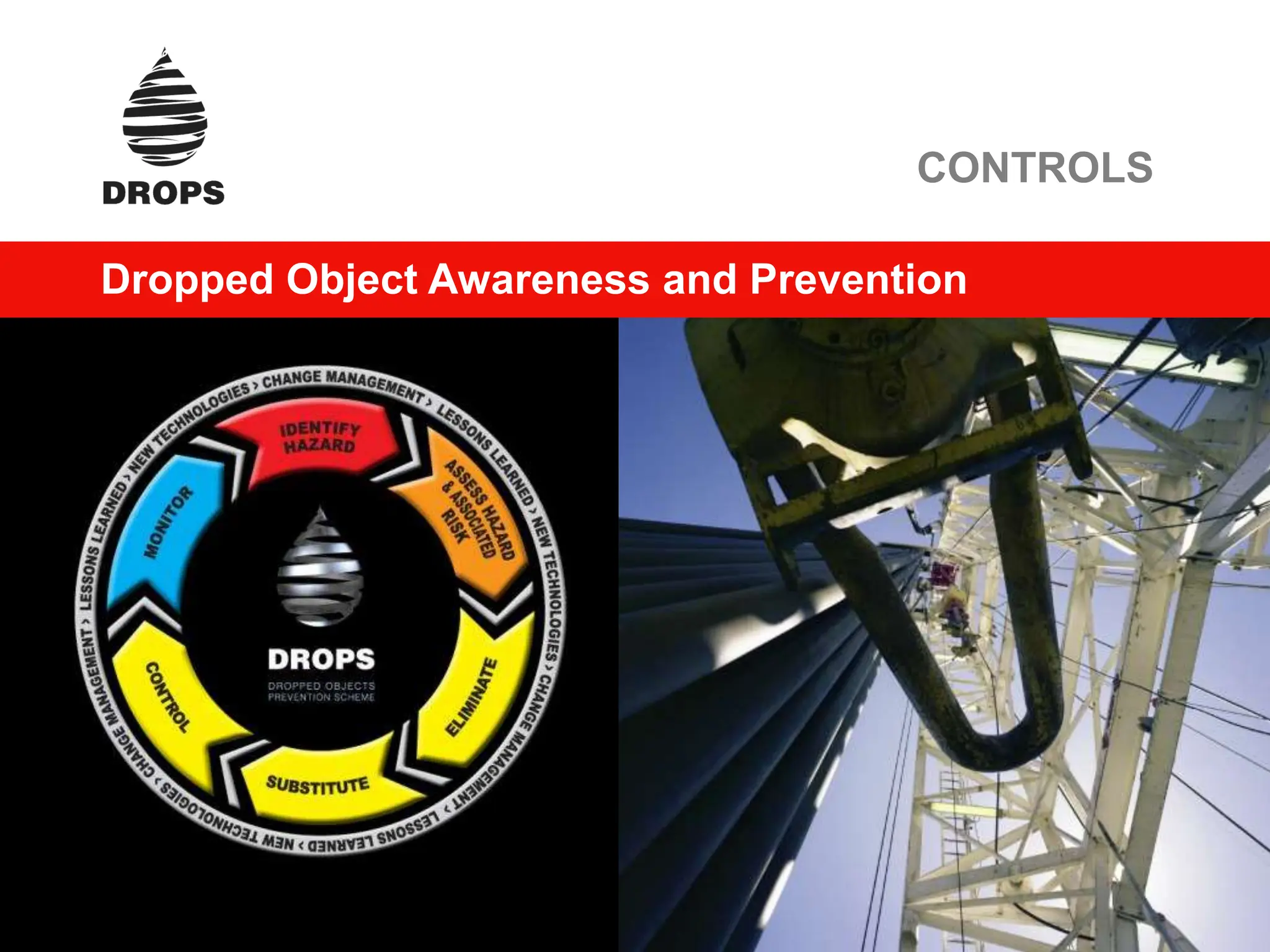
Dropped Object Awareness and Prevention
CONTROLS
Understanding and Preventing Dropped Objects
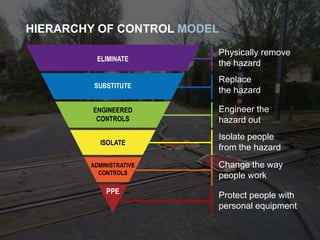
Engineer the
hazard out
Change the way
people work
Physically remove
the hazard
Replace
the hazard
Isolate people
from the hazard
Protect people with
personal equipment
HIERARCHY OF CONTROL MODEL
Understanding and Preventing Dropped Objects
CONTROLS (BARRIERS)
 HazID, Risk Assess, Eliminate, Substitute, Control
 Preventive and Mitigating Controls:
o Induction, Training, Competence
o Continuous Hazard Awareness, Observations, Stop Work Authority
o Planning, Prompt Card, Toolbox Talks, PTW, Worksite Procedures
o Codes, Standards, OEM Recommendations
o Reliable Securing - Primary fixings and Secondary retention
o Control of Tools and Equipment at Height
o Survey and Inspection, Maintenance, Certification
o Collision Checks / Checklists / Management of Distractions
o Cargo Handling / Securing for Adverse Weather Conditions
o Management of Change
o Red Zones and Restricted Access Areas / No Go Zones
o Safety Securing Systems, Barricades, Guards and Nets
o PPE and Communications
Understanding and Preventing Dropped Objects
DROPS SURVEY AND INSPECTION
Independent Inspections or DROPS Surveys are conducted by
Third Party Inspection specialists prior to start up of operations
and every three years thereafter (sometimes annually as the
Company requires).
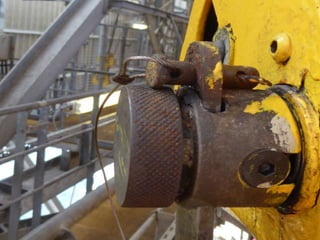
Planned Inspections or Systematic Inspections are
undertaken by suitably qualified asset personnel and are
scheduled:
• During equipment installation and following commissioning
• During and following major modifications or maintenance
• As recommended by OEM or Subject Matter Expert
Understanding and Preventing Dropped Objects
DROPS SURVEY AND INSPECTION
Unplanned or Ad Hoc Inspections follow the same process
but typically follow unplanned events such as dropped object
incidents, collisions, overloading or bad weather.
These may also follow any operations that subjected structure
and equipment to severe vibration and loadings.
More frequent inspections and checklists are required to focus
on specific components such as checking for loosening, wear
or missing components.
Understanding and Preventing Dropped Objects
DROPS SURVEY AND INSPECTION
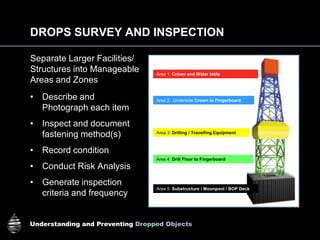
Separate Larger Facilities/
Structures into Manageable
Areas and Zones
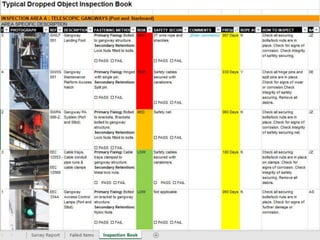
• Describe and
Photograph each item
• Inspect and document
fastening method(s)
• Record condition
• Conduct Risk Analysis
• Generate inspection
criteria and frequency
Area 1: Crown and Water table
Area 2: Underside Crown to Fingerboard
Area 3: Drilling / Travelling Equipment
Area 4: Drill Floor to Fingerboard
Area 5: Substructure / Moonpool / BOP Deck
Understanding and Preventing Dropped Objects
DROPS DEFINITIONS
UNDERSTANDING
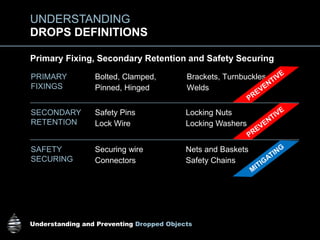
Primary Fixing, Secondary Retention and Safety Securing
Bolted, Clamped,
Pinned, Hinged
PRIMARY
FIXINGS
Safety Pins
Lock Wire
SECONDARY
RETENTION
Locking Nuts
Locking Washers
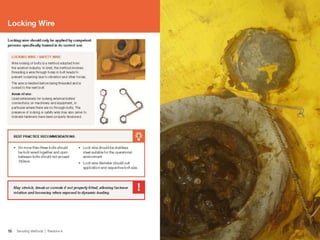
Securing wire
Connectors
SAFETY
SECURING
Nets and Baskets
Safety Chains
Brackets, Turnbuckles
Welds
Understanding and Preventing Dropped Objects
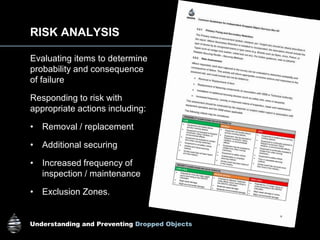
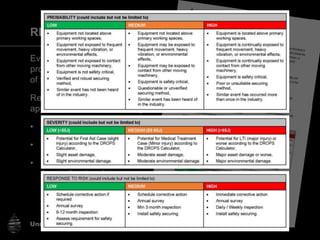
RISK ANALYSIS
Evaluating items to determine
probability and consequence
of failure
Responding to risk with
appropriate actions including:
• Removal / replacement
• Additional securing
• Increased frequency of
inspection / maintenance
• Exclusion Zones.
Understanding and Preventing Dropped Objects
RISK ANALYSIS
Evaluating items to determine
probability and consequence
of failure
Responding to risk with
appropriate actions including:
• Removal / replacement
• Additional securing
• Increased frequency of
inspection / maintenance.
Understanding and Preventing Dropped Objects
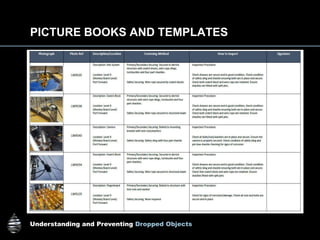
PICTURE BOOKS AND TEMPLATES
Understanding and Preventing Dropped Objects
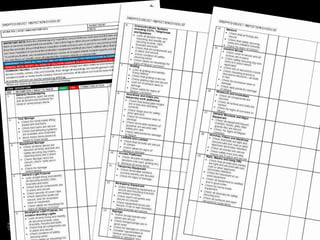
PICTURE BOOKS AND TEMPLATES
Understanding and Preventing Dropped Objects
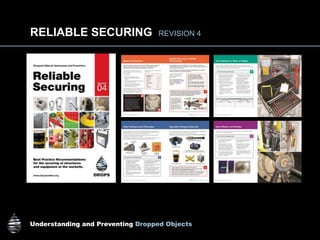
RELIABLE SECURING REVISION 4
Understanding and Preventing Dropped Objects
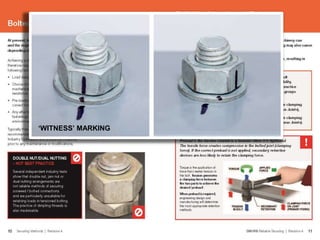
‘WITNESS’ MARKING
Understanding and Preventing Dropped Objects
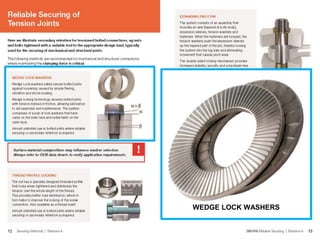
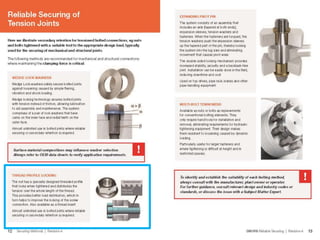
WEDGE LOCK WASHERS
Understanding and Preventing Dropped Objects
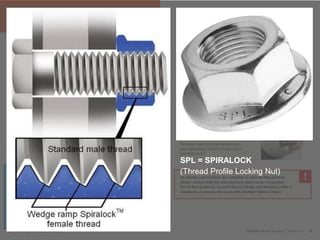
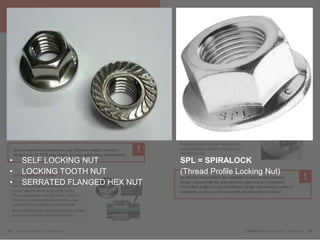
SPL = SPIRALOCK
(Thread Profile Locking Nut)
Understanding and Preventing Dropped Objects
SPL = SPIRALOCK
(Thread Profile Locking Nut)
• SELF LOCKING NUT
• LOCKING TOOTH NUT
• SERRATED FLANGED HEX NUT
Understanding and Preventing Dropped Objects
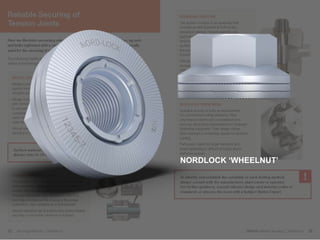
NORDLOCK ‘WHEELNUT’
Understanding and Preventing Dropped Objects
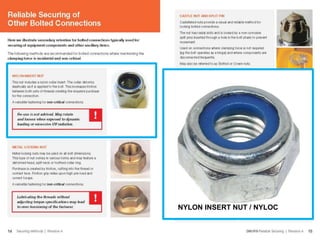
NYLON INSERT NUT / NYLOC
Understanding and Preventing Dropped Objects
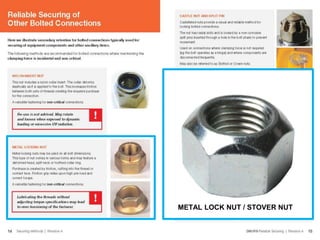
METAL LOCK NUT / STOVER NUT
Understanding and Preventing Dropped Objects
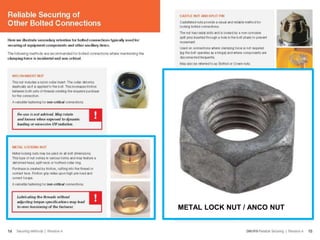
METAL LOCK NUT / ANCO NUT
Understanding and Preventing Dropped Objects
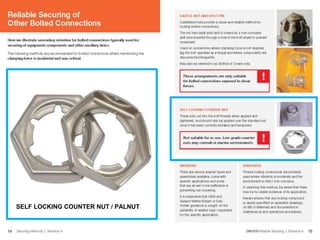
SELF LOCKING COUNTER NUT / PALNUT
Understanding and Preventing Dropped Objects
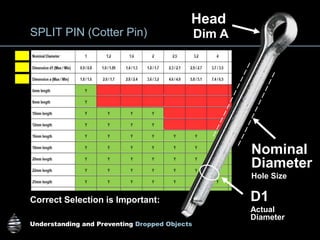
Tines
Head
D1
Actual
Diameter
Dim A
Nominal
Diameter
Hole Size
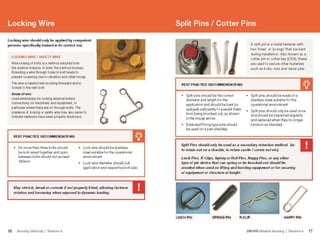
SPLIT PIN (Cotter Pin)
Correct Selection is Important:
Understanding and Preventing Dropped Objects
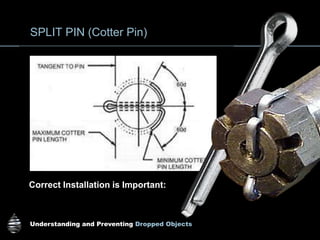
SPLIT PIN (Cotter Pin)
Correct Installation is Important:
Understanding and Preventing Dropped Objects
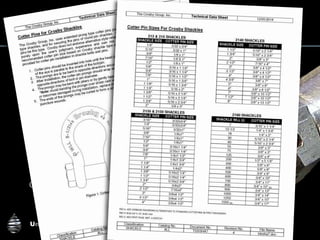
SPLIT PIN (Cotter Pin)
Correct Installation is Important:
Dropped Object Awareness
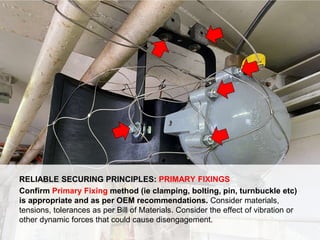
RELIABLE SECURING PRINCIPLES: PRIMARY FIXINGS
Confirm Primary Fixing method (ie clamping, bolting, pin, turnbuckle etc)
is appropriate and as per OEM recommendations. Consider materials,
tensions, tolerances as per Bill of Materials. Consider the effect of vibration or
other dynamic forces that could cause disengagement.
Dropped Object Awareness
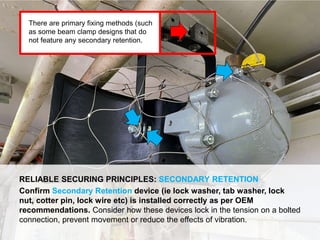
RELIABLE SECURING PRINCIPLES: SECONDARY RETENTION
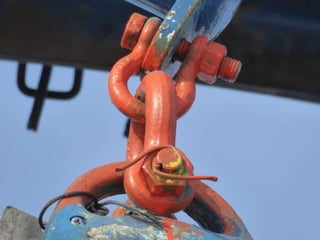
Confirm Secondary Retention device (ie lock washer, tab washer, lock
nut, cotter pin, lock wire etc) is installed correctly as per OEM
recommendations. Consider how these devices lock in the tension on a bolted
connection, prevent movement or reduce the effects of vibration.
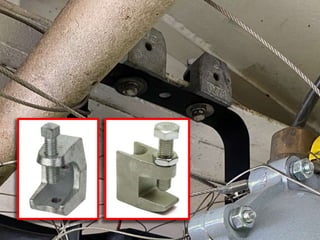
There are primary fixing methods (such
as some beam clamp designs that do
not feature any secondary retention.
Dropped Object Awareness
Understanding and Preventing Dropped Objects
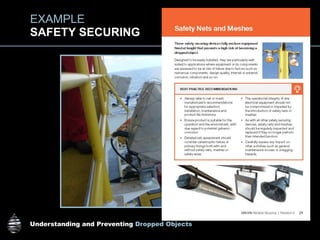
SAFETY SECURING
EXAMPLE
Dropped Object Awareness
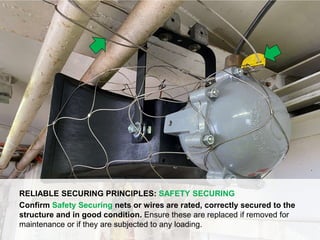
RELIABLE SECURING PRINCIPLES: SAFETY SECURING
Confirm Safety Securing nets or wires are rated, correctly secured to the
structure and in good condition. Ensure these are replaced if removed for
maintenance or if they are subjected to any loading.
Understanding and Preventing Dropped Objects
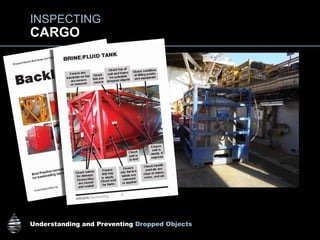
CARGO
INSPECTING
Understanding and Preventing Dropped Objects
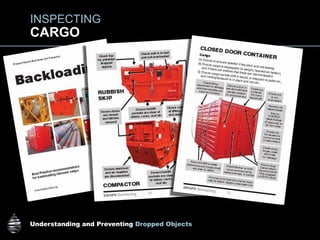
CARGO
INSPECTING
Understanding and Preventing Dropped Objects
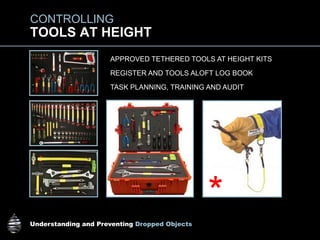
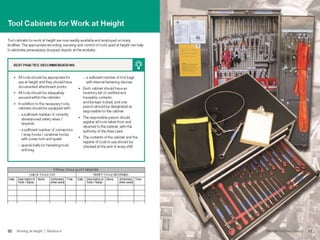
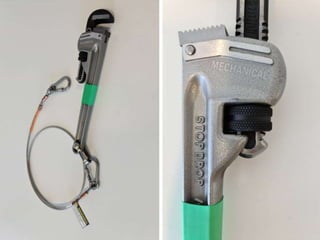
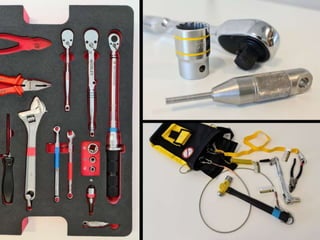
APPROVED TETHERED TOOLS AT HEIGHT KITS
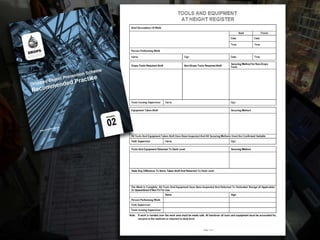
REGISTER AND TOOLS ALOFT LOG BOOK
TASK PLANNING, TRAINING AND AUDIT
TOOLS AT HEIGHT
CONTROLLING
*
Understanding and Preventing Dropped Objects
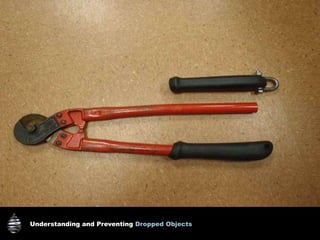
A Wolf in Sheep’s Clothing…
Understanding and Preventing Dropped Objects
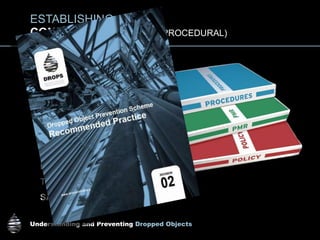
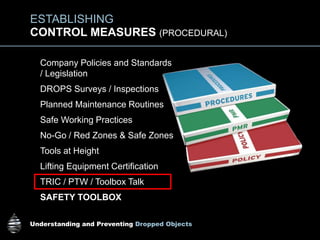
CONTROL MEASURES (PROCEDURAL)
ESTABLISHING
Company Policies and Standards
/ Legislation
DROPS Surveys / Inspections
Planned Maintenance Routines
Safe Working Practices
No-Go / Red Zones & Safe Zones
Tools at Height
Lifting Equipment Certification
TRIC / PTW / Toolbox Talk
SAFETY TOOLBOX
Understanding and Preventing Dropped Objects
CONTROL MEASURES (PROCEDURAL)
ESTABLISHING
Company Policies and Standards
/ Legislation
DROPS Surveys / Inspections
Planned Maintenance Routines
Safe Working Practices
No-Go / Red Zones & Safe Zones
Tools at Height
Lifting Equipment Certification
TRIC / PTW / Toolbox Talk
SAFETY TOOLBOX
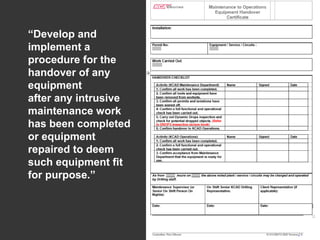
“Develop and
implement a
procedure for the
handover of any
equipment
after any intrusive
maintenance work
has been completed
or equipment
repaired to deem
such equipment fit
for purpose.”
Understanding and Preventing Dropped Objects
CONTROL MEASURES (PROCEDURAL)
ESTABLISHING
Company Policies and Standards
/ Legislation
DROPS Surveys / Inspections
Planned Maintenance Routines
Safe Working Practices
No-Go / Red Zones & Safe Zones
Tools at Height
Lifting Equipment Certification
TRIC / PTW / Toolbox Talk
SAFETY TOOLBOX
Understanding and Preventing Dropped Objects
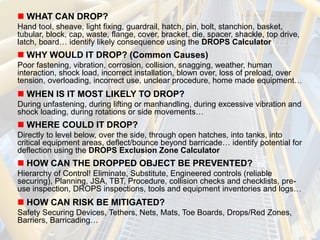
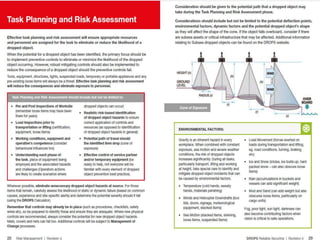
 WHAT CAN DROP?
Hand tool, sheave, light fixing, guardrail, hatch, pin, bolt, stanchion, basket,
tubular, block, cap, waste, flange, cover, bracket, die, spacer, shackle, top drive,
latch, board… identify likely consequence using the DROPS Calculator
 WHY WOULD IT DROP? (Common Causes)
Poor fastening, vibration, corrosion, collision, snagging, weather, human
interaction, shock load, incorrect installation, blown over, loss of preload, over
tension, overloading, incorrect use, unclear procedure, home made equipment…
 WHEN IS IT MOST LIKELY TO DROP?
During unfastening, during lifting or manhandling, during excessive vibration and
shock loading, during rotations or side movements…
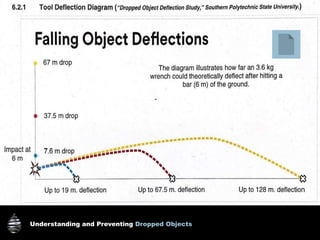
 WHERE COULD IT DROP?
Directly to level below, over the side, through open hatches, into tanks, into
critical equipment areas, deflect/bounce beyond barricade… identify potential for
deflection using the DROPS Exclusion Zone Calculator
 HOW CAN THE DROPPED OBJECT BE PREVENTED?
Hierarchy of Control! Eliminate, Substitute, Engineered controls (reliable
securing), Planning, JSA, TBT, Procedure, collision checks and checklists, pre-
use inspection, DROPS inspections, tools and equipment inventories and logs…
 HOW CAN RISK BE MITIGATED?
Safety Securing Devices, Tethers, Nets, Mats, Toe Boards, Drops/Red Zones,
Barriers, Barricading…
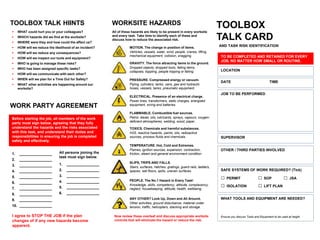
TOOLBOX
TALK CARD
LOCATION
TO BE COMPLETED AND RETAINED FOR EVERY
JOB, NO MATTER HOW SMALL OR ROUTINE.
DATE TIME
JOB TO BE PERFORMED
SUPERVISOR
OTHER / THIRD PARTIES INVOLVED
SAFE SYSTEMS OF WORK REQUIRED? (Tick)
□ PERMIT
□ ISOLATION
□ SOP □ JSA
□ LIFT PLAN
WHAT TOOLS AND EQUIPMENT ARE NEEDED?
Ensure you discuss Tools and Equipment to be used at height.
WORK PARTY AGREEMENT
Before starting the job, all members of the work
party must sign below, agreeing that they fully
understand the hazards and the risks associated
with this task, and understand their duties and
responsibilities in ensuring the job is completed
safely and effectively.
1. ________________
2. ________________
3. ________________
4. ________________
5. ________________
6. ________________
7. ________________
8. ________________
9. ________________
10. ________________
1. ________________
2. ________________
3. ________________
4. ________________
5. ________________
6. ________________
All persons joining the
task must sign below.
I agree to STOP THE JOB if the plan
changes of if any new hazards become
apparent.
TOOLBOX TALK HIINTS
AND TASK RISK IDENTIFICATION
 WHAT could hurt you or your colleagues?
 WHICH hazards did we find at the worksite?
 WHERE were they and how could the affect us?
 HOW will we reduce the likelihood of an incident?
 HOW will we reduce any consequences?
 HOW will we inspect our tools and equipment?
 WHO is going to manage these risks?
 WHO has been assigned specific tasks?
 HOW will we communicate with each other?
 WHEN will we plan for a Time Out for Safety?
 WHAT other activities are happening around our
worksite?
WORKSITE HAZARDS
All of these hazards are likely to be present in every worksite
and every task. Take time to identify each of these and
discuss how to reduce the associated risk.
MOTION. The change in position of items.
Vehicles, vessels, water, wind, people, cranes, lifting,
mechanical equipment, collision, snagging.
GRAVITY. The force attracting items to the ground.
Dropped objects, dropped tools, falling items,
collapses, toppling, people tripping or falling.
PRESSURE. Compressed energy or vacuum.
Piping, cylinders, tanks, cans, gas and hydraulic
hoses, vessels, tanks, pneumatic equipment.
ELECTRICAL. Presence of an electrical charge.
Power lines, transformers, static charges, energized
equipment, wiring and batteries.
FLAMMABLE. Combustible fuel sources.
Petrol, diesel, oils, lubricants, sprays, vapours, oxygen-
deficient atmospheres, welding, wood, paper.
TOXICS. Chemicals and harmful substances.
H2S, reactive hazards, paints, oils, radioactive
sources, process fluids and chemicals.
TEMPERATURE. Hot, Cold and Extremes.
Flames, ignition sources, expansion, contraction,
friction, steam and general environment condition.
SLIPS, TRIPS AND FALLS.
Stairs, surfaces, hatches, gratings, guard rails, ladders,
spaces, wet floors, spills, uneven surfaces.
PEOPLE. The No.1 Hazard in Every Task!
Knowledge, skills, competency, attitude, complacency,
neglect, housekeeping, attitude, health, wellbeing.
ANY OTHER? Look Up, Down and All Around.
Other activities, ground disturbance, material under
tension, traffic, helicopters, stacking and storage.
Now review these overleaf and discuss appropriate worksite
controls that will eliminate the hazard or reduce the risk.
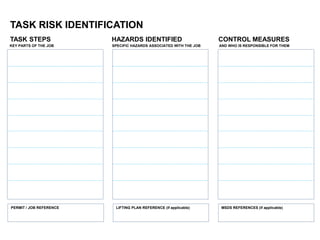
TASK RISK IDENTIFICATION
MSDS REFERENCES (if applicable)
TASK STEPS
AND WHO IS RESPONSIBLE FOR THEM
HAZARDS IDENTIFIED CONTROL MEASURES
PERMIT / JOB REFERENCE LIFTING PLAN REFERENCE (if applicable)
SPECIFIC HAZARDS ASSOCIATED WITH THE JOB
KEY PARTS OF THE JOB
Understanding and Preventing Dropped Objects
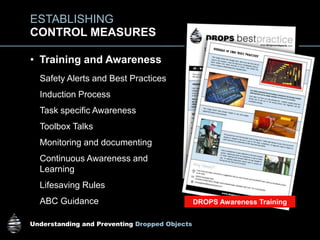
CONTROL MEASURES
ESTABLISHING
• Training and Awareness
Safety Alerts and Best Practices
Induction Process
Task specific Awareness
Toolbox Talks
Monitoring and documenting
Continuous Awareness and
Learning
Lifesaving Rules
ABC Guidance DROPS Awareness Training
Understanding and Preventing Dropped Objects
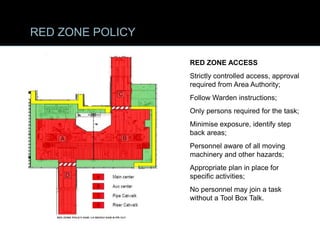
RED ZONE POLICY
RED ZONE ACCESS
Strictly controlled access, approval
required from Area Authority;
Follow Warden instructions;
Only persons required for the task;
Minimise exposure, identify step
back areas;
Personnel aware of all moving
machinery and other hazards;
Appropriate plan in place for
specific activities;
No personnel may join a task
without a Tool Box Talk.
Understanding and Preventing Dropped Objects
DROPS TRAIN THE TRAINER : EXAM
Understanding and Preventing Dropped Objects
Question 02
Name 3 types of
SECONDARY RETENTION
Understanding and Preventing Dropped Objects
Question 08
When are R-Clips NOT
RECOMMENDED as secondary
retention?
Understanding and Preventing Dropped Objects
Question 09
Give 3 KEY CONSIDERATIONS when
selecting and installing Safety
Securing wires and nets.
Understanding and Preventing Dropped Objects
Question 14
A 1.3kg piece of broken glass falls
2.5 meters.
What is the most likely OUTCOME
if it strikes a person?
Understanding and Preventing Dropped Objects
Question 19
Give 2 reasons why SCREW PIN
shackles are NOT recommended for
use on permanently suspended
equipment.
Understanding and Preventing Dropped Objects
Question 20
Name 3 PREVENTIVE measures that
would reduce the likelihood of
Dropped Tools.
Understanding and Preventing Dropped Objects
Question 24
What is the key difference between a
plain eyebolt and a collared eye
bolt?
Understanding and Preventing Dropped Objects
Dropped Object Awareness and Prevention

02 DROPS Awareness - CONTROLS Dropped objects

  • 1.
    Understanding and PreventingDropped Objects Dropped Object Awareness and Prevention CONTROLS
  • 2.
  • 3.
    Understanding and PreventingDropped Objects Engineer the hazard out Change the way people work Physically remove the hazard Replace the hazard Isolate people from the hazard Protect people with personal equipment HIERARCHY OF CONTROL MODEL
  • 4.
    Understanding and PreventingDropped Objects CONTROLS (BARRIERS)  HazID, Risk Assess, Eliminate, Substitute, Control  Preventive and Mitigating Controls: o Induction, Training, Competence o Continuous Hazard Awareness, Observations, Stop Work Authority o Planning, Prompt Card, Toolbox Talks, PTW, Worksite Procedures o Codes, Standards, OEM Recommendations o Reliable Securing - Primary fixings and Secondary retention o Control of Tools and Equipment at Height o Survey and Inspection, Maintenance, Certification o Collision Checks / Checklists / Management of Distractions o Cargo Handling / Securing for Adverse Weather Conditions o Management of Change o Red Zones and Restricted Access Areas / No Go Zones o Safety Securing Systems, Barricades, Guards and Nets o PPE and Communications
  • 5.
    Understanding and PreventingDropped Objects DROPS SURVEY AND INSPECTION Independent Inspections or DROPS Surveys are conducted by Third Party Inspection specialists prior to start up of operations and every three years thereafter (sometimes annually as the Company requires). Planned Inspections or Systematic Inspections are undertaken by suitably qualified asset personnel and are scheduled: • During equipment installation and following commissioning • During and following major modifications or maintenance • As recommended by OEM or Subject Matter Expert
  • 6.
    Understanding and PreventingDropped Objects DROPS SURVEY AND INSPECTION Unplanned or Ad Hoc Inspections follow the same process but typically follow unplanned events such as dropped object incidents, collisions, overloading or bad weather. These may also follow any operations that subjected structure and equipment to severe vibration and loadings. More frequent inspections and checklists are required to focus on specific components such as checking for loosening, wear or missing components.
  • 7.
  • 8.
    Understanding and PreventingDropped Objects DROPS SURVEY AND INSPECTION Separate Larger Facilities/ Structures into Manageable Areas and Zones • Describe and Photograph each item • Inspect and document fastening method(s) • Record condition • Conduct Risk Analysis • Generate inspection criteria and frequency Area 1: Crown and Water table Area 2: Underside Crown to Fingerboard Area 3: Drilling / Travelling Equipment Area 4: Drill Floor to Fingerboard Area 5: Substructure / Moonpool / BOP Deck
  • 9.
    Understanding and PreventingDropped Objects DROPS DEFINITIONS UNDERSTANDING Primary Fixing, Secondary Retention and Safety Securing Bolted, Clamped, Pinned, Hinged PRIMARY FIXINGS Safety Pins Lock Wire SECONDARY RETENTION Locking Nuts Locking Washers Securing wire Connectors SAFETY SECURING Nets and Baskets Safety Chains Brackets, Turnbuckles Welds
  • 10.
  • 11.
    Understanding and PreventingDropped Objects RISK ANALYSIS Evaluating items to determine probability and consequence of failure Responding to risk with appropriate actions including: • Removal / replacement • Additional securing • Increased frequency of inspection / maintenance • Exclusion Zones.
  • 12.
    Understanding and PreventingDropped Objects RISK ANALYSIS Evaluating items to determine probability and consequence of failure Responding to risk with appropriate actions including: • Removal / replacement • Additional securing • Increased frequency of inspection / maintenance.
  • 13.
    Understanding and PreventingDropped Objects PICTURE BOOKS AND TEMPLATES
  • 14.
    Understanding and PreventingDropped Objects PICTURE BOOKS AND TEMPLATES
  • 15.
    Understanding and PreventingDropped Objects RELIABLE SECURING REVISION 4
  • 16.
    Understanding and PreventingDropped Objects ‘WITNESS’ MARKING
  • 17.
    Understanding and PreventingDropped Objects WEDGE LOCK WASHERS
  • 18.
  • 19.
    Understanding and PreventingDropped Objects SPL = SPIRALOCK (Thread Profile Locking Nut)
  • 20.
    Understanding and PreventingDropped Objects SPL = SPIRALOCK (Thread Profile Locking Nut) • SELF LOCKING NUT • LOCKING TOOTH NUT • SERRATED FLANGED HEX NUT
  • 21.
    Understanding and PreventingDropped Objects NORDLOCK ‘WHEELNUT’
  • 22.
    Understanding and PreventingDropped Objects NYLON INSERT NUT / NYLOC
  • 23.
    Understanding and PreventingDropped Objects METAL LOCK NUT / STOVER NUT
  • 24.
    Understanding and PreventingDropped Objects METAL LOCK NUT / ANCO NUT
  • 25.
    Understanding and PreventingDropped Objects SELF LOCKING COUNTER NUT / PALNUT
  • 26.
  • 27.
  • 28.
    Understanding and PreventingDropped Objects Tines Head D1 Actual Diameter Dim A Nominal Diameter Hole Size SPLIT PIN (Cotter Pin) Correct Selection is Important:
  • 29.
    Understanding and PreventingDropped Objects SPLIT PIN (Cotter Pin) Correct Installation is Important:
  • 30.
    Understanding and PreventingDropped Objects SPLIT PIN (Cotter Pin) Correct Installation is Important:
  • 31.
  • 32.
    Dropped Object Awareness RELIABLESECURING PRINCIPLES: PRIMARY FIXINGS Confirm Primary Fixing method (ie clamping, bolting, pin, turnbuckle etc) is appropriate and as per OEM recommendations. Consider materials, tensions, tolerances as per Bill of Materials. Consider the effect of vibration or other dynamic forces that could cause disengagement.
  • 33.
    Dropped Object Awareness RELIABLESECURING PRINCIPLES: SECONDARY RETENTION Confirm Secondary Retention device (ie lock washer, tab washer, lock nut, cotter pin, lock wire etc) is installed correctly as per OEM recommendations. Consider how these devices lock in the tension on a bolted connection, prevent movement or reduce the effects of vibration. There are primary fixing methods (such as some beam clamp designs that do not feature any secondary retention.
  • 34.
  • 35.
  • 36.
    Understanding and PreventingDropped Objects SAFETY SECURING EXAMPLE
  • 37.
    Dropped Object Awareness RELIABLESECURING PRINCIPLES: SAFETY SECURING Confirm Safety Securing nets or wires are rated, correctly secured to the structure and in good condition. Ensure these are replaced if removed for maintenance or if they are subjected to any loading.
  • 38.
  • 39.
  • 40.
  • 41.
    Understanding and PreventingDropped Objects CARGO INSPECTING
  • 42.
    Understanding and PreventingDropped Objects CARGO INSPECTING
  • 43.
  • 44.
  • 45.
    Understanding and PreventingDropped Objects APPROVED TETHERED TOOLS AT HEIGHT KITS REGISTER AND TOOLS ALOFT LOG BOOK TASK PLANNING, TRAINING AND AUDIT TOOLS AT HEIGHT CONTROLLING *
  • 46.
  • 47.
  • 48.
    Understanding and PreventingDropped Objects A Wolf in Sheep’s Clothing…
  • 49.
  • 50.
  • 51.
  • 52.
  • 53.
    Understanding and PreventingDropped Objects CONTROL MEASURES (PROCEDURAL) ESTABLISHING Company Policies and Standards / Legislation DROPS Surveys / Inspections Planned Maintenance Routines Safe Working Practices No-Go / Red Zones & Safe Zones Tools at Height Lifting Equipment Certification TRIC / PTW / Toolbox Talk SAFETY TOOLBOX
  • 54.
    Understanding and PreventingDropped Objects CONTROL MEASURES (PROCEDURAL) ESTABLISHING Company Policies and Standards / Legislation DROPS Surveys / Inspections Planned Maintenance Routines Safe Working Practices No-Go / Red Zones & Safe Zones Tools at Height Lifting Equipment Certification TRIC / PTW / Toolbox Talk SAFETY TOOLBOX “Develop and implement a procedure for the handover of any equipment after any intrusive maintenance work has been completed or equipment repaired to deem such equipment fit for purpose.”
  • 55.
    Understanding and PreventingDropped Objects CONTROL MEASURES (PROCEDURAL) ESTABLISHING Company Policies and Standards / Legislation DROPS Surveys / Inspections Planned Maintenance Routines Safe Working Practices No-Go / Red Zones & Safe Zones Tools at Height Lifting Equipment Certification TRIC / PTW / Toolbox Talk SAFETY TOOLBOX
  • 56.
  • 57.
     WHAT CANDROP? Hand tool, sheave, light fixing, guardrail, hatch, pin, bolt, stanchion, basket, tubular, block, cap, waste, flange, cover, bracket, die, spacer, shackle, top drive, latch, board… identify likely consequence using the DROPS Calculator  WHY WOULD IT DROP? (Common Causes) Poor fastening, vibration, corrosion, collision, snagging, weather, human interaction, shock load, incorrect installation, blown over, loss of preload, over tension, overloading, incorrect use, unclear procedure, home made equipment…  WHEN IS IT MOST LIKELY TO DROP? During unfastening, during lifting or manhandling, during excessive vibration and shock loading, during rotations or side movements…  WHERE COULD IT DROP? Directly to level below, over the side, through open hatches, into tanks, into critical equipment areas, deflect/bounce beyond barricade… identify potential for deflection using the DROPS Exclusion Zone Calculator  HOW CAN THE DROPPED OBJECT BE PREVENTED? Hierarchy of Control! Eliminate, Substitute, Engineered controls (reliable securing), Planning, JSA, TBT, Procedure, collision checks and checklists, pre- use inspection, DROPS inspections, tools and equipment inventories and logs…  HOW CAN RISK BE MITIGATED? Safety Securing Devices, Tethers, Nets, Mats, Toe Boards, Drops/Red Zones, Barriers, Barricading…
  • 58.
    TOOLBOX TALK CARD LOCATION TO BECOMPLETED AND RETAINED FOR EVERY JOB, NO MATTER HOW SMALL OR ROUTINE. DATE TIME JOB TO BE PERFORMED SUPERVISOR OTHER / THIRD PARTIES INVOLVED SAFE SYSTEMS OF WORK REQUIRED? (Tick) □ PERMIT □ ISOLATION □ SOP □ JSA □ LIFT PLAN WHAT TOOLS AND EQUIPMENT ARE NEEDED? Ensure you discuss Tools and Equipment to be used at height. WORK PARTY AGREEMENT Before starting the job, all members of the work party must sign below, agreeing that they fully understand the hazards and the risks associated with this task, and understand their duties and responsibilities in ensuring the job is completed safely and effectively. 1. ________________ 2. ________________ 3. ________________ 4. ________________ 5. ________________ 6. ________________ 7. ________________ 8. ________________ 9. ________________ 10. ________________ 1. ________________ 2. ________________ 3. ________________ 4. ________________ 5. ________________ 6. ________________ All persons joining the task must sign below. I agree to STOP THE JOB if the plan changes of if any new hazards become apparent. TOOLBOX TALK HIINTS AND TASK RISK IDENTIFICATION  WHAT could hurt you or your colleagues?  WHICH hazards did we find at the worksite?  WHERE were they and how could the affect us?  HOW will we reduce the likelihood of an incident?  HOW will we reduce any consequences?  HOW will we inspect our tools and equipment?  WHO is going to manage these risks?  WHO has been assigned specific tasks?  HOW will we communicate with each other?  WHEN will we plan for a Time Out for Safety?  WHAT other activities are happening around our worksite? WORKSITE HAZARDS All of these hazards are likely to be present in every worksite and every task. Take time to identify each of these and discuss how to reduce the associated risk. MOTION. The change in position of items. Vehicles, vessels, water, wind, people, cranes, lifting, mechanical equipment, collision, snagging. GRAVITY. The force attracting items to the ground. Dropped objects, dropped tools, falling items, collapses, toppling, people tripping or falling. PRESSURE. Compressed energy or vacuum. Piping, cylinders, tanks, cans, gas and hydraulic hoses, vessels, tanks, pneumatic equipment. ELECTRICAL. Presence of an electrical charge. Power lines, transformers, static charges, energized equipment, wiring and batteries. FLAMMABLE. Combustible fuel sources. Petrol, diesel, oils, lubricants, sprays, vapours, oxygen- deficient atmospheres, welding, wood, paper. TOXICS. Chemicals and harmful substances. H2S, reactive hazards, paints, oils, radioactive sources, process fluids and chemicals. TEMPERATURE. Hot, Cold and Extremes. Flames, ignition sources, expansion, contraction, friction, steam and general environment condition. SLIPS, TRIPS AND FALLS. Stairs, surfaces, hatches, gratings, guard rails, ladders, spaces, wet floors, spills, uneven surfaces. PEOPLE. The No.1 Hazard in Every Task! Knowledge, skills, competency, attitude, complacency, neglect, housekeeping, attitude, health, wellbeing. ANY OTHER? Look Up, Down and All Around. Other activities, ground disturbance, material under tension, traffic, helicopters, stacking and storage. Now review these overleaf and discuss appropriate worksite controls that will eliminate the hazard or reduce the risk.
  • 59.
    TASK RISK IDENTIFICATION MSDSREFERENCES (if applicable) TASK STEPS AND WHO IS RESPONSIBLE FOR THEM HAZARDS IDENTIFIED CONTROL MEASURES PERMIT / JOB REFERENCE LIFTING PLAN REFERENCE (if applicable) SPECIFIC HAZARDS ASSOCIATED WITH THE JOB KEY PARTS OF THE JOB
  • 60.
    Understanding and PreventingDropped Objects CONTROL MEASURES ESTABLISHING • Training and Awareness Safety Alerts and Best Practices Induction Process Task specific Awareness Toolbox Talks Monitoring and documenting Continuous Awareness and Learning Lifesaving Rules ABC Guidance DROPS Awareness Training
  • 61.
    Understanding and PreventingDropped Objects RED ZONE POLICY RED ZONE ACCESS Strictly controlled access, approval required from Area Authority; Follow Warden instructions; Only persons required for the task; Minimise exposure, identify step back areas; Personnel aware of all moving machinery and other hazards; Appropriate plan in place for specific activities; No personnel may join a task without a Tool Box Talk.
  • 62.
  • 63.
  • 64.
    Understanding and PreventingDropped Objects DROPS TRAIN THE TRAINER : EXAM
  • 65.
    Understanding and PreventingDropped Objects Question 02 Name 3 types of SECONDARY RETENTION
  • 66.
    Understanding and PreventingDropped Objects Question 08 When are R-Clips NOT RECOMMENDED as secondary retention?
  • 67.
    Understanding and PreventingDropped Objects Question 09 Give 3 KEY CONSIDERATIONS when selecting and installing Safety Securing wires and nets.
  • 68.
    Understanding and PreventingDropped Objects Question 14 A 1.3kg piece of broken glass falls 2.5 meters. What is the most likely OUTCOME if it strikes a person?
  • 69.
    Understanding and PreventingDropped Objects Question 19 Give 2 reasons why SCREW PIN shackles are NOT recommended for use on permanently suspended equipment.
  • 70.
    Understanding and PreventingDropped Objects Question 20 Name 3 PREVENTIVE measures that would reduce the likelihood of Dropped Tools.
  • 71.
    Understanding and PreventingDropped Objects Question 24 What is the key difference between a plain eyebolt and a collared eye bolt?
  • 72.
    Understanding and PreventingDropped Objects Dropped Object Awareness and Prevention