Dropped Object Awareness
and Prevention
YOUR ASSET TITLE
Part 1: Understanding Dropped Objects
(Definitions, Common Causes, Consequences)
Dropped Object Awareness
• Introduction to Drops
•DROPS is the global initiative, we’re all active members
•Our approach to Drops Management reflects Best Practice
•Scope applies to all personnel, installations and facilities
•It’s Proactive, not just prescriptive
•Applies to all tasks, a key part of our HSE management system
•WE ARE ALL RESPONSIBLE for improving performance
Dropped Object Awareness
• Introduction to Drops
•DROPS is the global initiative, we’re all active members
•Our approach to Drops Management reflects Best Practice
•Scope applies to all personnel, installations and facilities
•It’s Proactive, not just prescriptive
•Applies to all tasks, a key part of our HSE management system
•WE ARE ALL RESPONSIBLE for improving performance
Dropped Object Awareness
Understanding Dropped Objects
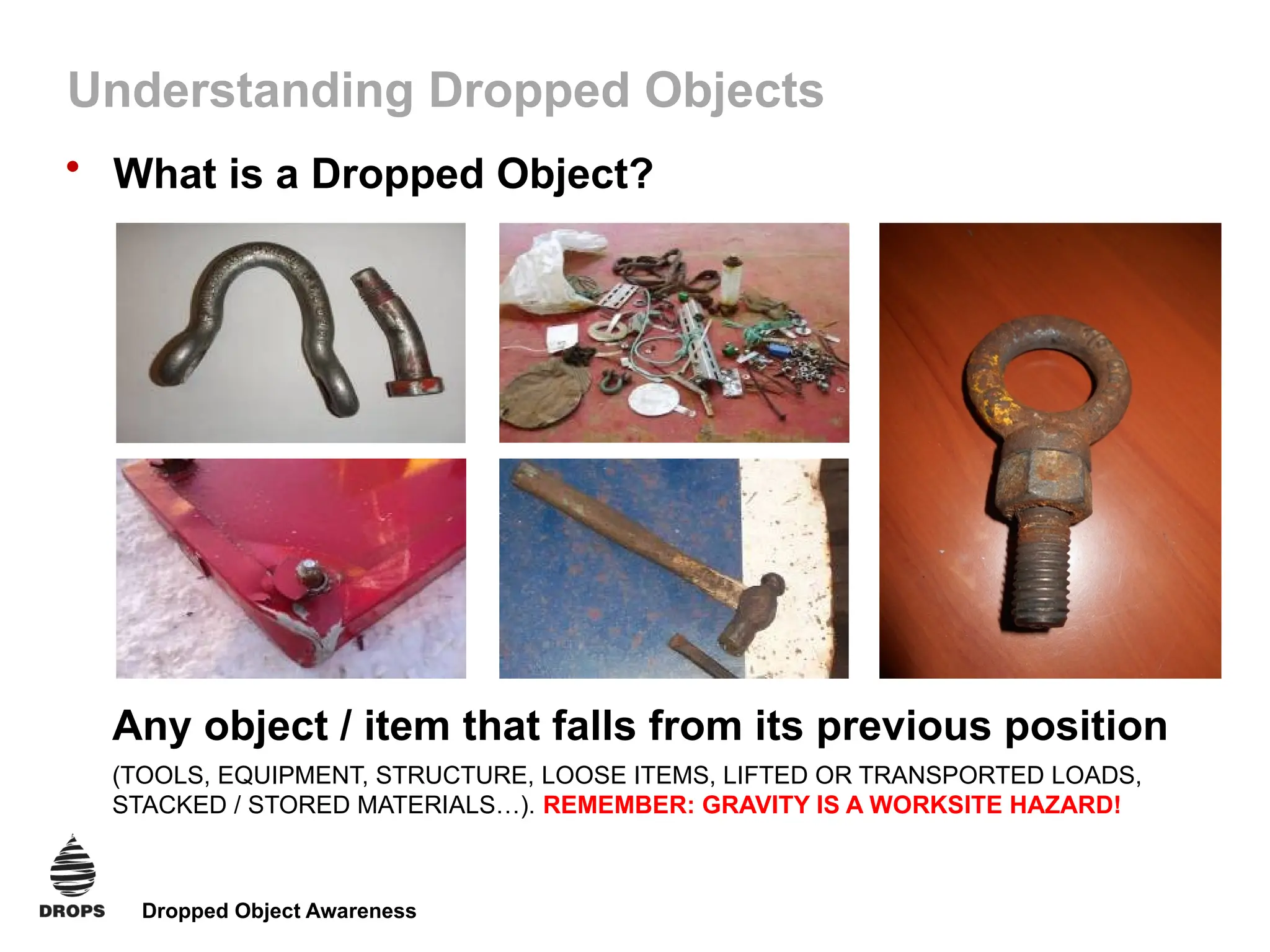
• What is a Dropped Object?
Any object / item that falls from its previous position
(TOOLS, EQUIPMENT, STRUCTURE, LOOSE ITEMS, LIFTED OR TRANSPORTED LOADS,
STACKED / STORED MATERIALS…). REMEMBER: GRAVITY IS A WORKSITE HAZARD!
Dropped Object Awareness
Dropped Object Categories
• Static Dropped Object
any object that falls from its previous position under its own weight
– where Gravity takes over!
• Dynamic Dropped Object
any object that falls from its previous position due to applied force
from equipment/machinery or moving object – like a collision,
perhaps during lifting or stacking… also manual handling,
pressure or electrical energy sources too
Now think about objects that can fall due to failure caused by
repeated cyclic loading, environmental factors and movement –
vibration, temperature, wind and so on…
Dropped Object Awareness
Presenter Notes
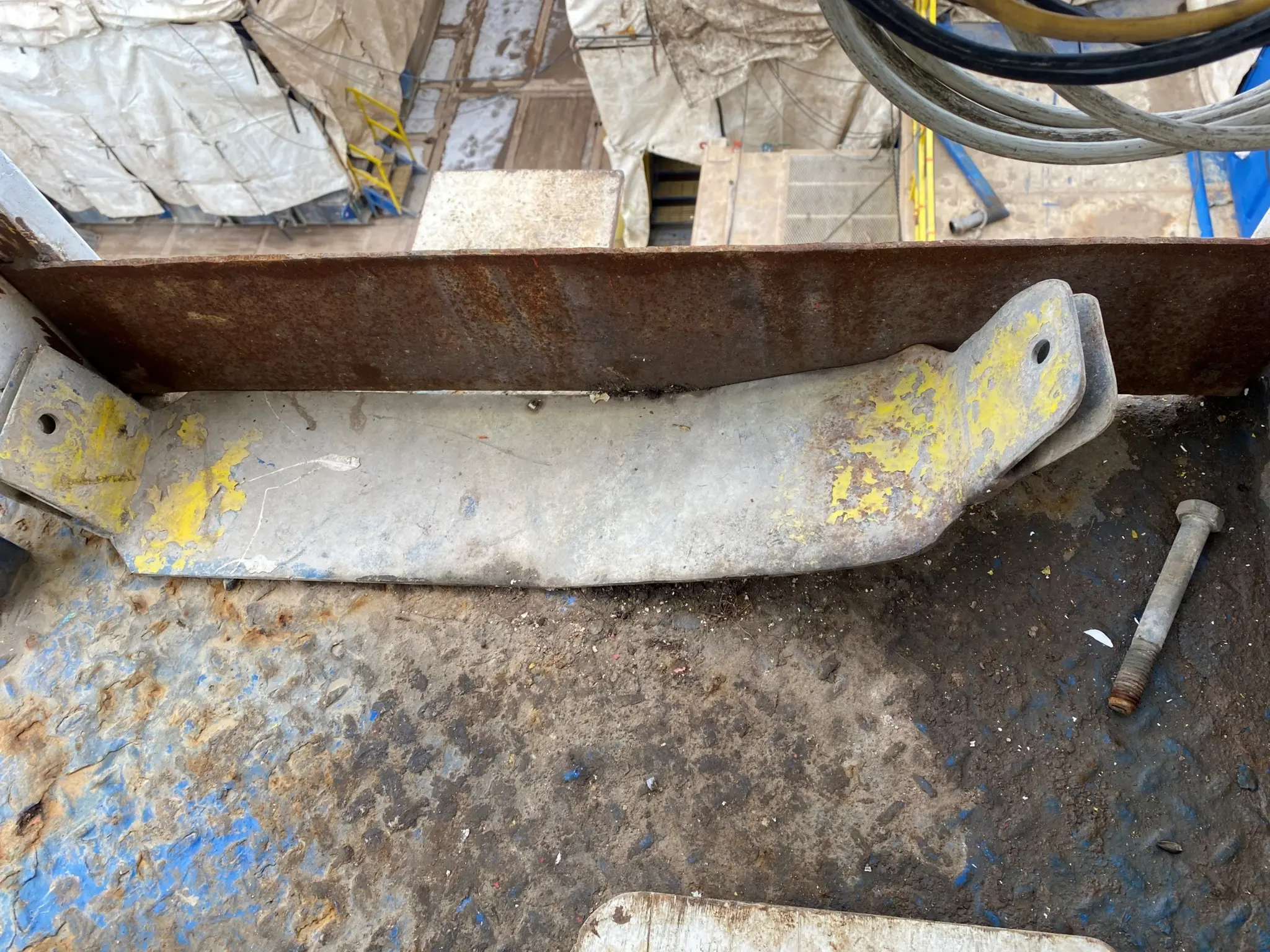
• Insert your own images from your worksite showing
examples of static and dynamic potentials
• If you wish, insert incident learnings which describe
both static and dynamic incidents
Dropped Object Awareness
Understanding Dropped Object Causes
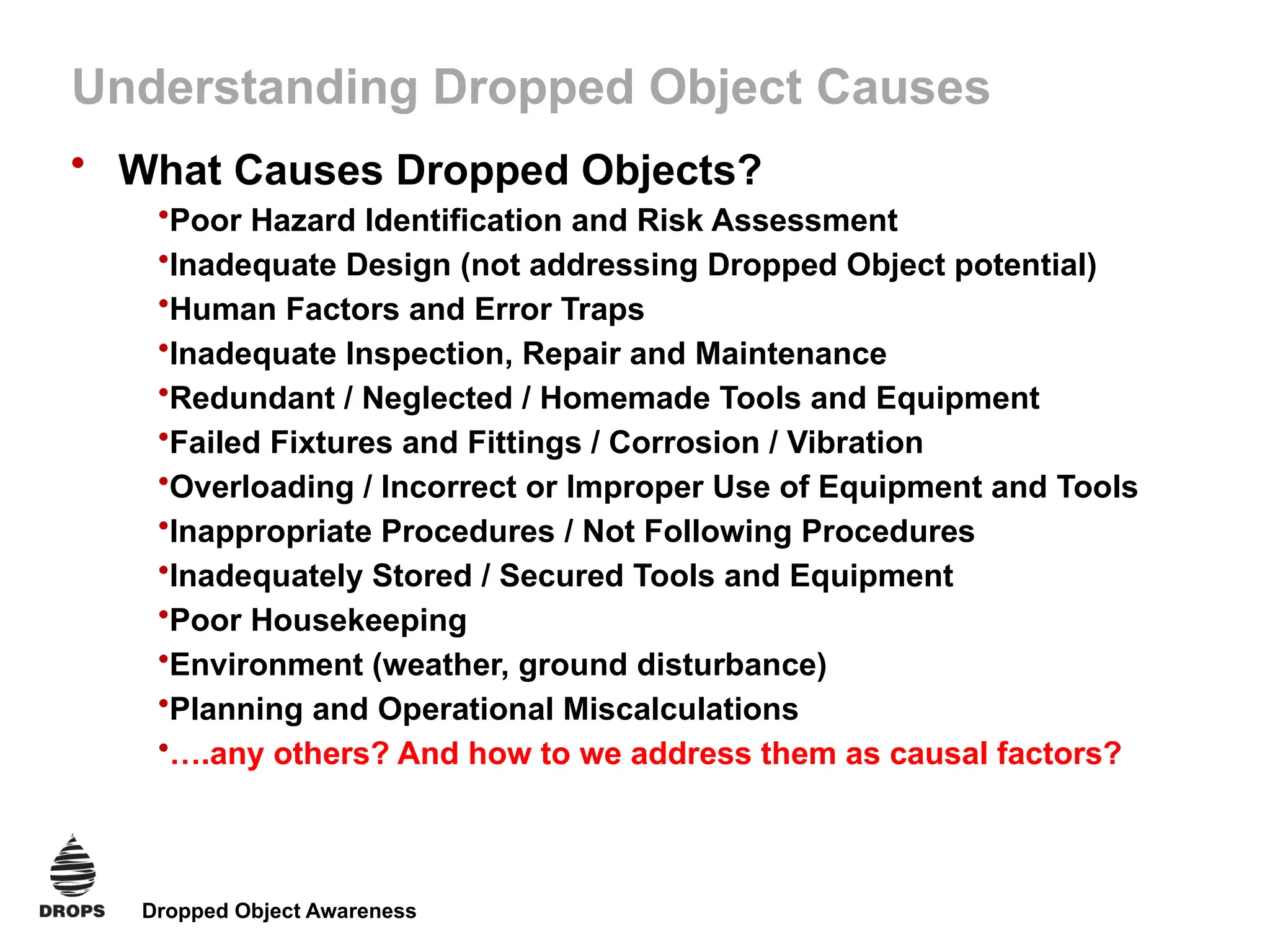
• What Causes Dropped Objects?
•Poor Hazard Identification and Risk Assessment
•Inadequate Design (not addressing Dropped Object potential)
•Human Factors and Error Traps
•Inadequate Inspection, Repair and Maintenance
•Redundant / Neglected / Homemade Tools and Equipment
•Failed Fixtures and Fittings / Corrosion / Vibration
•Overloading / Incorrect or Improper Use of Equipment and Tools
•Inappropriate Procedures / Not Following Procedures
•Inadequately Stored / Secured Tools and Equipment
•Poor Housekeeping
•Environment (weather, ground disturbance)
•Planning and Operational Miscalculations
•….any others? And how to we address them as causal factors?
Dropped Object Awareness
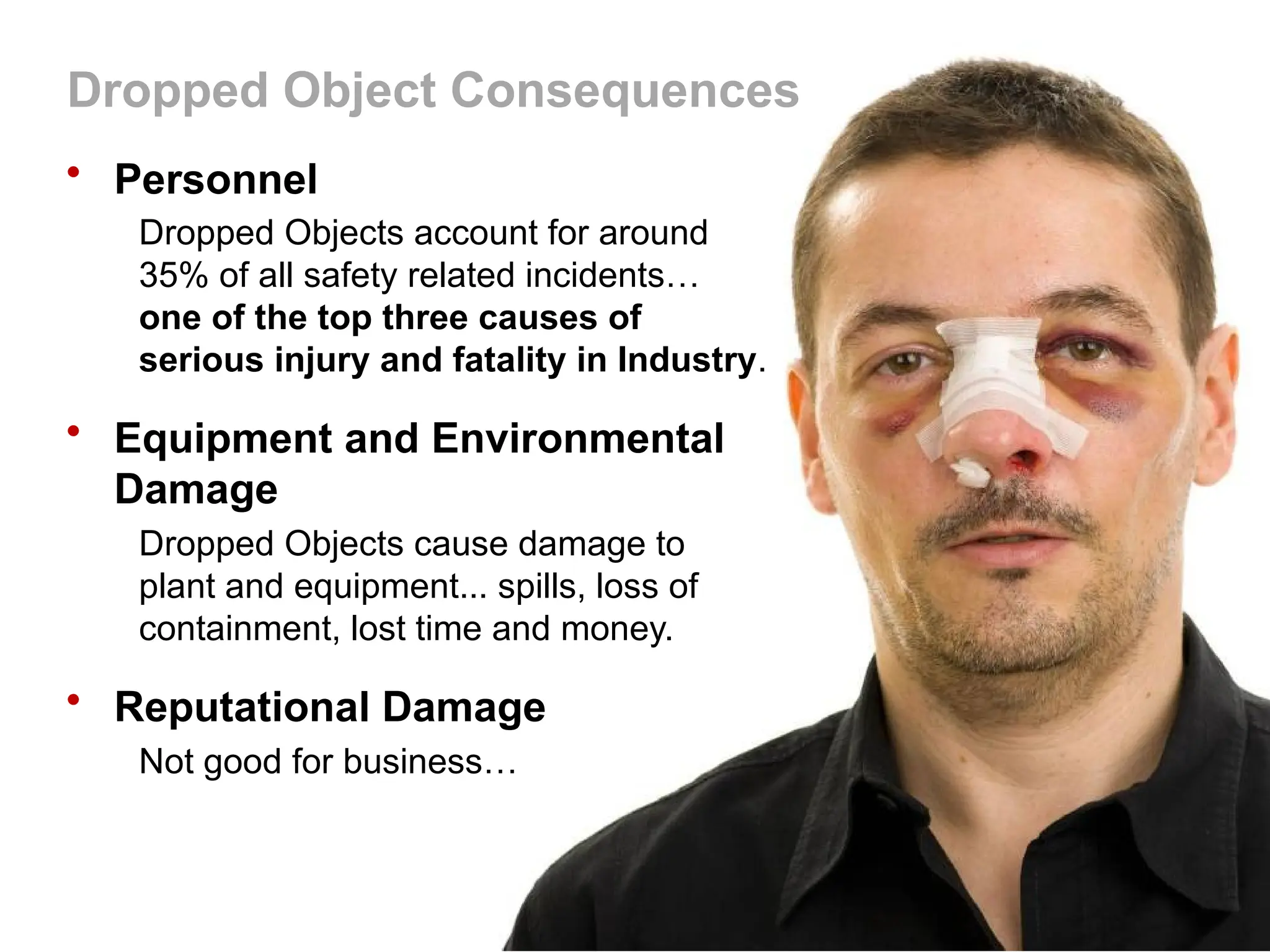
• Personnel
Dropped Objects account for around
35% of all safety related incidents…
one of the top three causes of
serious injury and fatality in Industry.
• Equipment and Environmental
Damage
Dropped Objects cause damage to
plant and equipment... spills, loss of
containment, lost time and money.
• Reputational Damage
Not good for business…
Dropped Object Consequences
Dropped Object Awareness
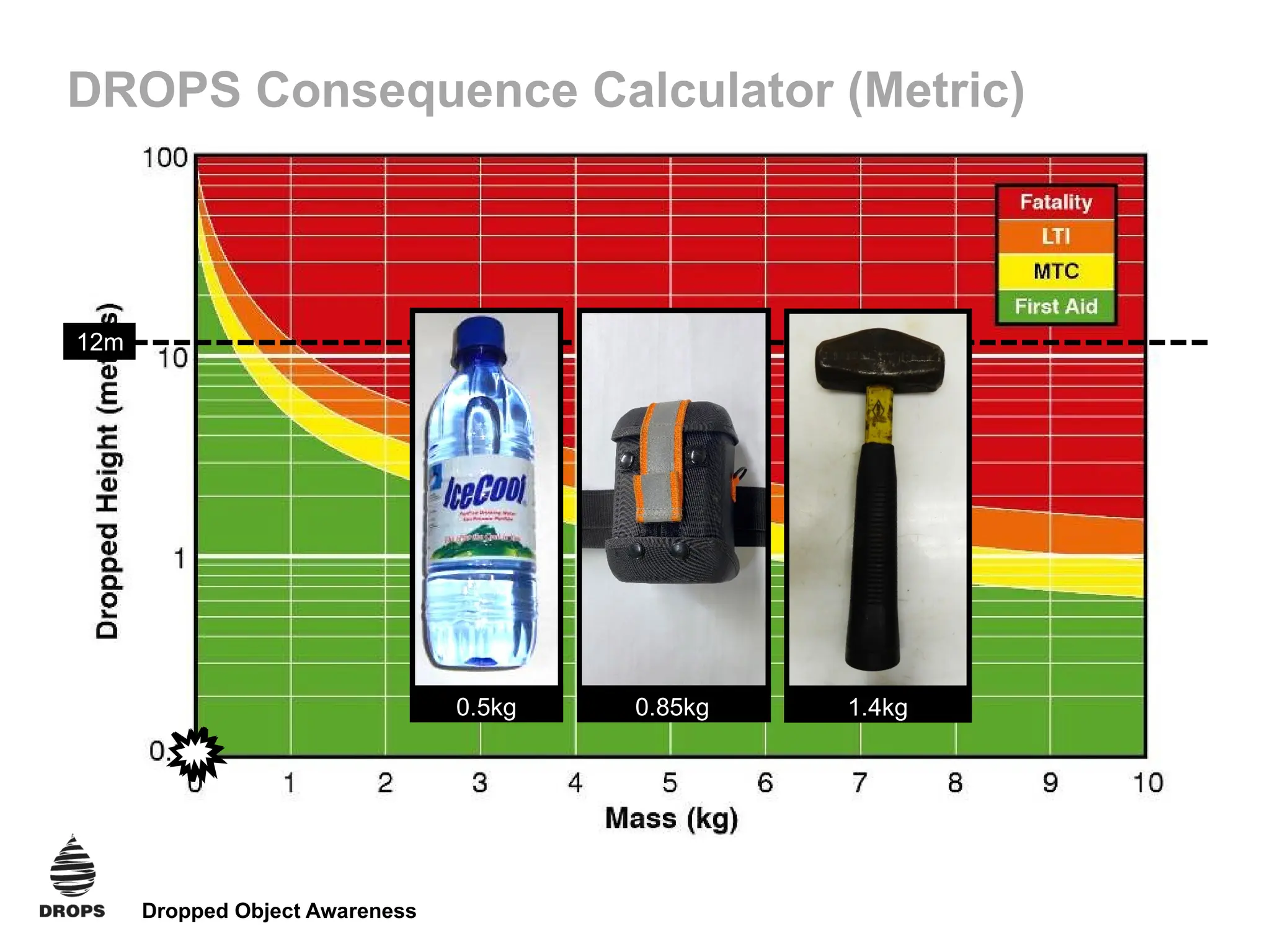
DROPS Consequence Calculator (Metric)
12m
0.5kg 1.4kg
0.85kg
Dropped Object Awareness
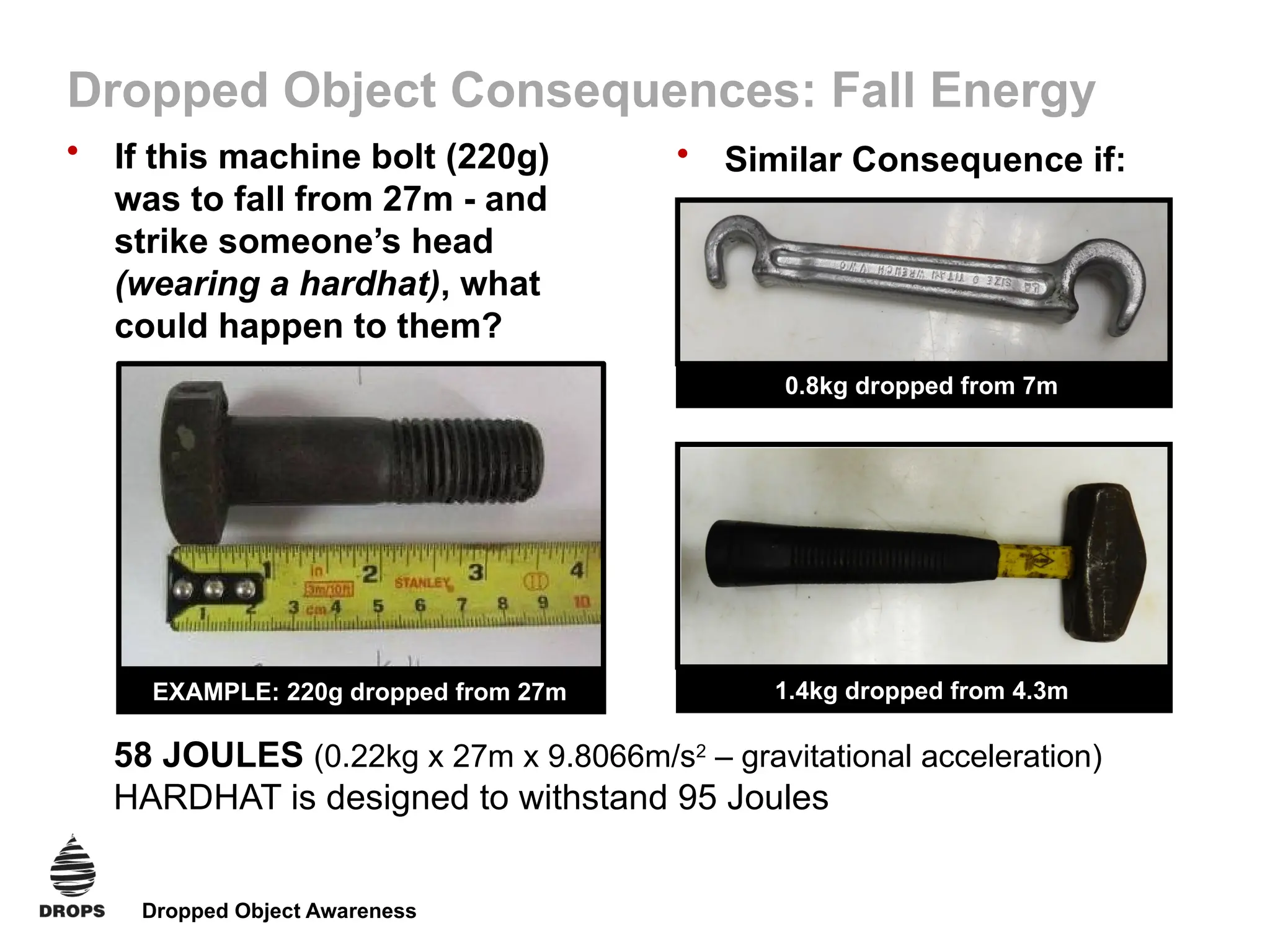
Dropped Object Consequences: Fall Energy
• If this machine bolt (220g)
was to fall from 27m - and
strike someone’s head
(wearing a hardhat), what
could happen to them?
EXAMPLE: 220g dropped from 27m
• Similar Consequence if:
0.8kg dropped from 7m
1.4kg dropped from 4.3m
58 JOULES (0.22kg x 27m x 9.8066m/s2
– gravitational acceleration)
HARDHAT is designed to withstand 95 Joules
Dropped Object Awareness
The ‘Cone of Exposure’
Dropped Object Awareness
Presenter Notes
• Conclude the first part by inserting recent dropped
object incident summary from the rig and show video
if appropriate
• Discuss the incident and share the learnings.
• At this point, take a break. Return (or host another
session) to discuss the Controls we have that will
reduce the likelihood of dropped objects and reduce
the consequence should they occur.
Dropped Object Awareness
Summary
• What do we know about Dropped Objects?
•Gravity is a Hazard, a constant force that cannot be isolated
•We must prevent the release of Gravity!
•Dropped objects can occur anywhere
•They can harm and they can kill
•Equipment and the Environment can be damaged
•Even small items can have severe consequence
•Static and Dynamic potential exists in all tasks
•There is a Company Procedure on Drops Prevention
•The DROPS Calculator is a tool that will inform our Risk
Assessments, but can also be used after an incident
•There are many common causes and many are attributable to
Human Factors – or the Error Traps that can lead to mistakes.
Dropped Object Awareness
and Prevention
YOUR ASSET TITLE
Part 2: Preventing Dropped Objects (The
Hierarchy of Control)
Dropped Object Awareness
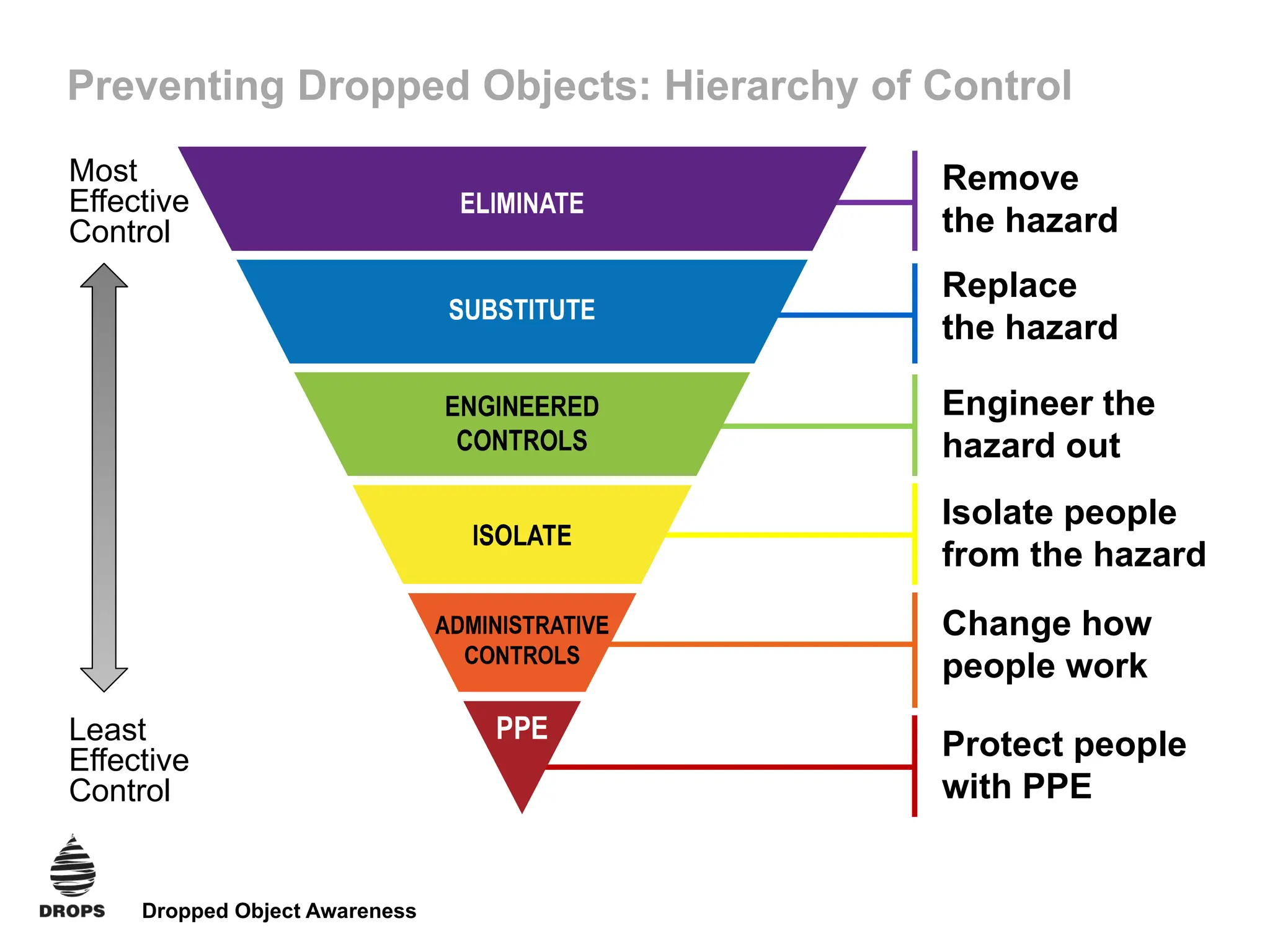
Preventing Dropped Objects: Hierarchy of Control
Engineer the
hazard out
Change how
people work
Remove
the hazard
Replace
the hazard
Isolate people
from the hazard
Protect people
with PPE
Most
Effective
Control
Least
Effective
Control
Dropped Object Awareness
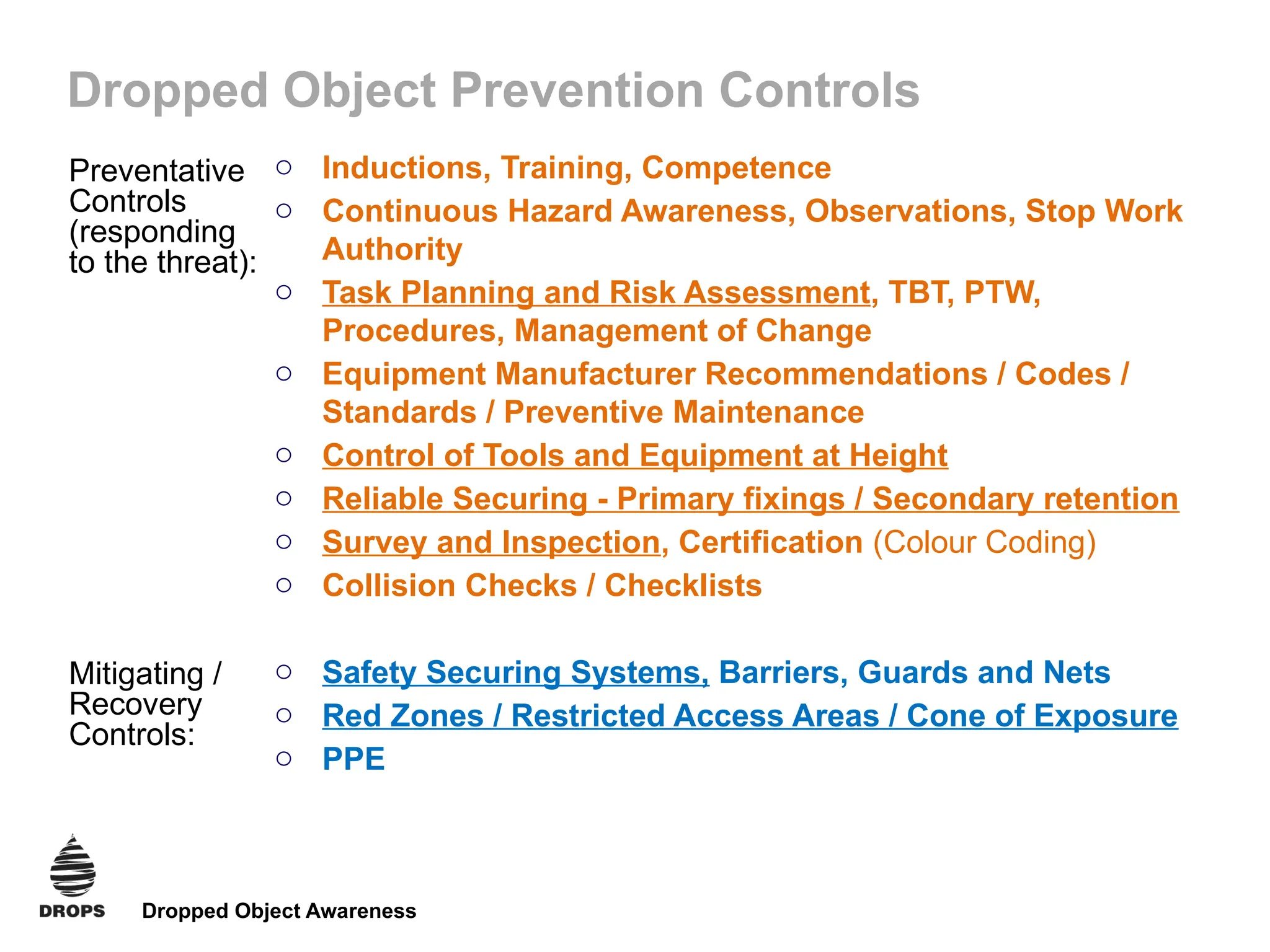
Dropped Object Prevention Controls
o Inductions, Training, Competence
o Continuous Hazard Awareness, Observations, Stop Work
Authority
o Task Planning and Risk Assessment, TBT, PTW,
Procedures, Management of Change
o Equipment Manufacturer Recommendations / Codes /
Standards / Preventive Maintenance
o Control of Tools and Equipment at Height
o Reliable Securing - Primary fixings / Secondary retention
o Survey and Inspection, Certification (Colour Coding)
o Collision Checks / Checklists
o Safety Securing Systems, Barriers, Guards and Nets
o Red Zones / Restricted Access Areas / Cone of Exposure
o PPE
Preventative
Controls
(responding
to the threat):
Mitigating /
Recovery
Controls:
Dropped Object Awareness
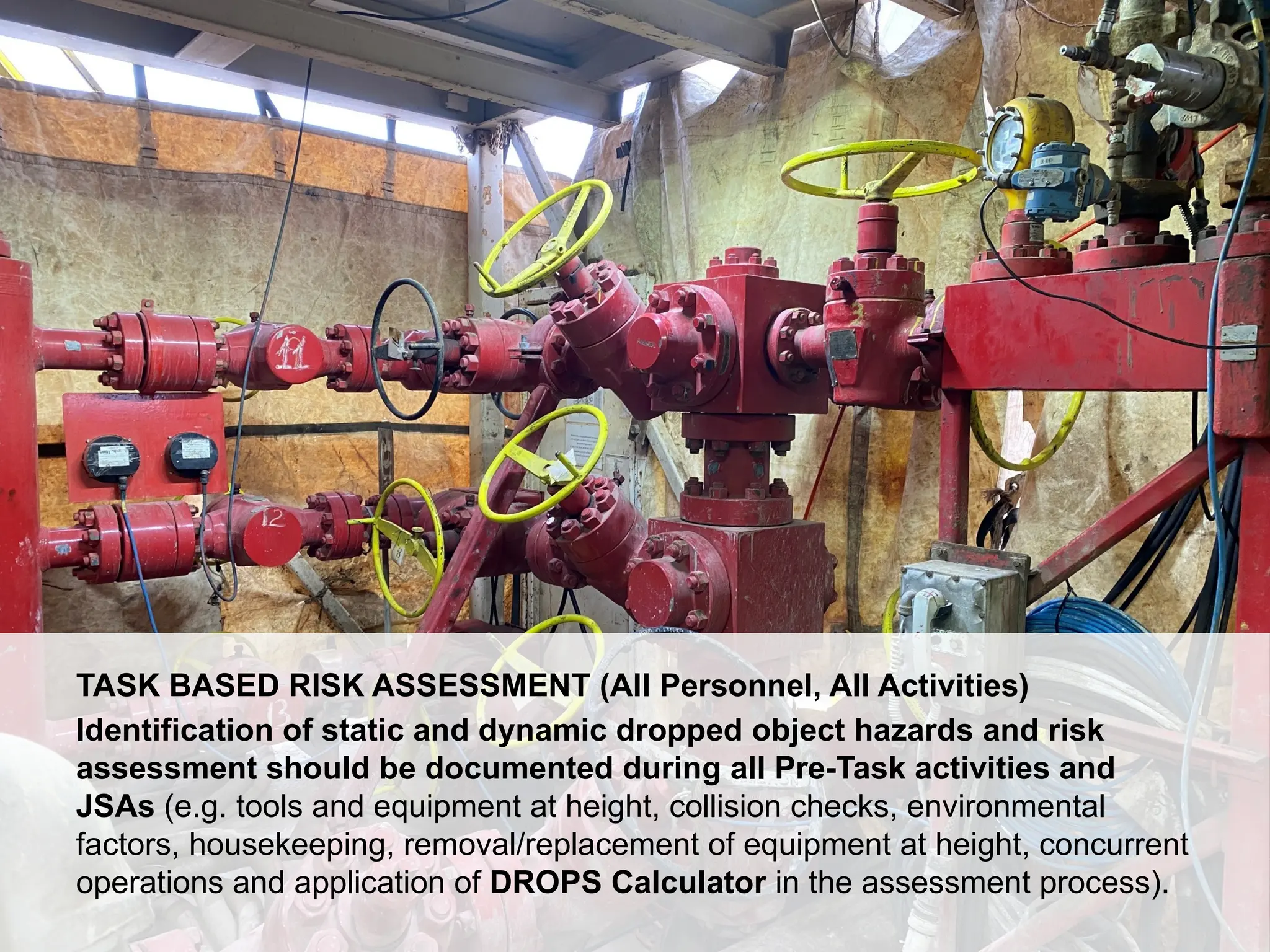
TASK BASED RISK ASSESSMENT (All Personnel, All Activities)
Identification of static and dynamic dropped object hazards and risk
assessment should be documented during all Pre-Task activities and
JSAs (e.g. tools and equipment at height, collision checks, environmental
factors, housekeeping, removal/replacement of equipment at height, concurrent
operations and application of DROPS Calculator in the assessment process).
Dropped Object Awareness
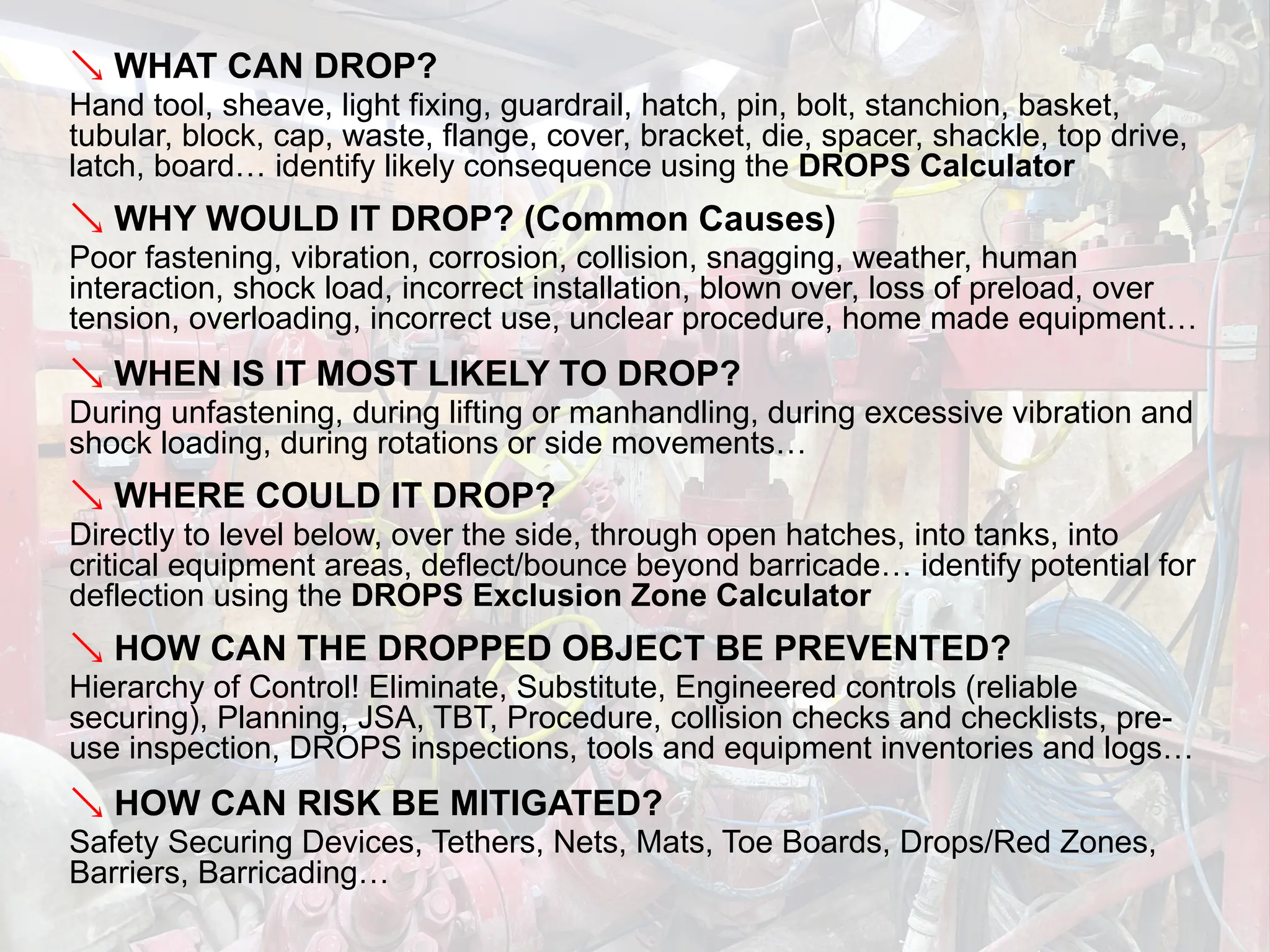
 WHAT CAN DROP?
Hand tool, sheave, light fixing, guardrail, hatch, pin, bolt, stanchion, basket,
tubular, block, cap, waste, flange, cover, bracket, die, spacer, shackle, top drive,
latch, board… identify likely consequence using the DROPS Calculator
 WHY WOULD IT DROP? (Common Causes)
Poor fastening, vibration, corrosion, collision, snagging, weather, human
interaction, shock load, incorrect installation, blown over, loss of preload, over
tension, overloading, incorrect use, unclear procedure, home made equipment…
 WHEN IS IT MOST LIKELY TO DROP?
During unfastening, during lifting or manhandling, during excessive vibration and
shock loading, during rotations or side movements…
 WHERE COULD IT DROP?
Directly to level below, over the side, through open hatches, into tanks, into
critical equipment areas, deflect/bounce beyond barricade… identify potential for
deflection using the DROPS Exclusion Zone Calculator
 HOW CAN THE DROPPED OBJECT BE PREVENTED?
Hierarchy of Control! Eliminate, Substitute, Engineered controls (reliable
securing), Planning, JSA, TBT, Procedure, collision checks and checklists, pre-
use inspection, DROPS inspections, tools and equipment inventories and logs…
 HOW CAN RISK BE MITIGATED?
Safety Securing Devices, Tethers, Nets, Mats, Toe Boards, Drops/Red Zones,
Barriers, Barricading…
Dropped Object Awareness
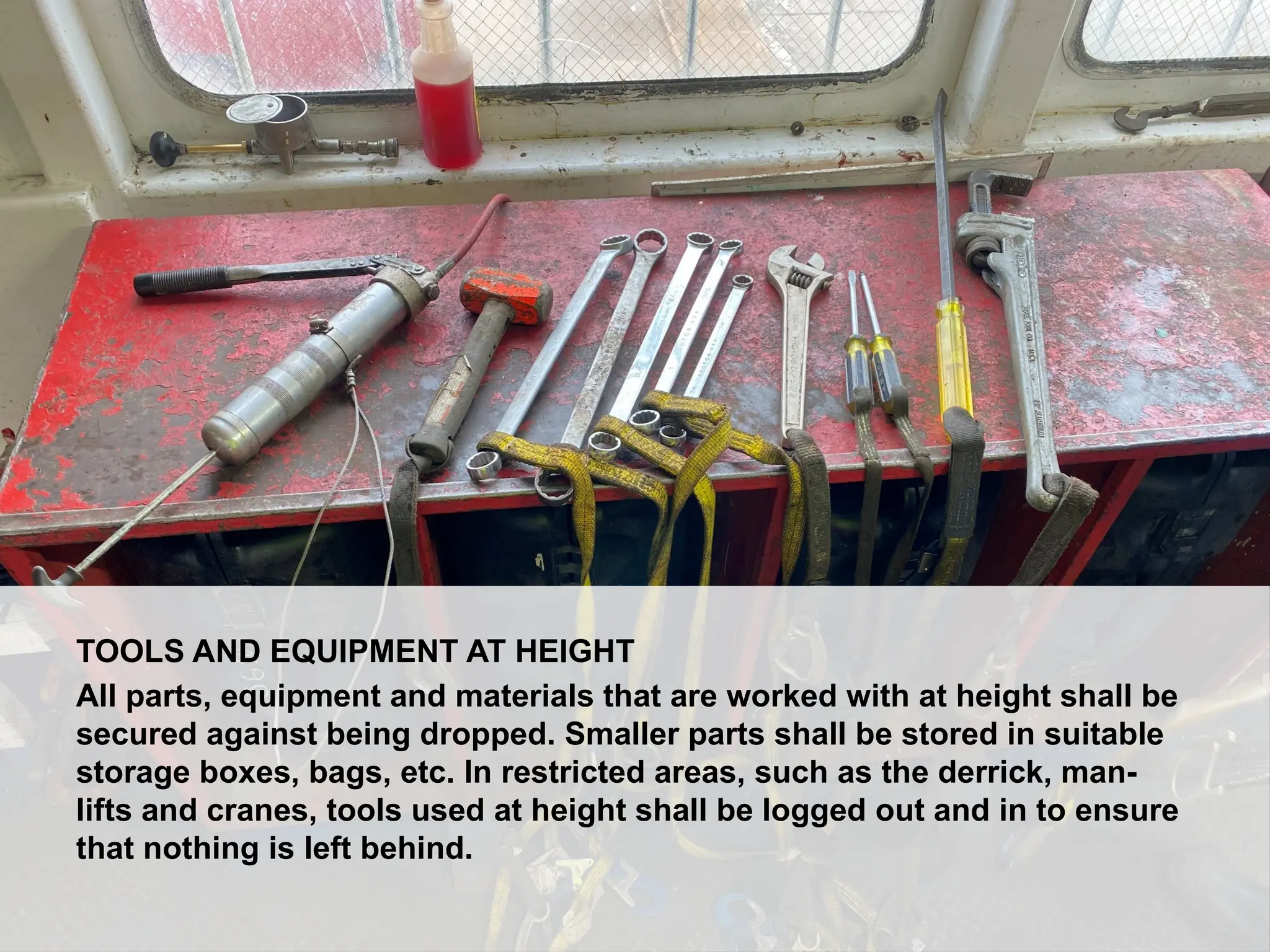
TOOLS AND EQUIPMENT AT HEIGHT
All parts, equipment and materials that are worked with at height shall be
secured against being dropped. Smaller parts shall be stored in suitable
storage boxes, bags, etc. In restricted areas, such as the derrick, man-
lifts and cranes, tools used at height shall be logged out and in to ensure
that nothing is left behind.
Dropped Object Awareness
TOOLS AND EQUIPMENT AT HEIGHT
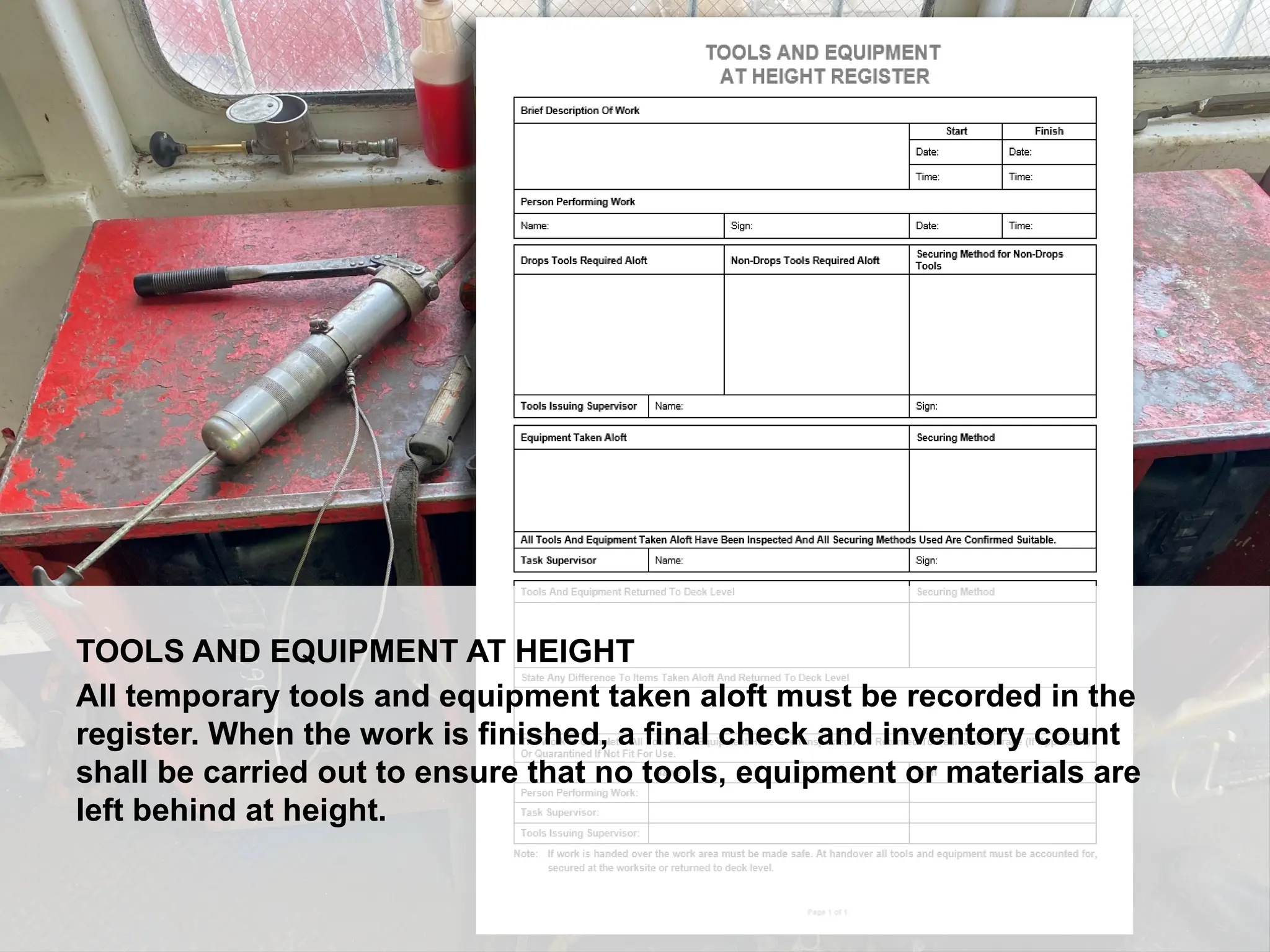
All temporary tools and equipment taken aloft must be recorded in the
register. When the work is finished, a final check and inventory count
shall be carried out to ensure that no tools, equipment or materials are
left behind at height.
Dropped Object Awareness
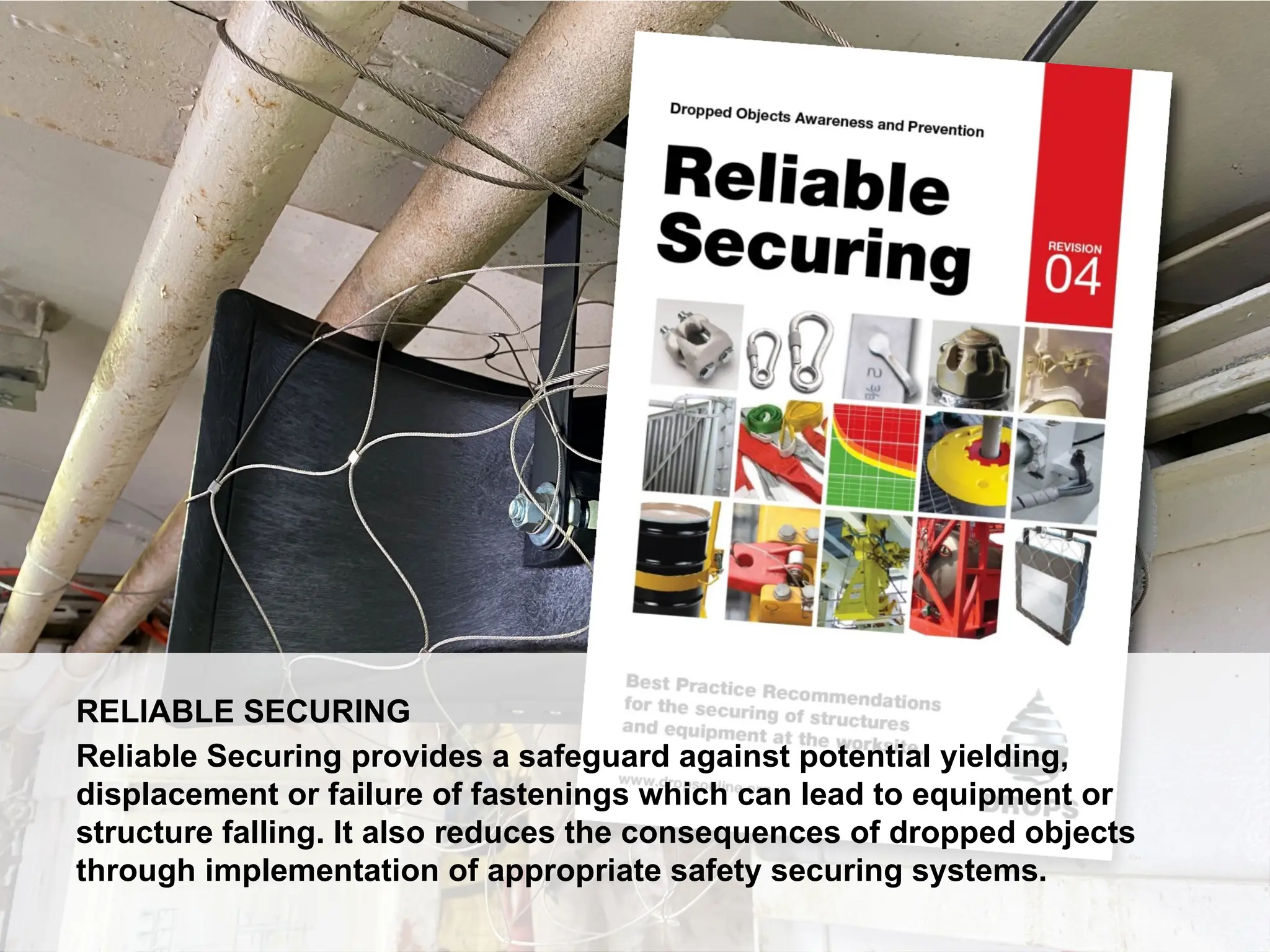
RELIABLE SECURING
Reliable Securing provides a safeguard against potential yielding,
displacement or failure of fastenings which can lead to equipment or
structure falling. It also reduces the consequences of dropped objects
through implementation of appropriate safety securing systems.
Dropped Object Awareness
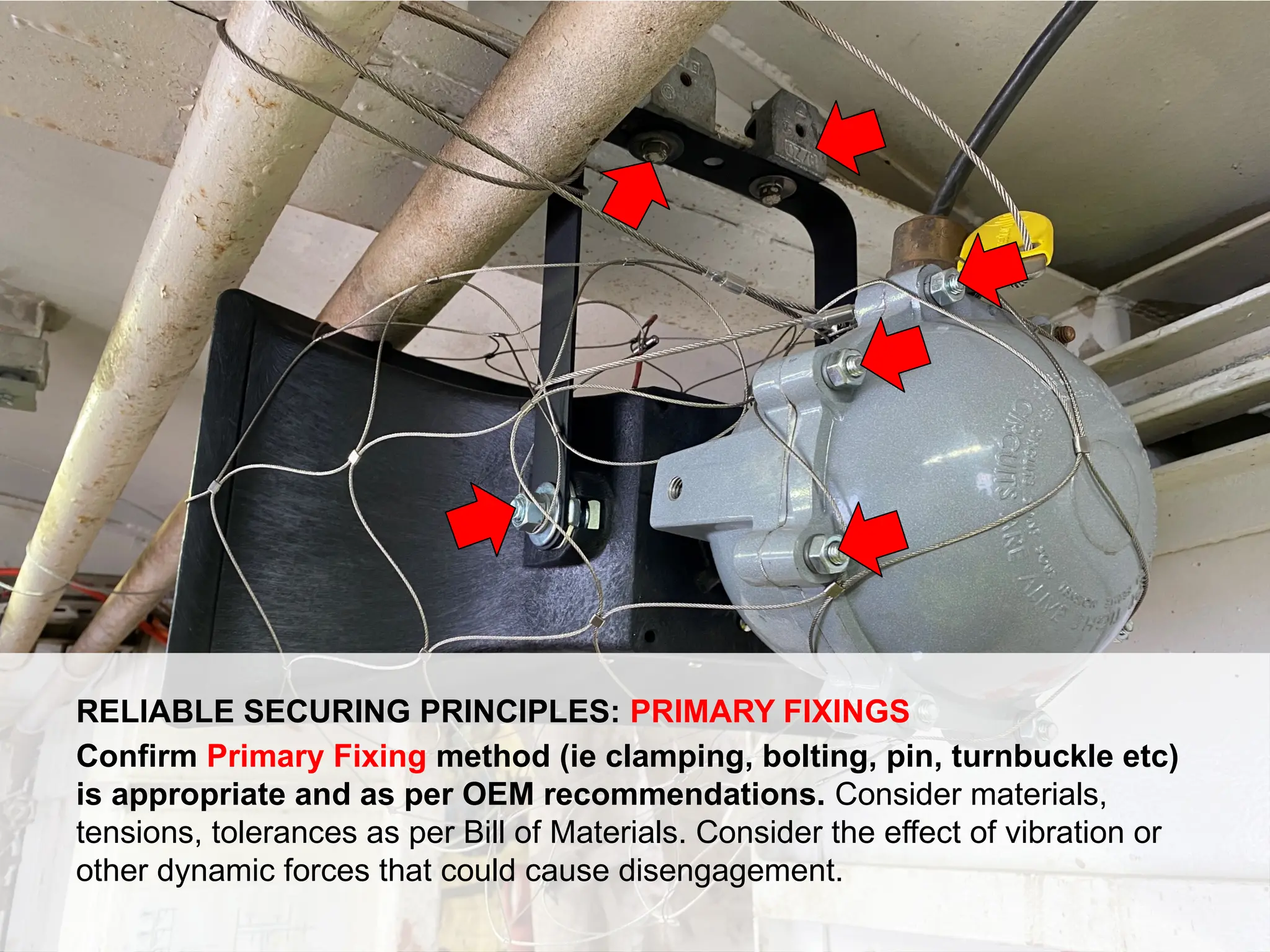
RELIABLE SECURING PRINCIPLES: PRIMARY FIXINGS
Confirm Primary Fixing method (ie clamping, bolting, pin, turnbuckle etc)
is appropriate and as per OEM recommendations. Consider materials,
tensions, tolerances as per Bill of Materials. Consider the effect of vibration or
other dynamic forces that could cause disengagement.
Dropped Object Awareness
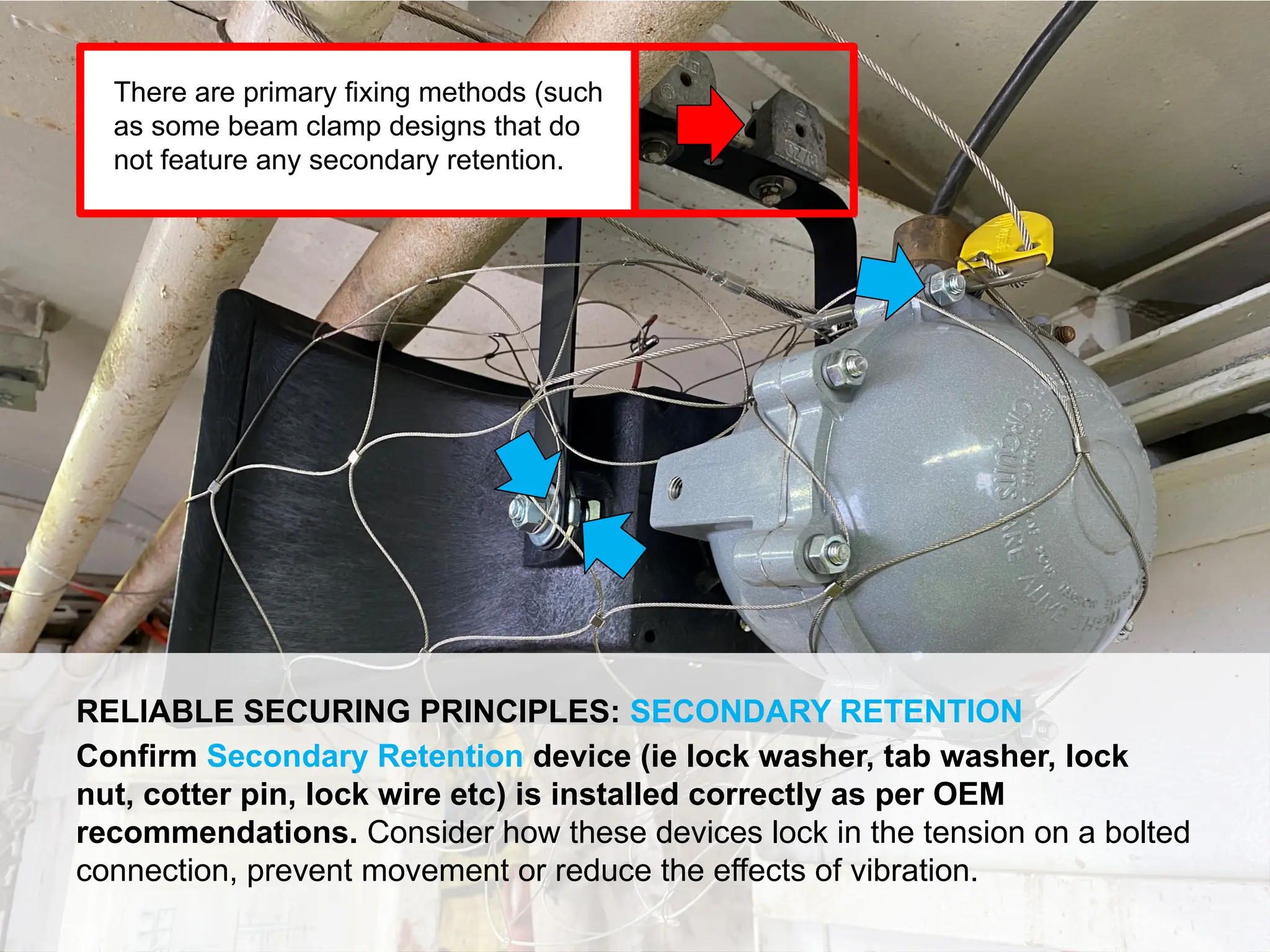
RELIABLE SECURING PRINCIPLES: SECONDARY RETENTION
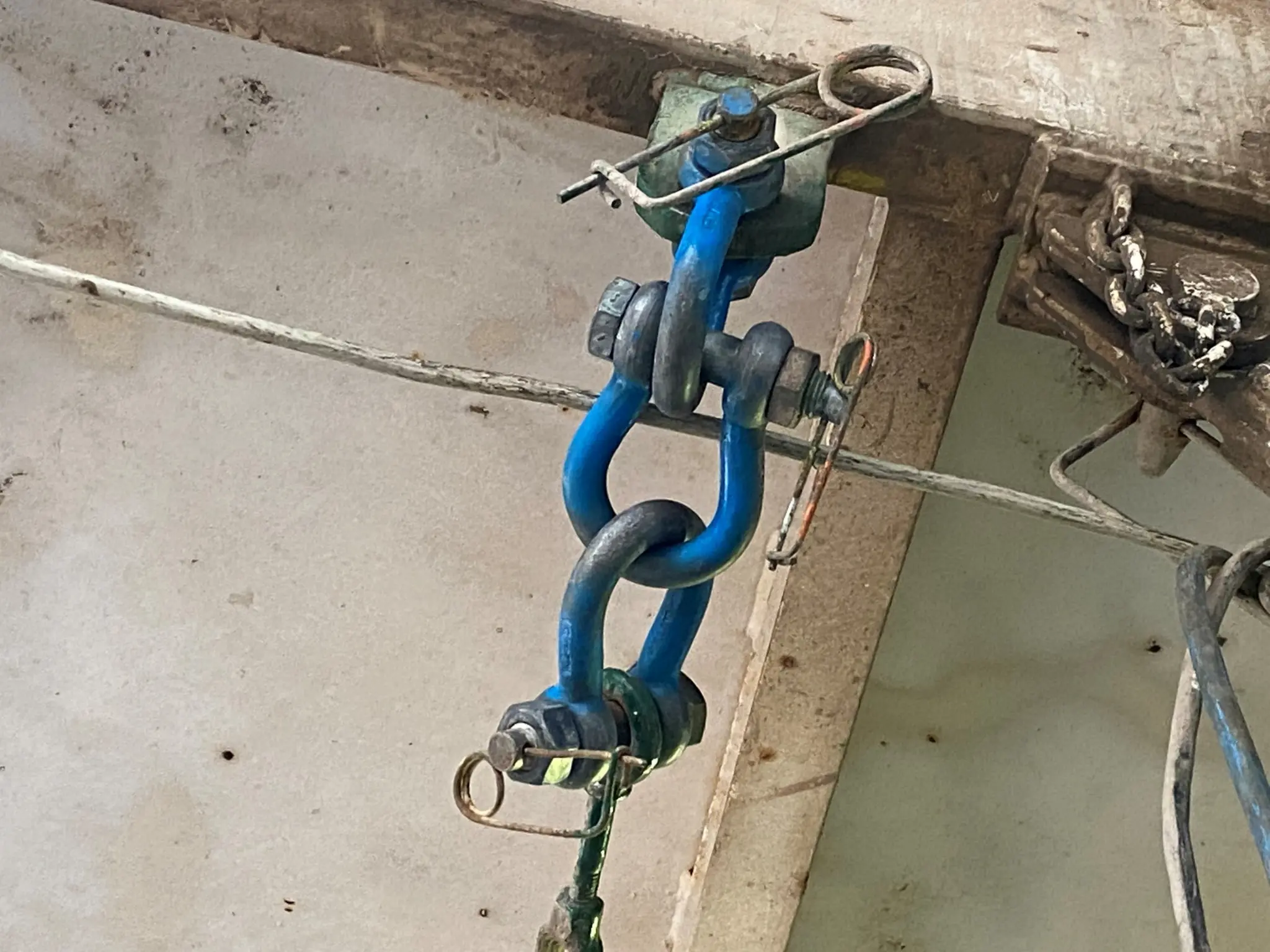
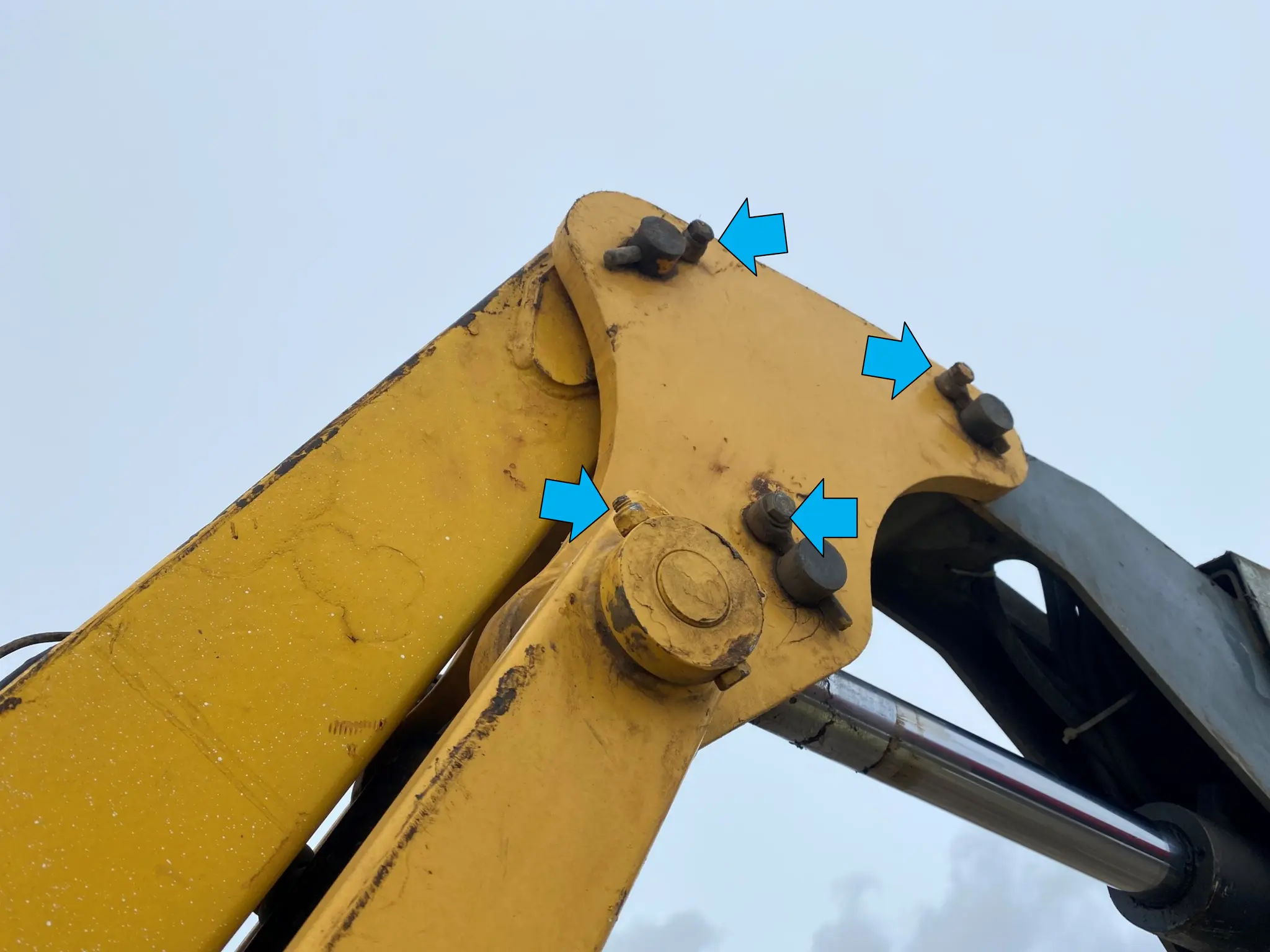
Confirm Secondary Retention device (ie lock washer, tab washer, lock
nut, cotter pin, lock wire etc) is installed correctly as per OEM
recommendations. Consider how these devices lock in the tension on a bolted
connection, prevent movement or reduce the effects of vibration.
There are primary fixing methods (such
as some beam clamp designs that do
not feature any secondary retention.
Dropped Object Awareness
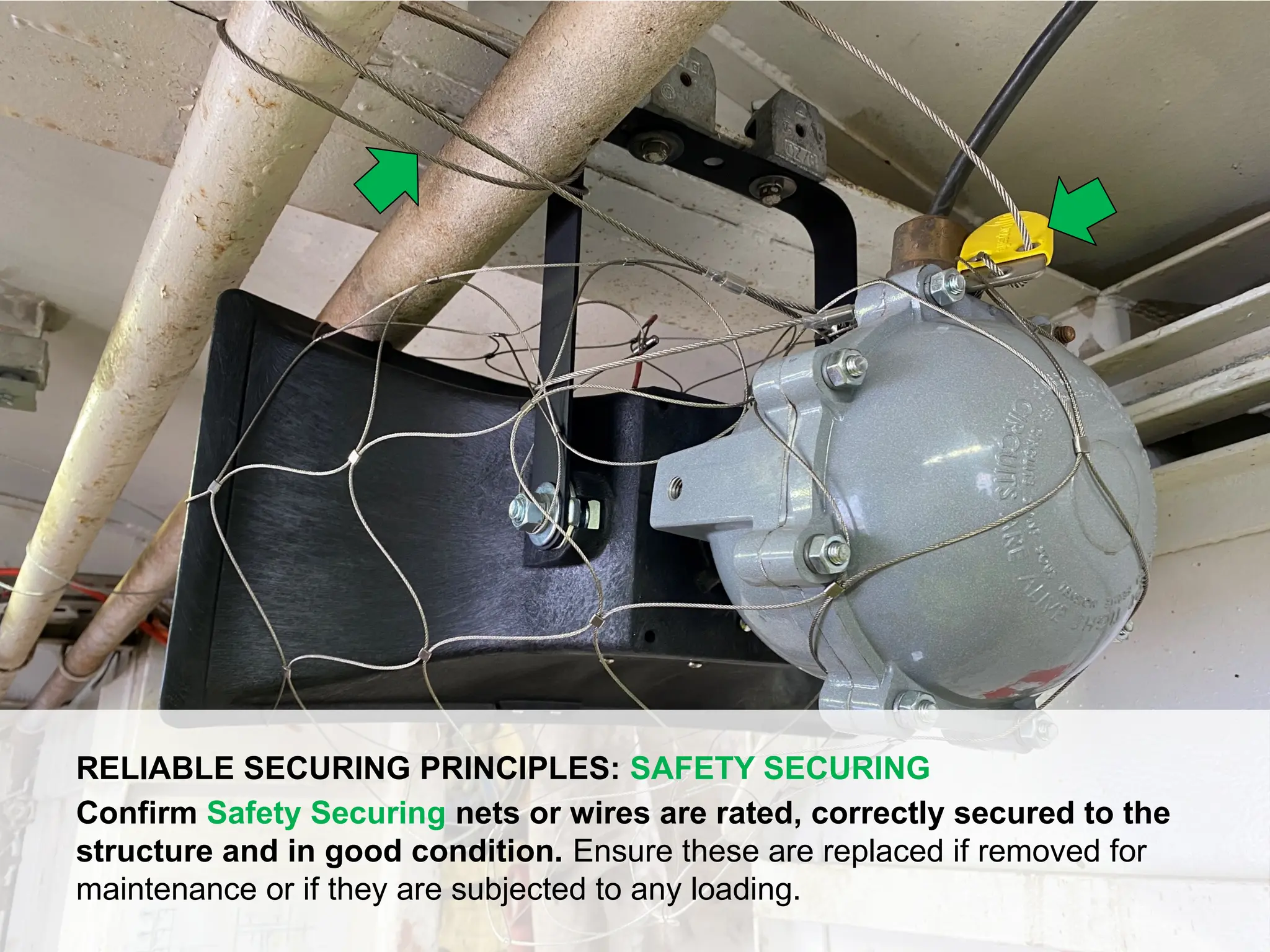
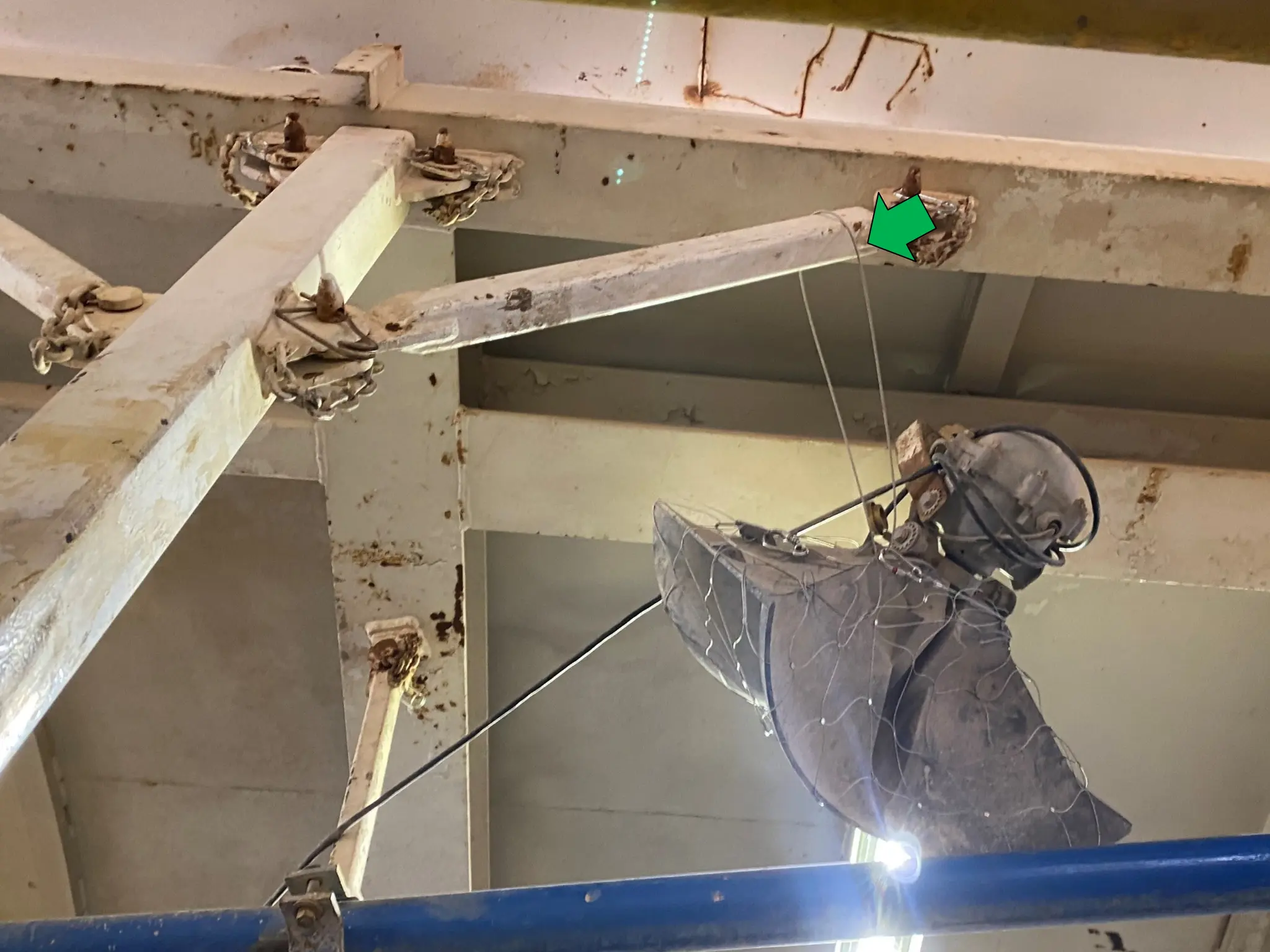
RELIABLE SECURING PRINCIPLES: SAFETY SECURING
Confirm Safety Securing nets or wires are rated, correctly secured to the
structure and in good condition. Ensure these are replaced if removed for
maintenance or if they are subjected to any loading.
Dropped Object Awareness
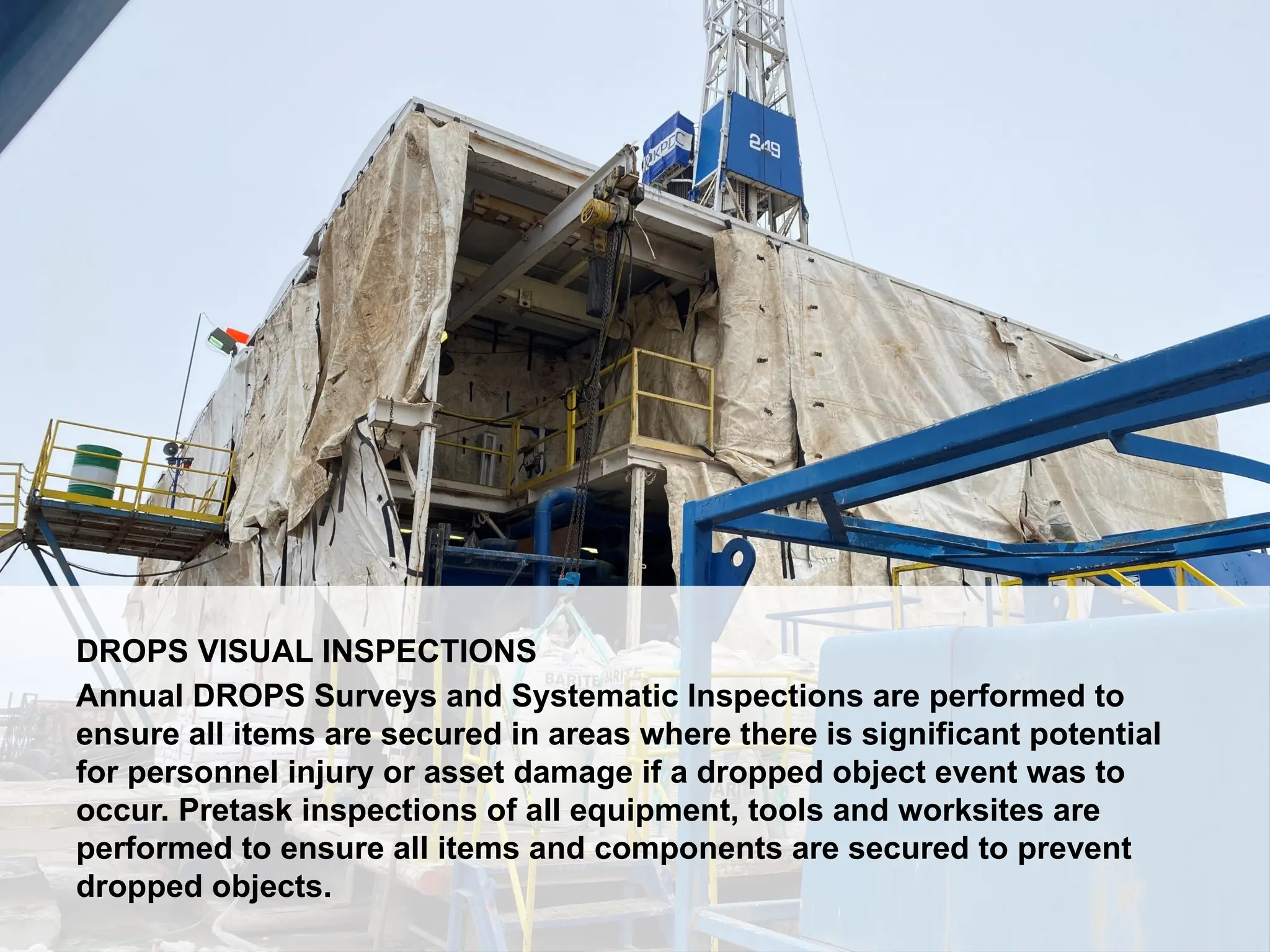
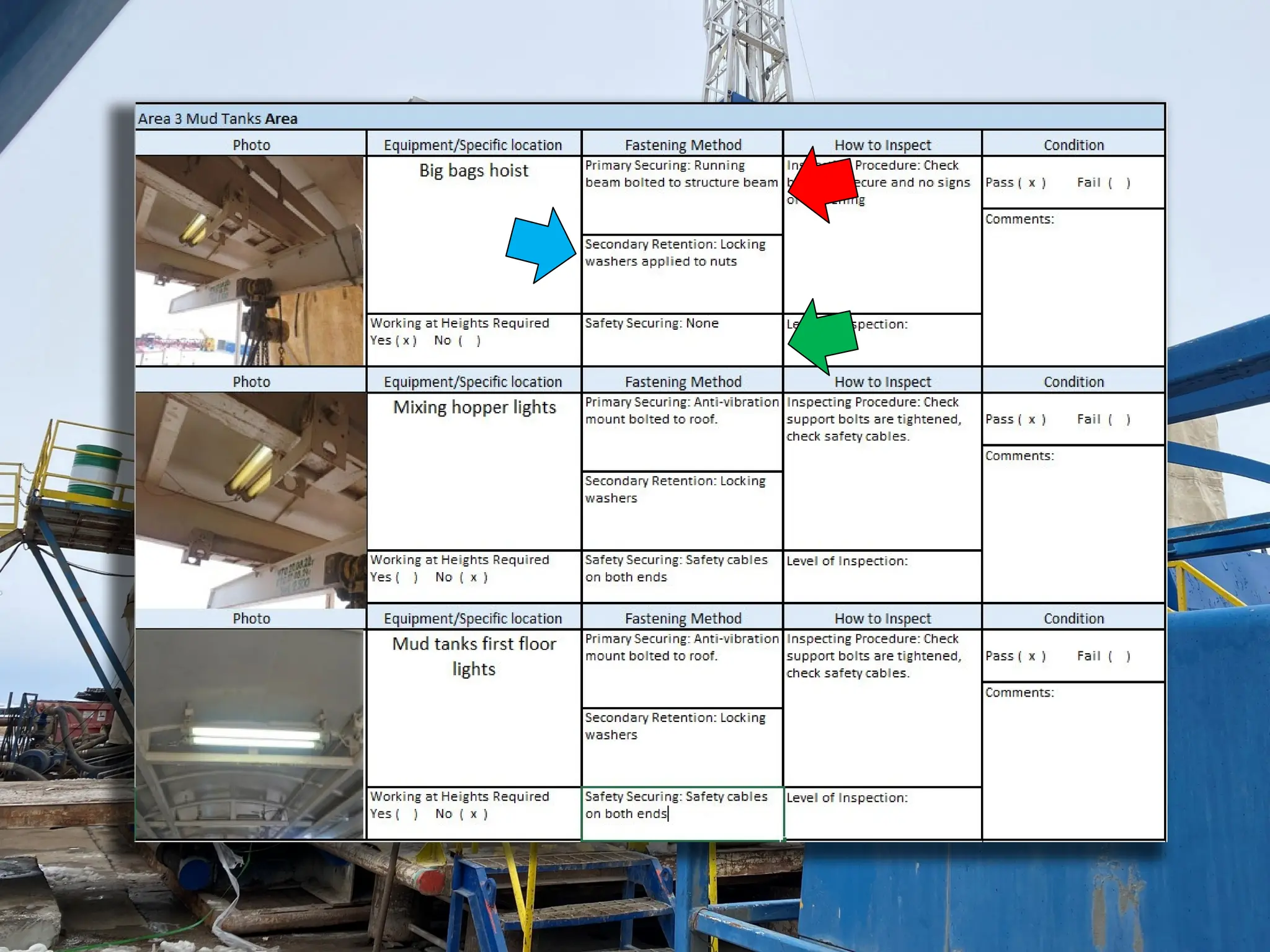
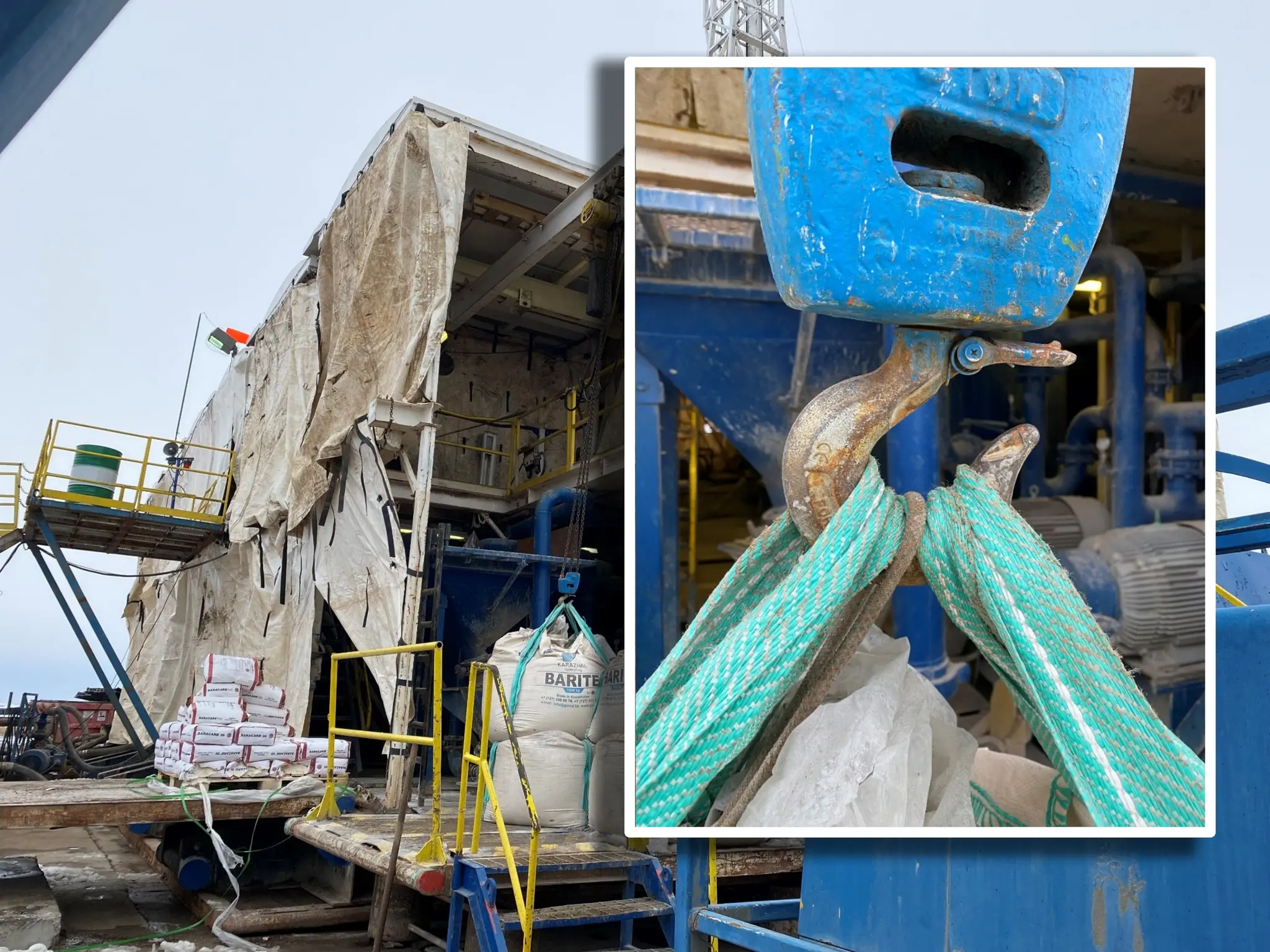
DROPS VISUAL INSPECTIONS
Annual DROPS Surveys and Systematic Inspections are performed to
ensure all items are secured in areas where there is significant potential
for personnel injury or asset damage if a dropped object event was to
occur. Pretask inspections of all equipment, tools and worksites are
performed to ensure all items and components are secured to prevent
dropped objects.
Dropped Object Awareness
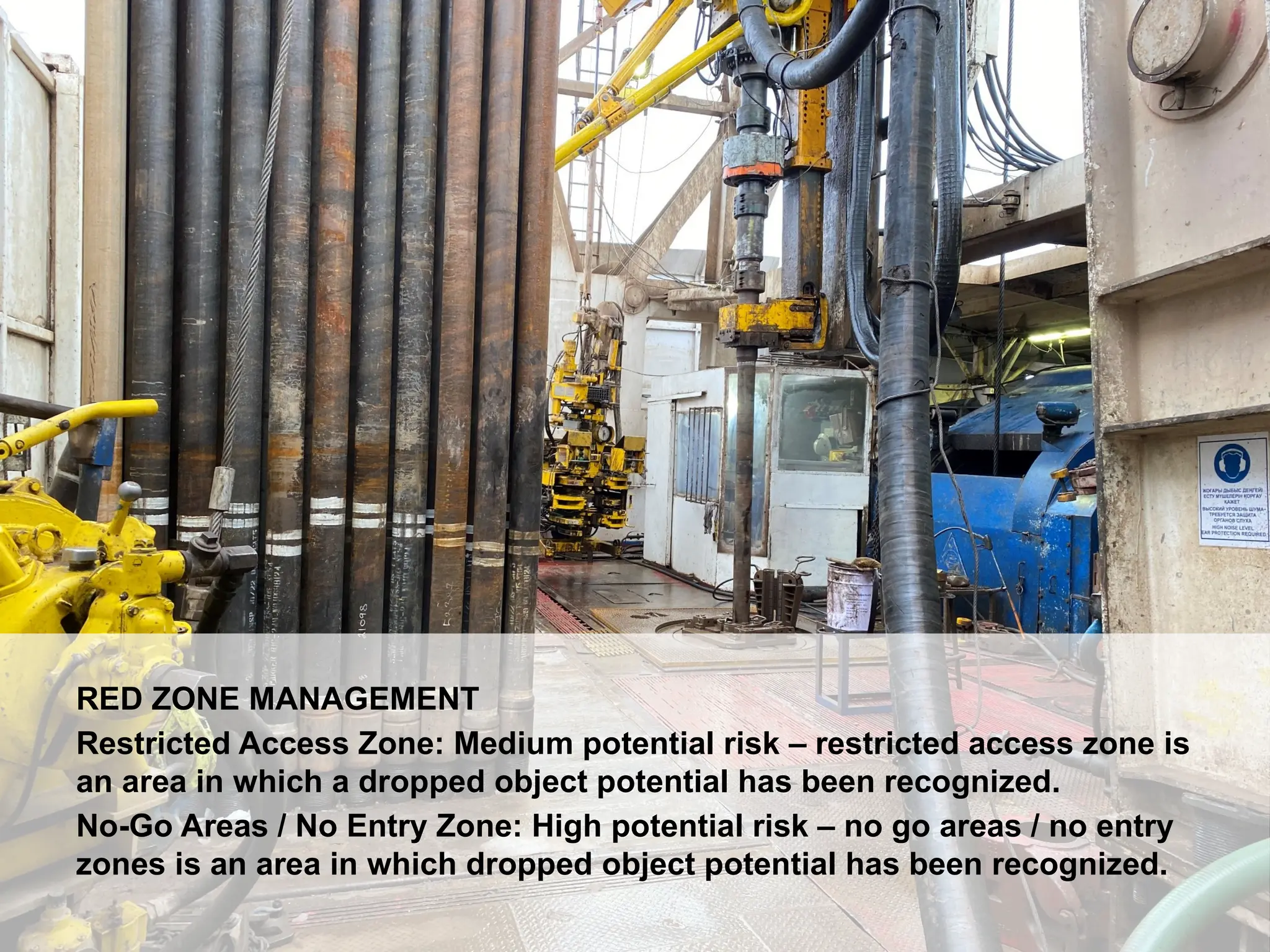
RED ZONE MANAGEMENT
Restricted Access Zone: Medium potential risk – restricted access zone is
an area in which a dropped object potential has been recognized.
No-Go Areas / No Entry Zone: High potential risk – no go areas / no entry
zones is an area in which dropped object potential has been recognized.
Dropped Object Awareness
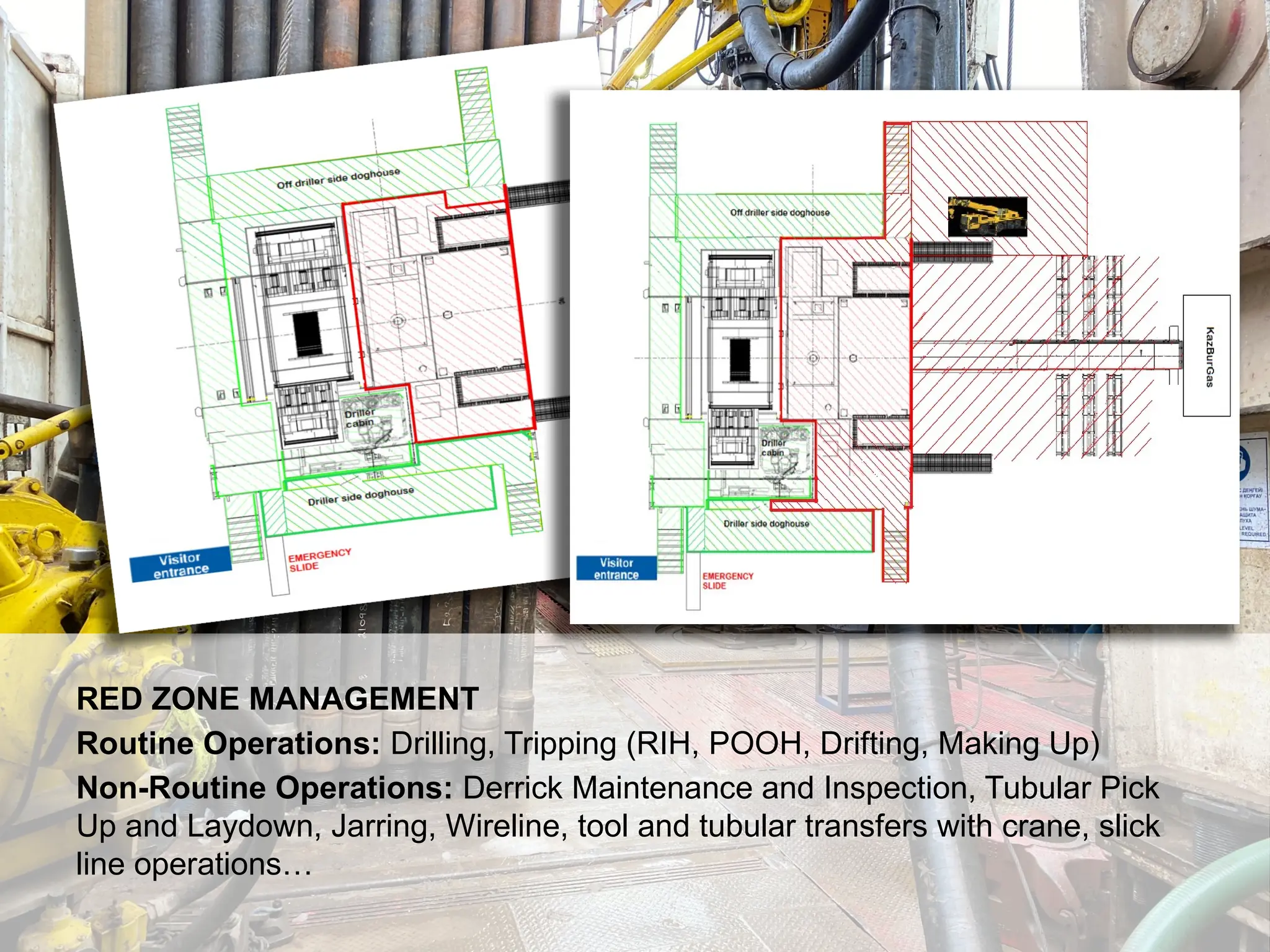
RED ZONE MANAGEMENT
Routine Operations: Drilling, Tripping (RIH, POOH, Drifting, Making Up)
Non-Routine Operations: Derrick Maintenance and Inspection, Tubular Pick
Up and Laydown, Jarring, Wireline, tool and tubular transfers with crane, slick
line operations…
Dropped Object Awareness
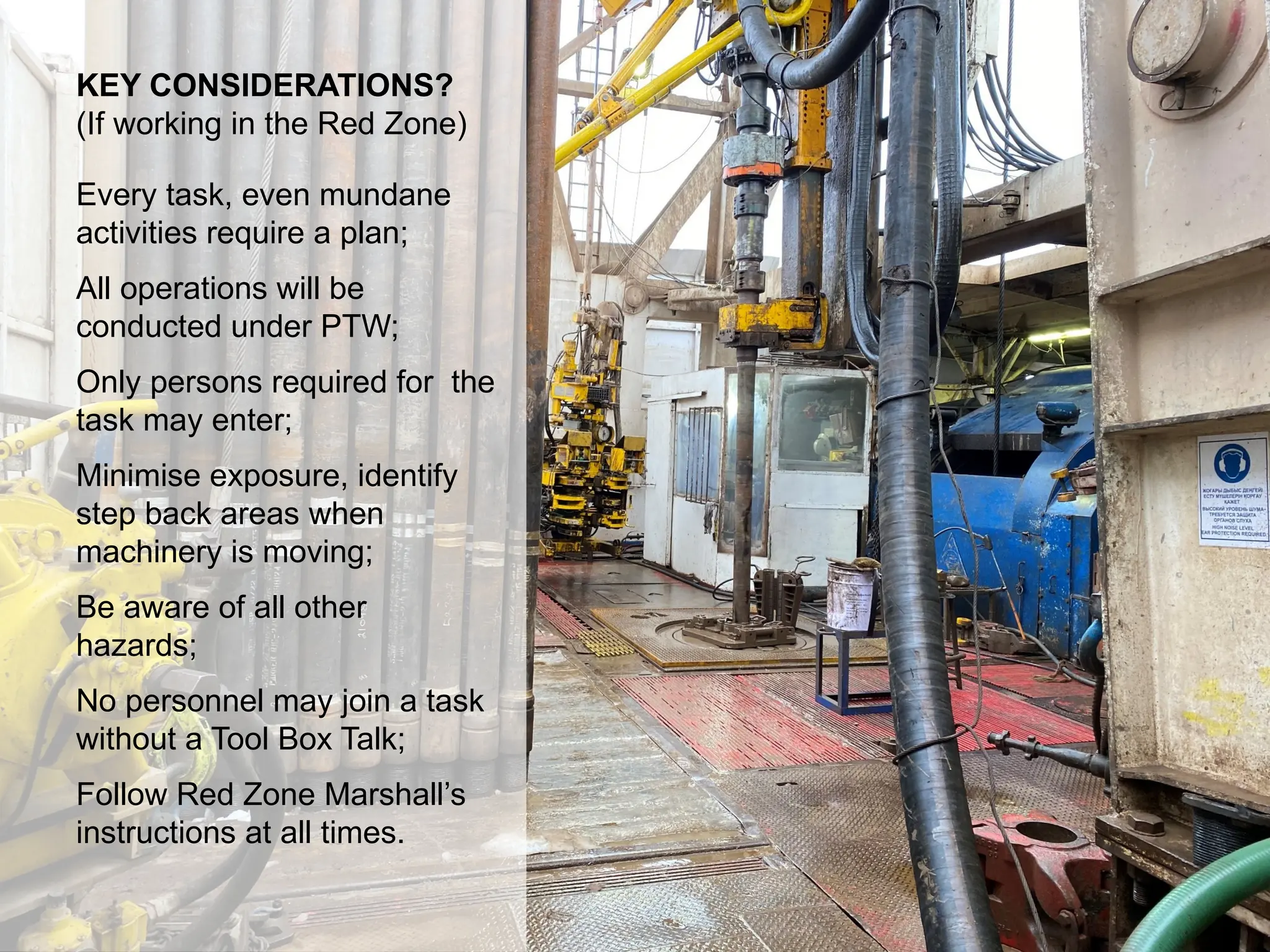
KEY CONSIDERATIONS?
(If working in the Red Zone)
Every task, even mundane
activities require a plan;
All operations will be
conducted under PTW;
Only persons required for the
task may enter;
Minimise exposure, identify
step back areas when
machinery is moving;
Be aware of all other
hazards;
No personnel may join a task
without a Tool Box Talk;
Follow Red Zone Marshall’s
instructions at all times.
Dropped Object Awareness
Understand Each General Requirement?
TASK PLANNING AND RISK ASSESSMENT
• All repairs and maintenance work carried out at height shall be
risk assessed.
TOOLS AND EQUIPMENT AT HEIGHT
• All equipment used where there is a risk of the equipment falling
to an underlying level shall be secured against being dropped.
• Smaller parts shall be stored in suitable storage boxes, bags, etc.
• In restricted areas, such as the derrick, man-lifts and cranes,
tools used at height shall be logged out and in to ensure that
nothing is left behind.
• When the work is finished, a final check and inventory count shall
be carried out to ensure that no tools, equipment or materials are
left behind at height.
Dropped Object Awareness
Understand Each General Requirement?
RELIABLE SECURING
• All equipment used where there is a risk of the equipment falling
to an underlying level shall be secured against being dropped.
SURVEY AND INSPECTION
• Each rig shall maintain a complete inventory of non-structural
equipment that is installed in the derrick.
• A weekly derrick/mast inspection shall be conducted for loose
or unsecured equipment.
• A regular rig DROPS inspection shall be conducted for loose
or unsecured equipment.
Dropped Object Awareness
Understand Each General Requirement?
RED ZONES
• Exclusion zone management shall be established to prevent
unauthorized personnel entry into work areas in which any work at
height or hoisting is being conducted (to include zones where
personnel are ‘guarded by position’ from dropped objects).
REPORTING
• Any dropped object shall be considered a serious incident,
regardless of potential severity, and fully investigated in accordance
with the Company incident investigation standard.
Dropped Object Awareness
Summary
• What are you going to do about preventing Dropped
Objects in the workplace?
•Communicate, raise awareness, intervene
•Reliable Securing – understand and question robustness of
fixings
•Use Task Risk Assessment effectively
•List inherent hazards so others may learn
•Guide others on dropped object prevention
•REPORT ALL DROPPED OBJECTS
•Dropped Objects occur everywhere, so be vigilant
•STOP WORK if dropped objects present an immediate hazard
• Any Questions?
•Speak to your Supervisor – or visit dropsonline.org
•Always remember dropped objects occur EVERYWHERE!
Dropped Object Awareness
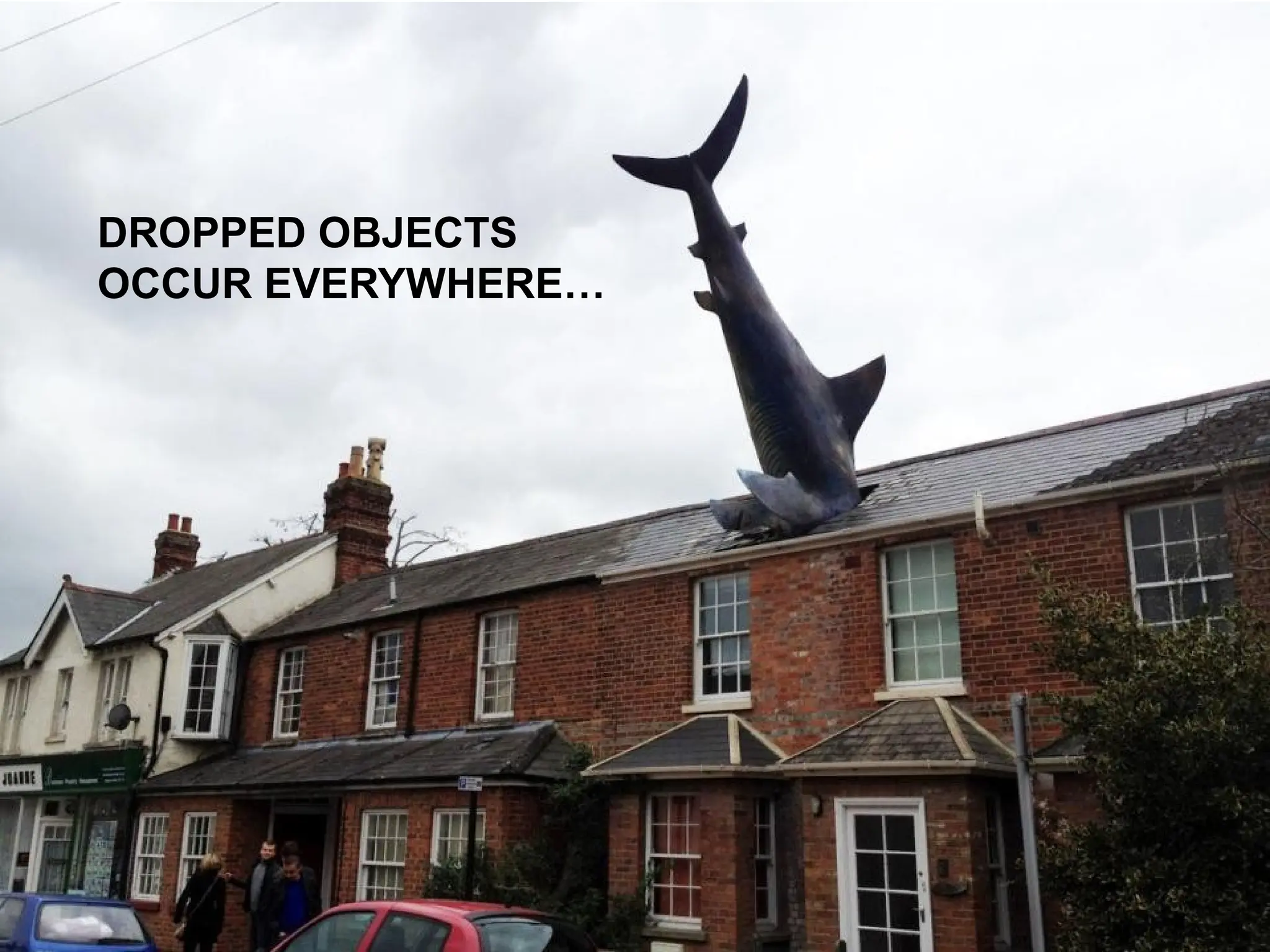
DROPPED OBJECTS
OCCUR EVERYWHERE…
Dropped Object Awareness
The fact remains:
What are you going to do about it?
Get Involved. Share Best Practice. Make a Difference

04 EXAMPLE DROPS Awareness Short Asset Specific.pptx

  • 1.
    Dropped Object Awareness DroppedObject Awareness and Prevention YOUR ASSET TITLE Part 1: Understanding Dropped Objects (Definitions, Common Causes, Consequences)
  • 2.
    Dropped Object Awareness DroppedObject Awareness • Introduction to Drops •DROPS is the global initiative, we’re all active members •Our approach to Drops Management reflects Best Practice •Scope applies to all personnel, installations and facilities •It’s Proactive, not just prescriptive •Applies to all tasks, a key part of our HSE management system •WE ARE ALL RESPONSIBLE for improving performance
  • 3.
    Dropped Object Awareness DroppedObject Awareness • Introduction to Drops •DROPS is the global initiative, we’re all active members •Our approach to Drops Management reflects Best Practice •Scope applies to all personnel, installations and facilities •It’s Proactive, not just prescriptive •Applies to all tasks, a key part of our HSE management system •WE ARE ALL RESPONSIBLE for improving performance
  • 4.
    Dropped Object Awareness UnderstandingDropped Objects • What is a Dropped Object? Any object / item that falls from its previous position (TOOLS, EQUIPMENT, STRUCTURE, LOOSE ITEMS, LIFTED OR TRANSPORTED LOADS, STACKED / STORED MATERIALS…). REMEMBER: GRAVITY IS A WORKSITE HAZARD!
  • 5.
    Dropped Object Awareness DroppedObject Categories • Static Dropped Object any object that falls from its previous position under its own weight – where Gravity takes over! • Dynamic Dropped Object any object that falls from its previous position due to applied force from equipment/machinery or moving object – like a collision, perhaps during lifting or stacking… also manual handling, pressure or electrical energy sources too Now think about objects that can fall due to failure caused by repeated cyclic loading, environmental factors and movement – vibration, temperature, wind and so on…
  • 6.
  • 7.
    Dropped Object Awareness PresenterNotes • Insert your own images from your worksite showing examples of static and dynamic potentials • If you wish, insert incident learnings which describe both static and dynamic incidents
  • 8.
  • 9.
  • 10.
  • 11.
  • 12.
    Dropped Object Awareness UnderstandingDropped Object Causes • What Causes Dropped Objects? •Poor Hazard Identification and Risk Assessment •Inadequate Design (not addressing Dropped Object potential) •Human Factors and Error Traps •Inadequate Inspection, Repair and Maintenance •Redundant / Neglected / Homemade Tools and Equipment •Failed Fixtures and Fittings / Corrosion / Vibration •Overloading / Incorrect or Improper Use of Equipment and Tools •Inappropriate Procedures / Not Following Procedures •Inadequately Stored / Secured Tools and Equipment •Poor Housekeeping •Environment (weather, ground disturbance) •Planning and Operational Miscalculations •….any others? And how to we address them as causal factors?
  • 13.
    Dropped Object Awareness •Personnel Dropped Objects account for around 35% of all safety related incidents… one of the top three causes of serious injury and fatality in Industry. • Equipment and Environmental Damage Dropped Objects cause damage to plant and equipment... spills, loss of containment, lost time and money. • Reputational Damage Not good for business… Dropped Object Consequences
  • 14.
    Dropped Object Awareness DROPSConsequence Calculator (Metric) 12m 0.5kg 1.4kg 0.85kg
  • 15.
    Dropped Object Awareness DroppedObject Consequences: Fall Energy • If this machine bolt (220g) was to fall from 27m - and strike someone’s head (wearing a hardhat), what could happen to them? EXAMPLE: 220g dropped from 27m • Similar Consequence if: 0.8kg dropped from 7m 1.4kg dropped from 4.3m 58 JOULES (0.22kg x 27m x 9.8066m/s2 – gravitational acceleration) HARDHAT is designed to withstand 95 Joules
  • 16.
  • 17.
    Dropped Object Awareness The‘Cone of Exposure’
  • 18.
    Dropped Object Awareness PresenterNotes • Conclude the first part by inserting recent dropped object incident summary from the rig and show video if appropriate • Discuss the incident and share the learnings. • At this point, take a break. Return (or host another session) to discuss the Controls we have that will reduce the likelihood of dropped objects and reduce the consequence should they occur.
  • 19.
    Dropped Object Awareness Summary •What do we know about Dropped Objects? •Gravity is a Hazard, a constant force that cannot be isolated •We must prevent the release of Gravity! •Dropped objects can occur anywhere •They can harm and they can kill •Equipment and the Environment can be damaged •Even small items can have severe consequence •Static and Dynamic potential exists in all tasks •There is a Company Procedure on Drops Prevention •The DROPS Calculator is a tool that will inform our Risk Assessments, but can also be used after an incident •There are many common causes and many are attributable to Human Factors – or the Error Traps that can lead to mistakes.
  • 20.
    Dropped Object Awareness DroppedObject Awareness and Prevention YOUR ASSET TITLE Part 2: Preventing Dropped Objects (The Hierarchy of Control)
  • 21.
    Dropped Object Awareness PreventingDropped Objects: Hierarchy of Control Engineer the hazard out Change how people work Remove the hazard Replace the hazard Isolate people from the hazard Protect people with PPE Most Effective Control Least Effective Control
  • 22.
    Dropped Object Awareness DroppedObject Prevention Controls o Inductions, Training, Competence o Continuous Hazard Awareness, Observations, Stop Work Authority o Task Planning and Risk Assessment, TBT, PTW, Procedures, Management of Change o Equipment Manufacturer Recommendations / Codes / Standards / Preventive Maintenance o Control of Tools and Equipment at Height o Reliable Securing - Primary fixings / Secondary retention o Survey and Inspection, Certification (Colour Coding) o Collision Checks / Checklists o Safety Securing Systems, Barriers, Guards and Nets o Red Zones / Restricted Access Areas / Cone of Exposure o PPE Preventative Controls (responding to the threat): Mitigating / Recovery Controls:
  • 23.
    Dropped Object Awareness TASKBASED RISK ASSESSMENT (All Personnel, All Activities) Identification of static and dynamic dropped object hazards and risk assessment should be documented during all Pre-Task activities and JSAs (e.g. tools and equipment at height, collision checks, environmental factors, housekeeping, removal/replacement of equipment at height, concurrent operations and application of DROPS Calculator in the assessment process).
  • 24.
  • 25.
     WHAT CANDROP? Hand tool, sheave, light fixing, guardrail, hatch, pin, bolt, stanchion, basket, tubular, block, cap, waste, flange, cover, bracket, die, spacer, shackle, top drive, latch, board… identify likely consequence using the DROPS Calculator  WHY WOULD IT DROP? (Common Causes) Poor fastening, vibration, corrosion, collision, snagging, weather, human interaction, shock load, incorrect installation, blown over, loss of preload, over tension, overloading, incorrect use, unclear procedure, home made equipment…  WHEN IS IT MOST LIKELY TO DROP? During unfastening, during lifting or manhandling, during excessive vibration and shock loading, during rotations or side movements…  WHERE COULD IT DROP? Directly to level below, over the side, through open hatches, into tanks, into critical equipment areas, deflect/bounce beyond barricade… identify potential for deflection using the DROPS Exclusion Zone Calculator  HOW CAN THE DROPPED OBJECT BE PREVENTED? Hierarchy of Control! Eliminate, Substitute, Engineered controls (reliable securing), Planning, JSA, TBT, Procedure, collision checks and checklists, pre- use inspection, DROPS inspections, tools and equipment inventories and logs…  HOW CAN RISK BE MITIGATED? Safety Securing Devices, Tethers, Nets, Mats, Toe Boards, Drops/Red Zones, Barriers, Barricading…
  • 26.
    Dropped Object Awareness TOOLSAND EQUIPMENT AT HEIGHT All parts, equipment and materials that are worked with at height shall be secured against being dropped. Smaller parts shall be stored in suitable storage boxes, bags, etc. In restricted areas, such as the derrick, man- lifts and cranes, tools used at height shall be logged out and in to ensure that nothing is left behind.
  • 27.
    Dropped Object Awareness TOOLSAND EQUIPMENT AT HEIGHT All temporary tools and equipment taken aloft must be recorded in the register. When the work is finished, a final check and inventory count shall be carried out to ensure that no tools, equipment or materials are left behind at height.
  • 28.
  • 29.
    Dropped Object Awareness RELIABLESECURING Reliable Securing provides a safeguard against potential yielding, displacement or failure of fastenings which can lead to equipment or structure falling. It also reduces the consequences of dropped objects through implementation of appropriate safety securing systems.
  • 30.
    Dropped Object Awareness RELIABLESECURING PRINCIPLES: PRIMARY FIXINGS Confirm Primary Fixing method (ie clamping, bolting, pin, turnbuckle etc) is appropriate and as per OEM recommendations. Consider materials, tensions, tolerances as per Bill of Materials. Consider the effect of vibration or other dynamic forces that could cause disengagement.
  • 31.
    Dropped Object Awareness RELIABLESECURING PRINCIPLES: SECONDARY RETENTION Confirm Secondary Retention device (ie lock washer, tab washer, lock nut, cotter pin, lock wire etc) is installed correctly as per OEM recommendations. Consider how these devices lock in the tension on a bolted connection, prevent movement or reduce the effects of vibration. There are primary fixing methods (such as some beam clamp designs that do not feature any secondary retention.
  • 32.
    Dropped Object Awareness RELIABLESECURING PRINCIPLES: SAFETY SECURING Confirm Safety Securing nets or wires are rated, correctly secured to the structure and in good condition. Ensure these are replaced if removed for maintenance or if they are subjected to any loading.
  • 33.
  • 34.
  • 35.
  • 36.
    Dropped Object Awareness DROPSVISUAL INSPECTIONS Annual DROPS Surveys and Systematic Inspections are performed to ensure all items are secured in areas where there is significant potential for personnel injury or asset damage if a dropped object event was to occur. Pretask inspections of all equipment, tools and worksites are performed to ensure all items and components are secured to prevent dropped objects.

  • 37.
  • 38.
  • 39.
    Dropped Object Awareness REDZONE MANAGEMENT Restricted Access Zone: Medium potential risk – restricted access zone is an area in which a dropped object potential has been recognized. No-Go Areas / No Entry Zone: High potential risk – no go areas / no entry zones is an area in which dropped object potential has been recognized.
  • 40.
    Dropped Object Awareness REDZONE MANAGEMENT Routine Operations: Drilling, Tripping (RIH, POOH, Drifting, Making Up) Non-Routine Operations: Derrick Maintenance and Inspection, Tubular Pick Up and Laydown, Jarring, Wireline, tool and tubular transfers with crane, slick line operations…
  • 41.
    Dropped Object Awareness KEYCONSIDERATIONS? (If working in the Red Zone) Every task, even mundane activities require a plan; All operations will be conducted under PTW; Only persons required for the task may enter; Minimise exposure, identify step back areas when machinery is moving; Be aware of all other hazards; No personnel may join a task without a Tool Box Talk; Follow Red Zone Marshall’s instructions at all times.
  • 42.
    Dropped Object Awareness UnderstandEach General Requirement? TASK PLANNING AND RISK ASSESSMENT • All repairs and maintenance work carried out at height shall be risk assessed. TOOLS AND EQUIPMENT AT HEIGHT • All equipment used where there is a risk of the equipment falling to an underlying level shall be secured against being dropped. • Smaller parts shall be stored in suitable storage boxes, bags, etc. • In restricted areas, such as the derrick, man-lifts and cranes, tools used at height shall be logged out and in to ensure that nothing is left behind. • When the work is finished, a final check and inventory count shall be carried out to ensure that no tools, equipment or materials are left behind at height.
  • 43.
    Dropped Object Awareness UnderstandEach General Requirement? RELIABLE SECURING • All equipment used where there is a risk of the equipment falling to an underlying level shall be secured against being dropped. SURVEY AND INSPECTION • Each rig shall maintain a complete inventory of non-structural equipment that is installed in the derrick. • A weekly derrick/mast inspection shall be conducted for loose or unsecured equipment. • A regular rig DROPS inspection shall be conducted for loose or unsecured equipment.
  • 44.
    Dropped Object Awareness UnderstandEach General Requirement? RED ZONES • Exclusion zone management shall be established to prevent unauthorized personnel entry into work areas in which any work at height or hoisting is being conducted (to include zones where personnel are ‘guarded by position’ from dropped objects). REPORTING • Any dropped object shall be considered a serious incident, regardless of potential severity, and fully investigated in accordance with the Company incident investigation standard.
  • 45.
    Dropped Object Awareness Summary •What are you going to do about preventing Dropped Objects in the workplace? •Communicate, raise awareness, intervene •Reliable Securing – understand and question robustness of fixings •Use Task Risk Assessment effectively •List inherent hazards so others may learn •Guide others on dropped object prevention •REPORT ALL DROPPED OBJECTS •Dropped Objects occur everywhere, so be vigilant •STOP WORK if dropped objects present an immediate hazard • Any Questions? •Speak to your Supervisor – or visit dropsonline.org •Always remember dropped objects occur EVERYWHERE!
  • 46.
    Dropped Object Awareness DROPPEDOBJECTS OCCUR EVERYWHERE…
  • 47.
    Dropped Object Awareness Thefact remains: What are you going to do about it? Get Involved. Share Best Practice. Make a Difference

Editor's Notes

  • #1 Welcome. Safety Briefing, Comfort etc. Ensure you have handouts prepared – DROPS Calculator as a minimum, ideally copies of DROPS Reliable Securing. Also include any of your own Hazard Identification and Task Risk Assessment Tools. Ensure you have a copy of your Company Drops Procedure for reference. This presentation has been produced on behalf of your worksite with the full support of DROPS – The global industry initiative focused on eliminating dropped objects from the workplace. It is in 2 parts. In this first part we Introduce DROPS and our commitment to dropped object prevention through our procedures and actions. We will discuss the definitions to ensure we truly understand the Hazard and respect how severe the consequences can be. We will look at the common causes and share learnings from some of our incidents that have occurred on our rig. In the second part (this can be after a short break, or follow up on another day) we will explore the controls that we have on site that, with your full involvement and vigilance will ensure we make every effort to prevent dropped objects at source and enforce the mitigations that eliminate the risk of exposure to personnel.
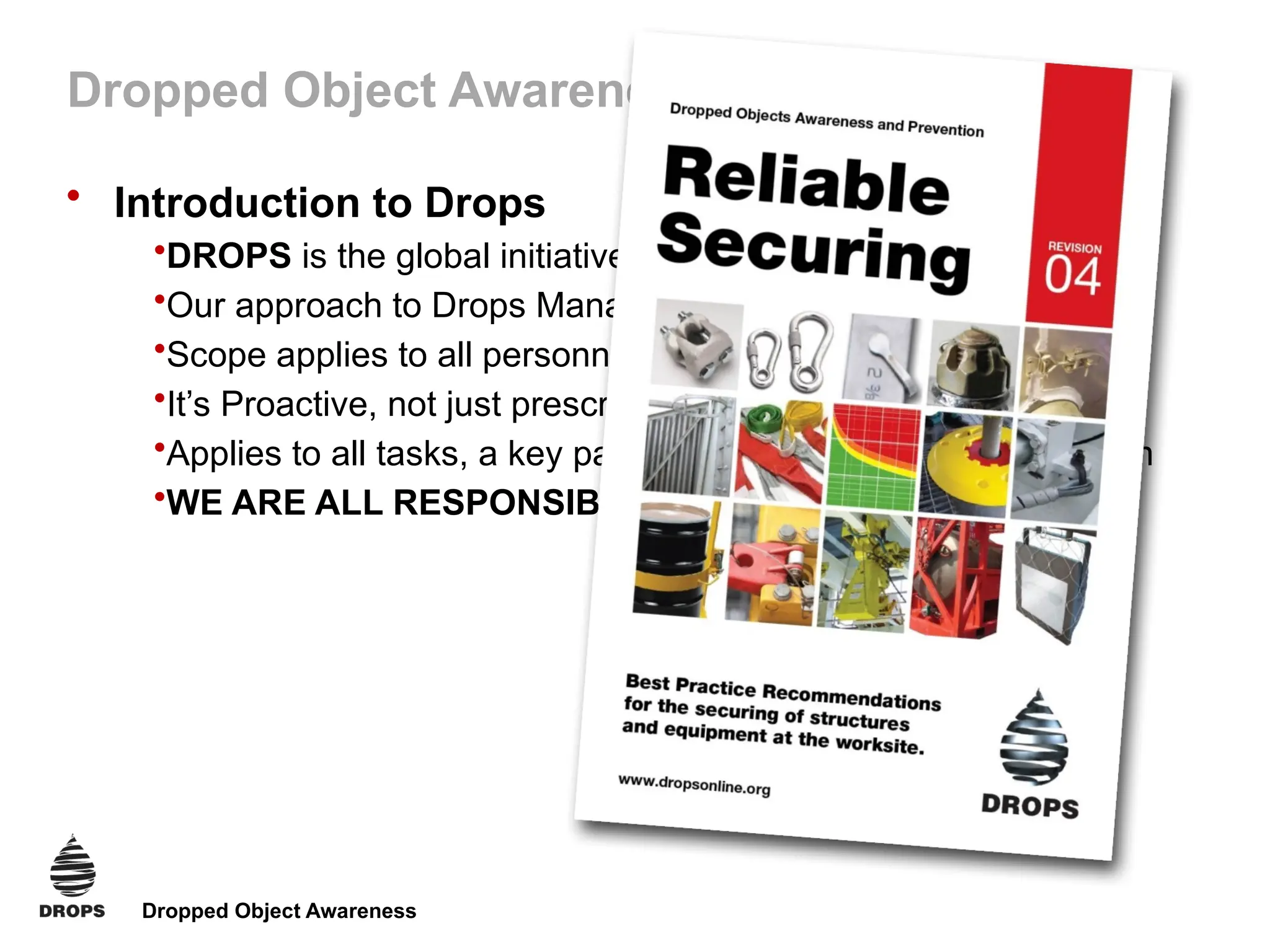
  • #2 Introduce concept of DROPS (the global initiative, we are all are active members – sharing best practice and striving for second nature dropped object prevention strategy). Specifically, review and confirm all obligations with regard to Company Drops (Dropped Object Prevention System). Be sure to address any client specific standards (for example KPO have standards and requirements with regard to dropped object management). State that the requirements reflect industry best practice – and that the foundation for DROPS came from systems that are employed in many other industries (such as defence and aerospace). DROPS applies to all tasks and is a key element of our HSE management system. Summarise that DROPS, the global initiative continues to grow in membership and knowledge which is shared freely and continually enhanced with new techniques and technologies. >>
  • #3 Introduce your corporate procedure, noting that the requirements and practices presented are all based on the foundation of DROPS and refer to DROPS Guidance materials such as Reliable Securing. Note that the content of Reliable Securing includes advanced guidance on fastenings to support equipment inspections, but also contains a number of useful job aids and prompts to support task risk assessment and planning.
  • #4 First let’s make sure we understand what a dropped object is. Let us look now at how we define dropped objects and understand their causes and consequences. >>What is a Dropped Object? Ask the class. >>(Reveal answer) A dropped object is any item or object that falls from its previous position. In essence, a dropped object is the result of the uncontrolled release of gravity. Ask delegates to describe how each of the different kinds of items could become dropped objects.
  • #5 It is important for us to analyse dropped objects and define them further – so we can understand how they happen and what we can do to prevent them. Ask delegates if they know what the two definitions of dropped objects are. Try to use a visual example – perhaps something in the worksite or classroom. You could even use a pen attached to a piece of string… >>Static - any object that falls from its previous static position under its own weight – the weight of the pen causes the knot in the string to fail and it falls. Gravity is one of the hazards identified in our Hazard Identification Wheel. >> Dynamic - any object that falls from its previous static position due to applied force from equipment/machinery or moving object – the pen is struck or is snagged, causing the knot to fail or the string to snap. Think Gravity, plus mechanical, motion, pressure – even electrical (electric shock from power tool results in drop etc) >> Also consider kinetic potential - any object that falls from its previous static position due to failure caused by repeated cyclic loading and movement – the pen swings continuously in a noisy, vibrating, windy environment – perhaps extreme temperature changes too - for days, weeks, months, causing the knot to fail or the string to snap or even the pen clip to fail due to the continuous wear. Consider more combinations of potential hazards that affect items secured or stored at height – or even stacked against a wall. If we add other factors such as corrosion or poorly selected and installed fittings, we begin to identify potential scenarios around common working activities that can cause dropped objects. Discuss some more examples / real incidents. Determine which were static, which were dynamic and which were kinetic. We will study these in more detail later on. >>
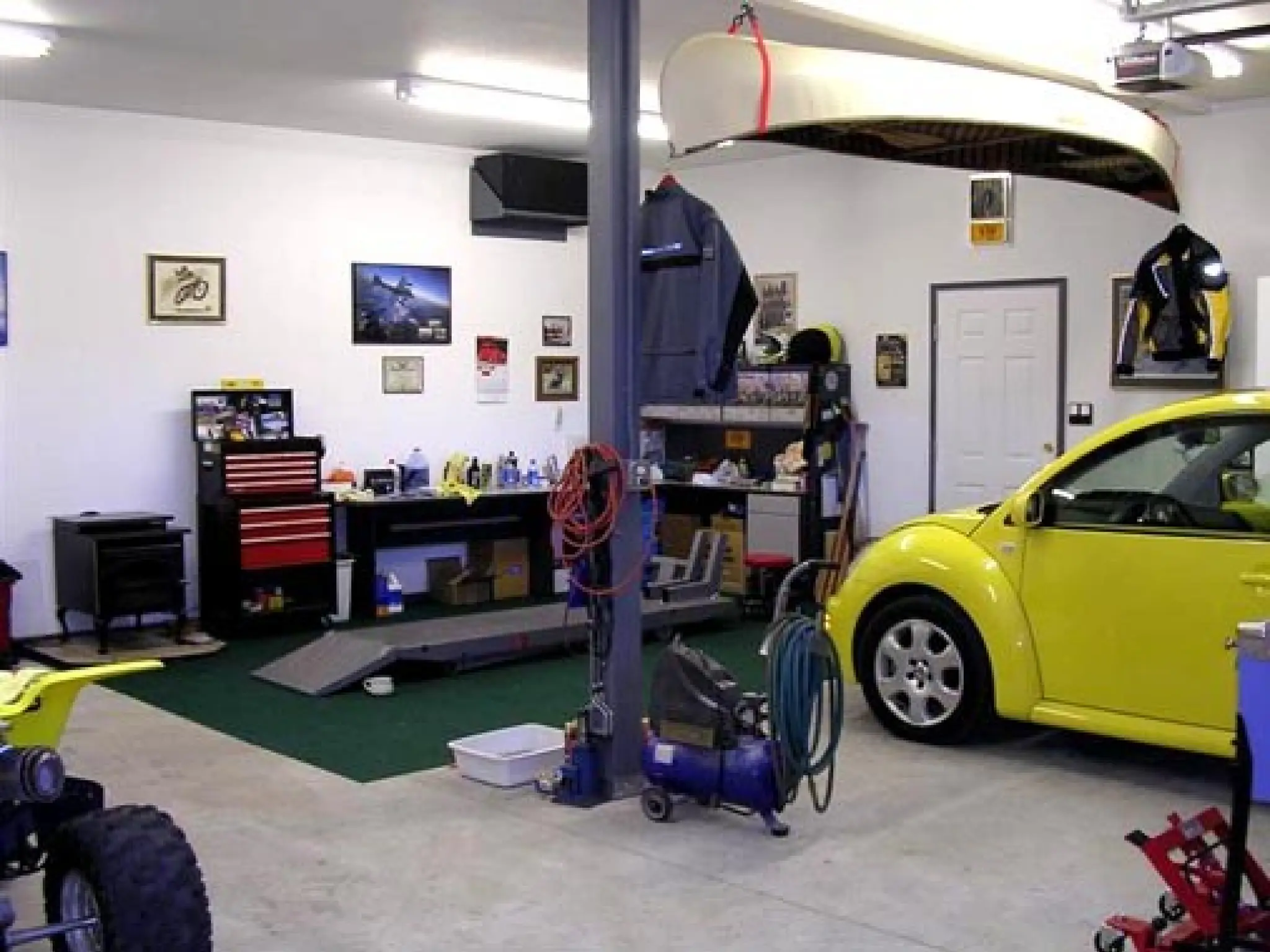
  • #6 Discuss Static, Dynamic - and Kinetic. Use the Hazard Identification Tool. Can you identify any potential dropped objects? What about the canoe. How could it become a Static or Dynamic dropped object? When (ie which task) is it most likely to become a dropped object? Garage door motor – potential for this to fall? Perhaps during maintenance, or due to lack of maintenance. Consider planning (ie method, approach, selection of materials) Consider scenarios (ie working on the garage door motor, colliding with canoe, canoe falls) Consider controls (eliminate, substitute, control) Also discuss risk ranking – which items would be most likely to fall and what would be the consequence?
  • #7 Insert your own examples
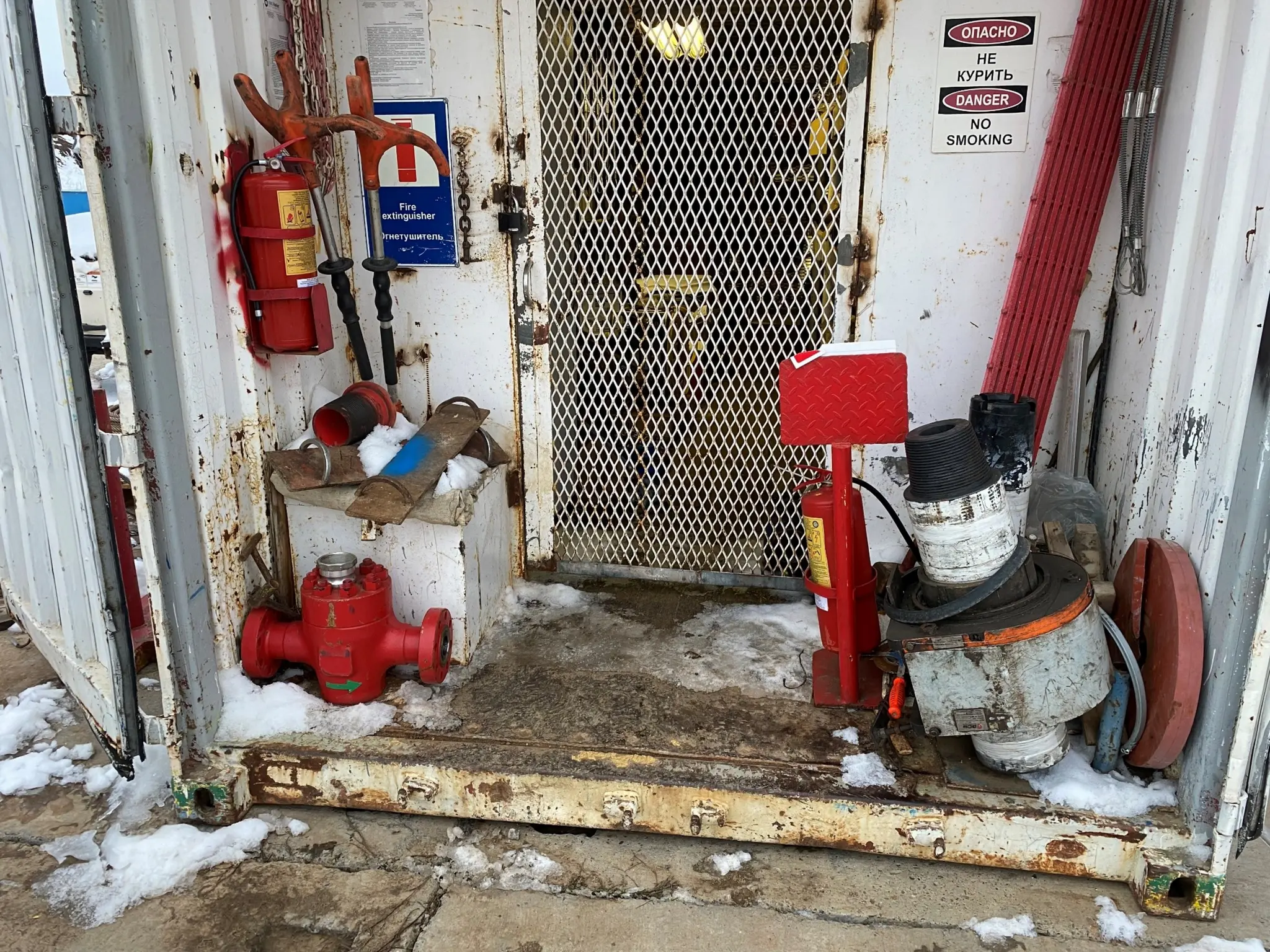
  • #8 Note the unsecured items. How might they fall and what would be the consequence.
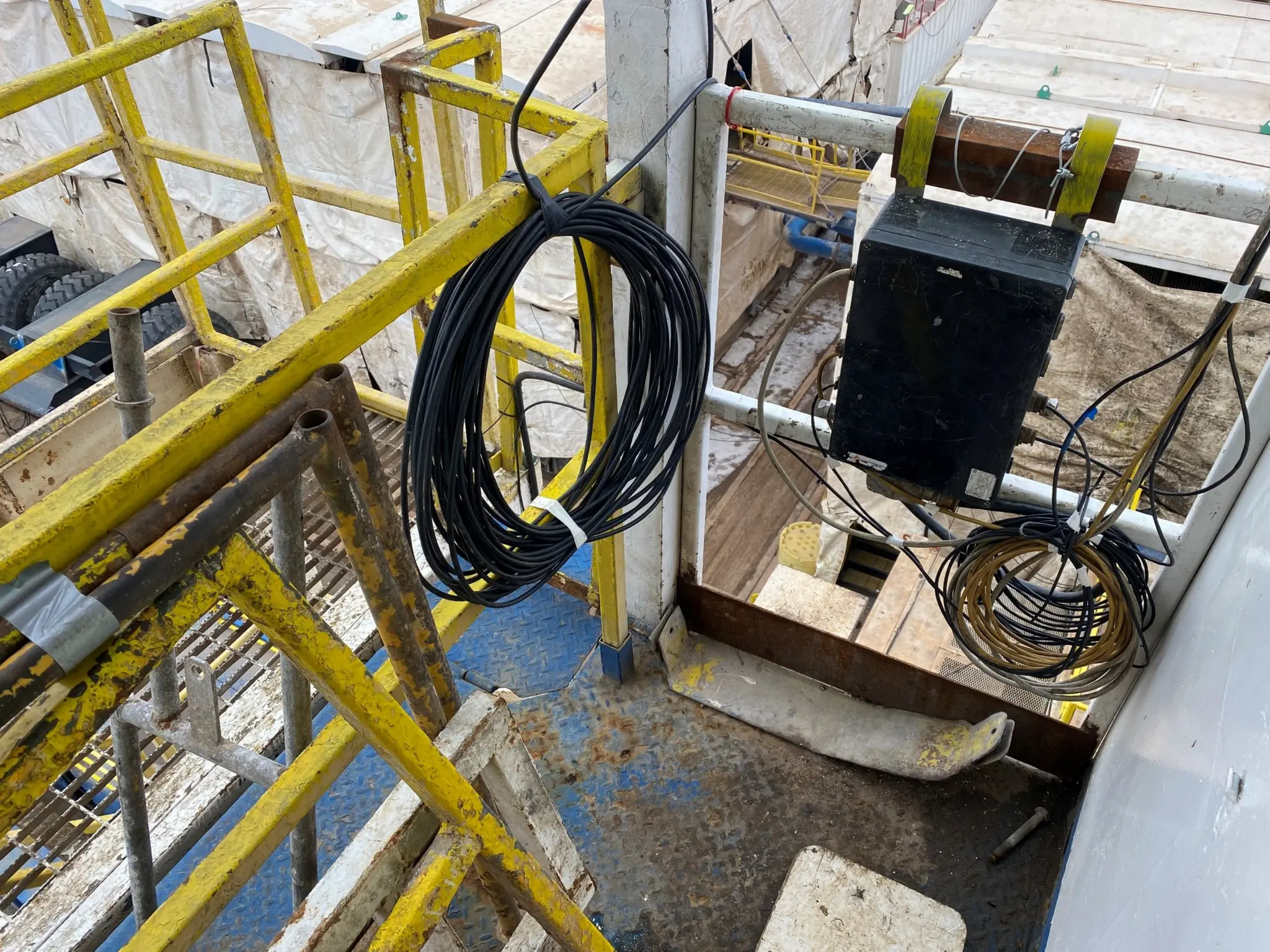
  • #9 What do you see in the image?
  • #10 How could these items become dropped objects?
  • #11 Even relatively small incidents can lead to a significant incident… (insert movie ‘Butterfly’)
  • #12 Invite the delegates to consider the main root causes of dropped objects. Note responses on white board. Recall some of the incidents quoted earlier by delegates and discuss relevant causes and factors. Explain that above all it’s Safety Culture that bears most influence on whether dropped objects (or any other undesired events) occur. Incidents and accidents WILL happen in the absence of a strong safety culture - one that makes us consider safety and the effects of our actions and omissions in ALL that we do. A poor safety culture or safety ethic will manifest itself in poor behaviours such as complacency, neglect and blindness to hazards and changes around us. But it is important to consider what leads a person to make mistakes. Error traps such as inadequate materials and tools or unclear instructions and procedures – even the working environment itself can be an error trap. Beyond behavioural and cultural causes, we can categorise more specific root causes for dropped objects as follows: >> Reveal main root causes and compare with delegate responses. Sum up noting that all causes relate to failings with People, Plant or Procedures – or a combination of all. Can you add any others? Of course we address housekeeping continuously, ensuring no loose or unsecured items are left at height. We conduct pretask checks and hazard hunts which include searching out loose items and removing them, or securing items that can become dynamic dropped objects. We conduct post task inspections to ensure no unnecessary items are left at the worksite. But our DROPS program is much broader, with systematic controls across all aspects of every task.
  • #13 Ask the class – What are the consequences of dropped objects? >>Click to reveal: It’s a fact. Dropped Objects account for around 35% of all safety related incidents. Throughout our industry, over 60% or more of all High Potential incidents (including those where personnel were not actually exposed) are dropped object related. We must not forget that dropped objects account for a number of incidents that cause equipment and environmental damage, lost time and lost production and ultimately damage to the business.
  • #14 Introduce the DROPS Calculator, the common benchmark for providing a cursory indication of a possible outcome. Note that it only reflects blunt force trauma and is not compatible with sharp objects. Sharp items such as sharp tools, sharp edged materials etc are likely to result in more severe injury such as puncturing of the skin. Use the Calculator to work out the potential consequences of each of the items. Discuss what you would do to prevent the item from falling unintentionally. Note that the discussion regarding use of a hammer at height should also consider how it is transported to and from the worksite and perhaps more importantly, what will be struck by the hammer and whether that item could be a dropped object. Insert your own examples and animations if required.
  • #15 How do we actually know what the potential consequence would be if an item (tool, piece of structure or equipment, container, loose item) were to fall and strike someone? We do need to have a realistic idea of this if we are to complete the Written Risk Assessment. We need to know the Severity rating. Here is a real example of what would happen if this 220g hex bolt fell approx 27m and struck a person below, on the head – a person wearing a hard hat. Fall energy is calculated as (mass/kg x distance/m x gravitational acceleration @ 9.8066m/s2). Using this calculation, the bolt will achieve 58Joules of fall energy. Also note that gravitational acceleration is a constant force that cannot be isolated at the worksite! It only takes 45Joules to create enough impact force to fracture an unprotected human skull. Also note that it takes 95Joules of fall energy to generate enough force to crack a hard hat! Click to reveal similar examples (ie 0.8kg spanner dropped from 7m would also generate 58J, the hammer at 1.4kg only needs to fall 4.3m to generate that same). >>click to play next slide with video of impact on the water melon
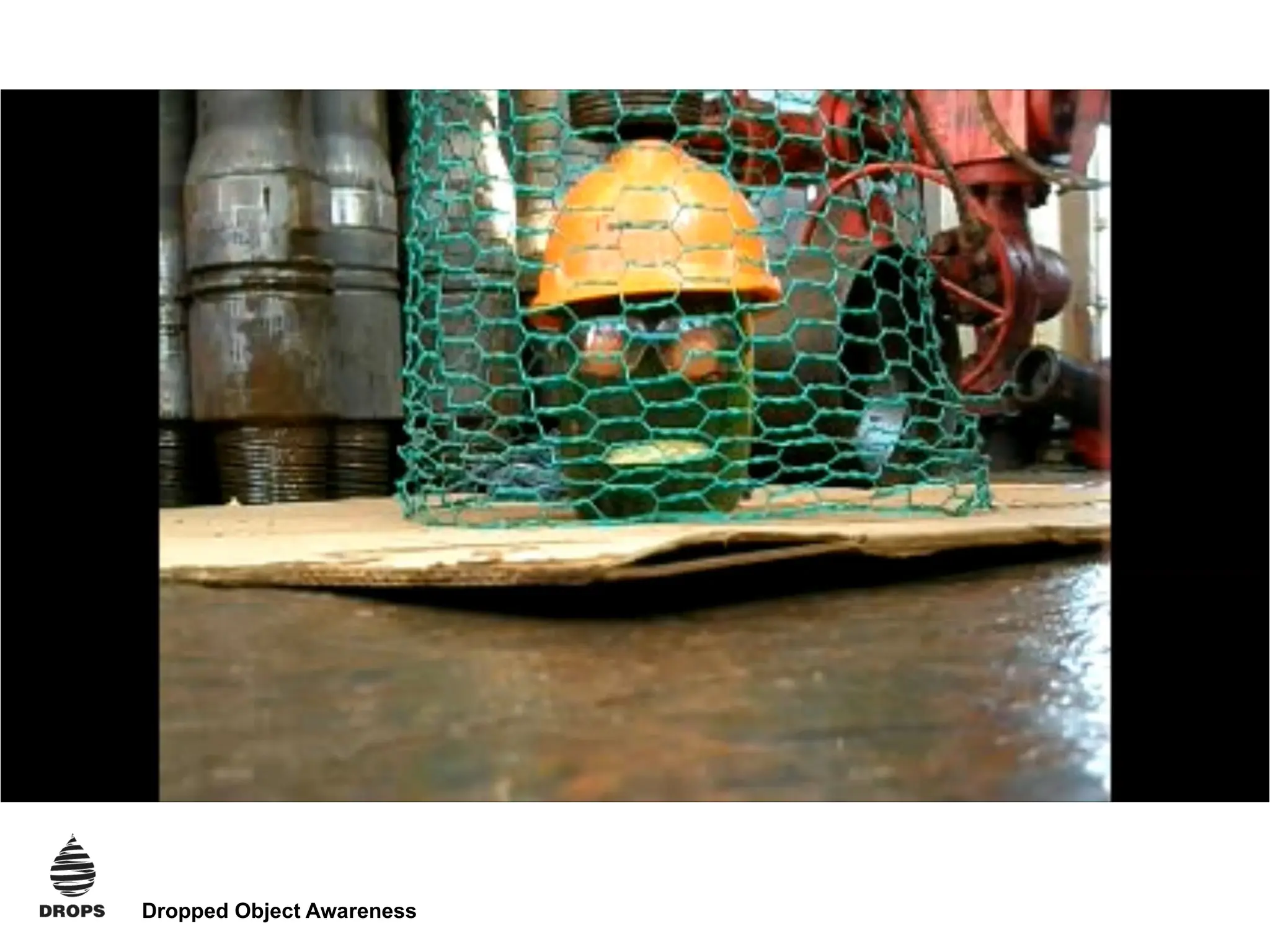
  • #16 Watch movie. Bolt is going to be dropped through the centre of a stand of tubulars. Discuss what happens. Note that the bolt does not pass through the hardhat. Force is transferred through the hat, cradle and into the head. Consider the effect on neck and back.
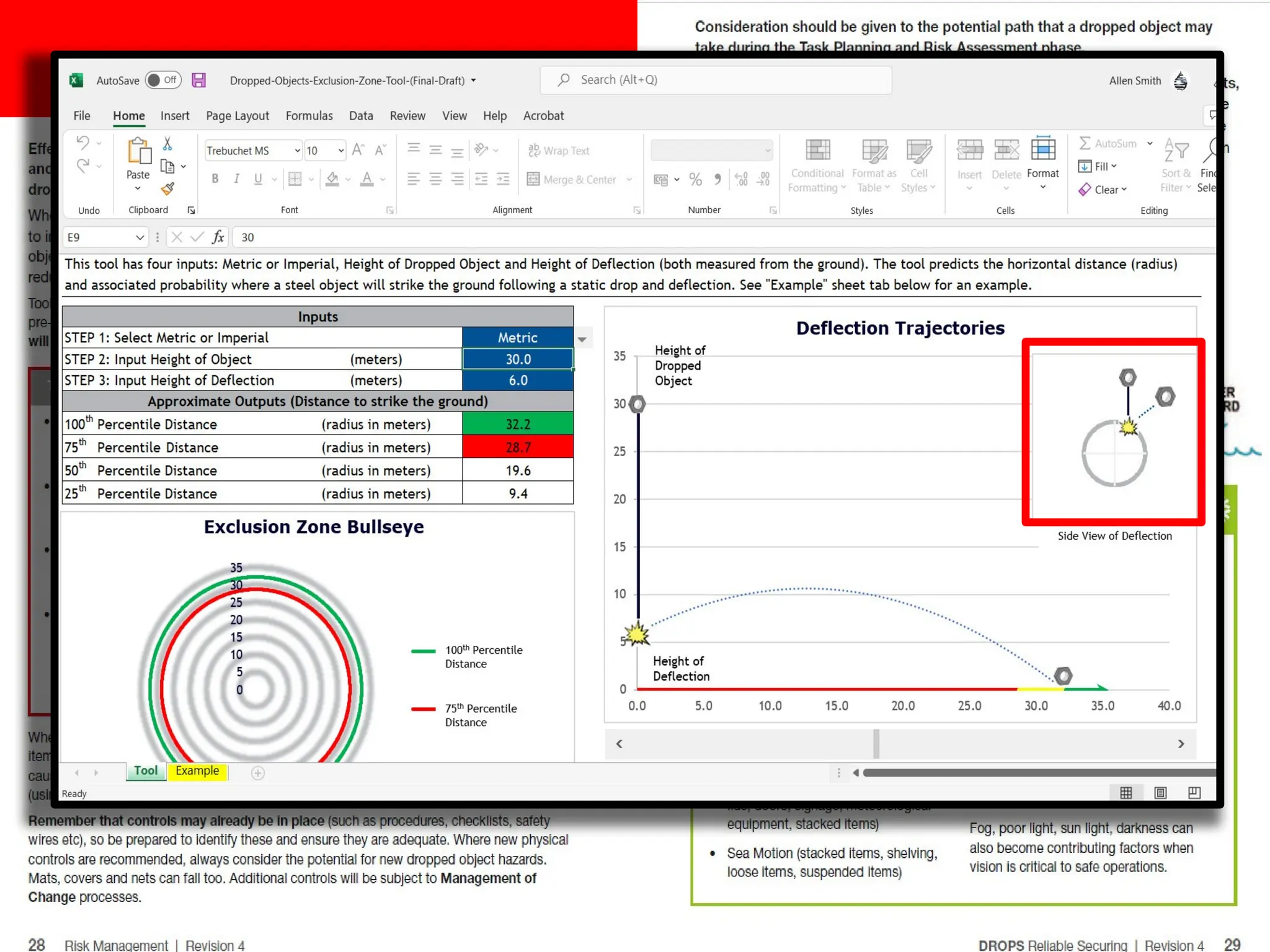
  • #17 In determining where an item may drop, there are many factors to consider including the shape, size, weight, weather effects and potential for deflection. Suspended loads that fail and fall significant distances can drop within a ‘cone’. Where items drop from within or above other structures, including temporary structures or equipment (such as scaffolding or mobile working platforms) there is a real potential for deflection. >> The DROPS exclusion zone calculator provides a cursory indication of deflection trajectories. The calculator tool allows for the deflection point to be adjusted to show the differing paths an object may take. Both tools should be used in the Risk Assessment to inform potential severity and also determine appropriate barricading at the point in the task where the risk of dropped objects increases (ie when removing fastenings or using tools).
  • #19 Summarise the first part by asking the class what they have learned. >>Reveal the list. >>Close with Questions and Answers Thank You. Looking forward to seeing you for the second part (schedule the second presentation e.g. after a short break or perhaps following day/week).
  • #20 Welcome. Safety Briefing, Comfort etc. Ensure you have handouts prepared – DROPS Calculator as a minimum, ideally copies of DROPS Reliable Securing. Also include any of your own Hazard Identification and Task Risk Assessment Tools. Ensure you have a copy of your Company Drops Procedure for reference. This presentation has been produced on behalf of your worksite with the full support of DROPS – The global industry initiative focused on eliminating dropped objects from the workplace. It is in 2 parts. In this first part we Introduce DROPS and our commitment to dropped object prevention through our procedures and actions. We will discuss the definitions to ensure we truly understand the Hazard and respect how severe the consequences can be. We will look at the common causes and share learnings from some of our incidents that have occurred on our rig. In the second part (this can be after a short break, or follow up on anther day) we will explore the controls that we have on site that, with your full involvement and vigilance will ensure we make every effort to prevent dropped objects at source and enforce the mitigations that eliminate the risk of exposure to personnel.
  • #21 Ask the class, what are the most effective controls when it comes to preventing a dropped object. Discuss each from the most effective to the least effective. >> Elimination of the item, or elimination of the dynamic force that could cause an item to drop. >> Substitution, replacing with less hazardous item (ie lighter or lower) or changing the item (ie remove metal signage and replace with stencil) >> Engineered Controls – the devices and fastenings that prevent the release of gravity (reliable securing) >> Isolating people by identifying the cone of exposure and creating barriered red zones and restricted access areas >> Administrative Controls such as inspection, verification, training, procedures, permits etc >> PPE – not very effective in protecting personnel from fall energy and impact.
  • #22 Ask the candidates which Controls are available at the worksite to reduce the likelihood of dropped objects (respond to the threat and stop dropped objects) and which controls reduce the consequence (recovery controls or fail safe measures). Reveal the answers. Briefly summarise each item. You could discuss JSA of a familiar task, identify which dropped objects have been identified and which of these controls have been applied and how they are managed. We recommend focusing on the underlined items: Task Planning and Risk Assessment Tools and Equipment at Height Reliable Securing (primary fixings, secondary retention and safety securing) Survey and Inspection (including cargo handling) Red Zones
  • #23 Choose your own task example. Emphasise the requirement to identify both static and dynamic potentials and determine appropriate control measures. Introduce the concept of the DROPS Calculator and how this can be used to familiarize personnel with the potential consequences. Take the time to consider which tools and equipment are being used, how collisions may occur, how the weather or working environment can affect the task, what waste may be generated, any lifts or requirements for temporary stacking and storing, any concurrent operations to consider. It’s not enough to simply create barricades in anticipation of dropped objects, we must be realistic about what could drop and how it could be caused to ensure we apply the correct control.
  • #24 If you wish, show this short video to illustrate just how important it is to consider all hazards at the worksite!
  • #25 Discuss the task step by step identifying potential dropped objects, being specific about what could drop and why. How it might drop, what would cause it and when in the task is drops exposure greatest? Discuss prevention, particular the engineered controls. Discuss mitigations and emphasise that all controls must be owned and managed. Let’s look at some of the main controls.
  • #26 Cover the key elements of the Tools and Equipment at Height control measures. IMPORTANT: Only approved tools may be used! Never mix and match lanyards with other tools. Create an Inventory, as list of all of the tools in the tool kit. Inspect the tools and ensure all components are in good condition. All tools should be secured to the tool belt or tool bag at all times. Items such as tally books, radios, pens, keys, tape measures must no be carried in pockets where they can fall out. If they are not required, leave them below. When using these tools, it is important that the tools are still identified as potential dropped objects in the risk assessment. Only the tools required for the task should be taken aloft and recorded in the Temporary Equipment at Height Register. Click to show the Form.
  • #27 Discuss the use of the Register. It is important to list all tools and equipment and verify that all items have been returned.
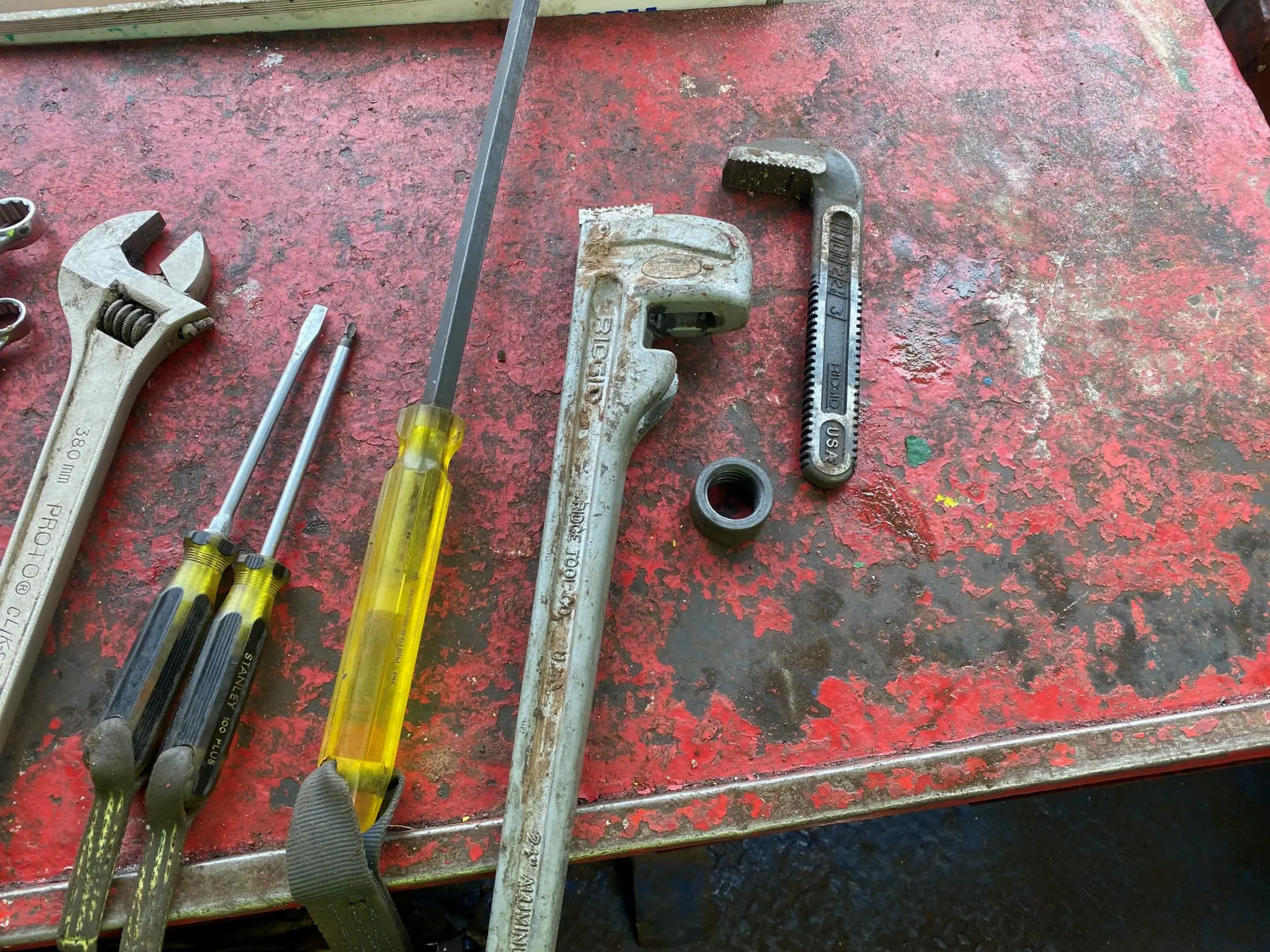
  • #28 Note that although tools may have lanyards / tethers, they may have individual parts that may become disengaged such as socket wrenches and other tools that are not composite / one-piece.
  • #29 Introduce Reliable Securing as part of the Corporate procedure, noting that there are specific requirements to understand and verify that the appropriate OEM fastenings are selected, installed correctly and inspected for any defects. Whilst the DROPS program does not require each of us to become a bolting expert, we can all play a role in supporting pretask equipment inspections and identifying potential for increased risk of dropped objects if any securing component becomes damaged or dislodged.
  • #30 Primary Fixing: The primary method by which an item is installed, mounted and secured to prevent the item falling, (eg bolted connections, screws, pins, buckles, clips, welds etc.) Note that this would include the tightness or tension that must be retained in a bolted connection.
  • #31 Secondary Retention is defined as the engineered method for securing the primary fixing to prevent loss of clamping force or displacement of fastening components, (eg locking washers, locking wire, split pins / cotter pins, etc.) Also referred to as Second Barrier or Fail Safe feature in some engineering descriptions. Note: Double Lock-nutting or Dual Nutting is NOT recommended as a reliable method for retaining loads in tensioned bolting.
  • #32 Safety securing is an additional mechanism for securing the item to the main structure, suitably selected to restrain the item or its components from falling should the primary fixing fail, (eg rated steel or synthetic nets, lanyards, baskets, wires, slings, chains etc.) Note that approved safety nets and safety wires will have tags which display the maximum break load rating.
  • #33 Always ensure that secondary retention is installed and functioning. Where there is potential for devices such as nappy pins to be snagged or knocked out, replace with correctly fitted cotter pin.
  • #34 All equipment, particularly items at height or equipment used for lifting must have appropriate secondary retention fitted. Ensure you check all equipment prior to use, and seek technical support if you have any queries. >>For example the clevis pins on the cherry picker arm are secured with pins which are bolted to threaded holes. The secondary retention here is critical. Also note that a locking nut is used on the ram.
  • #35 Is this a suitable point to secure the safety net?
  • #36 Introduce Dropped Object Surveys and Inspections as a key element of the DROPS management system. A picture book is created for each area and features all equipment that is not an integral part of the structure. The description and condition of fastenings is recorded as part of an initial survey, and any failed items are corrected. Typically all items are then inspected on a weekly basis.
  • #37 For example, the big bag hoist shown here is featured in Area 3 Mud Tanks book. Note that each fastening on the running beam is recorded and must be inspected, as too is the light fitting above. As per Reliable Securing, the Primary Fixing, Secondary Retention and Safety Securing (if fitted) for each individual item is described and recorded.
  • #38 However it is also the responsibility of personnel operating the equipment to ensure all components are in good working order. What do you notice on the hook. What could cause this damage?
  • #39 There are many hazards in these areas, including dropped object potential. These areas are enforced as they provide the Isolation control which significantly reduces the exposure of personnel to each of the hazards. Ask the class for examples of areas at the rig site that would be Restricted Access Zones or No-Go Areas / No Entry Zones and how we know where they are and how they are controlled. NOTES: Restricted Access Zones areidentified in the operational permit to work and authorized entrants are limited to the personnel required to perform the work. Areas are marked in RED or signs posted to clearly identify the covered area and specific risk of this zone. Drill floor activities will be controlled and enforced by the Red Zone Marshals – either 3 x floor men or their suitable qualified reliefs. Restricted access zones are shown below and they are not limited to it: • Drill floor • Sub-structure • Catwalk • Material / Chemical storage areas No Go Areas / No Entry Zones are identified in the permit to work, controlled to prevent unauthorized access, and differentiated form the Restricted Access Zones by barricades or signage. No Go Areas / No Entry Zones are shown below and they are not limited to it: • Under lifted loads • Under personnel working at height – with tools or equipment • Under Pick up / lay down machine • Wire line sheaves
  • #40 The Red Zone maps are displayed at the worksite for Routine and Non Routine operations. Ask the class, who authorizes access to these areas? Routine Ops: Driller and/or Red Zone Marshall Non-Routine Ops: Driller, Rig Manager or Company Man (CHECK AND CONFIRM – WHY COMPANY MAN?) Ask the classwhat are the key considerations for anyone who is authorized to work in the Red Zone? >> Click to reveal and discuss how this would be managed.
  • #41 Ask the class what are the key considerations for anyone who is authorized to work in the Red Zone? >> Click to reveal and discuss how this would be managed. Discuss tasks around well centre that require personnel to be in the vicinity of moving equipment and how complacency should be managed (ie Red Zone Marshall vigilance / follow Marshalls instructions).
  • #42 Review each General Requirement of the Company Drops Procedure and acknowledge they are understood.
  • #43 Review each General Requirement of the Company Drops Procedure and acknowledge they are understood.
  • #44 Review each General Requirement of the Company Drops Procedure and acknowledge they are understood.
  • #45 Summarise by inviting delegates to commit to action. >>Reveal the list. The list is not exhaustive. >>Close with Questions and Answers Thank You. I wish you and your colleagues a successful future free from dropped objects.
  • #46 Create your own story… but emphasise : DROPS occur Everywhere! Discuss how something like this could occur – or close the session with your own safety message.